CHC33015 Certificate III E1145 Individual Support Plan & Development
VerifiedAdded on 2023/06/14
|8
|2281
|487
Portfolio
AI Summary
This portfolio assignment demonstrates the application of individual support plans, focusing on positive support strategies for clients with various disabilities. It includes reflective journal entries detailing the provision of person-centered support, addressing behaviors of concern, and contributing to skill development through effective communication and collaboration. The assignment also explores the importance of recognizing and respecting diversity through interviews and reflections on cultural awareness, highlighting the influence of personal perspectives on professional practice. The student uses real-world examples to demonstrate their understanding of these key concepts within the healthcare setting, with all this study material available on Desklib.
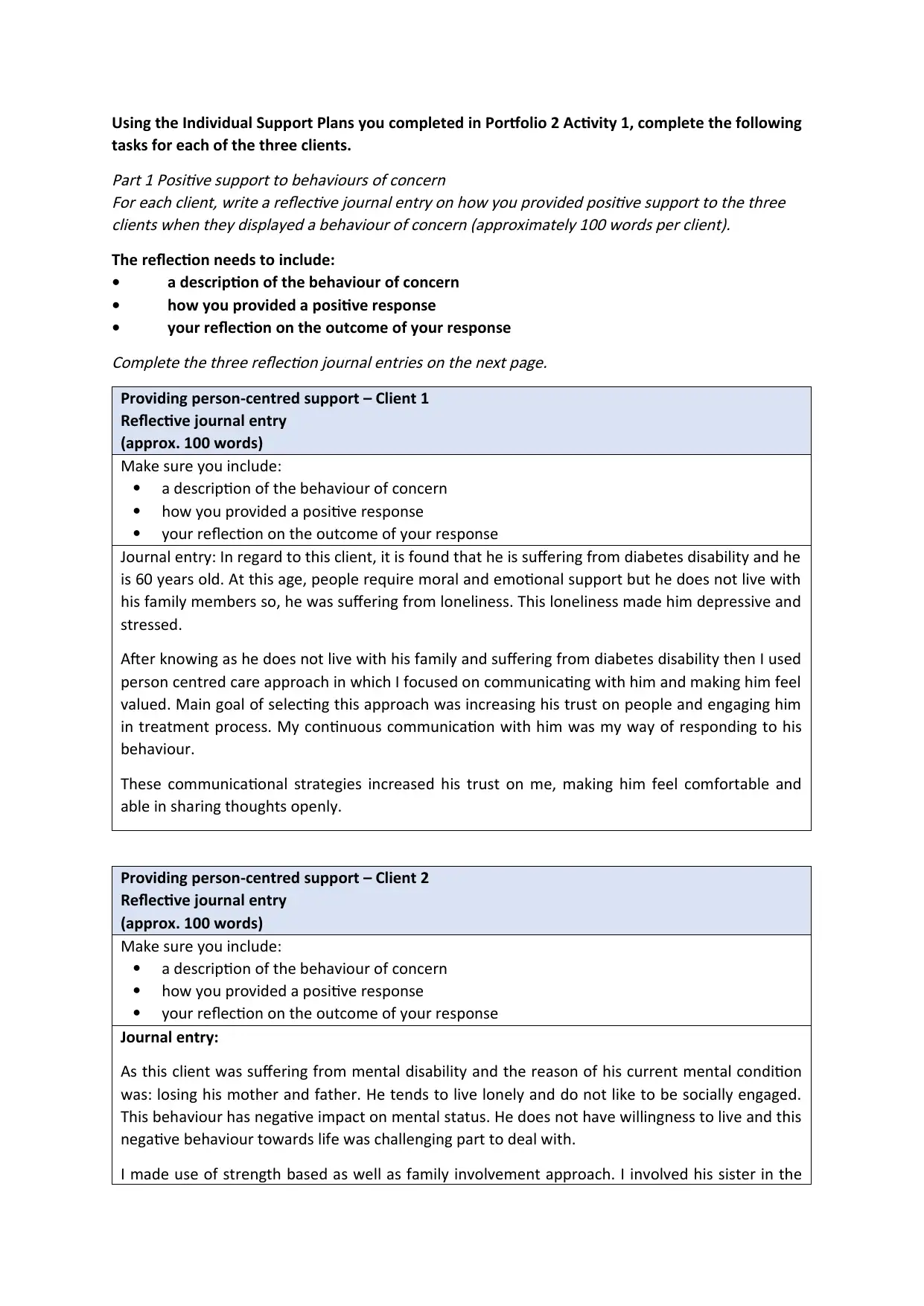
Using the Individual Support Plans you completed in Portfolio 2 Activity 1, complete the following
tasks for each of the three clients.Part 1 Positive support to behaviours of concern
For each client, write a reflective journal entry on how you provided positive support to the three
clients when they displayed a behaviour of concern (approximately 100 words per client).
The reflection needs to include:
• a description of the behaviour of concern
• how you provided a positive response
• your reflection on the outcome of your responseComplete the three reflection journal entries on the next page.
Providing person-centred support – Client 1
Reflective journal entry
(approx. 100 words)
Make sure you include:
a description of the behaviour of concern
how you provided a positive response
your reflection on the outcome of your response
Journal entry: In regard to this client, it is found that he is suffering from diabetes disability and he
is 60 years old. At this age, people require moral and emotional support but he does not live with
his family members so, he was suffering from loneliness. This loneliness made him depressive and
stressed.
After knowing as he does not live with his family and suffering from diabetes disability then I used
person centred care approach in which I focused on communicating with him and making him feel
valued. Main goal of selecting this approach was increasing his trust on people and engaging him
in treatment process. My continuous communication with him was my way of responding to his
behaviour.
These communicational strategies increased his trust on me, making him feel comfortable and
able in sharing thoughts openly.
Providing person-centred support – Client 2
Reflective journal entry
(approx. 100 words)
Make sure you include:
a description of the behaviour of concern
how you provided a positive response
your reflection on the outcome of your response
Journal entry:
As this client was suffering from mental disability and the reason of his current mental condition
was: losing his mother and father. He tends to live lonely and do not like to be socially engaged.
This behaviour has negative impact on mental status. He does not have willingness to live and this
negative behaviour towards life was challenging part to deal with.
I made use of strength based as well as family involvement approach. I involved his sister in the
tasks for each of the three clients.Part 1 Positive support to behaviours of concern
For each client, write a reflective journal entry on how you provided positive support to the three
clients when they displayed a behaviour of concern (approximately 100 words per client).
The reflection needs to include:
• a description of the behaviour of concern
• how you provided a positive response
• your reflection on the outcome of your responseComplete the three reflection journal entries on the next page.
Providing person-centred support – Client 1
Reflective journal entry
(approx. 100 words)
Make sure you include:
a description of the behaviour of concern
how you provided a positive response
your reflection on the outcome of your response
Journal entry: In regard to this client, it is found that he is suffering from diabetes disability and he
is 60 years old. At this age, people require moral and emotional support but he does not live with
his family members so, he was suffering from loneliness. This loneliness made him depressive and
stressed.
After knowing as he does not live with his family and suffering from diabetes disability then I used
person centred care approach in which I focused on communicating with him and making him feel
valued. Main goal of selecting this approach was increasing his trust on people and engaging him
in treatment process. My continuous communication with him was my way of responding to his
behaviour.
These communicational strategies increased his trust on me, making him feel comfortable and
able in sharing thoughts openly.
Providing person-centred support – Client 2
Reflective journal entry
(approx. 100 words)
Make sure you include:
a description of the behaviour of concern
how you provided a positive response
your reflection on the outcome of your response
Journal entry:
As this client was suffering from mental disability and the reason of his current mental condition
was: losing his mother and father. He tends to live lonely and do not like to be socially engaged.
This behaviour has negative impact on mental status. He does not have willingness to live and this
negative behaviour towards life was challenging part to deal with.
I made use of strength based as well as family involvement approach. I involved his sister in the

Paraphrase This Document
Need a fresh take? Get an instant paraphrase of this document with our AI Paraphraser
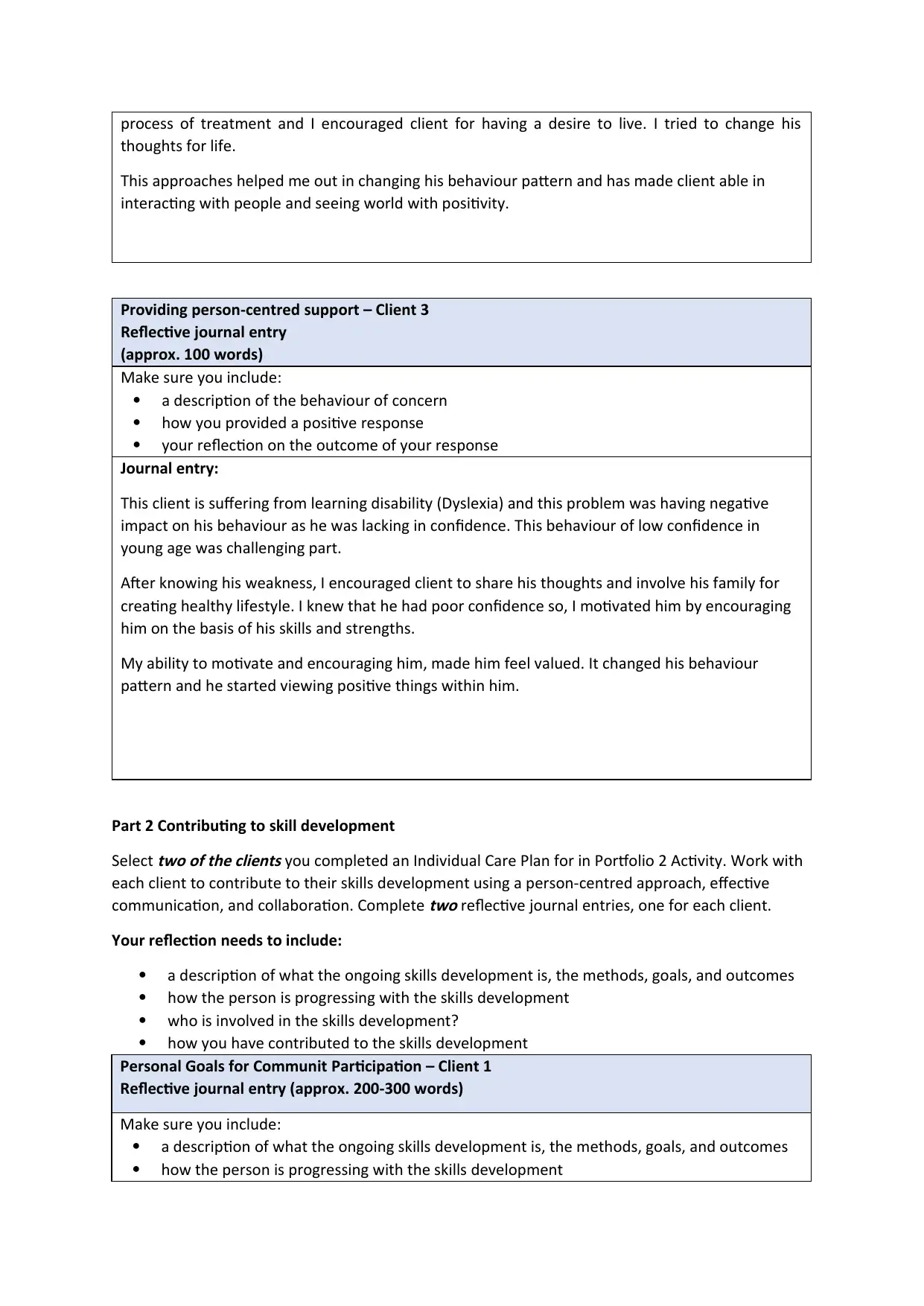
process of treatment and I encouraged client for having a desire to live. I tried to change his
thoughts for life.
This approaches helped me out in changing his behaviour pattern and has made client able in
interacting with people and seeing world with positivity.
Providing person-centred support – Client 3
Reflective journal entry
(approx. 100 words)
Make sure you include:
a description of the behaviour of concern
how you provided a positive response
your reflection on the outcome of your response
Journal entry:
This client is suffering from learning disability (Dyslexia) and this problem was having negative
impact on his behaviour as he was lacking in confidence. This behaviour of low confidence in
young age was challenging part.
After knowing his weakness, I encouraged client to share his thoughts and involve his family for
creating healthy lifestyle. I knew that he had poor confidence so, I motivated him by encouraging
him on the basis of his skills and strengths.
My ability to motivate and encouraging him, made him feel valued. It changed his behaviour
pattern and he started viewing positive things within him.
Part 2 Contributing to skill development
Select
two of the clients you completed an Individual Care Plan for in Portfolio 2 Activity. Work with
each client to contribute to their skills development using a person-centred approach, effective
communication, and collaboration. Complete
two reflective journal entries, one for each client.
Your reflection needs to include:
a description of what the ongoing skills development is, the methods, goals, and outcomes
how the person is progressing with the skills development
who is involved in the skills development?
how you have contributed to the skills development
Personal Goals for Communit Participation – Client 1
Reflective journal entry (approx. 200-300 words)
Make sure you include:
a description of what the ongoing skills development is, the methods, goals, and outcomes
how the person is progressing with the skills development
thoughts for life.
This approaches helped me out in changing his behaviour pattern and has made client able in
interacting with people and seeing world with positivity.
Providing person-centred support – Client 3
Reflective journal entry
(approx. 100 words)
Make sure you include:
a description of the behaviour of concern
how you provided a positive response
your reflection on the outcome of your response
Journal entry:
This client is suffering from learning disability (Dyslexia) and this problem was having negative
impact on his behaviour as he was lacking in confidence. This behaviour of low confidence in
young age was challenging part.
After knowing his weakness, I encouraged client to share his thoughts and involve his family for
creating healthy lifestyle. I knew that he had poor confidence so, I motivated him by encouraging
him on the basis of his skills and strengths.
My ability to motivate and encouraging him, made him feel valued. It changed his behaviour
pattern and he started viewing positive things within him.
Part 2 Contributing to skill development
Select
two of the clients you completed an Individual Care Plan for in Portfolio 2 Activity. Work with
each client to contribute to their skills development using a person-centred approach, effective
communication, and collaboration. Complete
two reflective journal entries, one for each client.
Your reflection needs to include:
a description of what the ongoing skills development is, the methods, goals, and outcomes
how the person is progressing with the skills development
who is involved in the skills development?
how you have contributed to the skills development
Personal Goals for Communit Participation – Client 1
Reflective journal entry (approx. 200-300 words)
Make sure you include:
a description of what the ongoing skills development is, the methods, goals, and outcomes
how the person is progressing with the skills development
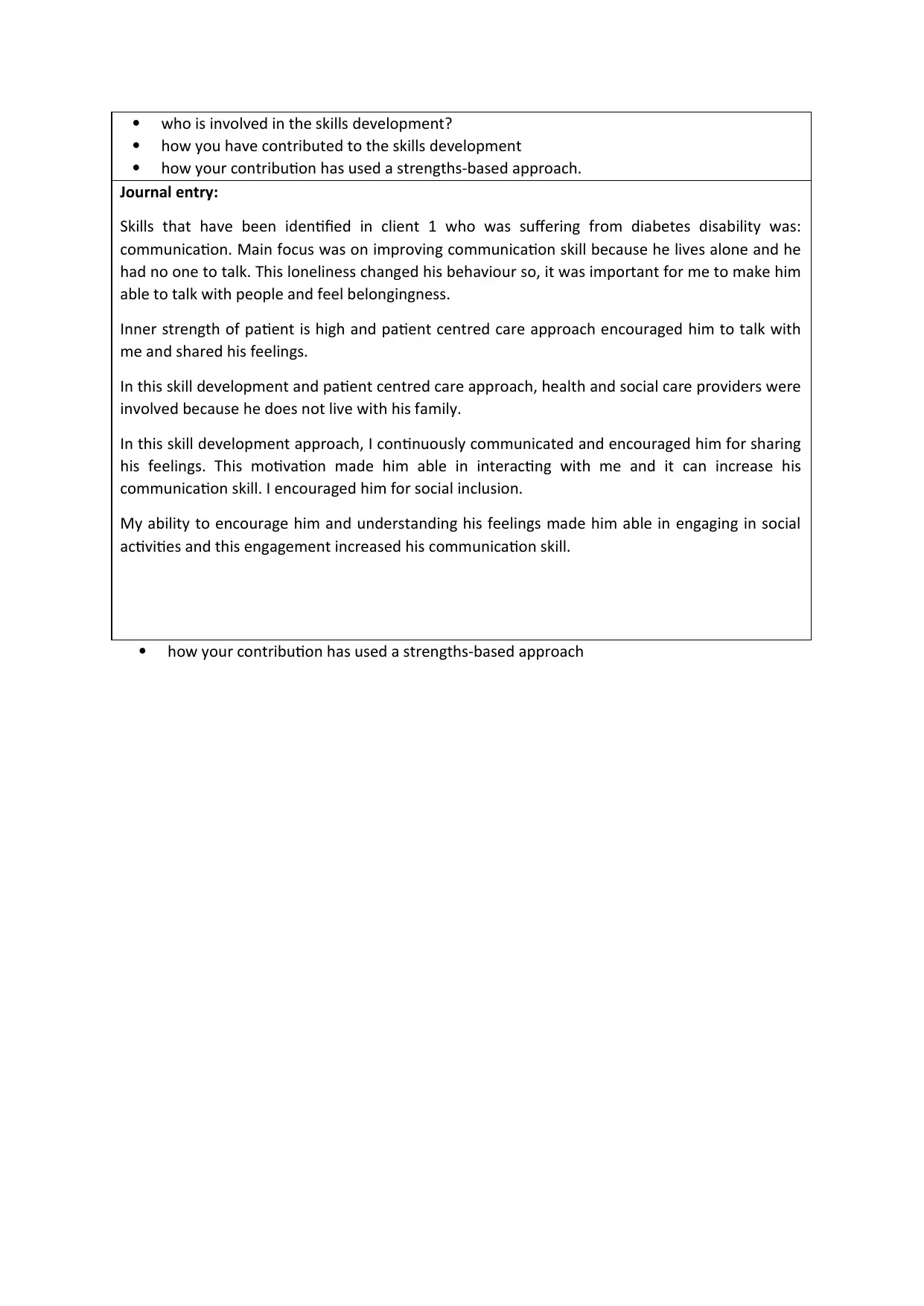
who is involved in the skills development?
how you have contributed to the skills development
how your contribution has used a strengths-based approach.
Journal entry:
Skills that have been identified in client 1 who was suffering from diabetes disability was:
communication. Main focus was on improving communication skill because he lives alone and he
had no one to talk. This loneliness changed his behaviour so, it was important for me to make him
able to talk with people and feel belongingness.
Inner strength of patient is high and patient centred care approach encouraged him to talk with
me and shared his feelings.
In this skill development and patient centred care approach, health and social care providers were
involved because he does not live with his family.
In this skill development approach, I continuously communicated and encouraged him for sharing
his feelings. This motivation made him able in interacting with me and it can increase his
communication skill. I encouraged him for social inclusion.
My ability to encourage him and understanding his feelings made him able in engaging in social
activities and this engagement increased his communication skill.
how your contribution has used a strengths-based approach
how you have contributed to the skills development
how your contribution has used a strengths-based approach.
Journal entry:
Skills that have been identified in client 1 who was suffering from diabetes disability was:
communication. Main focus was on improving communication skill because he lives alone and he
had no one to talk. This loneliness changed his behaviour so, it was important for me to make him
able to talk with people and feel belongingness.
Inner strength of patient is high and patient centred care approach encouraged him to talk with
me and shared his feelings.
In this skill development and patient centred care approach, health and social care providers were
involved because he does not live with his family.
In this skill development approach, I continuously communicated and encouraged him for sharing
his feelings. This motivation made him able in interacting with me and it can increase his
communication skill. I encouraged him for social inclusion.
My ability to encourage him and understanding his feelings made him able in engaging in social
activities and this engagement increased his communication skill.
how your contribution has used a strengths-based approach
⊘ This is a preview!⊘
Do you want full access?
Subscribe today to unlock all pages.

Trusted by 1+ million students worldwide
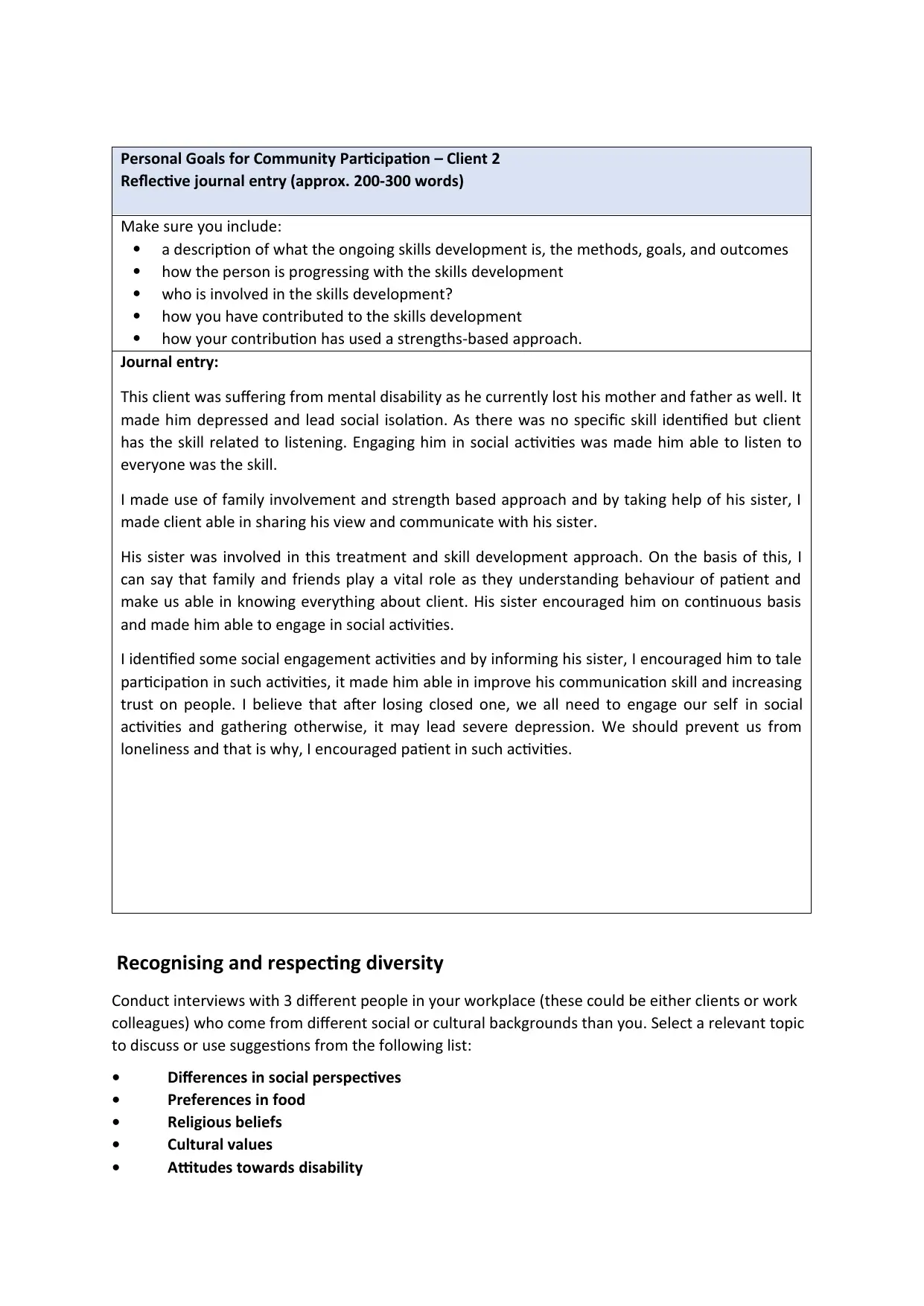
Personal Goals for Community Participation – Client 2
Reflective journal entry (approx. 200-300 words)
Make sure you include:
a description of what the ongoing skills development is, the methods, goals, and outcomes
how the person is progressing with the skills development
who is involved in the skills development?
how you have contributed to the skills development
how your contribution has used a strengths-based approach.
Journal entry:
This client was suffering from mental disability as he currently lost his mother and father as well. It
made him depressed and lead social isolation. As there was no specific skill identified but client
has the skill related to listening. Engaging him in social activities was made him able to listen to
everyone was the skill.
I made use of family involvement and strength based approach and by taking help of his sister, I
made client able in sharing his view and communicate with his sister.
His sister was involved in this treatment and skill development approach. On the basis of this, I
can say that family and friends play a vital role as they understanding behaviour of patient and
make us able in knowing everything about client. His sister encouraged him on continuous basis
and made him able to engage in social activities.
I identified some social engagement activities and by informing his sister, I encouraged him to tale
participation in such activities, it made him able in improve his communication skill and increasing
trust on people. I believe that after losing closed one, we all need to engage our self in social
activities and gathering otherwise, it may lead severe depression. We should prevent us from
loneliness and that is why, I encouraged patient in such activities.
Recognising and respecting diversity
Conduct interviews with 3 different people in your workplace (these could be either clients or work
colleagues) who come from different social or cultural backgrounds than you. Select a relevant topic
to discuss or use suggestions from the following list:
• Differences in social perspectives
• Preferences in food
• Religious beliefs
• Cultural values
• Attitudes towards disability
Reflective journal entry (approx. 200-300 words)
Make sure you include:
a description of what the ongoing skills development is, the methods, goals, and outcomes
how the person is progressing with the skills development
who is involved in the skills development?
how you have contributed to the skills development
how your contribution has used a strengths-based approach.
Journal entry:
This client was suffering from mental disability as he currently lost his mother and father as well. It
made him depressed and lead social isolation. As there was no specific skill identified but client
has the skill related to listening. Engaging him in social activities was made him able to listen to
everyone was the skill.
I made use of family involvement and strength based approach and by taking help of his sister, I
made client able in sharing his view and communicate with his sister.
His sister was involved in this treatment and skill development approach. On the basis of this, I
can say that family and friends play a vital role as they understanding behaviour of patient and
make us able in knowing everything about client. His sister encouraged him on continuous basis
and made him able to engage in social activities.
I identified some social engagement activities and by informing his sister, I encouraged him to tale
participation in such activities, it made him able in improve his communication skill and increasing
trust on people. I believe that after losing closed one, we all need to engage our self in social
activities and gathering otherwise, it may lead severe depression. We should prevent us from
loneliness and that is why, I encouraged patient in such activities.
Recognising and respecting diversity
Conduct interviews with 3 different people in your workplace (these could be either clients or work
colleagues) who come from different social or cultural backgrounds than you. Select a relevant topic
to discuss or use suggestions from the following list:
• Differences in social perspectives
• Preferences in food
• Religious beliefs
• Cultural values
• Attitudes towards disability
Paraphrase This Document
Need a fresh take? Get an instant paraphrase of this document with our AI Paraphraser
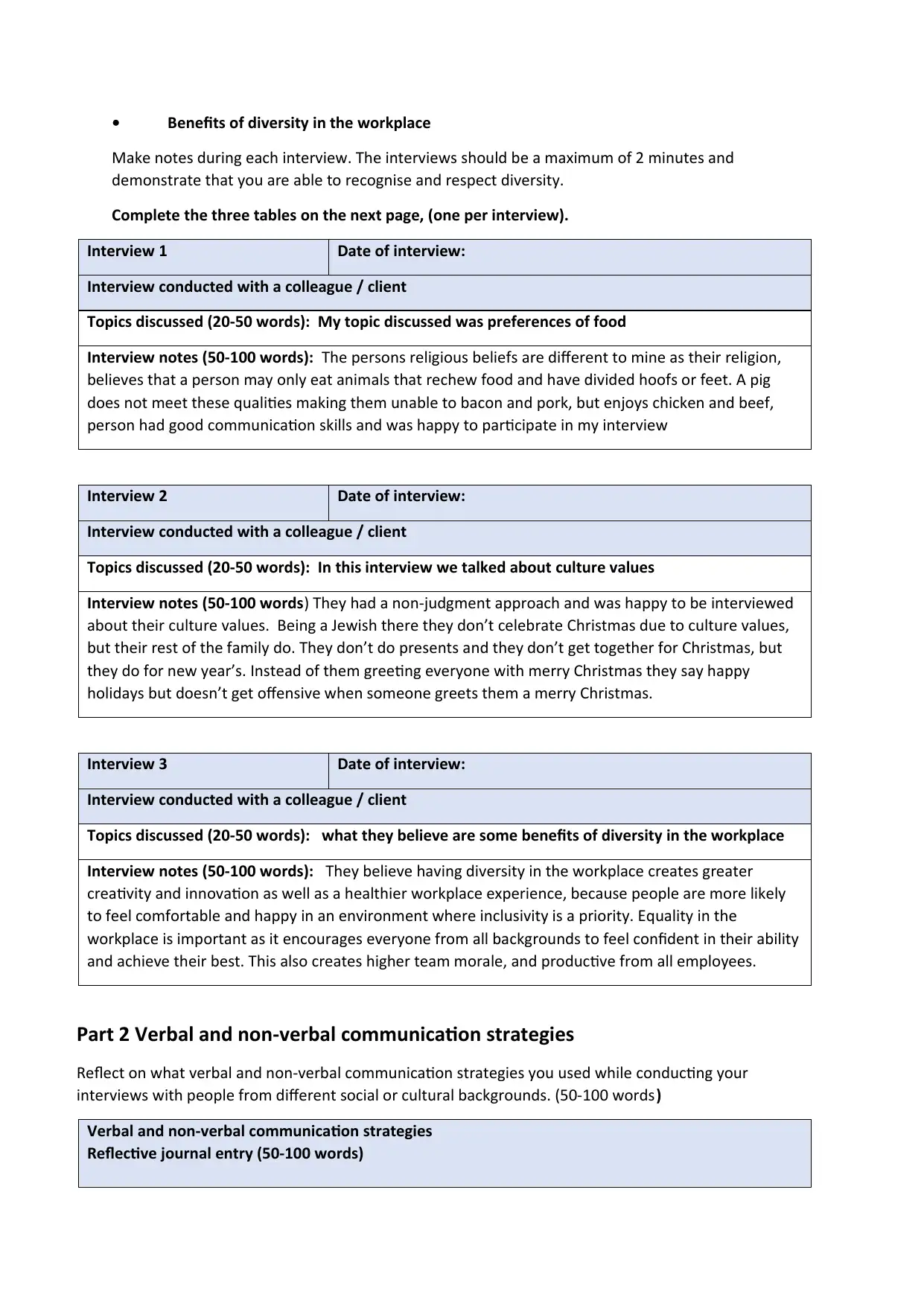
• Benefits of diversity in the workplace
Make notes during each interview. The interviews should be a maximum of 2 minutes and
demonstrate that you are able to recognise and respect diversity.
Complete the three tables on the next page, (one per interview).
Interview 1 Date of interview:
Interview conducted with a colleague / client
Topics discussed (20-50 words): My topic discussed was preferences of food
Interview notes (50-100 words): The persons religious beliefs are different to mine as their religion,
believes that a person may only eat animals that rechew food and have divided hoofs or feet. A pig
does not meet these qualities making them unable to bacon and pork, but enjoys chicken and beef,
person had good communication skills and was happy to participate in my interview
Interview 2 Date of interview:
Interview conducted with a colleague / client
Topics discussed (20-50 words): In this interview we talked about culture values
Interview notes (50-100 words) They had a non-judgment approach and was happy to be interviewed
about their culture values. Being a Jewish there they don’t celebrate Christmas due to culture values,
but their rest of the family do. They don’t do presents and they don’t get together for Christmas, but
they do for new year’s. Instead of them greeting everyone with merry Christmas they say happy
holidays but doesn’t get offensive when someone greets them a merry Christmas.
Interview 3 Date of interview:
Interview conducted with a colleague / client
Topics discussed (20-50 words): what they believe are some benefits of diversity in the workplace
Interview notes (50-100 words): They believe having diversity in the workplace creates greater
creativity and innovation as well as a healthier workplace experience, because people are more likely
to feel comfortable and happy in an environment where inclusivity is a priority. Equality in the
workplace is important as it encourages everyone from all backgrounds to feel confident in their ability
and achieve their best. This also creates higher team morale, and productive from all employees.
Part 2 Verbal and non-verbal communication strategies
Reflect on what verbal and non-verbal communication strategies you used while conducting your
interviews with people from different social or cultural backgrounds. (50-100 words)
Verbal and non-verbal communication strategies
Reflective journal entry (50-100 words)
Make notes during each interview. The interviews should be a maximum of 2 minutes and
demonstrate that you are able to recognise and respect diversity.
Complete the three tables on the next page, (one per interview).
Interview 1 Date of interview:
Interview conducted with a colleague / client
Topics discussed (20-50 words): My topic discussed was preferences of food
Interview notes (50-100 words): The persons religious beliefs are different to mine as their religion,
believes that a person may only eat animals that rechew food and have divided hoofs or feet. A pig
does not meet these qualities making them unable to bacon and pork, but enjoys chicken and beef,
person had good communication skills and was happy to participate in my interview
Interview 2 Date of interview:
Interview conducted with a colleague / client
Topics discussed (20-50 words): In this interview we talked about culture values
Interview notes (50-100 words) They had a non-judgment approach and was happy to be interviewed
about their culture values. Being a Jewish there they don’t celebrate Christmas due to culture values,
but their rest of the family do. They don’t do presents and they don’t get together for Christmas, but
they do for new year’s. Instead of them greeting everyone with merry Christmas they say happy
holidays but doesn’t get offensive when someone greets them a merry Christmas.
Interview 3 Date of interview:
Interview conducted with a colleague / client
Topics discussed (20-50 words): what they believe are some benefits of diversity in the workplace
Interview notes (50-100 words): They believe having diversity in the workplace creates greater
creativity and innovation as well as a healthier workplace experience, because people are more likely
to feel comfortable and happy in an environment where inclusivity is a priority. Equality in the
workplace is important as it encourages everyone from all backgrounds to feel confident in their ability
and achieve their best. This also creates higher team morale, and productive from all employees.
Part 2 Verbal and non-verbal communication strategies
Reflect on what verbal and non-verbal communication strategies you used while conducting your
interviews with people from different social or cultural backgrounds. (50-100 words)
Verbal and non-verbal communication strategies
Reflective journal entry (50-100 words)
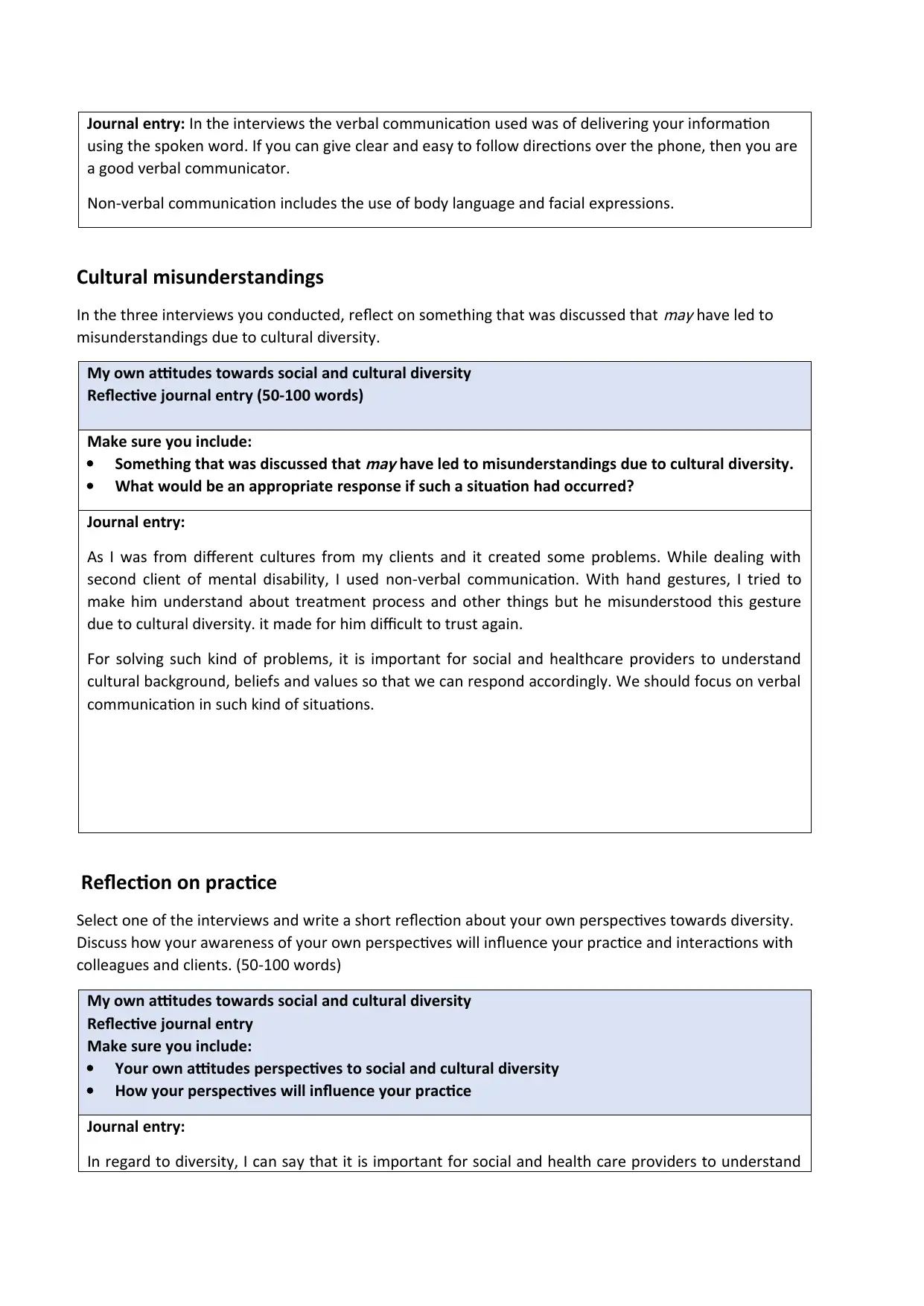
Journal entry: In the interviews the verbal communication used was of delivering your information
using the spoken word. If you can give clear and easy to follow directions over the phone, then you are
a good verbal communicator.
Non-verbal communication includes the use of body language and facial expressions.
Cultural misunderstandings
In the three interviews you conducted, reflect on something that was discussed that
may have led to
misunderstandings due to cultural diversity.
My own attitudes towards social and cultural diversity
Reflective journal entry (50-100 words)
Make sure you include:
Something that was discussed that
may have led to misunderstandings due to cultural diversity.
What would be an appropriate response if such a situation had occurred?
Journal entry:
As I was from different cultures from my clients and it created some problems. While dealing with
second client of mental disability, I used non-verbal communication. With hand gestures, I tried to
make him understand about treatment process and other things but he misunderstood this gesture
due to cultural diversity. it made for him difficult to trust again.
For solving such kind of problems, it is important for social and healthcare providers to understand
cultural background, beliefs and values so that we can respond accordingly. We should focus on verbal
communication in such kind of situations.
Reflection on practice
Select one of the interviews and write a short reflection about your own perspectives towards diversity.
Discuss how your awareness of your own perspectives will influence your practice and interactions with
colleagues and clients. (50-100 words)
My own attitudes towards social and cultural diversity
Reflective journal entry
Make sure you include:
Your own attitudes perspectives to social and cultural diversity
How your perspectives will influence your practice
Journal entry:
In regard to diversity, I can say that it is important for social and health care providers to understand
using the spoken word. If you can give clear and easy to follow directions over the phone, then you are
a good verbal communicator.
Non-verbal communication includes the use of body language and facial expressions.
Cultural misunderstandings
In the three interviews you conducted, reflect on something that was discussed that
may have led to
misunderstandings due to cultural diversity.
My own attitudes towards social and cultural diversity
Reflective journal entry (50-100 words)
Make sure you include:
Something that was discussed that
may have led to misunderstandings due to cultural diversity.
What would be an appropriate response if such a situation had occurred?
Journal entry:
As I was from different cultures from my clients and it created some problems. While dealing with
second client of mental disability, I used non-verbal communication. With hand gestures, I tried to
make him understand about treatment process and other things but he misunderstood this gesture
due to cultural diversity. it made for him difficult to trust again.
For solving such kind of problems, it is important for social and healthcare providers to understand
cultural background, beliefs and values so that we can respond accordingly. We should focus on verbal
communication in such kind of situations.
Reflection on practice
Select one of the interviews and write a short reflection about your own perspectives towards diversity.
Discuss how your awareness of your own perspectives will influence your practice and interactions with
colleagues and clients. (50-100 words)
My own attitudes towards social and cultural diversity
Reflective journal entry
Make sure you include:
Your own attitudes perspectives to social and cultural diversity
How your perspectives will influence your practice
Journal entry:
In regard to diversity, I can say that it is important for social and health care providers to understand
⊘ This is a preview!⊘
Do you want full access?
Subscribe today to unlock all pages.
Trusted by 1+ million students worldwide
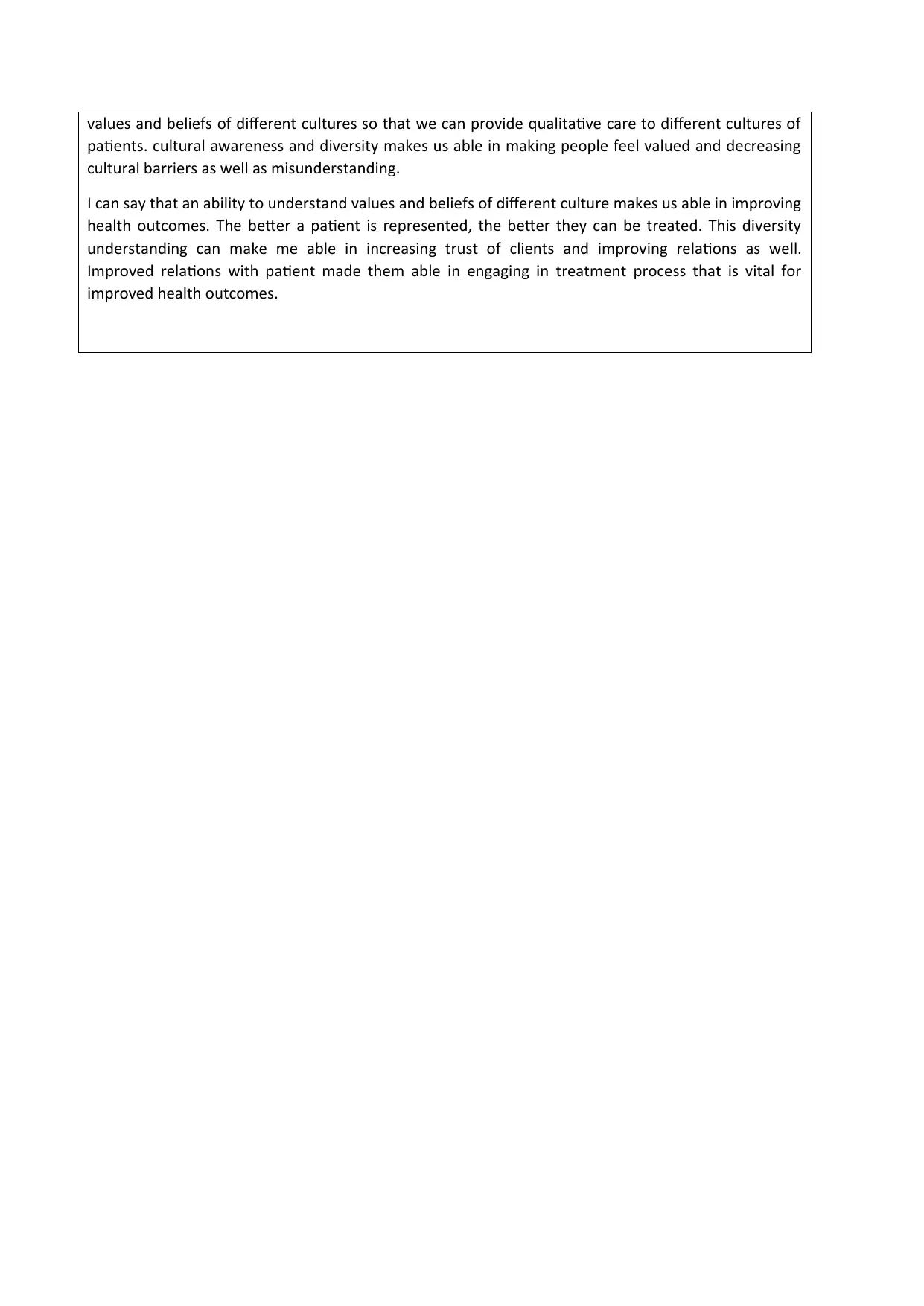
values and beliefs of different cultures so that we can provide qualitative care to different cultures of
patients. cultural awareness and diversity makes us able in making people feel valued and decreasing
cultural barriers as well as misunderstanding.
I can say that an ability to understand values and beliefs of different culture makes us able in improving
health outcomes. The better a patient is represented, the better they can be treated. This diversity
understanding can make me able in increasing trust of clients and improving relations as well.
Improved relations with patient made them able in engaging in treatment process that is vital for
improved health outcomes.
patients. cultural awareness and diversity makes us able in making people feel valued and decreasing
cultural barriers as well as misunderstanding.
I can say that an ability to understand values and beliefs of different culture makes us able in improving
health outcomes. The better a patient is represented, the better they can be treated. This diversity
understanding can make me able in increasing trust of clients and improving relations as well.
Improved relations with patient made them able in engaging in treatment process that is vital for
improved health outcomes.
Paraphrase This Document
Need a fresh take? Get an instant paraphrase of this document with our AI Paraphraser


1 out of 8


Related Documents


Your All-in-One AI-Powered Toolkit for Academic Success.
+13062052269
info@desklib.com
Available 24*7 on WhatsApp / Email
![[object Object]](/_next/static/media/star-bottom.7253800d.svg)
Unlock your academic potential
Copyright © 2020–2026 A2Z Services. All Rights Reserved. Developed and managed by ZUCOL.