Student Research Report on Hand Hygiene (CHCPOL003), Careers Australia
VerifiedAdded on 2023/01/23
|19
|9600
|86
Report
AI Summary
This document is a student's written report for the CHCPOL003 unit, focusing on research and applying evidence to practice, specifically concerning the effectiveness of hand hygiene in preventing infections within a hospital setting. The assignment, completed in pairs, requires students to address two research topics, with topic 1 focusing on hand hygiene. The report includes background information, identification of research areas, rationale for the research, research questions and objectives, connection to other disciplines, and sources of information like PubMed and CINAHL. The student outlines methods of gathering information, including literature reviews and surveys, and gathers information systematically. The report is designed to assess the student's ability to apply professional standards of practice and nursing research methodologies within the scope of an Enrolled Nurse. The assessment includes an evaluation of the student's understanding of hand hygiene protocols and their impact on reducing infection rates. This assignment, designed for Careers Australia, emphasizes the importance of evidence-based practice in nursing and infection control.
STUDENT
Assessment – Written report
CHCPOL003 Research and apply evidence to practice
Student Name: Student ID:
Group: Date:
Type of Assessment
This summative assessment will enable your Assessor to make a judgement of competency based on the submission of
your completed assignments against the requirements of this unit of competency.
Assessor Instructions
The Assessment Benchmark developed for each unit of competency is the evidence criteria used to judge the quality of
performance (i.e. the assessment decision-making rules). Assessors must use these benchmarks to make a judgement on
whether competency has been achieved and to determine if the participant has performed to the standard expected to
meet the unit requirement and learning outcomes. Competency results for each unit are recorded in the Record of
Assessment Form.
Reasonable Adjustment
Careers Australia will allow flexibility in relation to the way in which each unit is delivered and assessed based on the
student’s requirement. The following are the reasonable adjustments for this unit:
Trainer/Assessor must select which of the following is suitable for this unit and DELETE rows that are not
applicable
Reasonable Adjustment for this unit College Based On-Line Delivery
The assistance of a Learning Support Teacher for LLN issues 1 1
Modifications to physical environment, e.g. Wheelchair access 1 1
Changes to course design, e.g. Instead of written assessment task – change to verbal
questioning & assessor to write the answers 1 1
Changes in lecture schedules and arrangements, e.g. Relocating classes to an accessible venue 1 1
Modifications to computer equipment in the computer lab 1 1
Provision of information or course materials in accessible format, e.g. A textbook in braille 1 1
Supply of specialised equipment or services, e.g. A note taker for a student who cannot write 1 1
Assessment Coding
Assessment of this program of study is based on competency-based principles.
S = Satisfactory
NS = Not Satisfactory
Students who fail to perform satisfactorily for the assessment in the prescribed date may be assessed as ‘not satisfactory’.
You are required to be assessed as ‘Satisfactory’ on completion of Assessments assigned by your assessor for this unit of
competency.
Re-assessment
Any re-assessment is conducted as soon as practicable after you have been informed of the requirement to be re-assessed
and have been given the opportunity to be re-trained and assimilate the training. You are re-assessedin only the areas
assessed NS. It is at the assessor/s discretion to re-assess the entire assessment should it be demonstrated an overall
understanding of this unit has not been achieved. Students that are assessed ‘satisfactory’ after re-assessment of areas
deemed NS will achieve competency for this assignment.
I acknowledge the assessment process has been explained and agree to undertake the assessment. I am aware of Careers Australia’s appeals process,
should the need arise. I also understand that I must be assessed as ‘satisfactory’ in all parts of the assessment to gain a competent result for this unit of
competency. I declare that the work contained in this assessment is my own, except where acknowledgment of sources is made. I understand that a
person found responsible for academic misconduct will be subject to disciplinary action (refer to student handbook).
Student Signature: __________________________ Date: ______
Assessor use only
Assessor Comment/Feedback: _________________
__________
__________
__________
Assessor Name: ____________________________ Assessor Signature: _______________________________
Date: _________________ Result: Satisfactory/Not Satisfactory
Office use only:
12th January 2017 Page 1
Assessment – Written report
CHCPOL003 Research and apply evidence to practice
Student Name: Student ID:
Group: Date:
Type of Assessment
This summative assessment will enable your Assessor to make a judgement of competency based on the submission of
your completed assignments against the requirements of this unit of competency.
Assessor Instructions
The Assessment Benchmark developed for each unit of competency is the evidence criteria used to judge the quality of
performance (i.e. the assessment decision-making rules). Assessors must use these benchmarks to make a judgement on
whether competency has been achieved and to determine if the participant has performed to the standard expected to
meet the unit requirement and learning outcomes. Competency results for each unit are recorded in the Record of
Assessment Form.
Reasonable Adjustment
Careers Australia will allow flexibility in relation to the way in which each unit is delivered and assessed based on the
student’s requirement. The following are the reasonable adjustments for this unit:
Trainer/Assessor must select which of the following is suitable for this unit and DELETE rows that are not
applicable
Reasonable Adjustment for this unit College Based On-Line Delivery
The assistance of a Learning Support Teacher for LLN issues 1 1
Modifications to physical environment, e.g. Wheelchair access 1 1
Changes to course design, e.g. Instead of written assessment task – change to verbal
questioning & assessor to write the answers 1 1
Changes in lecture schedules and arrangements, e.g. Relocating classes to an accessible venue 1 1
Modifications to computer equipment in the computer lab 1 1
Provision of information or course materials in accessible format, e.g. A textbook in braille 1 1
Supply of specialised equipment or services, e.g. A note taker for a student who cannot write 1 1
Assessment Coding
Assessment of this program of study is based on competency-based principles.
S = Satisfactory
NS = Not Satisfactory
Students who fail to perform satisfactorily for the assessment in the prescribed date may be assessed as ‘not satisfactory’.
You are required to be assessed as ‘Satisfactory’ on completion of Assessments assigned by your assessor for this unit of
competency.
Re-assessment
Any re-assessment is conducted as soon as practicable after you have been informed of the requirement to be re-assessed
and have been given the opportunity to be re-trained and assimilate the training. You are re-assessedin only the areas
assessed NS. It is at the assessor/s discretion to re-assess the entire assessment should it be demonstrated an overall
understanding of this unit has not been achieved. Students that are assessed ‘satisfactory’ after re-assessment of areas
deemed NS will achieve competency for this assignment.
I acknowledge the assessment process has been explained and agree to undertake the assessment. I am aware of Careers Australia’s appeals process,
should the need arise. I also understand that I must be assessed as ‘satisfactory’ in all parts of the assessment to gain a competent result for this unit of
competency. I declare that the work contained in this assessment is my own, except where acknowledgment of sources is made. I understand that a
person found responsible for academic misconduct will be subject to disciplinary action (refer to student handbook).
Student Signature: __________________________ Date: ______
Assessor use only
Assessor Comment/Feedback: _________________
__________
__________
__________
Assessor Name: ____________________________ Assessor Signature: _______________________________
Date: _________________ Result: Satisfactory/Not Satisfactory
Office use only:
12th January 2017 Page 1

Paraphrase This Document
Need a fresh take? Get an instant paraphrase of this document with our AI Paraphraser
STUDENT
Assessment – Written report
CHCPOL003 Research and apply evidence to practice
Results entered by: Date: Skills Centre:
ASSESSMENT: Written report - Research assignment – 2 topics
S/NS result given. Must attain a satisfactory result.
Assignment INSTRUCTIONS - Topics 1 & 2
This assessment consists of two (2) research topics
o You must complete both topics – if you submit only one topic your assessment will be deemed not
satisfactory.
o Each topic asks the same questions.
o You may choose a different topic for assignment 1, but your educator must agree with the topic
you have chosen prior to completing the assignment.
Use the template provided.
You must submit your posters/flyers at the same time you submit the two research topics on
Blackboard. Label each poster/flyer clearly so your name can be identified by the educator.
o E.g. CHCPOL003 Surname_Poster1
Word count: no more than 2,000 words per assignment (no more than 4,000 words for the whole
assessment).
Read topic 1 and topic 2 at the end of the first class.
This assessment is to be doneIN PAIRS. Educators will allocate the pairs.
Youwill be assessed individually, for your submission of BOTH topics.Each student to submit their
assessment via Blackboard.
Do not wait until the last minute to complete the assessment as this is a time-consuming assessment
– you should start as early as possible.
You may use the PowerPoints for this unit and the learning activities to help you completethe
assessment.
You are required to communicate verbally and/or in writing with your educator throughout the
assessment to ensure you understand the process and to clarify any areas of uncertainty.
You are required to apply your Professional Standards of Practice throughout the assessment, the
framework for which included:
o NMBA Enrolled Nurse Standards for Practice
o NMBA Code of Ethics for Nurses
o NMBA Code of Professional Conduct for nurses
o Health Practitioner Regulation National Law Act (National Law)
o Scope of Nursing Practice Decision Making Framework
You are also required to apply an appropriate research approach to nursing practice within the scope
of the Enrolled Nurse and use nursing research methodologies and resources appropriately.
You will need to provide the exact number of words used at the end of the proposal.
o Word count does NOTinclude:The pre-existing templates, instructions and questions.
You must use analytical processes throughout the assessment including:comparing, contrasting,
challenging and reflecting.
12th January 2017 Page 2
Assessment – Written report
CHCPOL003 Research and apply evidence to practice
Results entered by: Date: Skills Centre:
ASSESSMENT: Written report - Research assignment – 2 topics
S/NS result given. Must attain a satisfactory result.
Assignment INSTRUCTIONS - Topics 1 & 2
This assessment consists of two (2) research topics
o You must complete both topics – if you submit only one topic your assessment will be deemed not
satisfactory.
o Each topic asks the same questions.
o You may choose a different topic for assignment 1, but your educator must agree with the topic
you have chosen prior to completing the assignment.
Use the template provided.
You must submit your posters/flyers at the same time you submit the two research topics on
Blackboard. Label each poster/flyer clearly so your name can be identified by the educator.
o E.g. CHCPOL003 Surname_Poster1
Word count: no more than 2,000 words per assignment (no more than 4,000 words for the whole
assessment).
Read topic 1 and topic 2 at the end of the first class.
This assessment is to be doneIN PAIRS. Educators will allocate the pairs.
Youwill be assessed individually, for your submission of BOTH topics.Each student to submit their
assessment via Blackboard.
Do not wait until the last minute to complete the assessment as this is a time-consuming assessment
– you should start as early as possible.
You may use the PowerPoints for this unit and the learning activities to help you completethe
assessment.
You are required to communicate verbally and/or in writing with your educator throughout the
assessment to ensure you understand the process and to clarify any areas of uncertainty.
You are required to apply your Professional Standards of Practice throughout the assessment, the
framework for which included:
o NMBA Enrolled Nurse Standards for Practice
o NMBA Code of Ethics for Nurses
o NMBA Code of Professional Conduct for nurses
o Health Practitioner Regulation National Law Act (National Law)
o Scope of Nursing Practice Decision Making Framework
You are also required to apply an appropriate research approach to nursing practice within the scope
of the Enrolled Nurse and use nursing research methodologies and resources appropriately.
You will need to provide the exact number of words used at the end of the proposal.
o Word count does NOTinclude:The pre-existing templates, instructions and questions.
You must use analytical processes throughout the assessment including:comparing, contrasting,
challenging and reflecting.
12th January 2017 Page 2
STUDENT
Assessment – Written report
CHCPOL003 Research and apply evidence to practice
Research Topic 1
Effectiveness of hand hygiene on preventing infection in hospital
(You may choose a different topic, but your educator must agree with the topic you have chosen.)
Topic 1 – Background
Read before starting your assignment
You are a new enrolled nurse working in a clinic located in a remote area. The clinic building is an older
structure and lacks the use of clinical and client information, such as posters. It has been identified that many
of the staff are efficient in their roles but have some out-of-date ideas in their nursing practice.
The clinic manager has asked you to research the most current information about a specific topic, such as:
Effectiveness of hand hygiene on preventing infection in hospital
Plan the research activity
1. In order to complete this assessment, you need to identify TWO (2)areas related to the topic,
where research can help support and improve your own practice as an EN.
Every nurse has to maintain hand hygiene in order to control the spread of infection. Each and every
departments of hospital have risks associated with spread of infection. However if proper hygiene is
maintained, then the spread of infection can be controlled. The two important areas which are related to the
topic are the importance of hand washing during routine nursing care and rate of reduction in infections in
hospitals. These two areas are related as the spread of infection can be controlled by washing hands at critical
point and adhering to hand hygiene protocol effectively.
2. Identify the reason(s) for undertaking your research from the list below.
You may select several reasons.
Provide a brief rationale for each.
This research has been conducted in order to extent my own knowledge and in strengthening the quality of
the practice. By conducting this research work the knowledge about the importance of maintaining hand
hygiene can be understood, the risks associated with infection for patient can also be understood. With
knowledge on information of benefits of hand hygiene on infection control, repeated hospital rate and cost
of care can be improved.
3. Write a clear statement highlighting your research question or hypothesis, e.g. “Is there a
difference between hand washing protocols and actual practice”.
It may include:
Nursing interventions applicable to the topic
12th January 2017 Page 3
Assessment – Written report
CHCPOL003 Research and apply evidence to practice
Research Topic 1
Effectiveness of hand hygiene on preventing infection in hospital
(You may choose a different topic, but your educator must agree with the topic you have chosen.)
Topic 1 – Background
Read before starting your assignment
You are a new enrolled nurse working in a clinic located in a remote area. The clinic building is an older
structure and lacks the use of clinical and client information, such as posters. It has been identified that many
of the staff are efficient in their roles but have some out-of-date ideas in their nursing practice.
The clinic manager has asked you to research the most current information about a specific topic, such as:
Effectiveness of hand hygiene on preventing infection in hospital
Plan the research activity
1. In order to complete this assessment, you need to identify TWO (2)areas related to the topic,
where research can help support and improve your own practice as an EN.
Every nurse has to maintain hand hygiene in order to control the spread of infection. Each and every
departments of hospital have risks associated with spread of infection. However if proper hygiene is
maintained, then the spread of infection can be controlled. The two important areas which are related to the
topic are the importance of hand washing during routine nursing care and rate of reduction in infections in
hospitals. These two areas are related as the spread of infection can be controlled by washing hands at critical
point and adhering to hand hygiene protocol effectively.
2. Identify the reason(s) for undertaking your research from the list below.
You may select several reasons.
Provide a brief rationale for each.
This research has been conducted in order to extent my own knowledge and in strengthening the quality of
the practice. By conducting this research work the knowledge about the importance of maintaining hand
hygiene can be understood, the risks associated with infection for patient can also be understood. With
knowledge on information of benefits of hand hygiene on infection control, repeated hospital rate and cost
of care can be improved.
3. Write a clear statement highlighting your research question or hypothesis, e.g. “Is there a
difference between hand washing protocols and actual practice”.
It may include:
Nursing interventions applicable to the topic
12th January 2017 Page 3
⊘ This is a preview!⊘
Do you want full access?
Subscribe today to unlock all pages.

Trusted by 1+ million students worldwide
STUDENT
Assessment – Written report
CHCPOL003 Research and apply evidence to practice
Client perceptions of the provision of this topic
Models of nursing care that utilise the topic
Political issues confronting nursing practice and health care provision in relation to the
topic
Does effective hand hygiene can prevent infection in hospitals?
The hypothesis behind this statement is washing hands with soap and water can reduce the chances of
infection as it kills or educes the germs than washing hands with only water. Washing our hands with only
water reduces the dirt present in the hands but does not kill the germs. So if the hands are not cleaned
properly before touching the patients, the germs can easily spreads to the patients, specially the new born
babies and the children are mostly prone to acquire the infection. So the nurses must wash their hands
properly, so that the infection cannot spread.
4. Establish and define the general research objective.
Tips:
A research objective summarises what is to be achieved by the study.
Ensure your objective is S.M.A.R.T and relevant, logical, feasible, observable and
measurable.
The objective should be clearly phrased – use verbs, e.g. to assess, to establish, to
determine, to compare, etc.
The research objectives are :
a. To know whether the nurses are washing their hands properly before handling the patients.
b. To measure the effectiveness of washing hands before handling patients.
c. To measure the reduction of the spread of infection among the patients of the hospital after they are being
handled by the nurses who washed hands properly.
5. Identify ONE (1) other disciplinethatcould be connected to this research activity.
Briefly explain your choice of discipline
The other discipline where the infection control need to be controlled is in the scientific research works,
where a small contamination can hamper the whole experiment.
6. In order to gather information about the research topic, you will need to access credible
sources of data and evidence.
List two (2) sources you intend to use for this assignment.
Copy the link address of the source and paste it next to the source’s name – this will
provide the proof to your assessor that you accessed it.
o E.g. PubMed - http://www.ncbi.nlm.nih.gov/pubmed
o Source 1: PubMed: http://www.ncbi.nlm.nih.gov/pubmed
Source 2: CINAHL:
https://www.ebscohost.com/nursing/products/cinahl-databases/cinahl-complete
HINT:This is a good time to contact your educator and discuss your research topic and verbally
gain confirmation that you and your partner are still on track.
12th January 2017 Page 4
Assessment – Written report
CHCPOL003 Research and apply evidence to practice
Client perceptions of the provision of this topic
Models of nursing care that utilise the topic
Political issues confronting nursing practice and health care provision in relation to the
topic
Does effective hand hygiene can prevent infection in hospitals?
The hypothesis behind this statement is washing hands with soap and water can reduce the chances of
infection as it kills or educes the germs than washing hands with only water. Washing our hands with only
water reduces the dirt present in the hands but does not kill the germs. So if the hands are not cleaned
properly before touching the patients, the germs can easily spreads to the patients, specially the new born
babies and the children are mostly prone to acquire the infection. So the nurses must wash their hands
properly, so that the infection cannot spread.
4. Establish and define the general research objective.
Tips:
A research objective summarises what is to be achieved by the study.
Ensure your objective is S.M.A.R.T and relevant, logical, feasible, observable and
measurable.
The objective should be clearly phrased – use verbs, e.g. to assess, to establish, to
determine, to compare, etc.
The research objectives are :
a. To know whether the nurses are washing their hands properly before handling the patients.
b. To measure the effectiveness of washing hands before handling patients.
c. To measure the reduction of the spread of infection among the patients of the hospital after they are being
handled by the nurses who washed hands properly.
5. Identify ONE (1) other disciplinethatcould be connected to this research activity.
Briefly explain your choice of discipline
The other discipline where the infection control need to be controlled is in the scientific research works,
where a small contamination can hamper the whole experiment.
6. In order to gather information about the research topic, you will need to access credible
sources of data and evidence.
List two (2) sources you intend to use for this assignment.
Copy the link address of the source and paste it next to the source’s name – this will
provide the proof to your assessor that you accessed it.
o E.g. PubMed - http://www.ncbi.nlm.nih.gov/pubmed
o Source 1: PubMed: http://www.ncbi.nlm.nih.gov/pubmed
Source 2: CINAHL:
https://www.ebscohost.com/nursing/products/cinahl-databases/cinahl-complete
HINT:This is a good time to contact your educator and discuss your research topic and verbally
gain confirmation that you and your partner are still on track.
12th January 2017 Page 4
Paraphrase This Document
Need a fresh take? Get an instant paraphrase of this document with our AI Paraphraser
STUDENT
Assessment – Written report
CHCPOL003 Research and apply evidence to practice
Gather information for your research
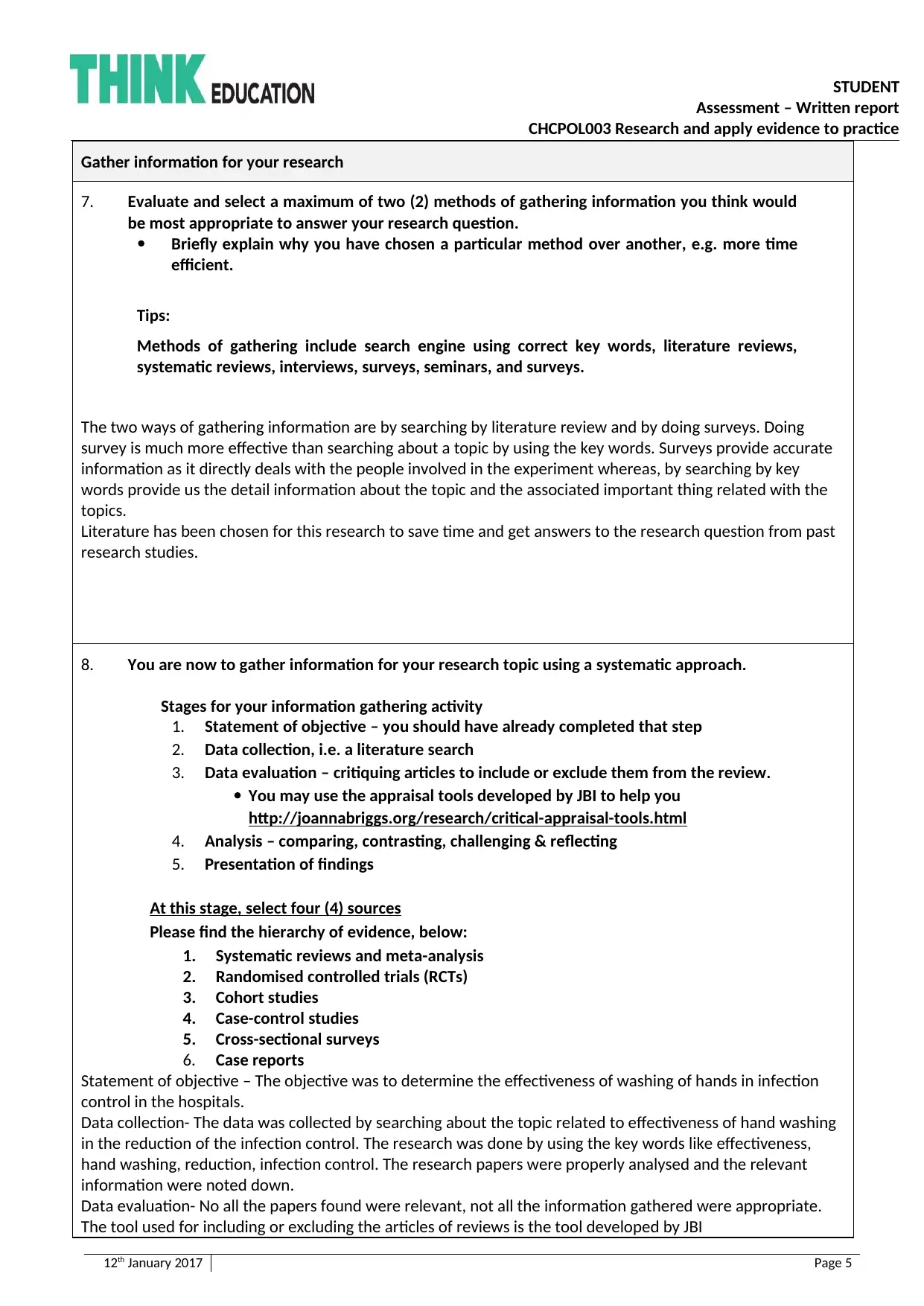
7. Evaluate and select a maximum of two (2) methods of gathering information you think would
be most appropriate to answer your research question.
Briefly explain why you have chosen a particular method over another, e.g. more time
efficient.
Tips:
Methods of gathering include search engine using correct key words, literature reviews,
systematic reviews, interviews, surveys, seminars, and surveys.
The two ways of gathering information are by searching by literature review and by doing surveys. Doing
survey is much more effective than searching about a topic by using the key words. Surveys provide accurate
information as it directly deals with the people involved in the experiment whereas, by searching by key
words provide us the detail information about the topic and the associated important thing related with the
topics.
Literature has been chosen for this research to save time and get answers to the research question from past
research studies.
8. You are now to gather information for your research topic using a systematic approach.
Stages for your information gathering activity
1. Statement of objective – you should have already completed that step
2. Data collection, i.e. a literature search
3. Data evaluation – critiquing articles to include or exclude them from the review.
You may use the appraisal tools developed by JBI to help you
http://joannabriggs.org/research/critical-appraisal-tools.html
4. Analysis – comparing, contrasting, challenging & reflecting
5. Presentation of findings
At this stage, select four (4) sources
Please find the hierarchy of evidence, below:
1. Systematic reviews and meta-analysis
2. Randomised controlled trials (RCTs)
3. Cohort studies
4. Case-control studies
5. Cross-sectional surveys
6. Case reports
Statement of objective – The objective was to determine the effectiveness of washing of hands in infection
control in the hospitals.
Data collection- The data was collected by searching about the topic related to effectiveness of hand washing
in the reduction of the infection control. The research was done by using the key words like effectiveness,
hand washing, reduction, infection control. The research papers were properly analysed and the relevant
information were noted down.
Data evaluation- No all the papers found were relevant, not all the information gathered were appropriate.
The tool used for including or excluding the articles of reviews is the tool developed by JBI
12th January 2017 Page 5
Assessment – Written report
CHCPOL003 Research and apply evidence to practice
Gather information for your research
7. Evaluate and select a maximum of two (2) methods of gathering information you think would
be most appropriate to answer your research question.
Briefly explain why you have chosen a particular method over another, e.g. more time
efficient.
Tips:
Methods of gathering include search engine using correct key words, literature reviews,
systematic reviews, interviews, surveys, seminars, and surveys.
The two ways of gathering information are by searching by literature review and by doing surveys. Doing
survey is much more effective than searching about a topic by using the key words. Surveys provide accurate
information as it directly deals with the people involved in the experiment whereas, by searching by key
words provide us the detail information about the topic and the associated important thing related with the
topics.
Literature has been chosen for this research to save time and get answers to the research question from past
research studies.
8. You are now to gather information for your research topic using a systematic approach.
Stages for your information gathering activity
1. Statement of objective – you should have already completed that step
2. Data collection, i.e. a literature search
3. Data evaluation – critiquing articles to include or exclude them from the review.
You may use the appraisal tools developed by JBI to help you
http://joannabriggs.org/research/critical-appraisal-tools.html
4. Analysis – comparing, contrasting, challenging & reflecting
5. Presentation of findings
At this stage, select four (4) sources
Please find the hierarchy of evidence, below:
1. Systematic reviews and meta-analysis
2. Randomised controlled trials (RCTs)
3. Cohort studies
4. Case-control studies
5. Cross-sectional surveys
6. Case reports
Statement of objective – The objective was to determine the effectiveness of washing of hands in infection
control in the hospitals.
Data collection- The data was collected by searching about the topic related to effectiveness of hand washing
in the reduction of the infection control. The research was done by using the key words like effectiveness,
hand washing, reduction, infection control. The research papers were properly analysed and the relevant
information were noted down.
Data evaluation- No all the papers found were relevant, not all the information gathered were appropriate.
The tool used for including or excluding the articles of reviews is the tool developed by JBI
12th January 2017 Page 5
STUDENT
Assessment – Written report
CHCPOL003 Research and apply evidence to practice
http://joannabriggs.org/research/critical-appraisal-tools.html
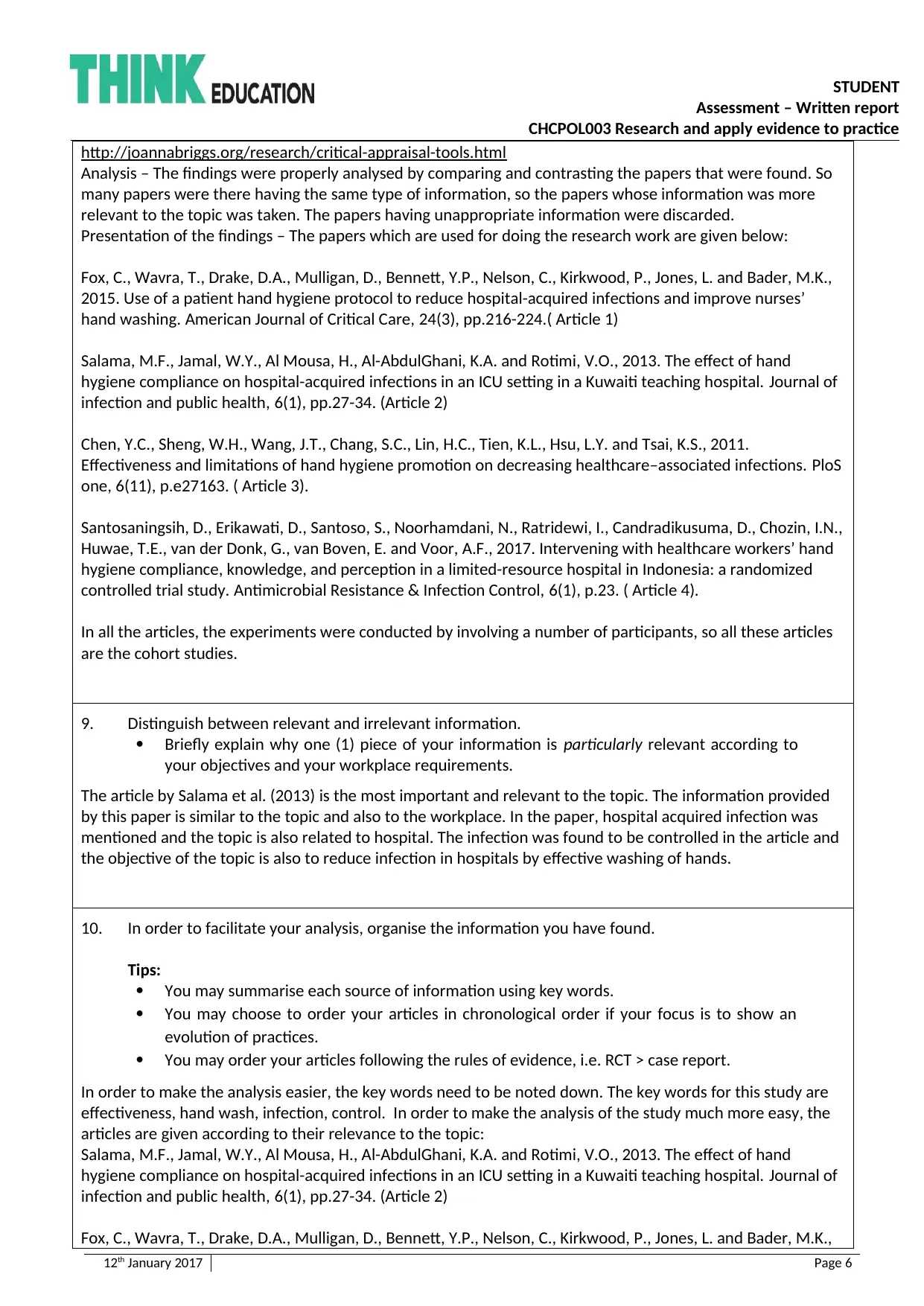
Analysis – The findings were properly analysed by comparing and contrasting the papers that were found. So
many papers were there having the same type of information, so the papers whose information was more
relevant to the topic was taken. The papers having unappropriate information were discarded.
Presentation of the findings – The papers which are used for doing the research work are given below:
Fox, C., Wavra, T., Drake, D.A., Mulligan, D., Bennett, Y.P., Nelson, C., Kirkwood, P., Jones, L. and Bader, M.K.,
2015. Use of a patient hand hygiene protocol to reduce hospital-acquired infections and improve nurses’
hand washing. American Journal of Critical Care, 24(3), pp.216-224.( Article 1)
Salama, M.F., Jamal, W.Y., Al Mousa, H., Al-AbdulGhani, K.A. and Rotimi, V.O., 2013. The effect of hand
hygiene compliance on hospital-acquired infections in an ICU setting in a Kuwaiti teaching hospital. Journal of
infection and public health, 6(1), pp.27-34. (Article 2)
Chen, Y.C., Sheng, W.H., Wang, J.T., Chang, S.C., Lin, H.C., Tien, K.L., Hsu, L.Y. and Tsai, K.S., 2011.
Effectiveness and limitations of hand hygiene promotion on decreasing healthcare–associated infections. PloS
one, 6(11), p.e27163. ( Article 3).
Santosaningsih, D., Erikawati, D., Santoso, S., Noorhamdani, N., Ratridewi, I., Candradikusuma, D., Chozin, I.N.,
Huwae, T.E., van der Donk, G., van Boven, E. and Voor, A.F., 2017. Intervening with healthcare workers’ hand
hygiene compliance, knowledge, and perception in a limited-resource hospital in Indonesia: a randomized
controlled trial study. Antimicrobial Resistance & Infection Control, 6(1), p.23. ( Article 4).
In all the articles, the experiments were conducted by involving a number of participants, so all these articles
are the cohort studies.
9. Distinguish between relevant and irrelevant information.
Briefly explain why one (1) piece of your information is particularly relevant according to
your objectives and your workplace requirements.
The article by Salama et al. (2013) is the most important and relevant to the topic. The information provided
by this paper is similar to the topic and also to the workplace. In the paper, hospital acquired infection was
mentioned and the topic is also related to hospital. The infection was found to be controlled in the article and
the objective of the topic is also to reduce infection in hospitals by effective washing of hands.
10. In order to facilitate your analysis, organise the information you have found.
Tips:
You may summarise each source of information using key words.
You may choose to order your articles in chronological order if your focus is to show an
evolution of practices.
You may order your articles following the rules of evidence, i.e. RCT > case report.
In order to make the analysis easier, the key words need to be noted down. The key words for this study are
effectiveness, hand wash, infection, control. In order to make the analysis of the study much more easy, the
articles are given according to their relevance to the topic:
Salama, M.F., Jamal, W.Y., Al Mousa, H., Al-AbdulGhani, K.A. and Rotimi, V.O., 2013. The effect of hand
hygiene compliance on hospital-acquired infections in an ICU setting in a Kuwaiti teaching hospital. Journal of
infection and public health, 6(1), pp.27-34. (Article 2)
Fox, C., Wavra, T., Drake, D.A., Mulligan, D., Bennett, Y.P., Nelson, C., Kirkwood, P., Jones, L. and Bader, M.K.,
12th January 2017 Page 6
Assessment – Written report
CHCPOL003 Research and apply evidence to practice
http://joannabriggs.org/research/critical-appraisal-tools.html
Analysis – The findings were properly analysed by comparing and contrasting the papers that were found. So
many papers were there having the same type of information, so the papers whose information was more
relevant to the topic was taken. The papers having unappropriate information were discarded.
Presentation of the findings – The papers which are used for doing the research work are given below:
Fox, C., Wavra, T., Drake, D.A., Mulligan, D., Bennett, Y.P., Nelson, C., Kirkwood, P., Jones, L. and Bader, M.K.,
2015. Use of a patient hand hygiene protocol to reduce hospital-acquired infections and improve nurses’
hand washing. American Journal of Critical Care, 24(3), pp.216-224.( Article 1)
Salama, M.F., Jamal, W.Y., Al Mousa, H., Al-AbdulGhani, K.A. and Rotimi, V.O., 2013. The effect of hand
hygiene compliance on hospital-acquired infections in an ICU setting in a Kuwaiti teaching hospital. Journal of
infection and public health, 6(1), pp.27-34. (Article 2)
Chen, Y.C., Sheng, W.H., Wang, J.T., Chang, S.C., Lin, H.C., Tien, K.L., Hsu, L.Y. and Tsai, K.S., 2011.
Effectiveness and limitations of hand hygiene promotion on decreasing healthcare–associated infections. PloS
one, 6(11), p.e27163. ( Article 3).
Santosaningsih, D., Erikawati, D., Santoso, S., Noorhamdani, N., Ratridewi, I., Candradikusuma, D., Chozin, I.N.,
Huwae, T.E., van der Donk, G., van Boven, E. and Voor, A.F., 2017. Intervening with healthcare workers’ hand
hygiene compliance, knowledge, and perception in a limited-resource hospital in Indonesia: a randomized
controlled trial study. Antimicrobial Resistance & Infection Control, 6(1), p.23. ( Article 4).
In all the articles, the experiments were conducted by involving a number of participants, so all these articles
are the cohort studies.
9. Distinguish between relevant and irrelevant information.
Briefly explain why one (1) piece of your information is particularly relevant according to
your objectives and your workplace requirements.
The article by Salama et al. (2013) is the most important and relevant to the topic. The information provided
by this paper is similar to the topic and also to the workplace. In the paper, hospital acquired infection was
mentioned and the topic is also related to hospital. The infection was found to be controlled in the article and
the objective of the topic is also to reduce infection in hospitals by effective washing of hands.
10. In order to facilitate your analysis, organise the information you have found.
Tips:
You may summarise each source of information using key words.
You may choose to order your articles in chronological order if your focus is to show an
evolution of practices.
You may order your articles following the rules of evidence, i.e. RCT > case report.
In order to make the analysis easier, the key words need to be noted down. The key words for this study are
effectiveness, hand wash, infection, control. In order to make the analysis of the study much more easy, the
articles are given according to their relevance to the topic:
Salama, M.F., Jamal, W.Y., Al Mousa, H., Al-AbdulGhani, K.A. and Rotimi, V.O., 2013. The effect of hand
hygiene compliance on hospital-acquired infections in an ICU setting in a Kuwaiti teaching hospital. Journal of
infection and public health, 6(1), pp.27-34. (Article 2)
Fox, C., Wavra, T., Drake, D.A., Mulligan, D., Bennett, Y.P., Nelson, C., Kirkwood, P., Jones, L. and Bader, M.K.,
12th January 2017 Page 6
⊘ This is a preview!⊘
Do you want full access?
Subscribe today to unlock all pages.
Trusted by 1+ million students worldwide
STUDENT
Assessment – Written report
CHCPOL003 Research and apply evidence to practice
2015. Use of a patient hand hygiene protocol to reduce hospital-acquired infections and improve nurses’
hand washing. American Journal of Critical Care, 24(3), pp.216-224.( Article 1)
Chen, Y.C., Sheng, W.H., Wang, J.T., Chang, S.C., Lin, H.C., Tien, K.L., Hsu, L.Y. and Tsai, K.S., 2011.
Effectiveness and limitations of hand hygiene promotion on decreasing healthcare–associated infections. PloS
one, 6(11), p.e27163. ( Article 3).
Santosaningsih, D., Erikawati, D., Santoso, S., Noorhamdani, N., Ratridewi, I., Candradikusuma, D., Chozin, I.N.,
Huwae, T.E., van der Donk, G., van Boven, E. and Voor, A.F., 2017. Intervening with healthcare workers’ hand
hygiene compliance, knowledge, and perception in a limited-resource hospital in Indonesia: a randomized
controlled trial study. Antimicrobial Resistance & Infection Control, 6(1), p.23. ( Article 4).
HINT: Contact your educator and discuss your research topic and verbally gain confirmation
that you and your partner are still on track.
Analyse the information
11. Prioritise information based on the research objectives.
Using questions 9 and 10 to help you, select only TWO (2) articles that you will keep for the
rest of this assignment.
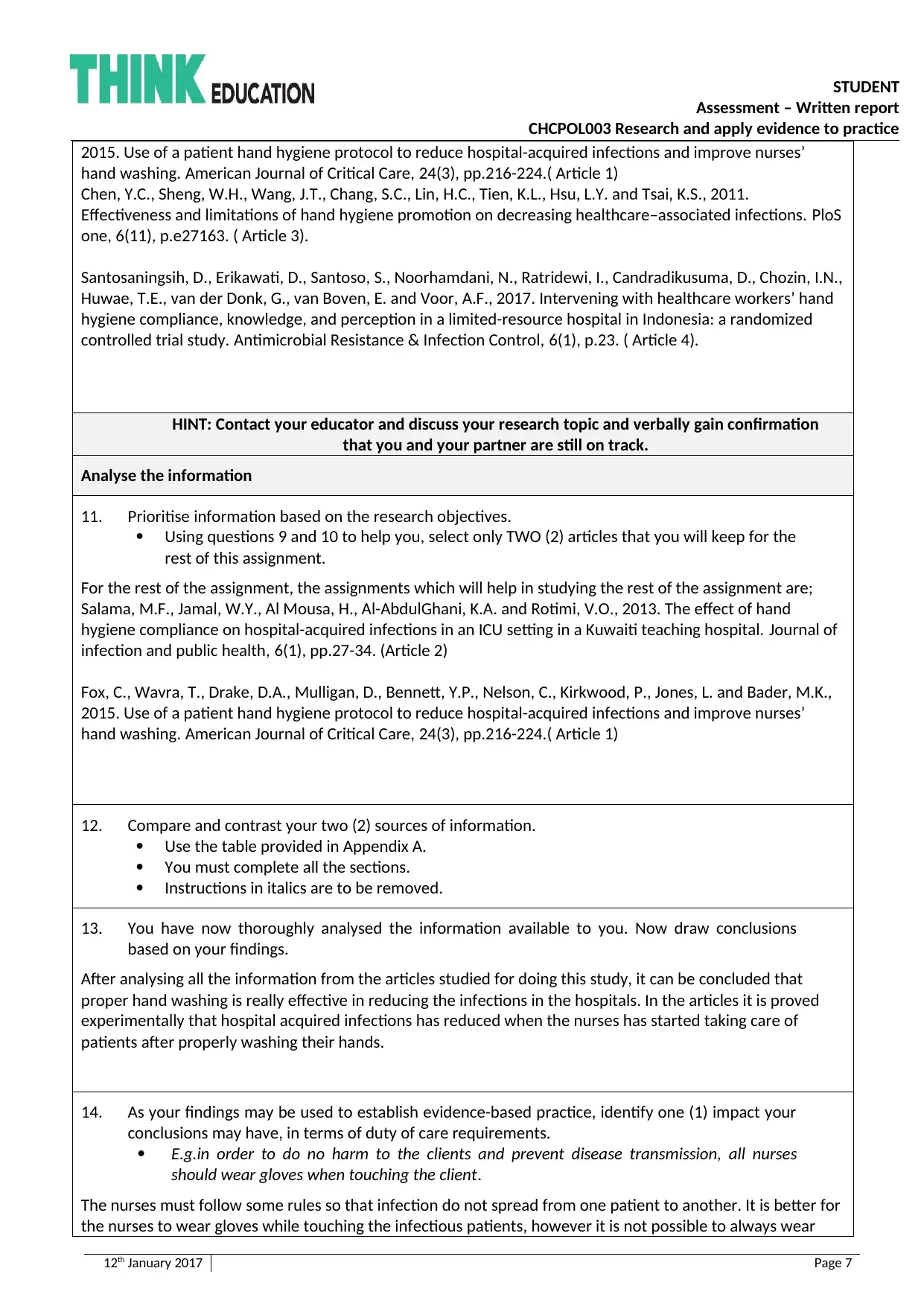
For the rest of the assignment, the assignments which will help in studying the rest of the assignment are;
Salama, M.F., Jamal, W.Y., Al Mousa, H., Al-AbdulGhani, K.A. and Rotimi, V.O., 2013. The effect of hand
hygiene compliance on hospital-acquired infections in an ICU setting in a Kuwaiti teaching hospital. Journal of
infection and public health, 6(1), pp.27-34. (Article 2)
Fox, C., Wavra, T., Drake, D.A., Mulligan, D., Bennett, Y.P., Nelson, C., Kirkwood, P., Jones, L. and Bader, M.K.,
2015. Use of a patient hand hygiene protocol to reduce hospital-acquired infections and improve nurses’
hand washing. American Journal of Critical Care, 24(3), pp.216-224.( Article 1)
12. Compare and contrast your two (2) sources of information.
Use the table provided in Appendix A.
You must complete all the sections.
Instructions in italics are to be removed.
13. You have now thoroughly analysed the information available to you. Now draw conclusions
based on your findings.
After analysing all the information from the articles studied for doing this study, it can be concluded that
proper hand washing is really effective in reducing the infections in the hospitals. In the articles it is proved
experimentally that hospital acquired infections has reduced when the nurses has started taking care of
patients after properly washing their hands.
14. As your findings may be used to establish evidence-based practice, identify one (1) impact your
conclusions may have, in terms of duty of care requirements.
E.g.in order to do no harm to the clients and prevent disease transmission, all nurses
should wear gloves when touching the client.
The nurses must follow some rules so that infection do not spread from one patient to another. It is better for
the nurses to wear gloves while touching the infectious patients, however it is not possible to always wear
12th January 2017 Page 7
Assessment – Written report
CHCPOL003 Research and apply evidence to practice
2015. Use of a patient hand hygiene protocol to reduce hospital-acquired infections and improve nurses’
hand washing. American Journal of Critical Care, 24(3), pp.216-224.( Article 1)
Chen, Y.C., Sheng, W.H., Wang, J.T., Chang, S.C., Lin, H.C., Tien, K.L., Hsu, L.Y. and Tsai, K.S., 2011.
Effectiveness and limitations of hand hygiene promotion on decreasing healthcare–associated infections. PloS
one, 6(11), p.e27163. ( Article 3).
Santosaningsih, D., Erikawati, D., Santoso, S., Noorhamdani, N., Ratridewi, I., Candradikusuma, D., Chozin, I.N.,
Huwae, T.E., van der Donk, G., van Boven, E. and Voor, A.F., 2017. Intervening with healthcare workers’ hand
hygiene compliance, knowledge, and perception in a limited-resource hospital in Indonesia: a randomized
controlled trial study. Antimicrobial Resistance & Infection Control, 6(1), p.23. ( Article 4).
HINT: Contact your educator and discuss your research topic and verbally gain confirmation
that you and your partner are still on track.
Analyse the information
11. Prioritise information based on the research objectives.
Using questions 9 and 10 to help you, select only TWO (2) articles that you will keep for the
rest of this assignment.
For the rest of the assignment, the assignments which will help in studying the rest of the assignment are;
Salama, M.F., Jamal, W.Y., Al Mousa, H., Al-AbdulGhani, K.A. and Rotimi, V.O., 2013. The effect of hand
hygiene compliance on hospital-acquired infections in an ICU setting in a Kuwaiti teaching hospital. Journal of
infection and public health, 6(1), pp.27-34. (Article 2)
Fox, C., Wavra, T., Drake, D.A., Mulligan, D., Bennett, Y.P., Nelson, C., Kirkwood, P., Jones, L. and Bader, M.K.,
2015. Use of a patient hand hygiene protocol to reduce hospital-acquired infections and improve nurses’
hand washing. American Journal of Critical Care, 24(3), pp.216-224.( Article 1)
12. Compare and contrast your two (2) sources of information.
Use the table provided in Appendix A.
You must complete all the sections.
Instructions in italics are to be removed.
13. You have now thoroughly analysed the information available to you. Now draw conclusions
based on your findings.
After analysing all the information from the articles studied for doing this study, it can be concluded that
proper hand washing is really effective in reducing the infections in the hospitals. In the articles it is proved
experimentally that hospital acquired infections has reduced when the nurses has started taking care of
patients after properly washing their hands.
14. As your findings may be used to establish evidence-based practice, identify one (1) impact your
conclusions may have, in terms of duty of care requirements.
E.g.in order to do no harm to the clients and prevent disease transmission, all nurses
should wear gloves when touching the client.
The nurses must follow some rules so that infection do not spread from one patient to another. It is better for
the nurses to wear gloves while touching the infectious patients, however it is not possible to always wear
12th January 2017 Page 7
Paraphrase This Document
Need a fresh take? Get an instant paraphrase of this document with our AI Paraphraser
STUDENT
Assessment – Written report
CHCPOL003 Research and apply evidence to practice
gloves so the nurse must wash their hands with soap and it will be better if they apply alcohol for killing the
germs.
HINT: Contact your educator and discuss your research topic and verbally gain confirmation that
you and your partner are still on track.
Use information in practice
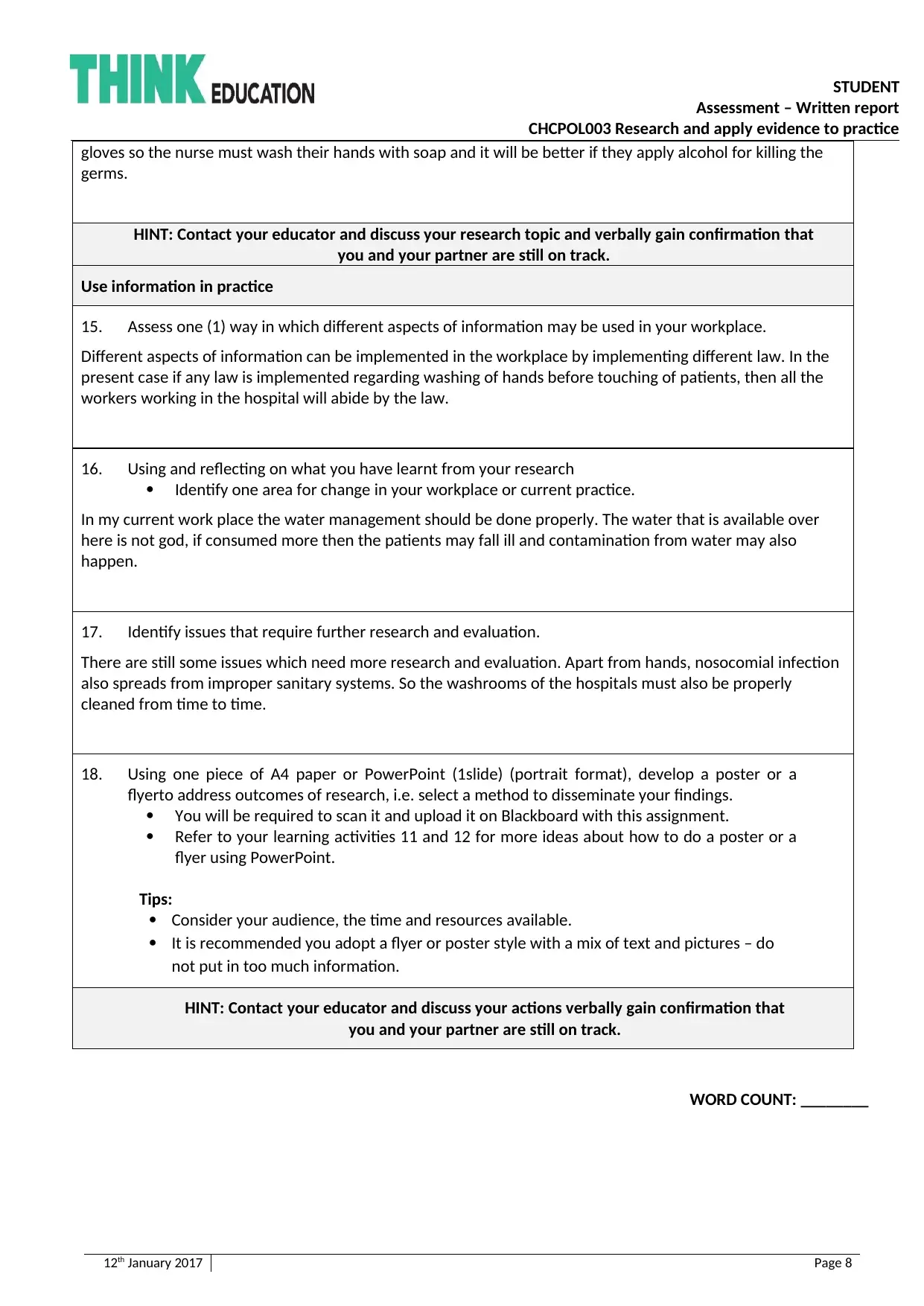
15. Assess one (1) way in which different aspects of information may be used in your workplace.
Different aspects of information can be implemented in the workplace by implementing different law. In the
present case if any law is implemented regarding washing of hands before touching of patients, then all the
workers working in the hospital will abide by the law.
16. Using and reflecting on what you have learnt from your research
Identify one area for change in your workplace or current practice.
In my current work place the water management should be done properly. The water that is available over
here is not god, if consumed more then the patients may fall ill and contamination from water may also
happen.
17. Identify issues that require further research and evaluation.
There are still some issues which need more research and evaluation. Apart from hands, nosocomial infection
also spreads from improper sanitary systems. So the washrooms of the hospitals must also be properly
cleaned from time to time.
18. Using one piece of A4 paper or PowerPoint (1slide) (portrait format), develop a poster or a
flyerto address outcomes of research, i.e. select a method to disseminate your findings.
You will be required to scan it and upload it on Blackboard with this assignment.
Refer to your learning activities 11 and 12 for more ideas about how to do a poster or a
flyer using PowerPoint.
Tips:
Consider your audience, the time and resources available.
It is recommended you adopt a flyer or poster style with a mix of text and pictures – do
not put in too much information.
HINT: Contact your educator and discuss your actions verbally gain confirmation that
you and your partner are still on track.
WORD COUNT: ________
12th January 2017 Page 8
Assessment – Written report
CHCPOL003 Research and apply evidence to practice
gloves so the nurse must wash their hands with soap and it will be better if they apply alcohol for killing the
germs.
HINT: Contact your educator and discuss your research topic and verbally gain confirmation that
you and your partner are still on track.
Use information in practice
15. Assess one (1) way in which different aspects of information may be used in your workplace.
Different aspects of information can be implemented in the workplace by implementing different law. In the
present case if any law is implemented regarding washing of hands before touching of patients, then all the
workers working in the hospital will abide by the law.
16. Using and reflecting on what you have learnt from your research
Identify one area for change in your workplace or current practice.
In my current work place the water management should be done properly. The water that is available over
here is not god, if consumed more then the patients may fall ill and contamination from water may also
happen.
17. Identify issues that require further research and evaluation.
There are still some issues which need more research and evaluation. Apart from hands, nosocomial infection
also spreads from improper sanitary systems. So the washrooms of the hospitals must also be properly
cleaned from time to time.
18. Using one piece of A4 paper or PowerPoint (1slide) (portrait format), develop a poster or a
flyerto address outcomes of research, i.e. select a method to disseminate your findings.
You will be required to scan it and upload it on Blackboard with this assignment.
Refer to your learning activities 11 and 12 for more ideas about how to do a poster or a
flyer using PowerPoint.
Tips:
Consider your audience, the time and resources available.
It is recommended you adopt a flyer or poster style with a mix of text and pictures – do
not put in too much information.
HINT: Contact your educator and discuss your actions verbally gain confirmation that
you and your partner are still on track.
WORD COUNT: ________
12th January 2017 Page 8
EDUCATOR
Assessment - Assignment
CHCPOL003 Research and apply evidence to practice
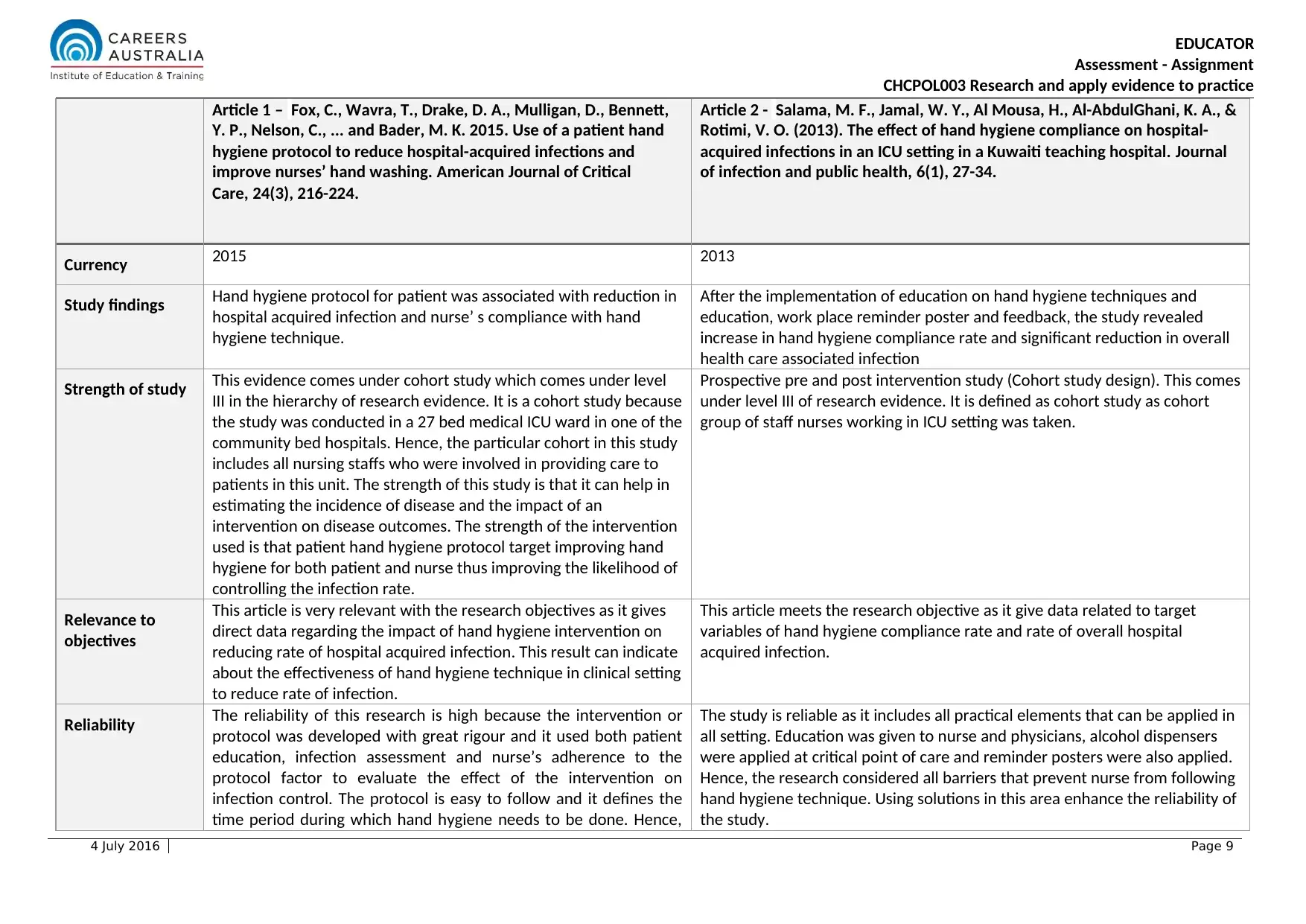
Article 1 – Fox, C., Wavra, T., Drake, D. A., Mulligan, D., Bennett,
Y. P., Nelson, C., ... and Bader, M. K. 2015. Use of a patient hand
hygiene protocol to reduce hospital-acquired infections and
improve nurses’ hand washing. American Journal of Critical
Care, 24(3), 216-224.
Article 2 - Salama, M. F., Jamal, W. Y., Al Mousa, H., Al-AbdulGhani, K. A., &
Rotimi, V. O. (2013). The effect of hand hygiene compliance on hospital-
acquired infections in an ICU setting in a Kuwaiti teaching hospital. Journal
of infection and public health, 6(1), 27-34.
Currency 2015 2013
Study findings Hand hygiene protocol for patient was associated with reduction in
hospital acquired infection and nurse’ s compliance with hand
hygiene technique.
After the implementation of education on hand hygiene techniques and
education, work place reminder poster and feedback, the study revealed
increase in hand hygiene compliance rate and significant reduction in overall
health care associated infection
Strength of study This evidence comes under cohort study which comes under level
III in the hierarchy of research evidence. It is a cohort study because
the study was conducted in a 27 bed medical ICU ward in one of the
community bed hospitals. Hence, the particular cohort in this study
includes all nursing staffs who were involved in providing care to
patients in this unit. The strength of this study is that it can help in
estimating the incidence of disease and the impact of an
intervention on disease outcomes. The strength of the intervention
used is that patient hand hygiene protocol target improving hand
hygiene for both patient and nurse thus improving the likelihood of
controlling the infection rate.
Prospective pre and post intervention study (Cohort study design). This comes
under level III of research evidence. It is defined as cohort study as cohort
group of staff nurses working in ICU setting was taken.
Relevance to
objectives
This article is very relevant with the research objectives as it gives
direct data regarding the impact of hand hygiene intervention on
reducing rate of hospital acquired infection. This result can indicate
about the effectiveness of hand hygiene technique in clinical setting
to reduce rate of infection.
This article meets the research objective as it give data related to target
variables of hand hygiene compliance rate and rate of overall hospital
acquired infection.
Reliability The reliability of this research is high because the intervention or
protocol was developed with great rigour and it used both patient
education, infection assessment and nurse’s adherence to the
protocol factor to evaluate the effect of the intervention on
infection control. The protocol is easy to follow and it defines the
time period during which hand hygiene needs to be done. Hence,
The study is reliable as it includes all practical elements that can be applied in
all setting. Education was given to nurse and physicians, alcohol dispensers
were applied at critical point of care and reminder posters were also applied.
Hence, the research considered all barriers that prevent nurse from following
hand hygiene technique. Using solutions in this area enhance the reliability of
the study.
4 July 2016 Page 9
Assessment - Assignment
CHCPOL003 Research and apply evidence to practice
Article 1 – Fox, C., Wavra, T., Drake, D. A., Mulligan, D., Bennett,
Y. P., Nelson, C., ... and Bader, M. K. 2015. Use of a patient hand
hygiene protocol to reduce hospital-acquired infections and
improve nurses’ hand washing. American Journal of Critical
Care, 24(3), 216-224.
Article 2 - Salama, M. F., Jamal, W. Y., Al Mousa, H., Al-AbdulGhani, K. A., &
Rotimi, V. O. (2013). The effect of hand hygiene compliance on hospital-
acquired infections in an ICU setting in a Kuwaiti teaching hospital. Journal
of infection and public health, 6(1), 27-34.
Currency 2015 2013
Study findings Hand hygiene protocol for patient was associated with reduction in
hospital acquired infection and nurse’ s compliance with hand
hygiene technique.
After the implementation of education on hand hygiene techniques and
education, work place reminder poster and feedback, the study revealed
increase in hand hygiene compliance rate and significant reduction in overall
health care associated infection
Strength of study This evidence comes under cohort study which comes under level
III in the hierarchy of research evidence. It is a cohort study because
the study was conducted in a 27 bed medical ICU ward in one of the
community bed hospitals. Hence, the particular cohort in this study
includes all nursing staffs who were involved in providing care to
patients in this unit. The strength of this study is that it can help in
estimating the incidence of disease and the impact of an
intervention on disease outcomes. The strength of the intervention
used is that patient hand hygiene protocol target improving hand
hygiene for both patient and nurse thus improving the likelihood of
controlling the infection rate.
Prospective pre and post intervention study (Cohort study design). This comes
under level III of research evidence. It is defined as cohort study as cohort
group of staff nurses working in ICU setting was taken.
Relevance to
objectives
This article is very relevant with the research objectives as it gives
direct data regarding the impact of hand hygiene intervention on
reducing rate of hospital acquired infection. This result can indicate
about the effectiveness of hand hygiene technique in clinical setting
to reduce rate of infection.
This article meets the research objective as it give data related to target
variables of hand hygiene compliance rate and rate of overall hospital
acquired infection.
Reliability The reliability of this research is high because the intervention or
protocol was developed with great rigour and it used both patient
education, infection assessment and nurse’s adherence to the
protocol factor to evaluate the effect of the intervention on
infection control. The protocol is easy to follow and it defines the
time period during which hand hygiene needs to be done. Hence,
The study is reliable as it includes all practical elements that can be applied in
all setting. Education was given to nurse and physicians, alcohol dispensers
were applied at critical point of care and reminder posters were also applied.
Hence, the research considered all barriers that prevent nurse from following
hand hygiene technique. Using solutions in this area enhance the reliability of
the study.
4 July 2016 Page 9
⊘ This is a preview!⊘
Do you want full access?
Subscribe today to unlock all pages.
Trusted by 1+ million students worldwide
EDUCATOR
Assessment - Assignment
CHCPOL003 Research and apply evidence to practice
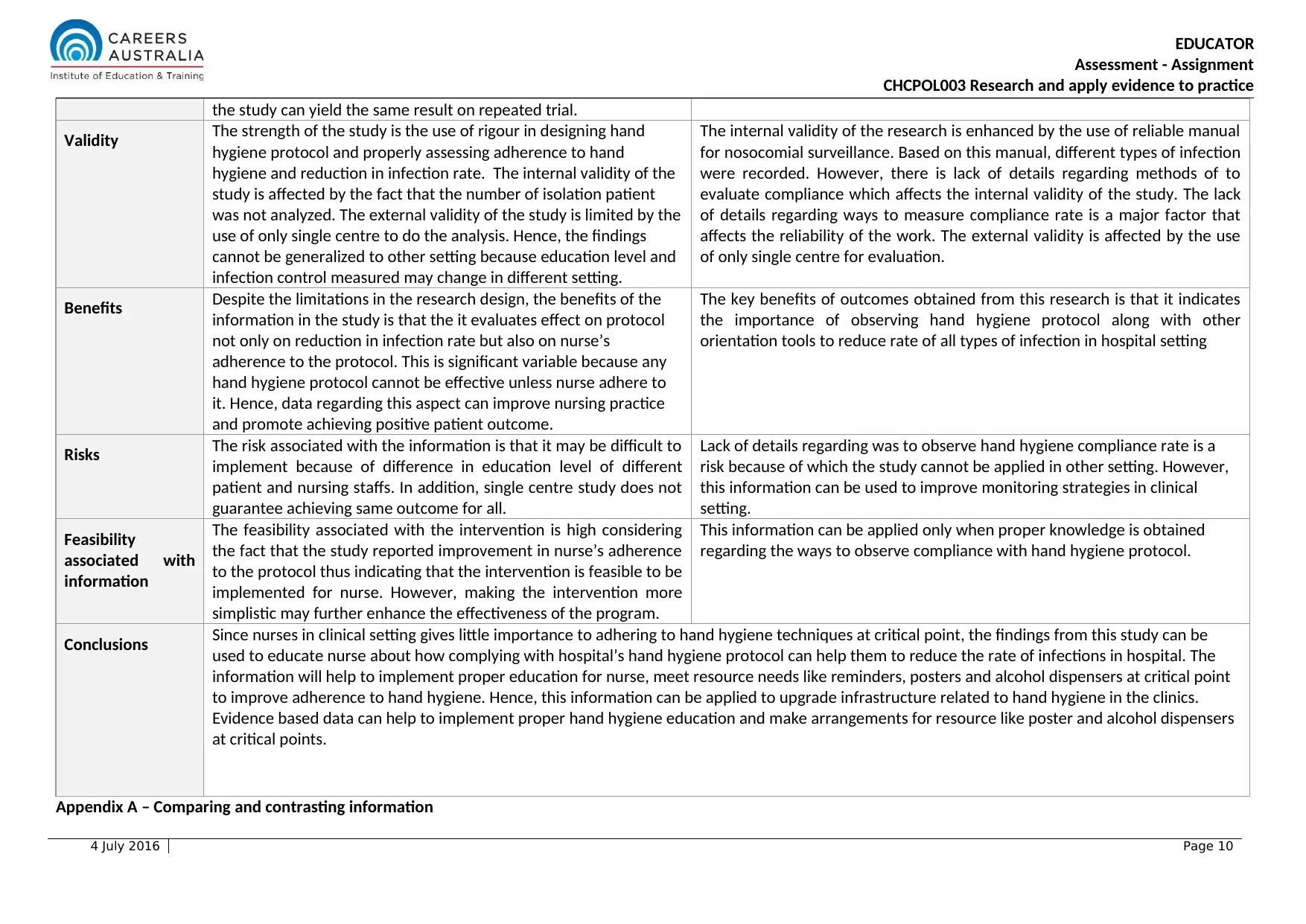
the study can yield the same result on repeated trial.
Validity The strength of the study is the use of rigour in designing hand
hygiene protocol and properly assessing adherence to hand
hygiene and reduction in infection rate. The internal validity of the
study is affected by the fact that the number of isolation patient
was not analyzed. The external validity of the study is limited by the
use of only single centre to do the analysis. Hence, the findings
cannot be generalized to other setting because education level and
infection control measured may change in different setting.
The internal validity of the research is enhanced by the use of reliable manual
for nosocomial surveillance. Based on this manual, different types of infection
were recorded. However, there is lack of details regarding methods of to
evaluate compliance which affects the internal validity of the study. The lack
of details regarding ways to measure compliance rate is a major factor that
affects the reliability of the work. The external validity is affected by the use
of only single centre for evaluation.
Benefits Despite the limitations in the research design, the benefits of the
information in the study is that the it evaluates effect on protocol
not only on reduction in infection rate but also on nurse’s
adherence to the protocol. This is significant variable because any
hand hygiene protocol cannot be effective unless nurse adhere to
it. Hence, data regarding this aspect can improve nursing practice
and promote achieving positive patient outcome.
The key benefits of outcomes obtained from this research is that it indicates
the importance of observing hand hygiene protocol along with other
orientation tools to reduce rate of all types of infection in hospital setting
Risks The risk associated with the information is that it may be difficult to
implement because of difference in education level of different
patient and nursing staffs. In addition, single centre study does not
guarantee achieving same outcome for all.
Lack of details regarding was to observe hand hygiene compliance rate is a
risk because of which the study cannot be applied in other setting. However,
this information can be used to improve monitoring strategies in clinical
setting.
Feasibility
associated with
information
The feasibility associated with the intervention is high considering
the fact that the study reported improvement in nurse’s adherence
to the protocol thus indicating that the intervention is feasible to be
implemented for nurse. However, making the intervention more
simplistic may further enhance the effectiveness of the program.
This information can be applied only when proper knowledge is obtained
regarding the ways to observe compliance with hand hygiene protocol.
Conclusions Since nurses in clinical setting gives little importance to adhering to hand hygiene techniques at critical point, the findings from this study can be
used to educate nurse about how complying with hospital’s hand hygiene protocol can help them to reduce the rate of infections in hospital. The
information will help to implement proper education for nurse, meet resource needs like reminders, posters and alcohol dispensers at critical point
to improve adherence to hand hygiene. Hence, this information can be applied to upgrade infrastructure related to hand hygiene in the clinics.
Evidence based data can help to implement proper hand hygiene education and make arrangements for resource like poster and alcohol dispensers
at critical points.
Appendix A – Comparing and contrasting information
4 July 2016 Page 10
Assessment - Assignment
CHCPOL003 Research and apply evidence to practice
the study can yield the same result on repeated trial.
Validity The strength of the study is the use of rigour in designing hand
hygiene protocol and properly assessing adherence to hand
hygiene and reduction in infection rate. The internal validity of the
study is affected by the fact that the number of isolation patient
was not analyzed. The external validity of the study is limited by the
use of only single centre to do the analysis. Hence, the findings
cannot be generalized to other setting because education level and
infection control measured may change in different setting.
The internal validity of the research is enhanced by the use of reliable manual
for nosocomial surveillance. Based on this manual, different types of infection
were recorded. However, there is lack of details regarding methods of to
evaluate compliance which affects the internal validity of the study. The lack
of details regarding ways to measure compliance rate is a major factor that
affects the reliability of the work. The external validity is affected by the use
of only single centre for evaluation.
Benefits Despite the limitations in the research design, the benefits of the
information in the study is that the it evaluates effect on protocol
not only on reduction in infection rate but also on nurse’s
adherence to the protocol. This is significant variable because any
hand hygiene protocol cannot be effective unless nurse adhere to
it. Hence, data regarding this aspect can improve nursing practice
and promote achieving positive patient outcome.
The key benefits of outcomes obtained from this research is that it indicates
the importance of observing hand hygiene protocol along with other
orientation tools to reduce rate of all types of infection in hospital setting
Risks The risk associated with the information is that it may be difficult to
implement because of difference in education level of different
patient and nursing staffs. In addition, single centre study does not
guarantee achieving same outcome for all.
Lack of details regarding was to observe hand hygiene compliance rate is a
risk because of which the study cannot be applied in other setting. However,
this information can be used to improve monitoring strategies in clinical
setting.
Feasibility
associated with
information
The feasibility associated with the intervention is high considering
the fact that the study reported improvement in nurse’s adherence
to the protocol thus indicating that the intervention is feasible to be
implemented for nurse. However, making the intervention more
simplistic may further enhance the effectiveness of the program.
This information can be applied only when proper knowledge is obtained
regarding the ways to observe compliance with hand hygiene protocol.
Conclusions Since nurses in clinical setting gives little importance to adhering to hand hygiene techniques at critical point, the findings from this study can be
used to educate nurse about how complying with hospital’s hand hygiene protocol can help them to reduce the rate of infections in hospital. The
information will help to implement proper education for nurse, meet resource needs like reminders, posters and alcohol dispensers at critical point
to improve adherence to hand hygiene. Hence, this information can be applied to upgrade infrastructure related to hand hygiene in the clinics.
Evidence based data can help to implement proper hand hygiene education and make arrangements for resource like poster and alcohol dispensers
at critical points.
Appendix A – Comparing and contrasting information
4 July 2016 Page 10
Paraphrase This Document
Need a fresh take? Get an instant paraphrase of this document with our AI Paraphraser
EDUCATOR
Assessment - Assignment
CHCPOL003 Research and apply evidence to practice
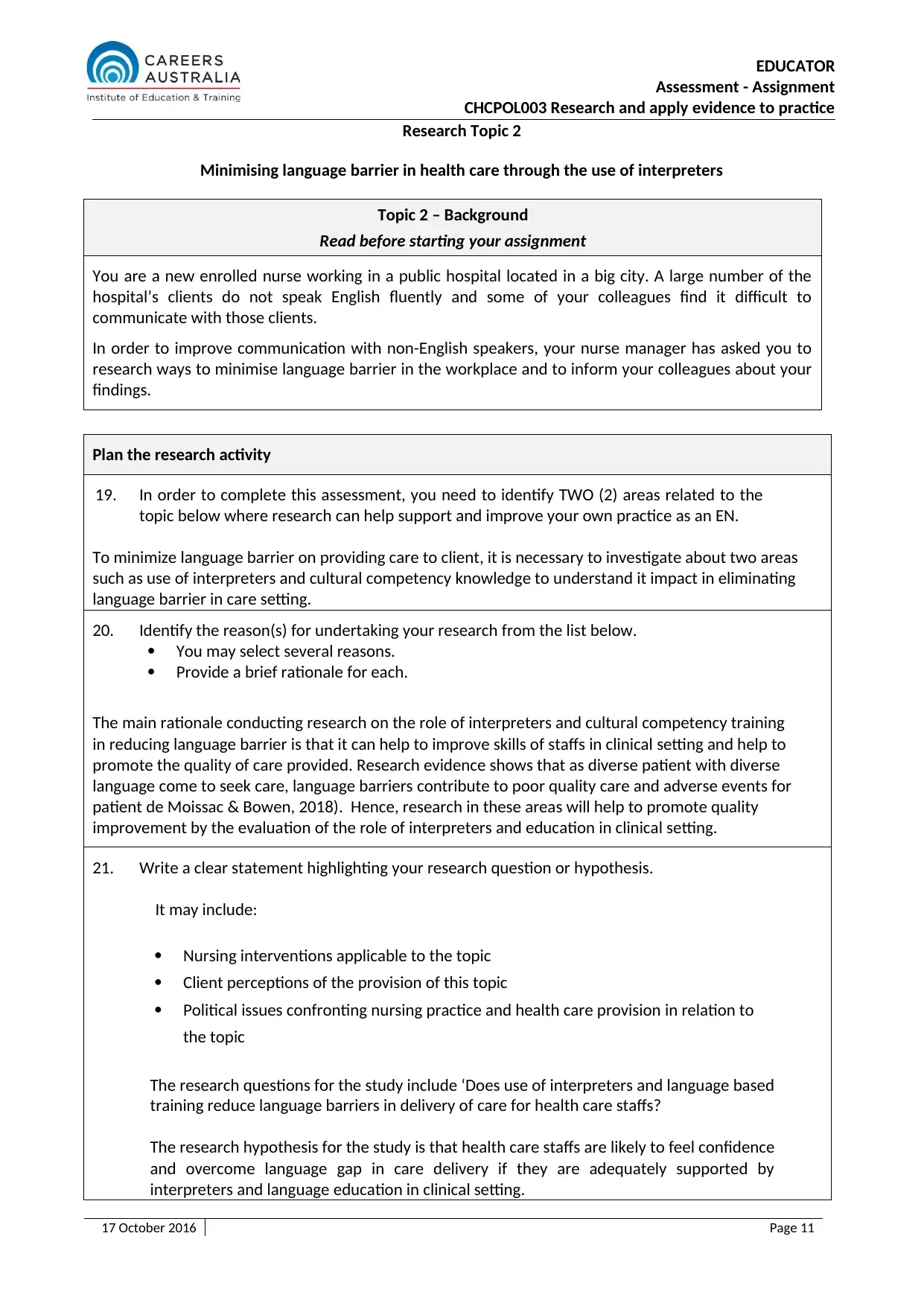
Research Topic 2
Minimising language barrier in health care through the use of interpreters
Topic 2 – Background
Read before starting your assignment
You are a new enrolled nurse working in a public hospital located in a big city. A large number of the
hospital’s clients do not speak English fluently and some of your colleagues find it difficult to
communicate with those clients.
In order to improve communication with non-English speakers, your nurse manager has asked you to
research ways to minimise language barrier in the workplace and to inform your colleagues about your
findings.
Plan the research activity
19. In order to complete this assessment, you need to identify TWO (2) areas related to the
topic below where research can help support and improve your own practice as an EN.
To minimize language barrier on providing care to client, it is necessary to investigate about two areas
such as use of interpreters and cultural competency knowledge to understand it impact in eliminating
language barrier in care setting.
20. Identify the reason(s) for undertaking your research from the list below.
You may select several reasons.
Provide a brief rationale for each.
The main rationale conducting research on the role of interpreters and cultural competency training
in reducing language barrier is that it can help to improve skills of staffs in clinical setting and help to
promote the quality of care provided. Research evidence shows that as diverse patient with diverse
language come to seek care, language barriers contribute to poor quality care and adverse events for
patient de Moissac & Bowen, 2018). Hence, research in these areas will help to promote quality
improvement by the evaluation of the role of interpreters and education in clinical setting.
21. Write a clear statement highlighting your research question or hypothesis.
It may include:
Nursing interventions applicable to the topic
Client perceptions of the provision of this topic
Political issues confronting nursing practice and health care provision in relation to
the topic
The research questions for the study include ‘Does use of interpreters and language based
training reduce language barriers in delivery of care for health care staffs?
The research hypothesis for the study is that health care staffs are likely to feel confidence
and overcome language gap in care delivery if they are adequately supported by
interpreters and language education in clinical setting.
17 October 2016 Page 11
Assessment - Assignment
CHCPOL003 Research and apply evidence to practice
Research Topic 2
Minimising language barrier in health care through the use of interpreters
Topic 2 – Background
Read before starting your assignment
You are a new enrolled nurse working in a public hospital located in a big city. A large number of the
hospital’s clients do not speak English fluently and some of your colleagues find it difficult to
communicate with those clients.
In order to improve communication with non-English speakers, your nurse manager has asked you to
research ways to minimise language barrier in the workplace and to inform your colleagues about your
findings.
Plan the research activity
19. In order to complete this assessment, you need to identify TWO (2) areas related to the
topic below where research can help support and improve your own practice as an EN.
To minimize language barrier on providing care to client, it is necessary to investigate about two areas
such as use of interpreters and cultural competency knowledge to understand it impact in eliminating
language barrier in care setting.
20. Identify the reason(s) for undertaking your research from the list below.
You may select several reasons.
Provide a brief rationale for each.
The main rationale conducting research on the role of interpreters and cultural competency training
in reducing language barrier is that it can help to improve skills of staffs in clinical setting and help to
promote the quality of care provided. Research evidence shows that as diverse patient with diverse
language come to seek care, language barriers contribute to poor quality care and adverse events for
patient de Moissac & Bowen, 2018). Hence, research in these areas will help to promote quality
improvement by the evaluation of the role of interpreters and education in clinical setting.
21. Write a clear statement highlighting your research question or hypothesis.
It may include:
Nursing interventions applicable to the topic
Client perceptions of the provision of this topic
Political issues confronting nursing practice and health care provision in relation to
the topic
The research questions for the study include ‘Does use of interpreters and language based
training reduce language barriers in delivery of care for health care staffs?
The research hypothesis for the study is that health care staffs are likely to feel confidence
and overcome language gap in care delivery if they are adequately supported by
interpreters and language education in clinical setting.
17 October 2016 Page 11
EDUCATOR
Assessment - Assignment
CHCPOL003 Research and apply evidence to practice
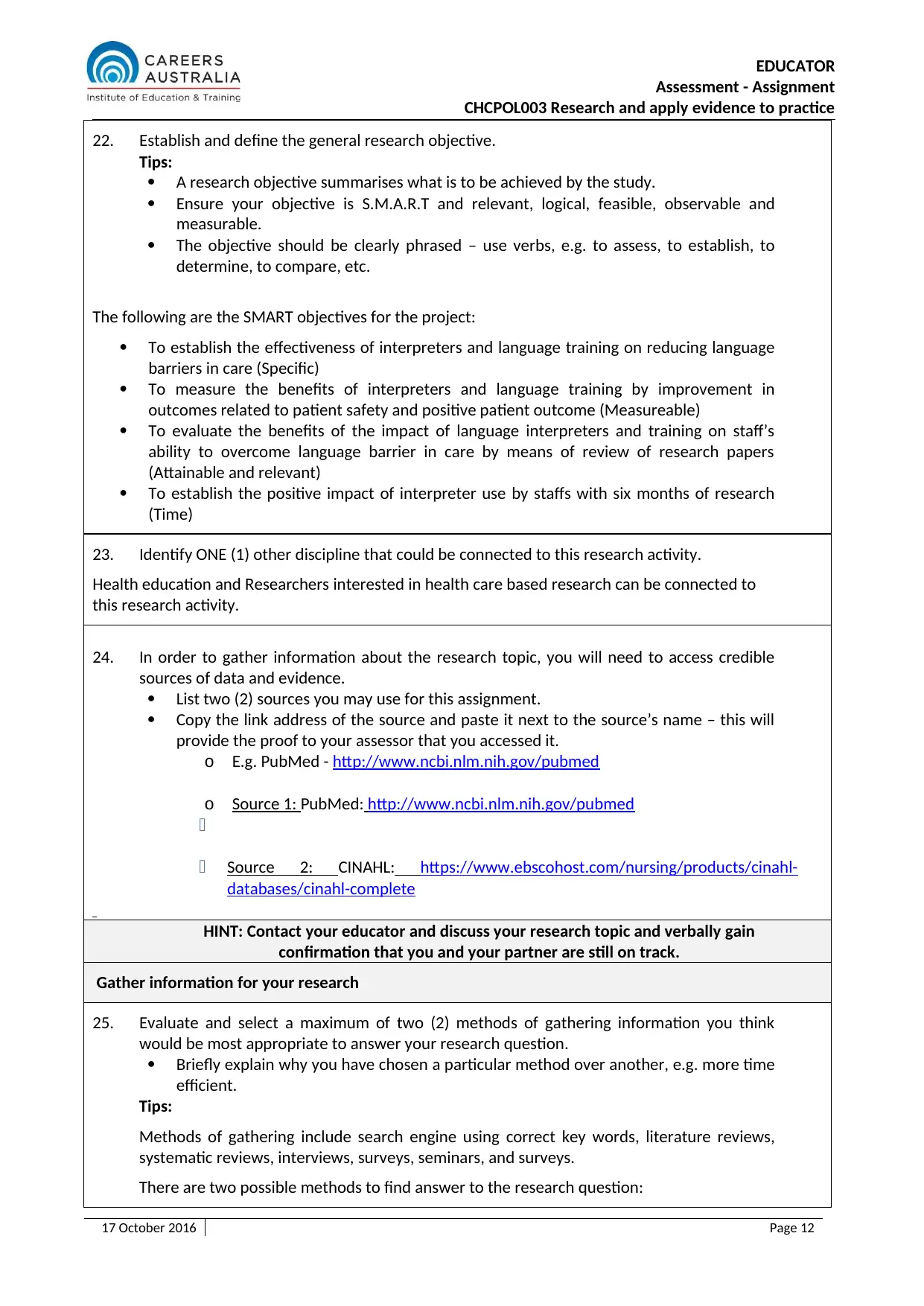
22. Establish and define the general research objective.
Tips:
A research objective summarises what is to be achieved by the study.
Ensure your objective is S.M.A.R.T and relevant, logical, feasible, observable and
measurable.
The objective should be clearly phrased – use verbs, e.g. to assess, to establish, to
determine, to compare, etc.
The following are the SMART objectives for the project:
To establish the effectiveness of interpreters and language training on reducing language
barriers in care (Specific)
To measure the benefits of interpreters and language training by improvement in
outcomes related to patient safety and positive patient outcome (Measureable)
To evaluate the benefits of the impact of language interpreters and training on staff’s
ability to overcome language barrier in care by means of review of research papers
(Attainable and relevant)
To establish the positive impact of interpreter use by staffs with six months of research
(Time)
23. Identify ONE (1) other discipline that could be connected to this research activity.
Health education and Researchers interested in health care based research can be connected to
this research activity.
24. In order to gather information about the research topic, you will need to access credible
sources of data and evidence.
List two (2) sources you may use for this assignment.
Copy the link address of the source and paste it next to the source’s name – this will
provide the proof to your assessor that you accessed it.
o E.g. PubMed - http://www.ncbi.nlm.nih.gov/pubmed
o Source 1: PubMed: http://www.ncbi.nlm.nih.gov/pubmed
Source 2: CINAHL: https://www.ebscohost.com/nursing/products/cinahl-
databases/cinahl-complete
HINT: Contact your educator and discuss your research topic and verbally gain
confirmation that you and your partner are still on track.
Gather information for your research
25. Evaluate and select a maximum of two (2) methods of gathering information you think
would be most appropriate to answer your research question.
Briefly explain why you have chosen a particular method over another, e.g. more time
efficient.
Tips:
Methods of gathering include search engine using correct key words, literature reviews,
systematic reviews, interviews, surveys, seminars, and surveys.
There are two possible methods to find answer to the research question:
17 October 2016 Page 12
Assessment - Assignment
CHCPOL003 Research and apply evidence to practice
22. Establish and define the general research objective.
Tips:
A research objective summarises what is to be achieved by the study.
Ensure your objective is S.M.A.R.T and relevant, logical, feasible, observable and
measurable.
The objective should be clearly phrased – use verbs, e.g. to assess, to establish, to
determine, to compare, etc.
The following are the SMART objectives for the project:
To establish the effectiveness of interpreters and language training on reducing language
barriers in care (Specific)
To measure the benefits of interpreters and language training by improvement in
outcomes related to patient safety and positive patient outcome (Measureable)
To evaluate the benefits of the impact of language interpreters and training on staff’s
ability to overcome language barrier in care by means of review of research papers
(Attainable and relevant)
To establish the positive impact of interpreter use by staffs with six months of research
(Time)
23. Identify ONE (1) other discipline that could be connected to this research activity.
Health education and Researchers interested in health care based research can be connected to
this research activity.
24. In order to gather information about the research topic, you will need to access credible
sources of data and evidence.
List two (2) sources you may use for this assignment.
Copy the link address of the source and paste it next to the source’s name – this will
provide the proof to your assessor that you accessed it.
o E.g. PubMed - http://www.ncbi.nlm.nih.gov/pubmed
o Source 1: PubMed: http://www.ncbi.nlm.nih.gov/pubmed
Source 2: CINAHL: https://www.ebscohost.com/nursing/products/cinahl-
databases/cinahl-complete
HINT: Contact your educator and discuss your research topic and verbally gain
confirmation that you and your partner are still on track.
Gather information for your research
25. Evaluate and select a maximum of two (2) methods of gathering information you think
would be most appropriate to answer your research question.
Briefly explain why you have chosen a particular method over another, e.g. more time
efficient.
Tips:
Methods of gathering include search engine using correct key words, literature reviews,
systematic reviews, interviews, surveys, seminars, and surveys.
There are two possible methods to find answer to the research question:
17 October 2016 Page 12
⊘ This is a preview!⊘
Do you want full access?
Subscribe today to unlock all pages.
Trusted by 1+ million students worldwide

1 out of 19


Related Documents


Your All-in-One AI-Powered Toolkit for Academic Success.
+13062052269
info@desklib.com
Available 24*7 on WhatsApp / Email
![[object Object]](/_next/static/media/star-bottom.7253800d.svg)
Unlock your academic potential
Copyright © 2020–2026 A2Z Services. All Rights Reserved. Developed and managed by ZUCOL.