CHCPRP001: Networks and Collaborative Partnerships Assignment Report
VerifiedAdded on 2023/06/08
|11
|3064
|286
Homework Assignment
AI Summary
This assignment solution for CHCPRP001, focusing on developing and maintaining networks and collaborative partnerships, addresses various aspects of collaboration. It explores different types of collaborative practices, including team and network collaboration, and methods for effective communication. The document examines identifying opportunities, the use of Gantt charts, and the differences between formal and informal meetings. It also covers first impressions, handling project conflicts, and ensuring confidentiality. Furthermore, the assignment analyzes record-keeping, ways to maintain relationships, and when to refer clients. The document also details legal and ethical considerations, principles of networking and collaboration, and examples of different network types. Finally, it discusses industry structure, existing networks, and the application of networking and collaboration in an aged care organization, including examples of external services.
CHCPRP001 Develop and
maintain networks and
collaborative partnerships
maintain networks and
collaborative partnerships

Paraphrase This Document
Need a fresh take? Get an instant paraphrase of this document with our AI Paraphraser
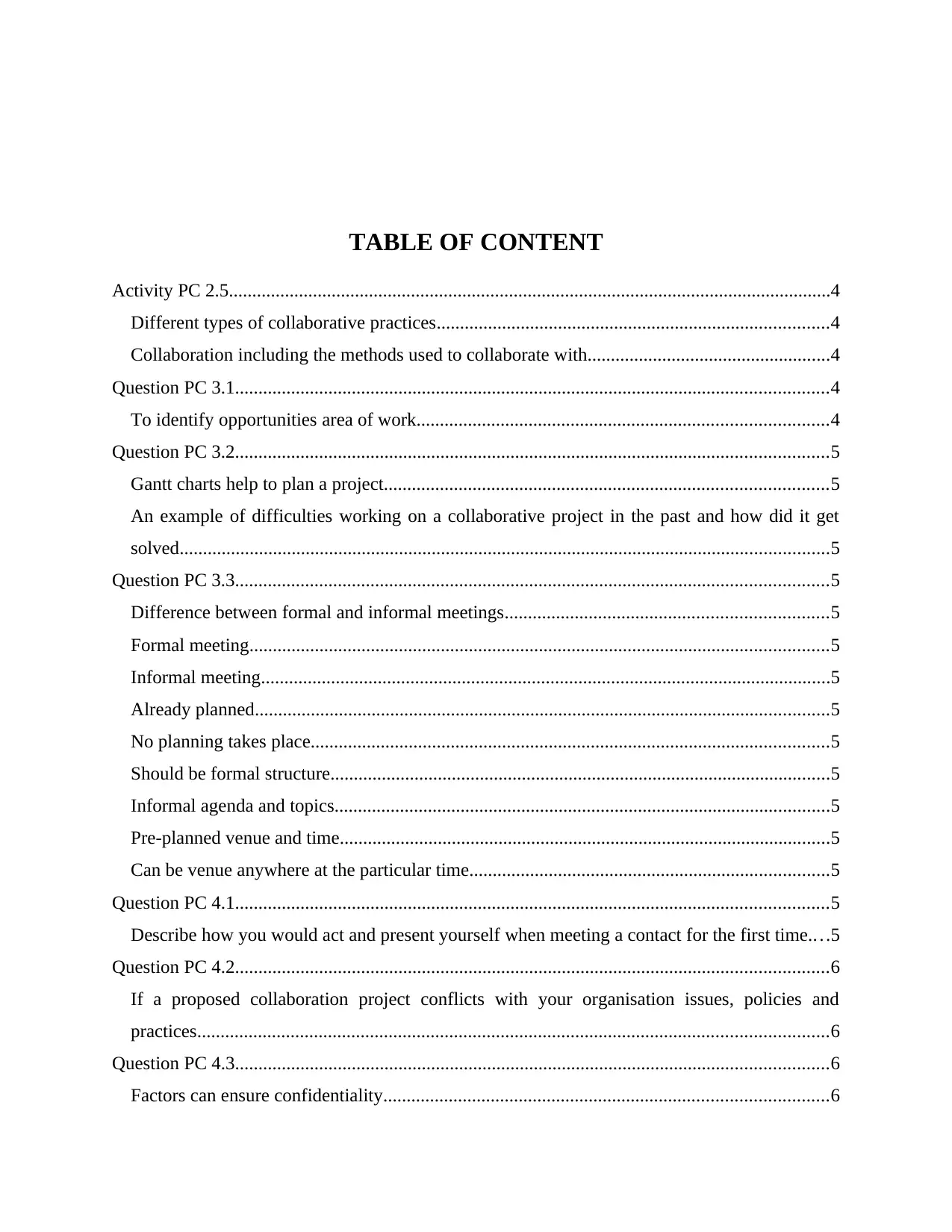
TABLE OF CONTENT
Activity PC 2.5.................................................................................................................................4
Different types of collaborative practices....................................................................................4
Collaboration including the methods used to collaborate with....................................................4
Question PC 3.1...............................................................................................................................4
To identify opportunities area of work........................................................................................4
Question PC 3.2...............................................................................................................................5
Gantt charts help to plan a project...............................................................................................5
An example of difficulties working on a collaborative project in the past and how did it get
solved...........................................................................................................................................5
Question PC 3.3...............................................................................................................................5
Difference between formal and informal meetings.....................................................................5
Formal meeting............................................................................................................................5
Informal meeting..........................................................................................................................5
Already planned...........................................................................................................................5
No planning takes place...............................................................................................................5
Should be formal structure...........................................................................................................5
Informal agenda and topics..........................................................................................................5
Pre-planned venue and time.........................................................................................................5
Can be venue anywhere at the particular time.............................................................................5
Question PC 4.1...............................................................................................................................5
Describe how you would act and present yourself when meeting a contact for the first time... .5
Question PC 4.2...............................................................................................................................6
If a proposed collaboration project conflicts with your organisation issues, policies and
practices.......................................................................................................................................6
Question PC 4.3...............................................................................................................................6
Factors can ensure confidentiality...............................................................................................6
Activity PC 2.5.................................................................................................................................4
Different types of collaborative practices....................................................................................4
Collaboration including the methods used to collaborate with....................................................4
Question PC 3.1...............................................................................................................................4
To identify opportunities area of work........................................................................................4
Question PC 3.2...............................................................................................................................5
Gantt charts help to plan a project...............................................................................................5
An example of difficulties working on a collaborative project in the past and how did it get
solved...........................................................................................................................................5
Question PC 3.3...............................................................................................................................5
Difference between formal and informal meetings.....................................................................5
Formal meeting............................................................................................................................5
Informal meeting..........................................................................................................................5
Already planned...........................................................................................................................5
No planning takes place...............................................................................................................5
Should be formal structure...........................................................................................................5
Informal agenda and topics..........................................................................................................5
Pre-planned venue and time.........................................................................................................5
Can be venue anywhere at the particular time.............................................................................5
Question PC 4.1...............................................................................................................................5
Describe how you would act and present yourself when meeting a contact for the first time... .5
Question PC 4.2...............................................................................................................................6
If a proposed collaboration project conflicts with your organisation issues, policies and
practices.......................................................................................................................................6
Question PC 4.3...............................................................................................................................6
Factors can ensure confidentiality...............................................................................................6
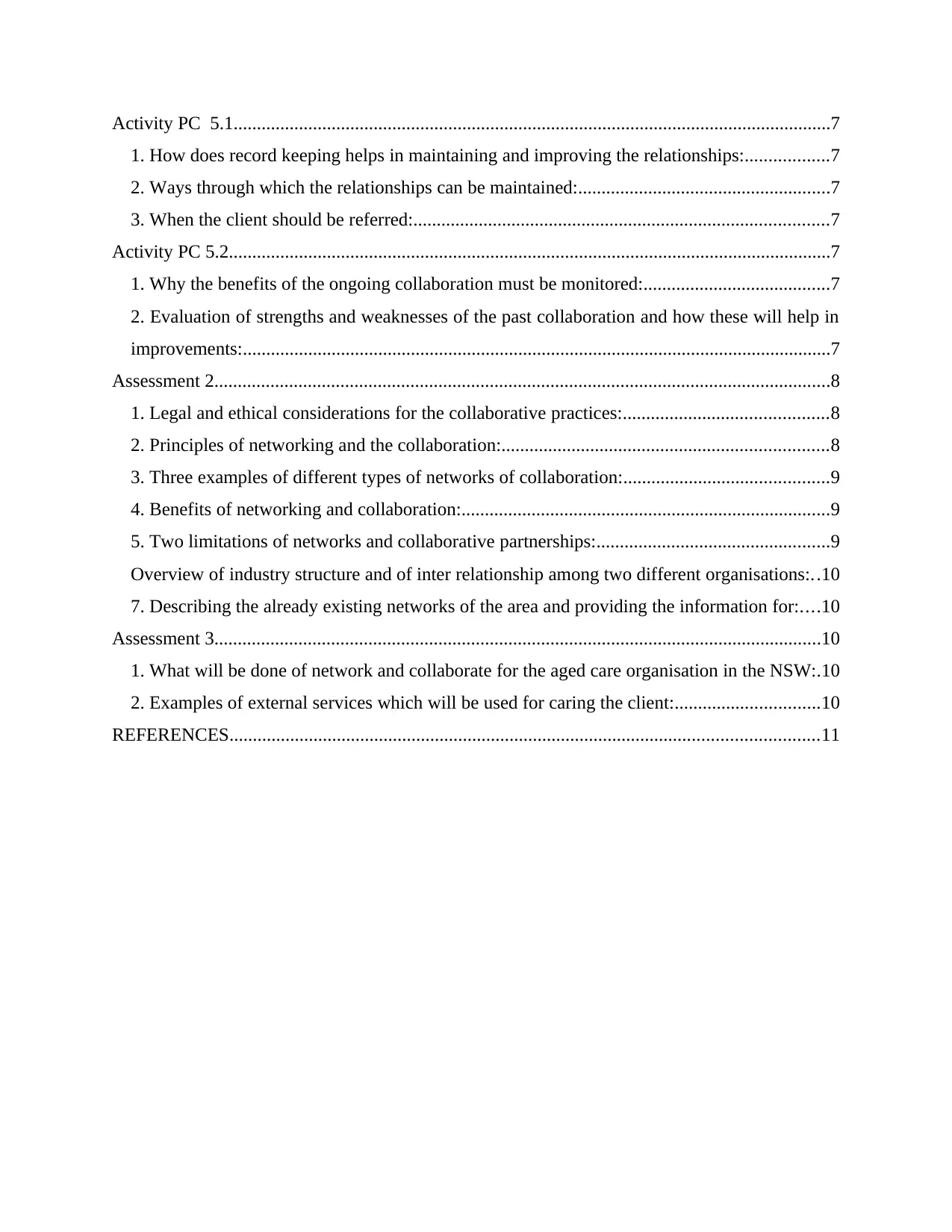
Activity PC 5.1................................................................................................................................7
1. How does record keeping helps in maintaining and improving the relationships:..................7
2. Ways through which the relationships can be maintained:......................................................7
3. When the client should be referred:.........................................................................................7
Activity PC 5.2.................................................................................................................................7
1. Why the benefits of the ongoing collaboration must be monitored:........................................7
2. Evaluation of strengths and weaknesses of the past collaboration and how these will help in
improvements:..............................................................................................................................7
Assessment 2....................................................................................................................................8
1. Legal and ethical considerations for the collaborative practices:............................................8
2. Principles of networking and the collaboration:......................................................................8
3. Three examples of different types of networks of collaboration:............................................9
4. Benefits of networking and collaboration:...............................................................................9
5. Two limitations of networks and collaborative partnerships:..................................................9
Overview of industry structure and of inter relationship among two different organisations:..10
7. Describing the already existing networks of the area and providing the information for:....10
Assessment 3..................................................................................................................................10
1. What will be done of network and collaborate for the aged care organisation in the NSW:.10
2. Examples of external services which will be used for caring the client:...............................10
REFERENCES..............................................................................................................................11
1. How does record keeping helps in maintaining and improving the relationships:..................7
2. Ways through which the relationships can be maintained:......................................................7
3. When the client should be referred:.........................................................................................7
Activity PC 5.2.................................................................................................................................7
1. Why the benefits of the ongoing collaboration must be monitored:........................................7
2. Evaluation of strengths and weaknesses of the past collaboration and how these will help in
improvements:..............................................................................................................................7
Assessment 2....................................................................................................................................8
1. Legal and ethical considerations for the collaborative practices:............................................8
2. Principles of networking and the collaboration:......................................................................8
3. Three examples of different types of networks of collaboration:............................................9
4. Benefits of networking and collaboration:...............................................................................9
5. Two limitations of networks and collaborative partnerships:..................................................9
Overview of industry structure and of inter relationship among two different organisations:..10
7. Describing the already existing networks of the area and providing the information for:....10
Assessment 3..................................................................................................................................10
1. What will be done of network and collaborate for the aged care organisation in the NSW:.10
2. Examples of external services which will be used for caring the client:...............................10
REFERENCES..............................................................................................................................11
⊘ This is a preview!⊘
Do you want full access?
Subscribe today to unlock all pages.

Trusted by 1+ million students worldwide
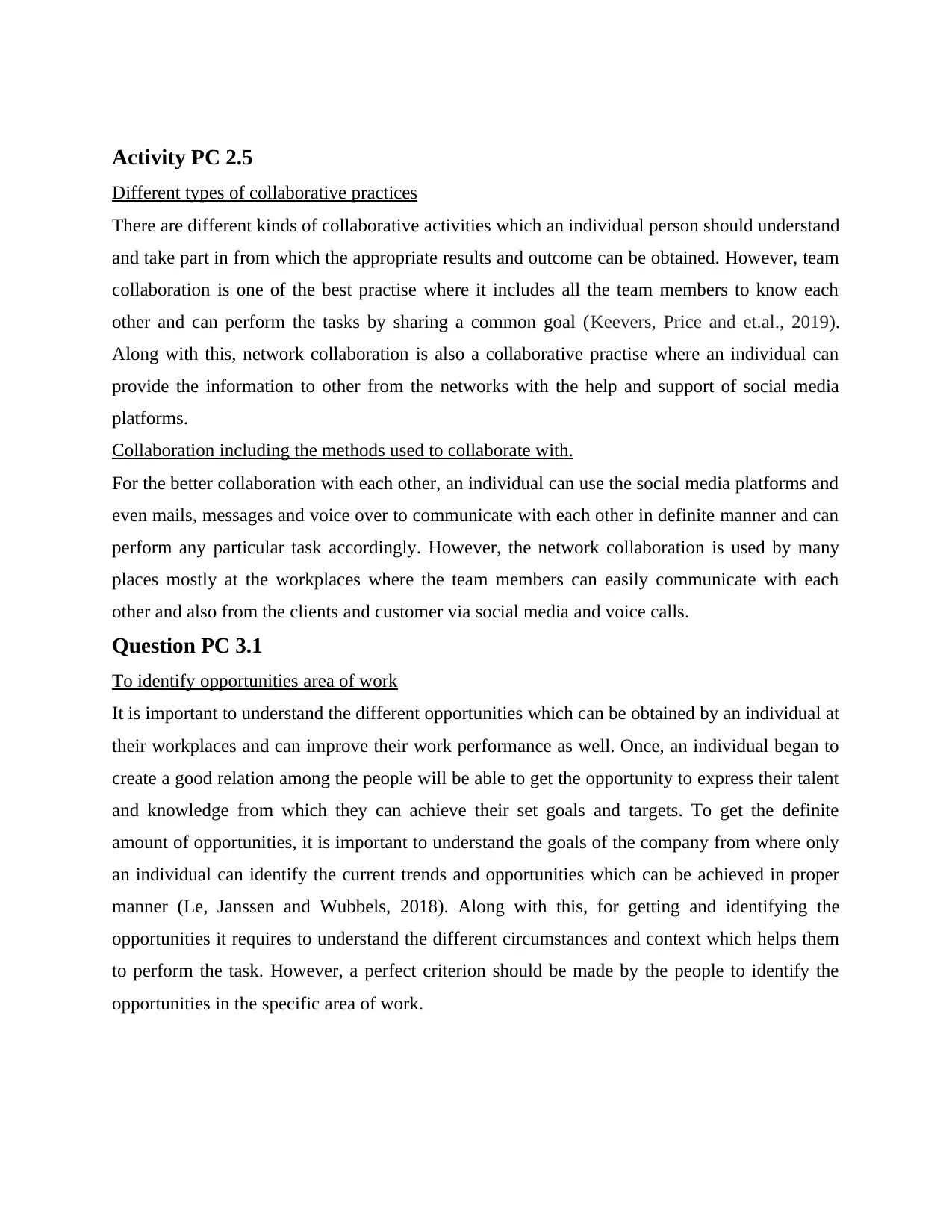
Activity PC 2.5
Different types of collaborative practices
There are different kinds of collaborative activities which an individual person should understand
and take part in from which the appropriate results and outcome can be obtained. However, team
collaboration is one of the best practise where it includes all the team members to know each
other and can perform the tasks by sharing a common goal (Keevers, Price and et.al., 2019).
Along with this, network collaboration is also a collaborative practise where an individual can
provide the information to other from the networks with the help and support of social media
platforms.
Collaboration including the methods used to collaborate with.
For the better collaboration with each other, an individual can use the social media platforms and
even mails, messages and voice over to communicate with each other in definite manner and can
perform any particular task accordingly. However, the network collaboration is used by many
places mostly at the workplaces where the team members can easily communicate with each
other and also from the clients and customer via social media and voice calls.
Question PC 3.1
To identify opportunities area of work
It is important to understand the different opportunities which can be obtained by an individual at
their workplaces and can improve their work performance as well. Once, an individual began to
create a good relation among the people will be able to get the opportunity to express their talent
and knowledge from which they can achieve their set goals and targets. To get the definite
amount of opportunities, it is important to understand the goals of the company from where only
an individual can identify the current trends and opportunities which can be achieved in proper
manner (Le, Janssen and Wubbels, 2018). Along with this, for getting and identifying the
opportunities it requires to understand the different circumstances and context which helps them
to perform the task. However, a perfect criterion should be made by the people to identify the
opportunities in the specific area of work.
Different types of collaborative practices
There are different kinds of collaborative activities which an individual person should understand
and take part in from which the appropriate results and outcome can be obtained. However, team
collaboration is one of the best practise where it includes all the team members to know each
other and can perform the tasks by sharing a common goal (Keevers, Price and et.al., 2019).
Along with this, network collaboration is also a collaborative practise where an individual can
provide the information to other from the networks with the help and support of social media
platforms.
Collaboration including the methods used to collaborate with.
For the better collaboration with each other, an individual can use the social media platforms and
even mails, messages and voice over to communicate with each other in definite manner and can
perform any particular task accordingly. However, the network collaboration is used by many
places mostly at the workplaces where the team members can easily communicate with each
other and also from the clients and customer via social media and voice calls.
Question PC 3.1
To identify opportunities area of work
It is important to understand the different opportunities which can be obtained by an individual at
their workplaces and can improve their work performance as well. Once, an individual began to
create a good relation among the people will be able to get the opportunity to express their talent
and knowledge from which they can achieve their set goals and targets. To get the definite
amount of opportunities, it is important to understand the goals of the company from where only
an individual can identify the current trends and opportunities which can be achieved in proper
manner (Le, Janssen and Wubbels, 2018). Along with this, for getting and identifying the
opportunities it requires to understand the different circumstances and context which helps them
to perform the task. However, a perfect criterion should be made by the people to identify the
opportunities in the specific area of work.
Paraphrase This Document
Need a fresh take? Get an instant paraphrase of this document with our AI Paraphraser
Question PC 3.2
Gantt charts help to plan a project
Gantt chart is used to analyse the difficult and complex projects with various tasks and can help
to manage the project with efficiency and effectiveness. This chart helps and motivate the team
members to collaborate on their projects and can make the proper planning. Also, it helps the
project teams to manage the tasks and also can allocate the roles and responsibilities to an
individual team member (Ricci and Fingon, 2018). It improves the productivity and supports the
resources planning of any particular project where the complex information can be managed.
An example of difficulties working on a collaborative project in the past and how did it get
solved
I want to share my work experience where I got difficulties in working on a collaborative project
in the past because of lack of leadership style and management. My leader has given me an
opportunity to do a collaborative project where me and my team members have individual
difference because our team leader never given us a chance to understand each other and interact
as well which creates difficulties for us to work on particular project. To overcome the issue, the
management has organised a well-structured training and development programs for the
employees where everyone can get engaged with each other. Along with this, our leader also get
the training session to improve their skills and abilities and encourage them to help the
employees to work collaboratively.
Question PC 3.3
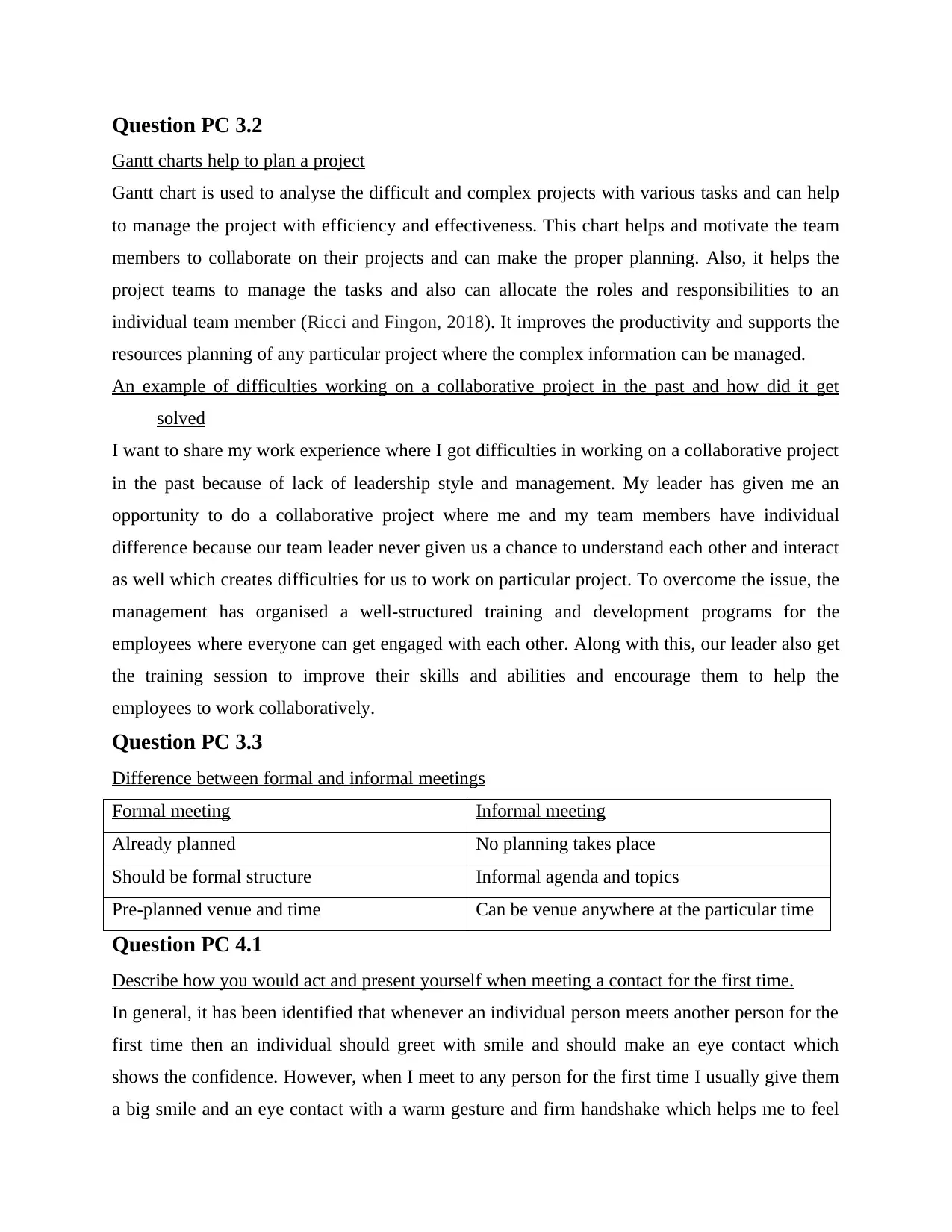
Difference between formal and informal meetings
Formal meeting Informal meeting
Already planned No planning takes place
Should be formal structure Informal agenda and topics
Pre-planned venue and time Can be venue anywhere at the particular time
Question PC 4.1
Describe how you would act and present yourself when meeting a contact for the first time.
In general, it has been identified that whenever an individual person meets another person for the
first time then an individual should greet with smile and should make an eye contact which
shows the confidence. However, when I meet to any person for the first time I usually give them
a big smile and an eye contact with a warm gesture and firm handshake which helps me to feel
Gantt charts help to plan a project
Gantt chart is used to analyse the difficult and complex projects with various tasks and can help
to manage the project with efficiency and effectiveness. This chart helps and motivate the team
members to collaborate on their projects and can make the proper planning. Also, it helps the
project teams to manage the tasks and also can allocate the roles and responsibilities to an
individual team member (Ricci and Fingon, 2018). It improves the productivity and supports the
resources planning of any particular project where the complex information can be managed.
An example of difficulties working on a collaborative project in the past and how did it get
solved
I want to share my work experience where I got difficulties in working on a collaborative project
in the past because of lack of leadership style and management. My leader has given me an
opportunity to do a collaborative project where me and my team members have individual
difference because our team leader never given us a chance to understand each other and interact
as well which creates difficulties for us to work on particular project. To overcome the issue, the
management has organised a well-structured training and development programs for the
employees where everyone can get engaged with each other. Along with this, our leader also get
the training session to improve their skills and abilities and encourage them to help the
employees to work collaboratively.
Question PC 3.3
Difference between formal and informal meetings
Formal meeting Informal meeting
Already planned No planning takes place
Should be formal structure Informal agenda and topics
Pre-planned venue and time Can be venue anywhere at the particular time
Question PC 4.1
Describe how you would act and present yourself when meeting a contact for the first time.
In general, it has been identified that whenever an individual person meets another person for the
first time then an individual should greet with smile and should make an eye contact which
shows the confidence. However, when I meet to any person for the first time I usually give them
a big smile and an eye contact with a warm gesture and firm handshake which helps me to feel
confident and encourage both of us. As, it has been known that first impression is the always a
last impression where the person creates an inner image of the individual.
Question PC 4.2
If a proposed collaboration project conflicts with your organisation issues, policies and practices
It has been evaluated that to work at any organisation, it is important to communicate with each
other in definite manner from which the successful outcome and collaborations can be obtained.
For the proper communication, it includes the rules, methods and a process enforced by the
company and can collaborate effectively (Wang, Weisz and et.al., 2019). However, whenever
networking with the people it is important to create a better communication with each other in
regard with following and practising the accurate policies and procedures made by the company.
The project conflicts can be resolved by communicating with individual member where the
meeting can be conducted which help the team members to share their views and issues related
to the project and can take the feedback which helps the management to work on it and can
deliver the appropriate result and outcome. Whenever, a proposed project conflicts with the
company policies and procedures they it is important to inform the people and team members
whom the collaboration is done and a suitable solution can b identified and can work on it
accordingly. The polices and procedures can be followed by using the appropriate
communication channels such as organisational website, staff newsletter, email and such more.
Question PC 4.3
Factors can ensure confidentiality
Confidentiality is required essential by law in certain areas of business. It is important to
maintain the privacy about the information and data of the company and also record of customer
data where if it is not maintained then it is a punishable act (Fernandes and O’Sullivan, 2022). It
includes the controlling and not sharing any confidential information, monitoring access to
records, not selling any data to another companies.
last impression where the person creates an inner image of the individual.
Question PC 4.2
If a proposed collaboration project conflicts with your organisation issues, policies and practices
It has been evaluated that to work at any organisation, it is important to communicate with each
other in definite manner from which the successful outcome and collaborations can be obtained.
For the proper communication, it includes the rules, methods and a process enforced by the
company and can collaborate effectively (Wang, Weisz and et.al., 2019). However, whenever
networking with the people it is important to create a better communication with each other in
regard with following and practising the accurate policies and procedures made by the company.
The project conflicts can be resolved by communicating with individual member where the
meeting can be conducted which help the team members to share their views and issues related
to the project and can take the feedback which helps the management to work on it and can
deliver the appropriate result and outcome. Whenever, a proposed project conflicts with the
company policies and procedures they it is important to inform the people and team members
whom the collaboration is done and a suitable solution can b identified and can work on it
accordingly. The polices and procedures can be followed by using the appropriate
communication channels such as organisational website, staff newsletter, email and such more.
Question PC 4.3
Factors can ensure confidentiality
Confidentiality is required essential by law in certain areas of business. It is important to
maintain the privacy about the information and data of the company and also record of customer
data where if it is not maintained then it is a punishable act (Fernandes and O’Sullivan, 2022). It
includes the controlling and not sharing any confidential information, monitoring access to
records, not selling any data to another companies.
⊘ This is a preview!⊘
Do you want full access?
Subscribe today to unlock all pages.
Trusted by 1+ million students worldwide
Activity PC 5.1
1. How does record keeping helps in maintaining and improving the relationships:
It usually encourages the creation of the accurate and complete records and this can be used
whenever it is required by the individual as proof. It also enables the individual for boosting the
sharing and collaboration among them.
2. Ways through which the relationships can be maintained:
Identifying the needs
Making time for others
Creating the healthy and meaningful bonds
Listening to others which paying full attention
3. When the client should be referred:
When the client is having diseases which cannot be cured within the same individual or the care
provider then in this case, the client has to be referred to another care taker.
Activity PC 5.2
1. Why the benefits of the ongoing collaboration must be monitored:
It is very important to keep eye on ongoing collaboration as this helps in leveraging the diverse
ideas, skills experience as well as views for solving the critical problem through providing the
solutions to it. These are to be monitored consistently as this helps in improving the
communication as well as creates the healthy environment across the organisation.
2. Evaluation of strengths and weaknesses of the past collaboration and how these will help in
improvements:
Performing the evaluation by understanding the strengths as well as the weaknesses helps the
individual to improve themselves. It enables them to track the changes within the nature as well
as what all different types of the collaboration members are there over the time period.
Strengths:
Effective division of the labour
Creates the greater input of the creativity
Improves the morale of employees
Weaknesses:
Creates the conflicts among the employees
1. How does record keeping helps in maintaining and improving the relationships:
It usually encourages the creation of the accurate and complete records and this can be used
whenever it is required by the individual as proof. It also enables the individual for boosting the
sharing and collaboration among them.
2. Ways through which the relationships can be maintained:
Identifying the needs
Making time for others
Creating the healthy and meaningful bonds
Listening to others which paying full attention
3. When the client should be referred:
When the client is having diseases which cannot be cured within the same individual or the care
provider then in this case, the client has to be referred to another care taker.
Activity PC 5.2
1. Why the benefits of the ongoing collaboration must be monitored:
It is very important to keep eye on ongoing collaboration as this helps in leveraging the diverse
ideas, skills experience as well as views for solving the critical problem through providing the
solutions to it. These are to be monitored consistently as this helps in improving the
communication as well as creates the healthy environment across the organisation.
2. Evaluation of strengths and weaknesses of the past collaboration and how these will help in
improvements:
Performing the evaluation by understanding the strengths as well as the weaknesses helps the
individual to improve themselves. It enables them to track the changes within the nature as well
as what all different types of the collaboration members are there over the time period.
Strengths:
Effective division of the labour
Creates the greater input of the creativity
Improves the morale of employees
Weaknesses:
Creates the conflicts among the employees
Paraphrase This Document
Need a fresh take? Get an instant paraphrase of this document with our AI Paraphraser
Lack of the trust and confidence among the employees
These weaknesses will help in improving by incorporating the effective practices which will help
them in eliminating the weaknesses.
Assessment 2
1. Legal and ethical considerations for the collaborative practices:
The ethical standards are basically based upon the human principles of the right as well as of the
wrong. There are various difference among these such as legal standards are usually based on the
written law and on the other hand, ethical standards are highly based upon the human rights and
the wrongs (Shaw, 2019). There are fie key values which are of collaboration as cooperation,
collegiality, fairness, accountability as well as of trust.
Legal standards can be defined as any of the statute, rule or code which involves decree of
municipal, court of appeals and many more. There are various laws which are farmed for the
collaborative practices and these are to be maintained within the collaboration.
2. Principles of networking and the collaboration:
There are various principles for the networking such as-
Principle 1: Understanding the users needs
Principle 2: Using the services for the protection of the data and not depending on the networks.
Principle 3: Designing for the interworking as well as the flexibility
Principles of the collaboration are such as-
Relationship management
Alignment of the vision as well as the values
Alignment of the objectives of business
Collaborative leadership
Governance and the process
Collaborative competence as well as the behaviour
Trust and the commitment to the mutual benefits
Value creation
Knowledge sharing as well as the information
Risk management
Measurement and the optimisation
These weaknesses will help in improving by incorporating the effective practices which will help
them in eliminating the weaknesses.
Assessment 2
1. Legal and ethical considerations for the collaborative practices:
The ethical standards are basically based upon the human principles of the right as well as of the
wrong. There are various difference among these such as legal standards are usually based on the
written law and on the other hand, ethical standards are highly based upon the human rights and
the wrongs (Shaw, 2019). There are fie key values which are of collaboration as cooperation,
collegiality, fairness, accountability as well as of trust.
Legal standards can be defined as any of the statute, rule or code which involves decree of
municipal, court of appeals and many more. There are various laws which are farmed for the
collaborative practices and these are to be maintained within the collaboration.
2. Principles of networking and the collaboration:
There are various principles for the networking such as-
Principle 1: Understanding the users needs
Principle 2: Using the services for the protection of the data and not depending on the networks.
Principle 3: Designing for the interworking as well as the flexibility
Principles of the collaboration are such as-
Relationship management
Alignment of the vision as well as the values
Alignment of the objectives of business
Collaborative leadership
Governance and the process
Collaborative competence as well as the behaviour
Trust and the commitment to the mutual benefits
Value creation
Knowledge sharing as well as the information
Risk management
Measurement and the optimisation
Exit strategies (Weber and Yuan, 2019.)
3. Three examples of different types of networks of collaboration:
The three types of the networks of the collaboration which can be used within the workplace are
such as
Team collaboration: For example the employees working remotely will be able to stay in touch
as well as with the office through the software for meeting and the communications.
Community Collaboration: Such as the partner agencies may effectively contribute to the
staffing, financial support, a meeting space and many more.
Network collaboration: For example, the bookmarking websites will help in finding it and then
finding the social bookmarking tool.
4. Benefits of networking and collaboration:
There are number of the benefits of networking such as-
Improves the business connections
Getting the innovative ideas
Improving the profile
Advancement of the career
Gaining more knowledge
The benefits of collaboration are-
Promotes the problem solving
Enables the employees to learn from each other
Improves the overall productivity (Hiele and et.al., 2019)
5. Two limitations of networks and collaborative partnerships:
Limitations of networks
Highly expensive method
More security difficulties
Limitations of collaborative networks
Competition among partnerships
Resistance to the change
3. Three examples of different types of networks of collaboration:
The three types of the networks of the collaboration which can be used within the workplace are
such as
Team collaboration: For example the employees working remotely will be able to stay in touch
as well as with the office through the software for meeting and the communications.
Community Collaboration: Such as the partner agencies may effectively contribute to the
staffing, financial support, a meeting space and many more.
Network collaboration: For example, the bookmarking websites will help in finding it and then
finding the social bookmarking tool.
4. Benefits of networking and collaboration:
There are number of the benefits of networking such as-
Improves the business connections
Getting the innovative ideas
Improving the profile
Advancement of the career
Gaining more knowledge
The benefits of collaboration are-
Promotes the problem solving
Enables the employees to learn from each other
Improves the overall productivity (Hiele and et.al., 2019)
5. Two limitations of networks and collaborative partnerships:
Limitations of networks
Highly expensive method
More security difficulties
Limitations of collaborative networks
Competition among partnerships
Resistance to the change
⊘ This is a preview!⊘
Do you want full access?
Subscribe today to unlock all pages.
Trusted by 1+ million students worldwide
Overview of industry structure and of inter relationship among two different organisations:
Siemens is basically the power house company which is highly focusing on the areas such as
electrification, automation as well as the digitalisation. The company is having two tier
management as well as the oversight structured is comprised of the Managing Board and of the
Supervisory Board that is two tier board structure (Franchi, Poggi and Tomaiuolo, 2020).
7. Describing the already existing networks of the area and providing the information for:
Structure: The communication as well as the information business arm of the German Industrial
conglomerate Siemens AG.
Key stakeholders: Investors, customers, suppliers, business partners, civil society and so on.
Vision and purpose: The company's vision is We make real what matters and main purpose is
for creation of high performing technology for changing the world.
Opportunities for participation: Participation within this company will enable the individual to
grow and excel within its overall career path by learning new skills ans gaining knowledge.
Assessment 3
1. What will be done of network and collaborate for the aged care organisation in the NSW:
It is very important to build the effective network and collaborations as this will help them in
taking the effective care of the aged care people within these organisations. This will be done by
performing the overall principles of the collaboration (Ahmad).
2. Examples of external services which will be used for caring the client:
The external services will have to be provided while taking care to the client as this will help
them in improving the health of the clients. This will include the services such as the bringing of
the products which will be required to take care and many such external services.
REFERENCES
Books and journals
Ahmad, F., The Role of Managers in Networking to Achieve Organizational Goals.
Siemens is basically the power house company which is highly focusing on the areas such as
electrification, automation as well as the digitalisation. The company is having two tier
management as well as the oversight structured is comprised of the Managing Board and of the
Supervisory Board that is two tier board structure (Franchi, Poggi and Tomaiuolo, 2020).
7. Describing the already existing networks of the area and providing the information for:
Structure: The communication as well as the information business arm of the German Industrial
conglomerate Siemens AG.
Key stakeholders: Investors, customers, suppliers, business partners, civil society and so on.
Vision and purpose: The company's vision is We make real what matters and main purpose is
for creation of high performing technology for changing the world.
Opportunities for participation: Participation within this company will enable the individual to
grow and excel within its overall career path by learning new skills ans gaining knowledge.
Assessment 3
1. What will be done of network and collaborate for the aged care organisation in the NSW:
It is very important to build the effective network and collaborations as this will help them in
taking the effective care of the aged care people within these organisations. This will be done by
performing the overall principles of the collaboration (Ahmad).
2. Examples of external services which will be used for caring the client:
The external services will have to be provided while taking care to the client as this will help
them in improving the health of the clients. This will include the services such as the bringing of
the products which will be required to take care and many such external services.
REFERENCES
Books and journals
Ahmad, F., The Role of Managers in Networking to Achieve Organizational Goals.
Paraphrase This Document
Need a fresh take? Get an instant paraphrase of this document with our AI Paraphraser
Fernandes, G. and O’Sullivan, D., 2022. Project management practices in major university-
industry R&D collaboration programs–a case study. The Journal of Technology
Transfer, pp.1-31.
Franchi, E., Poggi, A. and Tomaiuolo, M., 2020. Social media for online collaboration in firms
and organizations. In Information Diffusion Management and Knowledge Sharing:
Breakthroughs in Research and Practice (pp. 473-489). IGI Global.
Hiele, T.M., and et.al., 2019. Investigating students’ collaborative work to continue to use the
social networking site. International Journal of Advanced Trends in Computer Science
and Engineering, 8(1.5 Special Issue), pp.375-386.
Keevers, L.M., Price, and et.al., 2019. Practices to improve collaboration by reconfiguring
boundaries in transnational education. Journal of University Teaching & Learning
Practice, 16(2), p.11.
Le, H., Janssen, J. and Wubbels, T., 2018. Collaborative learning practices: teacher and student
perceived obstacles to effective student collaboration. Cambridge Journal of
Education, 48(1), pp.103-122.
Ricci, L.A. and Fingon, J., 2018. Experiences and Perceptions of University Students and
General and Special Educator Teacher Preparation Faculty Engaged in Collaboration
and Co-Teaching Practices. Networks: An Online Journal for Teacher Research, 20(2),
p.n2.
Shaw, I.F., 2019. Research networking and collaboration: a case study. Qualitative
Inquiry, 25(9-10), pp.1128-1136.
Wang, D., Weisz, and et.al., 2019. Human-AI collaboration in data science: Exploring data
scientists' perceptions of automated AI. Proceedings of the ACM on Human-Computer
Interaction, 3(CSCW), pp.1-24.
Weber, G.M. and Yuan, L.A., 2019. The power of research networking systems to find experts
and facilitate collaboration. In Strategies for Team Science Success (pp. 541-562).
Springer, Cham.
industry R&D collaboration programs–a case study. The Journal of Technology
Transfer, pp.1-31.
Franchi, E., Poggi, A. and Tomaiuolo, M., 2020. Social media for online collaboration in firms
and organizations. In Information Diffusion Management and Knowledge Sharing:
Breakthroughs in Research and Practice (pp. 473-489). IGI Global.
Hiele, T.M., and et.al., 2019. Investigating students’ collaborative work to continue to use the
social networking site. International Journal of Advanced Trends in Computer Science
and Engineering, 8(1.5 Special Issue), pp.375-386.
Keevers, L.M., Price, and et.al., 2019. Practices to improve collaboration by reconfiguring
boundaries in transnational education. Journal of University Teaching & Learning
Practice, 16(2), p.11.
Le, H., Janssen, J. and Wubbels, T., 2018. Collaborative learning practices: teacher and student
perceived obstacles to effective student collaboration. Cambridge Journal of
Education, 48(1), pp.103-122.
Ricci, L.A. and Fingon, J., 2018. Experiences and Perceptions of University Students and
General and Special Educator Teacher Preparation Faculty Engaged in Collaboration
and Co-Teaching Practices. Networks: An Online Journal for Teacher Research, 20(2),
p.n2.
Shaw, I.F., 2019. Research networking and collaboration: a case study. Qualitative
Inquiry, 25(9-10), pp.1128-1136.
Wang, D., Weisz, and et.al., 2019. Human-AI collaboration in data science: Exploring data
scientists' perceptions of automated AI. Proceedings of the ACM on Human-Computer
Interaction, 3(CSCW), pp.1-24.
Weber, G.M. and Yuan, L.A., 2019. The power of research networking systems to find experts
and facilitate collaboration. In Strategies for Team Science Success (pp. 541-562).
Springer, Cham.

1 out of 11


Related Documents


Your All-in-One AI-Powered Toolkit for Academic Success.
+13062052269
info@desklib.com
Available 24*7 on WhatsApp / Email
![[object Object]](/_next/static/media/star-bottom.7253800d.svg)
Unlock your academic potential
Copyright © 2020–2026 A2Z Services. All Rights Reserved. Developed and managed by ZUCOL.