Critical Analysis of Check-ins Replacing Annual Performance Appraisal
VerifiedAdded on 2023/05/30
|9
|2332
|419
Essay
AI Summary
This essay provides a critical analysis of the shift from traditional annual performance appraisals to more frequent check-ins in organizations. It examines the rationale behind this change, driven by the need for more dynamic feedback and flexibility in goal management. The essay evaluates the strengths and weaknesses of both approaches, highlighting the stress associated with annual appraisals and the potential benefits of regular check-ins for employee motivation and performance. It also addresses challenges in performance appraisal, such as evaluation errors and resistance, supporting the argument for implementing check-ins. The analysis concludes that while check-ins offer a promising alternative, a balanced approach that integrates elements of both systems may be the most effective way to manage and improve employee performance.
CRITICAL ANALYSIS OF REPLACING ANNUAL
PERFORMANCE APPRAISAL PROCESS WITH
CHECK-INS: CASE OF THROWING THE BABY WITH THE
BATH WATER
PERFORMANCE APPRAISAL PROCESS WITH
CHECK-INS: CASE OF THROWING THE BABY WITH THE
BATH WATER

Paraphrase This Document
Need a fresh take? Get an instant paraphrase of this document with our AI Paraphraser
Critical Evaluation
Information presented in the article regarding the appraisal process that is generally utilised
by the organisation is worth discussing because of the urgency in the current situation. In
current time is quite relevant as because motivating of employees in an organisation is
deemed to be one of the most important aspects to be considered for the future elevation of
Business Development graph. A general specification that relates to the understanding of
stack ranking and forced ranking system are well evaluated and critically processed in the
article. Your article is discussing the importance regarding the relevant topic of replacing
annual performance appraisal with chickens in organisations. The topic heading of the article
present says that the organisation is throwing their employees who are considered to be their
babies in bath water (metaphorical way). The article has discussed clear information related
to the evidence that is needed in order to understand the requirement for implementing check-
ins rather than annual performance report. The dynamic information that arises due to the
ever-changing business environment in society is taken into consideration in the article to
evaluate every slight change that happens to be demanding the appraisal system to be
changed.
The articles discuss regarding the changes in the performance appraisal system by Adobe in
2012 is still a hot topic in terms of understanding the requirement for knowing the exact way
to appraise the employees in the organisation to make them feel motivated (Liu, Gong, Zhou
& Huang, 2017). This form of changes in the performance appraisal system was then
followed by Microsoft and Accenture as mentioned in the article. With the clear change of
mentality from annually to weekly is quite dramatic in its own way.
The article says that performance appraisal time is a time of stress for the managers and
employees of an organisation as because of every other operation in the organisation that the
actual stop. This aspect of the performance appraisal system is quite genuine and evidently
Information presented in the article regarding the appraisal process that is generally utilised
by the organisation is worth discussing because of the urgency in the current situation. In
current time is quite relevant as because motivating of employees in an organisation is
deemed to be one of the most important aspects to be considered for the future elevation of
Business Development graph. A general specification that relates to the understanding of
stack ranking and forced ranking system are well evaluated and critically processed in the
article. Your article is discussing the importance regarding the relevant topic of replacing
annual performance appraisal with chickens in organisations. The topic heading of the article
present says that the organisation is throwing their employees who are considered to be their
babies in bath water (metaphorical way). The article has discussed clear information related
to the evidence that is needed in order to understand the requirement for implementing check-
ins rather than annual performance report. The dynamic information that arises due to the
ever-changing business environment in society is taken into consideration in the article to
evaluate every slight change that happens to be demanding the appraisal system to be
changed.
The articles discuss regarding the changes in the performance appraisal system by Adobe in
2012 is still a hot topic in terms of understanding the requirement for knowing the exact way
to appraise the employees in the organisation to make them feel motivated (Liu, Gong, Zhou
& Huang, 2017). This form of changes in the performance appraisal system was then
followed by Microsoft and Accenture as mentioned in the article. With the clear change of
mentality from annually to weekly is quite dramatic in its own way.
The article says that performance appraisal time is a time of stress for the managers and
employees of an organisation as because of every other operation in the organisation that the
actual stop. This aspect of the performance appraisal system is quite genuine and evidently
discussed in the article. To know that the performance appraisal system is time taking option
to analyse the performance of the employees and overly. Performance appraisal system
requires changes and personal evaluation to critically justify every work done by the
employees within the organisation for the last financial year. It is therefore quite justifiable to
say as said in the article regarding the stress of the managers and the employees. As
considered by Cappelli & Tavis (2016), the performance appraisal system is quite stressful
and a part of the fraction when it comes to the mental stress management of the employees
and the manager of the organisation
The article has positively undertaken the analysis of performance appraisal system to their
very own depth and has made us clear regarding the small bits of problems that the traditional
performance appraisal process has. The clear and distinctive aspect of this article is related to
the understanding of the situation where an employee is not able to make the benchmark
which leads to the situation where the organisation mark them as the one who has not met
with the expected. Such kind of situation as discussed in the article demotivates employees in
the organisation and it is completely viable to support. As supported by Levy, Tseng, Rosen
& Lueke (2017), Performance appraisal in front of every other worker in an organisation has
both a positive and negative impact. The figures that the employee presents in front of the
manager in an organisation are this basic calculation done by the managers after the
evaluation of the whole financial year of work by the single employee. Such an act according
to me is quite a time taking as justified by the article and also leading towards a situation
where the calculation might lead to dissatisfaction of wrong evaluation.
When clearly discussing the information presented in the article related to the importance of
performance appraisal be observed that it is described as a measurement tool identification
option and observing expect that must be kept in mind in order to evaluate the changes that
are required in an organisation. With a very clear answer, we can justify that the article has
to analyse the performance of the employees and overly. Performance appraisal system
requires changes and personal evaluation to critically justify every work done by the
employees within the organisation for the last financial year. It is therefore quite justifiable to
say as said in the article regarding the stress of the managers and the employees. As
considered by Cappelli & Tavis (2016), the performance appraisal system is quite stressful
and a part of the fraction when it comes to the mental stress management of the employees
and the manager of the organisation
The article has positively undertaken the analysis of performance appraisal system to their
very own depth and has made us clear regarding the small bits of problems that the traditional
performance appraisal process has. The clear and distinctive aspect of this article is related to
the understanding of the situation where an employee is not able to make the benchmark
which leads to the situation where the organisation mark them as the one who has not met
with the expected. Such kind of situation as discussed in the article demotivates employees in
the organisation and it is completely viable to support. As supported by Levy, Tseng, Rosen
& Lueke (2017), Performance appraisal in front of every other worker in an organisation has
both a positive and negative impact. The figures that the employee presents in front of the
manager in an organisation are this basic calculation done by the managers after the
evaluation of the whole financial year of work by the single employee. Such an act according
to me is quite a time taking as justified by the article and also leading towards a situation
where the calculation might lead to dissatisfaction of wrong evaluation.
When clearly discussing the information presented in the article related to the importance of
performance appraisal be observed that it is described as a measurement tool identification
option and observing expect that must be kept in mind in order to evaluate the changes that
are required in an organisation. With a very clear answer, we can justify that the article has
⊘ This is a preview!⊘
Do you want full access?
Subscribe today to unlock all pages.

Trusted by 1+ million students worldwide
presented the knowledge of performance appraisal system clearly and positively. However,
on analysing the case scenario it can be going otherwise as the matter of measuring is not
actually clear in terms of performance appraisal. The answer or the results come on an annual
basis that is exactly a wide stance and every action cannot be judged in a single day for
overall past year (Williams & Beck, 2018). Therefore we can justify that the effect of
performance appraisal some work not in a position to be declared as the most reliable source
of the performance appraisal system.
There is a complete agreement With the discussion that the performance appraisal process is
a constitution of performance review, potential review and reward review (Malcolm and
Jackson 2003). When considering the aspect of performance appraisal process the evaluation
of the system is quite justifiable and it can be said that the information gathered by
performance appraisal system in its most traditional format is worth mentioning in evaluating
the core competencies of the employees. However, on the other hand, the time profit and the
reliability state is not always available in terms of the traditional performance appraisal
process.
The importance of performance appraisal system over check-ins can be created when
discussing the benefits provided to the manager, employees and the organisation. As
indicated by Mueller-Hanson & Pulakos (2015), performance appraisal system provides
effective reward decision that helps in ensuring that the organisation and workforce have the
lowest amount of employee turnover rate. On discussing the benefit that the manager in the
organisation received while practising the performance appraisal system on yearly basis we
observe that the opportunities for formally recognising the hard working employees get
easier. However, on considering the recognition of employees in accordance to a single you
expect within a day is quite stressful and may lead to bios answers that would certainly
on analysing the case scenario it can be going otherwise as the matter of measuring is not
actually clear in terms of performance appraisal. The answer or the results come on an annual
basis that is exactly a wide stance and every action cannot be judged in a single day for
overall past year (Williams & Beck, 2018). Therefore we can justify that the effect of
performance appraisal some work not in a position to be declared as the most reliable source
of the performance appraisal system.
There is a complete agreement With the discussion that the performance appraisal process is
a constitution of performance review, potential review and reward review (Malcolm and
Jackson 2003). When considering the aspect of performance appraisal process the evaluation
of the system is quite justifiable and it can be said that the information gathered by
performance appraisal system in its most traditional format is worth mentioning in evaluating
the core competencies of the employees. However, on the other hand, the time profit and the
reliability state is not always available in terms of the traditional performance appraisal
process.
The importance of performance appraisal system over check-ins can be created when
discussing the benefits provided to the manager, employees and the organisation. As
indicated by Mueller-Hanson & Pulakos (2015), performance appraisal system provides
effective reward decision that helps in ensuring that the organisation and workforce have the
lowest amount of employee turnover rate. On discussing the benefit that the manager in the
organisation received while practising the performance appraisal system on yearly basis we
observe that the opportunities for formally recognising the hard working employees get
easier. However, on considering the recognition of employees in accordance to a single you
expect within a day is quite stressful and may lead to bios answers that would certainly
Paraphrase This Document
Need a fresh take? Get an instant paraphrase of this document with our AI Paraphraser
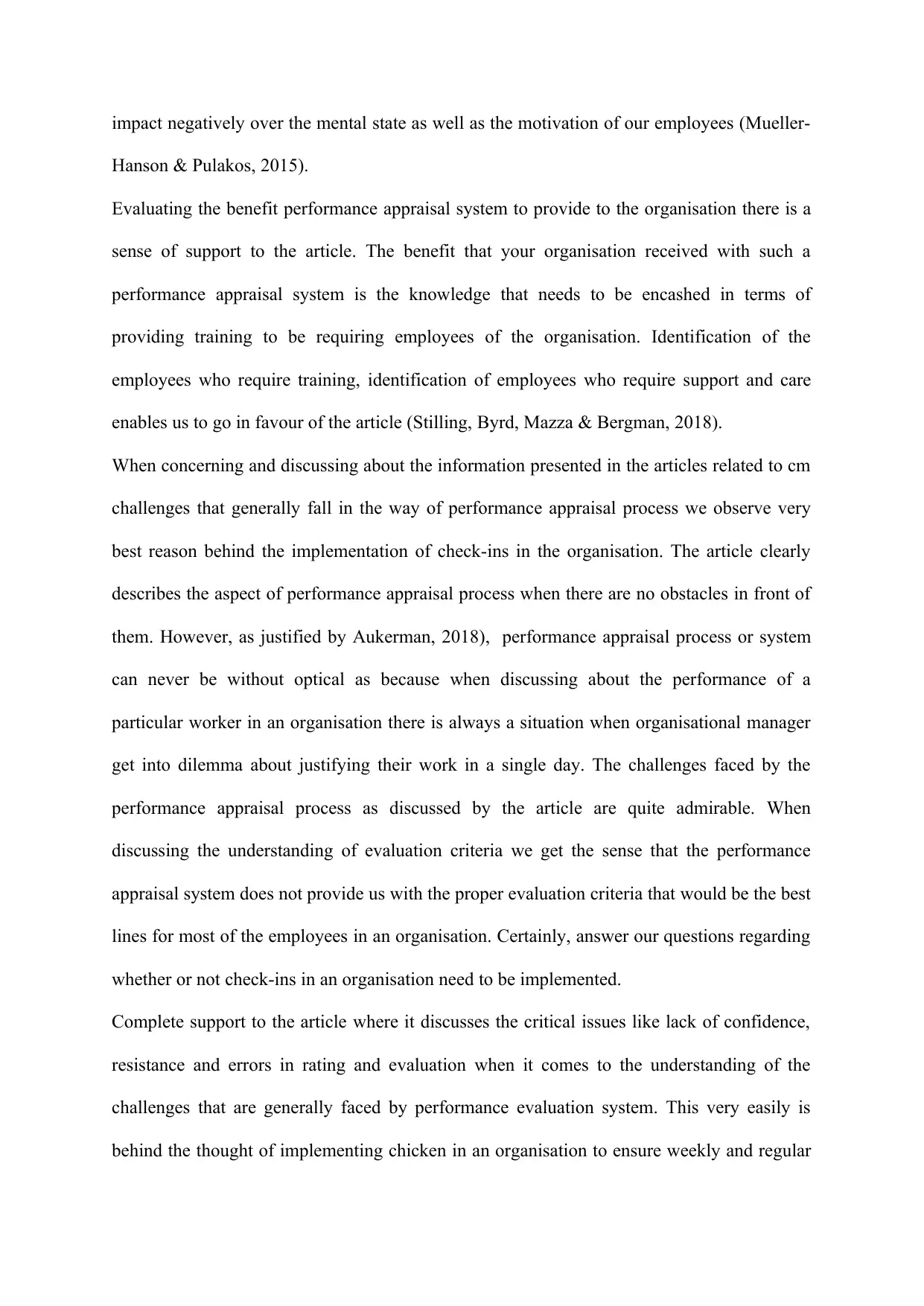
impact negatively over the mental state as well as the motivation of our employees (Mueller-
Hanson & Pulakos, 2015).
Evaluating the benefit performance appraisal system to provide to the organisation there is a
sense of support to the article. The benefit that your organisation received with such a
performance appraisal system is the knowledge that needs to be encashed in terms of
providing training to be requiring employees of the organisation. Identification of the
employees who require training, identification of employees who require support and care
enables us to go in favour of the article (Stilling, Byrd, Mazza & Bergman, 2018).
When concerning and discussing about the information presented in the articles related to cm
challenges that generally fall in the way of performance appraisal process we observe very
best reason behind the implementation of check-ins in the organisation. The article clearly
describes the aspect of performance appraisal process when there are no obstacles in front of
them. However, as justified by Aukerman, 2018), performance appraisal process or system
can never be without optical as because when discussing about the performance of a
particular worker in an organisation there is always a situation when organisational manager
get into dilemma about justifying their work in a single day. The challenges faced by the
performance appraisal process as discussed by the article are quite admirable. When
discussing the understanding of evaluation criteria we get the sense that the performance
appraisal system does not provide us with the proper evaluation criteria that would be the best
lines for most of the employees in an organisation. Certainly, answer our questions regarding
whether or not check-ins in an organisation need to be implemented.
Complete support to the article where it discusses the critical issues like lack of confidence,
resistance and errors in rating and evaluation when it comes to the understanding of the
challenges that are generally faced by performance evaluation system. This very easily is
behind the thought of implementing chicken in an organisation to ensure weekly and regular
Hanson & Pulakos, 2015).
Evaluating the benefit performance appraisal system to provide to the organisation there is a
sense of support to the article. The benefit that your organisation received with such a
performance appraisal system is the knowledge that needs to be encashed in terms of
providing training to be requiring employees of the organisation. Identification of the
employees who require training, identification of employees who require support and care
enables us to go in favour of the article (Stilling, Byrd, Mazza & Bergman, 2018).
When concerning and discussing about the information presented in the articles related to cm
challenges that generally fall in the way of performance appraisal process we observe very
best reason behind the implementation of check-ins in the organisation. The article clearly
describes the aspect of performance appraisal process when there are no obstacles in front of
them. However, as justified by Aukerman, 2018), performance appraisal process or system
can never be without optical as because when discussing about the performance of a
particular worker in an organisation there is always a situation when organisational manager
get into dilemma about justifying their work in a single day. The challenges faced by the
performance appraisal process as discussed by the article are quite admirable. When
discussing the understanding of evaluation criteria we get the sense that the performance
appraisal system does not provide us with the proper evaluation criteria that would be the best
lines for most of the employees in an organisation. Certainly, answer our questions regarding
whether or not check-ins in an organisation need to be implemented.
Complete support to the article where it discusses the critical issues like lack of confidence,
resistance and errors in rating and evaluation when it comes to the understanding of the
challenges that are generally faced by performance evaluation system. This very easily is
behind the thought of implementing chicken in an organisation to ensure weekly and regular
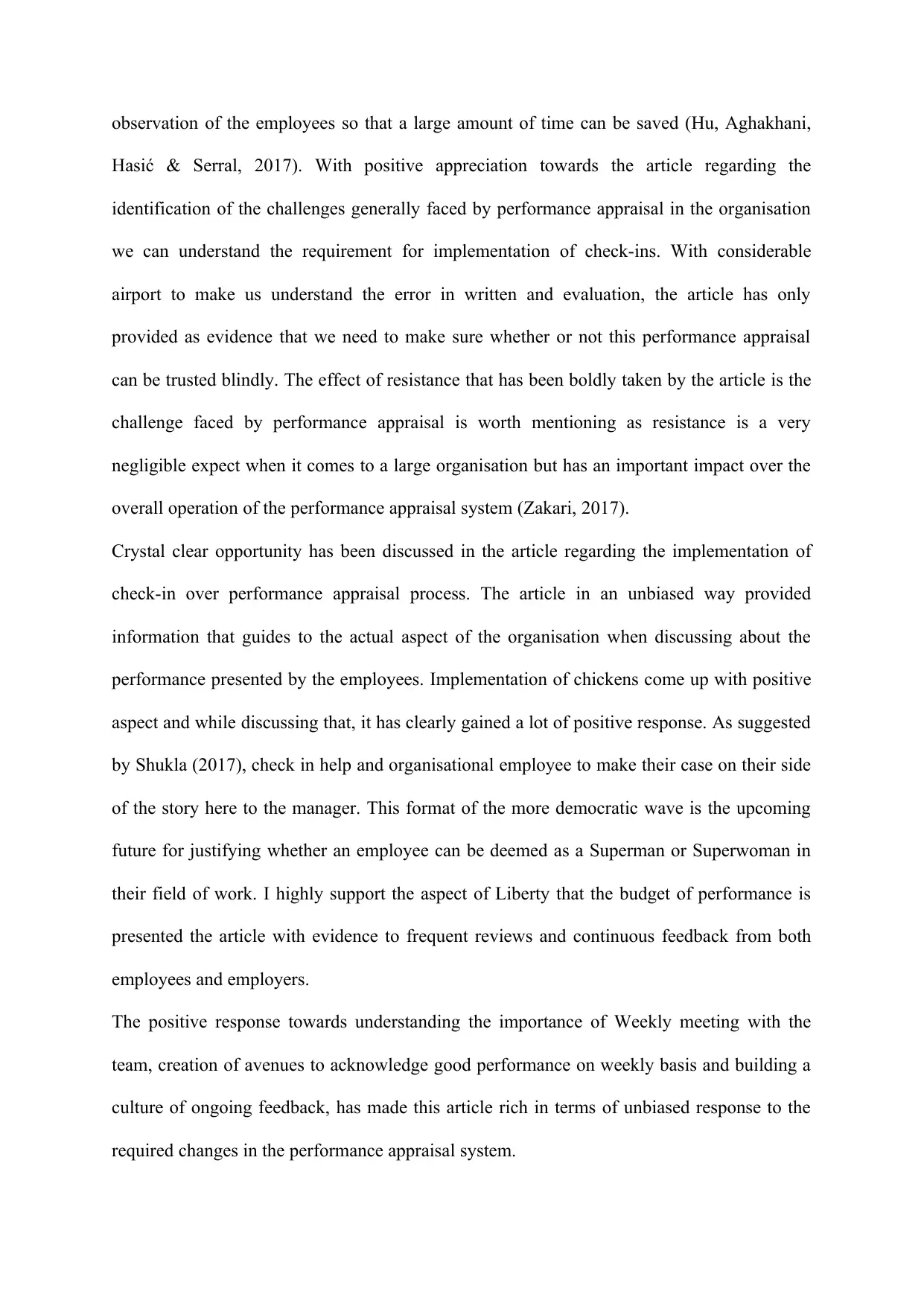
observation of the employees so that a large amount of time can be saved (Hu, Aghakhani,
Hasić & Serral, 2017). With positive appreciation towards the article regarding the
identification of the challenges generally faced by performance appraisal in the organisation
we can understand the requirement for implementation of check-ins. With considerable
airport to make us understand the error in written and evaluation, the article has only
provided as evidence that we need to make sure whether or not this performance appraisal
can be trusted blindly. The effect of resistance that has been boldly taken by the article is the
challenge faced by performance appraisal is worth mentioning as resistance is a very
negligible expect when it comes to a large organisation but has an important impact over the
overall operation of the performance appraisal system (Zakari, 2017).
Crystal clear opportunity has been discussed in the article regarding the implementation of
check-in over performance appraisal process. The article in an unbiased way provided
information that guides to the actual aspect of the organisation when discussing about the
performance presented by the employees. Implementation of chickens come up with positive
aspect and while discussing that, it has clearly gained a lot of positive response. As suggested
by Shukla (2017), check in help and organisational employee to make their case on their side
of the story here to the manager. This format of the more democratic wave is the upcoming
future for justifying whether an employee can be deemed as a Superman or Superwoman in
their field of work. I highly support the aspect of Liberty that the budget of performance is
presented the article with evidence to frequent reviews and continuous feedback from both
employees and employers.
The positive response towards understanding the importance of Weekly meeting with the
team, creation of avenues to acknowledge good performance on weekly basis and building a
culture of ongoing feedback, has made this article rich in terms of unbiased response to the
required changes in the performance appraisal system.
Hasić & Serral, 2017). With positive appreciation towards the article regarding the
identification of the challenges generally faced by performance appraisal in the organisation
we can understand the requirement for implementation of check-ins. With considerable
airport to make us understand the error in written and evaluation, the article has only
provided as evidence that we need to make sure whether or not this performance appraisal
can be trusted blindly. The effect of resistance that has been boldly taken by the article is the
challenge faced by performance appraisal is worth mentioning as resistance is a very
negligible expect when it comes to a large organisation but has an important impact over the
overall operation of the performance appraisal system (Zakari, 2017).
Crystal clear opportunity has been discussed in the article regarding the implementation of
check-in over performance appraisal process. The article in an unbiased way provided
information that guides to the actual aspect of the organisation when discussing about the
performance presented by the employees. Implementation of chickens come up with positive
aspect and while discussing that, it has clearly gained a lot of positive response. As suggested
by Shukla (2017), check in help and organisational employee to make their case on their side
of the story here to the manager. This format of the more democratic wave is the upcoming
future for justifying whether an employee can be deemed as a Superman or Superwoman in
their field of work. I highly support the aspect of Liberty that the budget of performance is
presented the article with evidence to frequent reviews and continuous feedback from both
employees and employers.
The positive response towards understanding the importance of Weekly meeting with the
team, creation of avenues to acknowledge good performance on weekly basis and building a
culture of ongoing feedback, has made this article rich in terms of unbiased response to the
required changes in the performance appraisal system.
⊘ This is a preview!⊘
Do you want full access?
Subscribe today to unlock all pages.
Trusted by 1+ million students worldwide

With the above justification over the up and down in the article, we can clearly present our
view that the article is a sort of guideline to the beginners as well as business manager to
understand whether changes are required or not (Sarkar, 2016).
view that the article is a sort of guideline to the beginners as well as business manager to
understand whether changes are required or not (Sarkar, 2016).
Paraphrase This Document
Need a fresh take? Get an instant paraphrase of this document with our AI Paraphraser
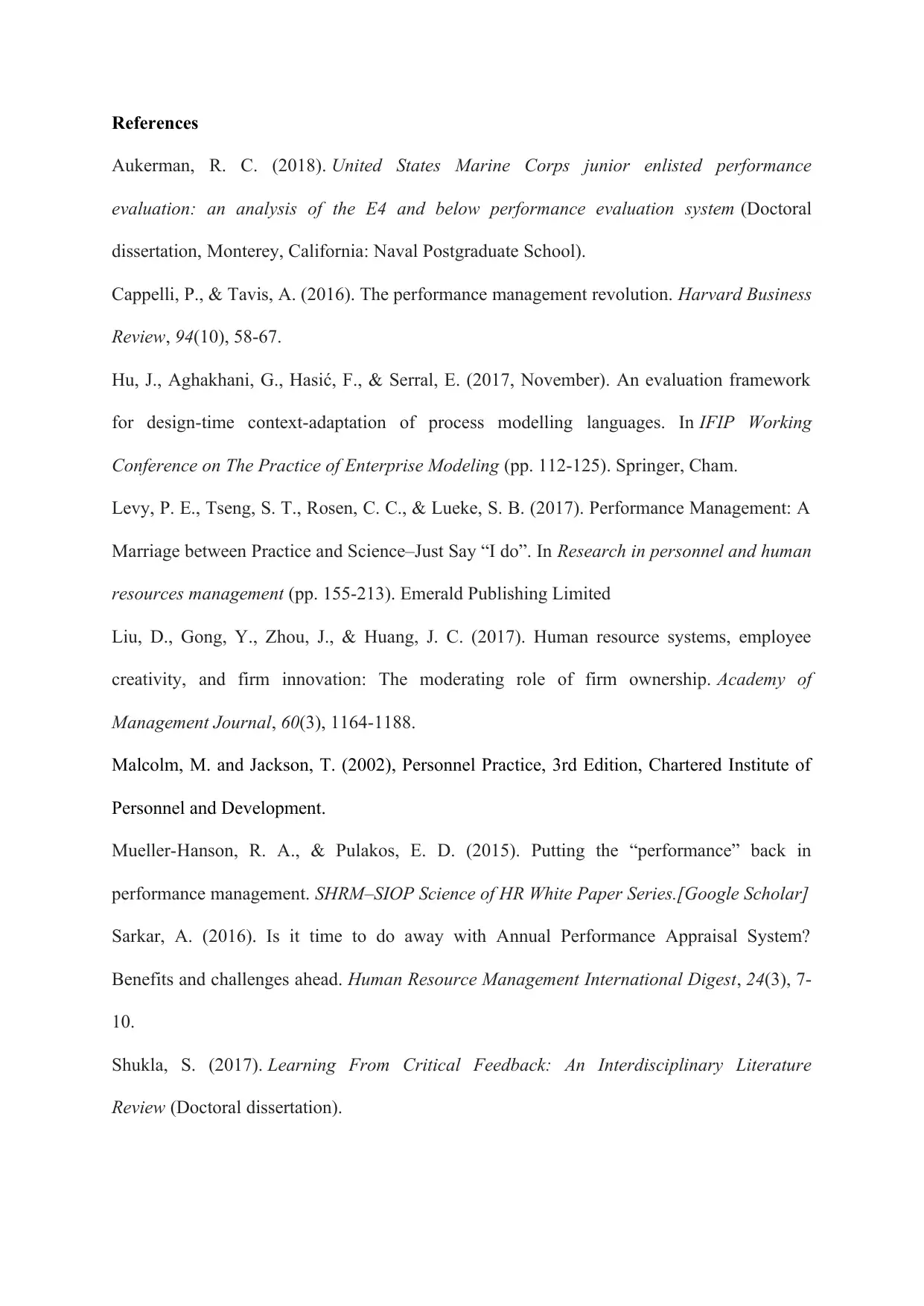
References
Aukerman, R. C. (2018). United States Marine Corps junior enlisted performance
evaluation: an analysis of the E4 and below performance evaluation system (Doctoral
dissertation, Monterey, California: Naval Postgraduate School).
Cappelli, P., & Tavis, A. (2016). The performance management revolution. Harvard Business
Review, 94(10), 58-67.
Hu, J., Aghakhani, G., Hasić, F., & Serral, E. (2017, November). An evaluation framework
for design-time context-adaptation of process modelling languages. In IFIP Working
Conference on The Practice of Enterprise Modeling (pp. 112-125). Springer, Cham.
Levy, P. E., Tseng, S. T., Rosen, C. C., & Lueke, S. B. (2017). Performance Management: A
Marriage between Practice and Science–Just Say “I do”. In Research in personnel and human
resources management (pp. 155-213). Emerald Publishing Limited
Liu, D., Gong, Y., Zhou, J., & Huang, J. C. (2017). Human resource systems, employee
creativity, and firm innovation: The moderating role of firm ownership. Academy of
Management Journal, 60(3), 1164-1188.
Malcolm, M. and Jackson, T. (2002), Personnel Practice, 3rd Edition, Chartered Institute of
Personnel and Development.
Mueller-Hanson, R. A., & Pulakos, E. D. (2015). Putting the “performance” back in
performance management. SHRM–SIOP Science of HR White Paper Series.[Google Scholar]
Sarkar, A. (2016). Is it time to do away with Annual Performance Appraisal System?
Benefits and challenges ahead. Human Resource Management International Digest, 24(3), 7-
10.
Shukla, S. (2017). Learning From Critical Feedback: An Interdisciplinary Literature
Review (Doctoral dissertation).
Aukerman, R. C. (2018). United States Marine Corps junior enlisted performance
evaluation: an analysis of the E4 and below performance evaluation system (Doctoral
dissertation, Monterey, California: Naval Postgraduate School).
Cappelli, P., & Tavis, A. (2016). The performance management revolution. Harvard Business
Review, 94(10), 58-67.
Hu, J., Aghakhani, G., Hasić, F., & Serral, E. (2017, November). An evaluation framework
for design-time context-adaptation of process modelling languages. In IFIP Working
Conference on The Practice of Enterprise Modeling (pp. 112-125). Springer, Cham.
Levy, P. E., Tseng, S. T., Rosen, C. C., & Lueke, S. B. (2017). Performance Management: A
Marriage between Practice and Science–Just Say “I do”. In Research in personnel and human
resources management (pp. 155-213). Emerald Publishing Limited
Liu, D., Gong, Y., Zhou, J., & Huang, J. C. (2017). Human resource systems, employee
creativity, and firm innovation: The moderating role of firm ownership. Academy of
Management Journal, 60(3), 1164-1188.
Malcolm, M. and Jackson, T. (2002), Personnel Practice, 3rd Edition, Chartered Institute of
Personnel and Development.
Mueller-Hanson, R. A., & Pulakos, E. D. (2015). Putting the “performance” back in
performance management. SHRM–SIOP Science of HR White Paper Series.[Google Scholar]
Sarkar, A. (2016). Is it time to do away with Annual Performance Appraisal System?
Benefits and challenges ahead. Human Resource Management International Digest, 24(3), 7-
10.
Shukla, S. (2017). Learning From Critical Feedback: An Interdisciplinary Literature
Review (Doctoral dissertation).
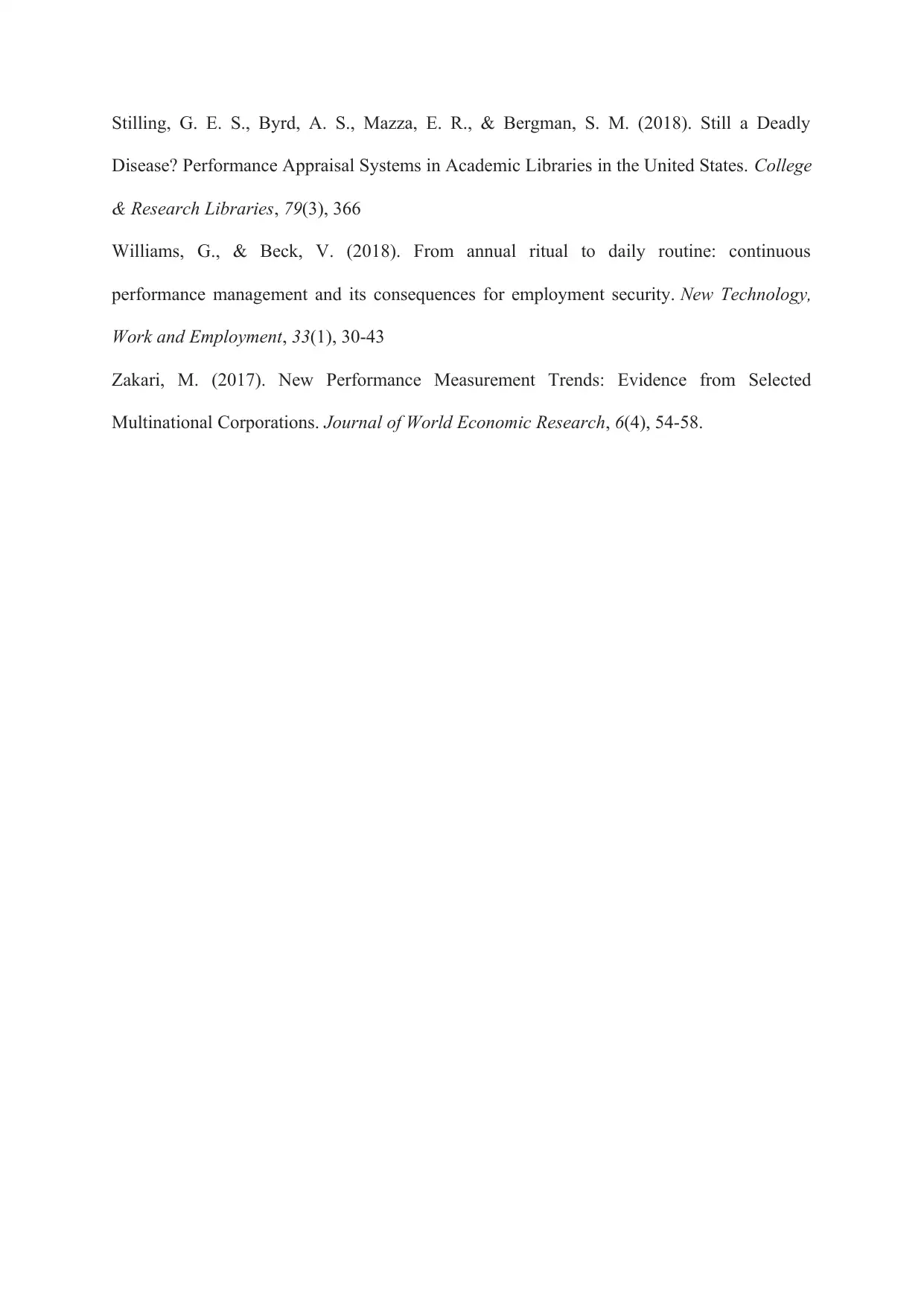
Stilling, G. E. S., Byrd, A. S., Mazza, E. R., & Bergman, S. M. (2018). Still a Deadly
Disease? Performance Appraisal Systems in Academic Libraries in the United States. College
& Research Libraries, 79(3), 366
Williams, G., & Beck, V. (2018). From annual ritual to daily routine: continuous
performance management and its consequences for employment security. New Technology,
Work and Employment, 33(1), 30-43
Zakari, M. (2017). New Performance Measurement Trends: Evidence from Selected
Multinational Corporations. Journal of World Economic Research, 6(4), 54-58.
Disease? Performance Appraisal Systems in Academic Libraries in the United States. College
& Research Libraries, 79(3), 366
Williams, G., & Beck, V. (2018). From annual ritual to daily routine: continuous
performance management and its consequences for employment security. New Technology,
Work and Employment, 33(1), 30-43
Zakari, M. (2017). New Performance Measurement Trends: Evidence from Selected
Multinational Corporations. Journal of World Economic Research, 6(4), 54-58.
⊘ This is a preview!⊘
Do you want full access?
Subscribe today to unlock all pages.
Trusted by 1+ million students worldwide

1 out of 9


Your All-in-One AI-Powered Toolkit for Academic Success.
+13062052269
info@desklib.com
Available 24*7 on WhatsApp / Email
![[object Object]](/_next/static/media/star-bottom.7253800d.svg)
Unlock your academic potential
Copyright © 2020–2026 A2Z Services. All Rights Reserved. Developed and managed by ZUCOL.