Analyzing and Managing Risks in a Chemical Waste Management System
VerifiedAdded on 2023/01/10
|11
|2542
|100
Report
AI Summary
This report presents a comprehensive analysis of risk management within a chemical waste management system implemented at Gdansk University. It begins by developing a risk register and matrix, linking them to the chemistry department's strategy. The report then explores the role of technology, specifically the SYGOS system, in reducing errors and enhancing safety. Furthermore, it evaluates the efficacy of the existing risk assessment plan, highlighting both successes and shortcomings, such as the inadequate handling of health and safety risks. The report also analyzes the plan's robustness, identifying areas for improvement and recommending strategies to mitigate potential future risks, including those related to chemical storage, health and safety standards, and technical failures. The conclusion summarizes the key findings and emphasizes the importance of proactive risk management in ensuring a safe and efficient chemical waste management system.
Managing Risk

Paraphrase This Document
Need a fresh take? Get an instant paraphrase of this document with our AI Paraphraser
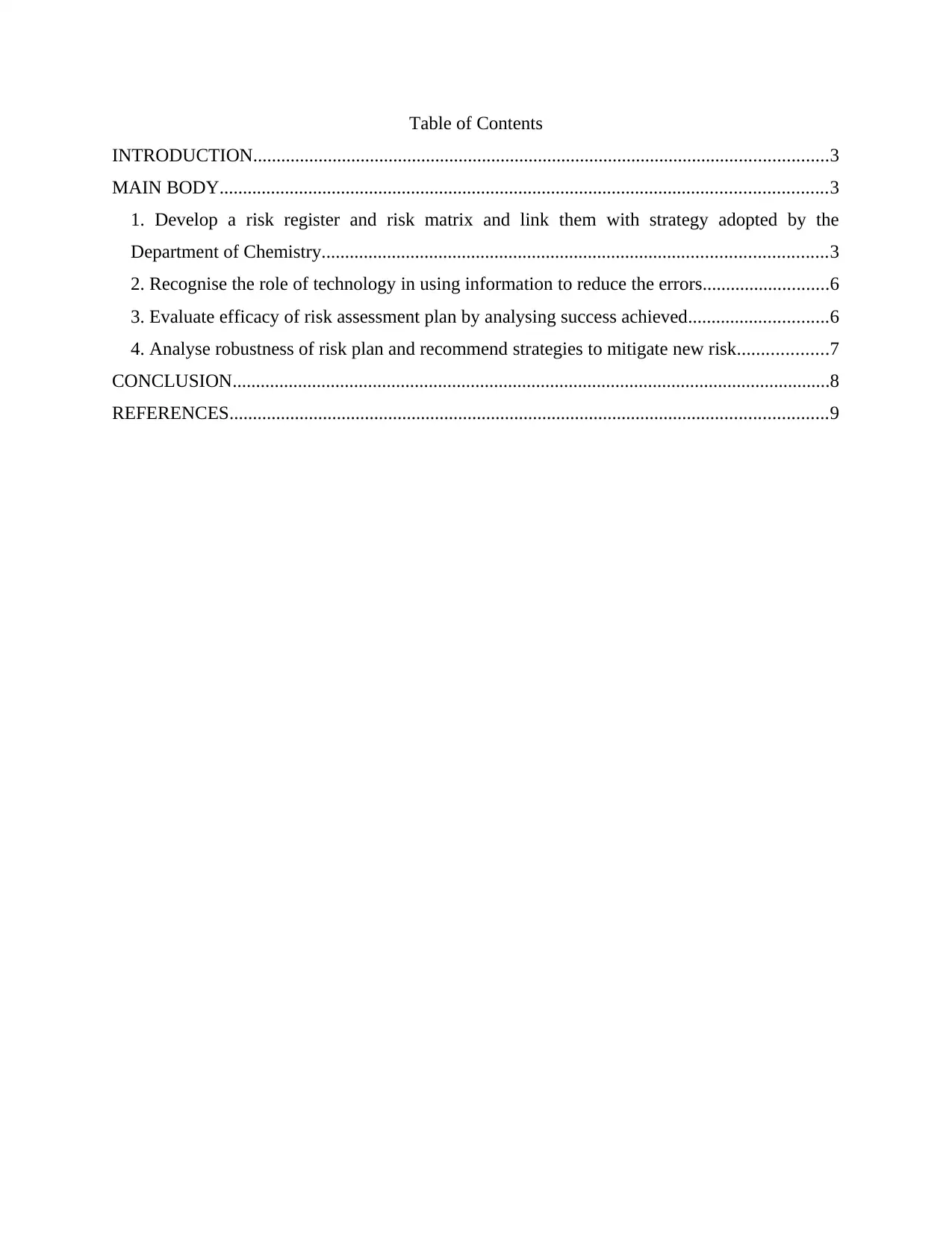
Table of Contents
INTRODUCTION...........................................................................................................................3
MAIN BODY..................................................................................................................................3
1. Develop a risk register and risk matrix and link them with strategy adopted by the
Department of Chemistry............................................................................................................3
2. Recognise the role of technology in using information to reduce the errors...........................6
3. Evaluate efficacy of risk assessment plan by analysing success achieved..............................6
4. Analyse robustness of risk plan and recommend strategies to mitigate new risk...................7
CONCLUSION................................................................................................................................8
REFERENCES................................................................................................................................9
INTRODUCTION...........................................................................................................................3
MAIN BODY..................................................................................................................................3
1. Develop a risk register and risk matrix and link them with strategy adopted by the
Department of Chemistry............................................................................................................3
2. Recognise the role of technology in using information to reduce the errors...........................6
3. Evaluate efficacy of risk assessment plan by analysing success achieved..............................6
4. Analyse robustness of risk plan and recommend strategies to mitigate new risk...................7
CONCLUSION................................................................................................................................8
REFERENCES................................................................................................................................9
INTRODUCTION
In project there are different types of risk which can occur. The risk varies on basis of type
and nature of project. Also, its degree and impact differ on type of risk which occurs. However,
it is necessary to mitigate impact of risk because it adversely effect on project. If risk impact is
not mitigated than it results in generating negative outcomes. thus, there are different types of
measures taken and strategies developed to manage risk. it enables in effectively managing of
risk by mitigating its impact. besides, it gives brief description about what has to be done and
how and who is responsible for it.
in this report it will be described about a case study in which a chemical and waste
management system is implemented in education. so, a risk register is developed in it along with
role of technology. besides, strategies to mitigate future risk will be explained.
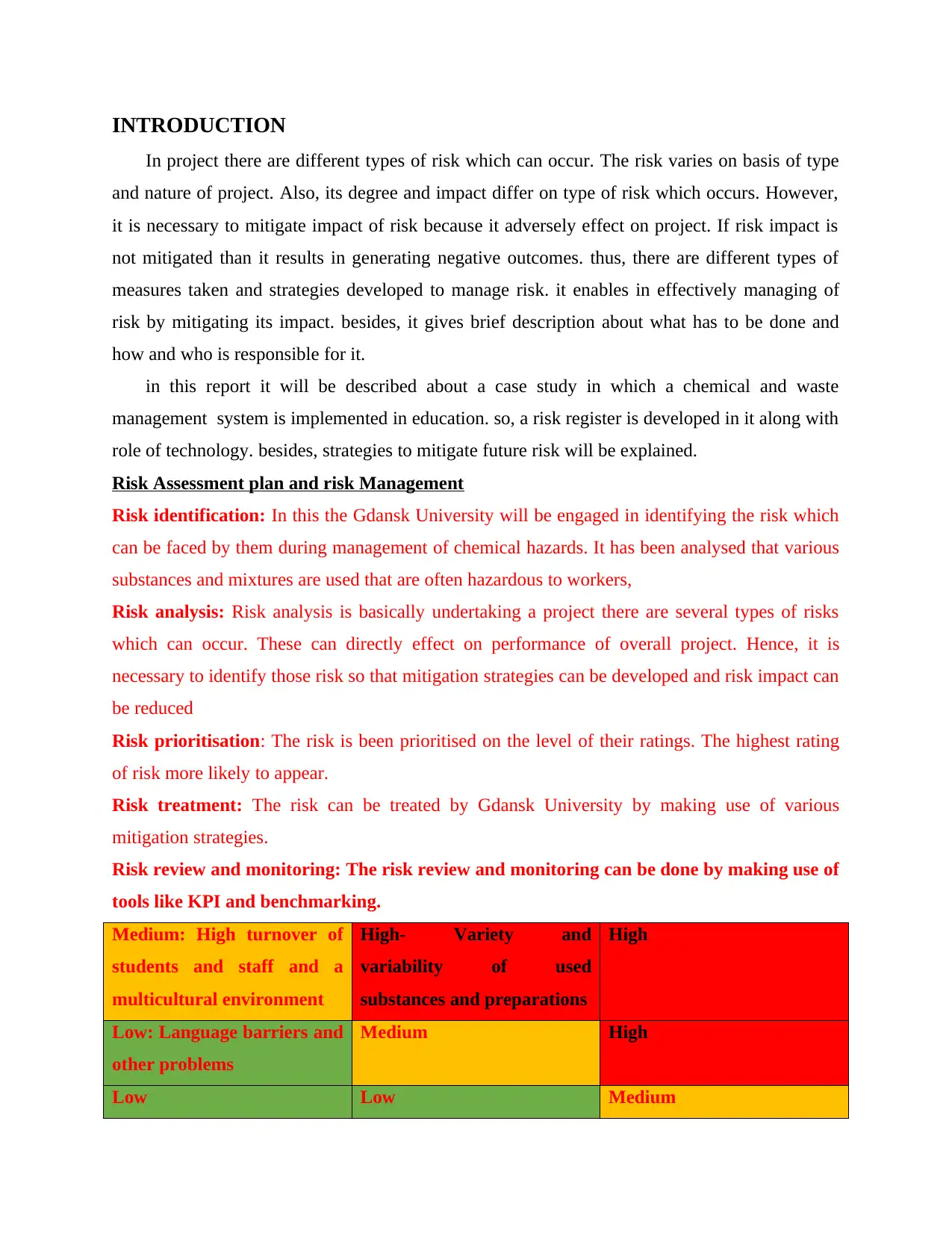
Risk Assessment plan and risk Management
Risk identification: In this the Gdansk University will be engaged in identifying the risk which
can be faced by them during management of chemical hazards. It has been analysed that various
substances and mixtures are used that are often hazardous to workers,
Risk analysis: Risk analysis is basically undertaking a project there are several types of risks
which can occur. These can directly effect on performance of overall project. Hence, it is
necessary to identify those risk so that mitigation strategies can be developed and risk impact can
be reduced
Risk prioritisation: The risk is been prioritised on the level of their ratings. The highest rating
of risk more likely to appear.
Risk treatment: The risk can be treated by Gdansk University by making use of various
mitigation strategies.
Risk review and monitoring: The risk review and monitoring can be done by making use of
tools like KPI and benchmarking.
Medium: High turnover of
students and staff and a
multicultural environment
High- Variety and
variability of used
substances and preparations
High
Low: Language barriers and
other problems
Medium High
Low Low Medium
In project there are different types of risk which can occur. The risk varies on basis of type
and nature of project. Also, its degree and impact differ on type of risk which occurs. However,
it is necessary to mitigate impact of risk because it adversely effect on project. If risk impact is
not mitigated than it results in generating negative outcomes. thus, there are different types of
measures taken and strategies developed to manage risk. it enables in effectively managing of
risk by mitigating its impact. besides, it gives brief description about what has to be done and
how and who is responsible for it.
in this report it will be described about a case study in which a chemical and waste
management system is implemented in education. so, a risk register is developed in it along with
role of technology. besides, strategies to mitigate future risk will be explained.
Risk Assessment plan and risk Management
Risk identification: In this the Gdansk University will be engaged in identifying the risk which
can be faced by them during management of chemical hazards. It has been analysed that various
substances and mixtures are used that are often hazardous to workers,
Risk analysis: Risk analysis is basically undertaking a project there are several types of risks
which can occur. These can directly effect on performance of overall project. Hence, it is
necessary to identify those risk so that mitigation strategies can be developed and risk impact can
be reduced
Risk prioritisation: The risk is been prioritised on the level of their ratings. The highest rating
of risk more likely to appear.
Risk treatment: The risk can be treated by Gdansk University by making use of various
mitigation strategies.
Risk review and monitoring: The risk review and monitoring can be done by making use of
tools like KPI and benchmarking.
Medium: High turnover of
students and staff and a
multicultural environment
High- Variety and
variability of used
substances and preparations
High
Low: Language barriers and
other problems
Medium High
Low Low Medium
⊘ This is a preview!⊘
Do you want full access?
Subscribe today to unlock all pages.

Trusted by 1+ million students worldwide
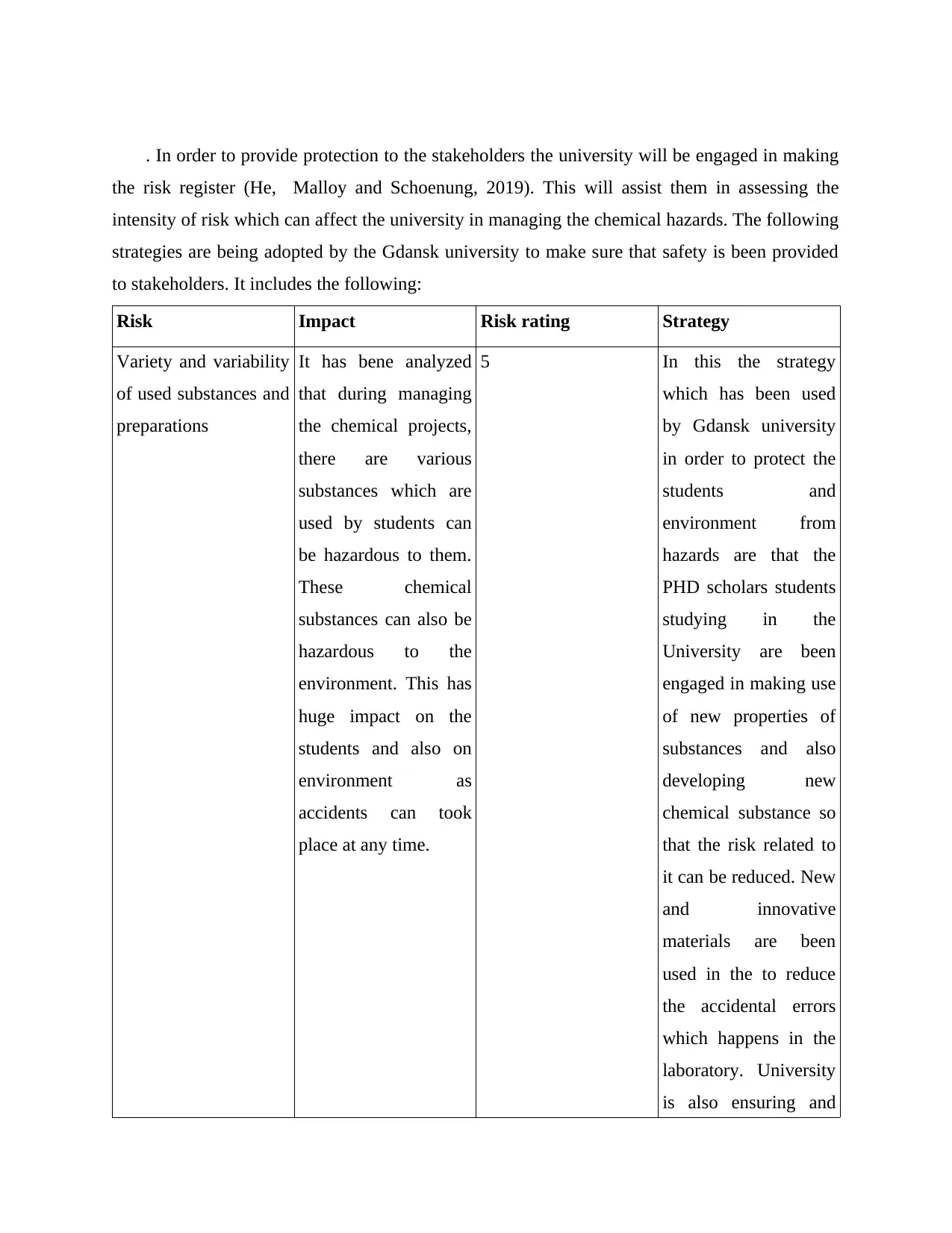
. In order to provide protection to the stakeholders the university will be engaged in making
the risk register (He, Malloy and Schoenung, 2019). This will assist them in assessing the
intensity of risk which can affect the university in managing the chemical hazards. The following
strategies are being adopted by the Gdansk university to make sure that safety is been provided
to stakeholders. It includes the following:
Risk Impact Risk rating Strategy
Variety and variability
of used substances and
preparations
It has bene analyzed
that during managing
the chemical projects,
there are various
substances which are
used by students can
be hazardous to them.
These chemical
substances can also be
hazardous to the
environment. This has
huge impact on the
students and also on
environment as
accidents can took
place at any time.
5 In this the strategy
which has been used
by Gdansk university
in order to protect the
students and
environment from
hazards are that the
PHD scholars students
studying in the
University are been
engaged in making use
of new properties of
substances and also
developing new
chemical substance so
that the risk related to
it can be reduced. New
and innovative
materials are been
used in the to reduce
the accidental errors
which happens in the
laboratory. University
is also ensuring and
the risk register (He, Malloy and Schoenung, 2019). This will assist them in assessing the
intensity of risk which can affect the university in managing the chemical hazards. The following
strategies are being adopted by the Gdansk university to make sure that safety is been provided
to stakeholders. It includes the following:
Risk Impact Risk rating Strategy
Variety and variability
of used substances and
preparations
It has bene analyzed
that during managing
the chemical projects,
there are various
substances which are
used by students can
be hazardous to them.
These chemical
substances can also be
hazardous to the
environment. This has
huge impact on the
students and also on
environment as
accidents can took
place at any time.
5 In this the strategy
which has been used
by Gdansk university
in order to protect the
students and
environment from
hazards are that the
PHD scholars students
studying in the
University are been
engaged in making use
of new properties of
substances and also
developing new
chemical substance so
that the risk related to
it can be reduced. New
and innovative
materials are been
used in the to reduce
the accidental errors
which happens in the
laboratory. University
is also ensuring and
Paraphrase This Document
Need a fresh take? Get an instant paraphrase of this document with our AI Paraphraser
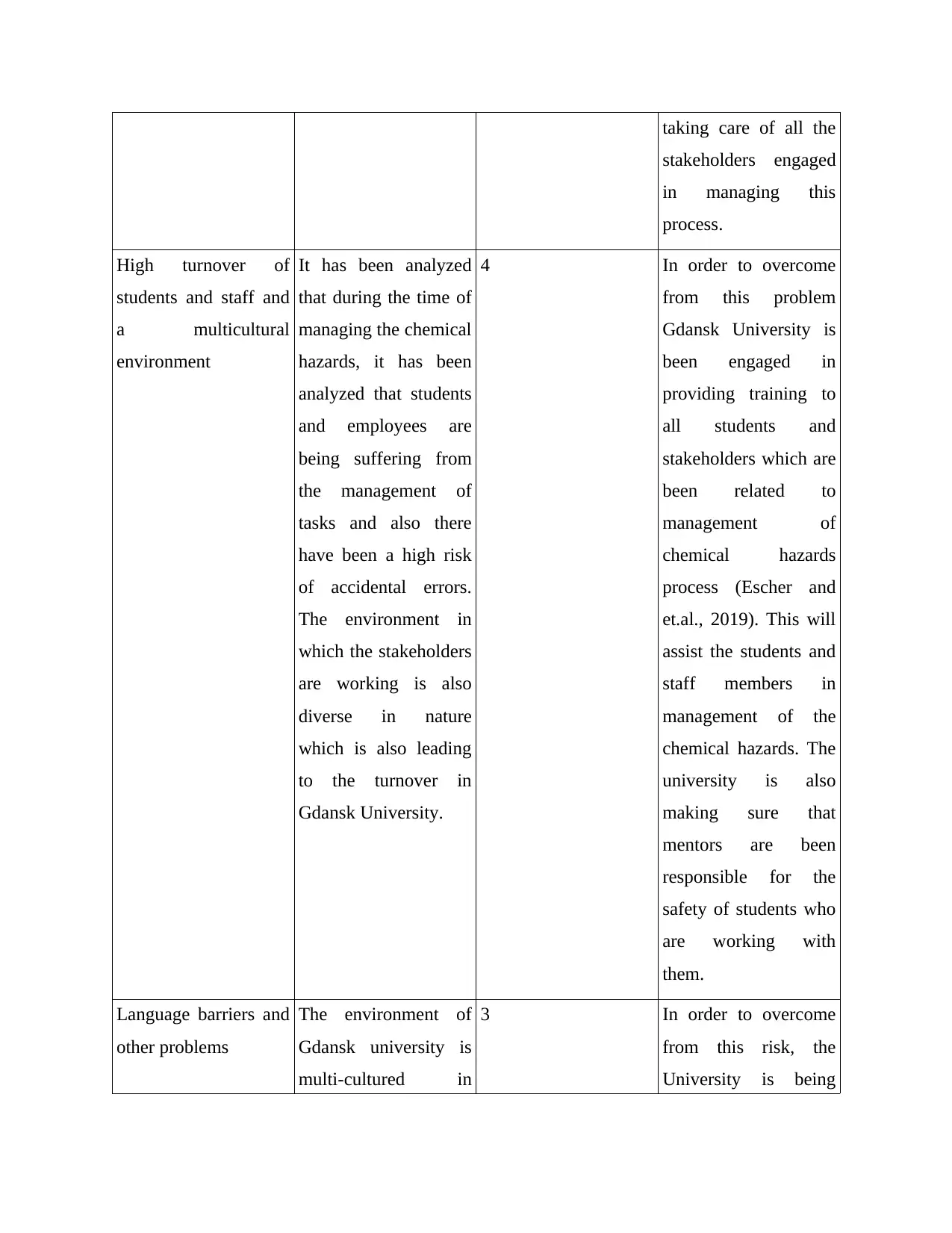
taking care of all the
stakeholders engaged
in managing this
process.
High turnover of
students and staff and
a multicultural
environment
It has been analyzed
that during the time of
managing the chemical
hazards, it has been
analyzed that students
and employees are
being suffering from
the management of
tasks and also there
have been a high risk
of accidental errors.
The environment in
which the stakeholders
are working is also
diverse in nature
which is also leading
to the turnover in
Gdansk University.
4 In order to overcome
from this problem
Gdansk University is
been engaged in
providing training to
all students and
stakeholders which are
been related to
management of
chemical hazards
process (Escher and
et.al., 2019). This will
assist the students and
staff members in
management of the
chemical hazards. The
university is also
making sure that
mentors are been
responsible for the
safety of students who
are working with
them.
Language barriers and
other problems
The environment of
Gdansk university is
multi-cultured in
3 In order to overcome
from this risk, the
University is being
stakeholders engaged
in managing this
process.
High turnover of
students and staff and
a multicultural
environment
It has been analyzed
that during the time of
managing the chemical
hazards, it has been
analyzed that students
and employees are
being suffering from
the management of
tasks and also there
have been a high risk
of accidental errors.
The environment in
which the stakeholders
are working is also
diverse in nature
which is also leading
to the turnover in
Gdansk University.
4 In order to overcome
from this problem
Gdansk University is
been engaged in
providing training to
all students and
stakeholders which are
been related to
management of
chemical hazards
process (Escher and
et.al., 2019). This will
assist the students and
staff members in
management of the
chemical hazards. The
university is also
making sure that
mentors are been
responsible for the
safety of students who
are working with
them.
Language barriers and
other problems
The environment of
Gdansk university is
multi-cultured in
3 In order to overcome
from this risk, the
University is being
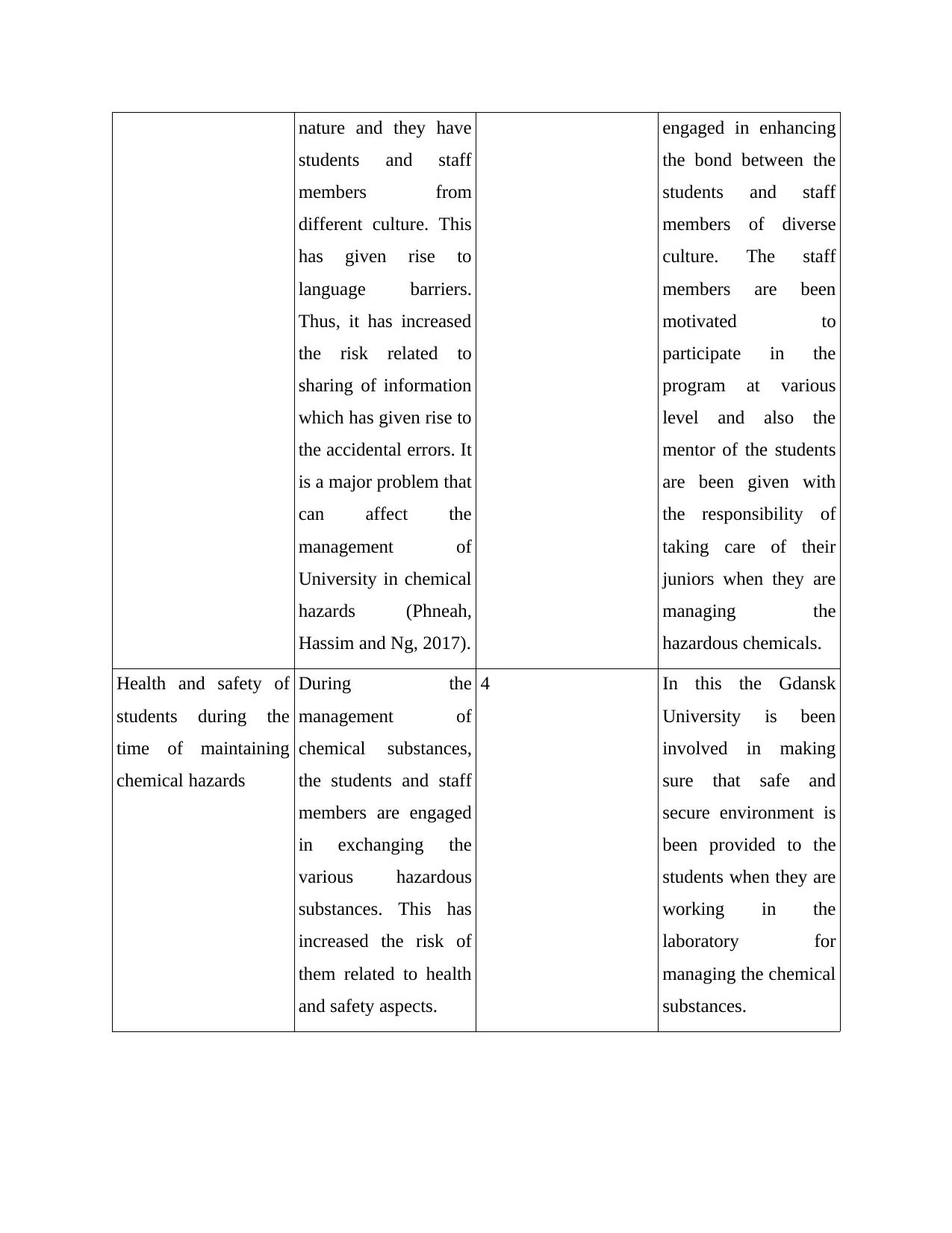
nature and they have
students and staff
members from
different culture. This
has given rise to
language barriers.
Thus, it has increased
the risk related to
sharing of information
which has given rise to
the accidental errors. It
is a major problem that
can affect the
management of
University in chemical
hazards (Phneah,
Hassim and Ng, 2017).
engaged in enhancing
the bond between the
students and staff
members of diverse
culture. The staff
members are been
motivated to
participate in the
program at various
level and also the
mentor of the students
are been given with
the responsibility of
taking care of their
juniors when they are
managing the
hazardous chemicals.
Health and safety of
students during the
time of maintaining
chemical hazards
During the
management of
chemical substances,
the students and staff
members are engaged
in exchanging the
various hazardous
substances. This has
increased the risk of
them related to health
and safety aspects.
4 In this the Gdansk
University is been
involved in making
sure that safe and
secure environment is
been provided to the
students when they are
working in the
laboratory for
managing the chemical
substances.
students and staff
members from
different culture. This
has given rise to
language barriers.
Thus, it has increased
the risk related to
sharing of information
which has given rise to
the accidental errors. It
is a major problem that
can affect the
management of
University in chemical
hazards (Phneah,
Hassim and Ng, 2017).
engaged in enhancing
the bond between the
students and staff
members of diverse
culture. The staff
members are been
motivated to
participate in the
program at various
level and also the
mentor of the students
are been given with
the responsibility of
taking care of their
juniors when they are
managing the
hazardous chemicals.
Health and safety of
students during the
time of maintaining
chemical hazards
During the
management of
chemical substances,
the students and staff
members are engaged
in exchanging the
various hazardous
substances. This has
increased the risk of
them related to health
and safety aspects.
4 In this the Gdansk
University is been
involved in making
sure that safe and
secure environment is
been provided to the
students when they are
working in the
laboratory for
managing the chemical
substances.
⊘ This is a preview!⊘
Do you want full access?
Subscribe today to unlock all pages.
Trusted by 1+ million students worldwide
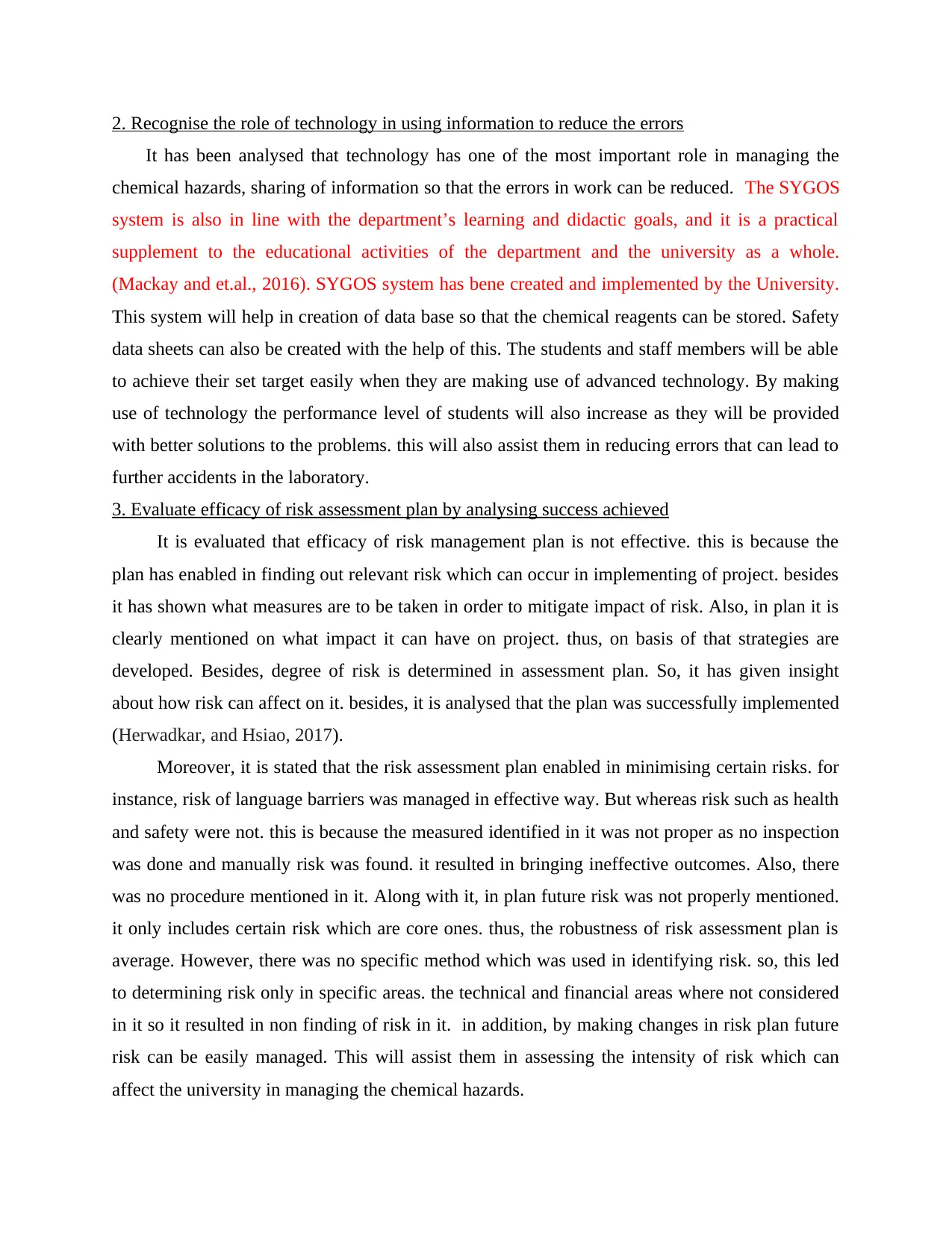
2. Recognise the role of technology in using information to reduce the errors
It has been analysed that technology has one of the most important role in managing the
chemical hazards, sharing of information so that the errors in work can be reduced. The SYGOS
system is also in line with the department’s learning and didactic goals, and it is a practical
supplement to the educational activities of the department and the university as a whole.
(Mackay and et.al., 2016). SYGOS system has bene created and implemented by the University.
This system will help in creation of data base so that the chemical reagents can be stored. Safety
data sheets can also be created with the help of this. The students and staff members will be able
to achieve their set target easily when they are making use of advanced technology. By making
use of technology the performance level of students will also increase as they will be provided
with better solutions to the problems. this will also assist them in reducing errors that can lead to
further accidents in the laboratory.
3. Evaluate efficacy of risk assessment plan by analysing success achieved
It is evaluated that efficacy of risk management plan is not effective. this is because the
plan has enabled in finding out relevant risk which can occur in implementing of project. besides
it has shown what measures are to be taken in order to mitigate impact of risk. Also, in plan it is
clearly mentioned on what impact it can have on project. thus, on basis of that strategies are
developed. Besides, degree of risk is determined in assessment plan. So, it has given insight
about how risk can affect on it. besides, it is analysed that the plan was successfully implemented
(Herwadkar, and Hsiao, 2017).
Moreover, it is stated that the risk assessment plan enabled in minimising certain risks. for
instance, risk of language barriers was managed in effective way. But whereas risk such as health
and safety were not. this is because the measured identified in it was not proper as no inspection
was done and manually risk was found. it resulted in bringing ineffective outcomes. Also, there
was no procedure mentioned in it. Along with it, in plan future risk was not properly mentioned.
it only includes certain risk which are core ones. thus, the robustness of risk assessment plan is
average. However, there was no specific method which was used in identifying risk. so, this led
to determining risk only in specific areas. the technical and financial areas where not considered
in it so it resulted in non finding of risk in it. in addition, by making changes in risk plan future
risk can be easily managed. This will assist them in assessing the intensity of risk which can
affect the university in managing the chemical hazards.
It has been analysed that technology has one of the most important role in managing the
chemical hazards, sharing of information so that the errors in work can be reduced. The SYGOS
system is also in line with the department’s learning and didactic goals, and it is a practical
supplement to the educational activities of the department and the university as a whole.
(Mackay and et.al., 2016). SYGOS system has bene created and implemented by the University.
This system will help in creation of data base so that the chemical reagents can be stored. Safety
data sheets can also be created with the help of this. The students and staff members will be able
to achieve their set target easily when they are making use of advanced technology. By making
use of technology the performance level of students will also increase as they will be provided
with better solutions to the problems. this will also assist them in reducing errors that can lead to
further accidents in the laboratory.
3. Evaluate efficacy of risk assessment plan by analysing success achieved
It is evaluated that efficacy of risk management plan is not effective. this is because the
plan has enabled in finding out relevant risk which can occur in implementing of project. besides
it has shown what measures are to be taken in order to mitigate impact of risk. Also, in plan it is
clearly mentioned on what impact it can have on project. thus, on basis of that strategies are
developed. Besides, degree of risk is determined in assessment plan. So, it has given insight
about how risk can affect on it. besides, it is analysed that the plan was successfully implemented
(Herwadkar, and Hsiao, 2017).
Moreover, it is stated that the risk assessment plan enabled in minimising certain risks. for
instance, risk of language barriers was managed in effective way. But whereas risk such as health
and safety were not. this is because the measured identified in it was not proper as no inspection
was done and manually risk was found. it resulted in bringing ineffective outcomes. Also, there
was no procedure mentioned in it. Along with it, in plan future risk was not properly mentioned.
it only includes certain risk which are core ones. thus, the robustness of risk assessment plan is
average. However, there was no specific method which was used in identifying risk. so, this led
to determining risk only in specific areas. the technical and financial areas where not considered
in it so it resulted in non finding of risk in it. in addition, by making changes in risk plan future
risk can be easily managed. This will assist them in assessing the intensity of risk which can
affect the university in managing the chemical hazards.
Paraphrase This Document
Need a fresh take? Get an instant paraphrase of this document with our AI Paraphraser
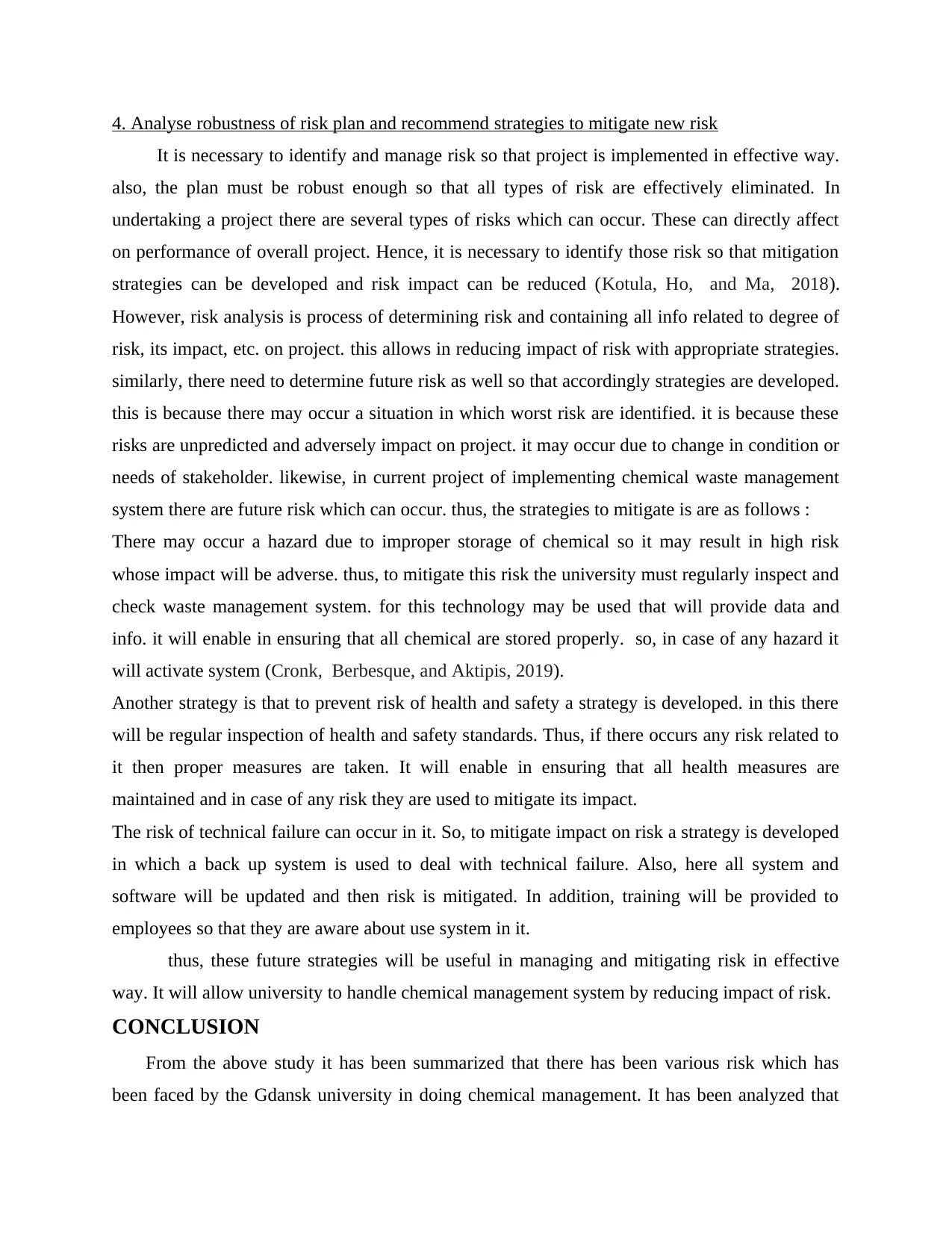
4. Analyse robustness of risk plan and recommend strategies to mitigate new risk
It is necessary to identify and manage risk so that project is implemented in effective way.
also, the plan must be robust enough so that all types of risk are effectively eliminated. In
undertaking a project there are several types of risks which can occur. These can directly affect
on performance of overall project. Hence, it is necessary to identify those risk so that mitigation
strategies can be developed and risk impact can be reduced (Kotula, Ho, and Ma, 2018).
However, risk analysis is process of determining risk and containing all info related to degree of
risk, its impact, etc. on project. this allows in reducing impact of risk with appropriate strategies.
similarly, there need to determine future risk as well so that accordingly strategies are developed.
this is because there may occur a situation in which worst risk are identified. it is because these
risks are unpredicted and adversely impact on project. it may occur due to change in condition or
needs of stakeholder. likewise, in current project of implementing chemical waste management
system there are future risk which can occur. thus, the strategies to mitigate is are as follows :
There may occur a hazard due to improper storage of chemical so it may result in high risk
whose impact will be adverse. thus, to mitigate this risk the university must regularly inspect and
check waste management system. for this technology may be used that will provide data and
info. it will enable in ensuring that all chemical are stored properly. so, in case of any hazard it
will activate system (Cronk, Berbesque, and Aktipis, 2019).
Another strategy is that to prevent risk of health and safety a strategy is developed. in this there
will be regular inspection of health and safety standards. Thus, if there occurs any risk related to
it then proper measures are taken. It will enable in ensuring that all health measures are
maintained and in case of any risk they are used to mitigate its impact.
The risk of technical failure can occur in it. So, to mitigate impact on risk a strategy is developed
in which a back up system is used to deal with technical failure. Also, here all system and
software will be updated and then risk is mitigated. In addition, training will be provided to
employees so that they are aware about use system in it.
thus, these future strategies will be useful in managing and mitigating risk in effective
way. It will allow university to handle chemical management system by reducing impact of risk.
CONCLUSION
From the above study it has been summarized that there has been various risk which has
been faced by the Gdansk university in doing chemical management. It has been analyzed that
It is necessary to identify and manage risk so that project is implemented in effective way.
also, the plan must be robust enough so that all types of risk are effectively eliminated. In
undertaking a project there are several types of risks which can occur. These can directly affect
on performance of overall project. Hence, it is necessary to identify those risk so that mitigation
strategies can be developed and risk impact can be reduced (Kotula, Ho, and Ma, 2018).
However, risk analysis is process of determining risk and containing all info related to degree of
risk, its impact, etc. on project. this allows in reducing impact of risk with appropriate strategies.
similarly, there need to determine future risk as well so that accordingly strategies are developed.
this is because there may occur a situation in which worst risk are identified. it is because these
risks are unpredicted and adversely impact on project. it may occur due to change in condition or
needs of stakeholder. likewise, in current project of implementing chemical waste management
system there are future risk which can occur. thus, the strategies to mitigate is are as follows :
There may occur a hazard due to improper storage of chemical so it may result in high risk
whose impact will be adverse. thus, to mitigate this risk the university must regularly inspect and
check waste management system. for this technology may be used that will provide data and
info. it will enable in ensuring that all chemical are stored properly. so, in case of any hazard it
will activate system (Cronk, Berbesque, and Aktipis, 2019).
Another strategy is that to prevent risk of health and safety a strategy is developed. in this there
will be regular inspection of health and safety standards. Thus, if there occurs any risk related to
it then proper measures are taken. It will enable in ensuring that all health measures are
maintained and in case of any risk they are used to mitigate its impact.
The risk of technical failure can occur in it. So, to mitigate impact on risk a strategy is developed
in which a back up system is used to deal with technical failure. Also, here all system and
software will be updated and then risk is mitigated. In addition, training will be provided to
employees so that they are aware about use system in it.
thus, these future strategies will be useful in managing and mitigating risk in effective
way. It will allow university to handle chemical management system by reducing impact of risk.
CONCLUSION
From the above study it has been summarized that there has been various risk which has
been faced by the Gdansk university in doing chemical management. It has been analyzed that
these risk has increased the accidental errors and also there has been a threat to the students
related to their health and safety. In order to overcome from this Gdansk University has been
engaged in taking various measures like they have been providing training to students and even
to staff members related to management of chemical substances. New and innovative material
has been used by students in order to reduce the effect of chemical hazards. It has also been
analyzed that mentors have also been engaged in taking care of safety and risk management of
their fellow students. The Gdansk university has also been engaged in reducing down the
language barriers which has been faced by the most of the students and staff members in
university.
related to their health and safety. In order to overcome from this Gdansk University has been
engaged in taking various measures like they have been providing training to students and even
to staff members related to management of chemical substances. New and innovative material
has been used by students in order to reduce the effect of chemical hazards. It has also been
analyzed that mentors have also been engaged in taking care of safety and risk management of
their fellow students. The Gdansk university has also been engaged in reducing down the
language barriers which has been faced by the most of the students and staff members in
university.
⊘ This is a preview!⊘
Do you want full access?
Subscribe today to unlock all pages.
Trusted by 1+ million students worldwide
REFERENCES
Books and Journals
Cronk, L., Berbesque, C. and Aktipis, A., 2019. Managing risk through cooperation: Need-based
transfers and risk pooling among the societies of the Human Generosity Project.
In Global Perspectives on Long Term Community Resource Management (pp. 41-75).
Springer, Cham.
Escher, S.E. and et.al., 2019. Towards grouping concepts based on new approach methodologies
in chemical hazard assessment: the read-across approach of the EU-ToxRisk
project. Archives of toxicology, 93(12), pp.3643-3667.
He, H., Malloy, T.F. and Schoenung, J.M., 2019. Multicriteria Decision Analysis
Characterization of Chemical Hazard Assessment Data Sources. Integrated
environmental assessment and management, 15(6), pp.895-908.
Herwadkar, R. and Hsiao, E., Oracle International Corp, 2017. Managing risk with continuous
queries. U.S. Patent 9,852,186.
Kotula, M., Ho, W.. and Ma, X., 2018. Managing risk in strategic sourcing: A cross-sectional
and multi-national case study. IEEE Engineering Management Review, 46(2), pp.74-86.
Mackay, D. and et.al., 2016. Processes influencing chemical biomagnification and trophic
magnification factors in aquatic ecosystems: Implications for chemical hazard and risk
assessment. Chemosphere, 154, pp.99-108.
Phneah, S.L., Hassim, M.H. and Ng, D.K.S., 2017. Review of Chemical hazard based
occupational health assessment methods for chemical processes. Chemical Engineering
Transactions, 56, pp.1813-1818.
Books and Journals
Cronk, L., Berbesque, C. and Aktipis, A., 2019. Managing risk through cooperation: Need-based
transfers and risk pooling among the societies of the Human Generosity Project.
In Global Perspectives on Long Term Community Resource Management (pp. 41-75).
Springer, Cham.
Escher, S.E. and et.al., 2019. Towards grouping concepts based on new approach methodologies
in chemical hazard assessment: the read-across approach of the EU-ToxRisk
project. Archives of toxicology, 93(12), pp.3643-3667.
He, H., Malloy, T.F. and Schoenung, J.M., 2019. Multicriteria Decision Analysis
Characterization of Chemical Hazard Assessment Data Sources. Integrated
environmental assessment and management, 15(6), pp.895-908.
Herwadkar, R. and Hsiao, E., Oracle International Corp, 2017. Managing risk with continuous
queries. U.S. Patent 9,852,186.
Kotula, M., Ho, W.. and Ma, X., 2018. Managing risk in strategic sourcing: A cross-sectional
and multi-national case study. IEEE Engineering Management Review, 46(2), pp.74-86.
Mackay, D. and et.al., 2016. Processes influencing chemical biomagnification and trophic
magnification factors in aquatic ecosystems: Implications for chemical hazard and risk
assessment. Chemosphere, 154, pp.99-108.
Phneah, S.L., Hassim, M.H. and Ng, D.K.S., 2017. Review of Chemical hazard based
occupational health assessment methods for chemical processes. Chemical Engineering
Transactions, 56, pp.1813-1818.
Paraphrase This Document
Need a fresh take? Get an instant paraphrase of this document with our AI Paraphraser

1

1 out of 11


Related Documents


Your All-in-One AI-Powered Toolkit for Academic Success.
+13062052269
info@desklib.com
Available 24*7 on WhatsApp / Email
![[object Object]](/_next/static/media/star-bottom.7253800d.svg)
Unlock your academic potential
Copyright © 2020–2026 A2Z Services. All Rights Reserved. Developed and managed by ZUCOL.