Chemistry Assignment: Solutions, Equilibrium, and Acid-Base Chemistry
VerifiedAdded on 2022/12/28
|10
|2814
|3
Homework Assignment
AI Summary
This chemistry assignment solution provides detailed answers to 22 problems covering a range of topics. The problems include calculations of Kw and percentage ionization, determination of Ka values, ordering acid strengths, identifying amphoteric substances, finding conjugate bases, calculating ammonia concentrations, identifying buffer solutions, and predicting pH changes. The solutions also address titration curves, pH calculations in titrations, identifying appropriate indicators, determining molar solubility, predicting precipitation, understanding complex ions, calculating non-spontaneous temperatures, identifying entropy changes, and determining equilibrium constants. The assignment provides comprehensive coverage of acid-base chemistry, equilibrium, solubility, and thermodynamics principles.
Chemistry
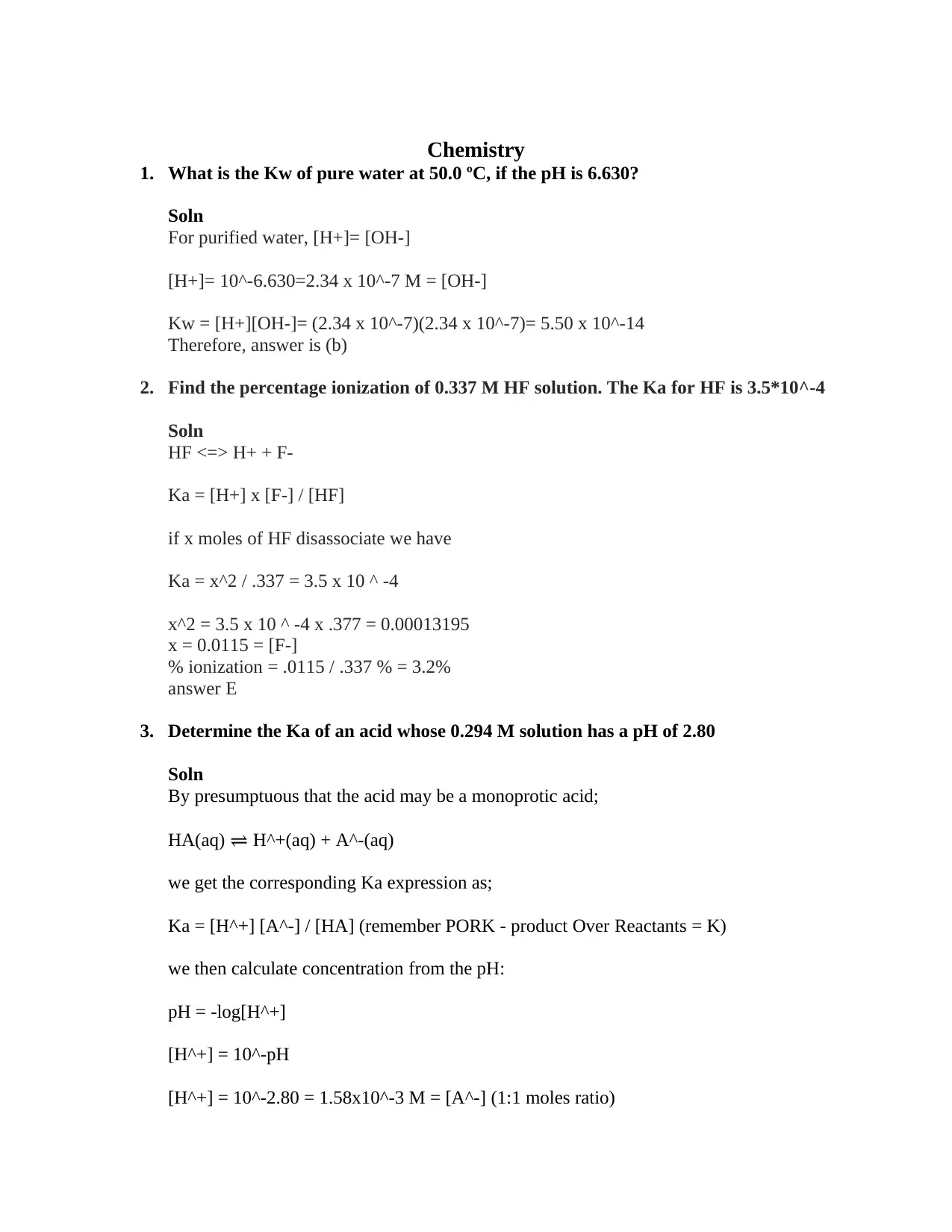
1. What is the Kw of pure water at 50.0 ºC, if the pH is 6.630?
Soln
For purified water, [H+]= [OH-]
[H+]= 10^-6.630=2.34 x 10^-7 M = [OH-]
Kw = [H+][OH-]= (2.34 x 10^-7)(2.34 x 10^-7)= 5.50 x 10^-14
Therefore, answer is (b)
2. Find the percentage ionization of 0.337 M HF solution. The Ka for HF is 3.5*10^-4
Soln
HF <=> H+ + F-
Ka = [H+] x [F-] / [HF]
if x moles of HF disassociate we have
Ka = x^2 / .337 = 3.5 x 10 ^ -4
x^2 = 3.5 x 10 ^ -4 x .377 = 0.00013195
x = 0.0115 = [F-]
% ionization = .0115 / .337 % = 3.2%
answer E
3. Determine the Ka of an acid whose 0.294 M solution has a pH of 2.80
Soln
By presumptuous that the acid may be a monoprotic acid;
HA(aq) ⇌ H^+(aq) + A^-(aq)
we get the corresponding Ka expression as;
Ka = [H^+] [A^-] / [HA] (remember PORK - product Over Reactants = K)
we then calculate concentration from the pH:
pH = -log[H^+]
[H^+] = 10^-pH
[H^+] = 10^-2.80 = 1.58x10^-3 M = [A^-] (1:1 moles ratio)
1. What is the Kw of pure water at 50.0 ºC, if the pH is 6.630?
Soln
For purified water, [H+]= [OH-]
[H+]= 10^-6.630=2.34 x 10^-7 M = [OH-]
Kw = [H+][OH-]= (2.34 x 10^-7)(2.34 x 10^-7)= 5.50 x 10^-14
Therefore, answer is (b)
2. Find the percentage ionization of 0.337 M HF solution. The Ka for HF is 3.5*10^-4
Soln
HF <=> H+ + F-
Ka = [H+] x [F-] / [HF]
if x moles of HF disassociate we have
Ka = x^2 / .337 = 3.5 x 10 ^ -4
x^2 = 3.5 x 10 ^ -4 x .377 = 0.00013195
x = 0.0115 = [F-]
% ionization = .0115 / .337 % = 3.2%
answer E
3. Determine the Ka of an acid whose 0.294 M solution has a pH of 2.80
Soln
By presumptuous that the acid may be a monoprotic acid;
HA(aq) ⇌ H^+(aq) + A^-(aq)
we get the corresponding Ka expression as;
Ka = [H^+] [A^-] / [HA] (remember PORK - product Over Reactants = K)
we then calculate concentration from the pH:
pH = -log[H^+]
[H^+] = 10^-pH
[H^+] = 10^-2.80 = 1.58x10^-3 M = [A^-] (1:1 moles ratio)

Paraphrase This Document
Need a fresh take? Get an instant paraphrase of this document with our AI Paraphraser
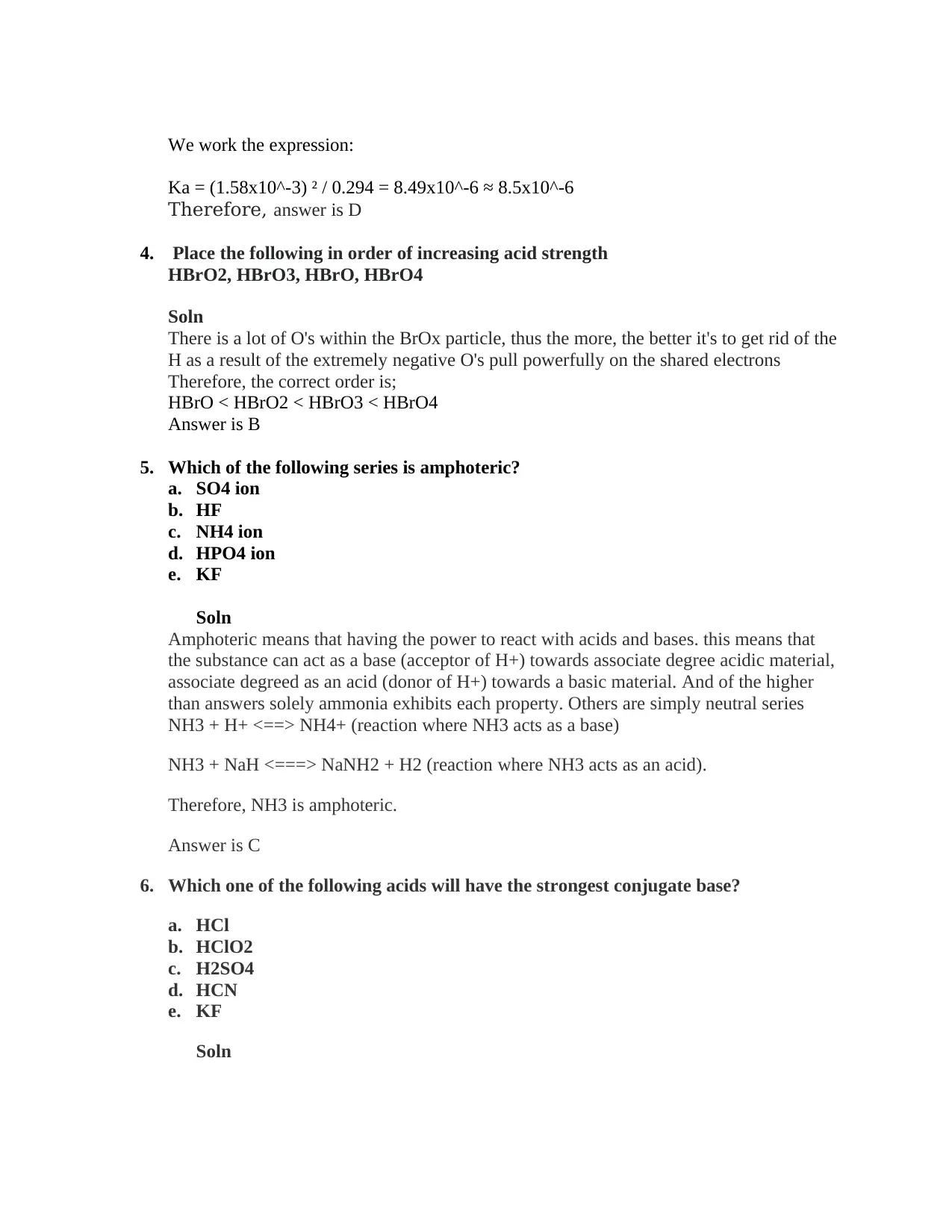
We work the expression:
Ka = (1.58x10^-3) ² / 0.294 = 8.49x10^-6 ≈ 8.5x10^-6
Therefore, answer is D
4. Place the following in order of increasing acid strength
HBrO2, HBrO3, HBrO, HBrO4
Soln
There is a lot of O's within the BrOx particle, thus the more, the better it's to get rid of the
H as a result of the extremely negative O's pull powerfully on the shared electrons
Therefore, the correct order is;
HBrO < HBrO2 < HBrO3 < HBrO4
Answer is B
5. Which of the following series is amphoteric?
a. SO4 ion
b. HF
c. NH4 ion
d. HPO4 ion
e. KF
Soln
Amphoteric means that having the power to react with acids and bases. this means that
the substance can act as a base (acceptor of H+) towards associate degree acidic material,
associate degreed as an acid (donor of H+) towards a basic material. And of the higher
than answers solely ammonia exhibits each property. Others are simply neutral series
NH3 + H+ <==> NH4+ (reaction where NH3 acts as a base)
NH3 + NaH <===> NaNH2 + H2 (reaction where NH3 acts as an acid).
Therefore, NH3 is amphoteric.
Answer is C
6. Which one of the following acids will have the strongest conjugate base?
a. HCl
b. HClO2
c. H2SO4
d. HCN
e. KF
Soln
Ka = (1.58x10^-3) ² / 0.294 = 8.49x10^-6 ≈ 8.5x10^-6
Therefore, answer is D
4. Place the following in order of increasing acid strength
HBrO2, HBrO3, HBrO, HBrO4
Soln
There is a lot of O's within the BrOx particle, thus the more, the better it's to get rid of the
H as a result of the extremely negative O's pull powerfully on the shared electrons
Therefore, the correct order is;
HBrO < HBrO2 < HBrO3 < HBrO4
Answer is B
5. Which of the following series is amphoteric?
a. SO4 ion
b. HF
c. NH4 ion
d. HPO4 ion
e. KF
Soln
Amphoteric means that having the power to react with acids and bases. this means that
the substance can act as a base (acceptor of H+) towards associate degree acidic material,
associate degreed as an acid (donor of H+) towards a basic material. And of the higher
than answers solely ammonia exhibits each property. Others are simply neutral series
NH3 + H+ <==> NH4+ (reaction where NH3 acts as a base)
NH3 + NaH <===> NaNH2 + H2 (reaction where NH3 acts as an acid).
Therefore, NH3 is amphoteric.
Answer is C
6. Which one of the following acids will have the strongest conjugate base?
a. HCl
b. HClO2
c. H2SO4
d. HCN
e. KF
Soln
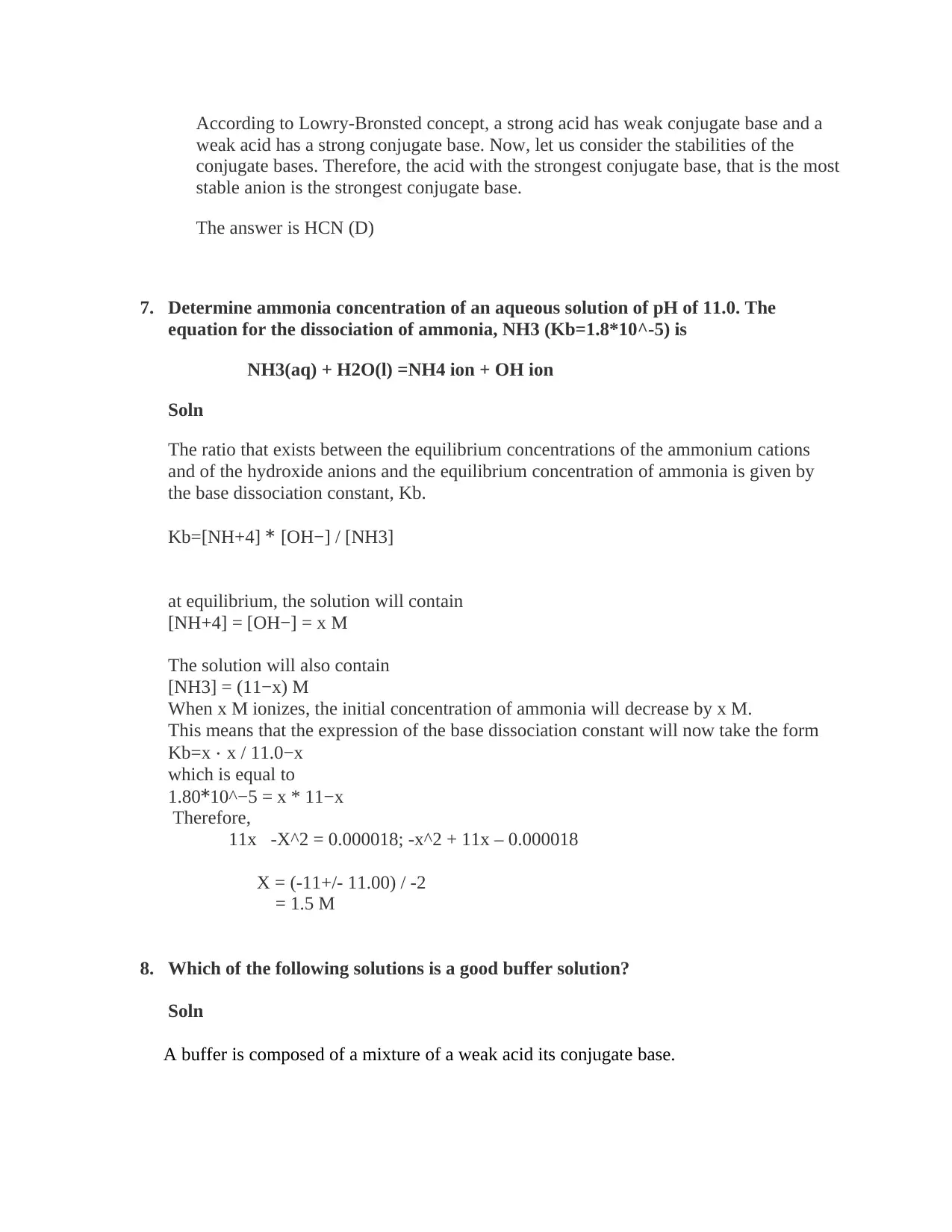
According to Lowry-Bronsted concept, a strong acid has weak conjugate base and a
weak acid has a strong conjugate base. Now, let us consider the stabilities of the
conjugate bases. Therefore, the acid with the strongest conjugate base, that is the most
stable anion is the strongest conjugate base.
The answer is HCN (D)
7. Determine ammonia concentration of an aqueous solution of pH of 11.0. The
equation for the dissociation of ammonia, NH3 (Kb=1.8*10^-5) is
NH3(aq) + H2O(l) =NH4 ion + OH ion
Soln
The ratio that exists between the equilibrium concentrations of the ammonium cations
and of the hydroxide anions and the equilibrium concentration of ammonia is given by
the base dissociation constant, Kb.
Kb=[NH+4] * [OH−] / [NH3]
at equilibrium, the solution will contain
[NH+4] = [OH−] = x M
The solution will also contain
[NH3] = (11−x) M
When x M ionizes, the initial concentration of ammonia will decrease by x M.
This means that the expression of the base dissociation constant will now take the form
Kb=x ⋅ x / 11.0−x
which is equal to
1.80*10^−5 = x * 11−x
Therefore,
11x -X^2 = 0.000018; -x^2 + 11x – 0.000018
X = (-11+/- 11.00) / -2
= 1.5 M
8. Which of the following solutions is a good buffer solution?
Soln
A buffer is composed of a mixture of a weak acid its conjugate base.
weak acid has a strong conjugate base. Now, let us consider the stabilities of the
conjugate bases. Therefore, the acid with the strongest conjugate base, that is the most
stable anion is the strongest conjugate base.
The answer is HCN (D)
7. Determine ammonia concentration of an aqueous solution of pH of 11.0. The
equation for the dissociation of ammonia, NH3 (Kb=1.8*10^-5) is
NH3(aq) + H2O(l) =NH4 ion + OH ion
Soln
The ratio that exists between the equilibrium concentrations of the ammonium cations
and of the hydroxide anions and the equilibrium concentration of ammonia is given by
the base dissociation constant, Kb.
Kb=[NH+4] * [OH−] / [NH3]
at equilibrium, the solution will contain
[NH+4] = [OH−] = x M
The solution will also contain
[NH3] = (11−x) M
When x M ionizes, the initial concentration of ammonia will decrease by x M.
This means that the expression of the base dissociation constant will now take the form
Kb=x ⋅ x / 11.0−x
which is equal to
1.80*10^−5 = x * 11−x
Therefore,
11x -X^2 = 0.000018; -x^2 + 11x – 0.000018
X = (-11+/- 11.00) / -2
= 1.5 M
8. Which of the following solutions is a good buffer solution?
Soln
A buffer is composed of a mixture of a weak acid its conjugate base.
⊘ This is a preview!⊘
Do you want full access?
Subscribe today to unlock all pages.

Trusted by 1+ million students worldwide
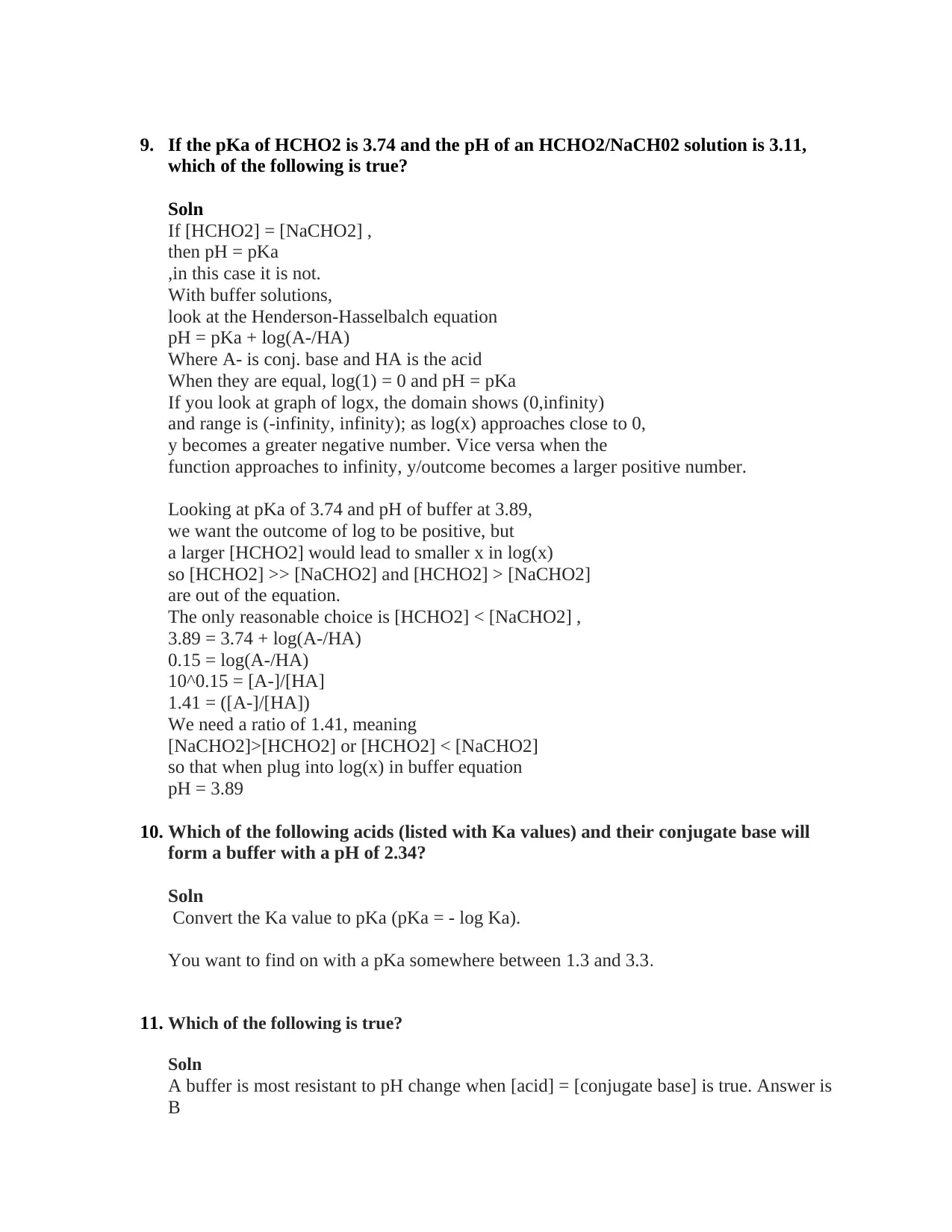
9. If the pKa of HCHO2 is 3.74 and the pH of an HCHO2/NaCH02 solution is 3.11,
which of the following is true?
Soln
If [HCHO2] = [NaCHO2] ,
then pH = pKa
,in this case it is not.
With buffer solutions,
look at the Henderson-Hasselbalch equation
pH = pKa + log(A-/HA)
Where A- is conj. base and HA is the acid
When they are equal, log(1) = 0 and pH = pKa
If you look at graph of logx, the domain shows (0,infinity)
and range is (-infinity, infinity); as log(x) approaches close to 0,
y becomes a greater negative number. Vice versa when the
function approaches to infinity, y/outcome becomes a larger positive number.
Looking at pKa of 3.74 and pH of buffer at 3.89,
we want the outcome of log to be positive, but
a larger [HCHO2] would lead to smaller x in log(x)
so [HCHO2] >> [NaCHO2] and [HCHO2] > [NaCHO2]
are out of the equation.
The only reasonable choice is [HCHO2] < [NaCHO2] ,
3.89 = 3.74 + log(A-/HA)
0.15 = log(A-/HA)
10^0.15 = [A-]/[HA]
1.41 = ([A-]/[HA])
We need a ratio of 1.41, meaning
[NaCHO2]>[HCHO2] or [HCHO2] < [NaCHO2]
so that when plug into log(x) in buffer equation
pH = 3.89
10. Which of the following acids (listed with Ka values) and their conjugate base will
form a buffer with a pH of 2.34?
Soln
Convert the Ka value to pKa (pKa = - log Ka).
You want to find on with a pKa somewhere between 1.3 and 3.3.
11. Which of the following is true?
Soln
A buffer is most resistant to pH change when [acid] = [conjugate base] is true. Answer is
B
which of the following is true?
Soln
If [HCHO2] = [NaCHO2] ,
then pH = pKa
,in this case it is not.
With buffer solutions,
look at the Henderson-Hasselbalch equation
pH = pKa + log(A-/HA)
Where A- is conj. base and HA is the acid
When they are equal, log(1) = 0 and pH = pKa
If you look at graph of logx, the domain shows (0,infinity)
and range is (-infinity, infinity); as log(x) approaches close to 0,
y becomes a greater negative number. Vice versa when the
function approaches to infinity, y/outcome becomes a larger positive number.
Looking at pKa of 3.74 and pH of buffer at 3.89,
we want the outcome of log to be positive, but
a larger [HCHO2] would lead to smaller x in log(x)
so [HCHO2] >> [NaCHO2] and [HCHO2] > [NaCHO2]
are out of the equation.
The only reasonable choice is [HCHO2] < [NaCHO2] ,
3.89 = 3.74 + log(A-/HA)
0.15 = log(A-/HA)
10^0.15 = [A-]/[HA]
1.41 = ([A-]/[HA])
We need a ratio of 1.41, meaning
[NaCHO2]>[HCHO2] or [HCHO2] < [NaCHO2]
so that when plug into log(x) in buffer equation
pH = 3.89
10. Which of the following acids (listed with Ka values) and their conjugate base will
form a buffer with a pH of 2.34?
Soln
Convert the Ka value to pKa (pKa = - log Ka).
You want to find on with a pKa somewhere between 1.3 and 3.3.
11. Which of the following is true?
Soln
A buffer is most resistant to pH change when [acid] = [conjugate base] is true. Answer is
B
Paraphrase This Document
Need a fresh take? Get an instant paraphrase of this document with our AI Paraphraser
12. Pick the titration curve for the titration of HNO3 with NaOH
Soln
The answer is B
The curve in B corresponds to the strong acid which is nitric acid.
13. A 100.0 mL sample of 0.1 M NH3 is titrated with 0.1M HNO3. Determine the pH of
the solution after the addition of 50.0 mL of HNO3. Kb of NH3 is 1.8 * 10^-5.
Soln
As the acid is added to the base the following neutralization takes place:
NH3(aq)+HNO3(aq)→NH4NO3(aq)+H2O(l)
The initial moles of NH3 present is given by:
nNH3=c×v=0.10×100/1000=0.01
The number of moles of HNO3 added is given by:
nHNO3=c×v=0.10×50x01000=0.005
From the equation you can see that the acid and base react in a molar ratio of 1:1.
So the no. moles of NH3 remaining will be 0.01 - 0.005 = 0.005.
The total volume is now 100.0+50.0=150.0xcm3
The concentration of NH3 is given by:
[NH3] = cv = 0.006140.01000=0.04286xmol/l
From an ICE table we get the expression:
pOH=12(pKb−logb)
Where b is the concentration of the base.
We can approximate this to the initial concentration since the dissociation is small.
pKb=−logKb=−log (1.8×10⁻⁵) = 4.744
Putting in the numbers:
pOH=12[4.744−log (0.04286)]
pOH=12[4.744−(−1.3679)] =3.056
At 25∘xC we know that:
pH + pOH=14
∴pH=14−3.056=10.9
14. A 100.0 mL sample of 0.1 M NH3 is titrated with 0.1M HNO3. Determine the pH of
the solution after the addition of 200.0 mL of HNO3. Kb of NH3 is 1.8 * 10^-5.
Soln
As the acid is added to the base the following neutralization takes place:
Soln
The answer is B
The curve in B corresponds to the strong acid which is nitric acid.
13. A 100.0 mL sample of 0.1 M NH3 is titrated with 0.1M HNO3. Determine the pH of
the solution after the addition of 50.0 mL of HNO3. Kb of NH3 is 1.8 * 10^-5.
Soln
As the acid is added to the base the following neutralization takes place:
NH3(aq)+HNO3(aq)→NH4NO3(aq)+H2O(l)
The initial moles of NH3 present is given by:
nNH3=c×v=0.10×100/1000=0.01
The number of moles of HNO3 added is given by:
nHNO3=c×v=0.10×50x01000=0.005
From the equation you can see that the acid and base react in a molar ratio of 1:1.
So the no. moles of NH3 remaining will be 0.01 - 0.005 = 0.005.
The total volume is now 100.0+50.0=150.0xcm3
The concentration of NH3 is given by:
[NH3] = cv = 0.006140.01000=0.04286xmol/l
From an ICE table we get the expression:
pOH=12(pKb−logb)
Where b is the concentration of the base.
We can approximate this to the initial concentration since the dissociation is small.
pKb=−logKb=−log (1.8×10⁻⁵) = 4.744
Putting in the numbers:
pOH=12[4.744−log (0.04286)]
pOH=12[4.744−(−1.3679)] =3.056
At 25∘xC we know that:
pH + pOH=14
∴pH=14−3.056=10.9
14. A 100.0 mL sample of 0.1 M NH3 is titrated with 0.1M HNO3. Determine the pH of
the solution after the addition of 200.0 mL of HNO3. Kb of NH3 is 1.8 * 10^-5.
Soln
As the acid is added to the base the following neutralization takes place:
NH3(aq)+HNO3(aq)→NH4NO3(aq)+H2O(l)
The initial moles of NH3 present is given by:
nNH3=c×v=0.10×100/1000=0.01
The number of moles of HNO3 added is given by:
nHNO3=c×v=0.10×200/1000=0.02
From the equation you can see that the acid and base react in a molar ratio of 1:1.
So the no. moles of NH3 remaining will be 0.01 - 0.02 = -0.01.
The total volume is now 100.0+200=300xcm3
The concentration of NH3 is given by:
[NH3] = cv = 0.006140.01000=0.04286xmol/l
From an ICE table we get the expression:
pOH=12(pKb−logb)
Where b is the concentration of the base.
We can approximate this to the initial concentration since the dissociation is small.
pKb=−logKb=−log (1.8×10⁻⁵) = 4.744
Putting in the numbers:
pOH=12[4.744−log (0.04286)]
pOH=12[4.744−(−1.3679)] =3.056
At 25∘xC we know that:
pH + pOH=14
∴pH=14−3.056=10.9
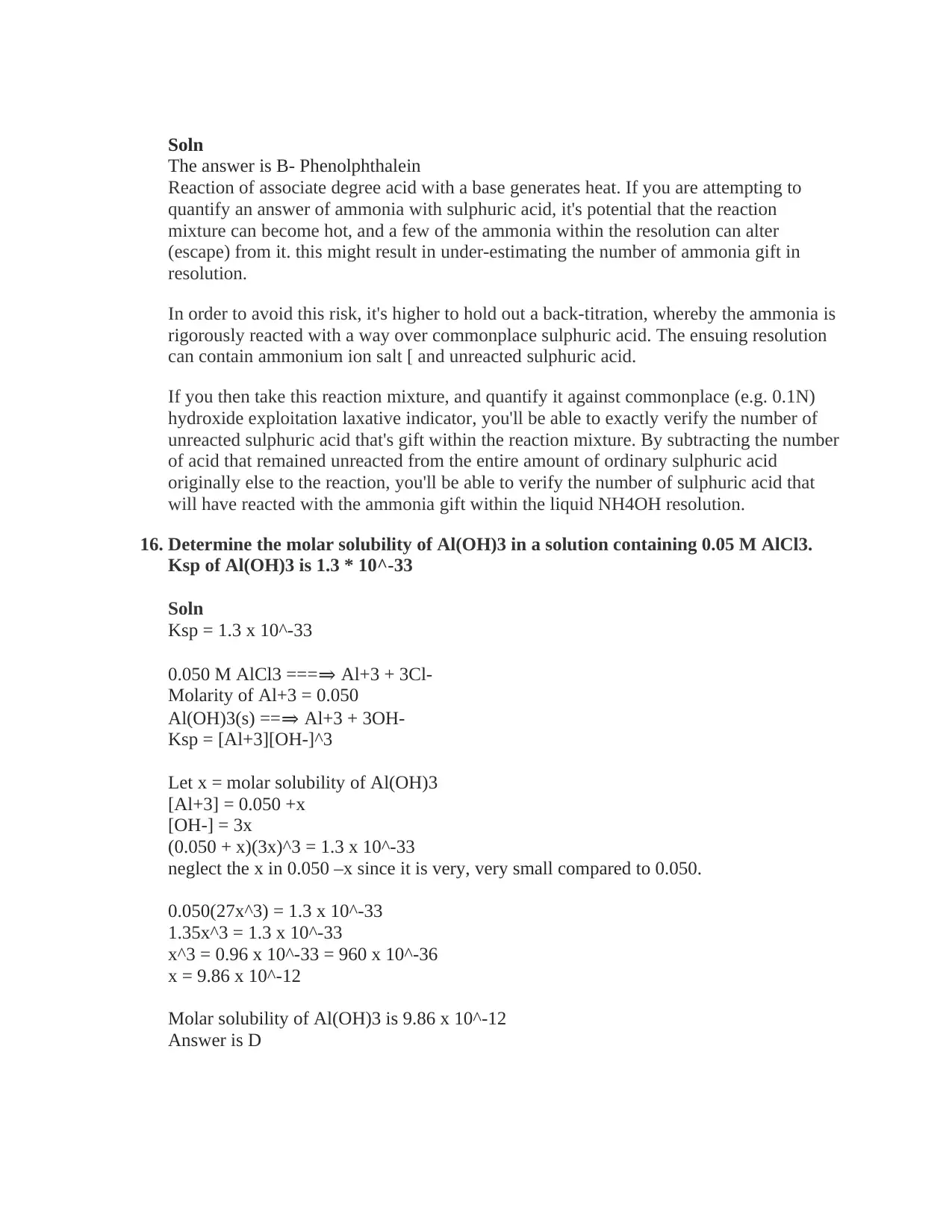
15. Which indicator will be best choice for titration of NH3 with HNO3 as shown by the
curve below;
The initial moles of NH3 present is given by:
nNH3=c×v=0.10×100/1000=0.01
The number of moles of HNO3 added is given by:
nHNO3=c×v=0.10×200/1000=0.02
From the equation you can see that the acid and base react in a molar ratio of 1:1.
So the no. moles of NH3 remaining will be 0.01 - 0.02 = -0.01.
The total volume is now 100.0+200=300xcm3
The concentration of NH3 is given by:
[NH3] = cv = 0.006140.01000=0.04286xmol/l
From an ICE table we get the expression:
pOH=12(pKb−logb)
Where b is the concentration of the base.
We can approximate this to the initial concentration since the dissociation is small.
pKb=−logKb=−log (1.8×10⁻⁵) = 4.744
Putting in the numbers:
pOH=12[4.744−log (0.04286)]
pOH=12[4.744−(−1.3679)] =3.056
At 25∘xC we know that:
pH + pOH=14
∴pH=14−3.056=10.9
15. Which indicator will be best choice for titration of NH3 with HNO3 as shown by the
curve below;
⊘ This is a preview!⊘
Do you want full access?
Subscribe today to unlock all pages.
Trusted by 1+ million students worldwide
Soln
The answer is B- Phenolphthalein
Reaction of associate degree acid with a base generates heat. If you are attempting to
quantify an answer of ammonia with sulphuric acid, it's potential that the reaction
mixture can become hot, and a few of the ammonia within the resolution can alter
(escape) from it. this might result in under-estimating the number of ammonia gift in
resolution.
In order to avoid this risk, it's higher to hold out a back-titration, whereby the ammonia is
rigorously reacted with a way over commonplace sulphuric acid. The ensuing resolution
can contain ammonium ion salt [ and unreacted sulphuric acid.
If you then take this reaction mixture, and quantify it against commonplace (e.g. 0.1N)
hydroxide exploitation laxative indicator, you'll be able to exactly verify the number of
unreacted sulphuric acid that's gift within the reaction mixture. By subtracting the number
of acid that remained unreacted from the entire amount of ordinary sulphuric acid
originally else to the reaction, you'll be able to verify the number of sulphuric acid that
will have reacted with the ammonia gift within the liquid NH4OH resolution.
16. Determine the molar solubility of Al(OH)3 in a solution containing 0.05 M AlCl3.
Ksp of Al(OH)3 is 1.3 * 10^-33
Soln
Ksp = 1.3 x 10^-33
0.050 M AlCl3 ===⇒ Al+3 + 3Cl-
Molarity of Al+3 = 0.050
Al(OH)3(s) ==⇒ Al+3 + 3OH-
Ksp = [Al+3][OH-]^3
Let x = molar solubility of Al(OH)3
[Al+3] = 0.050 +x
[OH-] = 3x
(0.050 + x)(3x)^3 = 1.3 x 10^-33
neglect the x in 0.050 –x since it is very, very small compared to 0.050.
0.050(27x^3) = 1.3 x 10^-33
1.35x^3 = 1.3 x 10^-33
x^3 = 0.96 x 10^-33 = 960 x 10^-36
x = 9.86 x 10^-12
Molar solubility of Al(OH)3 is 9.86 x 10^-12
Answer is D
The answer is B- Phenolphthalein
Reaction of associate degree acid with a base generates heat. If you are attempting to
quantify an answer of ammonia with sulphuric acid, it's potential that the reaction
mixture can become hot, and a few of the ammonia within the resolution can alter
(escape) from it. this might result in under-estimating the number of ammonia gift in
resolution.
In order to avoid this risk, it's higher to hold out a back-titration, whereby the ammonia is
rigorously reacted with a way over commonplace sulphuric acid. The ensuing resolution
can contain ammonium ion salt [ and unreacted sulphuric acid.
If you then take this reaction mixture, and quantify it against commonplace (e.g. 0.1N)
hydroxide exploitation laxative indicator, you'll be able to exactly verify the number of
unreacted sulphuric acid that's gift within the reaction mixture. By subtracting the number
of acid that remained unreacted from the entire amount of ordinary sulphuric acid
originally else to the reaction, you'll be able to verify the number of sulphuric acid that
will have reacted with the ammonia gift within the liquid NH4OH resolution.
16. Determine the molar solubility of Al(OH)3 in a solution containing 0.05 M AlCl3.
Ksp of Al(OH)3 is 1.3 * 10^-33
Soln
Ksp = 1.3 x 10^-33
0.050 M AlCl3 ===⇒ Al+3 + 3Cl-
Molarity of Al+3 = 0.050
Al(OH)3(s) ==⇒ Al+3 + 3OH-
Ksp = [Al+3][OH-]^3
Let x = molar solubility of Al(OH)3
[Al+3] = 0.050 +x
[OH-] = 3x
(0.050 + x)(3x)^3 = 1.3 x 10^-33
neglect the x in 0.050 –x since it is very, very small compared to 0.050.
0.050(27x^3) = 1.3 x 10^-33
1.35x^3 = 1.3 x 10^-33
x^3 = 0.96 x 10^-33 = 960 x 10^-36
x = 9.86 x 10^-12
Molar solubility of Al(OH)3 is 9.86 x 10^-12
Answer is D
Paraphrase This Document
Need a fresh take? Get an instant paraphrase of this document with our AI Paraphraser
17. A solution containing AgNO3 is mixed with a solution of NaCl to form a solution of
0.1 M in AgNO3 and 0.075 M in NaCl. What will happen once these solutions are
mixed? Ksp (AgCl) is 1.7 * 10^-10
Soln
(0.10 moles AgNO3 / L) x (1 mole Ag+ / 1 mole AgNO3) = 0.10 moles Ag+ / L = 0.10
M Ag+
(0.075 moles NaCl / L) x (1 mole Cl- / 1 mole NaCl) = 0.075 moles Cl- / L = 0.075 M
Cl-
Q = [Ag+][Cl-] = (0.10)(0.075) = 0.0075 which is much greater than Ksp (1.77 x 10^-
10).
In rationalization
once binary compound and caustic are mixed, a metathesis reaction takes place. The
silver particle becomes secured to the chloride ion. Since chloride is insoluble, this
substance precipitates out of resolution.
Answer is C
18. A complex ion contains
A complex ion contains a central metal cation bonded to one or more ligands.
Ligands are molecules or ions that surround the metal in a complex ion.
Answer is D
19. Below what temperature does the following reaction become non-spontaneous;
2HNO3(aq) + NO(g) = 3NO2(g) + H2O(l) ΔH = +136.5 KJ ΔS = 287.5 K/J
Soln
Since ΔG = ΔH-TΔS, you want to find the temperature at which ΔG = 0. So, simply set
ΔG=0, and plug in your values of ΔH and ΔS, and solve for T. Be careful with your units
since one is in kJ and the other in J.
20. Identify the statement that is false
Free atoms do not have less entropy than molecules
Therefore, answer is C
21. Which of the following reactions will have the largest equilibrium constant (K) at
298 K?
Soln
The answer is B
For the reaction of mercury and oxygen at -180.8 kJ
0.1 M in AgNO3 and 0.075 M in NaCl. What will happen once these solutions are
mixed? Ksp (AgCl) is 1.7 * 10^-10
Soln
(0.10 moles AgNO3 / L) x (1 mole Ag+ / 1 mole AgNO3) = 0.10 moles Ag+ / L = 0.10
M Ag+
(0.075 moles NaCl / L) x (1 mole Cl- / 1 mole NaCl) = 0.075 moles Cl- / L = 0.075 M
Cl-
Q = [Ag+][Cl-] = (0.10)(0.075) = 0.0075 which is much greater than Ksp (1.77 x 10^-
10).
In rationalization
once binary compound and caustic are mixed, a metathesis reaction takes place. The
silver particle becomes secured to the chloride ion. Since chloride is insoluble, this
substance precipitates out of resolution.
Answer is C
18. A complex ion contains
A complex ion contains a central metal cation bonded to one or more ligands.
Ligands are molecules or ions that surround the metal in a complex ion.
Answer is D
19. Below what temperature does the following reaction become non-spontaneous;
2HNO3(aq) + NO(g) = 3NO2(g) + H2O(l) ΔH = +136.5 KJ ΔS = 287.5 K/J
Soln
Since ΔG = ΔH-TΔS, you want to find the temperature at which ΔG = 0. So, simply set
ΔG=0, and plug in your values of ΔH and ΔS, and solve for T. Be careful with your units
since one is in kJ and the other in J.
20. Identify the statement that is false
Free atoms do not have less entropy than molecules
Therefore, answer is C
21. Which of the following reactions will have the largest equilibrium constant (K) at
298 K?
Soln
The answer is B
For the reaction of mercury and oxygen at -180.8 kJ
This is because for negative values of enthalpies the reaction is spontaneous at low
temperatures.
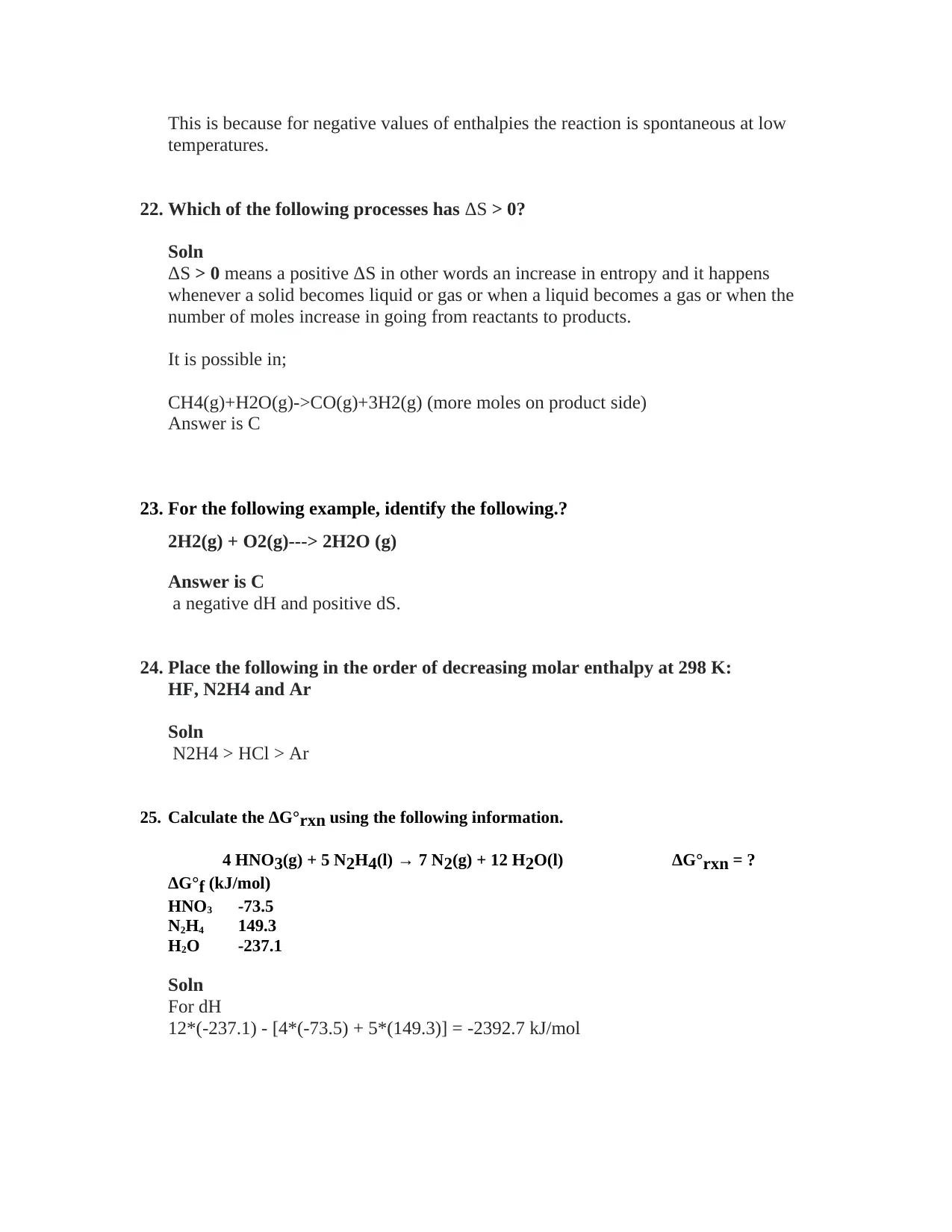
22. Which of the following processes has ΔS > 0?
Soln
ΔS > 0 means a positive ΔS in other words an increase in entropy and it happens
whenever a solid becomes liquid or gas or when a liquid becomes a gas or when the
number of moles increase in going from reactants to products.
It is possible in;
CH4(g)+H2O(g)->CO(g)+3H2(g) (more moles on product side)
Answer is C
23. For the following example, identify the following.?
2H2(g) + O2(g)---> 2H2O (g)
Answer is C
a negative dH and positive dS.
24. Place the following in the order of decreasing molar enthalpy at 298 K:
HF, N2H4 and Ar
Soln
N2H4 > HCl > Ar
25. Calculate the ΔG°rxn using the following information.
4 HNO3(g) + 5 N2H4(l) → 7 N2(g) + 12 H2O(l) ΔG°rxn = ?
ΔG°f (kJ/mol)
HNO3 -73.5
N2H4 149.3
H2O -237.1
Soln
For dH
12*(-237.1) - [4*(-73.5) + 5*(149.3)] = -2392.7 kJ/mol
temperatures.
22. Which of the following processes has ΔS > 0?
Soln
ΔS > 0 means a positive ΔS in other words an increase in entropy and it happens
whenever a solid becomes liquid or gas or when a liquid becomes a gas or when the
number of moles increase in going from reactants to products.
It is possible in;
CH4(g)+H2O(g)->CO(g)+3H2(g) (more moles on product side)
Answer is C
23. For the following example, identify the following.?
2H2(g) + O2(g)---> 2H2O (g)
Answer is C
a negative dH and positive dS.
24. Place the following in the order of decreasing molar enthalpy at 298 K:
HF, N2H4 and Ar
Soln
N2H4 > HCl > Ar
25. Calculate the ΔG°rxn using the following information.
4 HNO3(g) + 5 N2H4(l) → 7 N2(g) + 12 H2O(l) ΔG°rxn = ?
ΔG°f (kJ/mol)
HNO3 -73.5
N2H4 149.3
H2O -237.1
Soln
For dH
12*(-237.1) - [4*(-73.5) + 5*(149.3)] = -2392.7 kJ/mol
⊘ This is a preview!⊘
Do you want full access?
Subscribe today to unlock all pages.
Trusted by 1+ million students worldwide
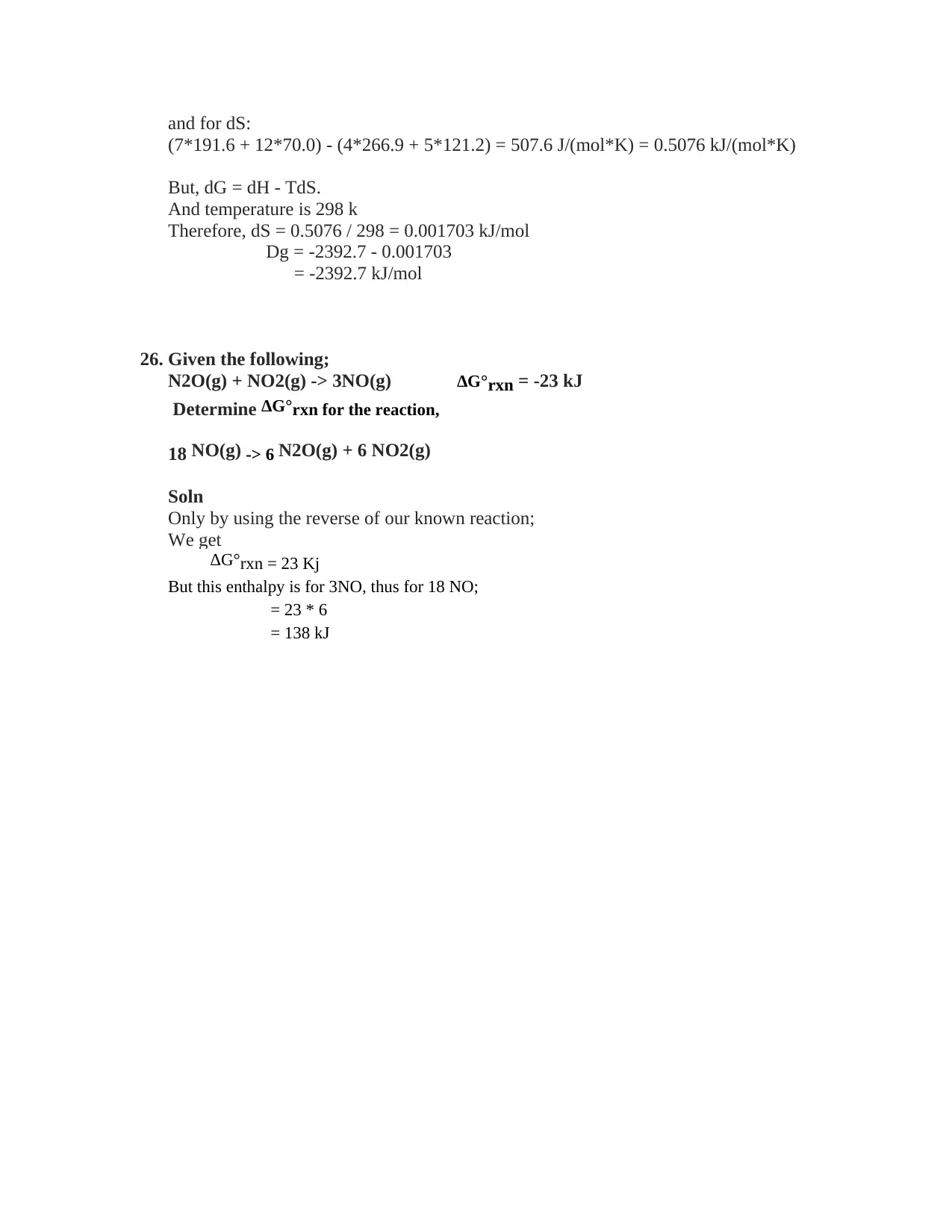
and for dS:
(7*191.6 + 12*70.0) - (4*266.9 + 5*121.2) = 507.6 J/(mol*K) = 0.5076 kJ/(mol*K)
But, dG = dH - TdS.
And temperature is 298 k
Therefore, dS = 0.5076 / 298 = 0.001703 kJ/mol
Dg = -2392.7 - 0.001703
= -2392.7 kJ/mol
26. Given the following;
N2O(g) + NO2(g) -> 3NO(g) ΔG°rxn = -23 kJ
Determine ΔG°rxn for the reaction,
18 NO(g) -> 6 N2O(g) + 6 NO2(g)
Soln
Only by using the reverse of our known reaction;
We get
ΔG°rxn = 23 Kj
But this enthalpy is for 3NO, thus for 18 NO;
= 23 * 6
= 138 kJ
(7*191.6 + 12*70.0) - (4*266.9 + 5*121.2) = 507.6 J/(mol*K) = 0.5076 kJ/(mol*K)
But, dG = dH - TdS.
And temperature is 298 k
Therefore, dS = 0.5076 / 298 = 0.001703 kJ/mol
Dg = -2392.7 - 0.001703
= -2392.7 kJ/mol
26. Given the following;
N2O(g) + NO2(g) -> 3NO(g) ΔG°rxn = -23 kJ
Determine ΔG°rxn for the reaction,
18 NO(g) -> 6 N2O(g) + 6 NO2(g)
Soln
Only by using the reverse of our known reaction;
We get
ΔG°rxn = 23 Kj
But this enthalpy is for 3NO, thus for 18 NO;
= 23 * 6
= 138 kJ

1 out of 10


Your All-in-One AI-Powered Toolkit for Academic Success.
+13062052269
info@desklib.com
Available 24*7 on WhatsApp / Email
![[object Object]](/_next/static/media/star-bottom.7253800d.svg)
Unlock your academic potential
Copyright © 2020–2026 A2Z Services. All Rights Reserved. Developed and managed by ZUCOL.