Child as Capable and Competent: Exercise for Learning and Development

Verified

Added on  2023/06/10

|3
|1390
|187
Homework Assignment
AI Summary
This assignment, focusing on the concept of the child as capable and competent, explores how educators perceive and support children's learning and development. The paper emphasizes that children are born ready to learn and actively engage in their education, not simply empty vessels. It delves into the importance of educators following children's interests, providing scaffolding, and offering diverse opportunities for children to demonstrate their knowledge through various activities such as reading, writing, and art. The assignment illustrates descriptors of a capable and competent child through real-life examples, highlighting independence, learning, exploration, research, and inquisitiveness. The assignment also references supporting literature that underlines the child's learning process and educator's role in it.
Document Page
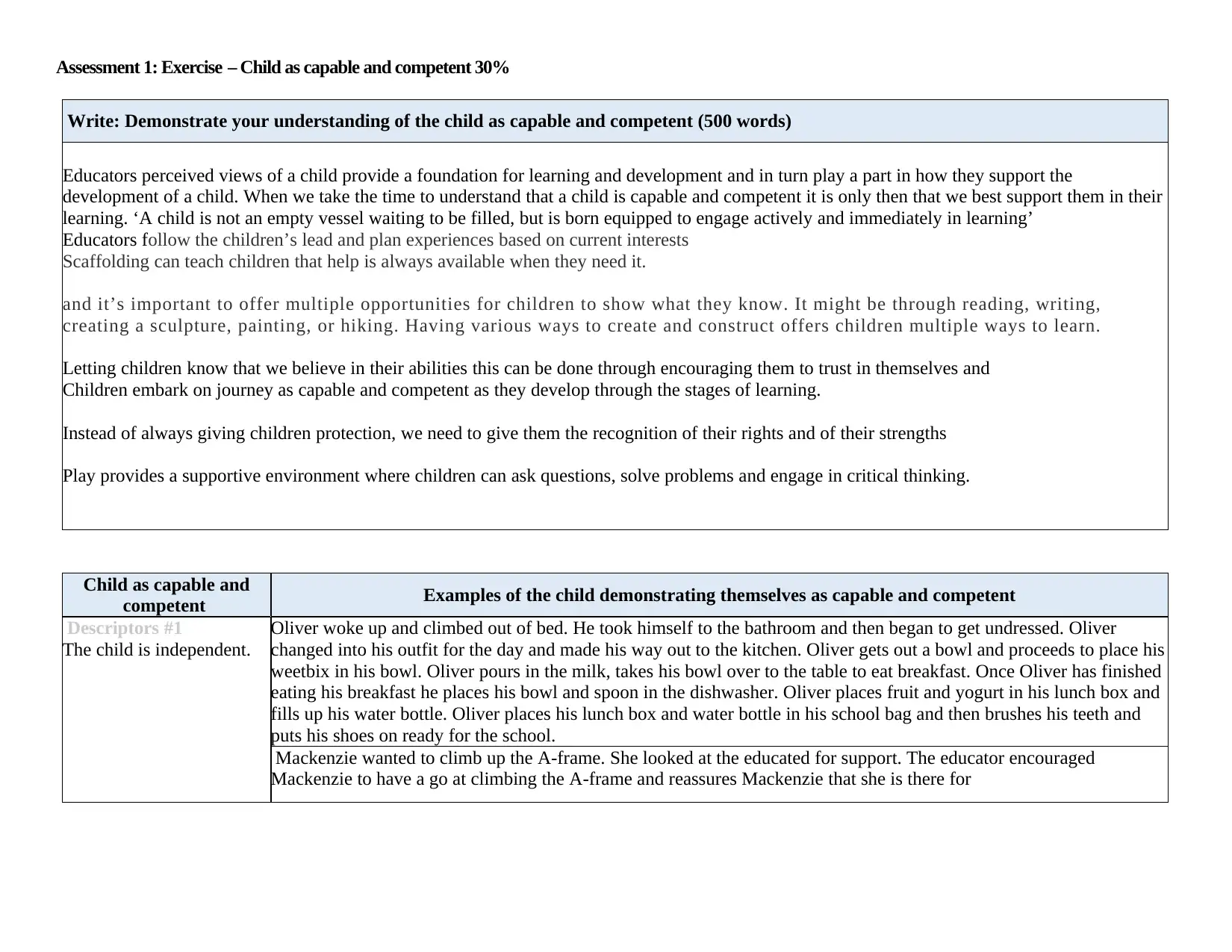
Assessment 1: Exercise – Child as capable and competent 30%
Write: Demonstrate your understanding of the child as capable and competent (500 words)
Educators perceived views of a child provide a foundation for learning and development and in turn play a part in how they support the
development of a child. When we take the time to understand that a child is capable and competent it is only then that we best support them in their
learning. ‘A child is not an empty vessel waiting to be filled, but is born equipped to engage actively and immediately in learning’
Educators follow the children’s lead and plan experiences based on current interests
Scaffolding can teach children that help is always available when they need it.
and it’s important to offer multiple opportunities for children to show what they know. It might be through reading, writing,
creating a sculpture, painting, or hiking. Having various ways to create and construct offers children multiple ways to learn.
Letting children know that we believe in their abilities this can be done through encouraging them to trust in themselves and
Children embark on journey as capable and competent as they develop through the stages of learning.
Instead of always giving children protection, we need to give them the recognition of their rights and of their strengths
Play provides a supportive environment where children can ask questions, solve problems and engage in critical thinking.
Child as capable and
competent Examples of the child demonstrating themselves as capable and competent
Descriptors #1
The child is independent.
Oliver woke up and climbed out of bed. He took himself to the bathroom and then began to get undressed. Oliver
changed into his outfit for the day and made his way out to the kitchen. Oliver gets out a bowl and proceeds to place his
weetbix in his bowl. Oliver pours in the milk, takes his bowl over to the table to eat breakfast. Once Oliver has finished
eating his breakfast he places his bowl and spoon in the dishwasher. Oliver places fruit and yogurt in his lunch box and
fills up his water bottle. Oliver places his lunch box and water bottle in his school bag and then brushes his teeth and
puts his shoes on ready for the school.
Mackenzie wanted to climb up the A-frame. She looked at the educated for support. The educator encouraged
Mackenzie to have a go at climbing the A-frame and reassures Mackenzie that she is there for
tabler-icon-diamond-filled.svg

Paraphrase This Document

Need a fresh take? Get an instant paraphrase of this document with our AI Paraphraser
Document Page
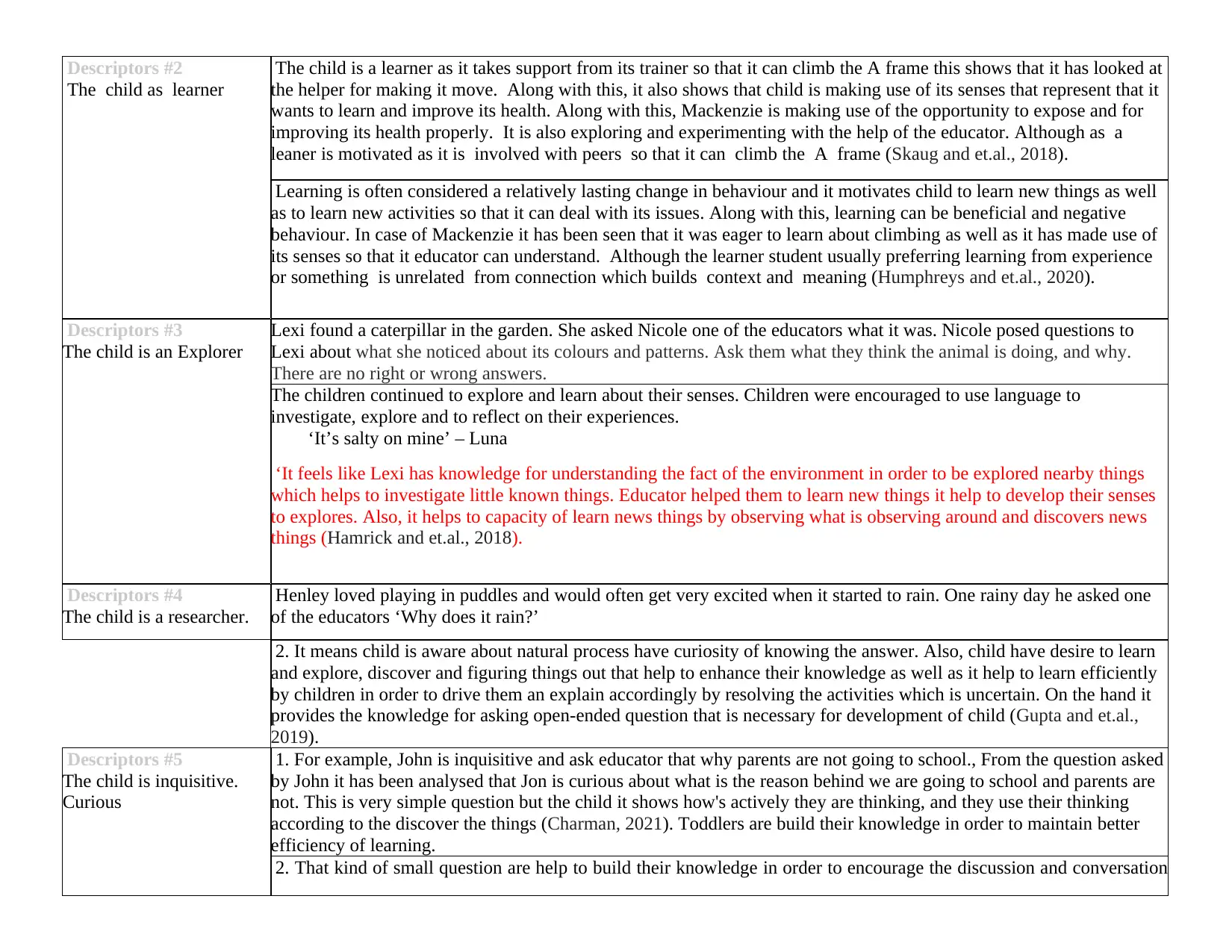
Descriptors #2
The child as learner
The child is a learner as it takes support from its trainer so that it can climb the A frame this shows that it has looked at
the helper for making it move. Along with this, it also shows that child is making use of its senses that represent that it
wants to learn and improve its health. Along with this, Mackenzie is making use of the opportunity to expose and for
improving its health properly. It is also exploring and experimenting with the help of the educator. Although as a
leaner is motivated as it is involved with peers so that it can climb the A frame (Skaug and et.al., 2018).
Learning is often considered a relatively lasting change in behaviour and it motivates child to learn new things as well
as to learn new activities so that it can deal with its issues. Along with this, learning can be beneficial and negative
behaviour. In case of Mackenzie it has been seen that it was eager to learn about climbing as well as it has made use of
its senses so that it educator can understand. Although the learner student usually preferring learning from experience
or something is unrelated from connection which builds context and meaning (Humphreys and et.al., 2020).
Descriptors #3
The child is an Explorer
Lexi found a caterpillar in the garden. She asked Nicole one of the educators what it was. Nicole posed questions to
Lexi about what she noticed about its colours and patterns. Ask them what they think the animal is doing, and why.
There are no right or wrong answers.
The children continued to explore and learn about their senses. Children were encouraged to use language to
investigate, explore and to reflect on their experiences.
‘It’s salty on mine’ – Luna
‘It feels like Lexi has knowledge for understanding the fact of the environment in order to be explored nearby things
which helps to investigate little known things. Educator helped them to learn new things it help to develop their senses
to explores. Also, it helps to capacity of learn news things by observing what is observing around and discovers news
things (Hamrick and et.al., 2018).
Descriptors #4
The child is a researcher.
Henley loved playing in puddles and would often get very excited when it started to rain. One rainy day he asked one
of the educators ‘Why does it rain?’
2. It means child is aware about natural process have curiosity of knowing the answer. Also, child have desire to learn
and explore, discover and figuring things out that help to enhance their knowledge as well as it help to learn efficiently
by children in order to drive them an explain accordingly by resolving the activities which is uncertain. On the hand it
provides the knowledge for asking open-ended question that is necessary for development of child (Gupta and et.al.,
2019).
Descriptors #5
The child is inquisitive.
Curious
1. For example, John is inquisitive and ask educator that why parents are not going to school., From the question asked
by John it has been analysed that Jon is curious about what is the reason behind we are going to school and parents are
not. This is very simple question but the child it shows how's actively they are thinking, and they use their thinking
according to the discover the things (Charman, 2021). Toddlers are build their knowledge in order to maintain better
efficiency of learning.
2. That kind of small question are help to build their knowledge in order to encourage the discussion and conversation
Document Page
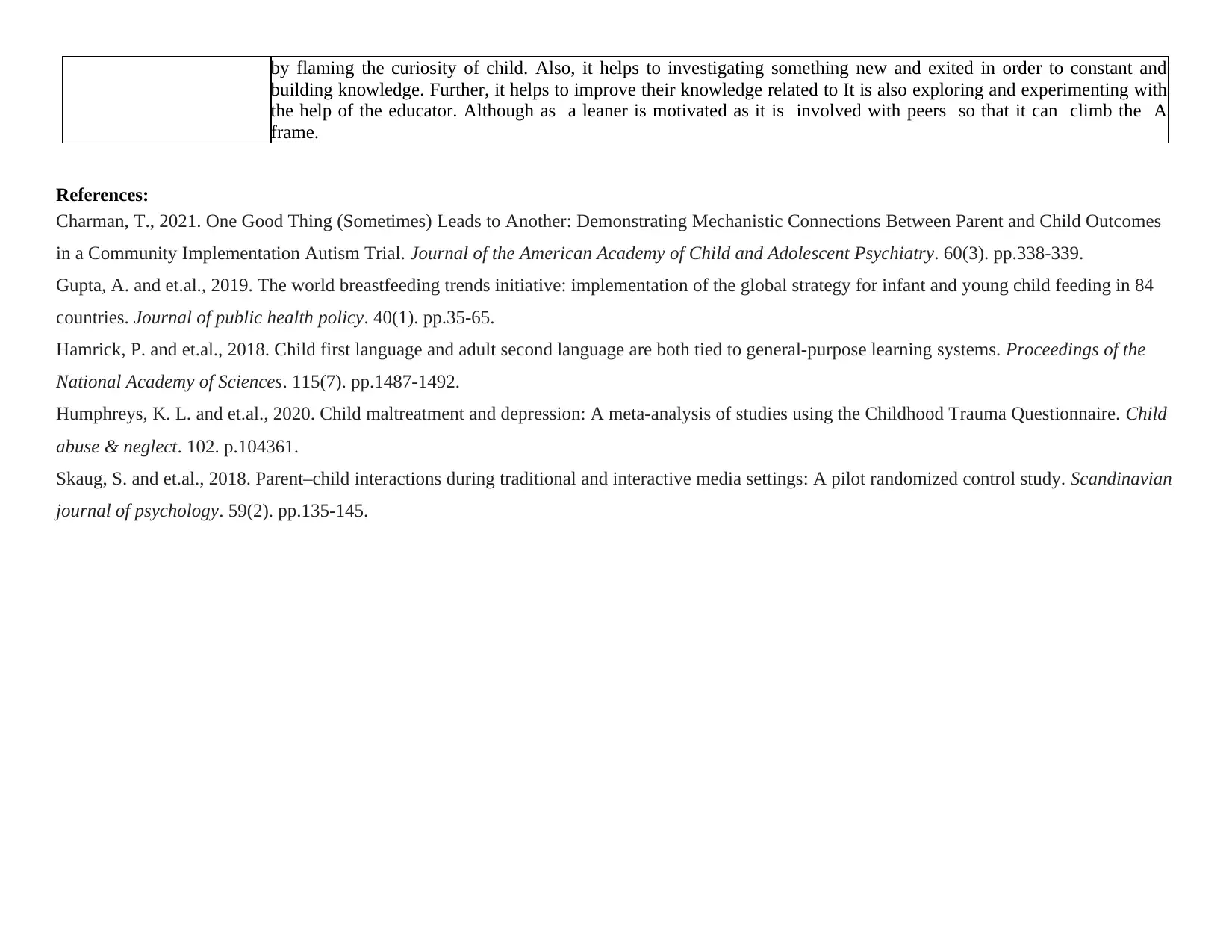
by flaming the curiosity of child. Also, it helps to investigating something new and exited in order to constant and
building knowledge. Further, it helps to improve their knowledge related to It is also exploring and experimenting with
the help of the educator. Although as a leaner is motivated as it is involved with peers so that it can climb the A
frame.
References:
Charman, T., 2021. One Good Thing (Sometimes) Leads to Another: Demonstrating Mechanistic Connections Between Parent and Child Outcomes
in a Community Implementation Autism Trial. Journal of the American Academy of Child and Adolescent Psychiatry. 60(3). pp.338-339.
Gupta, A. and et.al., 2019. The world breastfeeding trends initiative: implementation of the global strategy for infant and young child feeding in 84
countries. Journal of public health policy. 40(1). pp.35-65.
Hamrick, P. and et.al., 2018. Child first language and adult second language are both tied to general-purpose learning systems. Proceedings of the
National Academy of Sciences. 115(7). pp.1487-1492.
Humphreys, K. L. and et.al., 2020. Child maltreatment and depression: A meta-analysis of studies using the Childhood Trauma Questionnaire. Child
abuse & neglect. 102. p.104361.
Skaug, S. and et.al., 2018. Parent–child interactions during traditional and interactive media settings: A pilot randomized control study. Scandinavian
journal of psychology. 59(2). pp.135-145.
chevron_up_icon
1 out of 3
circle_padding
hide_on_mobile
zoom_out_icon
[object Object]