Child Care Report: Infectious Diseases, Data Protection, and Processes

Verified

Added on  2023/02/02

|5
|782
|67
Report
AI Summary
This report provides an overview of child care practices, focusing on two key areas: the exclusion periods for various infectious diseases and the processes employed to comply with data protection and information handling legislation within a child care setting. The report details exclusion periods for diseases like chicken pox, common cold, and influenza, highlighting the importance of preventing the spread of illness. It then outlines the implementation of data protection measures, including the secure storage of confidential information, adherence to the EYFS framework, staff training, and robust recruitment processes. The conclusion emphasizes the significance of child care in children's lives and summarizes the report's key findings regarding disease prevention and data compliance. References to supporting literature are also included.
Document Page
CHILD
CARE
tabler-icon-diamond-filled.svg

Paraphrase This Document

Need a fresh take? Get an instant paraphrase of this document with our AI Paraphraser
Document Page
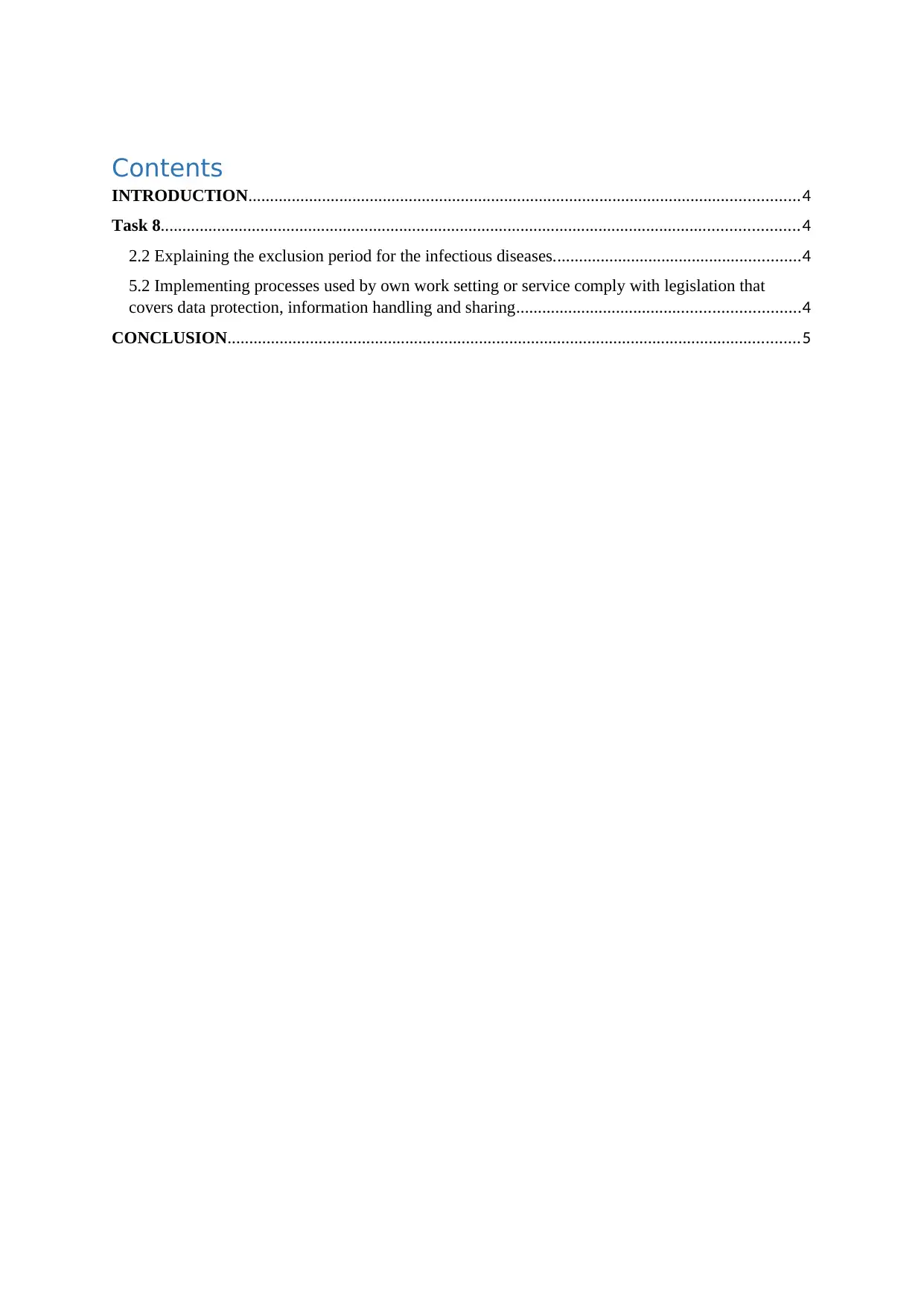
Contents
INTRODUCTION...............................................................................................................................4
Task 8...................................................................................................................................................4
2.2 Explaining the exclusion period for the infectious diseases.........................................................4
5.2 Implementing processes used by own work setting or service comply with legislation that
covers data protection, information handling and sharing.................................................................4
CONCLUSION....................................................................................................................................5
Document Page
INTRODUCTION
Present assignment is about the child care. Child care is a care or a supervision of a
child or multiple child at a time. Age of a child care ranges from sic weeks up to age thirteen.
The assignment will provide the exclusion period for various diseases. Report will also
present the processes used by own work setting or service comply with legislation that covers
data protection, information handling and sharing.
Task 8
2.2 Explaining the exclusion period for the infectious diseases.
The disorder caused by the organism such as bacteria, viruses, parasites and fungi.
Infectious diseases are those which are causes by organism like bacteria, viruses, fungi or
parasites. There are some infectious diseases which passes from one person to another. Some
of the diseases transmitted by insects or animals and some can be acquired from the ingesting
contaminated food or water. There symptoms vary depending on the organism causing the
infection. But commonly includes the fever and fatigue (Bauernschuster and Schlotter, 2015).
There are various infectious diseases which can be prevented by vaccine like measles and
chicken pox. Exclusion periods of the diseases depends upon the time with a specific disease
might be infectious to others.
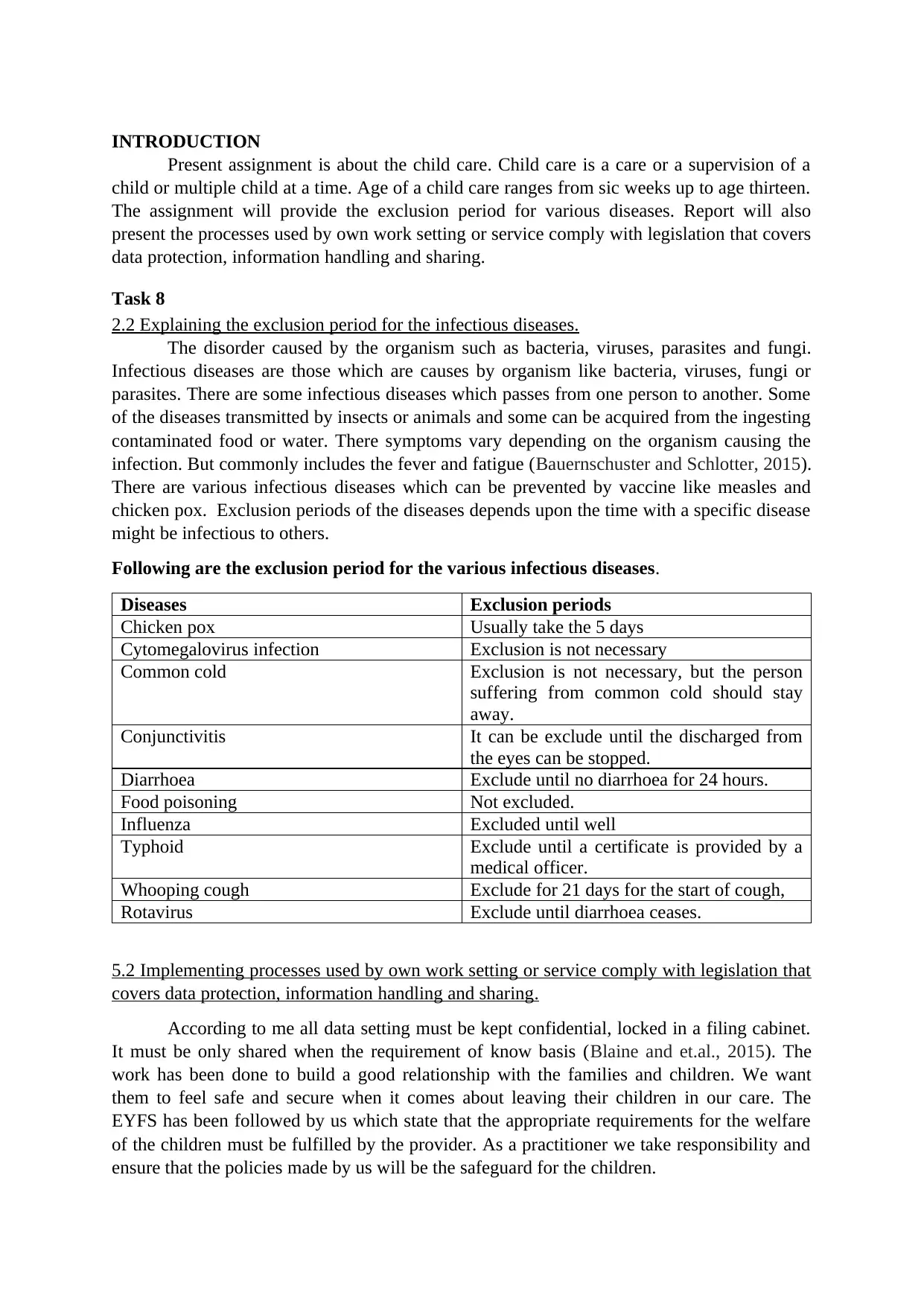
Following are the exclusion period for the various infectious diseases.
Diseases Exclusion periods
Chicken pox Usually take the 5 days
Cytomegalovirus infection Exclusion is not necessary
Common cold Exclusion is not necessary, but the person
suffering from common cold should stay
away.
Conjunctivitis It can be exclude until the discharged from
the eyes can be stopped.
Diarrhoea Exclude until no diarrhoea for 24 hours.
Food poisoning Not excluded.
Influenza Excluded until well
Typhoid Exclude until a certificate is provided by a
medical officer.
Whooping cough Exclude for 21 days for the start of cough,
Rotavirus Exclude until diarrhoea ceases.
5.2 Implementing processes used by own work setting or service comply with legislation that
covers data protection, information handling and sharing.
According to me all data setting must be kept confidential, locked in a filing cabinet.
It must be only shared when the requirement of know basis (Blaine and et.al., 2015). The
work has been done to build a good relationship with the families and children. We want
them to feel safe and secure when it comes about leaving their children in our care. The
EYFS has been followed by us which state that the appropriate requirements for the welfare
of the children must be fulfilled by the provider. As a practitioner we take responsibility and
ensure that the policies made by us will be the safeguard for the children.
Document Page
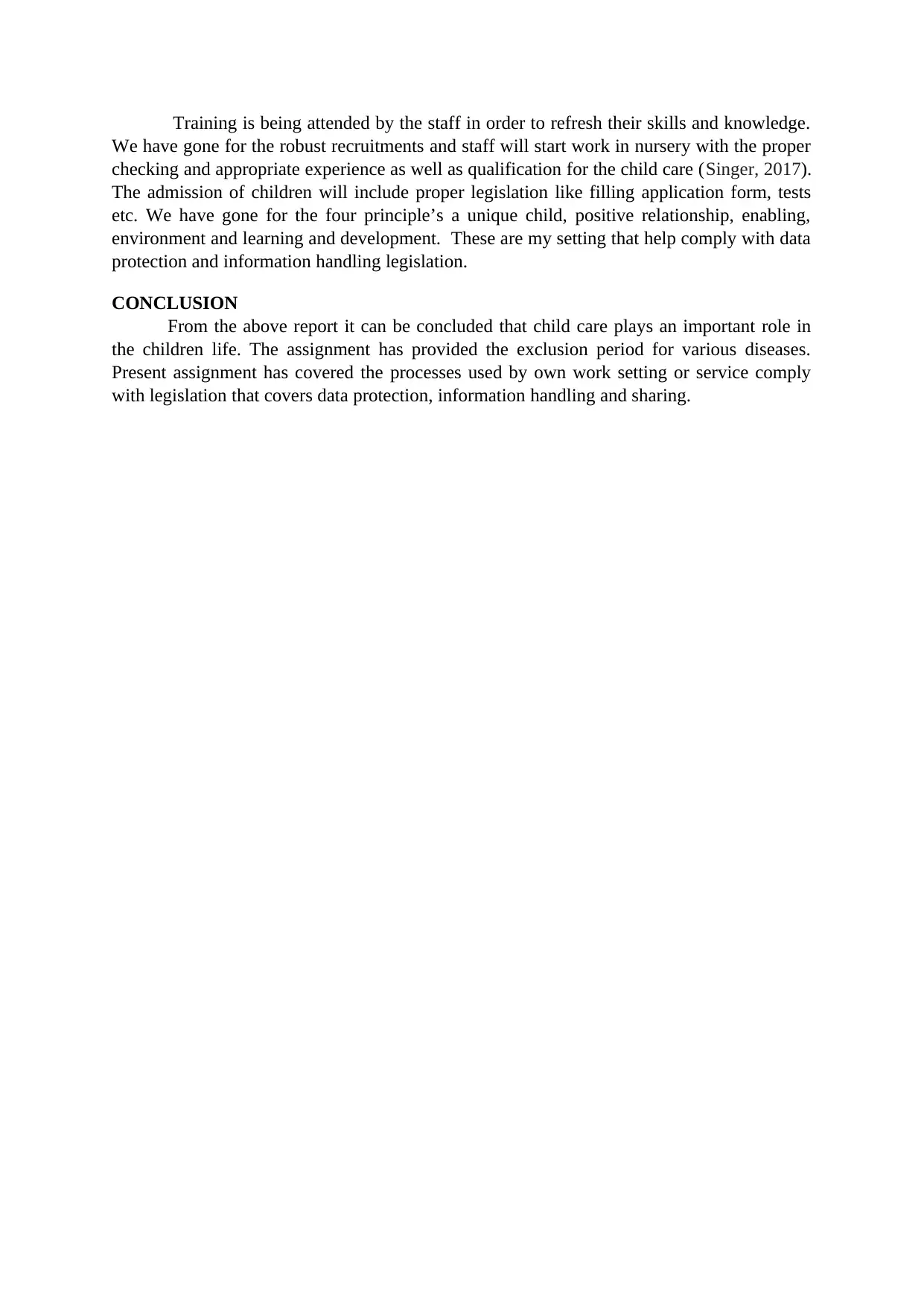
Training is being attended by the staff in order to refresh their skills and knowledge.
We have gone for the robust recruitments and staff will start work in nursery with the proper
checking and appropriate experience as well as qualification for the child care (Singer, 2017).
The admission of children will include proper legislation like filling application form, tests
etc. We have gone for the four principle’s a unique child, positive relationship, enabling,
environment and learning and development. These are my setting that help comply with data
protection and information handling legislation.
CONCLUSION
From the above report it can be concluded that child care plays an important role in
the children life. The assignment has provided the exclusion period for various diseases.
Present assignment has covered the processes used by own work setting or service comply
with legislation that covers data protection, information handling and sharing.
tabler-icon-diamond-filled.svg

Paraphrase This Document

Need a fresh take? Get an instant paraphrase of this document with our AI Paraphraser
Document Page
REFERENCES
Books and Journals
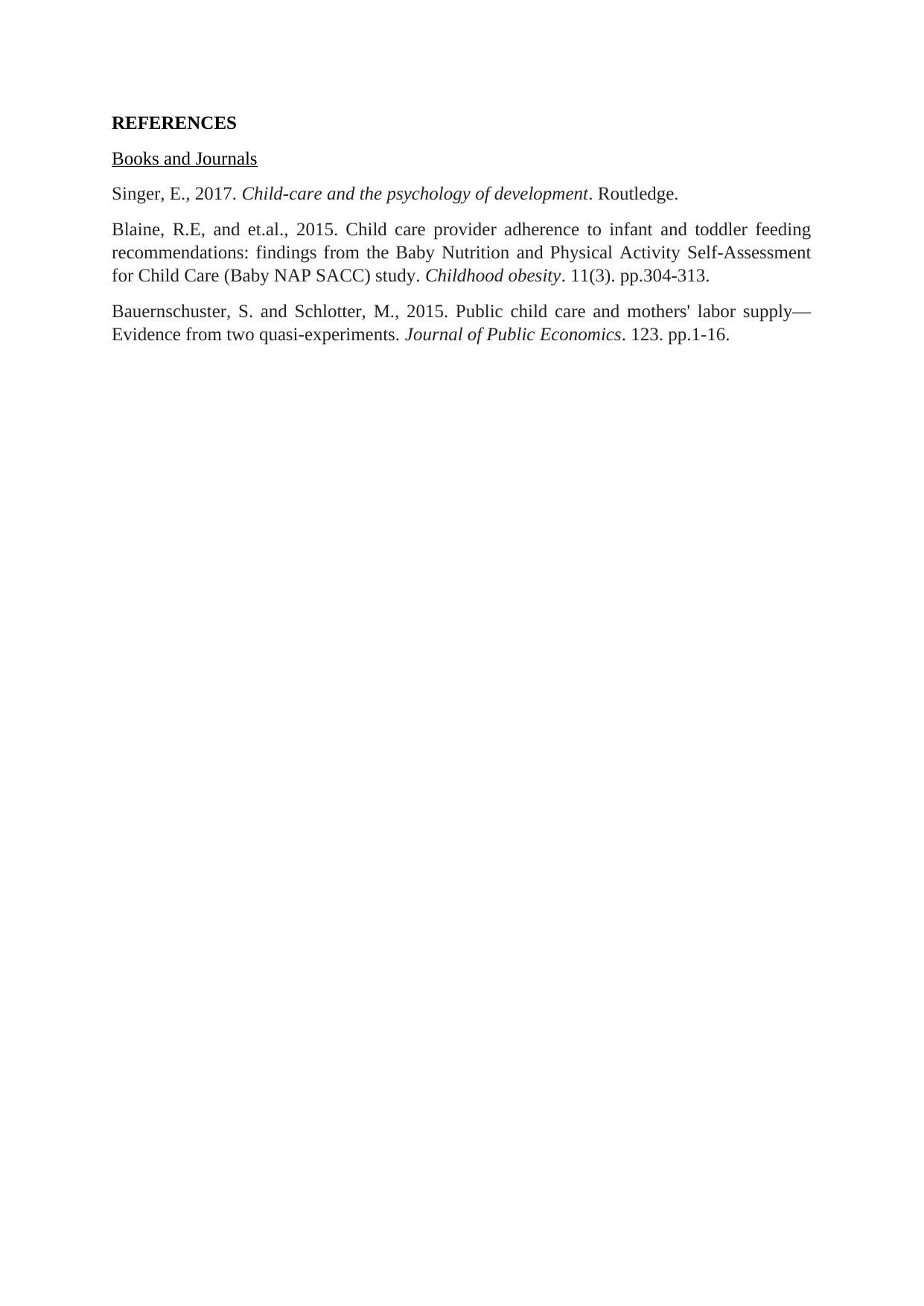
Singer, E., 2017. Child-care and the psychology of development. Routledge.
Blaine, R.E, and et.al., 2015. Child care provider adherence to infant and toddler feeding
recommendations: findings from the Baby Nutrition and Physical Activity Self-Assessment
for Child Care (Baby NAP SACC) study. Childhood obesity. 11(3). pp.304-313.
Bauernschuster, S. and Schlotter, M., 2015. Public child care and mothers' labor supply—
Evidence from two quasi-experiments. Journal of Public Economics. 123. pp.1-16.
chevron_up_icon
1 out of 5
circle_padding
hide_on_mobile
zoom_out_icon
[object Object]