Child Development, Learning Styles, and Learning Taxonomies - Module 2

Verified

Added on  2022/08/12

|12
|2080
|17
Homework Assignment
AI Summary
This assignment delves into the core concepts of child development, learning styles, and learning taxonomies, providing a comprehensive overview for aspiring educators. It begins by emphasizing the significance of understanding child development for teachers, highlighting the importance of recognizing developmental stages, individual differences, and potential abnormalities. The assignment then contrasts growth and development, and outlines the key stages of child development including physical, perceptual, cognitive, language, social, emotional, and moral development. It also examines various theories of child development (Gesell, Freud, Piaget, Skinner, and Social Learning), and their impact on a child's learning. The assignment further explores the concept of learning styles, analyzing models like VAK, Kolb, and Felder-Silverman, and discusses how to integrate these styles into teaching practices. Finally, it compares and contrasts different learning taxonomies, particularly Bloom's Taxonomy and its revised version, illustrating their application in teaching and learning, and concludes by discussing thinking skills levels and the importance of tailoring learning outcomes to these levels.
Document Page
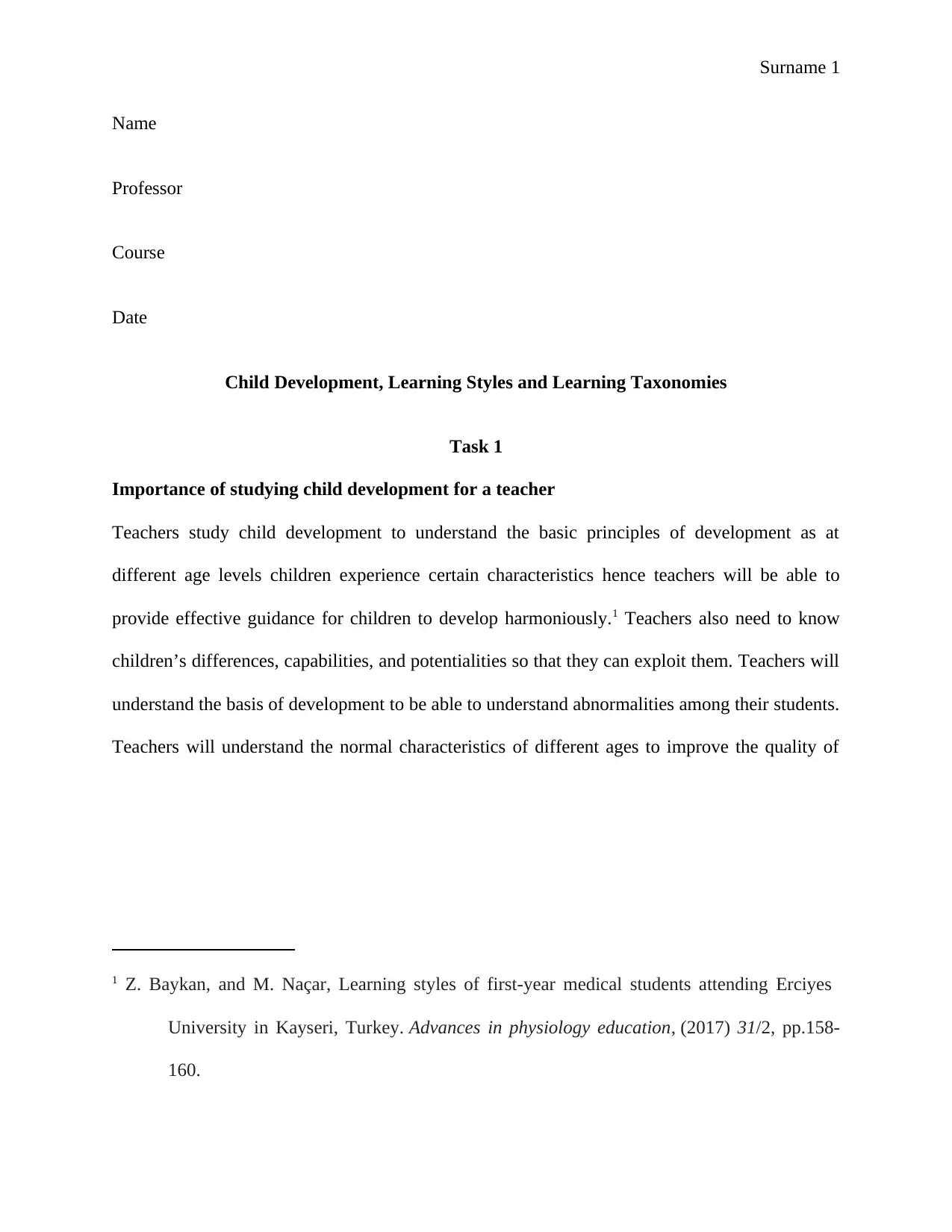
Surname 1
Name
Professor
Course
Date
Child Development, Learning Styles and Learning Taxonomies
Task 1
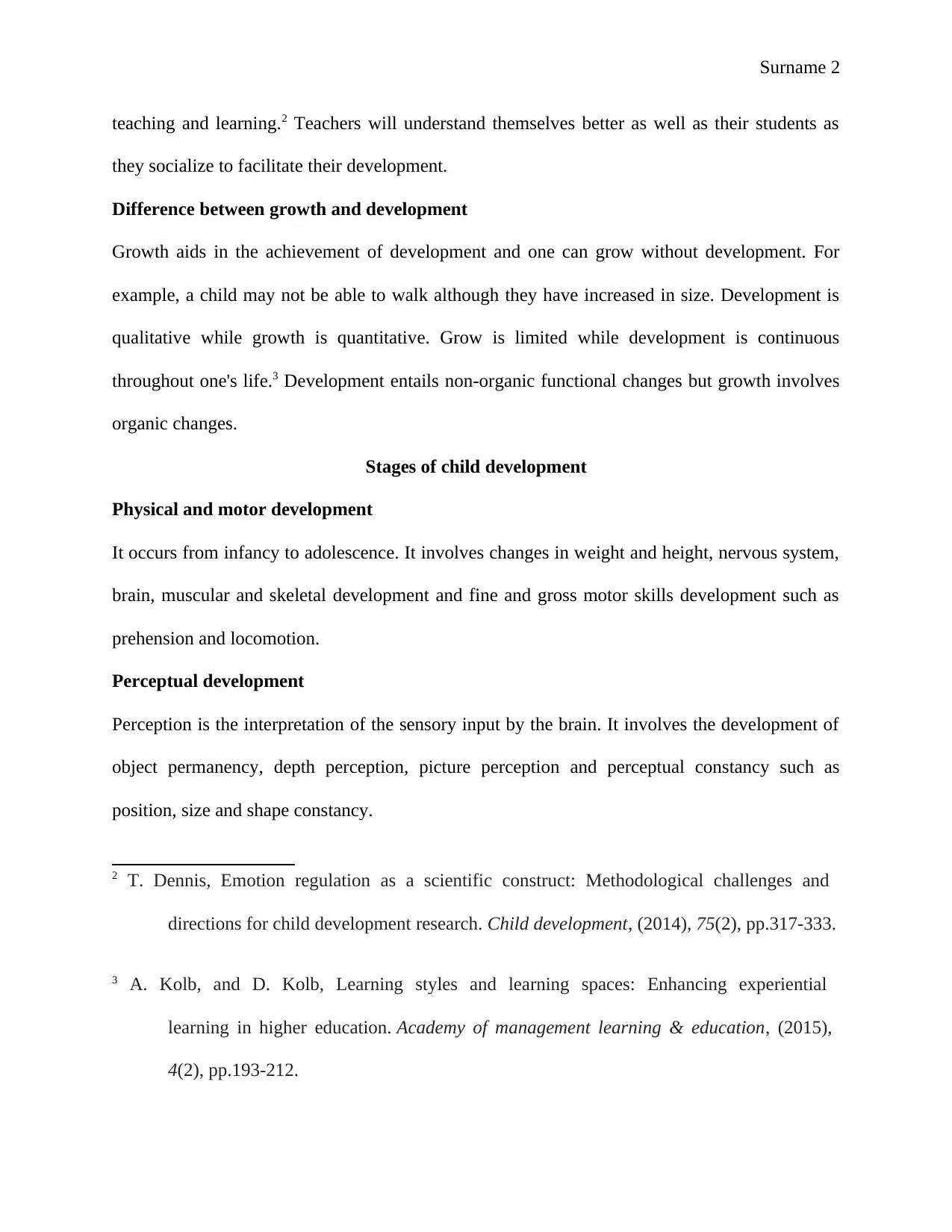
Importance of studying child development for a teacher
Teachers study child development to understand the basic principles of development as at
different age levels children experience certain characteristics hence teachers will be able to
provide effective guidance for children to develop harmoniously.1 Teachers also need to know
children’s differences, capabilities, and potentialities so that they can exploit them. Teachers will
understand the basis of development to be able to understand abnormalities among their students.
Teachers will understand the normal characteristics of different ages to improve the quality of
1 Z. Baykan, and M. Naçar, Learning styles of first-year medical students attending Erciyes
University in Kayseri, Turkey. Advances in physiology education, (2017) 31/2, pp.158-
160.
tabler-icon-diamond-filled.svg

Paraphrase This Document

Need a fresh take? Get an instant paraphrase of this document with our AI Paraphraser
Document Page
Surname 2
teaching and learning.2 Teachers will understand themselves better as well as their students as
they socialize to facilitate their development.
Difference between growth and development
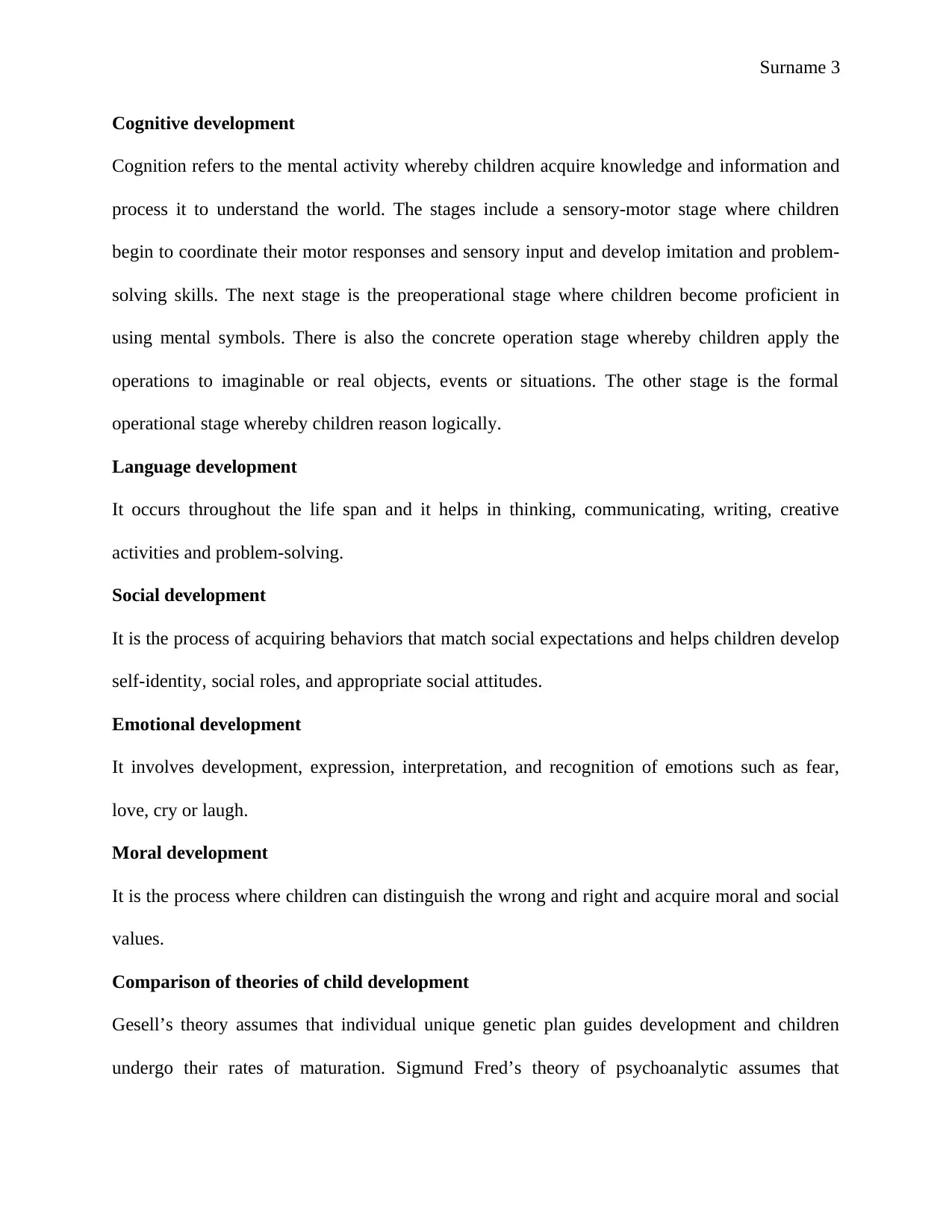
Growth aids in the achievement of development and one can grow without development. For
example, a child may not be able to walk although they have increased in size. Development is
qualitative while growth is quantitative. Grow is limited while development is continuous
throughout one's life.3 Development entails non-organic functional changes but growth involves
organic changes.
Stages of child development
Physical and motor development
It occurs from infancy to adolescence. It involves changes in weight and height, nervous system,
brain, muscular and skeletal development and fine and gross motor skills development such as
prehension and locomotion.
Perceptual development
Perception is the interpretation of the sensory input by the brain. It involves the development of
object permanency, depth perception, picture perception and perceptual constancy such as
position, size and shape constancy.
2 T. Dennis, Emotion regulation as a scientific construct: Methodological challenges and
directions for child development research. Child development, (2014), 75(2), pp.317-333.
3 A. Kolb, and D. Kolb, Learning styles and learning spaces: Enhancing experiential
learning in higher education. Academy of management learning & education, (2015),
4(2), pp.193-212.
Document Page
Surname 3
Cognitive development
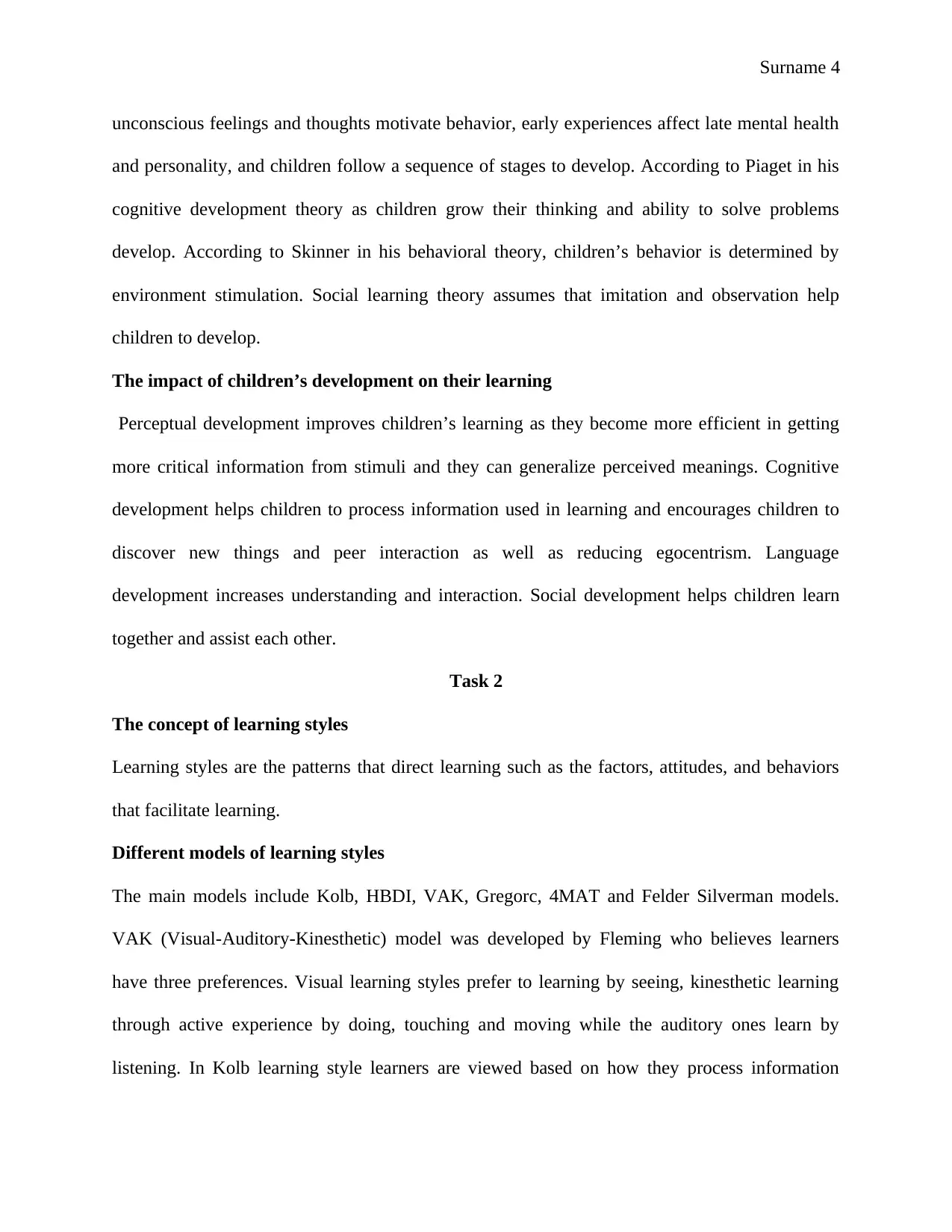
Cognition refers to the mental activity whereby children acquire knowledge and information and
process it to understand the world. The stages include a sensory-motor stage where children
begin to coordinate their motor responses and sensory input and develop imitation and problem-
solving skills. The next stage is the preoperational stage where children become proficient in
using mental symbols. There is also the concrete operation stage whereby children apply the
operations to imaginable or real objects, events or situations. The other stage is the formal
operational stage whereby children reason logically.
Language development
It occurs throughout the life span and it helps in thinking, communicating, writing, creative
activities and problem-solving.
Social development
It is the process of acquiring behaviors that match social expectations and helps children develop
self-identity, social roles, and appropriate social attitudes.
Emotional development
It involves development, expression, interpretation, and recognition of emotions such as fear,
love, cry or laugh.
Moral development
It is the process where children can distinguish the wrong and right and acquire moral and social
values.
Comparison of theories of child development
Gesell’s theory assumes that individual unique genetic plan guides development and children
undergo their rates of maturation. Sigmund Fred’s theory of psychoanalytic assumes that
Document Page
Surname 4
unconscious feelings and thoughts motivate behavior, early experiences affect late mental health
and personality, and children follow a sequence of stages to develop. According to Piaget in his
cognitive development theory as children grow their thinking and ability to solve problems
develop. According to Skinner in his behavioral theory, children’s behavior is determined by
environment stimulation. Social learning theory assumes that imitation and observation help
children to develop.
The impact of children’s development on their learning
Perceptual development improves children’s learning as they become more efficient in getting
more critical information from stimuli and they can generalize perceived meanings. Cognitive
development helps children to process information used in learning and encourages children to
discover new things and peer interaction as well as reducing egocentrism. Language
development increases understanding and interaction. Social development helps children learn
together and assist each other.
Task 2
The concept of learning styles
Learning styles are the patterns that direct learning such as the factors, attitudes, and behaviors
that facilitate learning.
Different models of learning styles
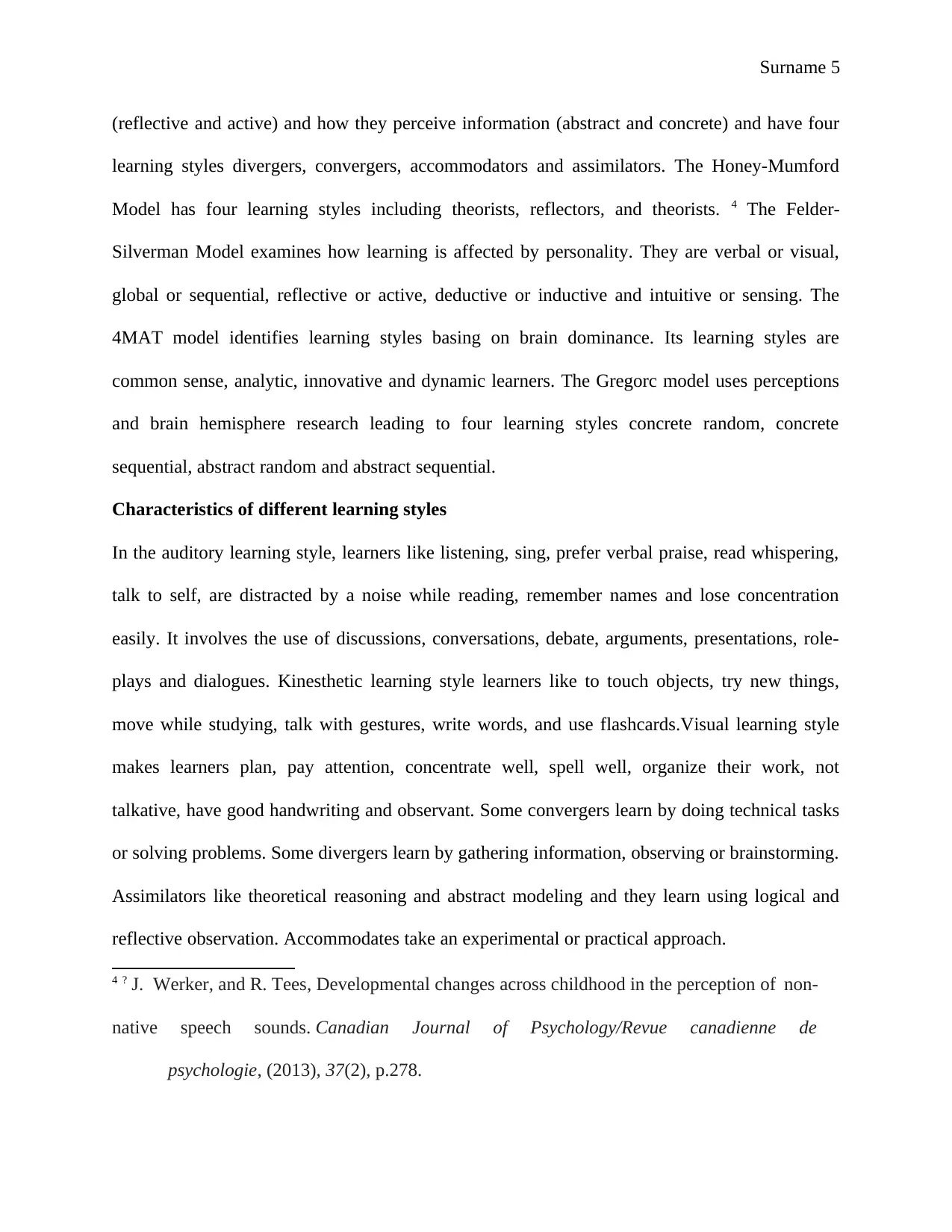
The main models include Kolb, HBDI, VAK, Gregorc, 4MAT and Felder Silverman models.
VAK (Visual-Auditory-Kinesthetic) model was developed by Fleming who believes learners
have three preferences. Visual learning styles prefer to learning by seeing, kinesthetic learning
through active experience by doing, touching and moving while the auditory ones learn by
listening. In Kolb learning style learners are viewed based on how they process information
tabler-icon-diamond-filled.svg

Paraphrase This Document

Need a fresh take? Get an instant paraphrase of this document with our AI Paraphraser
Document Page
Surname 5
(reflective and active) and how they perceive information (abstract and concrete) and have four
learning styles divergers, convergers, accommodators and assimilators. The Honey-Mumford
Model has four learning styles including theorists, reflectors, and theorists. 4 The Felder-
Silverman Model examines how learning is affected by personality. They are verbal or visual,
global or sequential, reflective or active, deductive or inductive and intuitive or sensing. The
4MAT model identifies learning styles basing on brain dominance. Its learning styles are
common sense, analytic, innovative and dynamic learners. The Gregorc model uses perceptions
and brain hemisphere research leading to four learning styles concrete random, concrete
sequential, abstract random and abstract sequential.
Characteristics of different learning styles
In the auditory learning style, learners like listening, sing, prefer verbal praise, read whispering,
talk to self, are distracted by a noise while reading, remember names and lose concentration
easily. It involves the use of discussions, conversations, debate, arguments, presentations, role-
plays and dialogues. Kinesthetic learning style learners like to touch objects, try new things,
move while studying, talk with gestures, write words, and use flashcards.Visual learning style
makes learners plan, pay attention, concentrate well, spell well, organize their work, not
talkative, have good handwriting and observant. Some convergers learn by doing technical tasks
or solving problems. Some divergers learn by gathering information, observing or brainstorming.
Assimilators like theoretical reasoning and abstract modeling and they learn using logical and
reflective observation. Accommodates take an experimental or practical approach.
4 ? J. Werker, and R. Tees, Developmental changes across childhood in the perception of non-
native speech sounds. Canadian Journal of Psychology/Revue canadienne de
psychologie, (2013), 37(2), p.278.
Document Page
Surname 6
How to integrate learning styles in teaching
To integrate the learning styles teachers need to use various teaching strategies such as using
visual aids, use pictures, emphasize key points using bold letters, use discussions and encourage
problem-solving tasks. They can also use mnemonic devices, role plays, group works, ask the
class to read aloud, use summaries, encourage inquiry Veness and incorporate questions during
lessons5. They can also ask for conclusions from students, give critical thinking exercise, give
personal assignments, and encourage them to draw, use physical exercises, provide real-life
examples and use experiments.
Task 3
Compare and contrast different learning taxonomies
Differences
Bloom taxonomy Bloom’s revised
taxonomy
6 facets SOLO taxonomy Fink’s taxonomy
application creating Explain Extended abstract Foundational
knowledge
Evaluation Evaluating Interpret Multistructural Application
Synthesis Analyzing Apply Unistructural Intergration
Analysis Applying Have perspective prestructural Human
dimensions
Comprehension Understanding emphathize Caring
5 C. Wolman, Thinking styles: teaching and learning styles in graduate education
students. Educational Psychology, (2010), 30(7), pp.837-848.
Document Page
Surname 7
Knowledge Remebering Have self
knowledge
Learning to learn
Similarities
1. Both Bloom’s taxonomy, Blooms revised taxonomy, six facets and Fink taxonomy have
an application
2. Both Bloom’s and Bloom’s revised taxonomies have an evaluation, analysis, and
application.
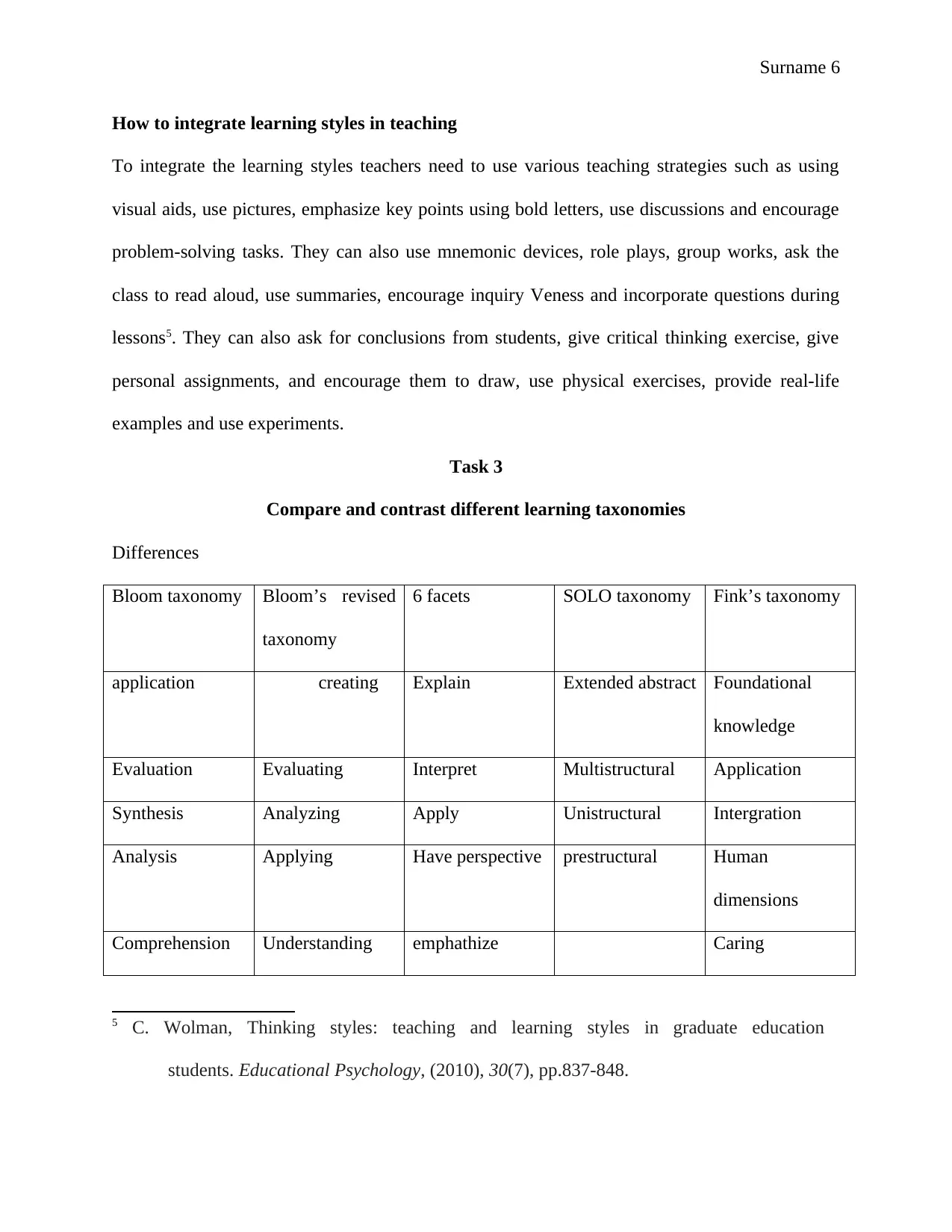
The evolution of bloom taxonomy
https://qph.fs.quoracdn.net/main-qimg-cdd9f5c66a3b775eefd6096fa77fc816
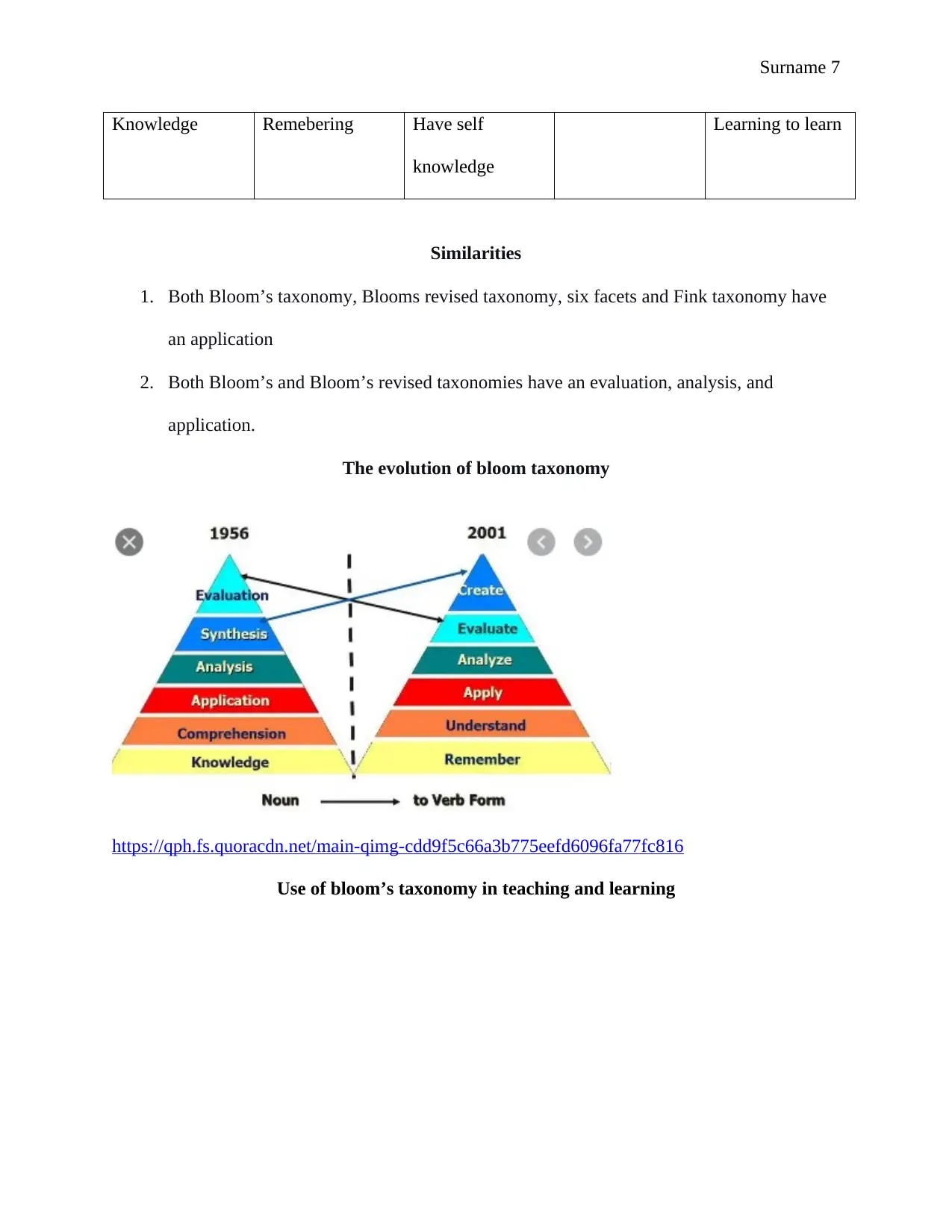
Use of bloom’s taxonomy in teaching and learning
tabler-icon-diamond-filled.svg

Paraphrase This Document

Need a fresh take? Get an instant paraphrase of this document with our AI Paraphraser
Document Page
Surname 8
https://lh3.googleusercontent.com/proxy/-DfU6eJ-
6LLGbTLQTeKkM5eZ9i6w9mpcJcv0T1EuupQaOD3ZhGFiyRFxzmgqPYqx0_d90KhclRP7_6
KZsRhtMgIics9wxADDJ0L66tveDQB7cUZfh1UcuNrrAWC7excSYHIM1jEf1A
https://s3.amazonaws.com/vuweb-s3-vuwebstaticassets-1i6c9zhn31ti6/vu-wp0/wp-content/
uploads/sites/59/2019/03/27124326/Blooms-Taxonomy-650x366.jpg
Document Page
Surname 9
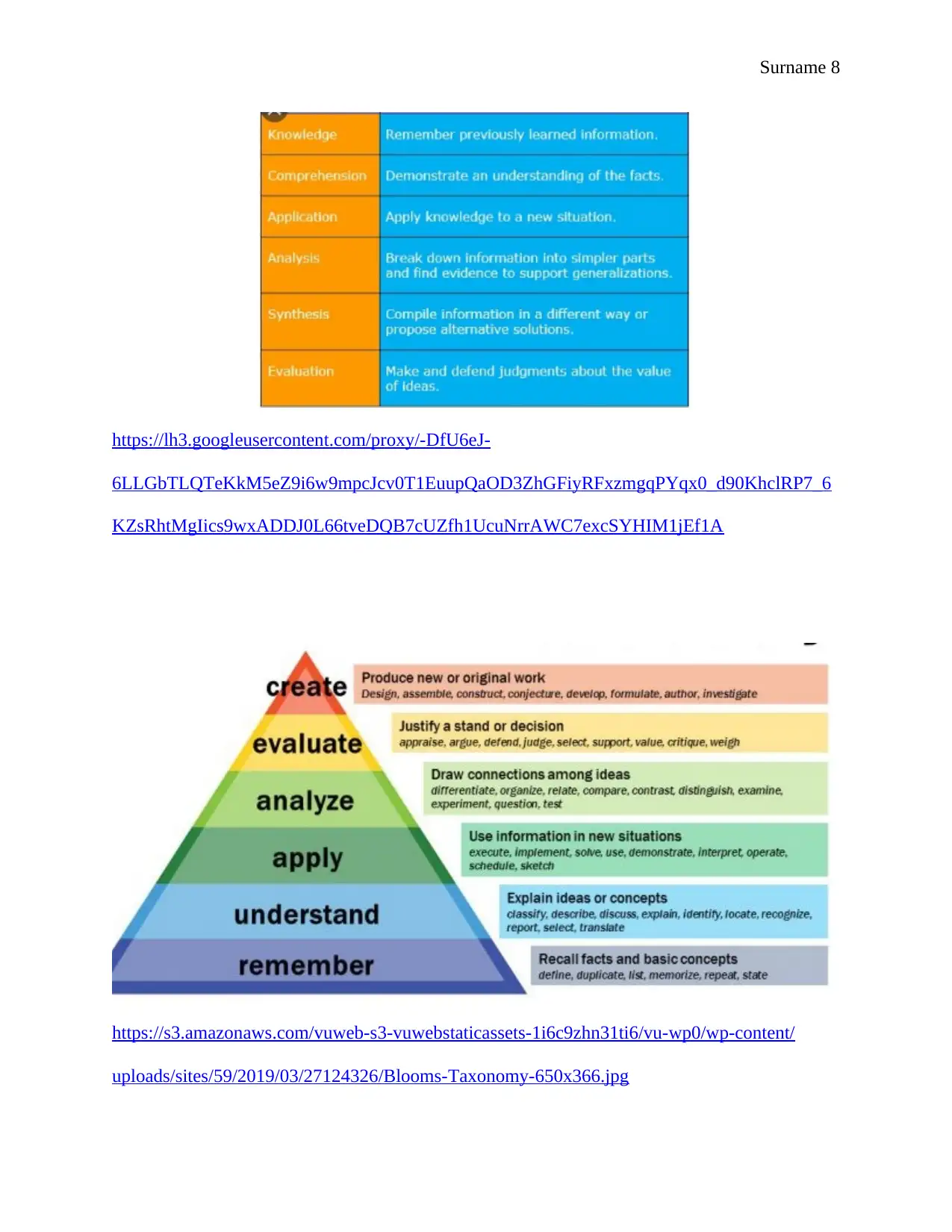
Difference between bloom’s taxonomy and Revised Bloom’s taxonomy
https://miro.medium.com/max/1456/1*eh_JkH4m56h3OrRdCLXY7Q.png
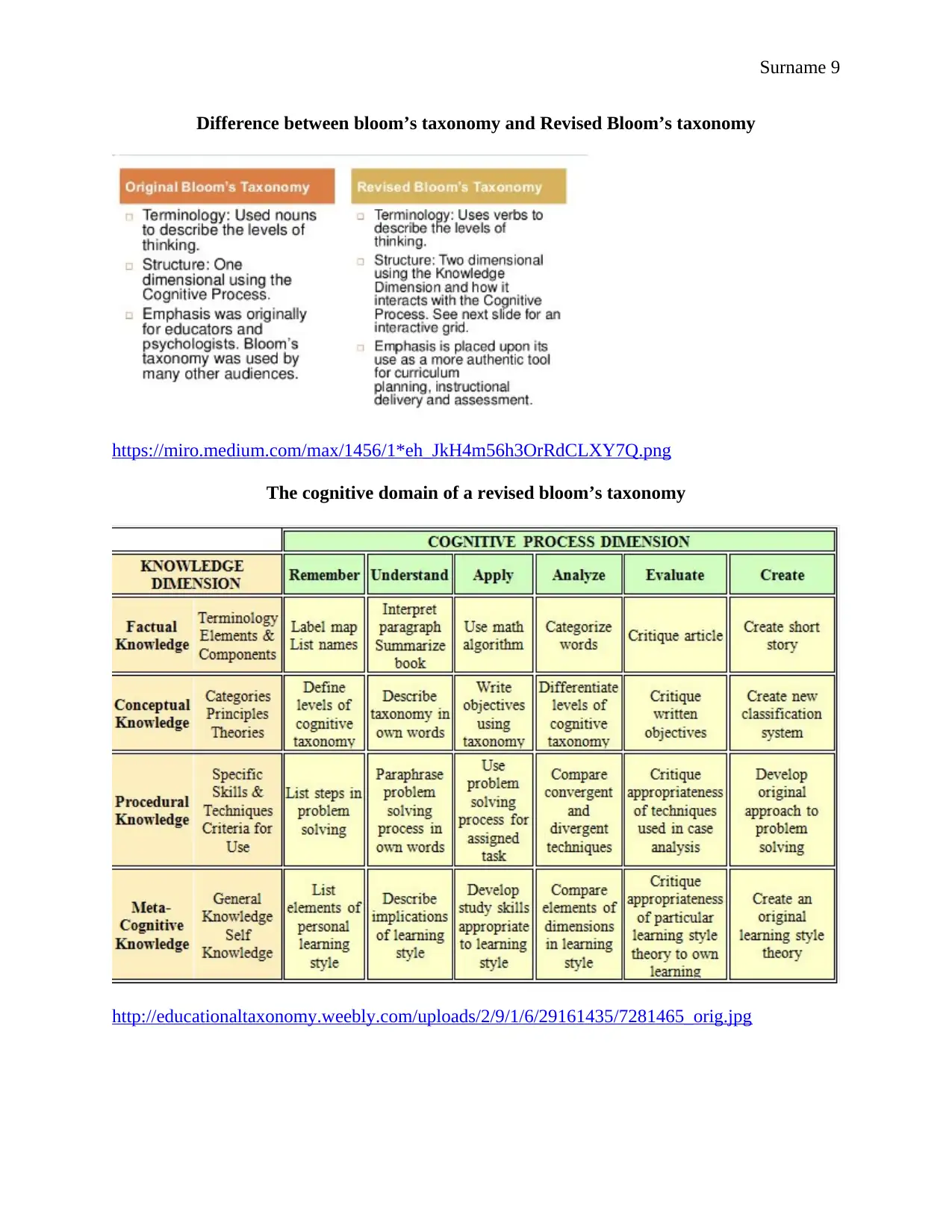
The cognitive domain of a revised bloom’s taxonomy
http://educationaltaxonomy.weebly.com/uploads/2/9/1/6/29161435/7281465_orig.jpg
Document Page
Surname 10
Task 4
a.Thinking skills levels
Knowledge: It is acquiring basic information. Teachers ask students to describe, list, define, state
and identify to improve their thinking at this level.
Comprehension
It involves getting the meaning of acquired knowledge and drawing conclusions. Teachers ask
compare, discuss, explain, group or summarize.
Application
It involves using learned knowledge in new situations. Teachers ask experiments, demonstrate,
discover, show or solve.
Analysis
Students are encouraged to think about a whole concept from its parts. Teachers ask compare,
outline, and contrast, analyze or classify.
Synthesis
Students connect different ideas to form a whole concept. Teachers asked to create, anticipate,
express, adapt or plan.
Evaluation
It involves making judgments and comparisons. Teachers ask to assess, conclude, convince,
grade, summarize, justify or support to encourage this level.
b. Individual students thinking skills
I have worked with a student who has six thinking skills. Some students had developed critical
thinking skills as they could connect ideas logically and engage in independent and reflective
tabler-icon-diamond-filled.svg

Paraphrase This Document

Need a fresh take? Get an instant paraphrase of this document with our AI Paraphraser
Document Page
Surname 11
thinking. Students could identify and determine the relevance and importance of ideas. Others
could systematically and consistently approach problems and identify errors in reasoning.
C. Learning outcomes
1. Students who had the knowledge skill should be able to define concepts
2. Students at the comprehension level should be able to describe concepts.
3. Students at the application level should be able to calculate/show or solve problems.
4. Students with analysis skills should be able to compare, illustrate or connect concepts.
5. Students with synthesis skills should be able to validate create or formulate ideas.
6. Students with evaluation skills should defend, criticize, judge, justify or assess concepts.
Document Page
Surname 12
References
Baykan, Z, and Melis N. "Learning styles of first-year medical students attending Erciyes
University in Kayseri, Turkey." Advances in physiology education 31/2 (2007): pp.158-
160.
Dennis, T. Emotion regulation as a scientific construct: Methodological challenges and
directions for child development research. Child development, (2014), 75(2), pp.317-
333.
Kolb, A. and Kolb, D. Learning styles and learning spaces: Enhancing experiential
learning in higher education. Academy of management learning & education, (2015),
4(2), pp.193-212.
Werker, J. and Tees, R. Developmental changes across childhood in the perception of non-
native speech sounds. Canadian Journal of Psychology/Revue canadienne de
psychologie, (2013), 37(2), p.278.
Wolman, C. Thinking styles: teaching and learning styles in graduate education
students. Educational Psychology, (2010), 30(7), pp.837-848.
chevron_up_icon
1 out of 12
circle_padding
hide_on_mobile
zoom_out_icon
[object Object]