Child Labour vs. Poverty: A Case Study Report on the Dilemma
VerifiedAdded on 2022/11/29
|9
|2516
|118
Report
AI Summary
This report delves into the complex and controversial issue of child labour, specifically examining the argument that it can be a preferable alternative to abject poverty. The report begins with an executive summary and an introduction that outlines the scope of the study. It then presents findings related to the issues of child labour and poverty, drawing on various sources to define these concepts and highlight their interconnectedness. The report explores arguments both for and against child labour, acknowledging the ethical implications while also considering the economic realities faced by impoverished families. It discusses the challenges of enforcing complete or partial bans on child labour, considering social, economic, legal, and organizational factors. Potential solutions, such as creating awareness, educating people, and providing support to children, are also presented. The report concludes by summarizing the key findings and reiterating the ethical inappropriateness of child labour, while also acknowledging the difficult circumstances in which it may arise. The report is supported by a comprehensive list of references.
Child labour is
better than living
in poverty
better than living
in poverty

Paraphrase This Document
Need a fresh take? Get an instant paraphrase of this document with our AI Paraphraser
Executive Summary
The study initiates to determine the Child labour is better than living in poverty, thus this is
a wide area of study and the report mainly contains the aspect of child labour and poverty and its
impact over the society. Thus, child labour is ethically inappropriate in any situation if child
labour is for filling the basic need of their family. There is assorted reason of child labour like
lack of education, poverty, individual need and so on. Child labour in the case of living is
poverty is better but it is unethical in nature so the people of family needs be concern over
managing the childhood of the kid as it has direct impact over the emotional and physical ability
of child.
The study initiates to determine the Child labour is better than living in poverty, thus this is
a wide area of study and the report mainly contains the aspect of child labour and poverty and its
impact over the society. Thus, child labour is ethically inappropriate in any situation if child
labour is for filling the basic need of their family. There is assorted reason of child labour like
lack of education, poverty, individual need and so on. Child labour in the case of living is
poverty is better but it is unethical in nature so the people of family needs be concern over
managing the childhood of the kid as it has direct impact over the emotional and physical ability
of child.
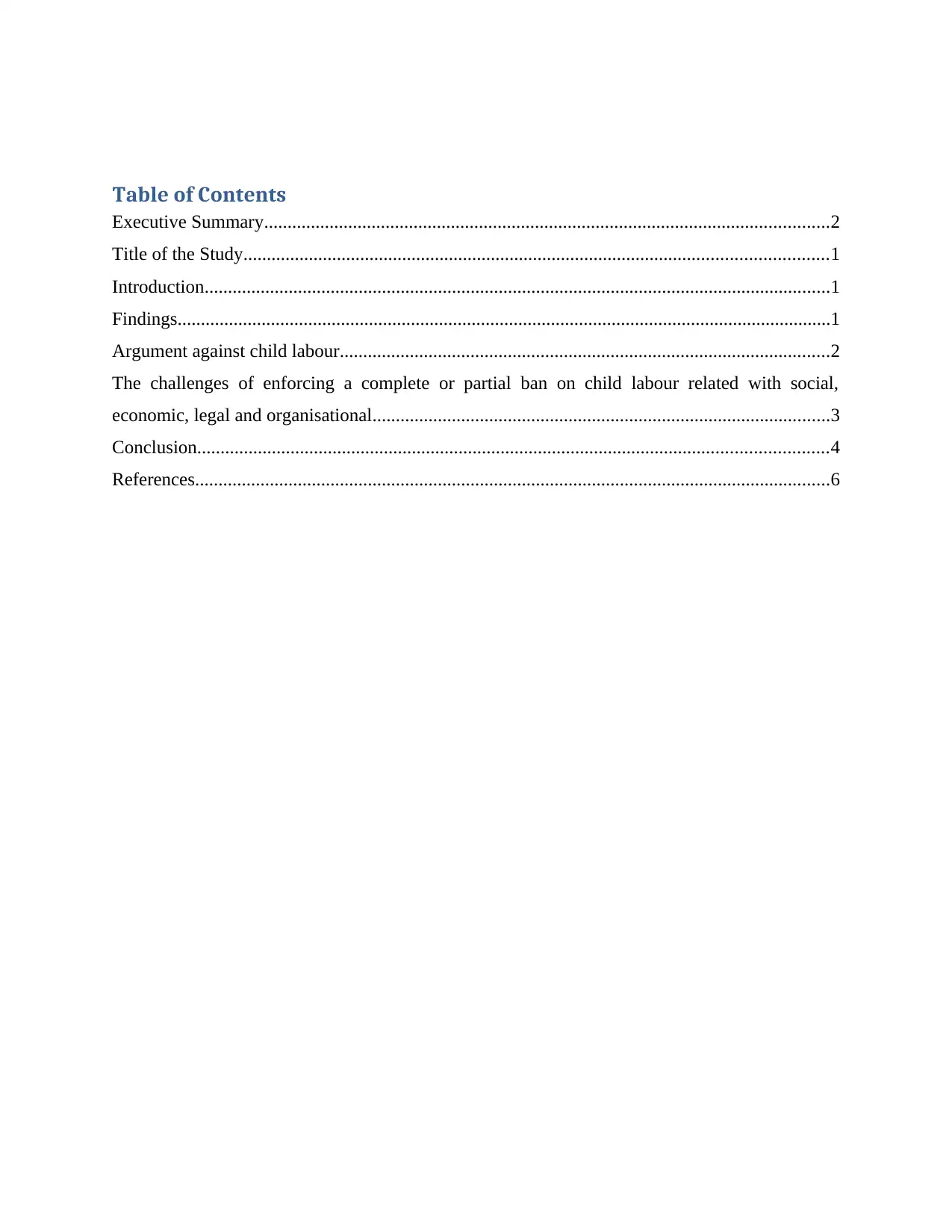
Table of Contents
Executive Summary.........................................................................................................................2
Title of the Study.............................................................................................................................1
Introduction......................................................................................................................................1
Findings............................................................................................................................................1
Argument against child labour.........................................................................................................2
The challenges of enforcing a complete or partial ban on child labour related with social,
economic, legal and organisational..................................................................................................3
Conclusion.......................................................................................................................................4
References........................................................................................................................................6
Executive Summary.........................................................................................................................2
Title of the Study.............................................................................................................................1
Introduction......................................................................................................................................1
Findings............................................................................................................................................1
Argument against child labour.........................................................................................................2
The challenges of enforcing a complete or partial ban on child labour related with social,
economic, legal and organisational..................................................................................................3
Conclusion.......................................................................................................................................4
References........................................................................................................................................6
⊘ This is a preview!⊘
Do you want full access?
Subscribe today to unlock all pages.

Trusted by 1+ million students worldwide
Title of the Study
Child labour is better than living in poverty.
Introduction
The study initiated to analyse the aspect of child labour is better than living in poverty, therefore,
many individual in the society think that each child is mainly entitled to their childhood, which
allows them to make friends, have fun, and attend school. Develop social and ethical skills and
so on. Hence, in the few phases of the world here are few circumstances that enable kids to freely
enjoy their life as they are forced to work or in the urge of doing work to provide themselves and
their families (Bartlett and et.al., 2016). Different individual has different opinion about the
controversy and the study further contains suitable idea about child labour is better than living in
poverty.
Findings
Issues related to child labour and poverty.
According to the views of Srivastav (2011), Child is the future resident of the Nation and
their sufficient improvement is most extreme need of the country. Accordingly, the term kid
work is characterized as a work which denies of their youth, their latent capacity and their poise
and which affects the physical and mental development of children. On the other hand poverty
mainly defined to the lack of sources that renders necessities of life which includes food, clean
water, haven and attire. However, in this day and age, that can be extensive to include admittance
to medical care, instruction and even transportation (Leadley, Hocking and Jones, 2020). There
are assorted issues associated with child labour and poverty as these two are termed as the major
issue which affects the living of people and also influencing the economic condition of the
country. The issues of child labour and poverty involve mental heal issue, absence of respectable
work openings for grown-ups and young people, movement and crises, generating social
inequalities, discrimination, influencing the economy of the country, physical, metal, sexual and
emotional abuse. In addition to this child labour and poverty and create issue in affecting the
economy of the country as well as influencing the employment of the country (Neuenkirch and
Neumeier, 2016).
Argument for Child Labour
1
Child labour is better than living in poverty.
Introduction
The study initiated to analyse the aspect of child labour is better than living in poverty, therefore,
many individual in the society think that each child is mainly entitled to their childhood, which
allows them to make friends, have fun, and attend school. Develop social and ethical skills and
so on. Hence, in the few phases of the world here are few circumstances that enable kids to freely
enjoy their life as they are forced to work or in the urge of doing work to provide themselves and
their families (Bartlett and et.al., 2016). Different individual has different opinion about the
controversy and the study further contains suitable idea about child labour is better than living in
poverty.
Findings
Issues related to child labour and poverty.
According to the views of Srivastav (2011), Child is the future resident of the Nation and
their sufficient improvement is most extreme need of the country. Accordingly, the term kid
work is characterized as a work which denies of their youth, their latent capacity and their poise
and which affects the physical and mental development of children. On the other hand poverty
mainly defined to the lack of sources that renders necessities of life which includes food, clean
water, haven and attire. However, in this day and age, that can be extensive to include admittance
to medical care, instruction and even transportation (Leadley, Hocking and Jones, 2020). There
are assorted issues associated with child labour and poverty as these two are termed as the major
issue which affects the living of people and also influencing the economic condition of the
country. The issues of child labour and poverty involve mental heal issue, absence of respectable
work openings for grown-ups and young people, movement and crises, generating social
inequalities, discrimination, influencing the economy of the country, physical, metal, sexual and
emotional abuse. In addition to this child labour and poverty and create issue in affecting the
economy of the country as well as influencing the employment of the country (Neuenkirch and
Neumeier, 2016).
Argument for Child Labour
1
Paraphrase This Document
Need a fresh take? Get an instant paraphrase of this document with our AI Paraphraser
According to Naeem, Shaukat, Ahmed (2016), Child labour is named as the most noticeably
awful type of misuse and abuse among kids sit affects their mental and physical ability and also
influencing their living. However, the convention on the right of child urges the government to
take suitable measures or actions for its eradication. Child labour is pervasive issue in developing
countries. Child labour mainly termed as one of the oldest issue in our society and still an
ongoing problem. Child labour is ethically inappropriate and recognised as the challenge in any
situation, the most essential thing which individual need to recognise is the influence of labour
on the child health, whether it is their physical, mental or emotional well being (Lohmann and
Marx, 2018).
It is important to comprehend that numerous child workers work extended periods under
hazardous conditions, with next to zero help of their managers taking care of their essential
requirements. Intermittently, child workers get lacking clinical consideration in the event that
they are harmed in any capacity, or they can't bear the cost of the particular treatment that they
need. Regardless of whether they are working in production lines, horticulture or development,
they are presented to risky synthetic substances, harmful material, pesticides, and in some cases
even explosives (Glewwe, Ross and Wydick, 2018). These unfavourable effects can likewise
prompt mental impacts like social issues, sorrow, and tension and impacts their youth
improvement. Nations ought not expect kids to take an interest in the workforce before the base
working age. There are many adverse consequences that can thwart a youngster's turn of events
on the off chance that they are not in a reasonable climate in which they can be appropriately
instructed and ready to uninhibitedly articulate their thoughts as kids. Accordingly, economies
ought to consider fair compensation for all grown-up specialists to make up for not having child
labour (Pryer, 2017).
Argument against child labour
Child labor has direct affects on overall social development of children and then they do
not get to occupy time with others their own age as well as even sufficient time with family
members. Children require to develop personal positive relationships to thrive as well as feel
confident. There are number of consequences of a child labour that are explained as below:
General children injuries as well as abuses like cuts, lacerations, tiredness, fractures and
dizziness, nightmares and excessive fears.
2
awful type of misuse and abuse among kids sit affects their mental and physical ability and also
influencing their living. However, the convention on the right of child urges the government to
take suitable measures or actions for its eradication. Child labour is pervasive issue in developing
countries. Child labour mainly termed as one of the oldest issue in our society and still an
ongoing problem. Child labour is ethically inappropriate and recognised as the challenge in any
situation, the most essential thing which individual need to recognise is the influence of labour
on the child health, whether it is their physical, mental or emotional well being (Lohmann and
Marx, 2018).
It is important to comprehend that numerous child workers work extended periods under
hazardous conditions, with next to zero help of their managers taking care of their essential
requirements. Intermittently, child workers get lacking clinical consideration in the event that
they are harmed in any capacity, or they can't bear the cost of the particular treatment that they
need. Regardless of whether they are working in production lines, horticulture or development,
they are presented to risky synthetic substances, harmful material, pesticides, and in some cases
even explosives (Glewwe, Ross and Wydick, 2018). These unfavourable effects can likewise
prompt mental impacts like social issues, sorrow, and tension and impacts their youth
improvement. Nations ought not expect kids to take an interest in the workforce before the base
working age. There are many adverse consequences that can thwart a youngster's turn of events
on the off chance that they are not in a reasonable climate in which they can be appropriately
instructed and ready to uninhibitedly articulate their thoughts as kids. Accordingly, economies
ought to consider fair compensation for all grown-up specialists to make up for not having child
labour (Pryer, 2017).
Argument against child labour
Child labor has direct affects on overall social development of children and then they do
not get to occupy time with others their own age as well as even sufficient time with family
members. Children require to develop personal positive relationships to thrive as well as feel
confident. There are number of consequences of a child labour that are explained as below:
General children injuries as well as abuses like cuts, lacerations, tiredness, fractures and
dizziness, nightmares and excessive fears.
2
Physical neglect like poor adequate provision of food, shelter, clothing and medical
treatment
Struggle of children with adult employees leads to depressing salaries and wages.
Poor schooling outputs in missing educational experiences as well as higher skills hence
perpetuating their life within poverty.
Emotional neglect that includes deprivation of family loves as well as affection that turn
to impact in loneliness, and hopelessness.
Therefore, it is complex for tracking and monitors the use of child labour within supply
chain. According to the laws and regulations related to the child labour, it is illegal for an
organisation to use child labour within the exporting and importing of raw materials to another
place. There is a responsibility of governments and business that do not check as well as enforce
existing child labour laws. Thus, development of child labour laws is a main responsibility of an
organisation.
The challenges of enforcing a complete or partial ban on child labour related
with social, economic, legal and organisational
Some cultural ethnicities boost child labor as ways to their parents' occupations. Lack of
governance, lack implementation and socioeconomic disparities of global contracts are amongst
major reasons of child labor. Aspects of Macroeconomic are also encouraging child labor
through the growth of little pay informal economy. Therefore, there is a different challenge of
enforcing a complete or partial ban on child labour. These are explained as below:
Child labour and misuse are the output of many factors such as social standards
overlooking them, deficiency, immigration and disasters, poor dressed work probabilities for
adults and youths. All these aspects are not the cause but also a consequence of social prejudices
reinforced by inequality.
There is an economic impact as youths are future residents of the Country and their
satisfactory improvement is most dangerous need of the country. Desolately, child work
submerges children crossways the domain. (Srivastava, 2020). Economic impact of enforcing a
complete or partial ban on child labour is decreased the economic growth of country. Today’s
most of the children are worked within organisations and not wants maximum amount of salary.
Some organisations are also faced some challenges such as hiring of experienced employee that
need higher amount of salary. They also require training and development that negatively impact
3
treatment
Struggle of children with adult employees leads to depressing salaries and wages.
Poor schooling outputs in missing educational experiences as well as higher skills hence
perpetuating their life within poverty.
Emotional neglect that includes deprivation of family loves as well as affection that turn
to impact in loneliness, and hopelessness.
Therefore, it is complex for tracking and monitors the use of child labour within supply
chain. According to the laws and regulations related to the child labour, it is illegal for an
organisation to use child labour within the exporting and importing of raw materials to another
place. There is a responsibility of governments and business that do not check as well as enforce
existing child labour laws. Thus, development of child labour laws is a main responsibility of an
organisation.
The challenges of enforcing a complete or partial ban on child labour related
with social, economic, legal and organisational
Some cultural ethnicities boost child labor as ways to their parents' occupations. Lack of
governance, lack implementation and socioeconomic disparities of global contracts are amongst
major reasons of child labor. Aspects of Macroeconomic are also encouraging child labor
through the growth of little pay informal economy. Therefore, there is a different challenge of
enforcing a complete or partial ban on child labour. These are explained as below:
Child labour and misuse are the output of many factors such as social standards
overlooking them, deficiency, immigration and disasters, poor dressed work probabilities for
adults and youths. All these aspects are not the cause but also a consequence of social prejudices
reinforced by inequality.
There is an economic impact as youths are future residents of the Country and their
satisfactory improvement is most dangerous need of the country. Desolately, child work
submerges children crossways the domain. (Srivastava, 2020). Economic impact of enforcing a
complete or partial ban on child labour is decreased the economic growth of country. Today’s
most of the children are worked within organisations and not wants maximum amount of salary.
Some organisations are also faced some challenges such as hiring of experienced employee that
need higher amount of salary. They also require training and development that negatively impact
3
⊘ This is a preview!⊘
Do you want full access?
Subscribe today to unlock all pages.
Trusted by 1+ million students worldwide
on business performance of company. Therefore all these are major challenges of banning child
labour. But according to the government, child labour is not good for organisations because it
increase demotivation among child who worked within an organisation. This has negative impact
on business.
Potential solutions to resolve the issue of child labour in supply chains (you have to position
your arguments to come up with your potential solution for the topic
According to the views of Rakestraw (2017), Child labour and poverty are termed to be the
major challenges in today’s scenario and individual and countries are facing assorted issues
related with child labour and poverty like economical issues, lower wage, financial disabilities
and so on (Lansley and Mack, 2015). Thus, here are assorted ways and solutions to resolve the
issue of child labour in supply chain, some are associated as under:
Creating Awareness: This is the most effective way which aid value in developing awareness
among people about the issue of child labour and the issues associated with child labour and
poverty. Appropriate knowledge about the issues helps people in having suitable idea and
mitigating the impact of child labour (Copus and et. al., 2015).
Educating people: This is also another important solution or way to mitigate the issue of child
labour as it is important for the people and government to increasing education among people.
Therefore, government needs to take initiate to provide education to the poor as well as to the
child that are not having the access of education as it aid value in reducing the issue of child
labour.
Providing support to children: Child are additionally at more extensive wellbeing and danger in
the work environment for the monstrous number of reasons like absence of work insight, need to
perform well, learn perilous wellbeing and security conduct through the grown-ups, probably
won't be painstakingly prepared and administered and so on. However, this sort of support helps
individual in gaining idea about the issue of child labour and trying to resolve the challenge in
effective manner to providing them safe and secure place (Jaehrling, Kalina and Mesaros, 2015).
Conclusion
According to the detailed analysis of the study it has been concluded that, child labour and
poverty termed as the key issue which has direct impact over the live and economy of the
country. Child labour forestalls the typical prosperity including physical, scholarly, and
enthusiastic psychosocial development of kids. This general medical problem can't be killed
4
labour. But according to the government, child labour is not good for organisations because it
increase demotivation among child who worked within an organisation. This has negative impact
on business.
Potential solutions to resolve the issue of child labour in supply chains (you have to position
your arguments to come up with your potential solution for the topic
According to the views of Rakestraw (2017), Child labour and poverty are termed to be the
major challenges in today’s scenario and individual and countries are facing assorted issues
related with child labour and poverty like economical issues, lower wage, financial disabilities
and so on (Lansley and Mack, 2015). Thus, here are assorted ways and solutions to resolve the
issue of child labour in supply chain, some are associated as under:
Creating Awareness: This is the most effective way which aid value in developing awareness
among people about the issue of child labour and the issues associated with child labour and
poverty. Appropriate knowledge about the issues helps people in having suitable idea and
mitigating the impact of child labour (Copus and et. al., 2015).
Educating people: This is also another important solution or way to mitigate the issue of child
labour as it is important for the people and government to increasing education among people.
Therefore, government needs to take initiate to provide education to the poor as well as to the
child that are not having the access of education as it aid value in reducing the issue of child
labour.
Providing support to children: Child are additionally at more extensive wellbeing and danger in
the work environment for the monstrous number of reasons like absence of work insight, need to
perform well, learn perilous wellbeing and security conduct through the grown-ups, probably
won't be painstakingly prepared and administered and so on. However, this sort of support helps
individual in gaining idea about the issue of child labour and trying to resolve the challenge in
effective manner to providing them safe and secure place (Jaehrling, Kalina and Mesaros, 2015).
Conclusion
According to the detailed analysis of the study it has been concluded that, child labour and
poverty termed as the key issue which has direct impact over the live and economy of the
country. Child labour forestalls the typical prosperity including physical, scholarly, and
enthusiastic psychosocial development of kids. This general medical problem can't be killed
4
Paraphrase This Document
Need a fresh take? Get an instant paraphrase of this document with our AI Paraphraser
through just implementation of kid work laws and guidelines. Any comprehensive norms needs
overwhelm a holistic tool over the instruction of youngsters and their families, interest in youth
development programs, building up government funded training teams in country zones,
executing approaches with worry on expanding grown-up compensation, and debilitating
purchasers to purchase things made through constrained child labour. Therefore, child labour is
ethically inappropriate and child labour in poverty is also inappropriate but in the circumstances
if child labour is fulfilling the needs of family.
5
overwhelm a holistic tool over the instruction of youngsters and their families, interest in youth
development programs, building up government funded training teams in country zones,
executing approaches with worry on expanding grown-up compensation, and debilitating
purchasers to purchase things made through constrained child labour. Therefore, child labour is
ethically inappropriate and child labour in poverty is also inappropriate but in the circumstances
if child labour is fulfilling the needs of family.
5
References
Books and Journals
Bartlett, S., Hart, R., Satterthwaite, D., de la Barra, X. and Missair, A., 2016. Cities for children:
children's rights, poverty and urban management. Routledge.
Leadley, S., Hocking, C. and Jones, M., 2020. The ways poverty influences a tamaiti/child’s
patterns of participation. Journal of Occupational Science, 27(3), pp.297-310.
Glewwe, P., Ross, P.H. and Wydick, B., 2018. Developing Hope among Impoverished Children
Using Child Self-Portraits to Measure Poverty Program Impacts. Journal of Human
Resources, 53(2), pp.330-355.
Lansley, S. and Mack, J., 2015. Breadline Britain: The rise of mass poverty. Simon and Schuster.
Copus, A., Melo, P.C., Kaup, S., Tagai, G. and Artelaris, P., 2015. Regional poverty mapping in
Europe–Challenges, advances, benefits and limitations. Local Economy, 30(7),
pp.742-764.
Jaehrling, K., Kalina, T. and Mesaros, L., 2015. A paradox of activation strategies: Why
increasing labour market participation among single mothers failed to bring down
poverty rates. Social Politics: International Studies in Gender, State & Society, 22(1),
pp.86-110.
Haanpää, L., Kuula, M. and Hakovirta, M., 2019. Social relationships, child poverty, and
children’s life satisfaction. Social Sciences, 8(2), p.35.
Lohmann, H. and Marx, I. eds., 2018. Handbook on in-work poverty. Edward Elgar Publishing.
Online
Theron. C., 2016. Can Child Labour ever be justified?. [online] Available through:<
https://www.ardeainternational.com/thinking/can-child-labour-ever-justified-vic-
manzano-clt-envirolaw/>
Shrivastava. K., 2011. Child labour issues and challenges. [online] Available through:<
https://www.ncbi.nlm.nih.gov/pmc/articles/PMC3425238/>
Srivastava. K., (2020), Child labour issues and challenges. [Online]. Available through: <
https://www.ncbi.nlm.nih.gov/pmc/articles/PMC3425238/>
Bartlett, S., Hart, R., Satterthwaite, D., de la Barra, X. and Missair, A., 2016
Leadley, S., Hocking, C. and Jones, M., 2020
Glewwe, P., Ross, P.H. and Wydick, B., 2018
Lansley, S. and Mack, J., 2015
Copus, A., Melo, P.C., Kaup, S., Tagai, G. and Artelaris, P., 2015
Jaehrling, K., Kalina, T. and Mesaros, L., 2015
Haanpää, L., Kuula, M. and Hakovirta, M., 2019
Lohmann, H. and Marx, I. eds., 2018
6
Books and Journals
Bartlett, S., Hart, R., Satterthwaite, D., de la Barra, X. and Missair, A., 2016. Cities for children:
children's rights, poverty and urban management. Routledge.
Leadley, S., Hocking, C. and Jones, M., 2020. The ways poverty influences a tamaiti/child’s
patterns of participation. Journal of Occupational Science, 27(3), pp.297-310.
Glewwe, P., Ross, P.H. and Wydick, B., 2018. Developing Hope among Impoverished Children
Using Child Self-Portraits to Measure Poverty Program Impacts. Journal of Human
Resources, 53(2), pp.330-355.
Lansley, S. and Mack, J., 2015. Breadline Britain: The rise of mass poverty. Simon and Schuster.
Copus, A., Melo, P.C., Kaup, S., Tagai, G. and Artelaris, P., 2015. Regional poverty mapping in
Europe–Challenges, advances, benefits and limitations. Local Economy, 30(7),
pp.742-764.
Jaehrling, K., Kalina, T. and Mesaros, L., 2015. A paradox of activation strategies: Why
increasing labour market participation among single mothers failed to bring down
poverty rates. Social Politics: International Studies in Gender, State & Society, 22(1),
pp.86-110.
Haanpää, L., Kuula, M. and Hakovirta, M., 2019. Social relationships, child poverty, and
children’s life satisfaction. Social Sciences, 8(2), p.35.
Lohmann, H. and Marx, I. eds., 2018. Handbook on in-work poverty. Edward Elgar Publishing.
Online
Theron. C., 2016. Can Child Labour ever be justified?. [online] Available through:<
https://www.ardeainternational.com/thinking/can-child-labour-ever-justified-vic-
manzano-clt-envirolaw/>
Shrivastava. K., 2011. Child labour issues and challenges. [online] Available through:<
https://www.ncbi.nlm.nih.gov/pmc/articles/PMC3425238/>
Srivastava. K., (2020), Child labour issues and challenges. [Online]. Available through: <
https://www.ncbi.nlm.nih.gov/pmc/articles/PMC3425238/>
Bartlett, S., Hart, R., Satterthwaite, D., de la Barra, X. and Missair, A., 2016
Leadley, S., Hocking, C. and Jones, M., 2020
Glewwe, P., Ross, P.H. and Wydick, B., 2018
Lansley, S. and Mack, J., 2015
Copus, A., Melo, P.C., Kaup, S., Tagai, G. and Artelaris, P., 2015
Jaehrling, K., Kalina, T. and Mesaros, L., 2015
Haanpää, L., Kuula, M. and Hakovirta, M., 2019
Lohmann, H. and Marx, I. eds., 2018
6
⊘ This is a preview!⊘
Do you want full access?
Subscribe today to unlock all pages.
Trusted by 1+ million students worldwide

1 out of 9


Related Documents


Your All-in-One AI-Powered Toolkit for Academic Success.
+13062052269
info@desklib.com
Available 24*7 on WhatsApp / Email
![[object Object]](/_next/static/media/star-bottom.7253800d.svg)
Unlock your academic potential
Copyright © 2020–2026 A2Z Services. All Rights Reserved. Developed and managed by ZUCOL.