Malnutrition in Indian Children (0-5 years)
VerifiedAdded on 2019/12/03
|38
|13049
|275
Report
AI Summary
This extensive report delves into the critical issue of malnutrition among children aged 0-5 years in India. It begins with an introduction outlining the scope and purpose of the research, focusing on identifying contributing factors to malnutrition and exploring the relationship between malnutrition and child mortality from diseases like diarrhea, measles, and malaria. A comprehensive literature review examines existing research on malnutrition in India, including its determinants, impact, and the differences between malnutrition and undernutrition. The report details the research methodology employed, including both quantitative and qualitative approaches, data collection methods (interviews with healthcare professionals and secondary data analysis), and the analytical techniques used. The data analysis and findings section (not fully provided in the excerpt) would present the results of the research. The conclusion and recommendations section would summarize the findings and suggest preventive measures to reduce malnutrition in India. Finally, a reflective statement would discuss the significance of the research and its potential impact.
qwertyuiopasdfghjklzxcvbnmqwertyui
opasdfghjklzxcvbnmqwertyuiopasdfgh
jklzxcvbnmqwertyuiopasdfghjklzxcvb
nmqwertyuiopasdfghjklzxcvbnmqwer
tyuiopasdfghjklzxcvbnmqwertyuiopas
dfghjklzxcvbnmqwertyuiopasdfghjklzx
cvbnmqwertyuiopasdfghjklzxcvbnmq
wertyuiopasdfghjklzxcvbnmqwertyuio
pasdfghjklzxcvbnmqwertyuiopasdfghj
klzxcvbnmqwertyuiopasdfghjklzxcvbn
mqwertyuiopasdfghjklzxcvbnmqwerty
uiopasdfghjklzxcvbnmqwertyuiopasdf
ghjklzxcvbnmqwertyuiopasdfghjklzxc
vbnmqwertyuiopasdfghjklzxcvbnmrty
uiopasdfghjklzxcvbnmqwertyuiopasdf
ghjklzxcvbnmqwertyuiopasdfghjklzxc
FACTORS CONTRIBUTING TO MALNUTRITION IN CHILDREN 0-5 YEARS
ADMITTED TO HOSPITALS IN INDIA
03-Apr-13
opasdfghjklzxcvbnmqwertyuiopasdfgh
jklzxcvbnmqwertyuiopasdfghjklzxcvb
nmqwertyuiopasdfghjklzxcvbnmqwer
tyuiopasdfghjklzxcvbnmqwertyuiopas
dfghjklzxcvbnmqwertyuiopasdfghjklzx
cvbnmqwertyuiopasdfghjklzxcvbnmq
wertyuiopasdfghjklzxcvbnmqwertyuio
pasdfghjklzxcvbnmqwertyuiopasdfghj
klzxcvbnmqwertyuiopasdfghjklzxcvbn
mqwertyuiopasdfghjklzxcvbnmqwerty
uiopasdfghjklzxcvbnmqwertyuiopasdf
ghjklzxcvbnmqwertyuiopasdfghjklzxc
vbnmqwertyuiopasdfghjklzxcvbnmrty
uiopasdfghjklzxcvbnmqwertyuiopasdf
ghjklzxcvbnmqwertyuiopasdfghjklzxc
FACTORS CONTRIBUTING TO MALNUTRITION IN CHILDREN 0-5 YEARS
ADMITTED TO HOSPITALS IN INDIA
03-Apr-13

Paraphrase This Document
Need a fresh take? Get an instant paraphrase of this document with our AI Paraphraser

ACKNOWLEDGMENT

ABSTRACT
⊘ This is a preview!⊘
Do you want full access?
Subscribe today to unlock all pages.

Trusted by 1+ million students worldwide
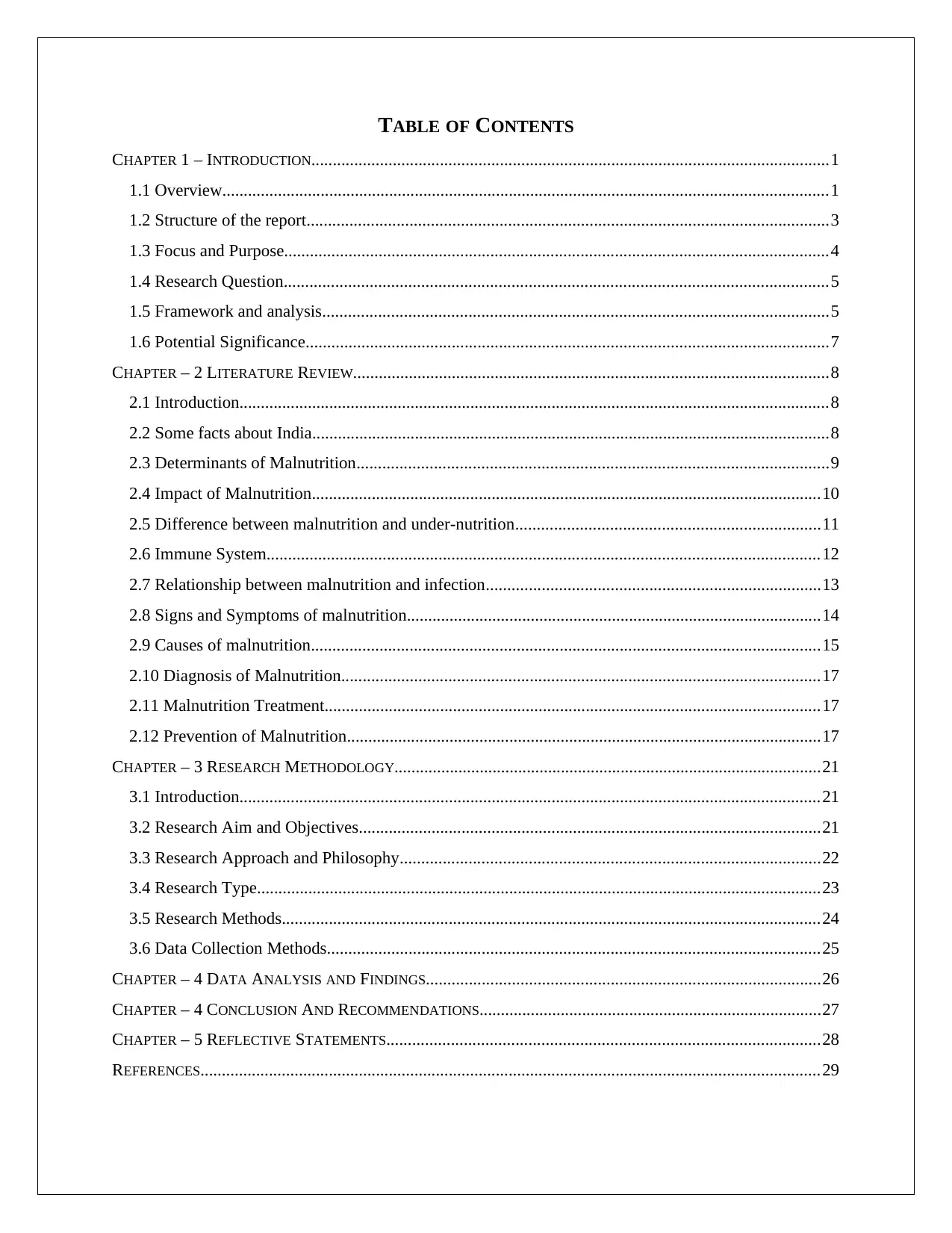
TABLE OF CONTENTS
CHAPTER 1 – INTRODUCTION.........................................................................................................................1
1.1 Overview..............................................................................................................................................1
1.2 Structure of the report..........................................................................................................................3
1.3 Focus and Purpose...............................................................................................................................4
1.4 Research Question...............................................................................................................................5
1.5 Framework and analysis......................................................................................................................5
1.6 Potential Significance..........................................................................................................................7
CHAPTER – 2 LITERATURE REVIEW...............................................................................................................8
2.1 Introduction..........................................................................................................................................8
2.2 Some facts about India.........................................................................................................................8
2.3 Determinants of Malnutrition..............................................................................................................9
2.4 Impact of Malnutrition.......................................................................................................................10
2.5 Difference between malnutrition and under-nutrition.......................................................................11
2.6 Immune System.................................................................................................................................12
2.7 Relationship between malnutrition and infection..............................................................................13
2.8 Signs and Symptoms of malnutrition.................................................................................................14
2.9 Causes of malnutrition.......................................................................................................................15
2.10 Diagnosis of Malnutrition................................................................................................................17
2.11 Malnutrition Treatment....................................................................................................................17
2.12 Prevention of Malnutrition...............................................................................................................17
CHAPTER – 3 RESEARCH METHODOLOGY....................................................................................................21
3.1 Introduction........................................................................................................................................21
3.2 Research Aim and Objectives............................................................................................................21
3.3 Research Approach and Philosophy..................................................................................................22
3.4 Research Type....................................................................................................................................23
3.5 Research Methods..............................................................................................................................24
3.6 Data Collection Methods...................................................................................................................25
CHAPTER – 4 DATA ANALYSIS AND FINDINGS............................................................................................26
CHAPTER – 4 CONCLUSION AND RECOMMENDATIONS................................................................................27
CHAPTER – 5 REFLECTIVE STATEMENTS.....................................................................................................28
REFERENCES.................................................................................................................................................29
CHAPTER 1 – INTRODUCTION.........................................................................................................................1
1.1 Overview..............................................................................................................................................1
1.2 Structure of the report..........................................................................................................................3
1.3 Focus and Purpose...............................................................................................................................4
1.4 Research Question...............................................................................................................................5
1.5 Framework and analysis......................................................................................................................5
1.6 Potential Significance..........................................................................................................................7
CHAPTER – 2 LITERATURE REVIEW...............................................................................................................8
2.1 Introduction..........................................................................................................................................8
2.2 Some facts about India.........................................................................................................................8
2.3 Determinants of Malnutrition..............................................................................................................9
2.4 Impact of Malnutrition.......................................................................................................................10
2.5 Difference between malnutrition and under-nutrition.......................................................................11
2.6 Immune System.................................................................................................................................12
2.7 Relationship between malnutrition and infection..............................................................................13
2.8 Signs and Symptoms of malnutrition.................................................................................................14
2.9 Causes of malnutrition.......................................................................................................................15
2.10 Diagnosis of Malnutrition................................................................................................................17
2.11 Malnutrition Treatment....................................................................................................................17
2.12 Prevention of Malnutrition...............................................................................................................17
CHAPTER – 3 RESEARCH METHODOLOGY....................................................................................................21
3.1 Introduction........................................................................................................................................21
3.2 Research Aim and Objectives............................................................................................................21
3.3 Research Approach and Philosophy..................................................................................................22
3.4 Research Type....................................................................................................................................23
3.5 Research Methods..............................................................................................................................24
3.6 Data Collection Methods...................................................................................................................25
CHAPTER – 4 DATA ANALYSIS AND FINDINGS............................................................................................26
CHAPTER – 4 CONCLUSION AND RECOMMENDATIONS................................................................................27
CHAPTER – 5 REFLECTIVE STATEMENTS.....................................................................................................28
REFERENCES.................................................................................................................................................29
Paraphrase This Document
Need a fresh take? Get an instant paraphrase of this document with our AI Paraphraser

LIST OF FIGURES
CHAPTER 1 – INTRODUCTION
The gravest single warning to worldwide public health is Malnutrition
1.1 Overview
Children are in a regular stage of development. Their corpse is in a period of continuous
repair and growth. These developing children need regular supplementation of calories, micro-
nutrients and protein for the reason to maintain the velocity of enhanced demands of the body.
Since, childhood is the most susceptible stage in the human life, so nutritional shortfalls will lead
to obstructing the development of the body. If such nutritional shortage is continued for a long
duration, it affects on the growth faltering apparent in the type of small height, low weight and
low IQ. The country’s future is determined by the rising generation of the nation. It is the health
position of the nation’s children, which signifies the health status of individuals of that
countryside (Burke, 2012).
As this increasing generation is going to be the productive citizens of upcoming period,
they must be healthy enough so that they can have maximum utilization of their productive age.
Scientific evidence has given that beyond the age of 2-3 years, the chronic malnutrition effects
are irreversible. The single largest contributor to mortality of below five is child malnutrition,
which is mainly due to slow recovery from illness and higher susceptibility of infections.
Misconception prevailing in the recent period is the unavailability of an adequate amount of
food. In between 6 to 18 months, a young child needs only 200-300 kcal food, in order to
maintain the normal development and growth, but due to the inadequate knowledge or
understanding of parents about feeding practices, they don’t supply enough food to their children
leading to uncertain growth and as a result illness or death of a child (Chopra, 2013).
By no means, India is a poorest nation on the globe, as it doesn’t have the lowest
expectancy of life and literacy rate as well as it has highest AIDS/HIV rate. It is estimated by the
World Bank that India is ranked second in the world in regards to the number of children
suffering from the problem of malnutrition. India is one of the largest in the globe where
underweight children are quite common. It is nearly double that of Sub-Saharan Africa with
terrible consequences for mortality, mobility, economic growth and productivity. The UN
measures that 2.1 million of Indian children die before attaining the age of 5 years, mostly due to
preventable illnesses, such as typhoid, diarrhea, measles, pneumonia and malaria. Recent
1
The gravest single warning to worldwide public health is Malnutrition
1.1 Overview
Children are in a regular stage of development. Their corpse is in a period of continuous
repair and growth. These developing children need regular supplementation of calories, micro-
nutrients and protein for the reason to maintain the velocity of enhanced demands of the body.
Since, childhood is the most susceptible stage in the human life, so nutritional shortfalls will lead
to obstructing the development of the body. If such nutritional shortage is continued for a long
duration, it affects on the growth faltering apparent in the type of small height, low weight and
low IQ. The country’s future is determined by the rising generation of the nation. It is the health
position of the nation’s children, which signifies the health status of individuals of that
countryside (Burke, 2012).
As this increasing generation is going to be the productive citizens of upcoming period,
they must be healthy enough so that they can have maximum utilization of their productive age.
Scientific evidence has given that beyond the age of 2-3 years, the chronic malnutrition effects
are irreversible. The single largest contributor to mortality of below five is child malnutrition,
which is mainly due to slow recovery from illness and higher susceptibility of infections.
Misconception prevailing in the recent period is the unavailability of an adequate amount of
food. In between 6 to 18 months, a young child needs only 200-300 kcal food, in order to
maintain the normal development and growth, but due to the inadequate knowledge or
understanding of parents about feeding practices, they don’t supply enough food to their children
leading to uncertain growth and as a result illness or death of a child (Chopra, 2013).
By no means, India is a poorest nation on the globe, as it doesn’t have the lowest
expectancy of life and literacy rate as well as it has highest AIDS/HIV rate. It is estimated by the
World Bank that India is ranked second in the world in regards to the number of children
suffering from the problem of malnutrition. India is one of the largest in the globe where
underweight children are quite common. It is nearly double that of Sub-Saharan Africa with
terrible consequences for mortality, mobility, economic growth and productivity. The UN
measures that 2.1 million of Indian children die before attaining the age of 5 years, mostly due to
preventable illnesses, such as typhoid, diarrhea, measles, pneumonia and malaria. Recent
1
⊘ This is a preview!⊘
Do you want full access?
Subscribe today to unlock all pages.
Trusted by 1+ million students worldwide
estimates propose that malnutrition is allied with about 50 percent of all deaths within children
(Denyer, 2013).
The malnutrition prevalence in India varied across states, with Madhya Pradesh recording
the highest rate (55%) and Kerala is amongst the lowest (27%). In children malnutrition is not
exaggerated by food eating alone, it is also inclined by quality of care for the child, access to
health services and good hygiene practices and pregnant mother (Malnutrition, 2011). Girls are
at more risk of malnutrition than boys, due to their low level of social status. Malnutrition in the
early period of childhood has serious, long term outcomes as it impedes sensory, motor,
emotional, social and cognitive development. Malnourished children are less expected to achieve
well in their school and more possible to grow into malnourished adults, at higher risk of disease
as well as early death. Around one third portion of all adult women in India is underweight.
Inadequate care of girls and women, particularly at the time of pregnancy, results in babies’ low-
birth weight. Almost 30 percent of every newborn has a low birth weight, which make them
vulnerable to further disease and malnutrition (Muoneke and et.al., 2011).
Mineral and vitamin deficiencies also influence the development and survival of children.
According to DeMaeyer and Adiels – Tegman (1985), the prevalence of Anemia in children is
very high, particularly in the case of developing countries and commonly it is multifactorial.
Anemia affects 74 percent of children below the age of three, 50 percent of women and above 90
percent of adolescent girls. Deficiency of iodine that reduces capacity of learning by up to 13
percent is general, as less than half of all households use iodized salt. Vitamin A deficiency that
increases morbidity and mortality as well as causes blindness among pre-schoolers, also remains
a health issue of public (Nordqvist, 2010).
In the subsequent chapter of this report, the researcher is doing an in depth analysis of
malnutrition. In this regard the research will be conducted on topics related to the relationship
between malnutrition and child mortality from acute respiratory illness, diarrhea, measles and
malaria conditions, which account for over 50 percent of deaths in children globally. Moreover,
the factors that lead to malnutrition in Indian people will also be examined in the body of the
report (Basavanthappa, 2008). In addition to this, the reader would be able to know about
symptoms, tests, treatment, complications and ways of prevention for such type of health issue.
Further, many people are found confused with the terms of hunger and malnutrition as well as
believe that both have equal meanings and consequences. In reality malnutrition and hunger is
2
(Denyer, 2013).
The malnutrition prevalence in India varied across states, with Madhya Pradesh recording
the highest rate (55%) and Kerala is amongst the lowest (27%). In children malnutrition is not
exaggerated by food eating alone, it is also inclined by quality of care for the child, access to
health services and good hygiene practices and pregnant mother (Malnutrition, 2011). Girls are
at more risk of malnutrition than boys, due to their low level of social status. Malnutrition in the
early period of childhood has serious, long term outcomes as it impedes sensory, motor,
emotional, social and cognitive development. Malnourished children are less expected to achieve
well in their school and more possible to grow into malnourished adults, at higher risk of disease
as well as early death. Around one third portion of all adult women in India is underweight.
Inadequate care of girls and women, particularly at the time of pregnancy, results in babies’ low-
birth weight. Almost 30 percent of every newborn has a low birth weight, which make them
vulnerable to further disease and malnutrition (Muoneke and et.al., 2011).
Mineral and vitamin deficiencies also influence the development and survival of children.
According to DeMaeyer and Adiels – Tegman (1985), the prevalence of Anemia in children is
very high, particularly in the case of developing countries and commonly it is multifactorial.
Anemia affects 74 percent of children below the age of three, 50 percent of women and above 90
percent of adolescent girls. Deficiency of iodine that reduces capacity of learning by up to 13
percent is general, as less than half of all households use iodized salt. Vitamin A deficiency that
increases morbidity and mortality as well as causes blindness among pre-schoolers, also remains
a health issue of public (Nordqvist, 2010).
In the subsequent chapter of this report, the researcher is doing an in depth analysis of
malnutrition. In this regard the research will be conducted on topics related to the relationship
between malnutrition and child mortality from acute respiratory illness, diarrhea, measles and
malaria conditions, which account for over 50 percent of deaths in children globally. Moreover,
the factors that lead to malnutrition in Indian people will also be examined in the body of the
report (Basavanthappa, 2008). In addition to this, the reader would be able to know about
symptoms, tests, treatment, complications and ways of prevention for such type of health issue.
Further, many people are found confused with the terms of hunger and malnutrition as well as
believe that both have equal meanings and consequences. In reality malnutrition and hunger is
2
Paraphrase This Document
Need a fresh take? Get an instant paraphrase of this document with our AI Paraphraser
not the same thing; however, they often go simultaneously. At times everyone feels hungry and
is the signal for the body that it requires food. Once individual eat enough food to satisfy his/her
needs, hunger goes away until the stomach is unfilled again (Brothers, 2005). People who are
chronically malnourished does not have the nutrients being required for proper development of
health. Someone can be malnourished for very short or long period of time and the situations
may be severe or mild. People who are malnourished are more likely to have poor health
expected and in severe cases, they may even die. On the basis of the UN World Food Program,
925 million of people in the whole world do not have a sufficient quantity of food to eat.
Malnutrition and chronic hunger can cause major health issues. People who feel hungry
repeatedly are expected to be underweight, considering a lot less than an average person of their
size. If malnourished as a child, their development might also be stunted, making them much
shorter than average. In developing nations, 1 out of 4 children younger than age of 5 are
malnourished (Klerk, 2009).
1.2 Structure of the report
The present research report will progress in a sequential manner because every chapter
will be interlinked, i.e. the subsequent chapter would proceed only after the completion of its
preceding section. The report structure is as follows:
Chapter 1: Introduction – This part of the dissertation is inculcating an overview of the subject
matter, which will be analyzed in the research. Moreover, it also includes a brief synopsis of
focus and purpose, significance along with the framework and analysis of the study.
Chapter 2: Literature Review – This section of research will evaluate the work that is already
done by several other authors on a particular topic. The initial explanation of the literature review
will speak about malnutrition and it’s causing factors. Further, it will guide the reader about the
test, symptoms and prevention of this disease. Varied academic books, journals, articles and
online materials will be reviewed by the researcher to complete this part. The chapter holds
considerable worth as it will support in comprehending the viewpoint of other authors and in
determining a gap of their works.
Chapter 3: Research Methodology – This will present distinct methodologies that the researcher
will employ for gathering relevant information and analyzing it. The discussion will involve aims
3
is the signal for the body that it requires food. Once individual eat enough food to satisfy his/her
needs, hunger goes away until the stomach is unfilled again (Brothers, 2005). People who are
chronically malnourished does not have the nutrients being required for proper development of
health. Someone can be malnourished for very short or long period of time and the situations
may be severe or mild. People who are malnourished are more likely to have poor health
expected and in severe cases, they may even die. On the basis of the UN World Food Program,
925 million of people in the whole world do not have a sufficient quantity of food to eat.
Malnutrition and chronic hunger can cause major health issues. People who feel hungry
repeatedly are expected to be underweight, considering a lot less than an average person of their
size. If malnourished as a child, their development might also be stunted, making them much
shorter than average. In developing nations, 1 out of 4 children younger than age of 5 are
malnourished (Klerk, 2009).
1.2 Structure of the report
The present research report will progress in a sequential manner because every chapter
will be interlinked, i.e. the subsequent chapter would proceed only after the completion of its
preceding section. The report structure is as follows:
Chapter 1: Introduction – This part of the dissertation is inculcating an overview of the subject
matter, which will be analyzed in the research. Moreover, it also includes a brief synopsis of
focus and purpose, significance along with the framework and analysis of the study.
Chapter 2: Literature Review – This section of research will evaluate the work that is already
done by several other authors on a particular topic. The initial explanation of the literature review
will speak about malnutrition and it’s causing factors. Further, it will guide the reader about the
test, symptoms and prevention of this disease. Varied academic books, journals, articles and
online materials will be reviewed by the researcher to complete this part. The chapter holds
considerable worth as it will support in comprehending the viewpoint of other authors and in
determining a gap of their works.
Chapter 3: Research Methodology – This will present distinct methodologies that the researcher
will employ for gathering relevant information and analyzing it. The discussion will involve aims
3
and objectives, data collection techniques, research question, research approach, data analysis
method, ethical considerations and research limitations.
Chapter 4: Data Analysis and Findings – The data, which will be accumulated for the purpose of
primary research, will be examined under this heading. It will basically involve results
assessment so that appropriate inferences could be produced.
Chapter 5: Conclusion and Recommendations – This chapter will contain a conclusion drawn
from the research findings and on the basis of it, the researcher will recommend some preventive
measures to lessen the number of malnutrition in a country.
Chapter 6: Reflective Statement – This final chapter will provide importance of selecting the
particular topic for study. Moreover, it will also reflect the knowledge, which would be gained
by researcher after conducting the present research. Further, the discussion will define about the
agency or institution that may be benefited by getting the results of this study.
1.3 Focus and Purpose
The main focus of this research is on factors that are causing malnutrition among children
of age group 0 to 5 years admitted to the different hospitals of India. The area of study is Indian
rural and urban children that are suffering from chronic hunger and malnutrition. The particular
region is chosen for the study, as a consequence of malnutrition is largely found in Indian
population. This is basically due to poor health and lack of education in the country. Moreover,
the Indian government is less concerned about the health of its population that leads to higher
rates of malnutrition in the nation (Majumdar, 2005).
Aim – To identify the factors that are causing malnutrition in children belonging to the age group
of 0-5 years in India is the ultimate aim of this research report.
Objectives – In order to realize the overall aim of study the following objectives are required to
be accomplished by the researcher:
To gain understanding about malnutrition and its symptoms.
To identify the key diseases that are interlinked with the malnutrition.
To examine the preventive measures and their effectiveness.
4
method, ethical considerations and research limitations.
Chapter 4: Data Analysis and Findings – The data, which will be accumulated for the purpose of
primary research, will be examined under this heading. It will basically involve results
assessment so that appropriate inferences could be produced.
Chapter 5: Conclusion and Recommendations – This chapter will contain a conclusion drawn
from the research findings and on the basis of it, the researcher will recommend some preventive
measures to lessen the number of malnutrition in a country.
Chapter 6: Reflective Statement – This final chapter will provide importance of selecting the
particular topic for study. Moreover, it will also reflect the knowledge, which would be gained
by researcher after conducting the present research. Further, the discussion will define about the
agency or institution that may be benefited by getting the results of this study.
1.3 Focus and Purpose
The main focus of this research is on factors that are causing malnutrition among children
of age group 0 to 5 years admitted to the different hospitals of India. The area of study is Indian
rural and urban children that are suffering from chronic hunger and malnutrition. The particular
region is chosen for the study, as a consequence of malnutrition is largely found in Indian
population. This is basically due to poor health and lack of education in the country. Moreover,
the Indian government is less concerned about the health of its population that leads to higher
rates of malnutrition in the nation (Majumdar, 2005).
Aim – To identify the factors that are causing malnutrition in children belonging to the age group
of 0-5 years in India is the ultimate aim of this research report.
Objectives – In order to realize the overall aim of study the following objectives are required to
be accomplished by the researcher:
To gain understanding about malnutrition and its symptoms.
To identify the key diseases that are interlinked with the malnutrition.
To examine the preventive measures and their effectiveness.
4
⊘ This is a preview!⊘
Do you want full access?
Subscribe today to unlock all pages.
Trusted by 1+ million students worldwide
To define reasons behind the excessive prevalence of malnutrition is children of age
group 0-5 years.
Various researches have been conducted on the topic of mal-nutrition in relation to Indian
children. Moreover, several researchers have made an attempt to find out its controlling
measures and preventive steps to be taken by the country’s government and the general
population. There are several factors, which are responsible for the rising problem of mal-
nutrition in the nation. Further, the diseases such as, malaria, acute respiratory, diarrhea and
measles leads to numerous deaths in children on a global level. But, till date no study has been
able to find out the relationship between mal-nutrition and child mortality due to these diseases
(Rice and et.al., 2000). Thus, the purpose of present research is to discover connection between
malnutrition and severe diseases. Moreover, the findings will provide that how different serious
diseases add in raising the number of malnutrition among Indian children. Further, the available
studies have not provided the effectiveness of preventive measures that are taken by the
government in relation to control such issue of public health, which will be addressed in this
particular research. In addition to this, the researcher will stress on finding out the reasons of
prevailing the given severe diseases and malnutrition in children of 0-5 years (Basit and et.al.,
2012).
1.4 Research Question
The given are some questions, which is required to be addressed by the researcher for the
purpose to complete the present dissertation adequately. These are as follows:
What is meant by the term malnutrition and its symptoms?
What are the main diseases that are interconnected with the malnutrition?
How malnutrition can be prevented by taking effective measures?
What are the reasons behind too much prevalence of malnutrition in children of 0-5
years?
1.5 Framework and analysis
The analysis and framework part of the dissertation basically gives details about the steps
in which the study will be performed. The framework section of the report presents an
explanation of several methodology and tactics adopted for undertaking the research. It primarily
presents the practical framework of varied research approaches utilized in the report. Discussions
5
group 0-5 years.
Various researches have been conducted on the topic of mal-nutrition in relation to Indian
children. Moreover, several researchers have made an attempt to find out its controlling
measures and preventive steps to be taken by the country’s government and the general
population. There are several factors, which are responsible for the rising problem of mal-
nutrition in the nation. Further, the diseases such as, malaria, acute respiratory, diarrhea and
measles leads to numerous deaths in children on a global level. But, till date no study has been
able to find out the relationship between mal-nutrition and child mortality due to these diseases
(Rice and et.al., 2000). Thus, the purpose of present research is to discover connection between
malnutrition and severe diseases. Moreover, the findings will provide that how different serious
diseases add in raising the number of malnutrition among Indian children. Further, the available
studies have not provided the effectiveness of preventive measures that are taken by the
government in relation to control such issue of public health, which will be addressed in this
particular research. In addition to this, the researcher will stress on finding out the reasons of
prevailing the given severe diseases and malnutrition in children of 0-5 years (Basit and et.al.,
2012).
1.4 Research Question
The given are some questions, which is required to be addressed by the researcher for the
purpose to complete the present dissertation adequately. These are as follows:
What is meant by the term malnutrition and its symptoms?
What are the main diseases that are interconnected with the malnutrition?
How malnutrition can be prevented by taking effective measures?
What are the reasons behind too much prevalence of malnutrition in children of 0-5
years?
1.5 Framework and analysis
The analysis and framework part of the dissertation basically gives details about the steps
in which the study will be performed. The framework section of the report presents an
explanation of several methodology and tactics adopted for undertaking the research. It primarily
presents the practical framework of varied research approaches utilized in the report. Discussions
5
Paraphrase This Document
Need a fresh take? Get an instant paraphrase of this document with our AI Paraphraser
in relation to data collection method, research techniques, analysis and sampling technique is
also given (Bhavsar, Hemant and Kulkarni, 2012). The significance of this part is substantial as
the authenticity and validity of the research will be recognized through it. An all encompassing
plan of analysis is essential, as it adds the researcher in espousing and identifying the correct
path while undertaking the research. The below mentioned techniques are implemented in the
present report for performing the research successfully:
Research Design – It covers the methodology plus procedure employed for conducting a
study. The designs are of two types i.e. descriptive and casual and the other one is
exploratory. In this dissertation, descriptive research design will be utilized as there is
specific research question in the intellects of the researcher and will prove useful in
investigating factors that are increasing the number of children affected by malnutrition
in India (Massingham, Massingham and Diment, 2012).
Research Philosophy – Research philosophy supports the investigator in identifying a
particular investigation pattern. Both Interpretivism and Positivism research philosophy
will be adopted in the present report (Janes, 2001).
Research Approach – The researcher will make use of inductive research approach in the
dissertation, as he will firstly observe the things, assume activities pattern, form a concept
and then at last originate a theory. No hypothesis testing will be implemented in the
present case and hence, inductive approach will be used (Hansen, 2011).
Research Type – Both quantitative and qualitative type of research will be adopted in the
current dissertation.
Data Collection Method – Data will be gathered from secondary and primary sources.
Primary data will be accumulated by conducting interview of health practitioners
providing services in regions of India, which accounts for more malnutrition cases. The
researcher will ask both open and close ended questions to the interviewee. Secondary
information will be collected through books, journals and online articles containing
materials related to this topic (Dey, 2002).
Sampling Technique – For selecting the sample of health practitioners in order to conduct
interview, which will represent the entire population, the researcher will make use of
simple random sampling (Coram, 2011).
6
also given (Bhavsar, Hemant and Kulkarni, 2012). The significance of this part is substantial as
the authenticity and validity of the research will be recognized through it. An all encompassing
plan of analysis is essential, as it adds the researcher in espousing and identifying the correct
path while undertaking the research. The below mentioned techniques are implemented in the
present report for performing the research successfully:
Research Design – It covers the methodology plus procedure employed for conducting a
study. The designs are of two types i.e. descriptive and casual and the other one is
exploratory. In this dissertation, descriptive research design will be utilized as there is
specific research question in the intellects of the researcher and will prove useful in
investigating factors that are increasing the number of children affected by malnutrition
in India (Massingham, Massingham and Diment, 2012).
Research Philosophy – Research philosophy supports the investigator in identifying a
particular investigation pattern. Both Interpretivism and Positivism research philosophy
will be adopted in the present report (Janes, 2001).
Research Approach – The researcher will make use of inductive research approach in the
dissertation, as he will firstly observe the things, assume activities pattern, form a concept
and then at last originate a theory. No hypothesis testing will be implemented in the
present case and hence, inductive approach will be used (Hansen, 2011).
Research Type – Both quantitative and qualitative type of research will be adopted in the
current dissertation.
Data Collection Method – Data will be gathered from secondary and primary sources.
Primary data will be accumulated by conducting interview of health practitioners
providing services in regions of India, which accounts for more malnutrition cases. The
researcher will ask both open and close ended questions to the interviewee. Secondary
information will be collected through books, journals and online articles containing
materials related to this topic (Dey, 2002).
Sampling Technique – For selecting the sample of health practitioners in order to conduct
interview, which will represent the entire population, the researcher will make use of
simple random sampling (Coram, 2011).
6
Data Analysis Technique – The accumulated data will be examined by using quantitative
and qualitative methods. For qualitative method, thematic analysis will be used to create
themes of data so attained. Further, graphical illustration of data will also be conducted to
bring a constituent of statistical accurateness of findings (Kelemen and Rumens, 2012).
1.6 Potential Significance
The present report holds an academic as well as practical significance. Till date only
general consequences and causing factors of malnutrition have been studied by several
researchers. The available report will provide insights about symptoms, test, treatment and
prevention of malnutrition. Further, there were no previous studies being conducted on
examining the effectiveness of the government and health sectors programs working towards
controlling the prevalence of malnutrition in India. There is no single cause of malnutrition;
rather it can be arise due to some severe diseases also. Thus, this research will provide discussion
on to what extent diseases like, diarrhea, cholera, malaria, etc. are contributing in increasing the
number of malnutrition. It will support others researchers with their part of work (Amaratunga
and et.al., 2002).
The research also holds possible relevance for practical purposes. At present, although
government and health care units are paying consideration to control the pervasiveness of
malnutrition, but the extent to which these policies and programs are valuable will be analyzed in
this report. Hence, the results will be helpful to Indian government in implementing adequate
strategies to lower down malnutrition in a country.
7
and qualitative methods. For qualitative method, thematic analysis will be used to create
themes of data so attained. Further, graphical illustration of data will also be conducted to
bring a constituent of statistical accurateness of findings (Kelemen and Rumens, 2012).
1.6 Potential Significance
The present report holds an academic as well as practical significance. Till date only
general consequences and causing factors of malnutrition have been studied by several
researchers. The available report will provide insights about symptoms, test, treatment and
prevention of malnutrition. Further, there were no previous studies being conducted on
examining the effectiveness of the government and health sectors programs working towards
controlling the prevalence of malnutrition in India. There is no single cause of malnutrition;
rather it can be arise due to some severe diseases also. Thus, this research will provide discussion
on to what extent diseases like, diarrhea, cholera, malaria, etc. are contributing in increasing the
number of malnutrition. It will support others researchers with their part of work (Amaratunga
and et.al., 2002).
The research also holds possible relevance for practical purposes. At present, although
government and health care units are paying consideration to control the pervasiveness of
malnutrition, but the extent to which these policies and programs are valuable will be analyzed in
this report. Hence, the results will be helpful to Indian government in implementing adequate
strategies to lower down malnutrition in a country.
7
⊘ This is a preview!⊘
Do you want full access?
Subscribe today to unlock all pages.
Trusted by 1+ million students worldwide

1 out of 38


Related Documents


Your All-in-One AI-Powered Toolkit for Academic Success.
+13062052269
info@desklib.com
Available 24*7 on WhatsApp / Email
![[object Object]](/_next/static/media/star-bottom.7253800d.svg)
Unlock your academic potential
Copyright © 2020–2026 A2Z Services. All Rights Reserved. Developed and managed by ZUCOL.