Early Childhood Education: Playdough Activity Planning Report

Verified

Added on  2023/06/05

|19
|4196
|162
Report
AI Summary
This report details the planning and evaluation of a playdough activity in an early childhood education setting. It highlights the importance of early childhood care and education, particularly the critical first six years of a child's life. The report discusses Irish frameworks, principles, and underpinning policies that influence the planning process. It illustrates how regulations and legislation, the early childhood curriculum Aistear, and the national quality framework Siolta guide practitioners in stimulating a child's holistic development. The activity, designed to be child-led and inclusive, aimed to provide a meaningful learning experience. The report also analyzes relevant social policies, such as Ready Steady Play 2019 and Ready to Learn 1999, and describes how they support the planning process. The report adheres to the Data Protection Act 2018 and GDPR 2018, emphasizing the practitioner's role in directing learning, staging future development, and understanding foundational theories of child growth. The playdough activity focused on providing children with knowledge on appropriate environmental use through an interactive and engaging approach, incorporating family and home culture while aligning with Aistear's goals of well-being, thinking and exploring, and belonging and recognition. The evaluation strategies and critical reflections provide insights into the effectiveness and potential improvements of the activity.

Document Page
Early Childhood Care
and Education
tabler-icon-diamond-filled.svg

Paraphrase This Document

Need a fresh take? Get an instant paraphrase of this document with our AI Paraphraser
Document Page
Table of Contents
INTRODUCTION...........................................................................................................................1
MAIN BODY...................................................................................................................................1
CONCLUSION................................................................................................................................1
REFERENCES................................................................................................................................2
Document Page
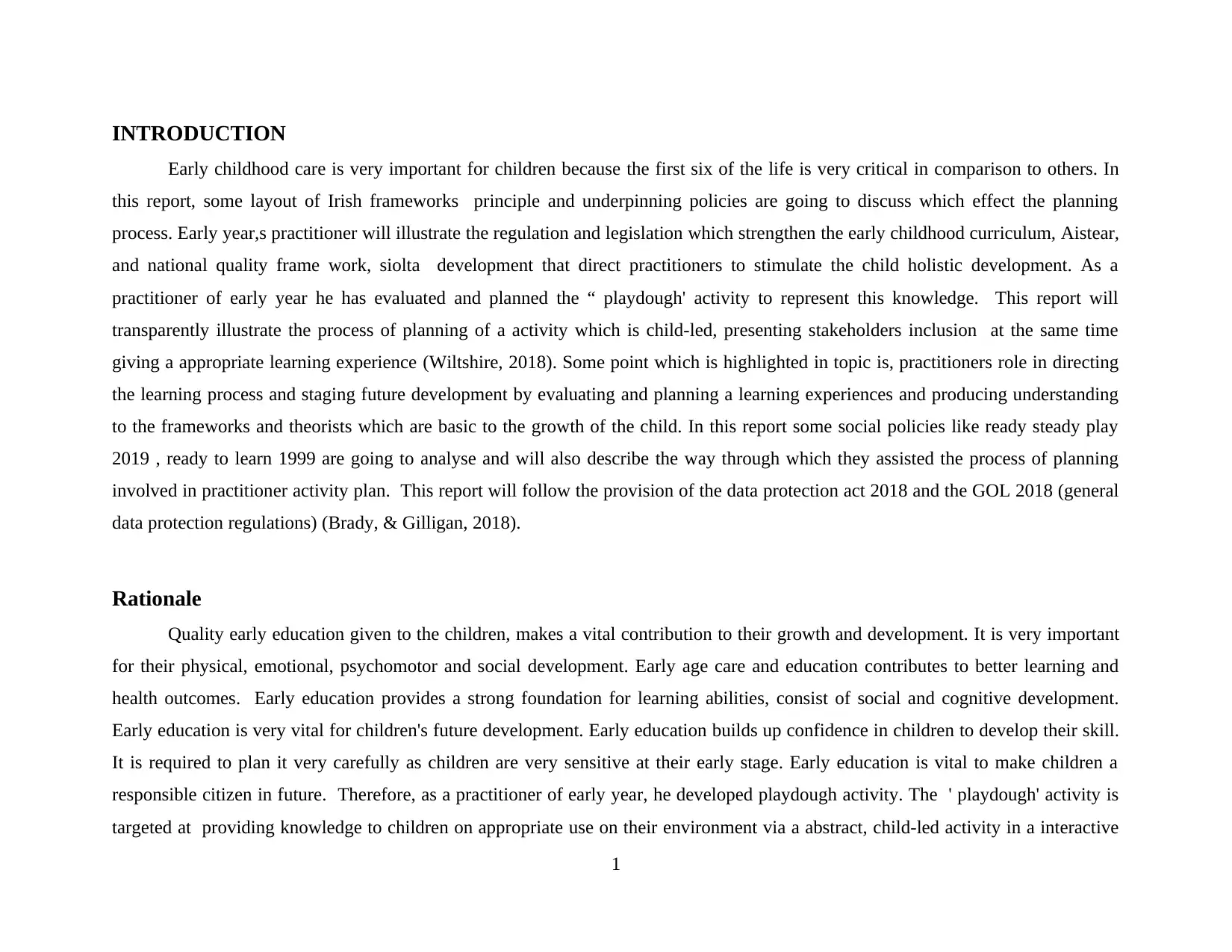
INTRODUCTION
Early childhood care is very important for children because the first six of the life is very critical in comparison to others. In
this report, some layout of Irish frameworks principle and underpinning policies are going to discuss which effect the planning
process. Early year,s practitioner will illustrate the regulation and legislation which strengthen the early childhood curriculum, Aistear,
and national quality frame work, siolta development that direct practitioners to stimulate the child holistic development. As a
practitioner of early year he has evaluated and planned the “ playdough' activity to represent this knowledge. This report will
transparently illustrate the process of planning of a activity which is child-led, presenting stakeholders inclusion at the same time
giving a appropriate learning experience (Wiltshire, 2018). Some point which is highlighted in topic is, practitioners role in directing
the learning process and staging future development by evaluating and planning a learning experiences and producing understanding
to the frameworks and theorists which are basic to the growth of the child. In this report some social policies like ready steady play
2019 , ready to learn 1999 are going to analyse and will also describe the way through which they assisted the process of planning
involved in practitioner activity plan. This report will follow the provision of the data protection act 2018 and the GOL 2018 (general
data protection regulations) (Brady, & Gilligan, 2018).
Rationale
Quality early education given to the children, makes a vital contribution to their growth and development. It is very important
for their physical, emotional, psychomotor and social development. Early age care and education contributes to better learning and
health outcomes. Early education provides a strong foundation for learning abilities, consist of social and cognitive development.
Early education is very vital for children's future development. Early education builds up confidence in children to develop their skill.
It is required to plan it very carefully as children are very sensitive at their early stage. Early education is vital to make children a
responsible citizen in future. Therefore, as a practitioner of early year, he developed playdough activity. The ' playdough' activity is
targeted at providing knowledge to children on appropriate use on their environment via a abstract, child-led activity in a interactive
1
Document Page
and funny approach. Collecting and gathering the substances included the family and involved the home culture in the classroom,
matching Aistear needs of 'well-being', 'thinking and exploring' and 'belonging and recognition'. Children were in lead or in charge of
their own activity and learning experience through identifying the different use of clay and representing it to their observation, also
stimulating the appropriate communication chances (Byrne, & Lundy, 2019).
Context
As an early year's practitioners, they work in Urban early years' service which had been establish in1986 and running till now.
The care services have two premises where they offer early education and sessional pre-school services. These care services are
provided to 3 years old children on daily basis for 3 hours. Pre-school learning facilitates play activities to children to improve their
learning skills. Early child education and care services provides five different classes to children at alternative time. Recently, teachers
and children with different languages and nationalities are present at the school. Children below the age of six are being provided
education to develop their cognitive and social skills. There are approx 20 students of 3 to 6 year's age group are attended the day of
the activity like playdough and to provide support two teachers also present in that activity. Montessori method is applied for child
centred approach for children learning. Guidelines of Aistear and Siolta are incorporated to assist and support children for their
leaning and development. Caregivers work collaboratively with parents to facilitate play activities and other programs for their
development (Casey, et. al., 2019).
Activity plan for early age children
Date: 15th April
2022
Room: Pre-
school
Practitioners: 2 Children; 21 Age range: 3 to
6 years
Area of
provision
Sense of
belonging
Key area of
learning
Areas of Aistear Siolta reflected Regulations and
legislations
Identification
of playdough
Actual life
skills. Learning
Getting
independence of
Principles
Connection of children
Principles
in early
2006 DCYA, 2019
ready to learn,
2
tabler-icon-diamond-filled.svg

Paraphrase This Document

Need a fresh take? Get an instant paraphrase of this document with our AI Paraphraser
Document Page
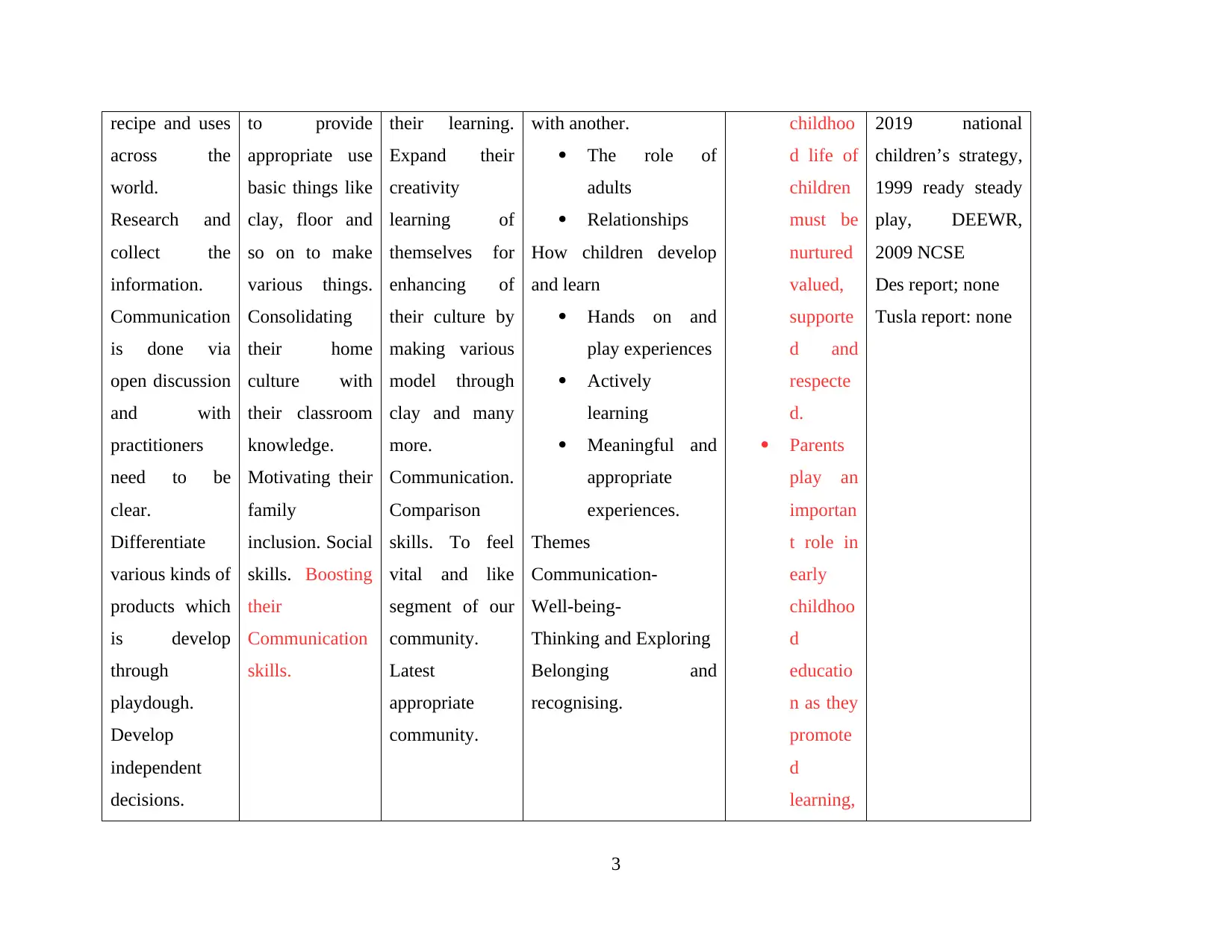
recipe and uses
across the
world.
Research and
collect the
information.
Communication
is done via
open discussion
and with
practitioners
need to be
clear.
Differentiate
various kinds of
products which
is develop
through
playdough.
Develop
independent
decisions.
to provide
appropriate use
basic things like
clay, floor and
so on to make
various things.
Consolidating
their home
culture with
their classroom
knowledge.
Motivating their
family
inclusion. Social
skills. Boosting
their
Communication
skills.
their learning.
Expand their
creativity
learning of
themselves for
enhancing of
their culture by
making various
model through
clay and many
more.
Communication.
Comparison
skills. To feel
vital and like
segment of our
community.
Latest
appropriate
community.
with another.
The role of
adults
Relationships
How children develop
and learn
Hands on and
play experiences
Actively
learning
Meaningful and
appropriate
experiences.
Themes
Communication-
Well-being-
Thinking and Exploring
Belonging and
recognising.
childhoo
d life of
children
must be
nurtured
valued,
supporte
d and
respecte
d.
Parents
play an
importan
t role in
early
childhoo
d
educatio
n as they
promote
d
learning,
2019 national
children’s strategy,
1999 ready steady
play, DEEWR,
2009 NCSE
Des report; none
Tusla report: none
3
Document Page
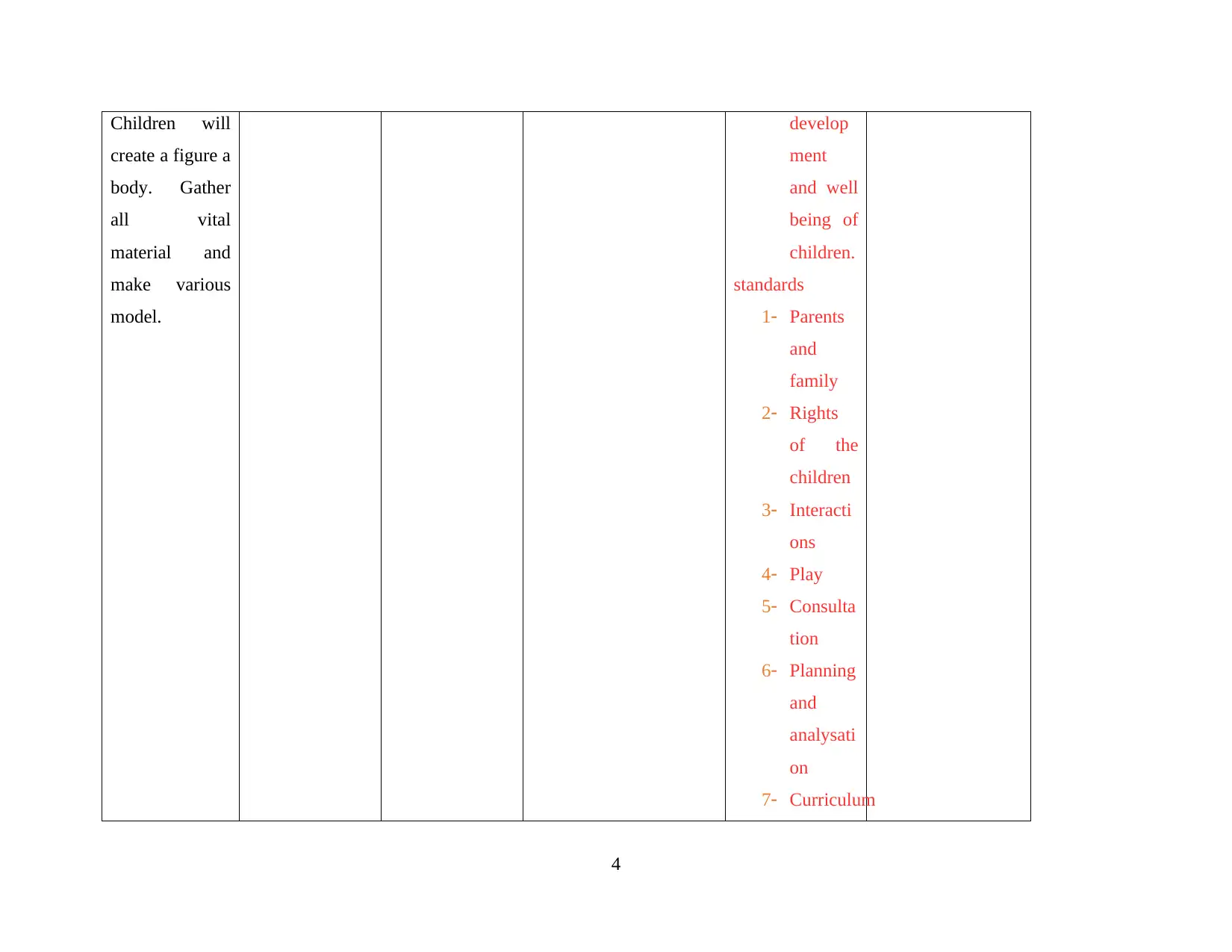
Children will
create a figure a
body. Gather
all vital
material and
make various
model.
develop
ment
and well
being of
children.
standards
1- Parents
and
family
2- Rights
of the
children
3- Interacti
ons
4- Play
5- Consulta
tion
6- Planning
and
analysati
on
7- Curriculum
4
Document Page
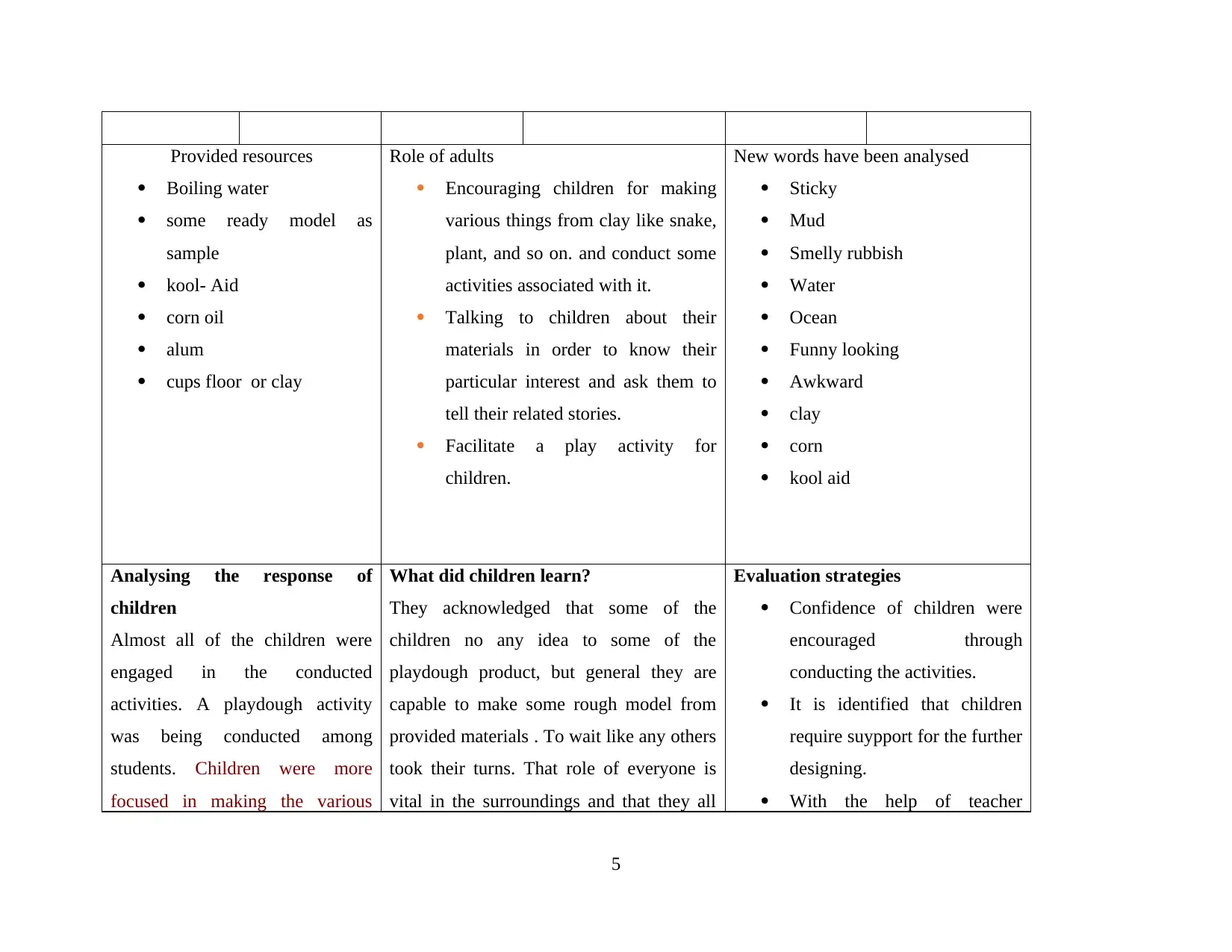
Provided resources
Boiling water
some ready model as
sample
kool- Aid
corn oil
alum
cups floor or clay
Role of adults
Encouraging children for making
various things from clay like snake,
plant, and so on. and conduct some
activities associated with it.
Talking to children about their
materials in order to know their
particular interest and ask them to
tell their related stories.
Facilitate a play activity for
children.
New words have been analysed
Sticky
Mud
Smelly rubbish
Water
Ocean
Funny looking
Awkward
clay
corn
kool aid
Analysing the response of
children
Almost all of the children were
engaged in the conducted
activities. A playdough activity
was being conducted among
students. Children were more
focused in making the various
What did children learn?
They acknowledged that some of the
children no any idea to some of the
playdough product, but general they are
capable to make some rough model from
provided materials . To wait like any others
took their turns. That role of everyone is
vital in the surroundings and that they all
Evaluation strategies
Confidence of children were
encouraged through
conducting the activities.
It is identified that children
require suypport for the further
designing.
With the help of teacher
5
tabler-icon-diamond-filled.svg

Paraphrase This Document

Need a fresh take? Get an instant paraphrase of this document with our AI Paraphraser
Document Page
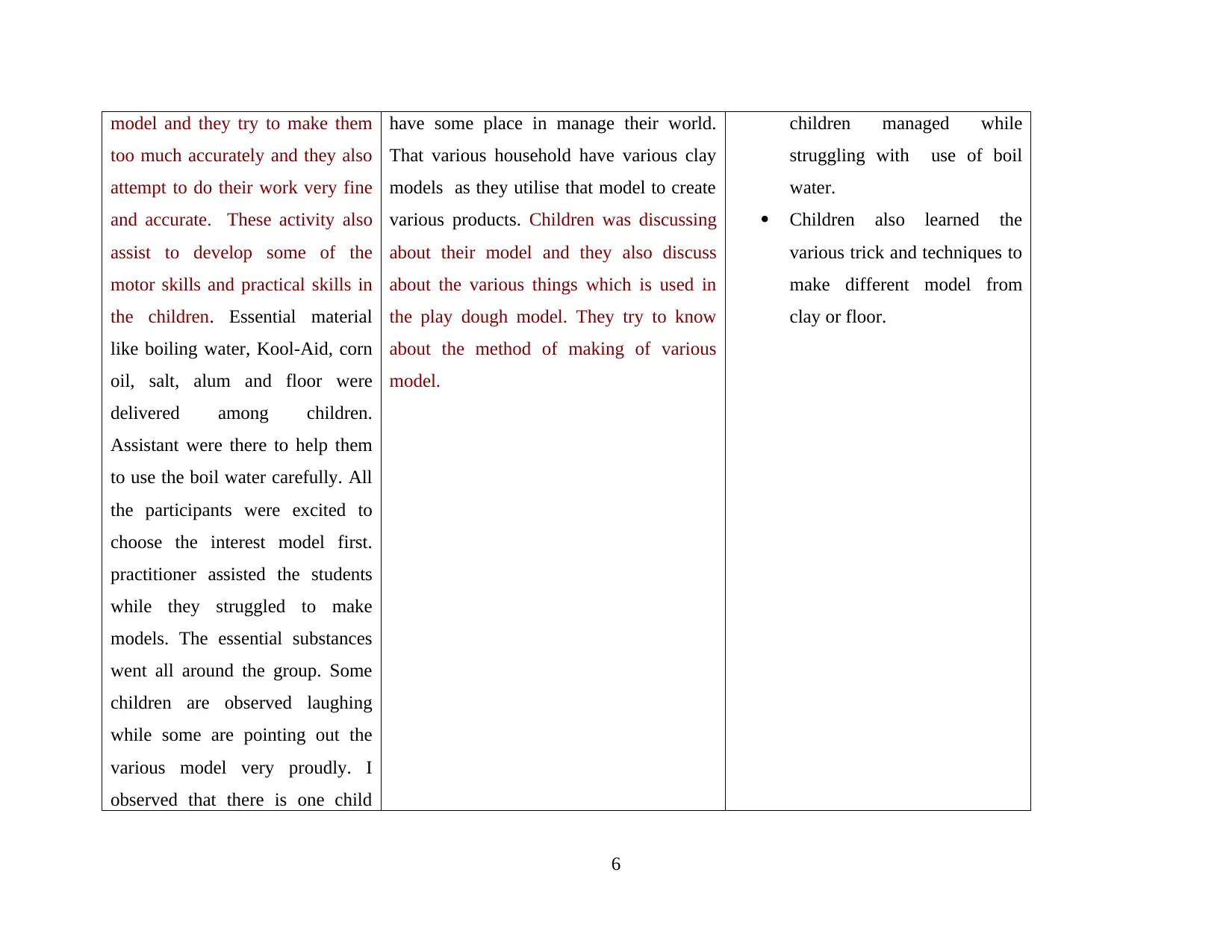
model and they try to make them
too much accurately and they also
attempt to do their work very fine
and accurate. These activity also
assist to develop some of the
motor skills and practical skills in
the children. Essential material
like boiling water, Kool-Aid, corn
oil, salt, alum and floor were
delivered among children.
Assistant were there to help them
to use the boil water carefully. All
the participants were excited to
choose the interest model first.
practitioner assisted the students
while they struggled to make
models. The essential substances
went all around the group. Some
children are observed laughing
while some are pointing out the
various model very proudly. I
observed that there is one child
have some place in manage their world.
That various household have various clay
models as they utilise that model to create
various products. Children was discussing
about their model and they also discuss
about the various things which is used in
the play dough model. They try to know
about the method of making of various
model.
children managed while
struggling with use of boil
water.
Children also learned the
various trick and techniques to
make different model from
clay or floor.
6
Document Page
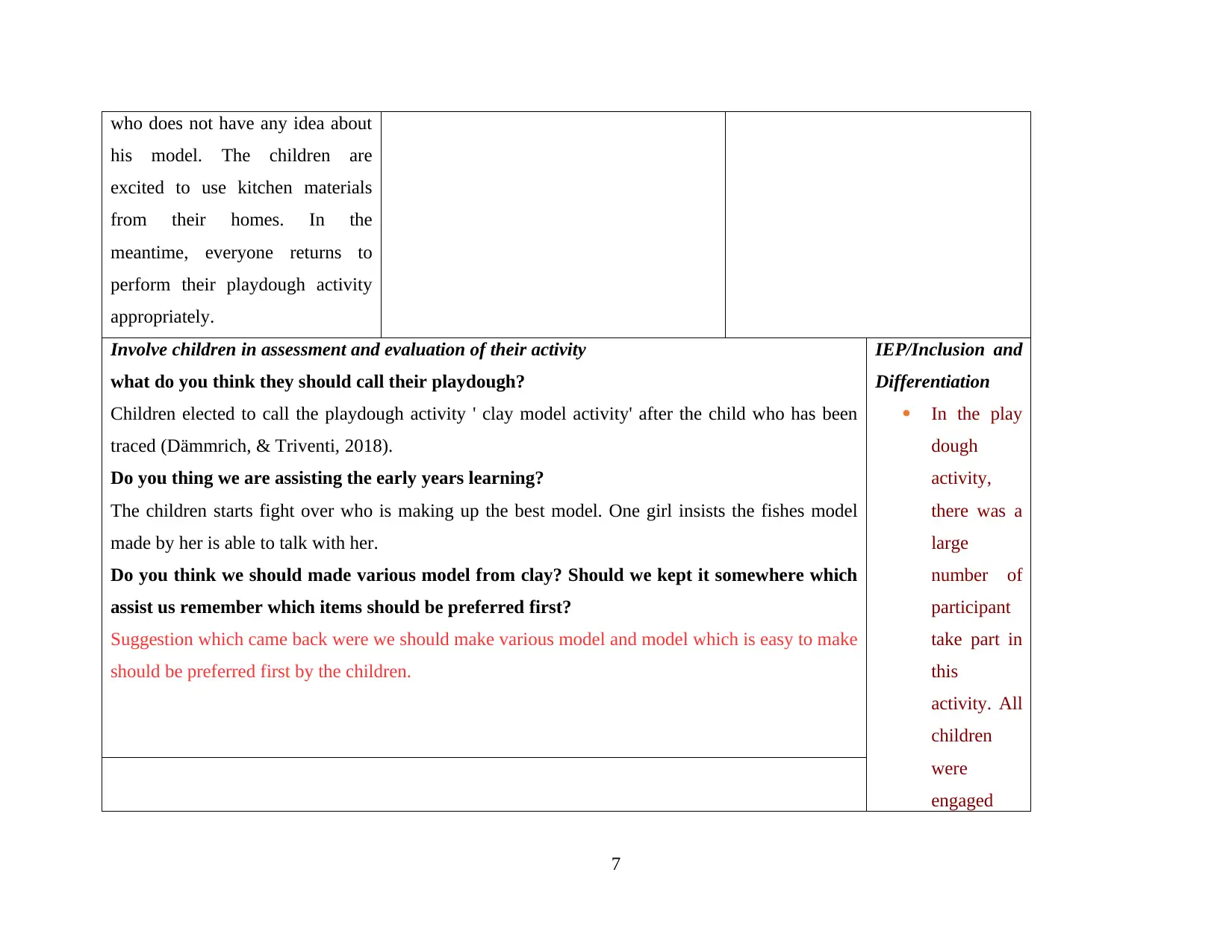
who does not have any idea about
his model. The children are
excited to use kitchen materials
from their homes. In the
meantime, everyone returns to
perform their playdough activity
appropriately.
Involve children in assessment and evaluation of their activity
what do you think they should call their playdough?
Children elected to call the playdough activity ' clay model activity' after the child who has been
traced (Dämmrich, & Triventi, 2018).
Do you thing we are assisting the early years learning?
The children starts fight over who is making up the best model. One girl insists the fishes model
made by her is able to talk with her.
Do you think we should made various model from clay? Should we kept it somewhere which
assist us remember which items should be preferred first?
Suggestion which came back were we should make various model and model which is easy to make
should be preferred first by the children.
IEP/Inclusion and
Differentiation
In the play
dough
activity,
there was a
large
number of
participant
take part in
this
activity. All
children
were
engaged
7
Document Page
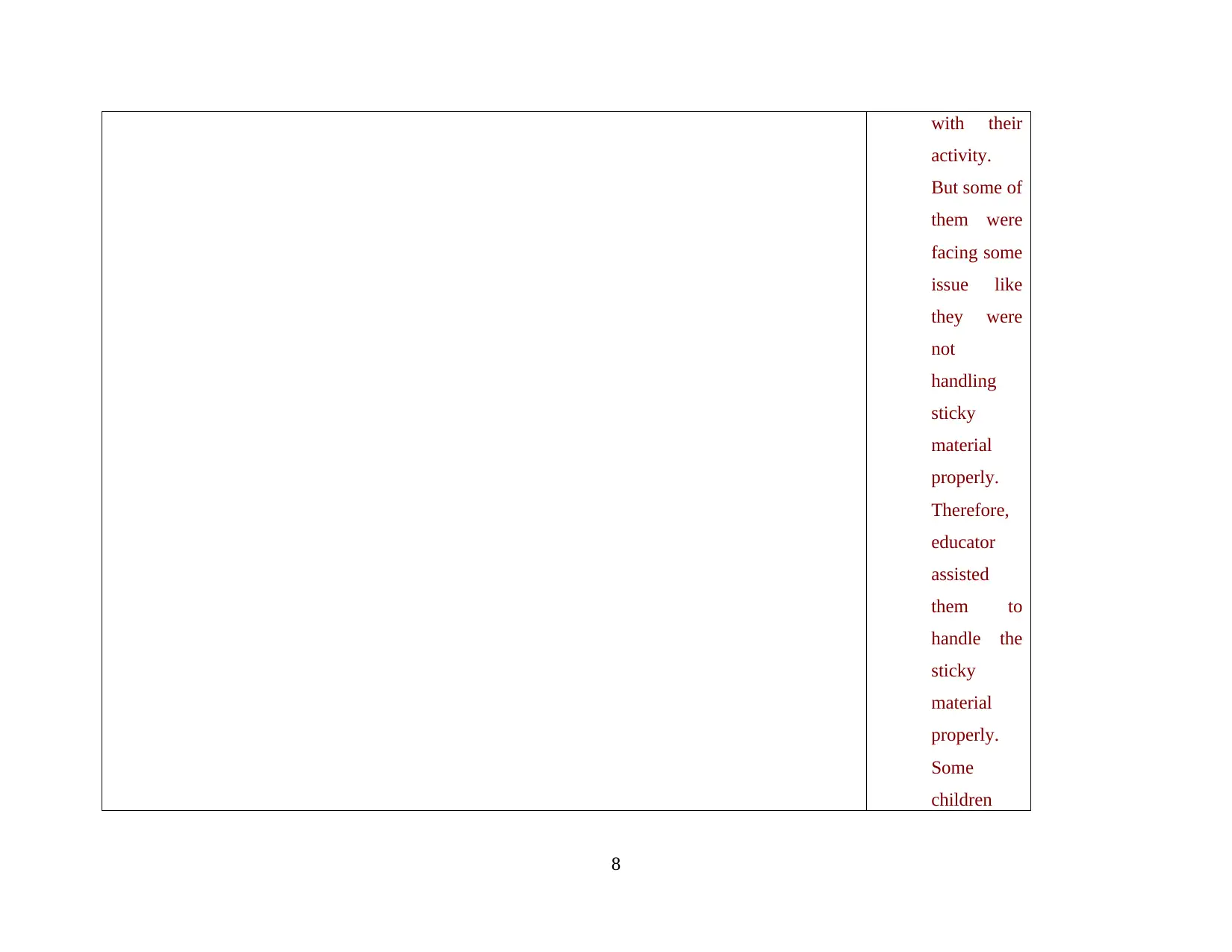
with their
activity.
But some of
them were
facing some
issue like
they were
not
handling
sticky
material
properly.
Therefore,
educator
assisted
them to
handle the
sticky
material
properly.
Some
children
8
tabler-icon-diamond-filled.svg

Paraphrase This Document

Need a fresh take? Get an instant paraphrase of this document with our AI Paraphraser
Document Page
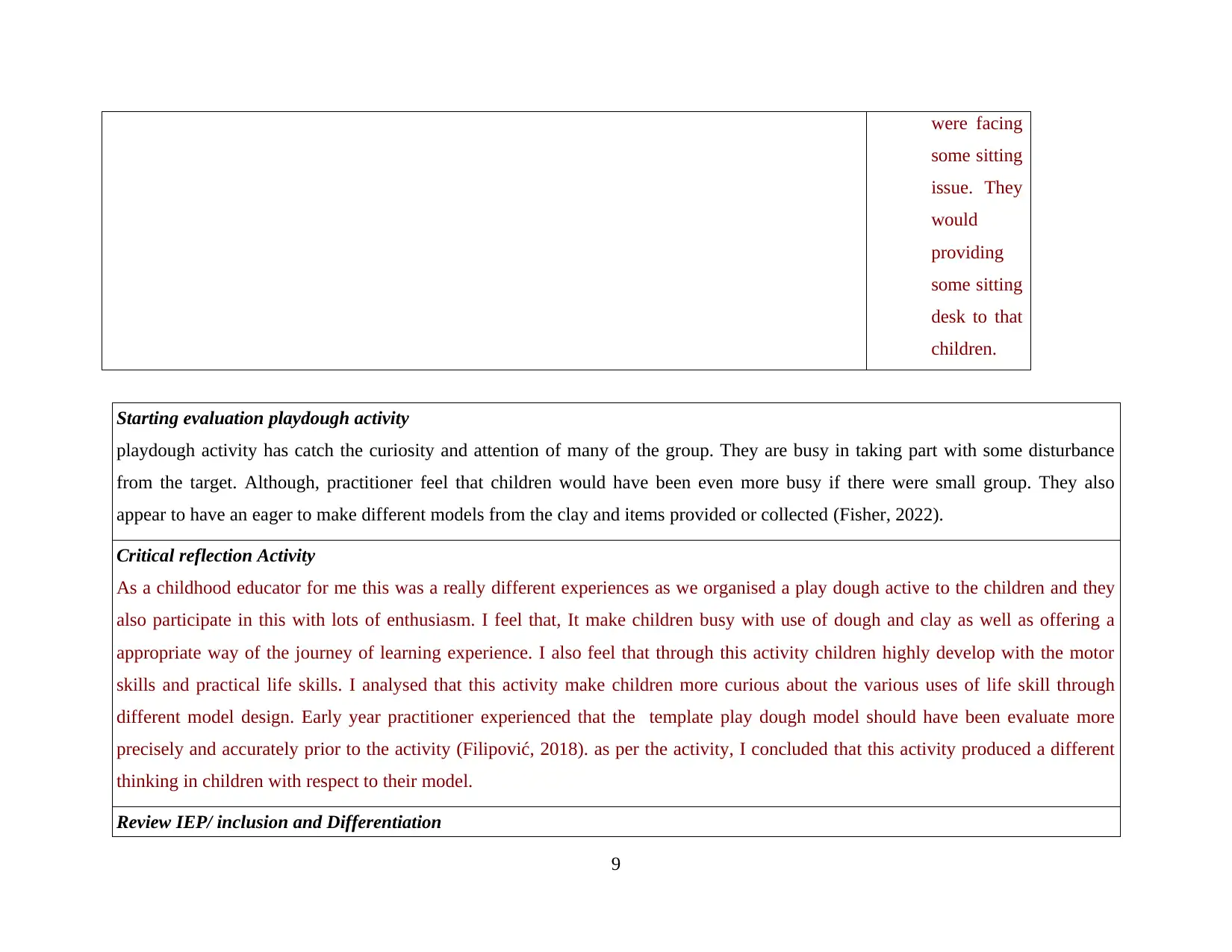
were facing
some sitting
issue. They
would
providing
some sitting
desk to that
children.
Starting evaluation playdough activity
playdough activity has catch the curiosity and attention of many of the group. They are busy in taking part with some disturbance
from the target. Although, practitioner feel that children would have been even more busy if there were small group. They also
appear to have an eager to make different models from the clay and items provided or collected (Fisher, 2022).
Critical reflection Activity
As a childhood educator for me this was a really different experiences as we organised a play dough active to the children and they
also participate in this with lots of enthusiasm. I feel that, It make children busy with use of dough and clay as well as offering a
appropriate way of the journey of learning experience. I also feel that through this activity children highly develop with the motor
skills and practical life skills. I analysed that this activity make children more curious about the various uses of life skill through
different model design. Early year practitioner experienced that the template play dough model should have been evaluate more
precisely and accurately prior to the activity (Filipović, 2018). as per the activity, I concluded that this activity produced a different
thinking in children with respect to their model.
Review IEP/ inclusion and Differentiation
9
Document Page
child 1 was not connected properly with the play dough activity but when teacher solved his sitting issue they focused on their
activity and attempt to made a good model.
2nd child creating the designed to the play-dough activity but he was totally confused about their selection of template but when their
teacher assisted him then he made a great work and designed a beautiful play dough model.
3rd child be in two minds to participate but once the practitioner offered to make it for her then she jumped up and make her
playdough model to the activity (Hawkins, 2019).
Opportunities for expand learning: Emergent Learning
Experiences
a large number of question should be asked from the
children.
Videography of their activity should be done so that they
can be motivated. Teacher should suggest more number of clay model for
the activities.
Opportunities to include stake holders
ask the parents to gather the required substances for playdough
project at home. Motivate parent to check the the substances prior
to the use for the model and to strengthen their child's learning
capability.
Supportive social legislation and policies:
'Social policy and legislation, as a consequence, ask them to recognise better approach in which a society can operate'. Offering a pre
school year without any pay enhance social inclusion that can directs to a stronger economy. Social policy as ' National Children's
strategy (NCS) – children and their lives, amendment in 2019, concentrates on providing a voice to children. These policy reviews
the' total child point of view' that he as a practitioners target to get in the process of planning (Ireland, et. al., 2018).
10
chevron_up_icon
1 out of 19
circle_padding
hide_on_mobile
zoom_out_icon
[object Object]