Obesity: Global Health Issue Report Analysis and Findings

Verified

Added on  2022/10/12

|1
|1051
|12
Report
AI Summary
This report addresses childhood obesity as a significant global health concern, examining its prevalence and associated risk factors, particularly within low socioeconomic groups. The study investigates the correlation between income inequalities, poor diet, and inadequate physical activity as contributors to increased obesity rates among children. The research analyzes data from a cohort study, considering confounding factors like gender, maternal health, and lifestyle choices. The findings highlight a greater risk of obesity in children from lower-income backgrounds, emphasizing the need for targeted interventions. Recommendations include raising awareness, promoting healthier diets, and modifying lifestyles to mitigate the impact of obesity, with the goal of improving public health outcomes. The report underscores the importance of follow-up studies and comprehensive data analysis to inform effective strategies.
Document Page
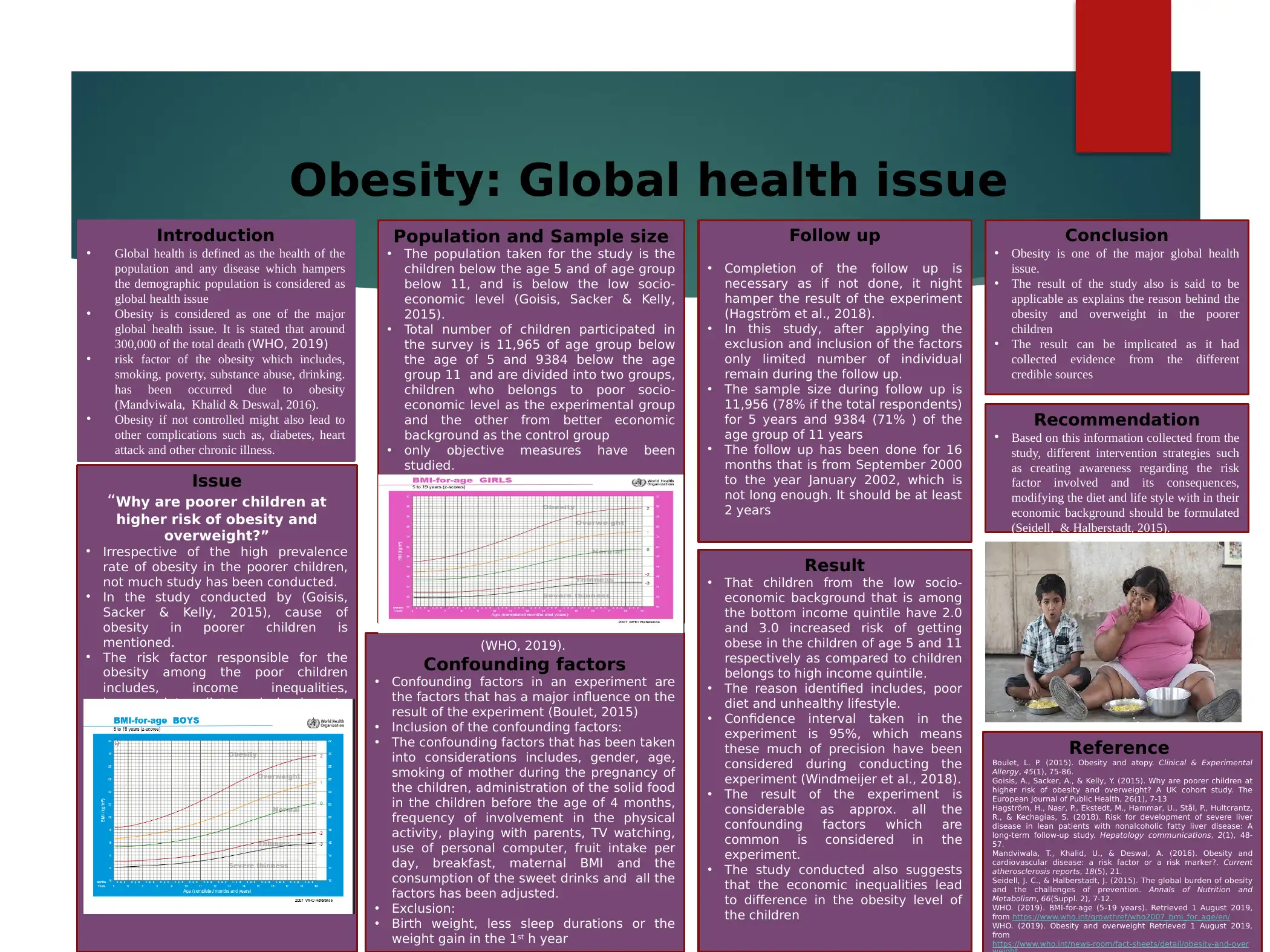
Obesity: Global health issue
Introduction
Global health is defined as the health of the
population and any disease which hampers
the demographic population is considered as
global health issue
Obesity is considered as one of the major
global health issue. It is stated that around
300,000 of the total death (WHO, 2019)
risk factor of the obesity which includes,
smoking, poverty, substance abuse, drinking.
has been occurred due to obesity
(Mandviwala, Khalid & Deswal, 2016).
Obesity if not controlled might also lead to
other complications such as, diabetes, heart
attack and other chronic illness.
Issue
Why are poorer children at
higher risk of obesity and
overweight?”
Irrespective of the high prevalence
rate of obesity in the poorer children,
not much study has been conducted.
In the study conducted by (Goisis,
Sacker & Kelly, 2015), cause of
obesity in poorer children is
mentioned.
The risk factor responsible for the
obesity among the poor children
includes, income inequalities,
inappropriate diet and inadequate
involvement in the physical activity.
Population and Sample size
The population taken for the study is the
children below the age 5 and of age group
below 11, and is below the low socio-
economic level (Goisis, Sacker & Kelly,
2015).
Total number of children participated in
the survey is 11,965 of age group below
the age of 5 and 9384 below the age
group 11 and are divided into two groups,
children who belongs to poor socio-
economic level as the experimental group
and the other from better economic
background as the control group
only objective measures have been
studied.
Conclusion
Obesity is one of the major global health
issue.
The result of the study also is said to be
applicable as explains the reason behind the
obesity and overweight in the poorer
children
The result can be implicated as it had
collected evidence from the different
credible sources
Follow up
Completion of the follow up is
necessary as if not done, it night
hamper the result of the experiment
(Hagström et al., 2018).
In this study, after applying the
exclusion and inclusion of the factors
only limited number of individual
remain during the follow up.
The sample size during follow up is
11,956 (78% if the total respondents)
for 5 years and 9384 (71% ) of the
age group of 11 years
The follow up has been done for 16
months that is from September 2000
to the year January 2002, which is
not long enough. It should be at least
2 years
(WHO, 2019).
Confounding factors
Confounding factors in an experiment are
the factors that has a major influence on the
result of the experiment (Boulet, 2015)
Inclusion of the confounding factors:
The confounding factors that has been taken
into considerations includes, gender, age,
smoking of mother during the pregnancy of
the children, administration of the solid food
in the children before the age of 4 months,
frequency of involvement in the physical
activity, playing with parents, TV watching,
use of personal computer, fruit intake per
day, breakfast, maternal BMI and the
consumption of the sweet drinks and all the
factors has been adjusted.
Exclusion:
Birth weight, less sleep durations or the
weight gain in the 1st h year
Result
That children from the low socio-
economic background that is among
the bottom income quintile have 2.0
and 3.0 increased risk of getting
obese in the children of age 5 and 11
respectively as compared to children
belongs to high income quintile.
The reason identified includes, poor
diet and unhealthy lifestyle.
Confidence interval taken in the
experiment is 95%, which means
these much of precision have been
considered during conducting the
experiment (Windmeijer et al., 2018).
The result of the experiment is
considerable as approx. all the
confounding factors which are
common is considered in the
experiment.
The study conducted also suggests
that the economic inequalities lead
to difference in the obesity level of
the children
Reference
Boulet, L. P. (2015). Obesity and atopy. Clinical & Experimental
Allergy, 45(1), 75-86.
Goisis, A., Sacker, A., & Kelly, Y. (2015). Why are poorer children at
higher risk of obesity and overweight? A UK cohort study. The
European Journal of Public Health, 26(1), 7-13
Hagström, H., Nasr, P., Ekstedt, M., Hammar, U., Stål, P., Hultcrantz,
R., & Kechagias, S. (2018). Risk for development of severe liver
disease in lean patients with nonalcoholic fatty liver disease: A
long‐term follow‐up study. Hepatology communications, 2(1), 48-
57.
Mandviwala, T., Khalid, U., & Deswal, A. (2016). Obesity and
cardiovascular disease: a risk factor or a risk marker?. Current
atherosclerosis reports, 18(5), 21.
Seidell, J. C., & Halberstadt, J. (2015). The global burden of obesity
and the challenges of prevention. Annals of Nutrition and
Metabolism, 66(Suppl. 2), 7-12.
WHO. (2019). BMI-for-age (5-19 years). Retrieved 1 August 2019,
from https://www.who.int/growthref/who2007_bmi_for_age/en/
WHO. (2019). Obesity and overweight Retrieved 1 August 2019,
from
https://www.who.int/news-room/fact-sheets/detail/obesity-and-over
Recommendation
Based on this information collected from the
study, different intervention strategies such
as creating awareness regarding the risk
factor involved and its consequences,
modifying the diet and life style with in their
economic background should be formulated
(Seidell, & Halberstadt, 2015).
tabler-icon-diamond-filled.svg

Paraphrase This Document

Need a fresh take? Get an instant paraphrase of this document with our AI Paraphraser
[object Object]