Identifying Factors of Childhood Obesity and Its Impact: Proposal
VerifiedAdded on 2020/06/06
|15
|5133
|131
Thesis and Dissertation
AI Summary
This dissertation proposal investigates the multifaceted issue of childhood obesity, specifically focusing on children aged 5 to 14. The proposal begins by defining the problem, highlighting its significance as a public health concern, and outlining the various factors contributing to it, including genetic, psychosocial, cultural, and environmental influences. The study aims to identify the primary causes of childhood obesity, determine the factors that significantly impact children, and analyze the effects of physical and psychosocial factors on their growth and development. The research will also explore potential solutions to address the issue of childhood obesity, supported by a thorough literature review, and will employ a detailed research methodology, including design, methods, data collection, and analysis techniques, along with acknowledging the limitations of the research. The proposal underscores the importance of understanding childhood obesity to develop effective interventions and improve children's overall well-being.
DISSERTATION
PROPOSAL
(Childhood Obesity)
PROPOSAL
(Childhood Obesity)

Paraphrase This Document
Need a fresh take? Get an instant paraphrase of this document with our AI Paraphraser
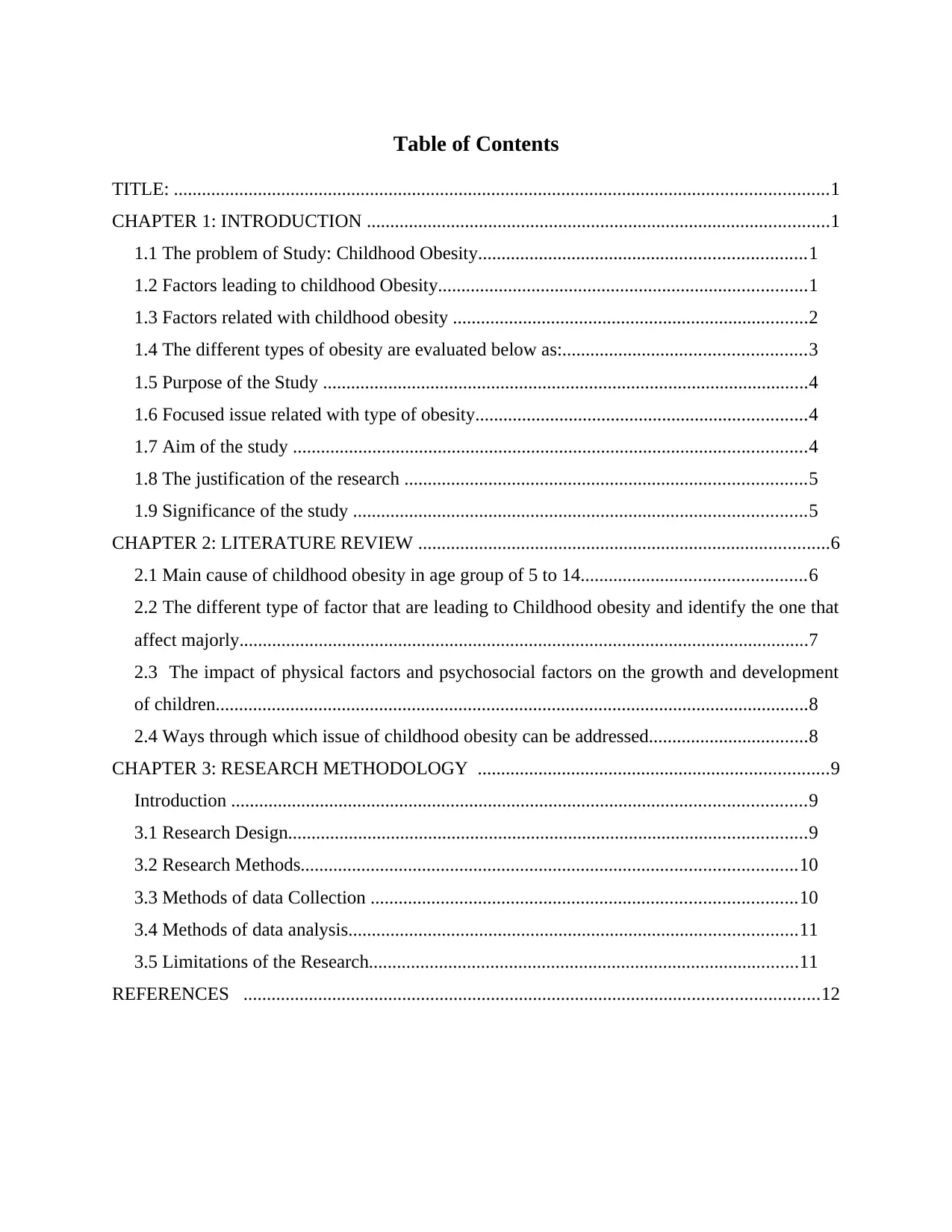
Table of Contents
TITLE: ............................................................................................................................................1
CHAPTER 1: INTRODUCTION ...................................................................................................1
1.1 The problem of Study: Childhood Obesity......................................................................1
1.2 Factors leading to childhood Obesity...............................................................................1
1.3 Factors related with childhood obesity ............................................................................2
1.4 The different types of obesity are evaluated below as:....................................................3
1.5 Purpose of the Study ........................................................................................................4
1.6 Focused issue related with type of obesity.......................................................................4
1.7 Aim of the study ..............................................................................................................4
1.8 The justification of the research ......................................................................................5
1.9 Significance of the study .................................................................................................5
CHAPTER 2: LITERATURE REVIEW ........................................................................................6
2.1 Main cause of childhood obesity in age group of 5 to 14................................................6
2.2 The different type of factor that are leading to Childhood obesity and identify the one that
affect majorly..........................................................................................................................7
2.3 The impact of physical factors and psychosocial factors on the growth and development
of children...............................................................................................................................8
2.4 Ways through which issue of childhood obesity can be addressed..................................8
CHAPTER 3: RESEARCH METHODOLOGY ...........................................................................9
Introduction ...........................................................................................................................9
3.1 Research Design...............................................................................................................9
3.2 Research Methods..........................................................................................................10
3.3 Methods of data Collection ...........................................................................................10
3.4 Methods of data analysis................................................................................................11
3.5 Limitations of the Research............................................................................................11
REFERENCES ...........................................................................................................................12
TITLE: ............................................................................................................................................1
CHAPTER 1: INTRODUCTION ...................................................................................................1
1.1 The problem of Study: Childhood Obesity......................................................................1
1.2 Factors leading to childhood Obesity...............................................................................1
1.3 Factors related with childhood obesity ............................................................................2
1.4 The different types of obesity are evaluated below as:....................................................3
1.5 Purpose of the Study ........................................................................................................4
1.6 Focused issue related with type of obesity.......................................................................4
1.7 Aim of the study ..............................................................................................................4
1.8 The justification of the research ......................................................................................5
1.9 Significance of the study .................................................................................................5
CHAPTER 2: LITERATURE REVIEW ........................................................................................6
2.1 Main cause of childhood obesity in age group of 5 to 14................................................6
2.2 The different type of factor that are leading to Childhood obesity and identify the one that
affect majorly..........................................................................................................................7
2.3 The impact of physical factors and psychosocial factors on the growth and development
of children...............................................................................................................................8
2.4 Ways through which issue of childhood obesity can be addressed..................................8
CHAPTER 3: RESEARCH METHODOLOGY ...........................................................................9
Introduction ...........................................................................................................................9
3.1 Research Design...............................................................................................................9
3.2 Research Methods..........................................................................................................10
3.3 Methods of data Collection ...........................................................................................10
3.4 Methods of data analysis................................................................................................11
3.5 Limitations of the Research............................................................................................11
REFERENCES ...........................................................................................................................12
TITLE:
To identifying the factors that cause childhood obesity and its impact on 5 to 14 age
group of child.
CHAPTER 1: INTRODUCTION
1.1 The problem of Study: Childhood Obesity
This section consist to be an essential part of research project as it helps in clearly
defining the issues on which research has to be conducted in effective and efficient manner.
Childhood obesity is recognized as a serious public health concern. In this modern era people
faces various type of health issues and conflicts in their life. Among all the issues childhood
obesity can be consist as an major problem which mainly impacts on the age group of 5 to 14
kids. Childhood obesity can be considered as a health condition in which excess body fat has a
negative influence on child's health and well-being. Childhood Obesity is one the major public
health challenges of the 21st century. Childhood obesity refers as a global issue and it has direct
influence on middle and low income countries. Obesity is consist as an abnormal or excessive fat
collection that has a direct influence on humans health (Ayala and et. al., 2015). Some time
people can store excessive fat in their body which cause various type of issues and conflicts in
their life. The weight of human body is interlinked with their height as in development of child
height and health needs to be change proportionally. As methods to analyse body fat directly are
difficult, the issue of obesity is significantly depend on body mass index. This type of issues are
mainly found in the middle income urban settings. The ratio of childhood obesity has increased
at a high rate. The number of children who are faces the issue of overweight under the age of five
is estimated to be over 41 million in the year of 2016. obese and overweight kids are likely to
live obese into adulthood and more likely to develop non-communicable issues such as diabetes
or cardiovascular diseases at a very younger age. Issues related with childhood obesity has direct
or indirect influence on health and well-being of kids.
1.2 Factors leading to childhood Obesity
Child obesity is described as those factors where children are seen overweighted and they
are constantly gaining weight. While making comparison with adults children are facing less
problems in relation to health aspects. If the children's are gaining weight then there are higher
chances that they will come across various type of problems related to their health like diabetes,
1
To identifying the factors that cause childhood obesity and its impact on 5 to 14 age
group of child.
CHAPTER 1: INTRODUCTION
1.1 The problem of Study: Childhood Obesity
This section consist to be an essential part of research project as it helps in clearly
defining the issues on which research has to be conducted in effective and efficient manner.
Childhood obesity is recognized as a serious public health concern. In this modern era people
faces various type of health issues and conflicts in their life. Among all the issues childhood
obesity can be consist as an major problem which mainly impacts on the age group of 5 to 14
kids. Childhood obesity can be considered as a health condition in which excess body fat has a
negative influence on child's health and well-being. Childhood Obesity is one the major public
health challenges of the 21st century. Childhood obesity refers as a global issue and it has direct
influence on middle and low income countries. Obesity is consist as an abnormal or excessive fat
collection that has a direct influence on humans health (Ayala and et. al., 2015). Some time
people can store excessive fat in their body which cause various type of issues and conflicts in
their life. The weight of human body is interlinked with their height as in development of child
height and health needs to be change proportionally. As methods to analyse body fat directly are
difficult, the issue of obesity is significantly depend on body mass index. This type of issues are
mainly found in the middle income urban settings. The ratio of childhood obesity has increased
at a high rate. The number of children who are faces the issue of overweight under the age of five
is estimated to be over 41 million in the year of 2016. obese and overweight kids are likely to
live obese into adulthood and more likely to develop non-communicable issues such as diabetes
or cardiovascular diseases at a very younger age. Issues related with childhood obesity has direct
or indirect influence on health and well-being of kids.
1.2 Factors leading to childhood Obesity
Child obesity is described as those factors where children are seen overweighted and they
are constantly gaining weight. While making comparison with adults children are facing less
problems in relation to health aspects. If the children's are gaining weight then there are higher
chances that they will come across various type of problems related to their health like diabetes,
1
⊘ This is a preview!⊘
Do you want full access?
Subscribe today to unlock all pages.

Trusted by 1+ million students worldwide
heart diseases etc. and this will harm their body parts an d they will not be physically fit for
perform any type of activity. The signs which are seen in children who are suffering from obesity
are stress, they want to live alone as they are sad and they are having very lower stem.
The major causes of Obesity are generic factors among children, they have not involved
themselves in different types of physical activities thus there is no development in their body
parts, they are consuming more fast foods rather then healthier food like fresh fruits and
vegetables and there can be various combination of all the above factors which are giving rise to
obesity in children. On the other hand the cause of obesity can also be linked with overweight
among children and this can be caused due to medical conditions such as Problems in the internal
hormones etc (Baidal and et. al., 2016). The blood test and the physical exams can be related
with the possibility of the medical department in order to find out the major causes behind
children obesity. Although there are various types of problems which are seen in families like
overweight but this is not the reason behind obesity in children's. The children who are born in
those families where all the family members are fats or overweighted then there are higher
chances that the children will also be healthy thus higher risk of gaining weight.
1.3 Factors related with childhood obesity
In today's scenario people are very much conscious towards their health and safety and
for this people made various efforts in order to making their self healthy and safe. In respect to
promoting healthy active living in the clinical setting has concern on helping families to effect
reconciled life style changes like developing the quality and quantity of physical activities and
creating effective nutritional choices. Childhood obesity can be consist to be a major issue in
modern society and for this various factors are to be considered in effective way in which some
are described as below:
Psychosocial factors: Kids with overweight and adolescents are mainly experience deleterious
psychosocial issues such as social isolation, depression, teasing, discrimination, diminished self
esteem, dissatisfaction with body image, reduce quality and standard of live and various
behavioural problems. A child's social environment involves parents, friends and family as
people are very much close to their parents, family and friends. Parents health condition,
behaviour, perception and psychosocial characteristics are essential elements which are
associated through childhood obesity. Parents are considered to be an essential role model for
their kids as they implement various rules and regulation or set some routines for physical and
2
perform any type of activity. The signs which are seen in children who are suffering from obesity
are stress, they want to live alone as they are sad and they are having very lower stem.
The major causes of Obesity are generic factors among children, they have not involved
themselves in different types of physical activities thus there is no development in their body
parts, they are consuming more fast foods rather then healthier food like fresh fruits and
vegetables and there can be various combination of all the above factors which are giving rise to
obesity in children. On the other hand the cause of obesity can also be linked with overweight
among children and this can be caused due to medical conditions such as Problems in the internal
hormones etc (Baidal and et. al., 2016). The blood test and the physical exams can be related
with the possibility of the medical department in order to find out the major causes behind
children obesity. Although there are various types of problems which are seen in families like
overweight but this is not the reason behind obesity in children's. The children who are born in
those families where all the family members are fats or overweighted then there are higher
chances that the children will also be healthy thus higher risk of gaining weight.
1.3 Factors related with childhood obesity
In today's scenario people are very much conscious towards their health and safety and
for this people made various efforts in order to making their self healthy and safe. In respect to
promoting healthy active living in the clinical setting has concern on helping families to effect
reconciled life style changes like developing the quality and quantity of physical activities and
creating effective nutritional choices. Childhood obesity can be consist to be a major issue in
modern society and for this various factors are to be considered in effective way in which some
are described as below:
Psychosocial factors: Kids with overweight and adolescents are mainly experience deleterious
psychosocial issues such as social isolation, depression, teasing, discrimination, diminished self
esteem, dissatisfaction with body image, reduce quality and standard of live and various
behavioural problems. A child's social environment involves parents, friends and family as
people are very much close to their parents, family and friends. Parents health condition,
behaviour, perception and psychosocial characteristics are essential elements which are
associated through childhood obesity. Parents are considered to be an essential role model for
their kids as they implement various rules and regulation or set some routines for physical and
2
Paraphrase This Document
Need a fresh take? Get an instant paraphrase of this document with our AI Paraphraser
eating activities. Childhood obesity is determined through developed risk for negative
psychosocial and physical health results and outcomes such as asthma, heart issues, diabetes, low
self esteem, weight related stress, anxiety and depression. Kids who are belong to ethnic
minority and low income level may be on higher risk for the negative issues related with obesity
through the exposure to the social risk factor.
Cultural Factor: In a society different people belongs from the different culture and their norms
are also based on their culture. In some culture and religion people are consuming high level of
oily food and this may cause various type of anxiety in humans health. This can also be
considered as an essential factor that may cause childhood obesity. This issue is mainly increases
in all ethnic and racial group of people, its ratio is high in non white population as compared to
the other people. The major reason for the difference in ratio of obesity among various groups
are crucial , in this various factors are involved such as genetics, culture, physiology, socio-
economic status and environment (Bauer and et. al., 2017).
1.4 The different types of obesity are evaluated below as:
Younger healthy females: The female members of the family who are overweighted and
this can be the reason of heredity among children's and there is internal problem in their
harmony's thus they are gaining weight. There can be complications in their internal systems and
they can be prone to various type of diseases such as diabetes.
Highly drunken males: The males who are consuming high alcohol are prone to obesity
as there will be disorders in their body parts, they will be overweighted etc. Consuming alcohol
in high quantity can affect the lungs and person can be prone to various diseases and sometimes
the conditions are critical that he had to give up his life in the end.
Anxious and unhappy middle age children's: This kind of obesity is mainly seen in
female members as they are affected by mental health, they are prone to insomnia and anxiety,
they like to be alone and sometimes they are prone to depression as they are thinking about the
diseases again and again but they are consuming alcohol in lower quantity and also they have
involved themselves in physical activities and exercises.
Affluent healthy elderly: These group is having best health in-spite they are consuming
higher alcohol and also sugar level is higher in their body. They had also focused on involving
themselves in healthy behaviour by taking with respect to everyone.
3
psychosocial and physical health results and outcomes such as asthma, heart issues, diabetes, low
self esteem, weight related stress, anxiety and depression. Kids who are belong to ethnic
minority and low income level may be on higher risk for the negative issues related with obesity
through the exposure to the social risk factor.
Cultural Factor: In a society different people belongs from the different culture and their norms
are also based on their culture. In some culture and religion people are consuming high level of
oily food and this may cause various type of anxiety in humans health. This can also be
considered as an essential factor that may cause childhood obesity. This issue is mainly increases
in all ethnic and racial group of people, its ratio is high in non white population as compared to
the other people. The major reason for the difference in ratio of obesity among various groups
are crucial , in this various factors are involved such as genetics, culture, physiology, socio-
economic status and environment (Bauer and et. al., 2017).
1.4 The different types of obesity are evaluated below as:
Younger healthy females: The female members of the family who are overweighted and
this can be the reason of heredity among children's and there is internal problem in their
harmony's thus they are gaining weight. There can be complications in their internal systems and
they can be prone to various type of diseases such as diabetes.
Highly drunken males: The males who are consuming high alcohol are prone to obesity
as there will be disorders in their body parts, they will be overweighted etc. Consuming alcohol
in high quantity can affect the lungs and person can be prone to various diseases and sometimes
the conditions are critical that he had to give up his life in the end.
Anxious and unhappy middle age children's: This kind of obesity is mainly seen in
female members as they are affected by mental health, they are prone to insomnia and anxiety,
they like to be alone and sometimes they are prone to depression as they are thinking about the
diseases again and again but they are consuming alcohol in lower quantity and also they have
involved themselves in physical activities and exercises.
Affluent healthy elderly: These group is having best health in-spite they are consuming
higher alcohol and also sugar level is higher in their body. They had also focused on involving
themselves in healthy behaviour by taking with respect to everyone.
3
Physically sick but they are elderly happy: These groups are always prone to chronic
health conditions and high prevalence. They are affected by high blood pressure but their
depression level is low and also anxiety.
Poorest Health: This is the last group of people who are suffering from obesity and they
suffer from high level of pain in their body parts and fatigue. They are affected by chronic health
conditions thus having higher BMI. These persons are also financially challenged in relation to
the diseases from which they are suffering.
The children's are mostly affected by poor health because if they are not consuming
healthier food then it will result in obesity where children will gain weight and the percentage
will be increased day by day.
1.5 Purpose of the Study
The research into consideration is based on the factors that cause childhood obesity and
its impact on 5 to 14 age group of child. This consist to be an essential issue in this modern era as
large number of kids and their families are affected with this problem. It is a physical condition
in which people faces the issues related with over weight and it has a direct impact on health and
well-being of humans. Kids with childhood obesity are seems to be adult than their age it means
they look more older (Cunningham, Kramer and Narayan, 2011). The body weight of such kids
are comparatively high than a normal child. Psychosocial factor can be considered as a most
essential element that may cause childhood obesity.
1.6 Focused issue related with type of obesity
There are different types of obesity analysed among children's and there are many
reasons such as higher level of anxiety, young healthy females etc. The problems among
children's should be analysed so that solutions can be provided to them for the same and they can
easily recover from their diseases.
1.7 Aim of the study
This consist to be an important part of research as the whole activity of research are based
on aim. This is a combination of all variables that are involved in the research project. The aim
for this particular research is to identifying the factors that cause childhood obesity and its
impact on 5 to 14 age group of child.
Research Objectives
4
health conditions and high prevalence. They are affected by high blood pressure but their
depression level is low and also anxiety.
Poorest Health: This is the last group of people who are suffering from obesity and they
suffer from high level of pain in their body parts and fatigue. They are affected by chronic health
conditions thus having higher BMI. These persons are also financially challenged in relation to
the diseases from which they are suffering.
The children's are mostly affected by poor health because if they are not consuming
healthier food then it will result in obesity where children will gain weight and the percentage
will be increased day by day.
1.5 Purpose of the Study
The research into consideration is based on the factors that cause childhood obesity and
its impact on 5 to 14 age group of child. This consist to be an essential issue in this modern era as
large number of kids and their families are affected with this problem. It is a physical condition
in which people faces the issues related with over weight and it has a direct impact on health and
well-being of humans. Kids with childhood obesity are seems to be adult than their age it means
they look more older (Cunningham, Kramer and Narayan, 2011). The body weight of such kids
are comparatively high than a normal child. Psychosocial factor can be considered as a most
essential element that may cause childhood obesity.
1.6 Focused issue related with type of obesity
There are different types of obesity analysed among children's and there are many
reasons such as higher level of anxiety, young healthy females etc. The problems among
children's should be analysed so that solutions can be provided to them for the same and they can
easily recover from their diseases.
1.7 Aim of the study
This consist to be an important part of research as the whole activity of research are based
on aim. This is a combination of all variables that are involved in the research project. The aim
for this particular research is to identifying the factors that cause childhood obesity and its
impact on 5 to 14 age group of child.
Research Objectives
4
⊘ This is a preview!⊘
Do you want full access?
Subscribe today to unlock all pages.
Trusted by 1+ million students worldwide
To determine the main cause of childhood obesity in age group of 5 to 14.
To ascertain the different type of factor that are leading to Childhood obesity and identify
the one that affect majorly.
To identify the impact of physical factors and psychosocial factors on the growth and
development of children. To identify the ways through which issue of childhood obesity can be addressed.
Research Question
What are the main cause of childhood obesity in age group of 5 to 14?
What are the different type of factor that are leading to Childhood obesity and identify
the one that affect majorly?
What is the impact of physical factors and psychosocial factors on the growth and
development of children?
What are the major ways through which issue of childhood obesity can be addressed?
1.8 The justification of the research
The major reason for conducting the research is to enhancing the skills and knowledge of
learner about the concept of childhood obesity. Childhood obesity is a serious medical condition
which affects children and teenagers. Each individual has their own body shape which is based
on their diet and physical and mental condition.
1.9 Significance of the study
The significance of the study is linked with analysing the major causes of child obesity
among children's of age group 5 to 14. The children's who are suffering from obesity are gaining
weight day by day and the major reasons which are analysed is that they are consuming fast
foods, they are not involving them physical activities thus there is no growth and development in
their body parts.
5
To ascertain the different type of factor that are leading to Childhood obesity and identify
the one that affect majorly.
To identify the impact of physical factors and psychosocial factors on the growth and
development of children. To identify the ways through which issue of childhood obesity can be addressed.
Research Question
What are the main cause of childhood obesity in age group of 5 to 14?
What are the different type of factor that are leading to Childhood obesity and identify
the one that affect majorly?
What is the impact of physical factors and psychosocial factors on the growth and
development of children?
What are the major ways through which issue of childhood obesity can be addressed?
1.8 The justification of the research
The major reason for conducting the research is to enhancing the skills and knowledge of
learner about the concept of childhood obesity. Childhood obesity is a serious medical condition
which affects children and teenagers. Each individual has their own body shape which is based
on their diet and physical and mental condition.
1.9 Significance of the study
The significance of the study is linked with analysing the major causes of child obesity
among children's of age group 5 to 14. The children's who are suffering from obesity are gaining
weight day by day and the major reasons which are analysed is that they are consuming fast
foods, they are not involving them physical activities thus there is no growth and development in
their body parts.
5
Paraphrase This Document
Need a fresh take? Get an instant paraphrase of this document with our AI Paraphraser
CHAPTER 2: LITERATURE REVIEW
2.1 Main cause of childhood obesity in age group of 5 to 14
As per the opinion of Davison and 2015, Obesity in childhood is a state where kids cross
their respective BMI and become overweight. Main cause for being obese is higher number of
calorie and fat intake. Being obese causes negative effect on health (physically and mentally).
Factors such as lifestyle, culture and social plays a crucial role in increase of obesity level among
kids. Following are few causes of obesity: Junk food and beverage intake- Major segment of people follow lifestyle where both the
parents work and kids are left on their own. Due to which they lean towards junk foods as
they are inexpensive and convenient in nature. Junk food comprises of pizza, burger and
snack foods (such as chips, candy, chocolates) that have high amount of calories with
low nutritional value. Same case is with beverages, they have high caloric content too. Quantity intake- Because of marketing strategy these junk foods are taste specific to
increase customer number. Kids get attracted towards them and intake large portion. This
imbalance in quantity along with quality leads to increase in weight gain and obesity.
Psychological disorder- Here, factors related to brain and perception are considered to
determine the reason of obesity among children. Few of them are given below:
Depression: Anxiety and depression are two major causes of obesity. When a person is
depressed he tend to cut himself out of every thing and get indulge in bad habits. A
depress person is not aware of the fact what is he is doing and what will be the
consequences.
Self esteem: It arises when fellow kids are of normal weight, individual becomes
conscious of its body and activeness. Body shaming: Due to beauty culture, kids fascinate themselves with perfect bodies and
spotless skin. But obesity increases fat in body and results in weight gain. Thus making
children victim of body shaming.
Activity level- Along with low nutritional food there comes in-activeness where children
between age of 10-14 practice sedentary lifestyle. Instead of participating in outdoor
activities they prefer sitting in-front of television set and desktops. As no workout is
practised therefore their activity level decreases and obesity level increases.
6
2.1 Main cause of childhood obesity in age group of 5 to 14
As per the opinion of Davison and 2015, Obesity in childhood is a state where kids cross
their respective BMI and become overweight. Main cause for being obese is higher number of
calorie and fat intake. Being obese causes negative effect on health (physically and mentally).
Factors such as lifestyle, culture and social plays a crucial role in increase of obesity level among
kids. Following are few causes of obesity: Junk food and beverage intake- Major segment of people follow lifestyle where both the
parents work and kids are left on their own. Due to which they lean towards junk foods as
they are inexpensive and convenient in nature. Junk food comprises of pizza, burger and
snack foods (such as chips, candy, chocolates) that have high amount of calories with
low nutritional value. Same case is with beverages, they have high caloric content too. Quantity intake- Because of marketing strategy these junk foods are taste specific to
increase customer number. Kids get attracted towards them and intake large portion. This
imbalance in quantity along with quality leads to increase in weight gain and obesity.
Psychological disorder- Here, factors related to brain and perception are considered to
determine the reason of obesity among children. Few of them are given below:
Depression: Anxiety and depression are two major causes of obesity. When a person is
depressed he tend to cut himself out of every thing and get indulge in bad habits. A
depress person is not aware of the fact what is he is doing and what will be the
consequences.
Self esteem: It arises when fellow kids are of normal weight, individual becomes
conscious of its body and activeness. Body shaming: Due to beauty culture, kids fascinate themselves with perfect bodies and
spotless skin. But obesity increases fat in body and results in weight gain. Thus making
children victim of body shaming.
Activity level- Along with low nutritional food there comes in-activeness where children
between age of 10-14 practice sedentary lifestyle. Instead of participating in outdoor
activities they prefer sitting in-front of television set and desktops. As no workout is
practised therefore their activity level decreases and obesity level increases.
6
2.2 The different type of factor that are leading to Childhood obesity and identify the one that
affect majorly.
As per the views expressed by Myles S. Faith and Tanja V.K Kral, 2018, Obesity is
simply refers as having too much body weight that the particular height and weight of a human
being. The issues related with childhood obesity is significantly rising all over the globe and it
has a huge effect on health and well-being of children. This is one of the most pressuring public
health disorder in the country of united state and other westernised countries. The ratio of
obesity is increasing globally and it is associated through concerning medical co-morbidities,
most noticeably the metabolic type and syndrome. Childhood obesity may cause through genetic
as well as environmental factor, There are various type of factors that are leading to childhood
obesity, in which some are associated as under:
Consumption of Food: This can be considered as the most essential element of environmental
factor as in this modern era people are very much concern on consuming variety of food and
mainly kids are attracted towards fast food and street foods. These are mainly cause childhood
obesity among kids. It is required for people to having a huge control on their food. It is the
major responsibility of parents or elders to set a routine for food and physical activity of kids.
Consumption of alcohol: Childhood obesity may cause through genetic issues and problems.
People who are consuming high level of alcohol may faces the issue of obesity as it create high
range of diabetes in human body and which is considers as the most essential factor that may
cause obesity. Childhood obesity mainly founds in the children of people who are consuming
high amount of alcohol at regular basis.
Mental and Physical Stress: This is an another factor that may cause high range of obesity in
people. This type of issues are majorly found in the kids and teenagers due to some mental as
well as physical stress. It is required for family members to provide comfortable zone to their
kids in order to effectively development of their body and mind set.
The above mentioned factors are considered to be most effective element that may highly
cause childhood obesity. Among all the elements consumption of food is considered to be a most
effective factor of obesity as high amount of unhealthy food may cause overweight in people.
7
affect majorly.
As per the views expressed by Myles S. Faith and Tanja V.K Kral, 2018, Obesity is
simply refers as having too much body weight that the particular height and weight of a human
being. The issues related with childhood obesity is significantly rising all over the globe and it
has a huge effect on health and well-being of children. This is one of the most pressuring public
health disorder in the country of united state and other westernised countries. The ratio of
obesity is increasing globally and it is associated through concerning medical co-morbidities,
most noticeably the metabolic type and syndrome. Childhood obesity may cause through genetic
as well as environmental factor, There are various type of factors that are leading to childhood
obesity, in which some are associated as under:
Consumption of Food: This can be considered as the most essential element of environmental
factor as in this modern era people are very much concern on consuming variety of food and
mainly kids are attracted towards fast food and street foods. These are mainly cause childhood
obesity among kids. It is required for people to having a huge control on their food. It is the
major responsibility of parents or elders to set a routine for food and physical activity of kids.
Consumption of alcohol: Childhood obesity may cause through genetic issues and problems.
People who are consuming high level of alcohol may faces the issue of obesity as it create high
range of diabetes in human body and which is considers as the most essential factor that may
cause obesity. Childhood obesity mainly founds in the children of people who are consuming
high amount of alcohol at regular basis.
Mental and Physical Stress: This is an another factor that may cause high range of obesity in
people. This type of issues are majorly found in the kids and teenagers due to some mental as
well as physical stress. It is required for family members to provide comfortable zone to their
kids in order to effectively development of their body and mind set.
The above mentioned factors are considered to be most effective element that may highly
cause childhood obesity. Among all the elements consumption of food is considered to be a most
effective factor of obesity as high amount of unhealthy food may cause overweight in people.
7
⊘ This is a preview!⊘
Do you want full access?
Subscribe today to unlock all pages.
Trusted by 1+ million students worldwide
2.3 The impact of physical factors and psychosocial factors on the growth and development of
children.
As per the opinion of Marie Cheour, 2017, physical and psychosocial factors factors has a
huge impact on growth and development of children. The process of human growth and
development is evaluated by different set of principles. These principles are associate typical
development as a ordinary and predictable process. Genetic and environmental factor has a direct
influence on growth and development of individual.
Genetics: At the time of child birth, kids has some unique set of genetic instruction that directly
impacts on their physical growth. Genetic has a strong impact on rate of human body as this is
influenced by the body posture of parents. As the physical development of a child is based on the
physical appearance of parents and elders.
Environmental: This also an essential factor of child growth and development. Environmental
factors such as nutrition and food can affect on physical growth and development of a child. It
can also impacted on the texture and quality of bones and teeth, the size of body parts and delay
the mental growth.
2.4 Ways through which issue of childhood obesity can be addressed
As per the view point of Foster and 2015. Prevention from obesity among kids can be
done by following manner which are evaluated below as:
1. Healthy eating habits- Involve foods such as vegetable, fruit as they are valuable in
providing nutrition value in human body. The products which consist of low facts should
be included, persons should drink lot of water in order to survive their life healthier and
they will not be prone to any type of diseases.
2. Prefer nutritional food- Adopt eating habits where heart-healthy dishes are incorporated
in diet. Try out new recipes to make healthy food good in taste so that kids prefer them
and eat them.
3. Avoid high calorie- Occasional treats are fine but crossing limits of fat and calorie intake
can cause obesity. Therefore, frequent consumption of rich calorie delights must be
removed from the menu.
4. Be active- Teach children to involve themselves in physical activities such as swimming,
jumping ropes, playing soccer and dancing. Being active benefits body in many ways. It
8
children.
As per the opinion of Marie Cheour, 2017, physical and psychosocial factors factors has a
huge impact on growth and development of children. The process of human growth and
development is evaluated by different set of principles. These principles are associate typical
development as a ordinary and predictable process. Genetic and environmental factor has a direct
influence on growth and development of individual.
Genetics: At the time of child birth, kids has some unique set of genetic instruction that directly
impacts on their physical growth. Genetic has a strong impact on rate of human body as this is
influenced by the body posture of parents. As the physical development of a child is based on the
physical appearance of parents and elders.
Environmental: This also an essential factor of child growth and development. Environmental
factors such as nutrition and food can affect on physical growth and development of a child. It
can also impacted on the texture and quality of bones and teeth, the size of body parts and delay
the mental growth.
2.4 Ways through which issue of childhood obesity can be addressed
As per the view point of Foster and 2015. Prevention from obesity among kids can be
done by following manner which are evaluated below as:
1. Healthy eating habits- Involve foods such as vegetable, fruit as they are valuable in
providing nutrition value in human body. The products which consist of low facts should
be included, persons should drink lot of water in order to survive their life healthier and
they will not be prone to any type of diseases.
2. Prefer nutritional food- Adopt eating habits where heart-healthy dishes are incorporated
in diet. Try out new recipes to make healthy food good in taste so that kids prefer them
and eat them.
3. Avoid high calorie- Occasional treats are fine but crossing limits of fat and calorie intake
can cause obesity. Therefore, frequent consumption of rich calorie delights must be
removed from the menu.
4. Be active- Teach children to involve themselves in physical activities such as swimming,
jumping ropes, playing soccer and dancing. Being active benefits body in many ways. It
8
Paraphrase This Document
Need a fresh take? Get an instant paraphrase of this document with our AI Paraphraser
maintains blood pressure, strengthens bones, reduces anxiety, helps in weight
management, etc. Active makes you healthy from inside and outside as well.
Reduce sedentary time- Kids already spend ample amount of time doing their home work and
studying. Therefore, sitting in-front of television, playing video games, chatting and laying must
be reduced from their daily activities. Instead, they must be involved in more sort of physical
activities. The issues of obesity which is seen among children's can be reduced if they are eat
healthy food and this will result in growth and development of their body. The children should
be offered high nutrition food by making those dishes which are favourite so they will avoid
consuming fast food.
CHAPTER 3: RESEARCH METHODOLOGY
Introduction
This can be described as the most essential part of research as it helps in carry out the
whole research work in well planned and effective direction. This section of research is based on
various application that all plays an effective part in moving forward towards right way as to
reaching at final result and output.
3.1 Research Design
Its referred to as set of method and procedure for collecting and analysing data's for
achieving aim and objectives of research in predetermine time period. They are generally two
type qualitative and quantitative method of research design.
Qualitative research method: In this method researcher are gather information form
analysing behaviour of customers. Collecting data's by interview and observation of an
individual and groups, document analysis etc. This method are used in an organisation.
Few qualitative research design are phenomenology, biographical study, ethnography and
case study etc.
Quantitative research method: This is a systematic method for investigating data's and
information in order to achieve aim and objectives. This is a observation method via
using mathematical, statistical and computational techniques which help to draw a valid
conclusion. The main quantitative method are descriptive, correlation design, quasi
experimental and experimental etc.
9
management, etc. Active makes you healthy from inside and outside as well.
Reduce sedentary time- Kids already spend ample amount of time doing their home work and
studying. Therefore, sitting in-front of television, playing video games, chatting and laying must
be reduced from their daily activities. Instead, they must be involved in more sort of physical
activities. The issues of obesity which is seen among children's can be reduced if they are eat
healthy food and this will result in growth and development of their body. The children should
be offered high nutrition food by making those dishes which are favourite so they will avoid
consuming fast food.
CHAPTER 3: RESEARCH METHODOLOGY
Introduction
This can be described as the most essential part of research as it helps in carry out the
whole research work in well planned and effective direction. This section of research is based on
various application that all plays an effective part in moving forward towards right way as to
reaching at final result and output.
3.1 Research Design
Its referred to as set of method and procedure for collecting and analysing data's for
achieving aim and objectives of research in predetermine time period. They are generally two
type qualitative and quantitative method of research design.
Qualitative research method: In this method researcher are gather information form
analysing behaviour of customers. Collecting data's by interview and observation of an
individual and groups, document analysis etc. This method are used in an organisation.
Few qualitative research design are phenomenology, biographical study, ethnography and
case study etc.
Quantitative research method: This is a systematic method for investigating data's and
information in order to achieve aim and objectives. This is a observation method via
using mathematical, statistical and computational techniques which help to draw a valid
conclusion. The main quantitative method are descriptive, correlation design, quasi
experimental and experimental etc.
9
In this research qualitative method are used to draw a valid outcomes. Thus help to
identify consumer as well as employees behaviour toward company product and services.
3.2 Research Methods
The selection of the method are based on the type of research as it has direct link with
type of investigation. A research can be qualitative or quantitative in nature and the selection of
research methods are based on the nature of the research. In the particular research secondary
research has to be taken into proper action. Secondary method of research is effective in
conducting the section of literature review in effective manner as it helps in completing the
section of literature review through the view point of various writers and authors. Secondary
source is effective in conducting an in-depth research.
3.3 Methods of data Collection
This consist to be an essential part of research methodology as it helps in providing a
significant direction to the researcher for moving forward towards appropriate direction. In this
section data has to be collected by researcher in order to reaching at final result and output.
Researcher use appropriate research method to gain positive outcome. Data and information
collection are very important step for researcher thus provide help to carry out whole research
activities in right direction. Mainly two type primary and secondary data collection method used
by researcher to achieve set goals and objectives.
Primary data collection: In this method researcher collecting data's and information form
first hand sources of information by observation, survey and experimentation. Researcher
gather data by several mode like interview, observation, questionnaire, scheduling etc.
Many company used this method for analysing research objectives and aim in a very
effective manner. This method help to researcher for gather information related to
customer's behaviour and thinking about firms product and services. They get suggestion
form clients to improve their quality of goods in order to satisfy needs and wants.
Secondary data collection method: In this method, researcher gather data's by existing
information and knowledge. Thus information are collecting form books, journals,
magazine, newspapers etc. This method help to save time and money of an organisation.
Researcher has conducting research in a given budgets, so they want to identify which
data collection method are most appropriate for them. Some time the relevant data's and
information are not available at secondary platform then researcher go for second option.
10
identify consumer as well as employees behaviour toward company product and services.
3.2 Research Methods
The selection of the method are based on the type of research as it has direct link with
type of investigation. A research can be qualitative or quantitative in nature and the selection of
research methods are based on the nature of the research. In the particular research secondary
research has to be taken into proper action. Secondary method of research is effective in
conducting the section of literature review in effective manner as it helps in completing the
section of literature review through the view point of various writers and authors. Secondary
source is effective in conducting an in-depth research.
3.3 Methods of data Collection
This consist to be an essential part of research methodology as it helps in providing a
significant direction to the researcher for moving forward towards appropriate direction. In this
section data has to be collected by researcher in order to reaching at final result and output.
Researcher use appropriate research method to gain positive outcome. Data and information
collection are very important step for researcher thus provide help to carry out whole research
activities in right direction. Mainly two type primary and secondary data collection method used
by researcher to achieve set goals and objectives.
Primary data collection: In this method researcher collecting data's and information form
first hand sources of information by observation, survey and experimentation. Researcher
gather data by several mode like interview, observation, questionnaire, scheduling etc.
Many company used this method for analysing research objectives and aim in a very
effective manner. This method help to researcher for gather information related to
customer's behaviour and thinking about firms product and services. They get suggestion
form clients to improve their quality of goods in order to satisfy needs and wants.
Secondary data collection method: In this method, researcher gather data's by existing
information and knowledge. Thus information are collecting form books, journals,
magazine, newspapers etc. This method help to save time and money of an organisation.
Researcher has conducting research in a given budgets, so they want to identify which
data collection method are most appropriate for them. Some time the relevant data's and
information are not available at secondary platform then researcher go for second option.
10
⊘ This is a preview!⊘
Do you want full access?
Subscribe today to unlock all pages.
Trusted by 1+ million students worldwide

1 out of 15


Related Documents


Your All-in-One AI-Powered Toolkit for Academic Success.
+13062052269
info@desklib.com
Available 24*7 on WhatsApp / Email
![[object Object]](/_next/static/media/star-bottom.7253800d.svg)
Unlock your academic potential
Copyright © 2020–2026 A2Z Services. All Rights Reserved. Developed and managed by ZUCOL.