Article Critique: The Secret of Children's Drawings in Psychology

Verified

Added on  2022/11/14

|4
|886
|461
Report
AI Summary
This report is an article critique of a psychology journal article titled "The Secret of Children's Drawings." The assignment analyzes the research methodology, which is content analysis based on secondary data from journals and articles. It explores the psychological aspects of children's drawings, including how they reflect emotions, experiences, and the influence of the limbic system in the brain on their motivation and expression. The critique discusses social factors influencing children's behavior and the impact of others' presence. It also examines the brain structures involved in emotion and motivation, particularly the limbic system. The report highlights the importance of understanding children's drawings as a means of expressing their inner thoughts and feelings, referencing theories from psychologists like Carl Gustav Jung, and it concludes with a concise summary of the article's strengths and weaknesses.
Document Page
Running head: THE SECRET OF CHILDREN’S DRAWINGS
THE SECRET OF CHILDREN’S DRAWINGS
Name of the Student
Name of the University
Author’s notes
tabler-icon-diamond-filled.svg

Paraphrase This Document

Need a fresh take? Get an instant paraphrase of this document with our AI Paraphraser
Document Page
1
THE SECRET OF CHILDREN’S DRAWINGS
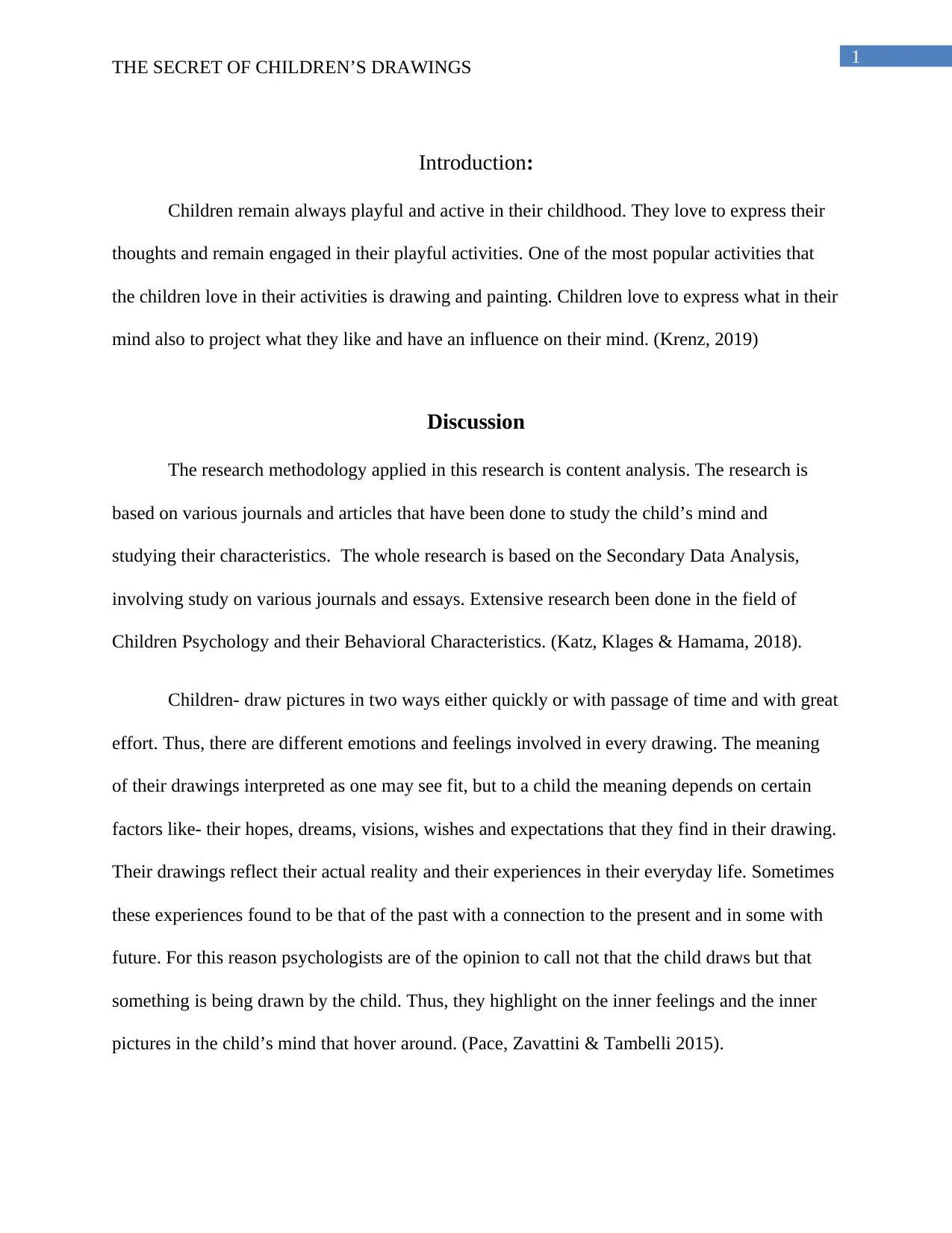
Introduction:
Children remain always playful and active in their childhood. They love to express their
thoughts and remain engaged in their playful activities. One of the most popular activities that
the children love in their activities is drawing and painting. Children love to express what in their
mind also to project what they like and have an influence on their mind. (Krenz, 2019)
Discussion
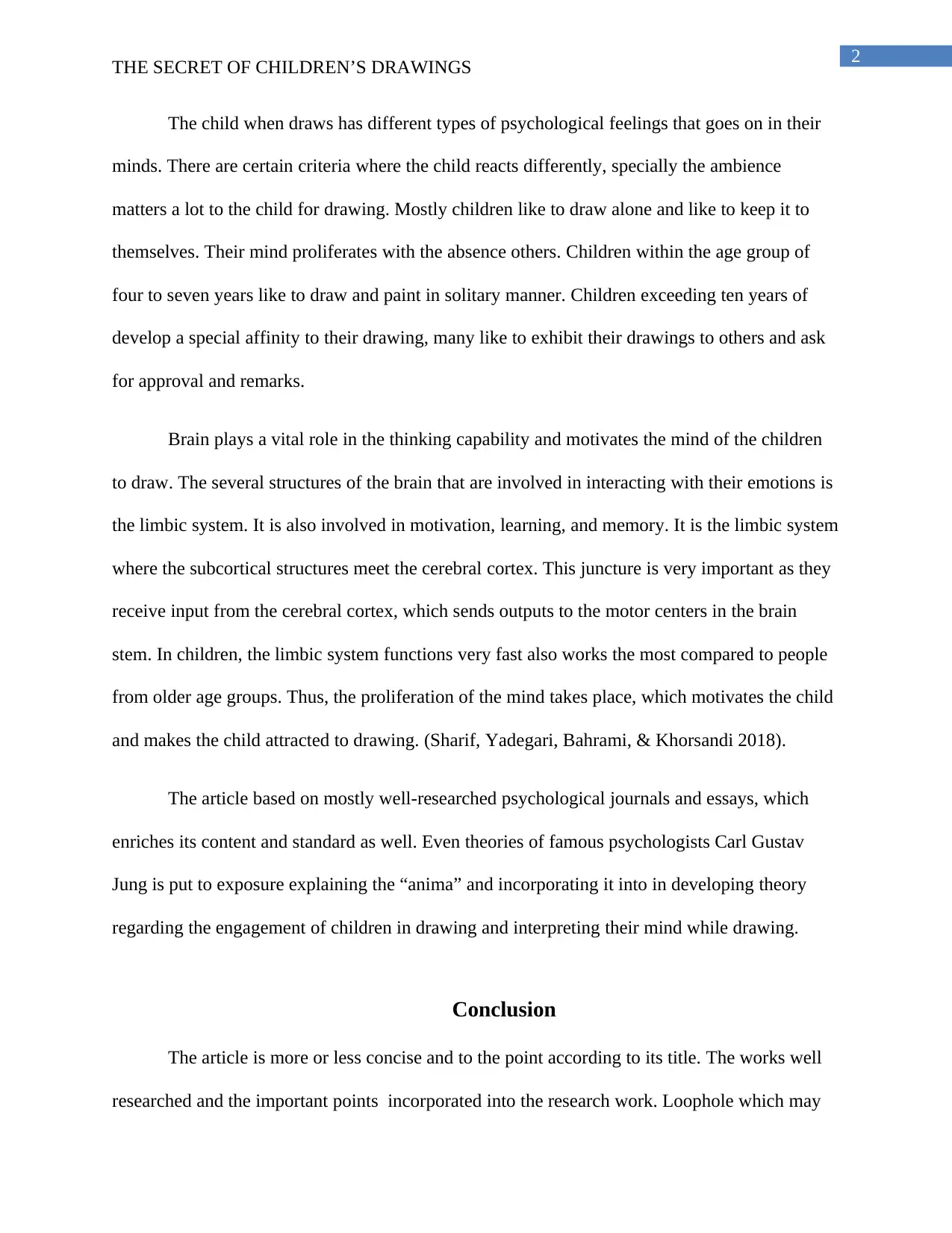
The research methodology applied in this research is content analysis. The research is
based on various journals and articles that have been done to study the child’s mind and
studying their characteristics. The whole research is based on the Secondary Data Analysis,
involving study on various journals and essays. Extensive research been done in the field of
Children Psychology and their Behavioral Characteristics. (Katz, Klages & Hamama, 2018).
Children- draw pictures in two ways either quickly or with passage of time and with great
effort. Thus, there are different emotions and feelings involved in every drawing. The meaning
of their drawings interpreted as one may see fit, but to a child the meaning depends on certain
factors like- their hopes, dreams, visions, wishes and expectations that they find in their drawing.
Their drawings reflect their actual reality and their experiences in their everyday life. Sometimes
these experiences found to be that of the past with a connection to the present and in some with
future. For this reason psychologists are of the opinion to call not that the child draws but that
something is being drawn by the child. Thus, they highlight on the inner feelings and the inner
pictures in the child’s mind that hover around. (Pace, Zavattini & Tambelli 2015).
Document Page
2
THE SECRET OF CHILDREN’S DRAWINGS
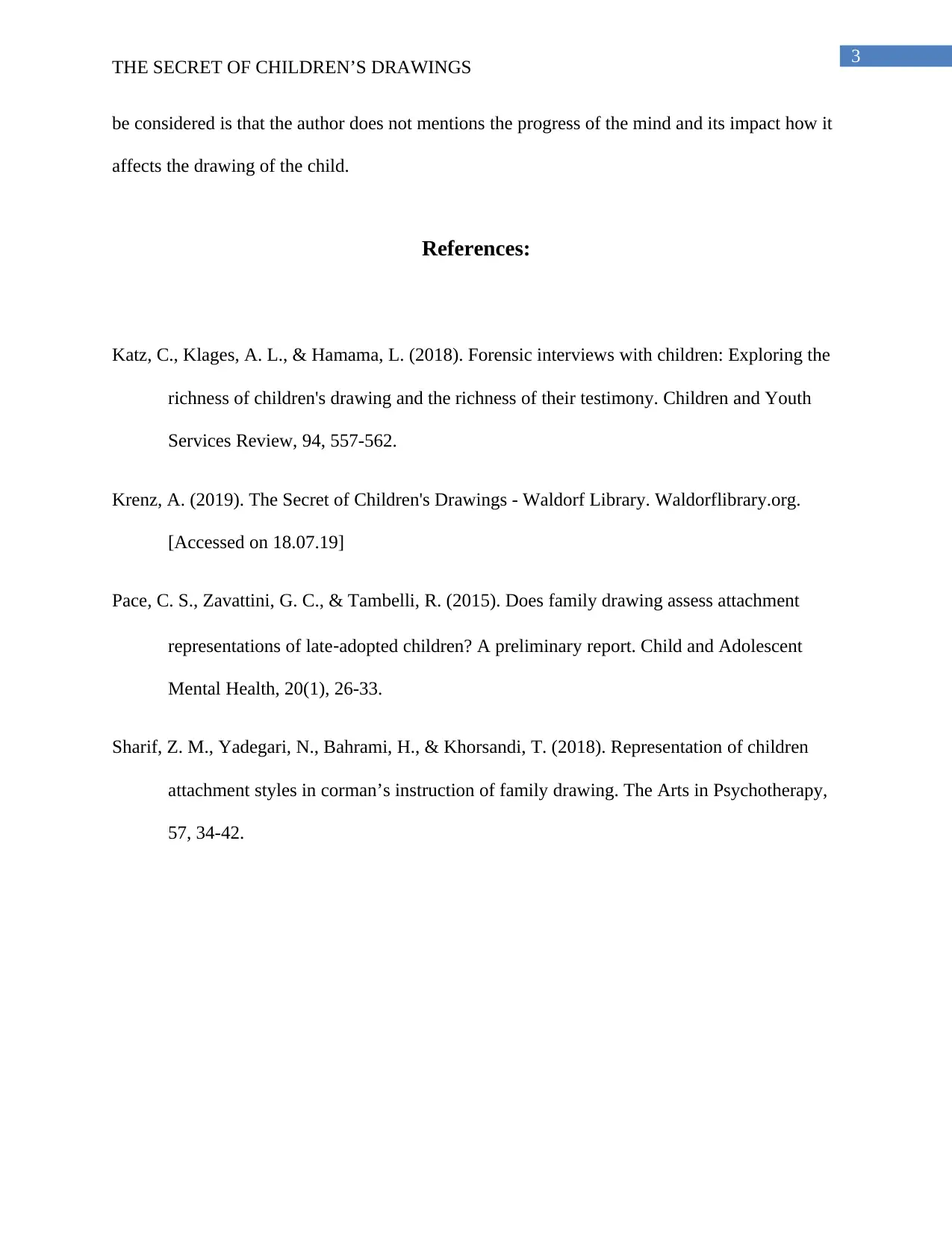
The child when draws has different types of psychological feelings that goes on in their
minds. There are certain criteria where the child reacts differently, specially the ambience
matters a lot to the child for drawing. Mostly children like to draw alone and like to keep it to
themselves. Their mind proliferates with the absence others. Children within the age group of
four to seven years like to draw and paint in solitary manner. Children exceeding ten years of
develop a special affinity to their drawing, many like to exhibit their drawings to others and ask
for approval and remarks.
Brain plays a vital role in the thinking capability and motivates the mind of the children
to draw. The several structures of the brain that are involved in interacting with their emotions is
the limbic system. It is also involved in motivation, learning, and memory. It is the limbic system
where the subcortical structures meet the cerebral cortex. This juncture is very important as they
receive input from the cerebral cortex, which sends outputs to the motor centers in the brain
stem. In children, the limbic system functions very fast also works the most compared to people
from older age groups. Thus, the proliferation of the mind takes place, which motivates the child
and makes the child attracted to drawing. (Sharif, Yadegari, Bahrami, & Khorsandi 2018).
The article based on mostly well-researched psychological journals and essays, which
enriches its content and standard as well. Even theories of famous psychologists Carl Gustav
Jung is put to exposure explaining the “anima” and incorporating it into in developing theory
regarding the engagement of children in drawing and interpreting their mind while drawing.
Conclusion
The article is more or less concise and to the point according to its title. The works well
researched and the important points incorporated into the research work. Loophole which may
Document Page
3
THE SECRET OF CHILDREN’S DRAWINGS
be considered is that the author does not mentions the progress of the mind and its impact how it
affects the drawing of the child.
References:
Katz, C., Klages, A. L., & Hamama, L. (2018). Forensic interviews with children: Exploring the
richness of children's drawing and the richness of their testimony. Children and Youth
Services Review, 94, 557-562.
Krenz, A. (2019). The Secret of Children's Drawings - Waldorf Library. Waldorflibrary.org.
[Accessed on 18.07.19]
Pace, C. S., Zavattini, G. C., & Tambelli, R. (2015). Does family drawing assess attachment
representations of lateadopted children? A preliminary report. Child and Adolescent
Mental Health, 20(1), 26-33.
Sharif, Z. M., Yadegari, N., Bahrami, H., & Khorsandi, T. (2018). Representation of children
attachment styles in corman’s instruction of family drawing. The Arts in Psychotherapy,
57, 34-42.
chevron_up_icon
1 out of 4
circle_padding
hide_on_mobile
zoom_out_icon
[object Object]