Discussion: Social Psychology and Science of Children's Eating Habits

Verified

Added on  2022/09/17

|3
|445
|18
Discussion Board Post
AI Summary
This discussion post delves into the social psychology of children's eating habits, examining the significant influence of parental behavior and modeling on children's food preferences. The author references research by Draxten et al. (2014) and Scaglioni, Salvioni, and Galimberti (2008) to support the claim that parental eating habits directly impact children's dietary choices. The post further connects these findings to Bandura's social learning theory, emphasizing that children learn by observing adults. The author supports the claim that healthy eating habits are not entirely a choice but can be influenced from early childhood. The post responds to a discussion question regarding children's eating habits and is part of a larger discussion board assignment that requires students to reflect on their classmates' posts and support their arguments with academic literature.
Document Page
Running head: SOCIAL PSYCHOLOGY AND SCIENCE
SOCIAL PSYCHOLOGY AND SCIENCE
Name of the Student
Name of the University
Author note
tabler-icon-diamond-filled.svg

Paraphrase This Document

Need a fresh take? Get an instant paraphrase of this document with our AI Paraphraser
Document Page
1SOCIAL PSYCHOLOGY AND SCIENCE
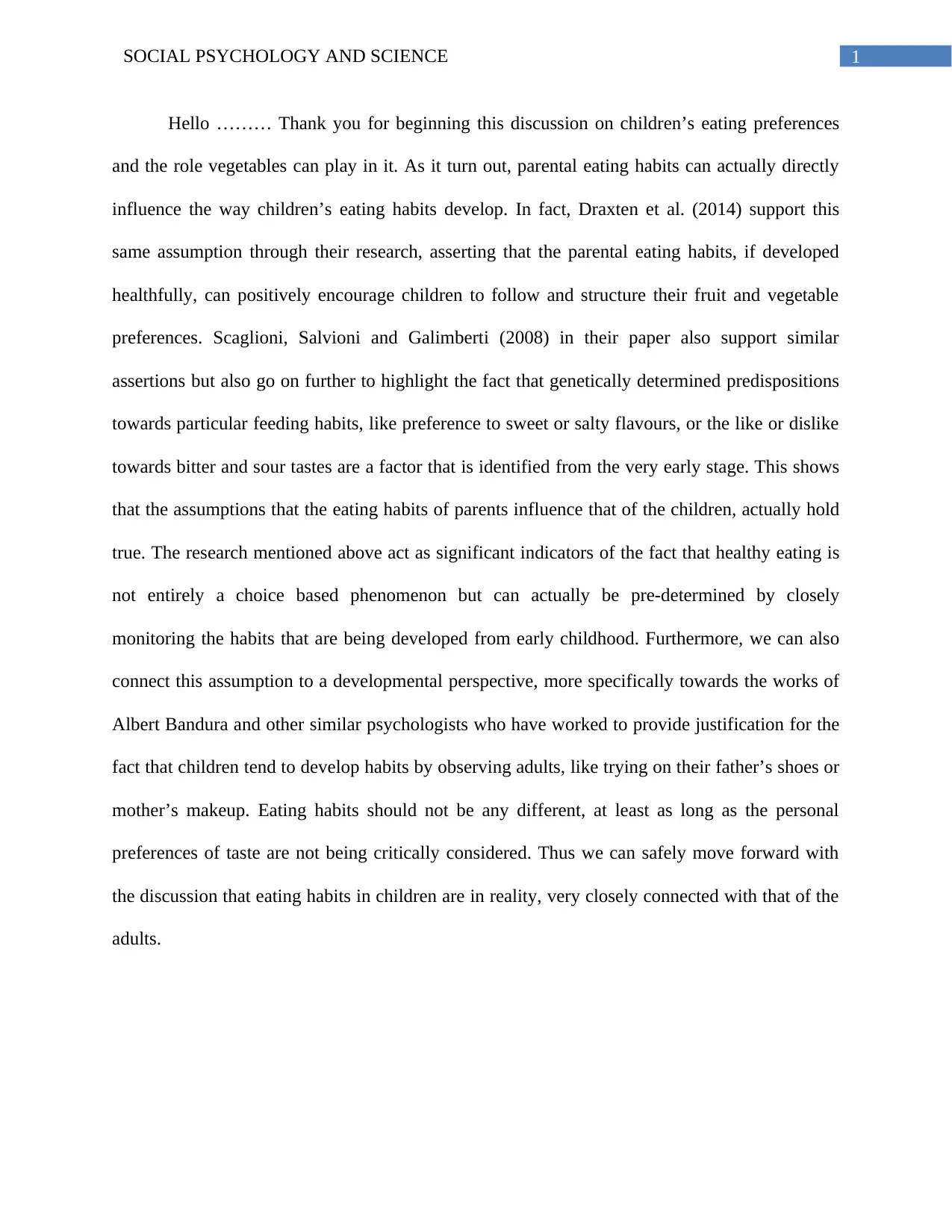
Hello ……… Thank you for beginning this discussion on children’s eating preferences
and the role vegetables can play in it. As it turn out, parental eating habits can actually directly
influence the way children’s eating habits develop. In fact, Draxten et al. (2014) support this
same assumption through their research, asserting that the parental eating habits, if developed
healthfully, can positively encourage children to follow and structure their fruit and vegetable
preferences. Scaglioni, Salvioni and Galimberti (2008) in their paper also support similar
assertions but also go on further to highlight the fact that genetically determined predispositions
towards particular feeding habits, like preference to sweet or salty flavours, or the like or dislike
towards bitter and sour tastes are a factor that is identified from the very early stage. This shows
that the assumptions that the eating habits of parents influence that of the children, actually hold
true. The research mentioned above act as significant indicators of the fact that healthy eating is
not entirely a choice based phenomenon but can actually be pre-determined by closely
monitoring the habits that are being developed from early childhood. Furthermore, we can also
connect this assumption to a developmental perspective, more specifically towards the works of
Albert Bandura and other similar psychologists who have worked to provide justification for the
fact that children tend to develop habits by observing adults, like trying on their father’s shoes or
mother’s makeup. Eating habits should not be any different, at least as long as the personal
preferences of taste are not being critically considered. Thus we can safely move forward with
the discussion that eating habits in children are in reality, very closely connected with that of the
adults.
Document Page
2SOCIAL PSYCHOLOGY AND SCIENCE
Reference
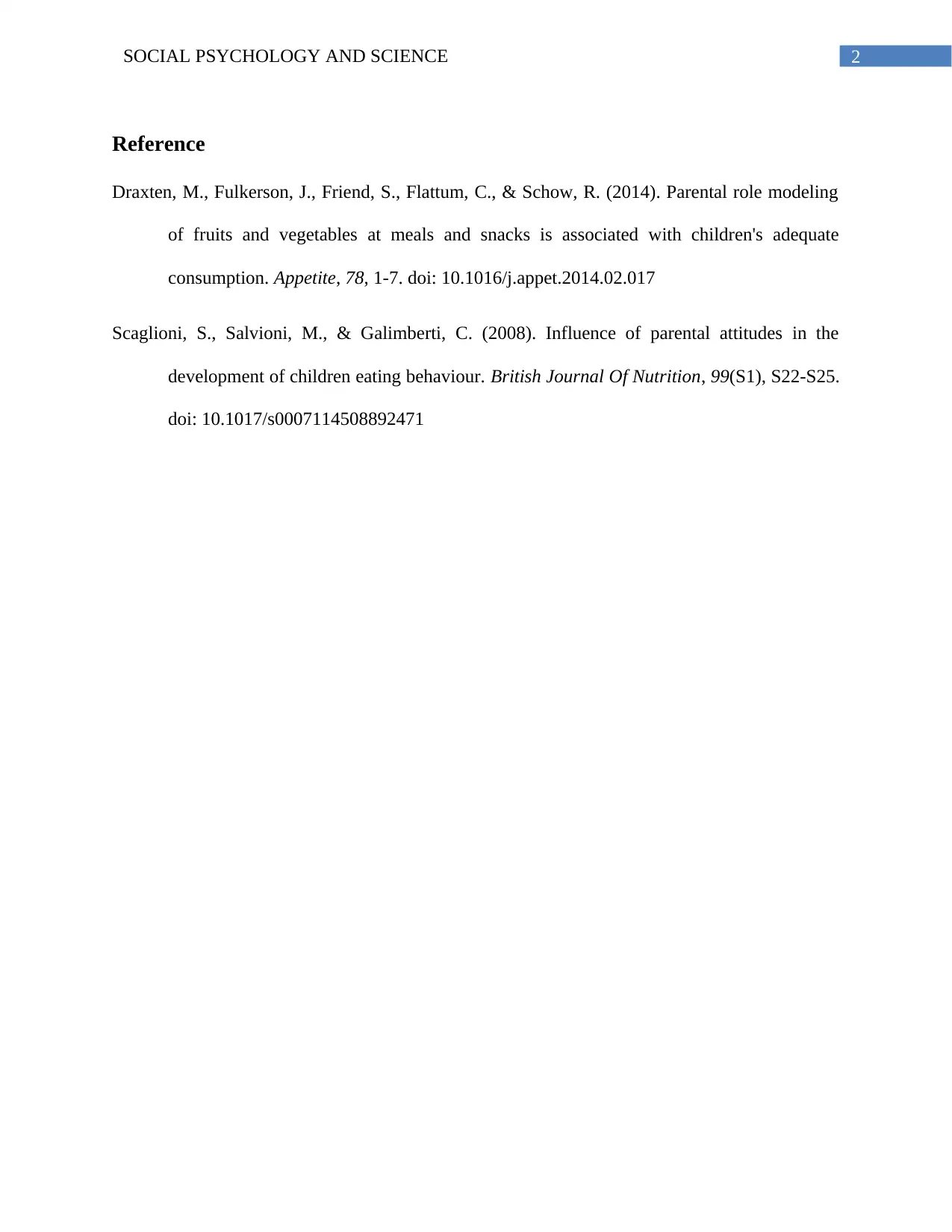
Draxten, M., Fulkerson, J., Friend, S., Flattum, C., & Schow, R. (2014). Parental role modeling
of fruits and vegetables at meals and snacks is associated with children's adequate
consumption. Appetite, 78, 1-7. doi: 10.1016/j.appet.2014.02.017
Scaglioni, S., Salvioni, M., & Galimberti, C. (2008). Influence of parental attitudes in the
development of children eating behaviour. British Journal Of Nutrition, 99(S1), S22-S25.
doi: 10.1017/s0007114508892471
chevron_up_icon
1 out of 3
circle_padding
hide_on_mobile
zoom_out_icon
[object Object]