Comprehensive Analysis of China's VAT Reform: Policies and Impact

Verified

Added on  2020/04/01

|5
|1264
|46
Report
AI Summary
This report provides a detailed analysis of China's Value Added Tax (VAT) reform, which began in 2012 and was fully implemented by the end of 2015. The reform aimed to shift the country's economic focus from low-value-added industries to services and consumption. It involved replacing the Business Tax (BT) with VAT across all sectors, as clarified by Circular 36 in 2016. The report examines the tax scope, including the introduction of new categories and sub-categories of services, and the different VAT rates applicable to various industries. It also explores the exemptions and zero-rated items. The reform's influence on different sectors, such as construction and real estate, is analyzed, highlighting both the beneficiaries and those who faced challenges. The report concludes by assessing the overall impact of the VAT reform on the Chinese economy and its future implications.
Document Page
BUSINESS CAPSTONE PROJECT
1. Introduction
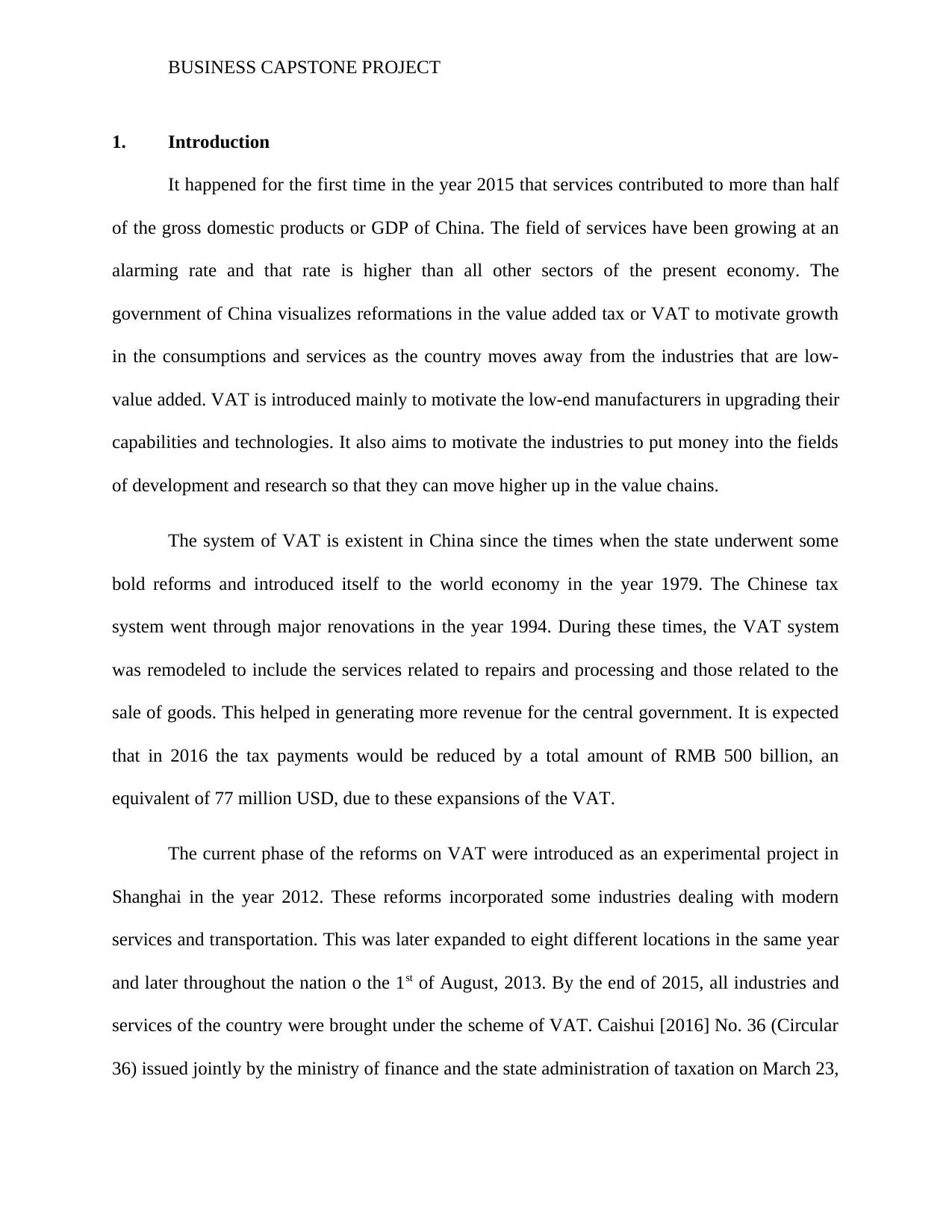
It happened for the first time in the year 2015 that services contributed to more than half
of the gross domestic products or GDP of China. The field of services have been growing at an
alarming rate and that rate is higher than all other sectors of the present economy. The
government of China visualizes reformations in the value added tax or VAT to motivate growth
in the consumptions and services as the country moves away from the industries that are low-
value added. VAT is introduced mainly to motivate the low-end manufacturers in upgrading their
capabilities and technologies. It also aims to motivate the industries to put money into the fields
of development and research so that they can move higher up in the value chains.
The system of VAT is existent in China since the times when the state underwent some
bold reforms and introduced itself to the world economy in the year 1979. The Chinese tax
system went through major renovations in the year 1994. During these times, the VAT system
was remodeled to include the services related to repairs and processing and those related to the
sale of goods. This helped in generating more revenue for the central government. It is expected
that in 2016 the tax payments would be reduced by a total amount of RMB 500 billion, an
equivalent of 77 million USD, due to these expansions of the VAT.
The current phase of the reforms on VAT were introduced as an experimental project in
Shanghai in the year 2012. These reforms incorporated some industries dealing with modern
services and transportation. This was later expanded to eight different locations in the same year
and later throughout the nation o the 1st of August, 2013. By the end of 2015, all industries and
services of the country were brought under the scheme of VAT. Caishui [2016] No. 36 (Circular
36) issued jointly by the ministry of finance and the state administration of taxation on March 23,
tabler-icon-diamond-filled.svg

Paraphrase This Document

Need a fresh take? Get an instant paraphrase of this document with our AI Paraphraser
Document Page
BUSINESS CAPSTONE PROJECT
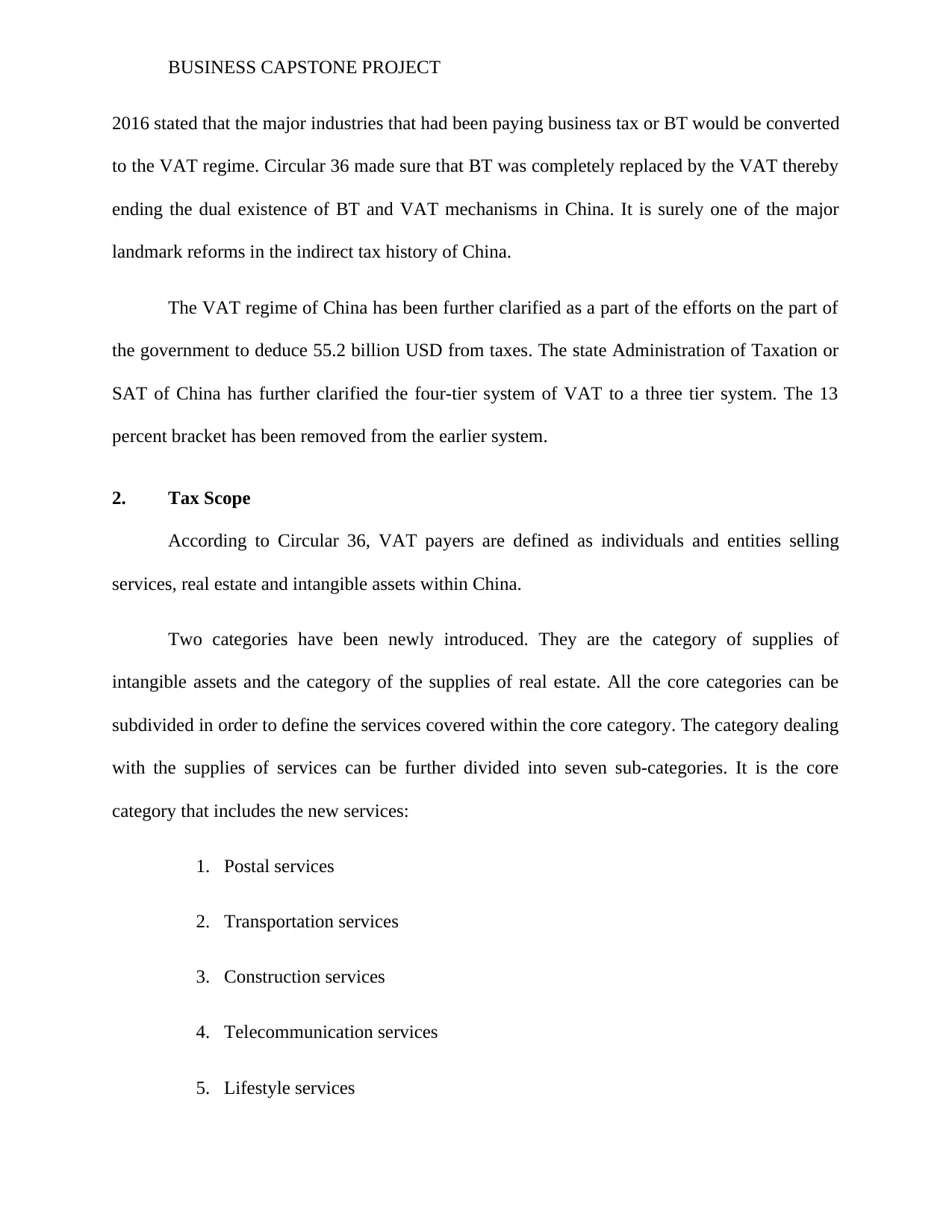
2016 stated that the major industries that had been paying business tax or BT would be converted
to the VAT regime. Circular 36 made sure that BT was completely replaced by the VAT thereby
ending the dual existence of BT and VAT mechanisms in China. It is surely one of the major
landmark reforms in the indirect tax history of China.
The VAT regime of China has been further clarified as a part of the efforts on the part of
the government to deduce 55.2 billion USD from taxes. The state Administration of Taxation or
SAT of China has further clarified the four-tier system of VAT to a three tier system. The 13
percent bracket has been removed from the earlier system.
2. Tax Scope
According to Circular 36, VAT payers are defined as individuals and entities selling
services, real estate and intangible assets within China.
Two categories have been newly introduced. They are the category of supplies of
intangible assets and the category of the supplies of real estate. All the core categories can be
subdivided in order to define the services covered within the core category. The category dealing
with the supplies of services can be further divided into seven sub-categories. It is the core
category that includes the new services:
1. Postal services
2. Transportation services
3. Construction services
4. Telecommunication services
5. Lifestyle services
Document Page
BUSINESS CAPSTONE PROJECT
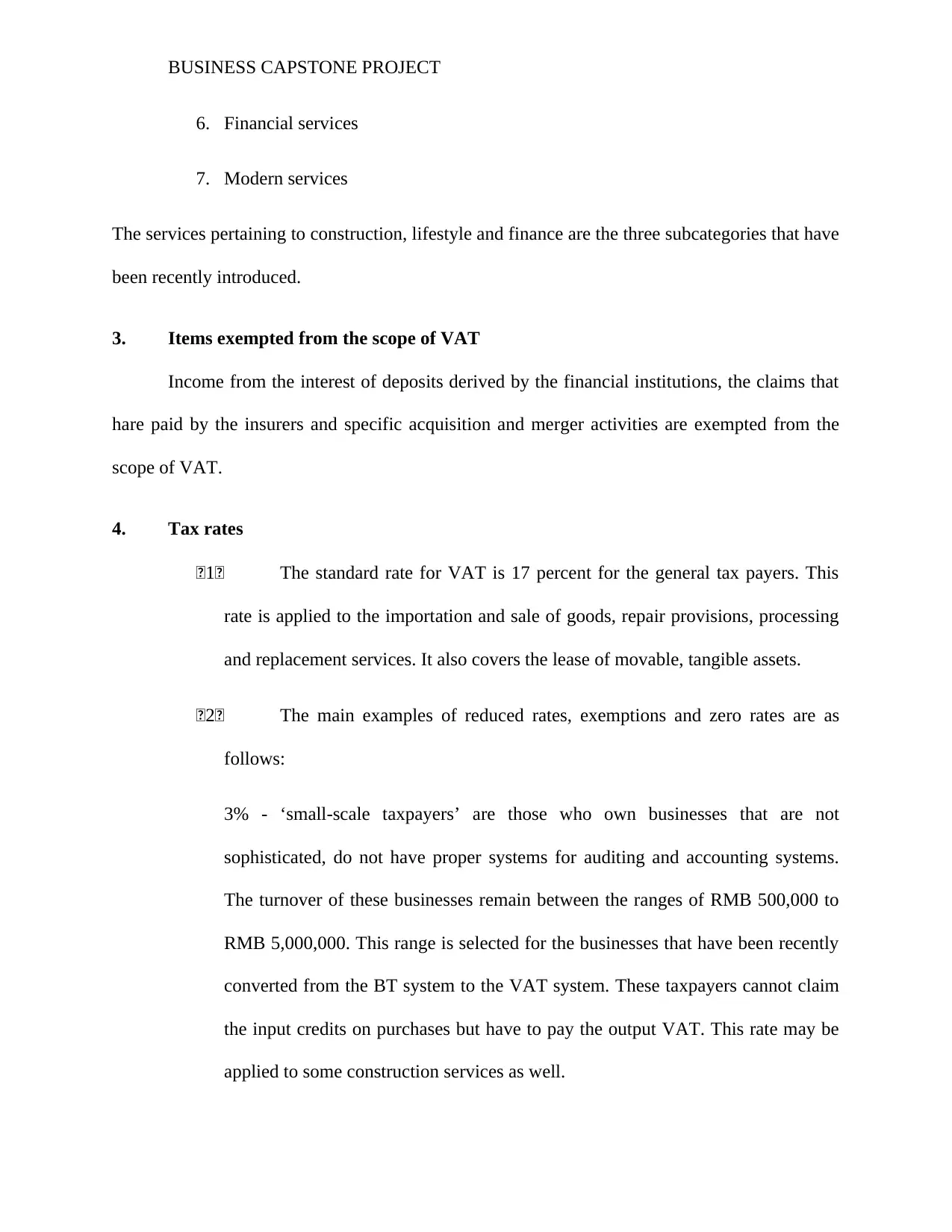
6. Financial services
7. Modern services
The services pertaining to construction, lifestyle and finance are the three subcategories that have
been recently introduced.
3. Items exempted from the scope of VAT
Income from the interest of deposits derived by the financial institutions, the claims that
hare paid by the insurers and specific acquisition and merger activities are exempted from the
scope of VAT.
4. Tax rates
1 The standard rate for VAT is 17 percent for the general tax payers. This
rate is applied to the importation and sale of goods, repair provisions, processing
and replacement services. It also covers the lease of movable, tangible assets.
2 The main examples of reduced rates, exemptions and zero rates are as
follows:
3% - ‘small-scale taxpayers’ are those who own businesses that are not
sophisticated, do not have proper systems for auditing and accounting systems.
The turnover of these businesses remain between the ranges of RMB 500,000 to
RMB 5,000,000. This range is selected for the businesses that have been recently
converted from the BT system to the VAT system. These taxpayers cannot claim
the input credits on purchases but have to pay the output VAT. This rate may be
applied to some construction services as well.
Document Page
BUSINESS CAPSTONE PROJECT
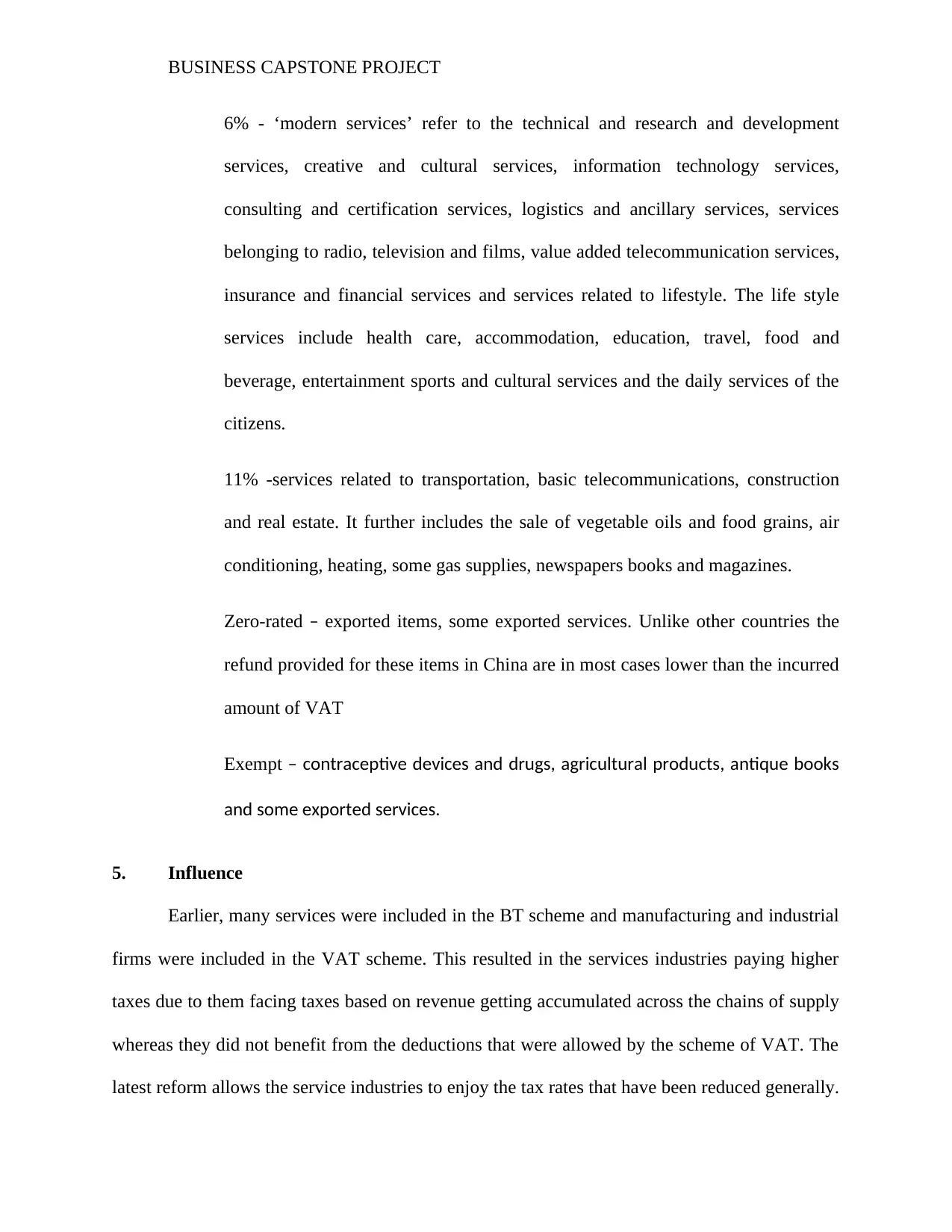
6% - ‘modern services’ refer to the technical and research and development
services, creative and cultural services, information technology services,
consulting and certification services, logistics and ancillary services, services
belonging to radio, television and films, value added telecommunication services,
insurance and financial services and services related to lifestyle. The life style
services include health care, accommodation, education, travel, food and
beverage, entertainment sports and cultural services and the daily services of the
citizens.
11% -services related to transportation, basic telecommunications, construction
and real estate. It further includes the sale of vegetable oils and food grains, air
conditioning, heating, some gas supplies, newspapers books and magazines.
Zero-rated exported items, some exported services. Unlike other countries the
refund provided for these items in China are in most cases lower than the incurred
amount of VAT
Exempt – contraceptive devices and drugs, agricultural products, antique books
and some exported services.
5. Influence
Earlier, many services were included in the BT scheme and manufacturing and industrial
firms were included in the VAT scheme. This resulted in the services industries paying higher
taxes due to them facing taxes based on revenue getting accumulated across the chains of supply
whereas they did not benefit from the deductions that were allowed by the scheme of VAT. The
latest reform allows the service industries to enjoy the tax rates that have been reduced generally.
tabler-icon-diamond-filled.svg

Paraphrase This Document

Need a fresh take? Get an instant paraphrase of this document with our AI Paraphraser
Document Page
BUSINESS CAPSTONE PROJECT
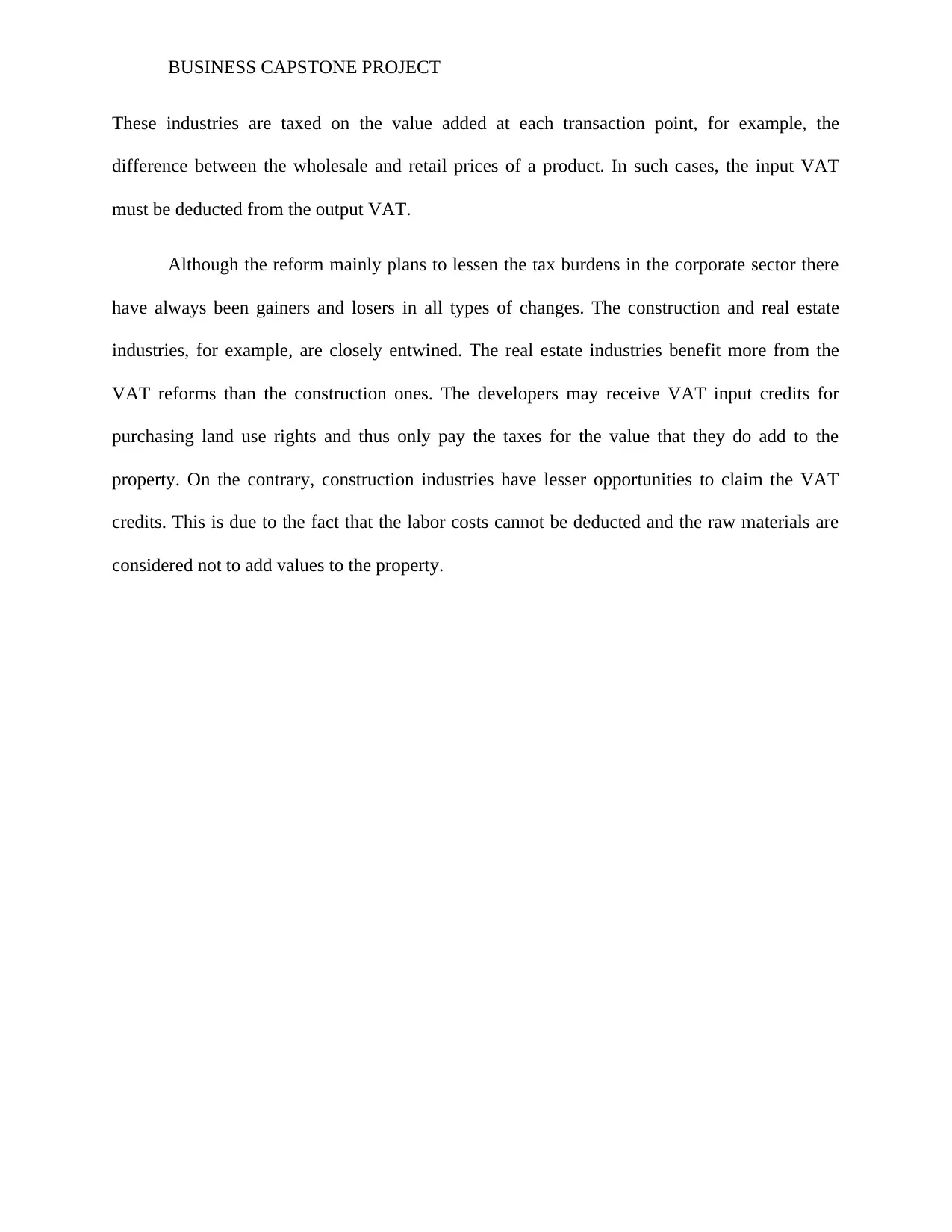
These industries are taxed on the value added at each transaction point, for example, the
difference between the wholesale and retail prices of a product. In such cases, the input VAT
must be deducted from the output VAT.
Although the reform mainly plans to lessen the tax burdens in the corporate sector there
have always been gainers and losers in all types of changes. The construction and real estate
industries, for example, are closely entwined. The real estate industries benefit more from the
VAT reforms than the construction ones. The developers may receive VAT input credits for
purchasing land use rights and thus only pay the taxes for the value that they do add to the
property. On the contrary, construction industries have lesser opportunities to claim the VAT
credits. This is due to the fact that the labor costs cannot be deducted and the raw materials are
considered not to add values to the property.
chevron_up_icon
1 out of 5
circle_padding
hide_on_mobile
zoom_out_icon
[object Object]