Analysis of China's History: The Sino-Japanese War and its Impact
VerifiedAdded on 2022/09/09
|10
|2902
|24
Essay
AI Summary
This essay delves into the historical context and profound impact of the First Sino-Japanese War (1894-1895) on China. It examines the war's origins in the dispute over Korea and explores how the conflict revealed the decline of the Chinese Empire and the rise of Japan as a major world power. The essay provides a detailed analysis of the war's effects on China's financial condition, including the economic strain and the country's struggle to modernize its military and administration. Furthermore, it investigates the influence of Westernization on both China and Japan, highlighting the adoption of Western technologies and medical practices. The essay also discusses the role of newspapers during the war and the development of the medical instrument industry, providing a comprehensive overview of the war's multifaceted consequences.
Running Head: CHINA HISTORY 0
China History
(Student Name)
4/1/2020
China History
(Student Name)
4/1/2020

Paraphrase This Document
Need a fresh take? Get an instant paraphrase of this document with our AI Paraphraser
CHINA HISTORY 1
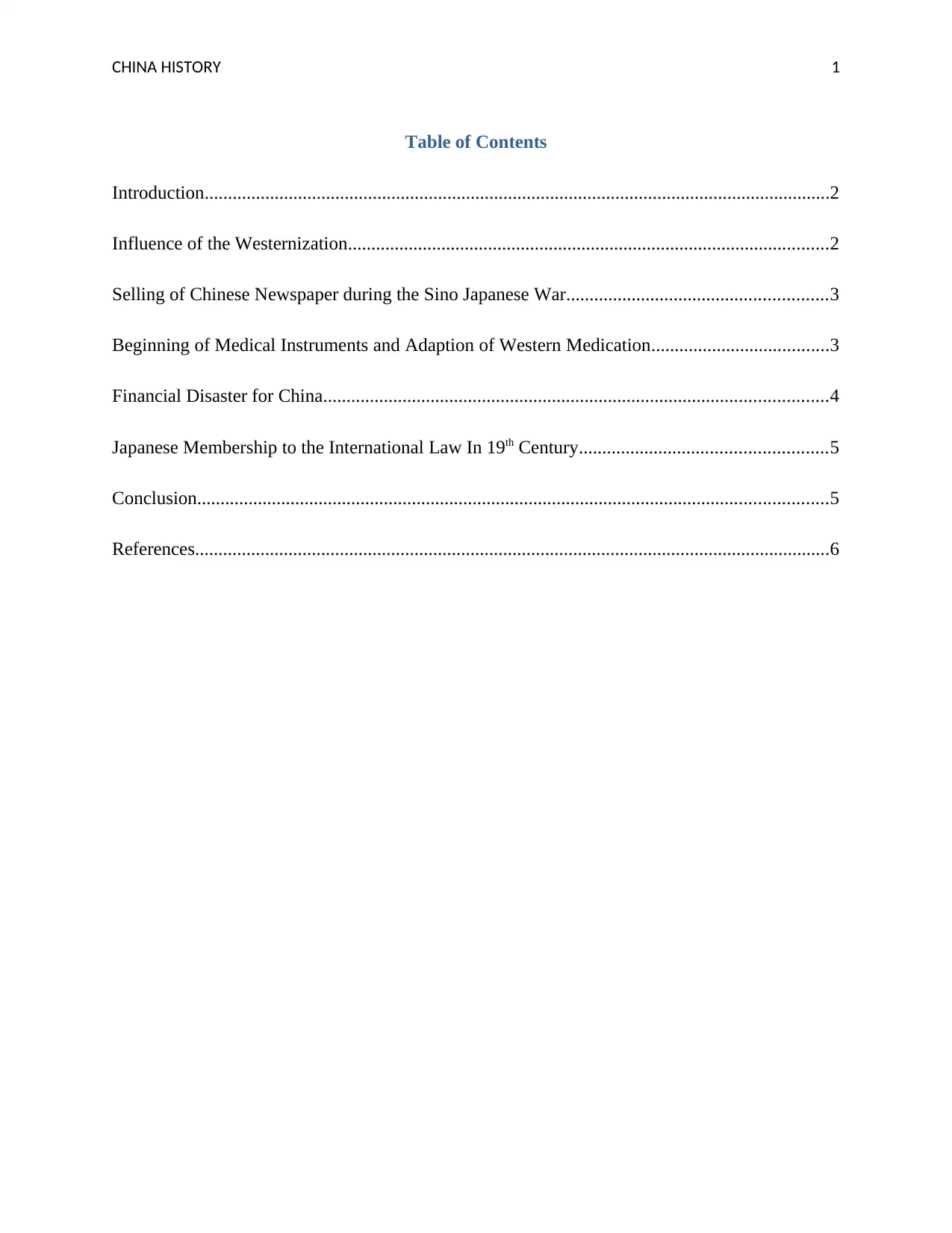
Table of Contents
Introduction......................................................................................................................................2
Influence of the Westernization.......................................................................................................2
Selling of Chinese Newspaper during the Sino Japanese War........................................................3
Beginning of Medical Instruments and Adaption of Western Medication......................................3
Financial Disaster for China............................................................................................................4
Japanese Membership to the International Law In 19th Century.....................................................5
Conclusion.......................................................................................................................................5
References........................................................................................................................................6
Table of Contents
Introduction......................................................................................................................................2
Influence of the Westernization.......................................................................................................2
Selling of Chinese Newspaper during the Sino Japanese War........................................................3
Beginning of Medical Instruments and Adaption of Western Medication......................................3
Financial Disaster for China............................................................................................................4
Japanese Membership to the International Law In 19th Century.....................................................5
Conclusion.......................................................................................................................................5
References........................................................................................................................................6
CHINA HISTORY 2
Introduction
The first Sino-Japanese war in 1894–95 is fighting between Japan and China, marked
Japan's rise as a major world power, revealing the Chinese Empire's decline. The war was born
out of the two Korean dominance nations 'dispute. Korea was China's main client state for a long
time, but Japan's attention was sparked by its strategic position across the Japanese Islands, as
well as its abundant carbon and iron wealth. In 1875 Japan, which began to embrace Western
technology, forced Korea to trade and declare itself independent of China in its foreign relations,
particularly with Japanese countries. The First Chinese-Japanese war was waged between the
Qing Dynasty and Meiji Japan over governorship and control over Korea for the duration 9
months between 1 August 1894 and 17 April 1895 (Liwen, 2015). The war in China is called the
Jiawu war, which signifies the date it took place in 1848 according to the standard Chinese
calendar. In the meanwhile Qing China, traditional East Asian heavy-weight king, struggled to
upgrade his military and administration and lost two opium wars to the west. China has had a
degree of dominance over neighboring tax Nations, including Joseon, Korea, Vietnam and, in
addition, Japan, for centuries as the leading force in the region. The exploitation of China by the
British and French showed its vulnerability, and when the 19th century came to an end, Japan
wanted to take advantage of the opportunity (Dong & Guo, 2018).
In the following part there will be detailed analysis on the impact of war on the financial
condition and other performance of China and Japan as well as influence of westernization on
both countries which include Japan and China.
Influence of the Westernization
In Korea, Japan quickly became aligned with the more progressive upgrade powers,
while China continuously supported the traditional officials clustered around the royal family.
The Korean government was to be overthrown by a coalition of pro-Japanese reformers in 1884,
but Chinese troops under Gen. Yuan Shikai saved the king by murdering several Japanese
legation officers. Through signing a Li-Itō Treaty, which promised to remove soldiers from
Korea, war between Japan and China was stopped. Unlike the western world in which the new
age is traditionally characterized as a beginning from the Renaissance, a step begun within
Introduction
The first Sino-Japanese war in 1894–95 is fighting between Japan and China, marked
Japan's rise as a major world power, revealing the Chinese Empire's decline. The war was born
out of the two Korean dominance nations 'dispute. Korea was China's main client state for a long
time, but Japan's attention was sparked by its strategic position across the Japanese Islands, as
well as its abundant carbon and iron wealth. In 1875 Japan, which began to embrace Western
technology, forced Korea to trade and declare itself independent of China in its foreign relations,
particularly with Japanese countries. The First Chinese-Japanese war was waged between the
Qing Dynasty and Meiji Japan over governorship and control over Korea for the duration 9
months between 1 August 1894 and 17 April 1895 (Liwen, 2015). The war in China is called the
Jiawu war, which signifies the date it took place in 1848 according to the standard Chinese
calendar. In the meanwhile Qing China, traditional East Asian heavy-weight king, struggled to
upgrade his military and administration and lost two opium wars to the west. China has had a
degree of dominance over neighboring tax Nations, including Joseon, Korea, Vietnam and, in
addition, Japan, for centuries as the leading force in the region. The exploitation of China by the
British and French showed its vulnerability, and when the 19th century came to an end, Japan
wanted to take advantage of the opportunity (Dong & Guo, 2018).
In the following part there will be detailed analysis on the impact of war on the financial
condition and other performance of China and Japan as well as influence of westernization on
both countries which include Japan and China.
Influence of the Westernization
In Korea, Japan quickly became aligned with the more progressive upgrade powers,
while China continuously supported the traditional officials clustered around the royal family.
The Korean government was to be overthrown by a coalition of pro-Japanese reformers in 1884,
but Chinese troops under Gen. Yuan Shikai saved the king by murdering several Japanese
legation officers. Through signing a Li-Itō Treaty, which promised to remove soldiers from
Korea, war between Japan and China was stopped. Unlike the western world in which the new
age is traditionally characterized as a beginning from the Renaissance, a step begun within
⊘ This is a preview!⊘
Do you want full access?
Subscribe today to unlock all pages.

Trusted by 1+ million students worldwide
CHINA HISTORY 3
Europe is generally defined by new China and Japan as being pushed into trading with Europe
from the mid-19th century onwards. Indeed, over the last 150 years, Westernization has been
fundamental to both China and Japan, and recent culture in both countries has become one way
of transitioning between traditional and Western values and practices (Bailey, 2019).
The new government understood that Japan's military powers were very small at the time
relative to other developed economies, based upon experience of problems between Japan and
foreign countries since the middles of the 19th century. In fact, Germany has been the greatest
influence in the Japanese government on the integration of military systems. The young Japanese
officers went to Germany, France and the United Kingdom to study and ultimately submit to the
Japanese army. The Chinese interpretation of Confucianism has been translated into practicality
(School of Practical Statecraft, extensive learning) by improving itself. The change was
ultimately related to the reform plans of 1890, this was the 100 days revolution and thus the New
Policies, claims Albert Feuerwerker. Western research as an understanding and implementation
of Confucian values has been combined with the Confucian worldview (Lin, 2016).
The Meiji government has started to restructure the social system and modernize each
sector since Japan has deeply felt the differences between Japan and Europe, especially the
United States. The Meiji government first advocated "Economic Wealth and Stability" Foreign
Strategy. Based upon the history of problems between Japan and foreign countries since the
middle of the 19th century, the new government has well acknowledged that, at the time,
Japanese armed forces were very small compared with other developed countries. In fact,
German influence on integration of the military structure has been the greatest in the Japanese
government. The young Japanese officers traveled to Germany, France and the UK to research
and eventually to call the Japanese army their own (Mitani, 2018).
Selling of Chinese Newspaper during the Sino Japanese War
In 1894 and 1895, the 1st Sino-Japanese War was a tumultuous period in foreign affairs.
It wasn't just the Western focus, but also a staple of Chinese newspaper readers, both in English
and in Chinese, as long as it existed. The Chinese public was keen to read reports of the war and
press owners used this chance to support their firms and fought to provide the latest information
by wartime advertising standards that had already been developed in the U.S. and Britain. The
Europe is generally defined by new China and Japan as being pushed into trading with Europe
from the mid-19th century onwards. Indeed, over the last 150 years, Westernization has been
fundamental to both China and Japan, and recent culture in both countries has become one way
of transitioning between traditional and Western values and practices (Bailey, 2019).
The new government understood that Japan's military powers were very small at the time
relative to other developed economies, based upon experience of problems between Japan and
foreign countries since the middles of the 19th century. In fact, Germany has been the greatest
influence in the Japanese government on the integration of military systems. The young Japanese
officers went to Germany, France and the United Kingdom to study and ultimately submit to the
Japanese army. The Chinese interpretation of Confucianism has been translated into practicality
(School of Practical Statecraft, extensive learning) by improving itself. The change was
ultimately related to the reform plans of 1890, this was the 100 days revolution and thus the New
Policies, claims Albert Feuerwerker. Western research as an understanding and implementation
of Confucian values has been combined with the Confucian worldview (Lin, 2016).
The Meiji government has started to restructure the social system and modernize each
sector since Japan has deeply felt the differences between Japan and Europe, especially the
United States. The Meiji government first advocated "Economic Wealth and Stability" Foreign
Strategy. Based upon the history of problems between Japan and foreign countries since the
middle of the 19th century, the new government has well acknowledged that, at the time,
Japanese armed forces were very small compared with other developed countries. In fact,
German influence on integration of the military structure has been the greatest in the Japanese
government. The young Japanese officers traveled to Germany, France and the UK to research
and eventually to call the Japanese army their own (Mitani, 2018).
Selling of Chinese Newspaper during the Sino Japanese War
In 1894 and 1895, the 1st Sino-Japanese War was a tumultuous period in foreign affairs.
It wasn't just the Western focus, but also a staple of Chinese newspaper readers, both in English
and in Chinese, as long as it existed. The Chinese public was keen to read reports of the war and
press owners used this chance to support their firms and fought to provide the latest information
by wartime advertising standards that had already been developed in the U.S. and Britain. The
Paraphrase This Document
Need a fresh take? Get an instant paraphrase of this document with our AI Paraphraser
CHINA HISTORY 4
Chinese vulnerability after the Opium Wars remained profoundly depressed for journalists; on
the other hand, they were shared by Hart and expressed an positive outlook to China's growth
capacity, which was born from an understanding of events that were shifting. The people, who
also saw trains, telegraphs and ships sail on the East and Yangtze Rivers, largely shared their
feelings. The Self-Strengthening Movement plan was a familiar subject, mostly talked through
the editorial of the favorite newspaper for most people reading Chinese papers like Shenbao,
Shibao in the Tianjin, Hubao and Wang Tao (1826–97) Xunhuan, or other political newspapers
(Liu, 2019).
During the second half of the 19th century, most Chinese newspapers, particularly
missionaries, belonged to foreigners. In Shanghai, Canton and Hong Kong, foreign investment
was especially prevalent. After the First Sino-Japanese War in 1895, the situation changed only
when Chinese intellectuals began to establish their own publications in order to spread their new
proposals for China stunned by China's defeat. The history was different, Shenbao and
Xinwenbao. Unlike successful Chinese-language missionary magazines, both titles had a clear
trade sense and were controlled by foreign-dominated companies. North China's global owners.
Shenbao has on several occasions provided good news to its readers since the war started and has
sought to cover the tragic reality with punchy and optimistic headlining in lengthy texts. But the
battle was very significant as the Yalu River marked the Korean-China frontier. Losing this
defensive line would mean that battle would take place in Chinese territory. China lost the war,
but it wasn't told its men (Guan, 2019).
Beginning of Medical Instruments and Adaption of Western Medication
The Japanese medical device industry became competitive on import products in the
1920s, and in the following decade its goods were sold to world markets. This was an excellent
accomplishment for Japan's new industry, which did not benefit from protectionism in particular
unlike so many other industries in the world in the interwar years. Technology, as Japanese
companies in this field was sufficiently creative to introduce profitable products. While the
industry's study of the R&D techniques seems necessary for proper comprehension of these
anomalies, two main issues emerge about the existence of this sector. The development of a
domestic medical instrument industry between 1900 and 1925 occurred. In this cycle the First
Chinese vulnerability after the Opium Wars remained profoundly depressed for journalists; on
the other hand, they were shared by Hart and expressed an positive outlook to China's growth
capacity, which was born from an understanding of events that were shifting. The people, who
also saw trains, telegraphs and ships sail on the East and Yangtze Rivers, largely shared their
feelings. The Self-Strengthening Movement plan was a familiar subject, mostly talked through
the editorial of the favorite newspaper for most people reading Chinese papers like Shenbao,
Shibao in the Tianjin, Hubao and Wang Tao (1826–97) Xunhuan, or other political newspapers
(Liu, 2019).
During the second half of the 19th century, most Chinese newspapers, particularly
missionaries, belonged to foreigners. In Shanghai, Canton and Hong Kong, foreign investment
was especially prevalent. After the First Sino-Japanese War in 1895, the situation changed only
when Chinese intellectuals began to establish their own publications in order to spread their new
proposals for China stunned by China's defeat. The history was different, Shenbao and
Xinwenbao. Unlike successful Chinese-language missionary magazines, both titles had a clear
trade sense and were controlled by foreign-dominated companies. North China's global owners.
Shenbao has on several occasions provided good news to its readers since the war started and has
sought to cover the tragic reality with punchy and optimistic headlining in lengthy texts. But the
battle was very significant as the Yalu River marked the Korean-China frontier. Losing this
defensive line would mean that battle would take place in Chinese territory. China lost the war,
but it wasn't told its men (Guan, 2019).
Beginning of Medical Instruments and Adaption of Western Medication
The Japanese medical device industry became competitive on import products in the
1920s, and in the following decade its goods were sold to world markets. This was an excellent
accomplishment for Japan's new industry, which did not benefit from protectionism in particular
unlike so many other industries in the world in the interwar years. Technology, as Japanese
companies in this field was sufficiently creative to introduce profitable products. While the
industry's study of the R&D techniques seems necessary for proper comprehension of these
anomalies, two main issues emerge about the existence of this sector. The development of a
domestic medical instrument industry between 1900 and 1925 occurred. In this cycle the First
CHINA HISTORY 5
World War played a vital role in highlighting the industry's boundaries and the challenges it
encountered. Export figures for medical instruments are provided from 1905 onwards (101.400
yen) and indicate a strong export development until World War I (356.340 yen in 1914). In
comparison, Japanese imports continued to grow until 1905 and then gradually decreased until
the first world war of 1913 (2,46,971 yen). In 1906, an increase in custom duty to 20% helped to
improve domestic demand. In 1913, the US represented 0.3% of Japanese exports of medical
instruments, rising to 49.8% by 1918.13 However, this was transient growth only because the
output became established, its annual value stagnated in 1919-1925, and its exports dropped in
1918. Thus, the Japanese medical instrument industry was seen to be concurring on global
markets in the post-war era. Since 1906, protectionism has been taken advantage of by Japanese
producers of medical instruments mainly relying on the domestic market, where their
competitive role was partially due to the policy of applying Western goods to Japan (McGrath,
Barrie & Way, 2017).
Whilst Western Medicine was adopted by the Japanese government in Meiji in 1868,
European medical devices were introduced and disseminated in at least the beginning of the 19th
century7. However, the creation of the new political system represented a break from the
eventual incorporation of Western medical culture into a conventional Japanese healthcare
system. Following this political transition, structural reforms led to an increasing demand from
hospitals (63 in 1875 and 783 in 1900) and medical practitioners (23,284 in 1875 and 40,924
in1900), contributing to the rise of the surgical instruments industry (Hsieh, Hsu & Wang, 2016).
Financial Disaster for China
At the end of the war, four cruisers and over 1000 men were lost to China, and a few hundred
Japanese sailors were injured and four ships were sunk. Chen Yue, Chair of the Chinese Navy
Historical Institute, who is specialized in war studies, said that this was a tragedy for the Chinese
navy. In the funding of the war, the Chinese economy is rudimentary and fragmented enough for
tremendous wear and tear that destroys a highly-developed centralized structure. The following
is a brief war summary:
1. Via exports. During the months of conflict China's overseas exchange has not been
disadvantageous. The offset causes were the fall in global product demand and the
World War played a vital role in highlighting the industry's boundaries and the challenges it
encountered. Export figures for medical instruments are provided from 1905 onwards (101.400
yen) and indicate a strong export development until World War I (356.340 yen in 1914). In
comparison, Japanese imports continued to grow until 1905 and then gradually decreased until
the first world war of 1913 (2,46,971 yen). In 1906, an increase in custom duty to 20% helped to
improve domestic demand. In 1913, the US represented 0.3% of Japanese exports of medical
instruments, rising to 49.8% by 1918.13 However, this was transient growth only because the
output became established, its annual value stagnated in 1919-1925, and its exports dropped in
1918. Thus, the Japanese medical instrument industry was seen to be concurring on global
markets in the post-war era. Since 1906, protectionism has been taken advantage of by Japanese
producers of medical instruments mainly relying on the domestic market, where their
competitive role was partially due to the policy of applying Western goods to Japan (McGrath,
Barrie & Way, 2017).
Whilst Western Medicine was adopted by the Japanese government in Meiji in 1868,
European medical devices were introduced and disseminated in at least the beginning of the 19th
century7. However, the creation of the new political system represented a break from the
eventual incorporation of Western medical culture into a conventional Japanese healthcare
system. Following this political transition, structural reforms led to an increasing demand from
hospitals (63 in 1875 and 783 in 1900) and medical practitioners (23,284 in 1875 and 40,924
in1900), contributing to the rise of the surgical instruments industry (Hsieh, Hsu & Wang, 2016).
Financial Disaster for China
At the end of the war, four cruisers and over 1000 men were lost to China, and a few hundred
Japanese sailors were injured and four ships were sunk. Chen Yue, Chair of the Chinese Navy
Historical Institute, who is specialized in war studies, said that this was a tragedy for the Chinese
navy. In the funding of the war, the Chinese economy is rudimentary and fragmented enough for
tremendous wear and tear that destroys a highly-developed centralized structure. The following
is a brief war summary:
1. Via exports. During the months of conflict China's overseas exchange has not been
disadvantageous. The offset causes were the fall in global product demand and the
⊘ This is a preview!⊘
Do you want full access?
Subscribe today to unlock all pages.
Trusted by 1+ million students worldwide
CHINA HISTORY 6
increase in Chinese prices for some raw materials, such as antimony, tungsten and tung
oil.
2. By consensus of barter. China has reached a barter deal with Germany in this respect.
Under the deal, China is supplied by other raw materials from Germany to purchase war
supplies.
3. Payment was deferred. A China-Russia deal seems to be in effect, but terms are not
announced. It's widely believed that under certain loan agreements China secures war
supplies from Russia. UK and France are expected to have reached or will enter into
similar deals in the near future with.
4. And international assets. Undoubtedly, a currency fund would be paid for a part of the
war supply. China exported 1,200 million yuan outside of China, as mentioned above.
This is not clear how much this quantity was used. The bank accounts of China indicate
that the banks already retain over one billion (Kudo, 2020)
Japanese Membership to the International Law In 19th Century
During the 19th century, foreign legal theorists turned to legal positivism to attempt, in
order to clarify the legal condition systemically in international affairs, to differentiate the law
from politics. In the century, the author discusses legal-political uncertainty rather than narrating
a increasing legal coherence with the international order. Japan acknowledged this excruciating
'reality' and adopted international law's accompanying theory. "Japan recognized foreign law in
full or in part without putting into questions its relevance or authority and strictly compliance
with its laws". Japan wanted to pursue equality to be an equal member in international
community, and to abolish consular authority. The fact that the definition in international law
remains ambiguous does not deter Japan from creating it by combining it with multifaceted
components (Sucharitkul, 2020).
Conclusion
The First Japanese-China War of 1894-95 marked the rise of Japan as a world power,
exposing the fall of the Empire. The war was born from the conflict between the two Korean
ruling states. Korea has long been China's biggest client power, but Japan's strategic location
around the Japanese Islands and plentiful iron and carbon have drawn Japan's interest. In 1875,
increase in Chinese prices for some raw materials, such as antimony, tungsten and tung
oil.
2. By consensus of barter. China has reached a barter deal with Germany in this respect.
Under the deal, China is supplied by other raw materials from Germany to purchase war
supplies.
3. Payment was deferred. A China-Russia deal seems to be in effect, but terms are not
announced. It's widely believed that under certain loan agreements China secures war
supplies from Russia. UK and France are expected to have reached or will enter into
similar deals in the near future with.
4. And international assets. Undoubtedly, a currency fund would be paid for a part of the
war supply. China exported 1,200 million yuan outside of China, as mentioned above.
This is not clear how much this quantity was used. The bank accounts of China indicate
that the banks already retain over one billion (Kudo, 2020)
Japanese Membership to the International Law In 19th Century
During the 19th century, foreign legal theorists turned to legal positivism to attempt, in
order to clarify the legal condition systemically in international affairs, to differentiate the law
from politics. In the century, the author discusses legal-political uncertainty rather than narrating
a increasing legal coherence with the international order. Japan acknowledged this excruciating
'reality' and adopted international law's accompanying theory. "Japan recognized foreign law in
full or in part without putting into questions its relevance or authority and strictly compliance
with its laws". Japan wanted to pursue equality to be an equal member in international
community, and to abolish consular authority. The fact that the definition in international law
remains ambiguous does not deter Japan from creating it by combining it with multifaceted
components (Sucharitkul, 2020).
Conclusion
The First Japanese-China War of 1894-95 marked the rise of Japan as a world power,
exposing the fall of the Empire. The war was born from the conflict between the two Korean
ruling states. Korea has long been China's biggest client power, but Japan's strategic location
around the Japanese Islands and plentiful iron and carbon have drawn Japan's interest. In 1875,
Paraphrase This Document
Need a fresh take? Get an instant paraphrase of this document with our AI Paraphraser
CHINA HISTORY 7
Korea started to use Westerner technology and in its foreign relations with China, especially
Japanese nations, was forced to trade and declare itself independent of China. Japan was soon
allied in Korea with growing upgrading forces, and China consistently sponsored the traditional
officials of the royal family. The Korean government was overthrown by a group of pro-
Japanese reformers in 1884, and by killing numerous Japanese legation officers Chinese troops
under Gen Yuan Shikai rescued the King. The conflict between Japan and China was stopped by
signing the Li-Itō Agreement, which agreed to withdraw troops from Korea. Four cruisers and
over 1000 people died in China at the end of the battle, and a few hundred Japanese mariners
were wounded and four ships sunk. Chen Yue, Chairman of the Center for Chinese Historical
Research, said it was a disaster in the China Navy. Chen Yue is an authority on military history.
Furthermore, Global legal scholars turned to political positivism during the 19th century to try to
separate law from politics and explain the political circumstances on foreign matters. In this
century, instead of saying an growing legal aligned with the world order, the author addresses
legal and political ambiguity. Japan has recognized this atrocious 'fact' and embraced
accompanying theory of international law.
Korea started to use Westerner technology and in its foreign relations with China, especially
Japanese nations, was forced to trade and declare itself independent of China. Japan was soon
allied in Korea with growing upgrading forces, and China consistently sponsored the traditional
officials of the royal family. The Korean government was overthrown by a group of pro-
Japanese reformers in 1884, and by killing numerous Japanese legation officers Chinese troops
under Gen Yuan Shikai rescued the King. The conflict between Japan and China was stopped by
signing the Li-Itō Agreement, which agreed to withdraw troops from Korea. Four cruisers and
over 1000 people died in China at the end of the battle, and a few hundred Japanese mariners
were wounded and four ships sunk. Chen Yue, Chairman of the Center for Chinese Historical
Research, said it was a disaster in the China Navy. Chen Yue is an authority on military history.
Furthermore, Global legal scholars turned to political positivism during the 19th century to try to
separate law from politics and explain the political circumstances on foreign matters. In this
century, instead of saying an growing legal aligned with the world order, the author addresses
legal and political ambiguity. Japan has recognized this atrocious 'fact' and embraced
accompanying theory of international law.
CHINA HISTORY 8
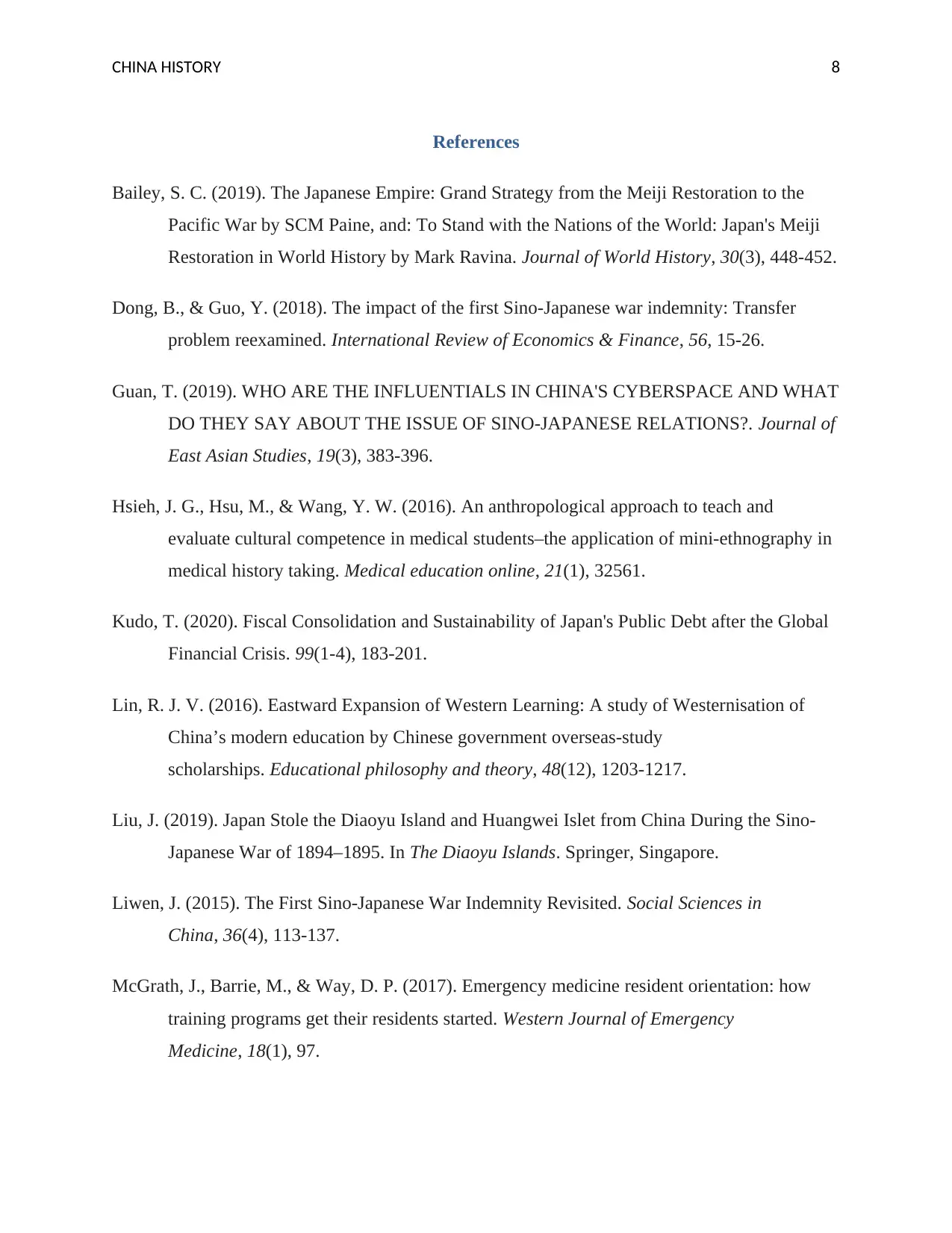
References
Bailey, S. C. (2019). The Japanese Empire: Grand Strategy from the Meiji Restoration to the
Pacific War by SCM Paine, and: To Stand with the Nations of the World: Japan's Meiji
Restoration in World History by Mark Ravina. Journal of World History, 30(3), 448-452.
Dong, B., & Guo, Y. (2018). The impact of the first Sino-Japanese war indemnity: Transfer
problem reexamined. International Review of Economics & Finance, 56, 15-26.
Guan, T. (2019). WHO ARE THE INFLUENTIALS IN CHINA'S CYBERSPACE AND WHAT
DO THEY SAY ABOUT THE ISSUE OF SINO-JAPANESE RELATIONS?. Journal of
East Asian Studies, 19(3), 383-396.
Hsieh, J. G., Hsu, M., & Wang, Y. W. (2016). An anthropological approach to teach and
evaluate cultural competence in medical students–the application of mini-ethnography in
medical history taking. Medical education online, 21(1), 32561.
Kudo, T. (2020). Fiscal Consolidation and Sustainability of Japan's Public Debt after the Global
Financial Crisis. 99(1-4), 183-201.
Lin, R. J. V. (2016). Eastward Expansion of Western Learning: A study of Westernisation of
China’s modern education by Chinese government overseas-study
scholarships. Educational philosophy and theory, 48(12), 1203-1217.
Liu, J. (2019). Japan Stole the Diaoyu Island and Huangwei Islet from China During the Sino-
Japanese War of 1894–1895. In The Diaoyu Islands. Springer, Singapore.
Liwen, J. (2015). The First Sino-Japanese War Indemnity Revisited. Social Sciences in
China, 36(4), 113-137.
McGrath, J., Barrie, M., & Way, D. P. (2017). Emergency medicine resident orientation: how
training programs get their residents started. Western Journal of Emergency
Medicine, 18(1), 97.
References
Bailey, S. C. (2019). The Japanese Empire: Grand Strategy from the Meiji Restoration to the
Pacific War by SCM Paine, and: To Stand with the Nations of the World: Japan's Meiji
Restoration in World History by Mark Ravina. Journal of World History, 30(3), 448-452.
Dong, B., & Guo, Y. (2018). The impact of the first Sino-Japanese war indemnity: Transfer
problem reexamined. International Review of Economics & Finance, 56, 15-26.
Guan, T. (2019). WHO ARE THE INFLUENTIALS IN CHINA'S CYBERSPACE AND WHAT
DO THEY SAY ABOUT THE ISSUE OF SINO-JAPANESE RELATIONS?. Journal of
East Asian Studies, 19(3), 383-396.
Hsieh, J. G., Hsu, M., & Wang, Y. W. (2016). An anthropological approach to teach and
evaluate cultural competence in medical students–the application of mini-ethnography in
medical history taking. Medical education online, 21(1), 32561.
Kudo, T. (2020). Fiscal Consolidation and Sustainability of Japan's Public Debt after the Global
Financial Crisis. 99(1-4), 183-201.
Lin, R. J. V. (2016). Eastward Expansion of Western Learning: A study of Westernisation of
China’s modern education by Chinese government overseas-study
scholarships. Educational philosophy and theory, 48(12), 1203-1217.
Liu, J. (2019). Japan Stole the Diaoyu Island and Huangwei Islet from China During the Sino-
Japanese War of 1894–1895. In The Diaoyu Islands. Springer, Singapore.
Liwen, J. (2015). The First Sino-Japanese War Indemnity Revisited. Social Sciences in
China, 36(4), 113-137.
McGrath, J., Barrie, M., & Way, D. P. (2017). Emergency medicine resident orientation: how
training programs get their residents started. Western Journal of Emergency
Medicine, 18(1), 97.
⊘ This is a preview!⊘
Do you want full access?
Subscribe today to unlock all pages.
Trusted by 1+ million students worldwide
CHINA HISTORY 9
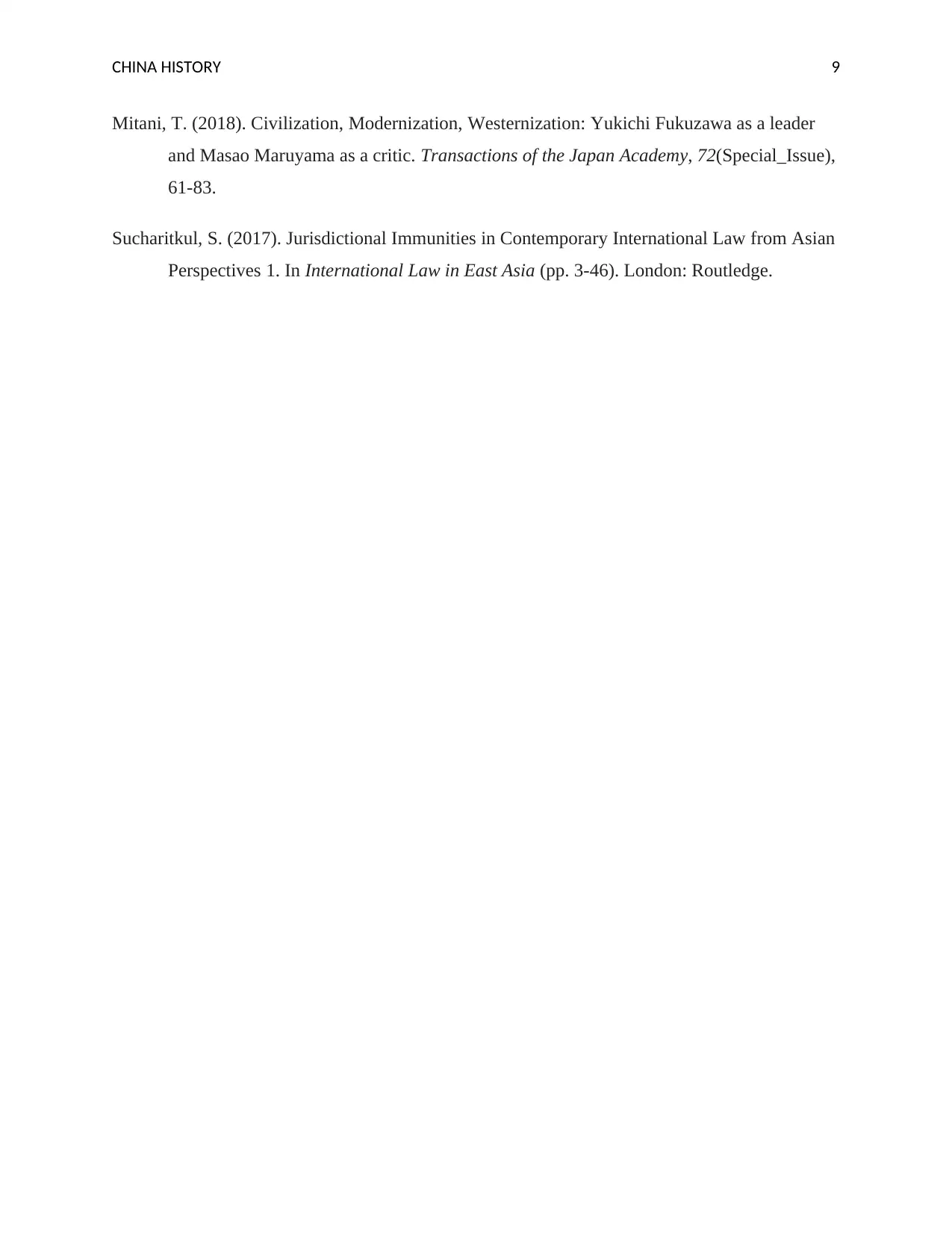
Mitani, T. (2018). Civilization, Modernization, Westernization: Yukichi Fukuzawa as a leader
and Masao Maruyama as a critic. Transactions of the Japan Academy, 72(Special_Issue),
61-83.
Sucharitkul, S. (2017). Jurisdictional Immunities in Contemporary International Law from Asian
Perspectives 1. In International Law in East Asia (pp. 3-46). London: Routledge.
Mitani, T. (2018). Civilization, Modernization, Westernization: Yukichi Fukuzawa as a leader
and Masao Maruyama as a critic. Transactions of the Japan Academy, 72(Special_Issue),
61-83.
Sucharitkul, S. (2017). Jurisdictional Immunities in Contemporary International Law from Asian
Perspectives 1. In International Law in East Asia (pp. 3-46). London: Routledge.

1 out of 10


Related Documents


Your All-in-One AI-Powered Toolkit for Academic Success.
+13062052269
info@desklib.com
Available 24*7 on WhatsApp / Email
![[object Object]](/_next/static/media/star-bottom.7253800d.svg)
Unlock your academic potential
Copyright © 2020–2026 A2Z Services. All Rights Reserved. Developed and managed by ZUCOL.