Choice of Law Analysis for USCO, ARGO, JVCO: Contract and Tort Claims
VerifiedAdded on 2019/10/09
|9
|2651
|186
Case Study
AI Summary
This case study analyzes the choice of law issues arising from a joint venture (JVCO) between USCO and ARGO in Argentina, focusing on contract, tort, and employment disputes. The analysis explores the application of the Restatement (Second) of Conflict of Laws, particularly Sections 6 and 188, to determine whether Argentinian or California law should govern the various claims. The case involves a JVA, a license agreement, and an employment agreement with an executive, Richard. Claims include breach of the JVA, misappropriation of trade secrets, and sexual harassment. The analysis considers factors such as the location of performance, place of negotiation, and the interests of the involved parties, including the protection of trade secrets and the impact on international business relations. The study examines the application of Argentina's statute of limitations and analyzes the relevance of governing law clauses in different agreements. The conclusion suggests that Argentinian law should apply to most of the claims, considering the location of the alleged misconduct and the interests of Argentina in regulating business activities within its borders.
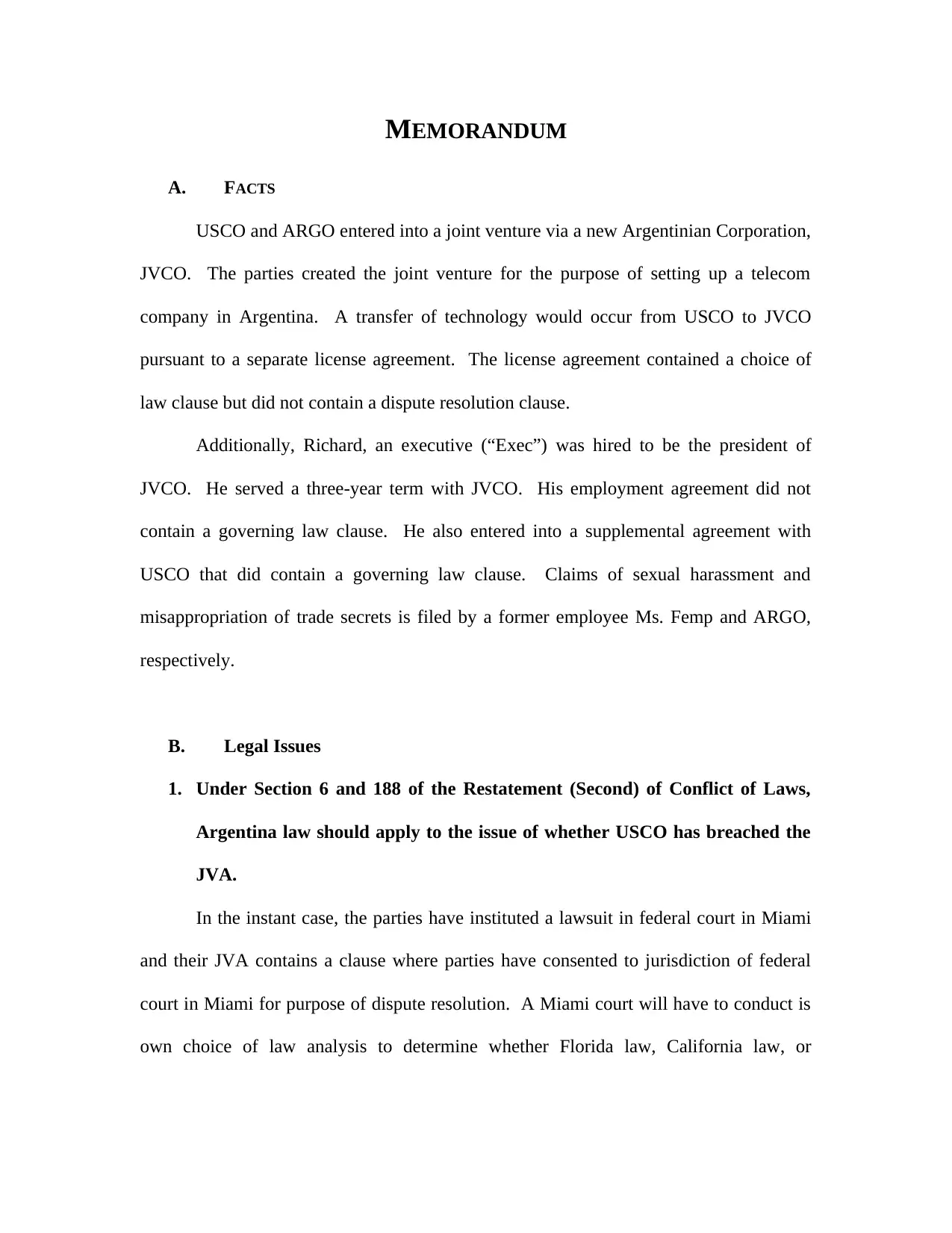
MEMORANDUM
A. FACTS
USCO and ARGO entered into a joint venture via a new Argentinian Corporation,
JVCO. The parties created the joint venture for the purpose of setting up a telecom
company in Argentina. A transfer of technology would occur from USCO to JVCO
pursuant to a separate license agreement. The license agreement contained a choice of
law clause but did not contain a dispute resolution clause.
Additionally, Richard, an executive (“Exec”) was hired to be the president of
JVCO. He served a three-year term with JVCO. His employment agreement did not
contain a governing law clause. He also entered into a supplemental agreement with
USCO that did contain a governing law clause. Claims of sexual harassment and
misappropriation of trade secrets is filed by a former employee Ms. Femp and ARGO,
respectively.
B. Legal Issues
1. Under Section 6 and 188 of the Restatement (Second) of Conflict of Laws,
Argentina law should apply to the issue of whether USCO has breached the
JVA.
In the instant case, the parties have instituted a lawsuit in federal court in Miami
and their JVA contains a clause where parties have consented to jurisdiction of federal
court in Miami for purpose of dispute resolution. A Miami court will have to conduct is
own choice of law analysis to determine whether Florida law, California law, or
A. FACTS
USCO and ARGO entered into a joint venture via a new Argentinian Corporation,
JVCO. The parties created the joint venture for the purpose of setting up a telecom
company in Argentina. A transfer of technology would occur from USCO to JVCO
pursuant to a separate license agreement. The license agreement contained a choice of
law clause but did not contain a dispute resolution clause.
Additionally, Richard, an executive (“Exec”) was hired to be the president of
JVCO. He served a three-year term with JVCO. His employment agreement did not
contain a governing law clause. He also entered into a supplemental agreement with
USCO that did contain a governing law clause. Claims of sexual harassment and
misappropriation of trade secrets is filed by a former employee Ms. Femp and ARGO,
respectively.
B. Legal Issues
1. Under Section 6 and 188 of the Restatement (Second) of Conflict of Laws,
Argentina law should apply to the issue of whether USCO has breached the
JVA.
In the instant case, the parties have instituted a lawsuit in federal court in Miami
and their JVA contains a clause where parties have consented to jurisdiction of federal
court in Miami for purpose of dispute resolution. A Miami court will have to conduct is
own choice of law analysis to determine whether Florida law, California law, or

Paraphrase This Document
Need a fresh take? Get an instant paraphrase of this document with our AI Paraphraser
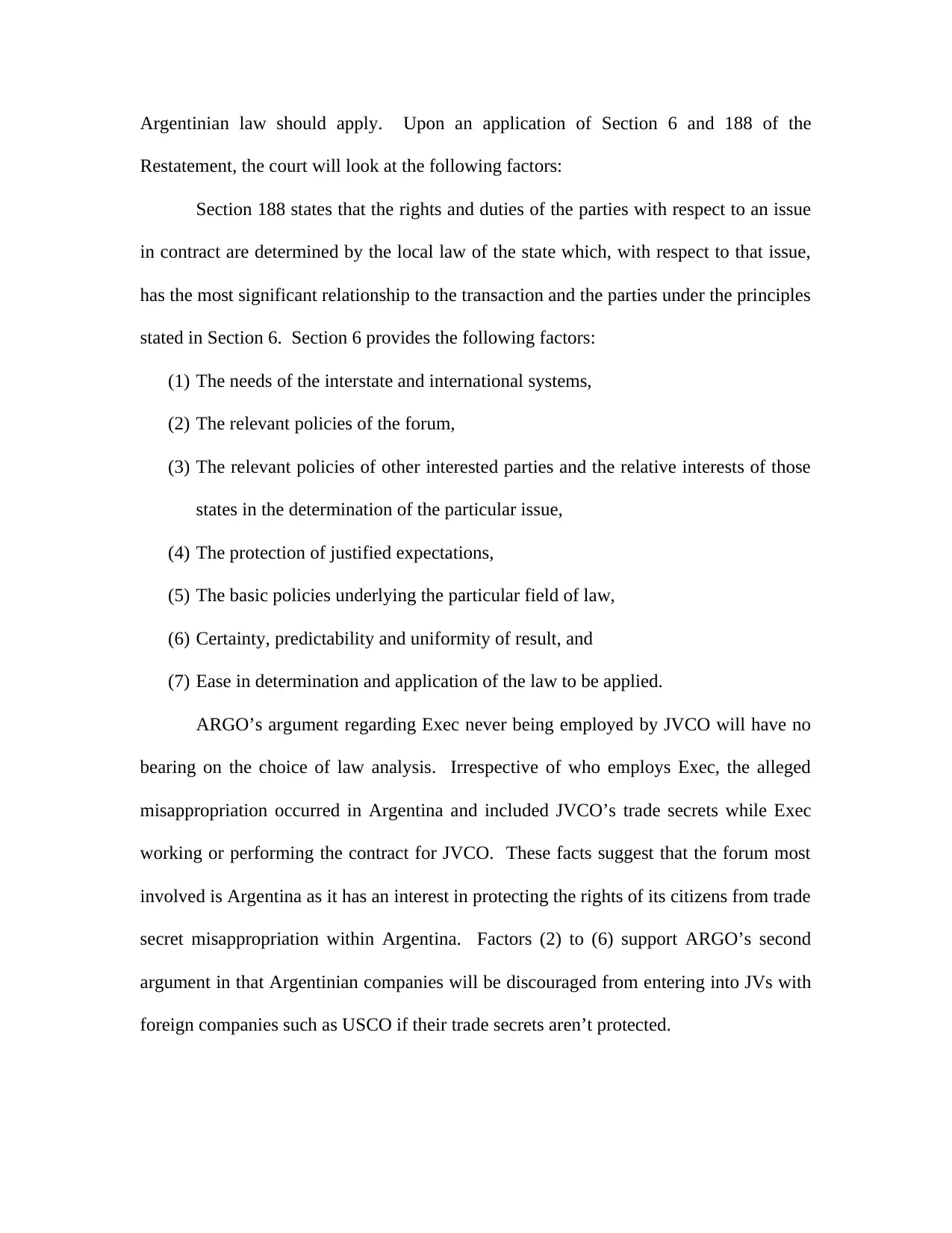
Argentinian law should apply. Upon an application of Section 6 and 188 of the
Restatement, the court will look at the following factors:
Section 188 states that the rights and duties of the parties with respect to an issue
in contract are determined by the local law of the state which, with respect to that issue,
has the most significant relationship to the transaction and the parties under the principles
stated in Section 6. Section 6 provides the following factors:
(1) The needs of the interstate and international systems,
(2) The relevant policies of the forum,
(3) The relevant policies of other interested parties and the relative interests of those
states in the determination of the particular issue,
(4) The protection of justified expectations,
(5) The basic policies underlying the particular field of law,
(6) Certainty, predictability and uniformity of result, and
(7) Ease in determination and application of the law to be applied.
ARGO’s argument regarding Exec never being employed by JVCO will have no
bearing on the choice of law analysis. Irrespective of who employs Exec, the alleged
misappropriation occurred in Argentina and included JVCO’s trade secrets while Exec
working or performing the contract for JVCO. These facts suggest that the forum most
involved is Argentina as it has an interest in protecting the rights of its citizens from trade
secret misappropriation within Argentina. Factors (2) to (6) support ARGO’s second
argument in that Argentinian companies will be discouraged from entering into JVs with
foreign companies such as USCO if their trade secrets aren’t protected.
Restatement, the court will look at the following factors:
Section 188 states that the rights and duties of the parties with respect to an issue
in contract are determined by the local law of the state which, with respect to that issue,
has the most significant relationship to the transaction and the parties under the principles
stated in Section 6. Section 6 provides the following factors:
(1) The needs of the interstate and international systems,
(2) The relevant policies of the forum,
(3) The relevant policies of other interested parties and the relative interests of those
states in the determination of the particular issue,
(4) The protection of justified expectations,
(5) The basic policies underlying the particular field of law,
(6) Certainty, predictability and uniformity of result, and
(7) Ease in determination and application of the law to be applied.
ARGO’s argument regarding Exec never being employed by JVCO will have no
bearing on the choice of law analysis. Irrespective of who employs Exec, the alleged
misappropriation occurred in Argentina and included JVCO’s trade secrets while Exec
working or performing the contract for JVCO. These facts suggest that the forum most
involved is Argentina as it has an interest in protecting the rights of its citizens from trade
secret misappropriation within Argentina. Factors (2) to (6) support ARGO’s second
argument in that Argentinian companies will be discouraged from entering into JVs with
foreign companies such as USCO if their trade secrets aren’t protected.
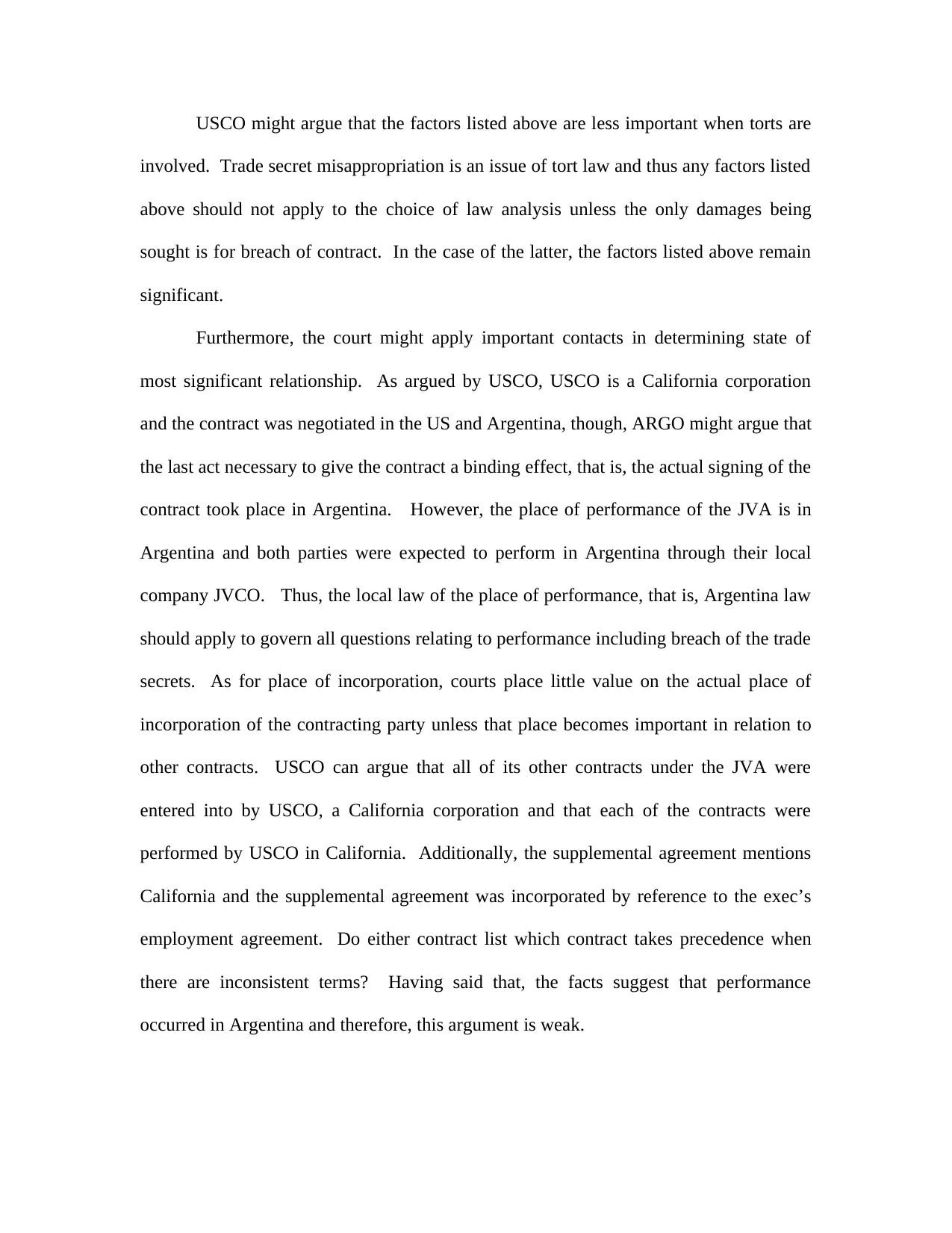
USCO might argue that the factors listed above are less important when torts are
involved. Trade secret misappropriation is an issue of tort law and thus any factors listed
above should not apply to the choice of law analysis unless the only damages being
sought is for breach of contract. In the case of the latter, the factors listed above remain
significant.
Furthermore, the court might apply important contacts in determining state of
most significant relationship. As argued by USCO, USCO is a California corporation
and the contract was negotiated in the US and Argentina, though, ARGO might argue that
the last act necessary to give the contract a binding effect, that is, the actual signing of the
contract took place in Argentina. However, the place of performance of the JVA is in
Argentina and both parties were expected to perform in Argentina through their local
company JVCO. Thus, the local law of the place of performance, that is, Argentina law
should apply to govern all questions relating to performance including breach of the trade
secrets. As for place of incorporation, courts place little value on the actual place of
incorporation of the contracting party unless that place becomes important in relation to
other contracts. USCO can argue that all of its other contracts under the JVA were
entered into by USCO, a California corporation and that each of the contracts were
performed by USCO in California. Additionally, the supplemental agreement mentions
California and the supplemental agreement was incorporated by reference to the exec’s
employment agreement. Do either contract list which contract takes precedence when
there are inconsistent terms? Having said that, the facts suggest that performance
occurred in Argentina and therefore, this argument is weak.
involved. Trade secret misappropriation is an issue of tort law and thus any factors listed
above should not apply to the choice of law analysis unless the only damages being
sought is for breach of contract. In the case of the latter, the factors listed above remain
significant.
Furthermore, the court might apply important contacts in determining state of
most significant relationship. As argued by USCO, USCO is a California corporation
and the contract was negotiated in the US and Argentina, though, ARGO might argue that
the last act necessary to give the contract a binding effect, that is, the actual signing of the
contract took place in Argentina. However, the place of performance of the JVA is in
Argentina and both parties were expected to perform in Argentina through their local
company JVCO. Thus, the local law of the place of performance, that is, Argentina law
should apply to govern all questions relating to performance including breach of the trade
secrets. As for place of incorporation, courts place little value on the actual place of
incorporation of the contracting party unless that place becomes important in relation to
other contracts. USCO can argue that all of its other contracts under the JVA were
entered into by USCO, a California corporation and that each of the contracts were
performed by USCO in California. Additionally, the supplemental agreement mentions
California and the supplemental agreement was incorporated by reference to the exec’s
employment agreement. Do either contract list which contract takes precedence when
there are inconsistent terms? Having said that, the facts suggest that performance
occurred in Argentina and therefore, this argument is weak.
⊘ This is a preview!⊘
Do you want full access?
Subscribe today to unlock all pages.

Trusted by 1+ million students worldwide
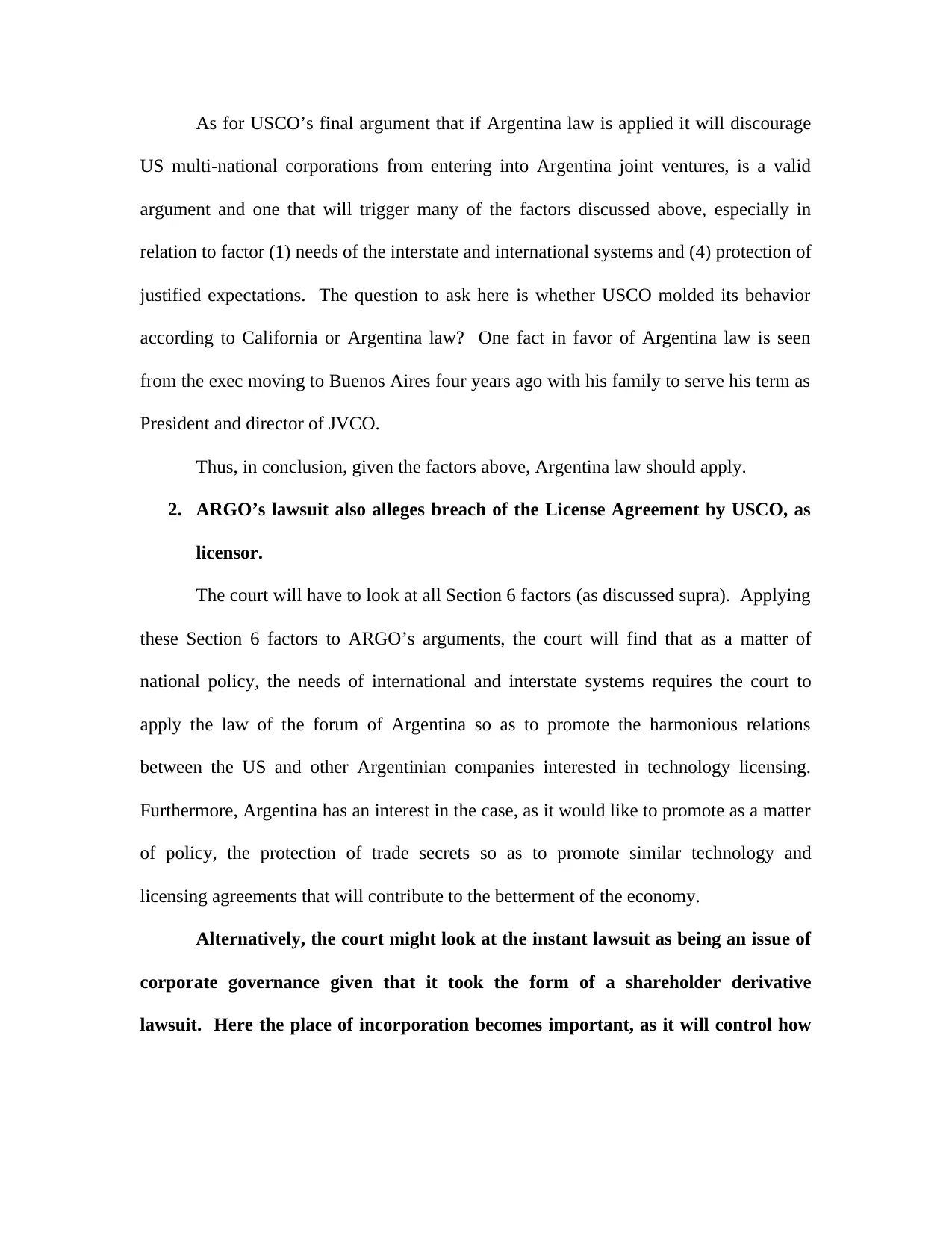
As for USCO’s final argument that if Argentina law is applied it will discourage
US multi-national corporations from entering into Argentina joint ventures, is a valid
argument and one that will trigger many of the factors discussed above, especially in
relation to factor (1) needs of the interstate and international systems and (4) protection of
justified expectations. The question to ask here is whether USCO molded its behavior
according to California or Argentina law? One fact in favor of Argentina law is seen
from the exec moving to Buenos Aires four years ago with his family to serve his term as
President and director of JVCO.
Thus, in conclusion, given the factors above, Argentina law should apply.
2. ARGO’s lawsuit also alleges breach of the License Agreement by USCO, as
licensor.
The court will have to look at all Section 6 factors (as discussed supra). Applying
these Section 6 factors to ARGO’s arguments, the court will find that as a matter of
national policy, the needs of international and interstate systems requires the court to
apply the law of the forum of Argentina so as to promote the harmonious relations
between the US and other Argentinian companies interested in technology licensing.
Furthermore, Argentina has an interest in the case, as it would like to promote as a matter
of policy, the protection of trade secrets so as to promote similar technology and
licensing agreements that will contribute to the betterment of the economy.
Alternatively, the court might look at the instant lawsuit as being an issue of
corporate governance given that it took the form of a shareholder derivative
lawsuit. Here the place of incorporation becomes important, as it will control how
US multi-national corporations from entering into Argentina joint ventures, is a valid
argument and one that will trigger many of the factors discussed above, especially in
relation to factor (1) needs of the interstate and international systems and (4) protection of
justified expectations. The question to ask here is whether USCO molded its behavior
according to California or Argentina law? One fact in favor of Argentina law is seen
from the exec moving to Buenos Aires four years ago with his family to serve his term as
President and director of JVCO.
Thus, in conclusion, given the factors above, Argentina law should apply.
2. ARGO’s lawsuit also alleges breach of the License Agreement by USCO, as
licensor.
The court will have to look at all Section 6 factors (as discussed supra). Applying
these Section 6 factors to ARGO’s arguments, the court will find that as a matter of
national policy, the needs of international and interstate systems requires the court to
apply the law of the forum of Argentina so as to promote the harmonious relations
between the US and other Argentinian companies interested in technology licensing.
Furthermore, Argentina has an interest in the case, as it would like to promote as a matter
of policy, the protection of trade secrets so as to promote similar technology and
licensing agreements that will contribute to the betterment of the economy.
Alternatively, the court might look at the instant lawsuit as being an issue of
corporate governance given that it took the form of a shareholder derivative
lawsuit. Here the place of incorporation becomes important, as it will control how
Paraphrase This Document
Need a fresh take? Get an instant paraphrase of this document with our AI Paraphraser
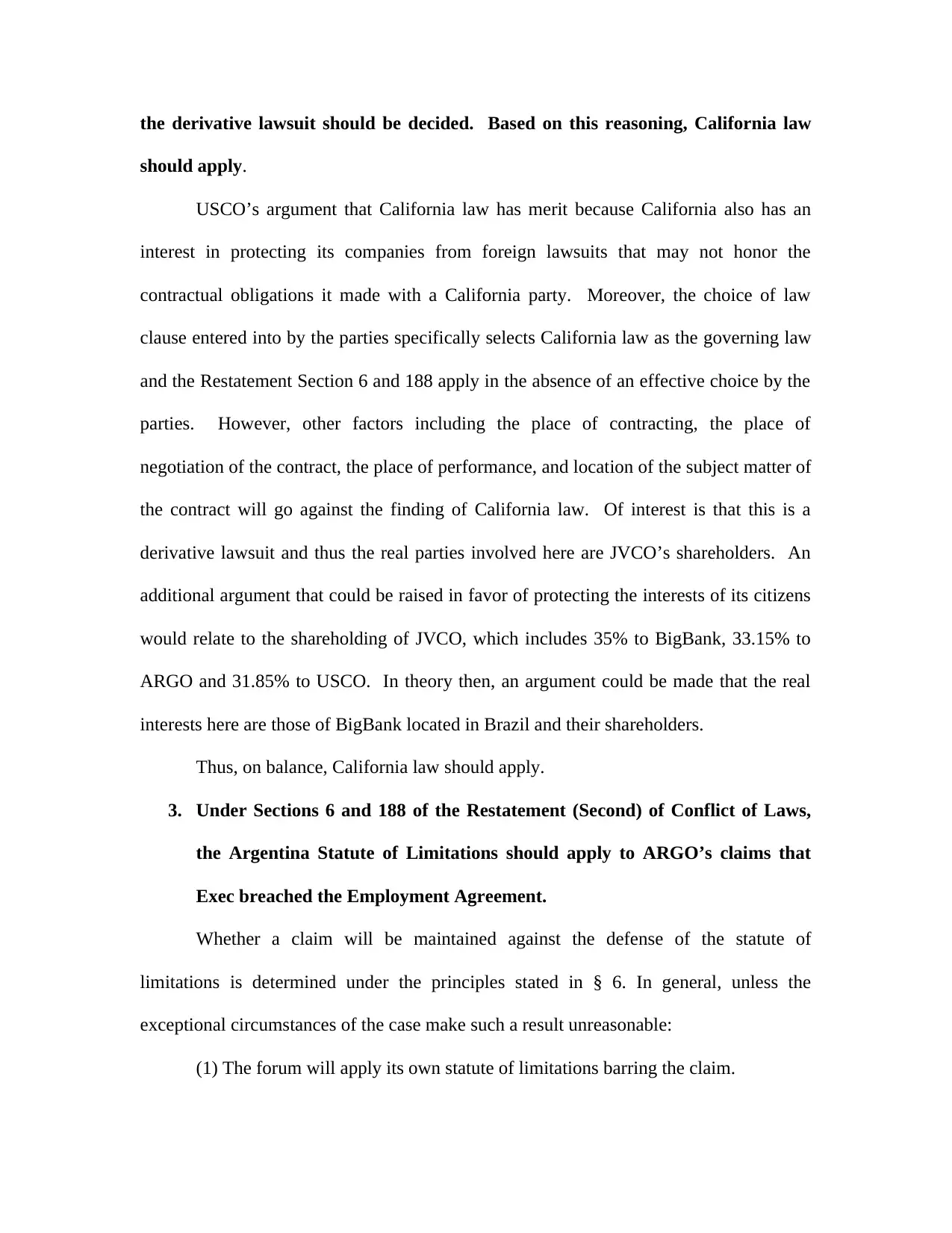
the derivative lawsuit should be decided. Based on this reasoning, California law
should apply.
USCO’s argument that California law has merit because California also has an
interest in protecting its companies from foreign lawsuits that may not honor the
contractual obligations it made with a California party. Moreover, the choice of law
clause entered into by the parties specifically selects California law as the governing law
and the Restatement Section 6 and 188 apply in the absence of an effective choice by the
parties. However, other factors including the place of contracting, the place of
negotiation of the contract, the place of performance, and location of the subject matter of
the contract will go against the finding of California law. Of interest is that this is a
derivative lawsuit and thus the real parties involved here are JVCO’s shareholders. An
additional argument that could be raised in favor of protecting the interests of its citizens
would relate to the shareholding of JVCO, which includes 35% to BigBank, 33.15% to
ARGO and 31.85% to USCO. In theory then, an argument could be made that the real
interests here are those of BigBank located in Brazil and their shareholders.
Thus, on balance, California law should apply.
3. Under Sections 6 and 188 of the Restatement (Second) of Conflict of Laws,
the Argentina Statute of Limitations should apply to ARGO’s claims that
Exec breached the Employment Agreement.
Whether a claim will be maintained against the defense of the statute of
limitations is determined under the principles stated in § 6. In general, unless the
exceptional circumstances of the case make such a result unreasonable:
(1) The forum will apply its own statute of limitations barring the claim.
should apply.
USCO’s argument that California law has merit because California also has an
interest in protecting its companies from foreign lawsuits that may not honor the
contractual obligations it made with a California party. Moreover, the choice of law
clause entered into by the parties specifically selects California law as the governing law
and the Restatement Section 6 and 188 apply in the absence of an effective choice by the
parties. However, other factors including the place of contracting, the place of
negotiation of the contract, the place of performance, and location of the subject matter of
the contract will go against the finding of California law. Of interest is that this is a
derivative lawsuit and thus the real parties involved here are JVCO’s shareholders. An
additional argument that could be raised in favor of protecting the interests of its citizens
would relate to the shareholding of JVCO, which includes 35% to BigBank, 33.15% to
ARGO and 31.85% to USCO. In theory then, an argument could be made that the real
interests here are those of BigBank located in Brazil and their shareholders.
Thus, on balance, California law should apply.
3. Under Sections 6 and 188 of the Restatement (Second) of Conflict of Laws,
the Argentina Statute of Limitations should apply to ARGO’s claims that
Exec breached the Employment Agreement.
Whether a claim will be maintained against the defense of the statute of
limitations is determined under the principles stated in § 6. In general, unless the
exceptional circumstances of the case make such a result unreasonable:
(1) The forum will apply its own statute of limitations barring the claim.
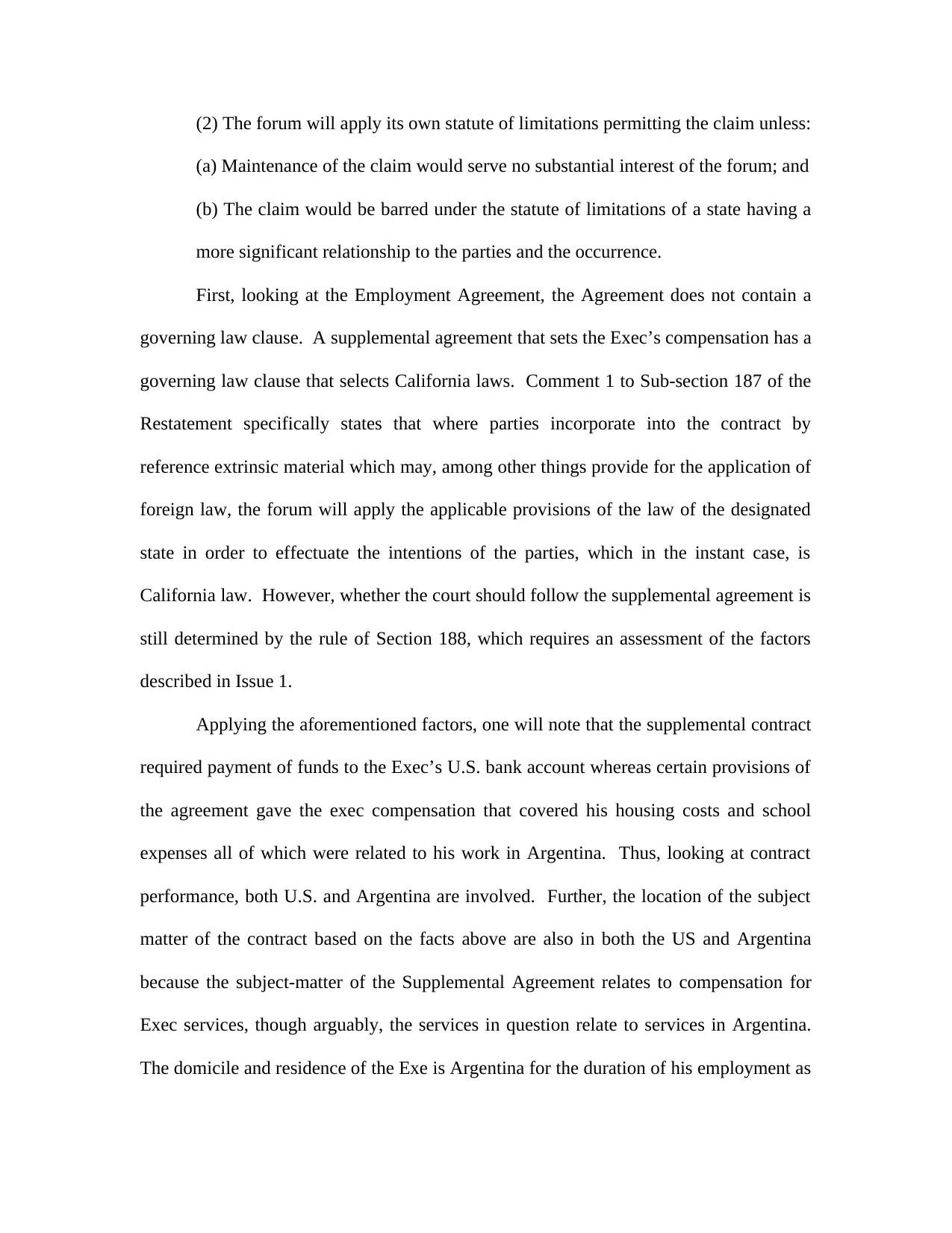
(2) The forum will apply its own statute of limitations permitting the claim unless:
(a) Maintenance of the claim would serve no substantial interest of the forum; and
(b) The claim would be barred under the statute of limitations of a state having a
more significant relationship to the parties and the occurrence.
First, looking at the Employment Agreement, the Agreement does not contain a
governing law clause. A supplemental agreement that sets the Exec’s compensation has a
governing law clause that selects California laws. Comment 1 to Sub-section 187 of the
Restatement specifically states that where parties incorporate into the contract by
reference extrinsic material which may, among other things provide for the application of
foreign law, the forum will apply the applicable provisions of the law of the designated
state in order to effectuate the intentions of the parties, which in the instant case, is
California law. However, whether the court should follow the supplemental agreement is
still determined by the rule of Section 188, which requires an assessment of the factors
described in Issue 1.
Applying the aforementioned factors, one will note that the supplemental contract
required payment of funds to the Exec’s U.S. bank account whereas certain provisions of
the agreement gave the exec compensation that covered his housing costs and school
expenses all of which were related to his work in Argentina. Thus, looking at contract
performance, both U.S. and Argentina are involved. Further, the location of the subject
matter of the contract based on the facts above are also in both the US and Argentina
because the subject-matter of the Supplemental Agreement relates to compensation for
Exec services, though arguably, the services in question relate to services in Argentina.
The domicile and residence of the Exe is Argentina for the duration of his employment as
(a) Maintenance of the claim would serve no substantial interest of the forum; and
(b) The claim would be barred under the statute of limitations of a state having a
more significant relationship to the parties and the occurrence.
First, looking at the Employment Agreement, the Agreement does not contain a
governing law clause. A supplemental agreement that sets the Exec’s compensation has a
governing law clause that selects California laws. Comment 1 to Sub-section 187 of the
Restatement specifically states that where parties incorporate into the contract by
reference extrinsic material which may, among other things provide for the application of
foreign law, the forum will apply the applicable provisions of the law of the designated
state in order to effectuate the intentions of the parties, which in the instant case, is
California law. However, whether the court should follow the supplemental agreement is
still determined by the rule of Section 188, which requires an assessment of the factors
described in Issue 1.
Applying the aforementioned factors, one will note that the supplemental contract
required payment of funds to the Exec’s U.S. bank account whereas certain provisions of
the agreement gave the exec compensation that covered his housing costs and school
expenses all of which were related to his work in Argentina. Thus, looking at contract
performance, both U.S. and Argentina are involved. Further, the location of the subject
matter of the contract based on the facts above are also in both the US and Argentina
because the subject-matter of the Supplemental Agreement relates to compensation for
Exec services, though arguably, the services in question relate to services in Argentina.
The domicile and residence of the Exe is Argentina for the duration of his employment as
⊘ This is a preview!⊘
Do you want full access?
Subscribe today to unlock all pages.
Trusted by 1+ million students worldwide
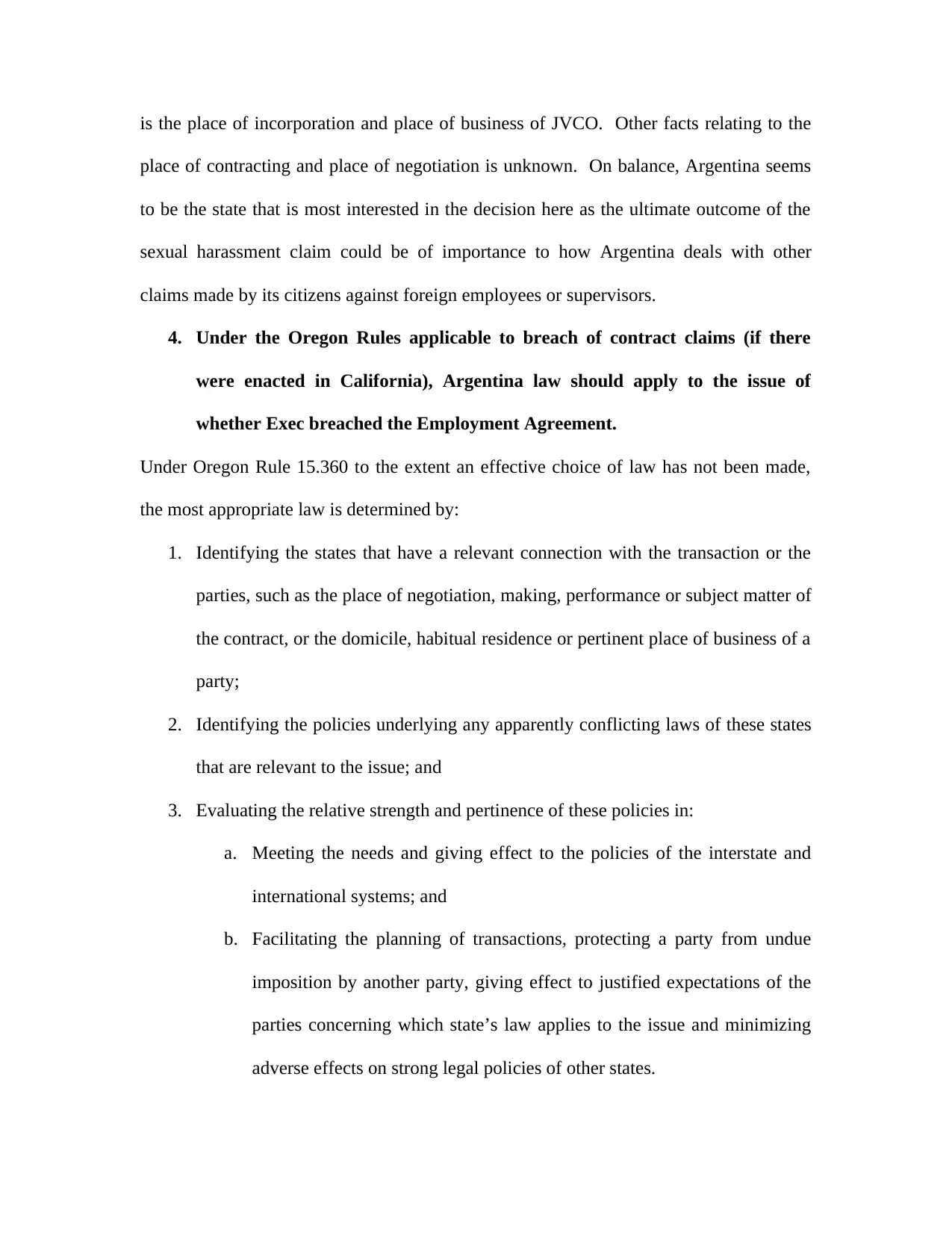
is the place of incorporation and place of business of JVCO. Other facts relating to the
place of contracting and place of negotiation is unknown. On balance, Argentina seems
to be the state that is most interested in the decision here as the ultimate outcome of the
sexual harassment claim could be of importance to how Argentina deals with other
claims made by its citizens against foreign employees or supervisors.
4. Under the Oregon Rules applicable to breach of contract claims (if there
were enacted in California), Argentina law should apply to the issue of
whether Exec breached the Employment Agreement.
Under Oregon Rule 15.360 to the extent an effective choice of law has not been made,
the most appropriate law is determined by:
1. Identifying the states that have a relevant connection with the transaction or the
parties, such as the place of negotiation, making, performance or subject matter of
the contract, or the domicile, habitual residence or pertinent place of business of a
party;
2. Identifying the policies underlying any apparently conflicting laws of these states
that are relevant to the issue; and
3. Evaluating the relative strength and pertinence of these policies in:
a. Meeting the needs and giving effect to the policies of the interstate and
international systems; and
b. Facilitating the planning of transactions, protecting a party from undue
imposition by another party, giving effect to justified expectations of the
parties concerning which state’s law applies to the issue and minimizing
adverse effects on strong legal policies of other states.
place of contracting and place of negotiation is unknown. On balance, Argentina seems
to be the state that is most interested in the decision here as the ultimate outcome of the
sexual harassment claim could be of importance to how Argentina deals with other
claims made by its citizens against foreign employees or supervisors.
4. Under the Oregon Rules applicable to breach of contract claims (if there
were enacted in California), Argentina law should apply to the issue of
whether Exec breached the Employment Agreement.
Under Oregon Rule 15.360 to the extent an effective choice of law has not been made,
the most appropriate law is determined by:
1. Identifying the states that have a relevant connection with the transaction or the
parties, such as the place of negotiation, making, performance or subject matter of
the contract, or the domicile, habitual residence or pertinent place of business of a
party;
2. Identifying the policies underlying any apparently conflicting laws of these states
that are relevant to the issue; and
3. Evaluating the relative strength and pertinence of these policies in:
a. Meeting the needs and giving effect to the policies of the interstate and
international systems; and
b. Facilitating the planning of transactions, protecting a party from undue
imposition by another party, giving effect to justified expectations of the
parties concerning which state’s law applies to the issue and minimizing
adverse effects on strong legal policies of other states.
Paraphrase This Document
Need a fresh take? Get an instant paraphrase of this document with our AI Paraphraser
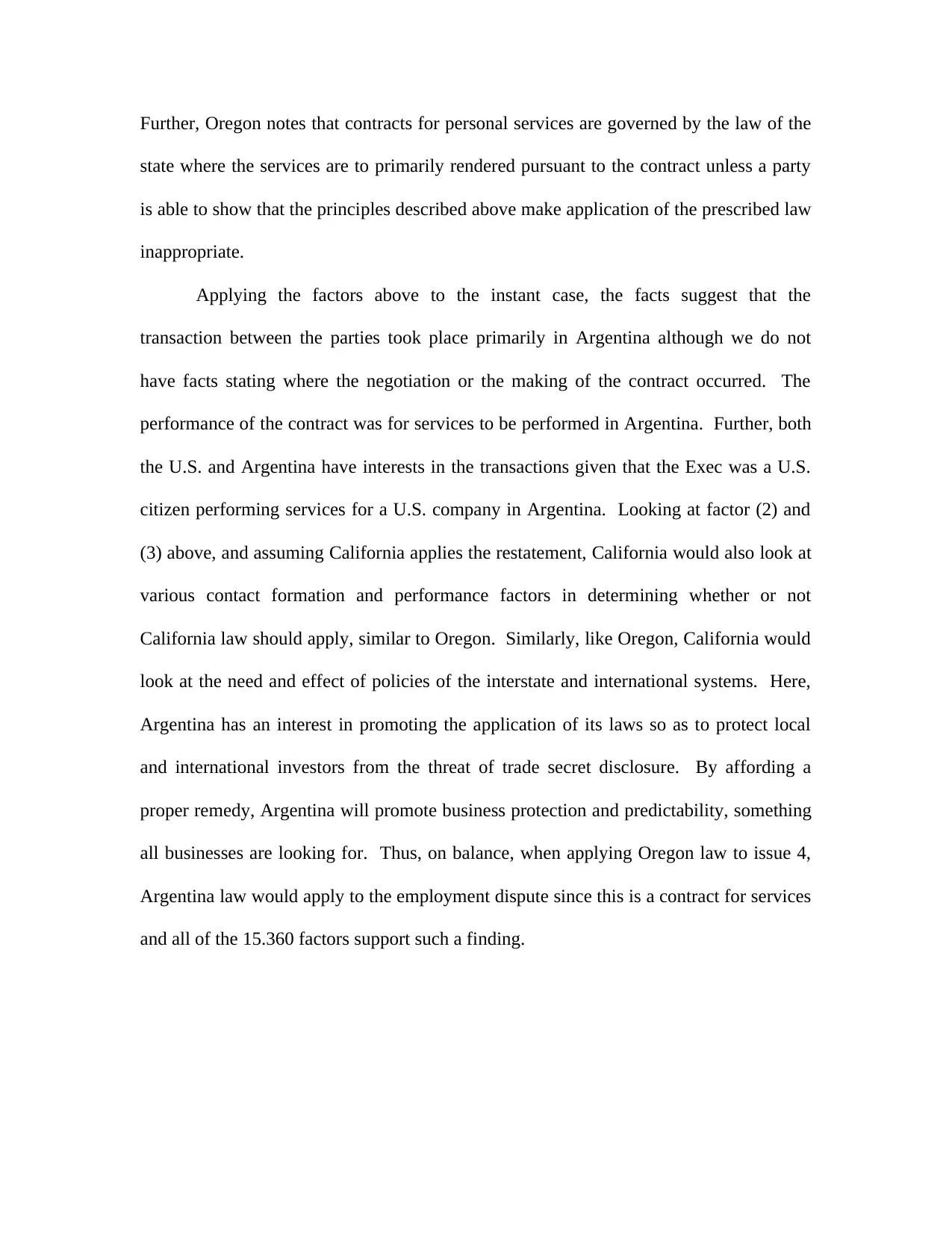
Further, Oregon notes that contracts for personal services are governed by the law of the
state where the services are to primarily rendered pursuant to the contract unless a party
is able to show that the principles described above make application of the prescribed law
inappropriate.
Applying the factors above to the instant case, the facts suggest that the
transaction between the parties took place primarily in Argentina although we do not
have facts stating where the negotiation or the making of the contract occurred. The
performance of the contract was for services to be performed in Argentina. Further, both
the U.S. and Argentina have interests in the transactions given that the Exec was a U.S.
citizen performing services for a U.S. company in Argentina. Looking at factor (2) and
(3) above, and assuming California applies the restatement, California would also look at
various contact formation and performance factors in determining whether or not
California law should apply, similar to Oregon. Similarly, like Oregon, California would
look at the need and effect of policies of the interstate and international systems. Here,
Argentina has an interest in promoting the application of its laws so as to protect local
and international investors from the threat of trade secret disclosure. By affording a
proper remedy, Argentina will promote business protection and predictability, something
all businesses are looking for. Thus, on balance, when applying Oregon law to issue 4,
Argentina law would apply to the employment dispute since this is a contract for services
and all of the 15.360 factors support such a finding.
state where the services are to primarily rendered pursuant to the contract unless a party
is able to show that the principles described above make application of the prescribed law
inappropriate.
Applying the factors above to the instant case, the facts suggest that the
transaction between the parties took place primarily in Argentina although we do not
have facts stating where the negotiation or the making of the contract occurred. The
performance of the contract was for services to be performed in Argentina. Further, both
the U.S. and Argentina have interests in the transactions given that the Exec was a U.S.
citizen performing services for a U.S. company in Argentina. Looking at factor (2) and
(3) above, and assuming California applies the restatement, California would also look at
various contact formation and performance factors in determining whether or not
California law should apply, similar to Oregon. Similarly, like Oregon, California would
look at the need and effect of policies of the interstate and international systems. Here,
Argentina has an interest in promoting the application of its laws so as to protect local
and international investors from the threat of trade secret disclosure. By affording a
proper remedy, Argentina will promote business protection and predictability, something
all businesses are looking for. Thus, on balance, when applying Oregon law to issue 4,
Argentina law would apply to the employment dispute since this is a contract for services
and all of the 15.360 factors support such a finding.
5. Under the Oregon Rules applicable to Ms. Femp’s tort claims of sexual
harassment, Ms. Femp’s claims should be barred by the Argentina statute of
limitations.
According to Section 15.440 of Oregon law, non contractual claims between an
injured person and the person whose conduct caused the injury are governed by the law
of the state designated in this section. Specifically, subsection (3) provides, if the injured
person and the person who caused the conduct were domiciled in different states than the
laws of those states on the disputes issues would produce a different outcome, then (a) if
both the injurious conduct and the resulting injury occurred in the same state, the law of
that state governs if either the injured person or the person whose conduct caused the
injury was domiciled in that state.
Applying this section to issue 5, we will see that the outcome in California and
Argentina on the issue of statute of limitations would produce a different outcome.
Specifically, only in California would a claim be heard. Thus, applying sub-section 3(a)
Argentina law should apply since both the injurious conduct and the resulting injury
occurred in Argentina and the injured person is domiciled in Argentina.
Applying section 15.445 might different results the court will apply when section
15440 lead to Inappropriate. Ms. Femp argue where relay 15.455 and so Ms. Femp might
be able to sue Exec under California law which has longer statute of limitation applicable
of sexual harassment.
Best regards,
Faisal Alkhaliwi
harassment, Ms. Femp’s claims should be barred by the Argentina statute of
limitations.
According to Section 15.440 of Oregon law, non contractual claims between an
injured person and the person whose conduct caused the injury are governed by the law
of the state designated in this section. Specifically, subsection (3) provides, if the injured
person and the person who caused the conduct were domiciled in different states than the
laws of those states on the disputes issues would produce a different outcome, then (a) if
both the injurious conduct and the resulting injury occurred in the same state, the law of
that state governs if either the injured person or the person whose conduct caused the
injury was domiciled in that state.
Applying this section to issue 5, we will see that the outcome in California and
Argentina on the issue of statute of limitations would produce a different outcome.
Specifically, only in California would a claim be heard. Thus, applying sub-section 3(a)
Argentina law should apply since both the injurious conduct and the resulting injury
occurred in Argentina and the injured person is domiciled in Argentina.
Applying section 15.445 might different results the court will apply when section
15440 lead to Inappropriate. Ms. Femp argue where relay 15.455 and so Ms. Femp might
be able to sue Exec under California law which has longer statute of limitation applicable
of sexual harassment.
Best regards,
Faisal Alkhaliwi
⊘ This is a preview!⊘
Do you want full access?
Subscribe today to unlock all pages.
Trusted by 1+ million students worldwide

1 out of 9


Related Documents


Your All-in-One AI-Powered Toolkit for Academic Success.
+13062052269
info@desklib.com
Available 24*7 on WhatsApp / Email
![[object Object]](/_next/static/media/star-bottom.7253800d.svg)
Unlock your academic potential
Copyright © 2020–2026 A2Z Services. All Rights Reserved. Developed and managed by ZUCOL.