Women in Choson Korea Essay
VerifiedAdded on 2019/10/08
|9
|2194
|626
Essay
AI Summary
This essay examines the lives of women in Choson Korea, focusing on the transformative effects of Neo-Confucianism. It contrasts the pre-Neo-Confucian era, where women held varying degrees of power and autonomy, with the subsequent period marked by increased patriarchal control and restrictions. The essay details how Neo-Confucian ideals, such as the emphasis on female chastity and domesticity, reshaped women's roles within the family and society. It explores the forced implementation of Confucianism and its impact on gender construction in Korean society, highlighting the complexities and contradictions within the historical narrative. The essay concludes by summarizing the decline in women's status under Neo-Confucianism and the lasting impact of this ideology on Korean gender dynamics. The author uses various scholarly sources to support their analysis.
Women in Choson Korea
Student name
Student ID
Course ID
Presented to
Date
Student name
Student ID
Course ID
Presented to
Date

Paraphrase This Document
Need a fresh take? Get an instant paraphrase of this document with our AI Paraphraser
Introduction
The entire essay will revolve around the central topic that is "Women in Choson Korea". It
has been observed that throughout Korea, China, as well as Japan, Confucianism ordered and
structured society. The Choson Dynasty was founded in Korea in the year 1392 and it is
believed that it created Neo-Confucian society, discouraging as well as at times mistreating
Buddhism. With the help of implementing a lot of policies, it has been observed that the
Choson Dynasty changed the indigenous, traditional structure of the Korean family which
had offered a huge amount of importance to the women. However, this essay will highlight
the following: Description of the Korean society before the time of neo-Confucianism and
indicating the lives of the women, the alterations neo-Confucianism on the lives of the
women and the reason behind the forced implementation of the Confucianism altered the
gender construction with regards to the Korean society.
Body
Korean society before the neo-Confucianism and the lives of the women
The Choson Dynasty marked the ascendancy of the neo-Confucianism and it was the
dominant system with regards to the social government. The term neo-Confucianism is
mainly highlighted a religious movement in the religious philosophy that derived from the
Confucianism in China around AD 1000 in response to the ideas of Buddhism and Taoism.
The lives of the Korean people were completely different before neo-Confucianism
especially highlighting the women it can be said that one of the main obstacles was making
the women visible under the power of Confucianism1. Before the neo- Confucianism the was
1 Deuchler, Martina. "Propagating Female Virtue in Chosŏn Korea." Ko, Kim, and Piggot,
Women and Confucian Culture(2003): 160-61.
2
The entire essay will revolve around the central topic that is "Women in Choson Korea". It
has been observed that throughout Korea, China, as well as Japan, Confucianism ordered and
structured society. The Choson Dynasty was founded in Korea in the year 1392 and it is
believed that it created Neo-Confucian society, discouraging as well as at times mistreating
Buddhism. With the help of implementing a lot of policies, it has been observed that the
Choson Dynasty changed the indigenous, traditional structure of the Korean family which
had offered a huge amount of importance to the women. However, this essay will highlight
the following: Description of the Korean society before the time of neo-Confucianism and
indicating the lives of the women, the alterations neo-Confucianism on the lives of the
women and the reason behind the forced implementation of the Confucianism altered the
gender construction with regards to the Korean society.
Body
Korean society before the neo-Confucianism and the lives of the women
The Choson Dynasty marked the ascendancy of the neo-Confucianism and it was the
dominant system with regards to the social government. The term neo-Confucianism is
mainly highlighted a religious movement in the religious philosophy that derived from the
Confucianism in China around AD 1000 in response to the ideas of Buddhism and Taoism.
The lives of the Korean people were completely different before neo-Confucianism
especially highlighting the women it can be said that one of the main obstacles was making
the women visible under the power of Confucianism1. Before the neo- Confucianism the was
1 Deuchler, Martina. "Propagating Female Virtue in Chosŏn Korea." Ko, Kim, and Piggot,
Women and Confucian Culture(2003): 160-61.
2
not at all cultural and ideological force that shaped the lives of the Korean Women. Some of
the scholars have highlighted their viewpoints stating that the ancient Confucianism is the
subordinate role that has placed women in a historical manner. Arguably, some of the
researchers also argued with the fact that some of the women received a considerable amount
of freedom and were even more educated before neo-Confucianism. Women just before neo-
Confucianism were instructed to remain separated from the men. The undeniable fact of
history is that the Confucian principles highly contributed towards the suppression of the
women even though suppressing the women were not at all the primary objective of
Confucianism. The Confucians always tend to argue with the fact that before neo-
Confucianism the women had power at home but not outside but after neo-Confucianism,
they lost both the powers.
Throwing light on the above-mentioned discussion it can be said that the women before the
neo-Confucianism were observed as the core of their family. The roles that were mainly
played by the women were mostly related to the kingship such as daughter-in-law, daughter,
sister, mother-in-law, and wife. In the above-mentioned roles, it was incumbent on women to
accord with the needs and wishes of closely related men. The status of women was weak
before neo-Confucianism. The two of the most prominent signs of decline most importantly
needs to be mentioned are the practice of binding the girls that were young from preventing
them to grow few inches long as well as the huge amount of pressure of the widows not to
marry again2.
On the contrary, some of the women in the fictional large families had a considerable amount
of power. The young and the unmarried women were able to acquire the top-notch literary
educations as good as the male but the only difference was that they had less control over
their fate when contrasted with the male. Some of the scholars have indicated the fact that
2 Haboush, Jahyun Kim. "Filial emotions and filial values: Changing patterns in the discourse of filiality in late
Chosŏn Korea." Harvard Journal of Asiatic Studies (1995): 129-
3
the scholars have highlighted their viewpoints stating that the ancient Confucianism is the
subordinate role that has placed women in a historical manner. Arguably, some of the
researchers also argued with the fact that some of the women received a considerable amount
of freedom and were even more educated before neo-Confucianism. Women just before neo-
Confucianism were instructed to remain separated from the men. The undeniable fact of
history is that the Confucian principles highly contributed towards the suppression of the
women even though suppressing the women were not at all the primary objective of
Confucianism. The Confucians always tend to argue with the fact that before neo-
Confucianism the women had power at home but not outside but after neo-Confucianism,
they lost both the powers.
Throwing light on the above-mentioned discussion it can be said that the women before the
neo-Confucianism were observed as the core of their family. The roles that were mainly
played by the women were mostly related to the kingship such as daughter-in-law, daughter,
sister, mother-in-law, and wife. In the above-mentioned roles, it was incumbent on women to
accord with the needs and wishes of closely related men. The status of women was weak
before neo-Confucianism. The two of the most prominent signs of decline most importantly
needs to be mentioned are the practice of binding the girls that were young from preventing
them to grow few inches long as well as the huge amount of pressure of the widows not to
marry again2.
On the contrary, some of the women in the fictional large families had a considerable amount
of power. The young and the unmarried women were able to acquire the top-notch literary
educations as good as the male but the only difference was that they had less control over
their fate when contrasted with the male. Some of the scholars have indicated the fact that
2 Haboush, Jahyun Kim. "Filial emotions and filial values: Changing patterns in the discourse of filiality in late
Chosŏn Korea." Harvard Journal of Asiatic Studies (1995): 129-
3
⊘ This is a preview!⊘
Do you want full access?
Subscribe today to unlock all pages.

Trusted by 1+ million students worldwide
there was an old family system that existed for the women before neo-Confucianism and it
limited the chances of the women to a great extent. The parental control of marriage, widow
chastity, concubinage, and the foot binding existed for the women before neo-Confucianism.
The pre-Choson period the women were directed to move to their in-law's house after getting
married along with their husband. The wives in this period were also divided into two
categories namely: Legitimate wife and concubines. Neo-Confucianism in Korea was also
perceived to be matrilineal with patrilineal societies becoming dominant later with the rise of
the social division of the labor and pastoralism3.
Hence, it can be clearly depicted and argued that the life of the women during neo-
Confucianism was quite tough. It can be proved more when neo-Confucianism is contrasted
with the Tang Dynasty as it is regarded as the golden age for the women. It has been
mentioned earlier that during the neo-Confucianism the women observed widow suicide,
foot-binding, and the widow chastity is quite normal. Furthermore, during the Song Dynasty
neo-Confucianism became one of the most dominant belief systems and a lot of scholars have
argued and proved the fact that the status of the women was declined during the neo-
Confucianism.
The changes brought by neo-Confucianism on the lives of the women
It has been observed that neo-Confucianism was able to bring a lot of changes in the lives of
women to a great extent. Women were forced with regards to the ideology on the neo-
Confucianism for remaining chaste before marriage and barred from marrying again once
their husband had passed away. The neo-Confucianist inspired the alterations contributed
towards the strengthening of the patriarchal system during the Choson era. As a result of this
type of alterations, the activities and rights of the Choson women became significantly
3 Ko, Dorothy, JaHyun Kim Haboush, and Joan Piggott, eds. Women and Confucian cultures
in premodern China, Korea, and Japan. Univ of California Press, 2003.
4
limited the chances of the women to a great extent. The parental control of marriage, widow
chastity, concubinage, and the foot binding existed for the women before neo-Confucianism.
The pre-Choson period the women were directed to move to their in-law's house after getting
married along with their husband. The wives in this period were also divided into two
categories namely: Legitimate wife and concubines. Neo-Confucianism in Korea was also
perceived to be matrilineal with patrilineal societies becoming dominant later with the rise of
the social division of the labor and pastoralism3.
Hence, it can be clearly depicted and argued that the life of the women during neo-
Confucianism was quite tough. It can be proved more when neo-Confucianism is contrasted
with the Tang Dynasty as it is regarded as the golden age for the women. It has been
mentioned earlier that during the neo-Confucianism the women observed widow suicide,
foot-binding, and the widow chastity is quite normal. Furthermore, during the Song Dynasty
neo-Confucianism became one of the most dominant belief systems and a lot of scholars have
argued and proved the fact that the status of the women was declined during the neo-
Confucianism.
The changes brought by neo-Confucianism on the lives of the women
It has been observed that neo-Confucianism was able to bring a lot of changes in the lives of
women to a great extent. Women were forced with regards to the ideology on the neo-
Confucianism for remaining chaste before marriage and barred from marrying again once
their husband had passed away. The neo-Confucianist inspired the alterations contributed
towards the strengthening of the patriarchal system during the Choson era. As a result of this
type of alterations, the activities and rights of the Choson women became significantly
3 Ko, Dorothy, JaHyun Kim Haboush, and Joan Piggott, eds. Women and Confucian cultures
in premodern China, Korea, and Japan. Univ of California Press, 2003.
4
Paraphrase This Document
Need a fresh take? Get an instant paraphrase of this document with our AI Paraphraser
restricted. Arguably, from a very long time, it has been observed that the society of China
was highly influenced by the moral and intellectual codes with regards to the Confucianism.
The rise of neo-Confucianism marked the new birth of women as a lot of doctrines were also
born that was intended to keep these women ahead of the men. Arguably, the majority of the
alterations introduced by the neo-Confucian model were meant to subjugate the women and
they also helped the women by opening the door into the feminine intellectual discourse by
addressing the women in a direct manner. Hence, despite the intentions neo-Confucianism
pushed the women forward in terms of becoming a lot more in the Chinese society that was
quite dominated by the male4. The rise of neo-Confucianism had a great and significant
impact on the society and to be specific on the lives of the women. The roles of the women
under the neo-Confucianism for instance housework and presiding over the ancestral rites
kept them tied closely to their home and out of the public environment. It can be also argued
that neo-Confucianism women were able to begin their own intellectual discourse even it was
limited to the home only in the initial times.
Neo-Confucianism also subjected the women as subservient, quiet and molded creatures to
the will of the male. Furthermore, the neo-Confucian models the roles of each and every
woman were detained for their own knowledge along with the knowledge of the men. During
the Song Dynasty, there was a huge amount of attempt made in terms of bringing back a lot
of main teachings of the Confucianism that was adopted for modern China. One of the main
goals of the neo-Confucianism was preserving the imperial order and benefiting along with
controlling a large group of people. On the other hand, the Neo-Confucians of the period such
as Cheng Yi and Zhu Xi placed a strong emphasis on the Chastity and it had been also
accused earlier that cult of widow chastity was promoted by Cheng Yi. Other Neo-
4 Kim, Youngmin, and Michael J. Pettid, eds. Women and Confucianism in Choson Korea:
New Perspectives. Suny Press, 2011.
5
was highly influenced by the moral and intellectual codes with regards to the Confucianism.
The rise of neo-Confucianism marked the new birth of women as a lot of doctrines were also
born that was intended to keep these women ahead of the men. Arguably, the majority of the
alterations introduced by the neo-Confucian model were meant to subjugate the women and
they also helped the women by opening the door into the feminine intellectual discourse by
addressing the women in a direct manner. Hence, despite the intentions neo-Confucianism
pushed the women forward in terms of becoming a lot more in the Chinese society that was
quite dominated by the male4. The rise of neo-Confucianism had a great and significant
impact on the society and to be specific on the lives of the women. The roles of the women
under the neo-Confucianism for instance housework and presiding over the ancestral rites
kept them tied closely to their home and out of the public environment. It can be also argued
that neo-Confucianism women were able to begin their own intellectual discourse even it was
limited to the home only in the initial times.
Neo-Confucianism also subjected the women as subservient, quiet and molded creatures to
the will of the male. Furthermore, the neo-Confucian models the roles of each and every
woman were detained for their own knowledge along with the knowledge of the men. During
the Song Dynasty, there was a huge amount of attempt made in terms of bringing back a lot
of main teachings of the Confucianism that was adopted for modern China. One of the main
goals of the neo-Confucianism was preserving the imperial order and benefiting along with
controlling a large group of people. On the other hand, the Neo-Confucians of the period such
as Cheng Yi and Zhu Xi placed a strong emphasis on the Chastity and it had been also
accused earlier that cult of widow chastity was promoted by Cheng Yi. Other Neo-
4 Kim, Youngmin, and Michael J. Pettid, eds. Women and Confucianism in Choson Korea:
New Perspectives. Suny Press, 2011.
5
Confucians such as Sima Guang observed women and men as being part of the yang and in
order, with separation and distinction to the outer men and inner women. He stated in that
period that women are instructed to remain in the indoors and not to make any type of contact
with the outside world after attaining the age of 10 and women were also prohibited to
discuss anything about men to the outside world. One of the most common argument has
taken place with regards towards pointing out the decline of the status of the women from the
Song Dynasty itself to the Qing was due to the rise of the neo-Confucianism, there are some
of the other scholars who have suggested that the cause may more complicated, as an
outcome of different economic, social, political, cultural and legal forces for instance
alterations in inheritance practices and the social structure5.
The forced implementation of Confucianism alteration the gender construction of the
society of Korea
The gender construction in the modern society of Korea sheds some light on the desire of
Korea for its liberation and sovereignty. It was mainly the forced implementation of the
Confucianism that revealed the psychological activities of the society at the turn of the
century during the period of colonization. Historically the Korean society highlights an
almost prima facie case for using gender as an interpretive framework. It has been argued that
nationalistic and patriarchal discourses have served to construct the foreign women's gender
through the roles of wife, mother, and daughter-in-law in particular ways that serve the
interests of Korea as a nation6.
5 Levi, Nicolas. "Confucianism in South Korea and Japan: similarities and differences." Acta
Asiatica Varsoviensia 26 (2013): 185-195.
6 Baker, Don. "Privatization of Buddhism in the Choson Dynasty." Sungkyun Journal of East
Asian Studies 14, no. 2 (2014).
6
order, with separation and distinction to the outer men and inner women. He stated in that
period that women are instructed to remain in the indoors and not to make any type of contact
with the outside world after attaining the age of 10 and women were also prohibited to
discuss anything about men to the outside world. One of the most common argument has
taken place with regards towards pointing out the decline of the status of the women from the
Song Dynasty itself to the Qing was due to the rise of the neo-Confucianism, there are some
of the other scholars who have suggested that the cause may more complicated, as an
outcome of different economic, social, political, cultural and legal forces for instance
alterations in inheritance practices and the social structure5.
The forced implementation of Confucianism alteration the gender construction of the
society of Korea
The gender construction in the modern society of Korea sheds some light on the desire of
Korea for its liberation and sovereignty. It was mainly the forced implementation of the
Confucianism that revealed the psychological activities of the society at the turn of the
century during the period of colonization. Historically the Korean society highlights an
almost prima facie case for using gender as an interpretive framework. It has been argued that
nationalistic and patriarchal discourses have served to construct the foreign women's gender
through the roles of wife, mother, and daughter-in-law in particular ways that serve the
interests of Korea as a nation6.
5 Levi, Nicolas. "Confucianism in South Korea and Japan: similarities and differences." Acta
Asiatica Varsoviensia 26 (2013): 185-195.
6 Baker, Don. "Privatization of Buddhism in the Choson Dynasty." Sungkyun Journal of East
Asian Studies 14, no. 2 (2014).
6
⊘ This is a preview!⊘
Do you want full access?
Subscribe today to unlock all pages.
Trusted by 1+ million students worldwide
It can be also argued that as the ideology of the Confucianism widespread and it is passed
into a time when its value is maximized, women also approached it in a gradual manner. In
terms of the gender construction, the women understood the fact that Confucianism was one
of the most essential elements for managing life in the main social current. Women
themselves wanted to become the subjects with regards to the Confucianism even though
there was no such political enhancement for them. On the contrary, Confucianism was a
philosophy that was universal for each and every one completely based on the idea that one
could complete their character via comprehending the principles of nature. The Confucianism
mainly originated in the Song of China dated in 960-1279 and it became quite widespread in
the intellectual society followed by the Choson period7.
Conclusion
It has been observed that the status of the women declined more during neo-Confucianism
when contrasted with other Dynasty/era. The Choson Dynasty was founded in Korea in the
year 1392 and it is believed that it created Neo-Confucian society, discouraging as well as at
times mistreating Buddhism. With the help of implementing a lot of policies, it has been
observed that the Choson Dynasty changed the indigenous, traditional structure of the Korean
family which had offered a huge amount of importance to the women. The introduction of
Neo-Confucianism as the new state ideology altered their social standing, their place within
family and kin group, and their relations to the nondomestic outside world.
7 Bernhardt, Kathryn. "A Ming-Qing transition in Chinese women’s history? The perspective
from law." The History and Theory of Legal Practice in China: Toward a Historical-Social
Jurisprudence (2014): 29.
7
into a time when its value is maximized, women also approached it in a gradual manner. In
terms of the gender construction, the women understood the fact that Confucianism was one
of the most essential elements for managing life in the main social current. Women
themselves wanted to become the subjects with regards to the Confucianism even though
there was no such political enhancement for them. On the contrary, Confucianism was a
philosophy that was universal for each and every one completely based on the idea that one
could complete their character via comprehending the principles of nature. The Confucianism
mainly originated in the Song of China dated in 960-1279 and it became quite widespread in
the intellectual society followed by the Choson period7.
Conclusion
It has been observed that the status of the women declined more during neo-Confucianism
when contrasted with other Dynasty/era. The Choson Dynasty was founded in Korea in the
year 1392 and it is believed that it created Neo-Confucian society, discouraging as well as at
times mistreating Buddhism. With the help of implementing a lot of policies, it has been
observed that the Choson Dynasty changed the indigenous, traditional structure of the Korean
family which had offered a huge amount of importance to the women. The introduction of
Neo-Confucianism as the new state ideology altered their social standing, their place within
family and kin group, and their relations to the nondomestic outside world.
7 Bernhardt, Kathryn. "A Ming-Qing transition in Chinese women’s history? The perspective
from law." The History and Theory of Legal Practice in China: Toward a Historical-Social
Jurisprudence (2014): 29.
7
Paraphrase This Document
Need a fresh take? Get an instant paraphrase of this document with our AI Paraphraser
It is also noted from the study that the strong images of the women are least expected in a
complicated, patriarchal and patrilineal society such as the Choson Korea. More usual in such
societies are the negative representations with regards to the women in the ritual and myth. In
a lot of Korean readings, the women are highlighted as quite strong and positive but the entire
concept of the female pollution with the hands of the neo-Confucianism have been
widespread.
Works Cited
Baker, Don. "Privatization of Buddhism in the Choson Dynasty." Sungkyun Journal of East
Asian Studies 14, no. 2 (2014).
Bernhardt, Kathryn. "A Ming-Qing transition in Chinese women’s history? The perspective
from law." The History and Theory of Legal Practice in China: Toward a Historical-
Social Jurisprudence (2014): 29.
Deuchler, Martina. "Propagating Female Virtue in Chosŏn Korea." Ko, Kim, and Piggot,
Women and Confucian Culture(2003): 160-61.
8
complicated, patriarchal and patrilineal society such as the Choson Korea. More usual in such
societies are the negative representations with regards to the women in the ritual and myth. In
a lot of Korean readings, the women are highlighted as quite strong and positive but the entire
concept of the female pollution with the hands of the neo-Confucianism have been
widespread.
Works Cited
Baker, Don. "Privatization of Buddhism in the Choson Dynasty." Sungkyun Journal of East
Asian Studies 14, no. 2 (2014).
Bernhardt, Kathryn. "A Ming-Qing transition in Chinese women’s history? The perspective
from law." The History and Theory of Legal Practice in China: Toward a Historical-
Social Jurisprudence (2014): 29.
Deuchler, Martina. "Propagating Female Virtue in Chosŏn Korea." Ko, Kim, and Piggot,
Women and Confucian Culture(2003): 160-61.
8
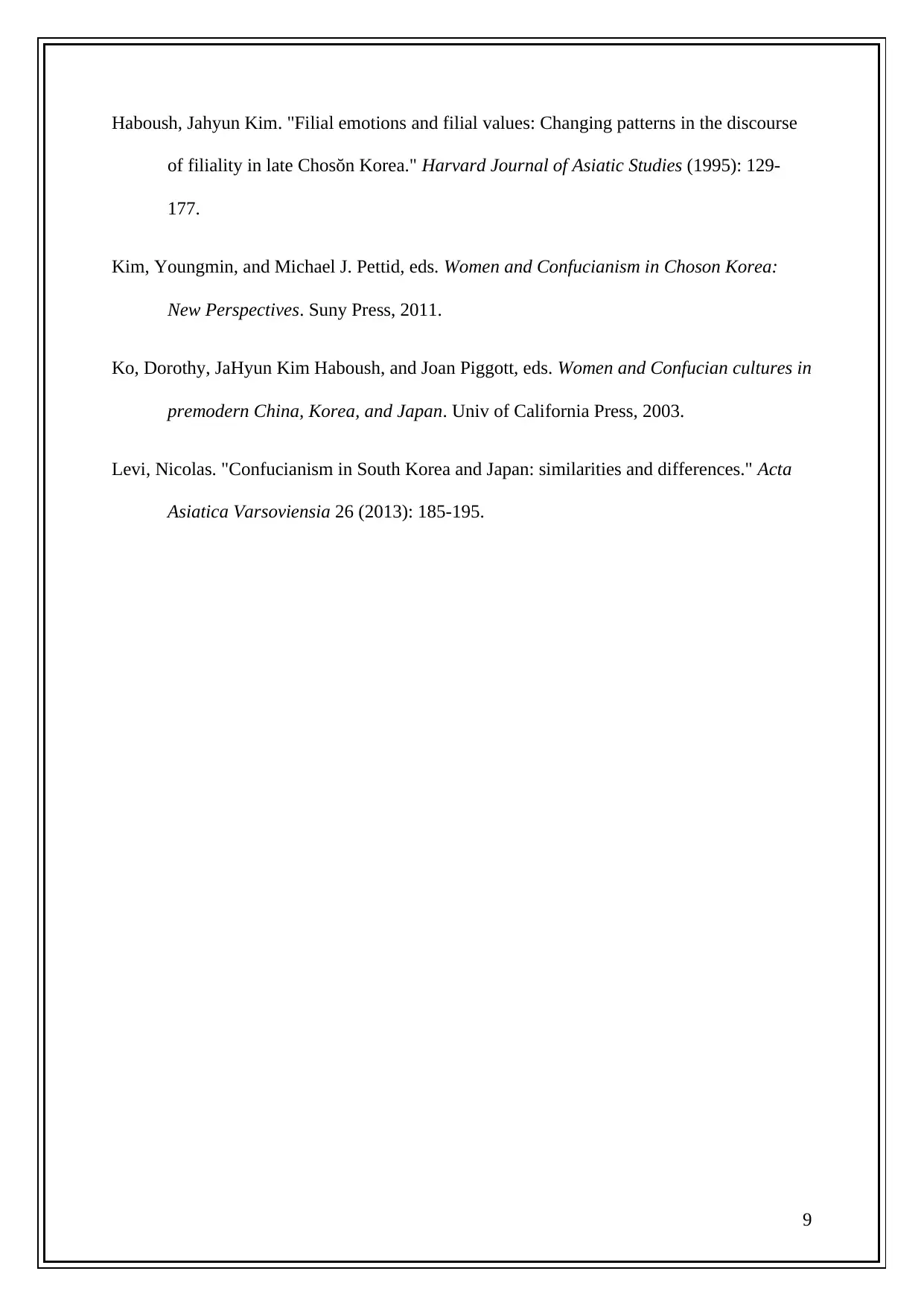
Haboush, Jahyun Kim. "Filial emotions and filial values: Changing patterns in the discourse
of filiality in late Chosŏn Korea." Harvard Journal of Asiatic Studies (1995): 129-
177.
Kim, Youngmin, and Michael J. Pettid, eds. Women and Confucianism in Choson Korea:
New Perspectives. Suny Press, 2011.
Ko, Dorothy, JaHyun Kim Haboush, and Joan Piggott, eds. Women and Confucian cultures in
premodern China, Korea, and Japan. Univ of California Press, 2003.
Levi, Nicolas. "Confucianism in South Korea and Japan: similarities and differences." Acta
Asiatica Varsoviensia 26 (2013): 185-195.
9
of filiality in late Chosŏn Korea." Harvard Journal of Asiatic Studies (1995): 129-
177.
Kim, Youngmin, and Michael J. Pettid, eds. Women and Confucianism in Choson Korea:
New Perspectives. Suny Press, 2011.
Ko, Dorothy, JaHyun Kim Haboush, and Joan Piggott, eds. Women and Confucian cultures in
premodern China, Korea, and Japan. Univ of California Press, 2003.
Levi, Nicolas. "Confucianism in South Korea and Japan: similarities and differences." Acta
Asiatica Varsoviensia 26 (2013): 185-195.
9
⊘ This is a preview!⊘
Do you want full access?
Subscribe today to unlock all pages.
Trusted by 1+ million students worldwide

1 out of 9


Your All-in-One AI-Powered Toolkit for Academic Success.
+13062052269
info@desklib.com
Available 24*7 on WhatsApp / Email
![[object Object]](/_next/static/media/star-bottom.7253800d.svg)
Unlock your academic potential
Copyright © 2020–2026 A2Z Services. All Rights Reserved. Developed and managed by ZUCOL.