Avondale University: Chronic Disease Management Essay - NURS30037
VerifiedAdded on 2022/07/28
|9
|2504
|21
Essay
AI Summary
This essay, written for the NURS30037 Chronic Disease Management course at Avondale University, delves into the controversial topic of whether smokers should be denied equal access to medical services. The author argues against such discrimination, citing the ethical and legal obligations of healthcare providers in Australia. The essay explores the multifaceted nature of chronic diseases, emphasizing that smoking is not the sole predisposing factor, and highlights the importance of addressing all risk factors. It references relevant literature and legal considerations, including the rights to health and the code of ethics for nurses, to support the stance that denying care to smokers is irrational and potentially harmful, ultimately advocating for equitable treatment and smoking cessation advice rather than discriminatory practices. The paper also touches on the ineffectiveness of prohibition policies, and the impact of smoking on both the individual and the wider community, including passive smokers and families.
Running head: CHRONIC DISEASE MANAGEMENT 1
Chronic Disease Management
Student’s Name
Institutional Affiliation
Chronic Disease Management
Student’s Name
Institutional Affiliation

Paraphrase This Document
Need a fresh take? Get an instant paraphrase of this document with our AI Paraphraser
CHRONIC DISEASE MANAGEMENT 2
Chronic Disease Management
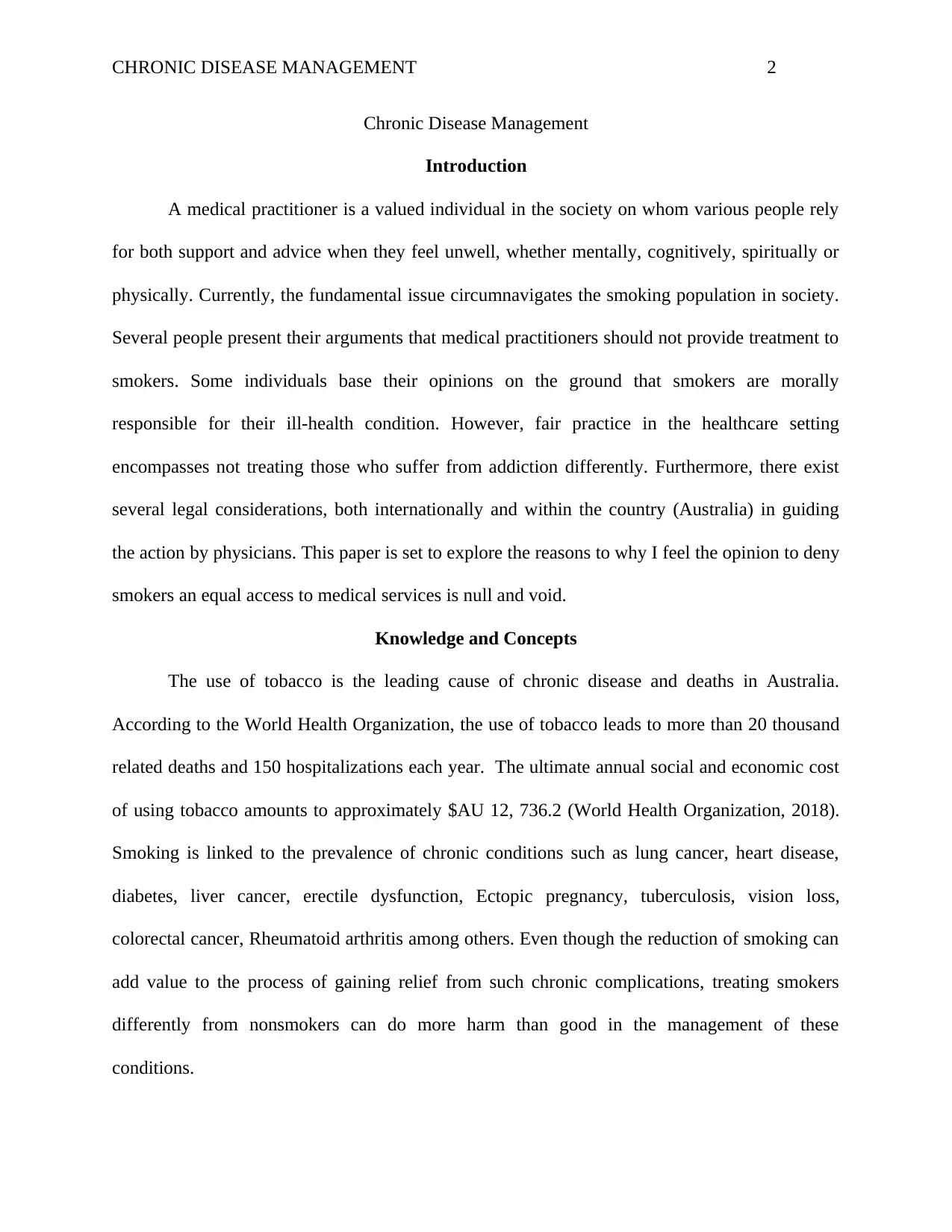
Introduction
A medical practitioner is a valued individual in the society on whom various people rely
for both support and advice when they feel unwell, whether mentally, cognitively, spiritually or
physically. Currently, the fundamental issue circumnavigates the smoking population in society.
Several people present their arguments that medical practitioners should not provide treatment to
smokers. Some individuals base their opinions on the ground that smokers are morally
responsible for their ill-health condition. However, fair practice in the healthcare setting
encompasses not treating those who suffer from addiction differently. Furthermore, there exist
several legal considerations, both internationally and within the country (Australia) in guiding
the action by physicians. This paper is set to explore the reasons to why I feel the opinion to deny
smokers an equal access to medical services is null and void.
Knowledge and Concepts
The use of tobacco is the leading cause of chronic disease and deaths in Australia.
According to the World Health Organization, the use of tobacco leads to more than 20 thousand
related deaths and 150 hospitalizations each year. The ultimate annual social and economic cost
of using tobacco amounts to approximately $AU 12, 736.2 (World Health Organization, 2018).
Smoking is linked to the prevalence of chronic conditions such as lung cancer, heart disease,
diabetes, liver cancer, erectile dysfunction, Ectopic pregnancy, tuberculosis, vision loss,
colorectal cancer, Rheumatoid arthritis among others. Even though the reduction of smoking can
add value to the process of gaining relief from such chronic complications, treating smokers
differently from nonsmokers can do more harm than good in the management of these
conditions.
Chronic Disease Management
Introduction
A medical practitioner is a valued individual in the society on whom various people rely
for both support and advice when they feel unwell, whether mentally, cognitively, spiritually or
physically. Currently, the fundamental issue circumnavigates the smoking population in society.
Several people present their arguments that medical practitioners should not provide treatment to
smokers. Some individuals base their opinions on the ground that smokers are morally
responsible for their ill-health condition. However, fair practice in the healthcare setting
encompasses not treating those who suffer from addiction differently. Furthermore, there exist
several legal considerations, both internationally and within the country (Australia) in guiding
the action by physicians. This paper is set to explore the reasons to why I feel the opinion to deny
smokers an equal access to medical services is null and void.
Knowledge and Concepts
The use of tobacco is the leading cause of chronic disease and deaths in Australia.
According to the World Health Organization, the use of tobacco leads to more than 20 thousand
related deaths and 150 hospitalizations each year. The ultimate annual social and economic cost
of using tobacco amounts to approximately $AU 12, 736.2 (World Health Organization, 2018).
Smoking is linked to the prevalence of chronic conditions such as lung cancer, heart disease,
diabetes, liver cancer, erectile dysfunction, Ectopic pregnancy, tuberculosis, vision loss,
colorectal cancer, Rheumatoid arthritis among others. Even though the reduction of smoking can
add value to the process of gaining relief from such chronic complications, treating smokers
differently from nonsmokers can do more harm than good in the management of these
conditions.
CHRONIC DISEASE MANAGEMENT 3
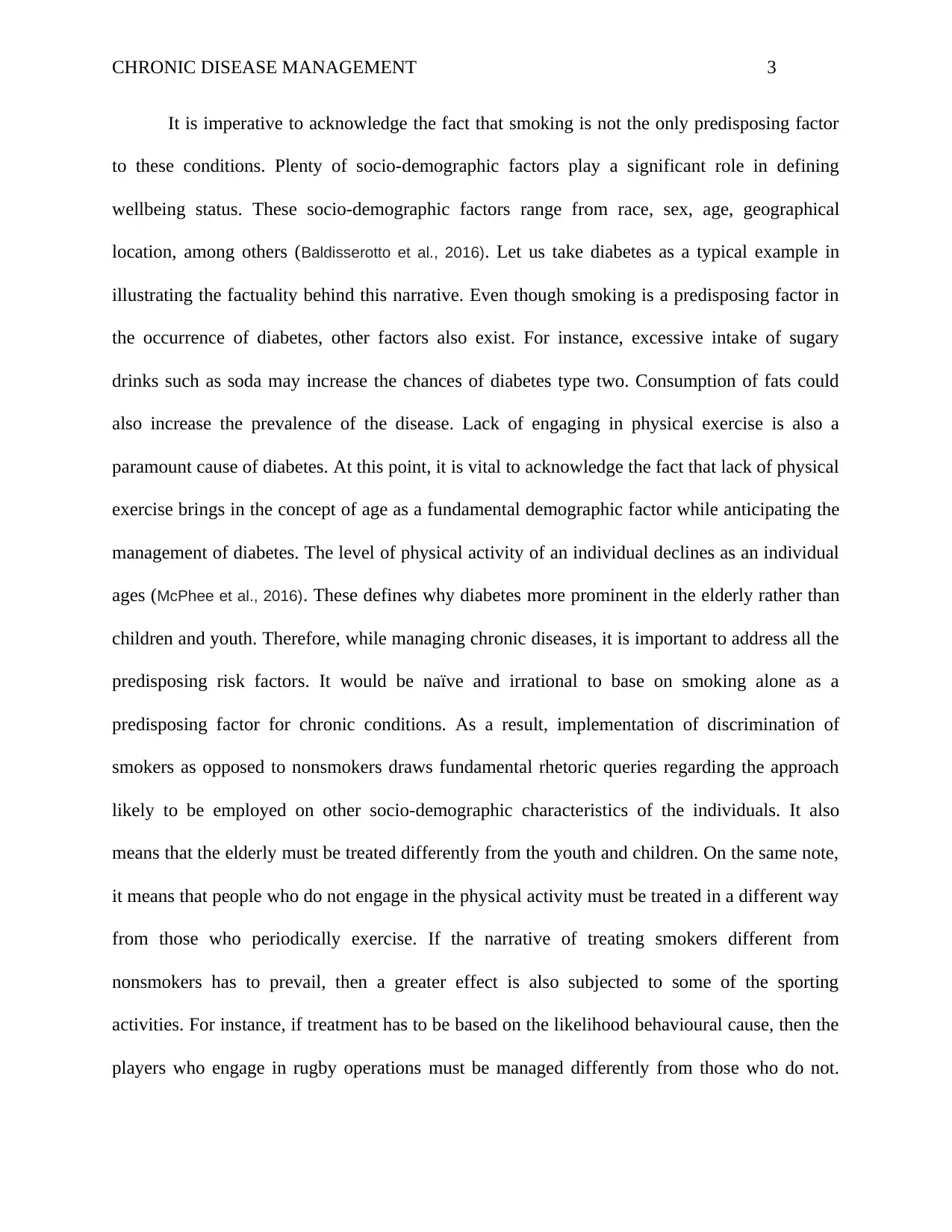
It is imperative to acknowledge the fact that smoking is not the only predisposing factor
to these conditions. Plenty of socio-demographic factors play a significant role in defining
wellbeing status. These socio-demographic factors range from race, sex, age, geographical
location, among others (Baldisserotto et al., 2016). Let us take diabetes as a typical example in
illustrating the factuality behind this narrative. Even though smoking is a predisposing factor in
the occurrence of diabetes, other factors also exist. For instance, excessive intake of sugary
drinks such as soda may increase the chances of diabetes type two. Consumption of fats could
also increase the prevalence of the disease. Lack of engaging in physical exercise is also a
paramount cause of diabetes. At this point, it is vital to acknowledge the fact that lack of physical
exercise brings in the concept of age as a fundamental demographic factor while anticipating the
management of diabetes. The level of physical activity of an individual declines as an individual
ages (McPhee et al., 2016). These defines why diabetes more prominent in the elderly rather than
children and youth. Therefore, while managing chronic diseases, it is important to address all the
predisposing risk factors. It would be naïve and irrational to base on smoking alone as a
predisposing factor for chronic conditions. As a result, implementation of discrimination of
smokers as opposed to nonsmokers draws fundamental rhetoric queries regarding the approach
likely to be employed on other socio-demographic characteristics of the individuals. It also
means that the elderly must be treated differently from the youth and children. On the same note,
it means that people who do not engage in the physical activity must be treated in a different way
from those who periodically exercise. If the narrative of treating smokers different from
nonsmokers has to prevail, then a greater effect is also subjected to some of the sporting
activities. For instance, if treatment has to be based on the likelihood behavioural cause, then the
players who engage in rugby operations must be managed differently from those who do not.
It is imperative to acknowledge the fact that smoking is not the only predisposing factor
to these conditions. Plenty of socio-demographic factors play a significant role in defining
wellbeing status. These socio-demographic factors range from race, sex, age, geographical
location, among others (Baldisserotto et al., 2016). Let us take diabetes as a typical example in
illustrating the factuality behind this narrative. Even though smoking is a predisposing factor in
the occurrence of diabetes, other factors also exist. For instance, excessive intake of sugary
drinks such as soda may increase the chances of diabetes type two. Consumption of fats could
also increase the prevalence of the disease. Lack of engaging in physical exercise is also a
paramount cause of diabetes. At this point, it is vital to acknowledge the fact that lack of physical
exercise brings in the concept of age as a fundamental demographic factor while anticipating the
management of diabetes. The level of physical activity of an individual declines as an individual
ages (McPhee et al., 2016). These defines why diabetes more prominent in the elderly rather than
children and youth. Therefore, while managing chronic diseases, it is important to address all the
predisposing risk factors. It would be naïve and irrational to base on smoking alone as a
predisposing factor for chronic conditions. As a result, implementation of discrimination of
smokers as opposed to nonsmokers draws fundamental rhetoric queries regarding the approach
likely to be employed on other socio-demographic characteristics of the individuals. It also
means that the elderly must be treated differently from the youth and children. On the same note,
it means that people who do not engage in the physical activity must be treated in a different way
from those who periodically exercise. If the narrative of treating smokers different from
nonsmokers has to prevail, then a greater effect is also subjected to some of the sporting
activities. For instance, if treatment has to be based on the likelihood behavioural cause, then the
players who engage in rugby operations must be managed differently from those who do not.
⊘ This is a preview!⊘
Do you want full access?
Subscribe today to unlock all pages.

Trusted by 1+ million students worldwide
CHRONIC DISEASE MANAGEMENT 4
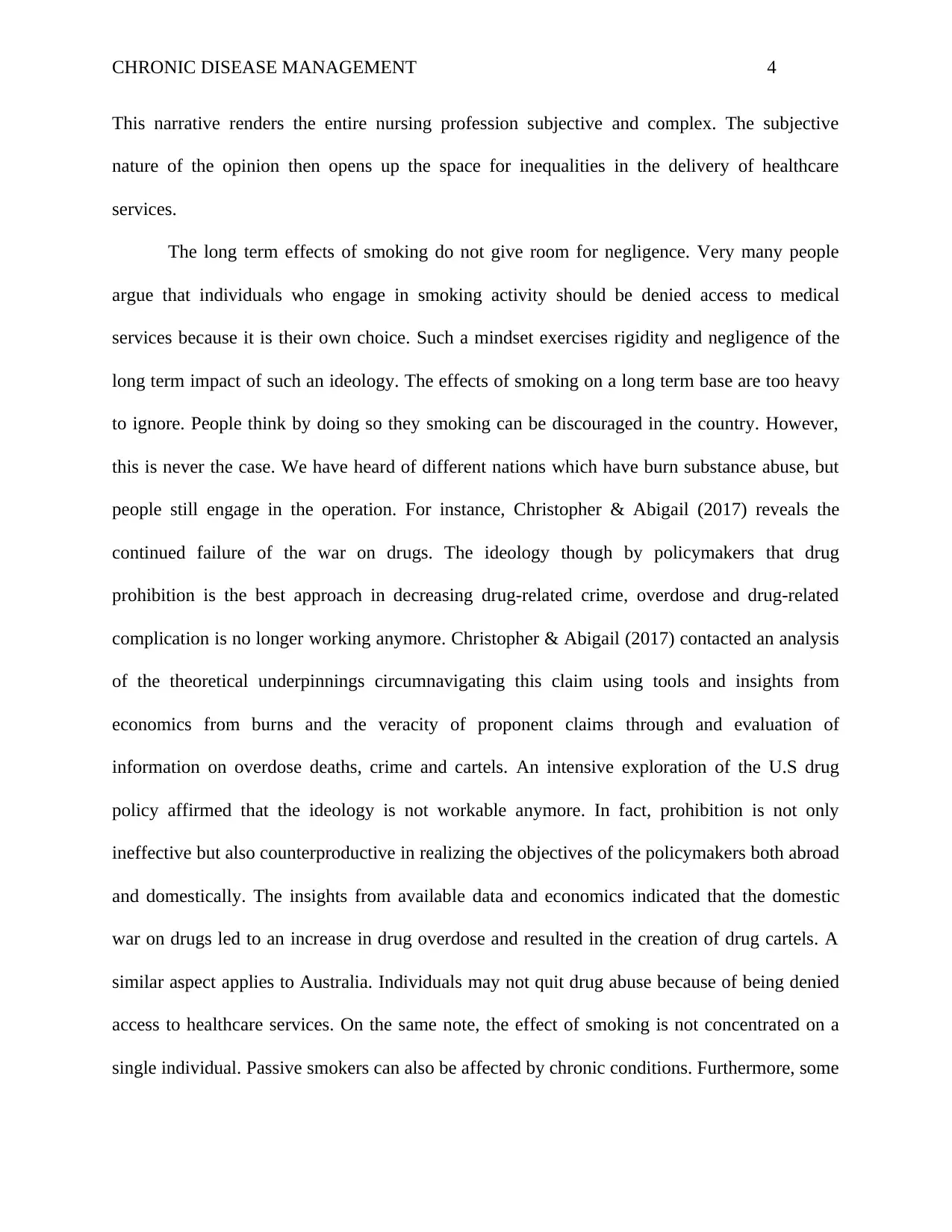
This narrative renders the entire nursing profession subjective and complex. The subjective
nature of the opinion then opens up the space for inequalities in the delivery of healthcare
services.
The long term effects of smoking do not give room for negligence. Very many people
argue that individuals who engage in smoking activity should be denied access to medical
services because it is their own choice. Such a mindset exercises rigidity and negligence of the
long term impact of such an ideology. The effects of smoking on a long term base are too heavy
to ignore. People think by doing so they smoking can be discouraged in the country. However,
this is never the case. We have heard of different nations which have burn substance abuse, but
people still engage in the operation. For instance, Christopher & Abigail (2017) reveals the
continued failure of the war on drugs. The ideology though by policymakers that drug
prohibition is the best approach in decreasing drug-related crime, overdose and drug-related
complication is no longer working anymore. Christopher & Abigail (2017) contacted an analysis
of the theoretical underpinnings circumnavigating this claim using tools and insights from
economics from burns and the veracity of proponent claims through and evaluation of
information on overdose deaths, crime and cartels. An intensive exploration of the U.S drug
policy affirmed that the ideology is not workable anymore. In fact, prohibition is not only
ineffective but also counterproductive in realizing the objectives of the policymakers both abroad
and domestically. The insights from available data and economics indicated that the domestic
war on drugs led to an increase in drug overdose and resulted in the creation of drug cartels. A
similar aspect applies to Australia. Individuals may not quit drug abuse because of being denied
access to healthcare services. On the same note, the effect of smoking is not concentrated on a
single individual. Passive smokers can also be affected by chronic conditions. Furthermore, some
This narrative renders the entire nursing profession subjective and complex. The subjective
nature of the opinion then opens up the space for inequalities in the delivery of healthcare
services.
The long term effects of smoking do not give room for negligence. Very many people
argue that individuals who engage in smoking activity should be denied access to medical
services because it is their own choice. Such a mindset exercises rigidity and negligence of the
long term impact of such an ideology. The effects of smoking on a long term base are too heavy
to ignore. People think by doing so they smoking can be discouraged in the country. However,
this is never the case. We have heard of different nations which have burn substance abuse, but
people still engage in the operation. For instance, Christopher & Abigail (2017) reveals the
continued failure of the war on drugs. The ideology though by policymakers that drug
prohibition is the best approach in decreasing drug-related crime, overdose and drug-related
complication is no longer working anymore. Christopher & Abigail (2017) contacted an analysis
of the theoretical underpinnings circumnavigating this claim using tools and insights from
economics from burns and the veracity of proponent claims through and evaluation of
information on overdose deaths, crime and cartels. An intensive exploration of the U.S drug
policy affirmed that the ideology is not workable anymore. In fact, prohibition is not only
ineffective but also counterproductive in realizing the objectives of the policymakers both abroad
and domestically. The insights from available data and economics indicated that the domestic
war on drugs led to an increase in drug overdose and resulted in the creation of drug cartels. A
similar aspect applies to Australia. Individuals may not quit drug abuse because of being denied
access to healthcare services. On the same note, the effect of smoking is not concentrated on a
single individual. Passive smokers can also be affected by chronic conditions. Furthermore, some
Paraphrase This Document
Need a fresh take? Get an instant paraphrase of this document with our AI Paraphraser
CHRONIC DISEASE MANAGEMENT 5
of the smokers have responsibilities and maybe the determiners of health and wellbeing among
their members of the family. Discriminating such individuals may impact their motive in taking
care of the wellbeing of their family members. Usually, prevention is better than cure (Moodie,
Tolhurst, & Martin, 2016). It is vital to handle issues at their initial stages of development rather
than in adverse conditions. Chronic conditions can also be managed at early stages rather than
waiting until they are in critical situations (Zwar et al., 2017). On this sense, it is paramount to
treat the few smokers and advise them to quit smoking rather than neglecting them. Negligence
can make the population of individuals with chronic conditions bigger and unmanageable at the
country level.
Legal Consideration
A piece of literature published in the Medical Journal of Australia suggests that smokers
should refrain from a range of surgical procedures. For instance, smoking has a profound
positive impact on complications resulting from breast reduction (Bikhchandani, Varma, &
Henderson, 2007). The editorial suggests that stoppage of smoking a days before the operation
should be adopted as a significant eligibility criterion for breast reduction. Even though the
argument brought forward is scientifically appealing, the ultimate end of the argument is fully
illegal. The study was brought forth to justify the notion that smokers should receive lesser
benefits from treatment. It is clear that the rates of wound infection may be higher in smokers
compared to their counterpart nonsmokers, thus leading to delays in hospital discharge.
However, this is not a justification to disadvantage smokers on the acquiring treatment.
Furthermore, the suggested initiative is illegal and unethical not only in Australia but
internationally. According to the Royal Australasian College of Surgeons, good practice in the
of the smokers have responsibilities and maybe the determiners of health and wellbeing among
their members of the family. Discriminating such individuals may impact their motive in taking
care of the wellbeing of their family members. Usually, prevention is better than cure (Moodie,
Tolhurst, & Martin, 2016). It is vital to handle issues at their initial stages of development rather
than in adverse conditions. Chronic conditions can also be managed at early stages rather than
waiting until they are in critical situations (Zwar et al., 2017). On this sense, it is paramount to
treat the few smokers and advise them to quit smoking rather than neglecting them. Negligence
can make the population of individuals with chronic conditions bigger and unmanageable at the
country level.
Legal Consideration
A piece of literature published in the Medical Journal of Australia suggests that smokers
should refrain from a range of surgical procedures. For instance, smoking has a profound
positive impact on complications resulting from breast reduction (Bikhchandani, Varma, &
Henderson, 2007). The editorial suggests that stoppage of smoking a days before the operation
should be adopted as a significant eligibility criterion for breast reduction. Even though the
argument brought forward is scientifically appealing, the ultimate end of the argument is fully
illegal. The study was brought forth to justify the notion that smokers should receive lesser
benefits from treatment. It is clear that the rates of wound infection may be higher in smokers
compared to their counterpart nonsmokers, thus leading to delays in hospital discharge.
However, this is not a justification to disadvantage smokers on the acquiring treatment.
Furthermore, the suggested initiative is illegal and unethical not only in Australia but
internationally. According to the Royal Australasian College of Surgeons, good practice in the
CHRONIC DISEASE MANAGEMENT 6
nursing profession entails deviation from patients prejudice on the ground that their behavior
might have resulted into the underlying condition (Senderovich, 2016). This includes realizing
that many medication approaches provide patients with a potential psychological benefit. The
patients may feel satisfied with the medication and obtain relief. Hence, even though physicians
have a moral responsibility to advise their patients to quit smoking, it is their legal obligation to
provide treatment to the patients irrespective of whether or not they change their behavior.
Standard 21 of the national practice for nurses in general practice calls upon effective
communication, information sharing and promotion of collaboration with the general practice
team. This aspect of effective communication may be challenged with the implementation of
discrimination of smokers. The chances that the relationship between a smoker patient and a
medical practitioner will be deteriorated through the execution of this opinion is high. Standard
22 for nurses in general practice also stipulates that nurses have the obligation to effectively liase
with relevant agencies and health professionals to facilitate access to services and continuity of
care. Subsection 12 of this provision (standard 22) stipulates for the development of strategies to
promote equitable access to services (Australian Nursing and Midwifery Federation, 2014). One
would wonder if this provision shall still operate if smokers are entitled to different treatment
compared to their counterpart nonsmokers. The code of ethics for nurses in Australia stipulates
that nurses should empress kindness to themselves and others. Even though kindness is not
provided measurability parameters, it is clear that kindness cannot be displayed with a sense of
discrimination. If nurses are allowed to treat smokers differently, then there exists a great
likelihood that they won’t be kind to them hence impacting the welfare of these patients. The
same code of ethics calls upon nurses to value the diversity of people (WAUBRA
FOUNDATION, 2019). Diversity incorporates culture, traditions, individual behaviour, age, race
nursing profession entails deviation from patients prejudice on the ground that their behavior
might have resulted into the underlying condition (Senderovich, 2016). This includes realizing
that many medication approaches provide patients with a potential psychological benefit. The
patients may feel satisfied with the medication and obtain relief. Hence, even though physicians
have a moral responsibility to advise their patients to quit smoking, it is their legal obligation to
provide treatment to the patients irrespective of whether or not they change their behavior.
Standard 21 of the national practice for nurses in general practice calls upon effective
communication, information sharing and promotion of collaboration with the general practice
team. This aspect of effective communication may be challenged with the implementation of
discrimination of smokers. The chances that the relationship between a smoker patient and a
medical practitioner will be deteriorated through the execution of this opinion is high. Standard
22 for nurses in general practice also stipulates that nurses have the obligation to effectively liase
with relevant agencies and health professionals to facilitate access to services and continuity of
care. Subsection 12 of this provision (standard 22) stipulates for the development of strategies to
promote equitable access to services (Australian Nursing and Midwifery Federation, 2014). One
would wonder if this provision shall still operate if smokers are entitled to different treatment
compared to their counterpart nonsmokers. The code of ethics for nurses in Australia stipulates
that nurses should empress kindness to themselves and others. Even though kindness is not
provided measurability parameters, it is clear that kindness cannot be displayed with a sense of
discrimination. If nurses are allowed to treat smokers differently, then there exists a great
likelihood that they won’t be kind to them hence impacting the welfare of these patients. The
same code of ethics calls upon nurses to value the diversity of people (WAUBRA
FOUNDATION, 2019). Diversity incorporates culture, traditions, individual behaviour, age, race
⊘ This is a preview!⊘
Do you want full access?
Subscribe today to unlock all pages.
Trusted by 1+ million students worldwide
CHRONIC DISEASE MANAGEMENT 7
and other related socio-demographic factors. This attribute cannot liase with the opinion of
discriminating smokers in the treatment program. The Right to Health as stipulated in Australia
originates from international laws. The United Nation Committee on Economic Social and
Cultural Rights has stated that health is an essential human right indispensable for the exercise of
other human rights. Every human being is entitled to enjoy health wellbeing of the highest
attainable standard (Australian Government Attorney-General’s Department, 2019). This
provision is the guiding principle of the right to health in the country. The execution of the right
to health has also been emphasized by the Health Equity Policy formulated by the Public Health
Association of Australia (Public Health Association of Australia, 2016). This illustrates the facts
behind the narrative that no one should be discriminated from health services on the ground of
racial aspects, smoking status, and other socio-demographic aspects in Australia.
Conclusion
In conclusion, even though smoking is the greatest contributor to the occurrence of
chronic conditions across the country, it is naïve to initiate a program that would promote
discrimination of smokers. The aspect of providing smokers with different medication on the
ground of individual behaviour is irrational and causes more harm than good. The initiative may
cause an increase in the number of chronic condition across the country in the long run. On the
same note, the opinion of discriminating smokers introduces an aspect of inequality based on
socio-demographic factors. It is fundamental to acknowledge the fact that healthcare inequality is
a fundamental problem in the country and the federal government is working extra hard to curb
the issue in order to comply with international laws health equality. Therefore, smokers should
be treated similarly to nonsmokers and advice to quit the program rather than promoting
inequality in the healthcare sector.
and other related socio-demographic factors. This attribute cannot liase with the opinion of
discriminating smokers in the treatment program. The Right to Health as stipulated in Australia
originates from international laws. The United Nation Committee on Economic Social and
Cultural Rights has stated that health is an essential human right indispensable for the exercise of
other human rights. Every human being is entitled to enjoy health wellbeing of the highest
attainable standard (Australian Government Attorney-General’s Department, 2019). This
provision is the guiding principle of the right to health in the country. The execution of the right
to health has also been emphasized by the Health Equity Policy formulated by the Public Health
Association of Australia (Public Health Association of Australia, 2016). This illustrates the facts
behind the narrative that no one should be discriminated from health services on the ground of
racial aspects, smoking status, and other socio-demographic aspects in Australia.
Conclusion
In conclusion, even though smoking is the greatest contributor to the occurrence of
chronic conditions across the country, it is naïve to initiate a program that would promote
discrimination of smokers. The aspect of providing smokers with different medication on the
ground of individual behaviour is irrational and causes more harm than good. The initiative may
cause an increase in the number of chronic condition across the country in the long run. On the
same note, the opinion of discriminating smokers introduces an aspect of inequality based on
socio-demographic factors. It is fundamental to acknowledge the fact that healthcare inequality is
a fundamental problem in the country and the federal government is working extra hard to curb
the issue in order to comply with international laws health equality. Therefore, smokers should
be treated similarly to nonsmokers and advice to quit the program rather than promoting
inequality in the healthcare sector.
Paraphrase This Document
Need a fresh take? Get an instant paraphrase of this document with our AI Paraphraser
CHRONIC DISEASE MANAGEMENT 8
References
Australian Government Attoney-General’s Department (2019). Rights to Health [online].
Retrieved from: https://www.ag.gov.au/RightsAndProtections/HumanRights/Human-
rights-scrutiny/PublicSectorGuidanceSheets/Pages/Righttohealth.aspx
Australian Nursing and Midwifery Federation (2014). National practice standards for nurses in
general practice [online]. Retrieved from:
https://www.anmf.org.au/documents/National_Practice_Standards_for_Nurses_in_Gener
al_Practice.pdf
Baldisserotto, J., Kopittke, L., Nedel, F. B., Takeda, S. P., Mendonça, C. S., Sirena, S. A., ... &
Nicolau, B. (2016). Socio-demographic caracteristics and prevalence of risk factors in a
hypertensive and diabetics population: a cross-sectional study in primary health care in
Brazil. BMC Public Health, 16(1), 573.
Bikhchandani, J., Varma, S. K., & Henderson, H. P. (2007). Is it justified to refuse breast
reduction to smokers?. Journal of plastic, reconstructive & aesthetic surgery, 60(9),
1050-1054.
Christopher, J., and Abigail, F., (2017). For decades and counting: The continued failure of the
war on drug [online]. Retrieved from:
https://www.cato.org/publications/policy-analysis/four-decades-counting-continued-
failure-war-drugs
McPhee, J. S., French, D. P., Jackson, D., Nazroo, J., Pendleton, N., & Degens, H. (2016).
Physical activity in older age: perspectives for healthy ageing and
frailty. Biogerontology, 17(3), 567-580.
References
Australian Government Attoney-General’s Department (2019). Rights to Health [online].
Retrieved from: https://www.ag.gov.au/RightsAndProtections/HumanRights/Human-
rights-scrutiny/PublicSectorGuidanceSheets/Pages/Righttohealth.aspx
Australian Nursing and Midwifery Federation (2014). National practice standards for nurses in
general practice [online]. Retrieved from:
https://www.anmf.org.au/documents/National_Practice_Standards_for_Nurses_in_Gener
al_Practice.pdf
Baldisserotto, J., Kopittke, L., Nedel, F. B., Takeda, S. P., Mendonça, C. S., Sirena, S. A., ... &
Nicolau, B. (2016). Socio-demographic caracteristics and prevalence of risk factors in a
hypertensive and diabetics population: a cross-sectional study in primary health care in
Brazil. BMC Public Health, 16(1), 573.
Bikhchandani, J., Varma, S. K., & Henderson, H. P. (2007). Is it justified to refuse breast
reduction to smokers?. Journal of plastic, reconstructive & aesthetic surgery, 60(9),
1050-1054.
Christopher, J., and Abigail, F., (2017). For decades and counting: The continued failure of the
war on drug [online]. Retrieved from:
https://www.cato.org/publications/policy-analysis/four-decades-counting-continued-
failure-war-drugs
McPhee, J. S., French, D. P., Jackson, D., Nazroo, J., Pendleton, N., & Degens, H. (2016).
Physical activity in older age: perspectives for healthy ageing and
frailty. Biogerontology, 17(3), 567-580.
CHRONIC DISEASE MANAGEMENT 9
Moodie, A. R., Tolhurst, P., & Martin, J. E. (2016). Australia's health: being accountable for
prevention. Medical Journal of Australia, 204(6), 223-225.
Public Health Association of Australia (2016). Policy at Glance-Health Equity Policy [online].
Retrieved from: https://www.phaa.net.au/documents/item/1705
Senderovich, H. (2016). How can we balance ethics and law when treating smokers?. Rambam
Maimonides medical journal, 7(2).
WAUBRA FOUNDATION (2019). Code of Ethics for Nurses in Australia [online] Retrieved
from: https://waubrafoundation.org.au/resources/code-ethics-for-nurses-australia/
World Health Organization (2018). Report on Smoke-Free Policies in Australia [online].
Retrieved from:
https://www.who.int/tobacco/training/success_stories/en/best_practices_australia_smokef
ree_policies.pdf
Zwar, N., Harris, M., Griffiths, R., Roland, M., Dennis, S., Powell Davies, G., & Hasan, I.
(2017). A systematic review of chronic disease management.
Moodie, A. R., Tolhurst, P., & Martin, J. E. (2016). Australia's health: being accountable for
prevention. Medical Journal of Australia, 204(6), 223-225.
Public Health Association of Australia (2016). Policy at Glance-Health Equity Policy [online].
Retrieved from: https://www.phaa.net.au/documents/item/1705
Senderovich, H. (2016). How can we balance ethics and law when treating smokers?. Rambam
Maimonides medical journal, 7(2).
WAUBRA FOUNDATION (2019). Code of Ethics for Nurses in Australia [online] Retrieved
from: https://waubrafoundation.org.au/resources/code-ethics-for-nurses-australia/
World Health Organization (2018). Report on Smoke-Free Policies in Australia [online].
Retrieved from:
https://www.who.int/tobacco/training/success_stories/en/best_practices_australia_smokef
ree_policies.pdf
Zwar, N., Harris, M., Griffiths, R., Roland, M., Dennis, S., Powell Davies, G., & Hasan, I.
(2017). A systematic review of chronic disease management.
⊘ This is a preview!⊘
Do you want full access?
Subscribe today to unlock all pages.
Trusted by 1+ million students worldwide

1 out of 9


Related Documents


Your All-in-One AI-Powered Toolkit for Academic Success.
+13062052269
info@desklib.com
Available 24*7 on WhatsApp / Email
![[object Object]](/_next/static/media/star-bottom.7253800d.svg)
Unlock your academic potential
Copyright © 2020–2026 A2Z Services. All Rights Reserved. Developed and managed by ZUCOL.