Chronic Kidney Disease: Pathophysiology, Causes, and Impact Analysis
VerifiedAdded on 2022/12/14
|10
|3033
|383
Essay
AI Summary
This essay comprehensively examines chronic kidney disease (CKD), a significant global health issue. It begins with a brief overview of the pathophysiology of CKD, highlighting the role of nephrons and the progression of kidney damage. The essay then delves into the leading causes of CKD, including high blood pressure and diabetes, and explains how these conditions damage the kidneys. A detailed discussion of the impact of CKD on individuals and their families follows, addressing the physical, emotional, and financial burdens associated with the disease. The essay also emphasizes the importance of health promotion strategies, such as screening and education, in preventing and managing CKD. Furthermore, it explores the concepts of cultural safety and patient empowerment, emphasizing the need for healthcare providers to respect patients' cultural practices and empower them to actively participate in their care. The essay concludes by underscoring the importance of these factors in improving patient outcomes and quality of life.
Running head: CHRONIC KIDNEY DISEASE 1
Chronic Kidney Disease
Name
Institutional Affiliation
Chronic Kidney Disease
Name
Institutional Affiliation

Paraphrase This Document
Need a fresh take? Get an instant paraphrase of this document with our AI Paraphraser
CHRONIC KIDNEY DISEASE 2
Chronic Kidney Disease
Chronic diseases are among the leading causes of disability as well as death all over the
world. The rate of ailments from chronic conditions is accelerating worldwide proceeding across
each region and permeating the socioeconomic classes (Crews et al., 2014; Morton et al., 2017).
According to the World Health Report of 2002, the morbidity, mortality, and disability rates
accredited to the leading chronic conditions which accounted for about 60% of the total number
of deaths as well as 43% of the global disease burden (Parrinello et al., 2017). The World Health
Organization indicates that, by 2020, the contribution of chronic diseases is expected to rise to
73% of the total number of deaths and 60% of the overall global disease burden. Additionally,
79% of the fatalities caused by chronic diseases transpire in developing countries (Parrinello et
al., 2017). This paper focuses on chronic kidney disease, providing brief pathophysiology,
looking into its leading causes, its impact on the patient and the caregivers, health promotion,
cultural safety, and empowerment.
Brief Pathophysiology
The healthy kidney has about 1 million nephrons, and each plays a vital part in the entire
glomerular filtration speed. In case of a renal injury, a human being has an inherent ability to
maintain the glomerular filtration rate, regardless of the ongoing destruction of nephrons. This is
because the remaining healthy nephrons patent compensatory and hyperfiltration hypertrophy.
The nephron malleability allows continuous average clearance of the plasma solutes. The levels
of substances like creatinine and urea begin to display a measurable increase after the total
glomerular filtration rate has increased to 50% (Hill et al., 2016). The value of plasma creatinine
doubles when glomerular filtration rate undergoes a 50% reduction.
Chronic Kidney Disease
Chronic diseases are among the leading causes of disability as well as death all over the
world. The rate of ailments from chronic conditions is accelerating worldwide proceeding across
each region and permeating the socioeconomic classes (Crews et al., 2014; Morton et al., 2017).
According to the World Health Report of 2002, the morbidity, mortality, and disability rates
accredited to the leading chronic conditions which accounted for about 60% of the total number
of deaths as well as 43% of the global disease burden (Parrinello et al., 2017). The World Health
Organization indicates that, by 2020, the contribution of chronic diseases is expected to rise to
73% of the total number of deaths and 60% of the overall global disease burden. Additionally,
79% of the fatalities caused by chronic diseases transpire in developing countries (Parrinello et
al., 2017). This paper focuses on chronic kidney disease, providing brief pathophysiology,
looking into its leading causes, its impact on the patient and the caregivers, health promotion,
cultural safety, and empowerment.
Brief Pathophysiology
The healthy kidney has about 1 million nephrons, and each plays a vital part in the entire
glomerular filtration speed. In case of a renal injury, a human being has an inherent ability to
maintain the glomerular filtration rate, regardless of the ongoing destruction of nephrons. This is
because the remaining healthy nephrons patent compensatory and hyperfiltration hypertrophy.
The nephron malleability allows continuous average clearance of the plasma solutes. The levels
of substances like creatinine and urea begin to display a measurable increase after the total
glomerular filtration rate has increased to 50% (Hill et al., 2016). The value of plasma creatinine
doubles when glomerular filtration rate undergoes a 50% reduction.
CHRONIC KIDNEY DISEASE 3
The hypertrophy and hyperfiltration of remaining nephrons have been conjectured as a
representation of a leading cause of liberal renal dysfunction. In case of an increase in the
pressure of the glomerular capillaries, the capillaries might get damaged, which leads to
secondary segmental and focal glomerulosclerosis and ultimately to global glomerulosclerosis.
There are other factors other than the underlying process of the disease as well as glomerular
hypertension which might cause progressive chronic kidney disease (Khan & Khan, 2015).
These factors include a decrease in perfusion, for instance, from severe dehydration or even
shock episodes, systemic hypertension, nephrotoxins such as nonsteroidal anti-inflammatory
drugs, smoking, hyperlipidemia uncontrolled diabetes and hyperphosphatemia with the
deposition of calcium phosphate
There is a massive association between acute kidney injury and accumulative risk for
advanced chronic kidney disease development in patients who have diabetes mellitus who have
experienced acute kidney injury. Severe kidney injury is a risk factor of chronic kidney disease
in stage 4, with each additional acute kidney injury episode doubling the risk (Hill et al., 2016).
Additionally, hemostasis and inflammation are predecessor pathways to acquiring chronic
kidney disease.
Causes of Chronic Kidney Disease
High blood pressure and diabetes are the leading causes of chronic kidney disease
(Ghaderian & Beladi-Mousavi, 2014). The healthcare provider looks at a patient’s health history
and does tests to find out why one has kidney disease. The cause of a patient’s kidney disease
has an effect on the type of treatment one receives.
If an individual has too much glucose in their blood, the kidney filters are damaged. With
time, the patient’s kidney can become damaged to the extent of failing to perform their function
The hypertrophy and hyperfiltration of remaining nephrons have been conjectured as a
representation of a leading cause of liberal renal dysfunction. In case of an increase in the
pressure of the glomerular capillaries, the capillaries might get damaged, which leads to
secondary segmental and focal glomerulosclerosis and ultimately to global glomerulosclerosis.
There are other factors other than the underlying process of the disease as well as glomerular
hypertension which might cause progressive chronic kidney disease (Khan & Khan, 2015).
These factors include a decrease in perfusion, for instance, from severe dehydration or even
shock episodes, systemic hypertension, nephrotoxins such as nonsteroidal anti-inflammatory
drugs, smoking, hyperlipidemia uncontrolled diabetes and hyperphosphatemia with the
deposition of calcium phosphate
There is a massive association between acute kidney injury and accumulative risk for
advanced chronic kidney disease development in patients who have diabetes mellitus who have
experienced acute kidney injury. Severe kidney injury is a risk factor of chronic kidney disease
in stage 4, with each additional acute kidney injury episode doubling the risk (Hill et al., 2016).
Additionally, hemostasis and inflammation are predecessor pathways to acquiring chronic
kidney disease.
Causes of Chronic Kidney Disease
High blood pressure and diabetes are the leading causes of chronic kidney disease
(Ghaderian & Beladi-Mousavi, 2014). The healthcare provider looks at a patient’s health history
and does tests to find out why one has kidney disease. The cause of a patient’s kidney disease
has an effect on the type of treatment one receives.
If an individual has too much glucose in their blood, the kidney filters are damaged. With
time, the patient’s kidney can become damaged to the extent of failing to perform their function
⊘ This is a preview!⊘
Do you want full access?
Subscribe today to unlock all pages.

Trusted by 1+ million students worldwide
CHRONIC KIDNEY DISEASE 4
of filtering extra fluid and waste from the blood. Usually, the first sign of chronic kidney disease
from a diabetes patient is protein in their urine. In case the filters are damaged a protein named
albumin needed to stay healthy, passes out of one’s blood into the urine (Ene-Iordache et al.,
2016). If a kidney is healthy, the albumin cannot move from one’s blood into their urine. The
medical term used for kidney disease known as diabetes is diabetic kidney disease.
High blood pressure, on the other hand can cause damage to blood vessels found in the
kidney preventing them from performing their functions effectively. If blood vessels in an
individual’s kidney are damaged, the kidneys might not effectively remove extra fluid and
wastes from the body (Ene-Iordache et al., 2016). The extra fluids which are in the blood vessels,
in turn, raises the blood pressure more, which eventually creates a dangerous cycle. Another
cause of kidney disease is a genetic disorder which leads to the growth of many cysts in a
patient’s kidney. This disorder is also known as polycystic kidney disease. Other causes include
infection, hefty metal poisoning, such as lead poisoning, cases of rare genetic disorders like
Alport syndrome, complications such as Goodpasture syndrome which the immune system of the
body attacks its organs and cells, drugs that are toxic to the kidney and a syndrome in children
referred to as a hemolytic uremic syndrome
Impact of Chronic Kidney Disease on an Individual and Family
The patient of kidney disease often experiences the feeling of an individual with flu
fulltime. The person often feels weak and tired. It makes it hard for one to walk or a long-
distance and also feels they need to sleep longer than usual. The individual also feels cold all
through, experiencing the feeling of having a fever. A patient also suffers from forgetfulness and
lacks concentration (Grey et al., 2015). This symptom is mostly caused by red blood cells
shortage known as anemia, which is treatable.
of filtering extra fluid and waste from the blood. Usually, the first sign of chronic kidney disease
from a diabetes patient is protein in their urine. In case the filters are damaged a protein named
albumin needed to stay healthy, passes out of one’s blood into the urine (Ene-Iordache et al.,
2016). If a kidney is healthy, the albumin cannot move from one’s blood into their urine. The
medical term used for kidney disease known as diabetes is diabetic kidney disease.
High blood pressure, on the other hand can cause damage to blood vessels found in the
kidney preventing them from performing their functions effectively. If blood vessels in an
individual’s kidney are damaged, the kidneys might not effectively remove extra fluid and
wastes from the body (Ene-Iordache et al., 2016). The extra fluids which are in the blood vessels,
in turn, raises the blood pressure more, which eventually creates a dangerous cycle. Another
cause of kidney disease is a genetic disorder which leads to the growth of many cysts in a
patient’s kidney. This disorder is also known as polycystic kidney disease. Other causes include
infection, hefty metal poisoning, such as lead poisoning, cases of rare genetic disorders like
Alport syndrome, complications such as Goodpasture syndrome which the immune system of the
body attacks its organs and cells, drugs that are toxic to the kidney and a syndrome in children
referred to as a hemolytic uremic syndrome
Impact of Chronic Kidney Disease on an Individual and Family
The patient of kidney disease often experiences the feeling of an individual with flu
fulltime. The person often feels weak and tired. It makes it hard for one to walk or a long-
distance and also feels they need to sleep longer than usual. The individual also feels cold all
through, experiencing the feeling of having a fever. A patient also suffers from forgetfulness and
lacks concentration (Grey et al., 2015). This symptom is mostly caused by red blood cells
shortage known as anemia, which is treatable.
Paraphrase This Document
Need a fresh take? Get an instant paraphrase of this document with our AI Paraphraser
CHRONIC KIDNEY DISEASE 5
Swelling is another impact that kidney disease has on a patient. The person has kidneys
that are not removing fluids from the body, which often causes the swelling of the face, feet,
hands, and ankles. Extra body fluids in a person’s lungs also make it hard for them to breathe
appropriately, which might be mistaken for pneumonia or asthma (Grey et al., 2015). A kidney
disease patient also experiences restlessness on their legs, phosphorous itching, and insomnia.
The families and caregivers of individuals suffering from chronic kidney failure have a
considerable role to play. First, the individual requires much mental support as well as love to
prevent them from suffering from stress which might worsen their health. Caregivers, therefore,
need to be present, ensuring that the patient feels loved, and can freely express their selves (Grey
et al., 2015).
The treatment of chronic kidney disease presents a substantial financial burden on the
individual and their entire family. A patient might be drained financially as they attempt to cater
to the hospital bills. In case the patient is unable to clear the funds, their families come in to help,
which might also be a burden to them. The drugs and dialysis require a significant amount of
money to cater for medical expenses (Grey et al., 2015).
Kidney disease is a lifetime disorder (Grey et al., 2015). These patients often feel that
they can no longer fight on such that some patients decide they do not want to be treated
anymore. They also face access and equity issues since they have limited choices on the barriers
to living donations and dialysis treatment.
Health Promotion
Health promotion is vital in the prevention and treatment of chronic kidney disease all
over the world. Every individual requires screening as long as they are high-risk subjects. For
Swelling is another impact that kidney disease has on a patient. The person has kidneys
that are not removing fluids from the body, which often causes the swelling of the face, feet,
hands, and ankles. Extra body fluids in a person’s lungs also make it hard for them to breathe
appropriately, which might be mistaken for pneumonia or asthma (Grey et al., 2015). A kidney
disease patient also experiences restlessness on their legs, phosphorous itching, and insomnia.
The families and caregivers of individuals suffering from chronic kidney failure have a
considerable role to play. First, the individual requires much mental support as well as love to
prevent them from suffering from stress which might worsen their health. Caregivers, therefore,
need to be present, ensuring that the patient feels loved, and can freely express their selves (Grey
et al., 2015).
The treatment of chronic kidney disease presents a substantial financial burden on the
individual and their entire family. A patient might be drained financially as they attempt to cater
to the hospital bills. In case the patient is unable to clear the funds, their families come in to help,
which might also be a burden to them. The drugs and dialysis require a significant amount of
money to cater for medical expenses (Grey et al., 2015).
Kidney disease is a lifetime disorder (Grey et al., 2015). These patients often feel that
they can no longer fight on such that some patients decide they do not want to be treated
anymore. They also face access and equity issues since they have limited choices on the barriers
to living donations and dialysis treatment.
Health Promotion
Health promotion is vital in the prevention and treatment of chronic kidney disease all
over the world. Every individual requires screening as long as they are high-risk subjects. For
CHRONIC KIDNEY DISEASE 6
instance, an individual whose family has become a chronic kidney disease patient needs to be
screened. Also, an individual who has diabetes has a higher chance of having kidney disease.
Health promotion can also be achieved by offering optimal treatment administration on
diseases. Health facilities should ascertain that they treat all kidney disease patients with the
necessary treatment to prevent further negative impacts. It will also help to retard the chronic
kidney disease from progressing. The government, the World Health Organization, and the
Chronic Disease Control need to enhance the health education of chronic kidney disease
prevention (Ricardo et al., 2015). Educating people on the causes of the disease and its impact on
an individual and their caregivers helps to equip them with knowledge on the dos and don’ts. A
chronic kidney disease patient who knows about the disorder manages to take precaution to
ensure that they reduce the chances of worsening their health.
Counseling services are also vital for the prevention and control of chronic kidney
disease. Counseling helps to provide guidance and knowledge to those at a high risk of being
affected as well as the already sick patients. In most cases, some patients end up getting tired of
the dialysis, which necessitates counseling to help them keep on taking treatment (Ricardo et al.,
2015).
Also, the case management of chronic disease patients should be presented in medical
institutes. The presentations of the statistics, as well as the cases, helps the students to assess
further solutions to the issue and prevalence of chronic kidney disease (Ricardo et al., 2015).
New research has been pointed out as a solution to the problem of chronic diseases worldwide.
Cultural Safety
Cultural safety entails individual as well as community empowerment aimed at managing
an individual’s wellbeing, health, and social issues. Health systems thus need to examine their
instance, an individual whose family has become a chronic kidney disease patient needs to be
screened. Also, an individual who has diabetes has a higher chance of having kidney disease.
Health promotion can also be achieved by offering optimal treatment administration on
diseases. Health facilities should ascertain that they treat all kidney disease patients with the
necessary treatment to prevent further negative impacts. It will also help to retard the chronic
kidney disease from progressing. The government, the World Health Organization, and the
Chronic Disease Control need to enhance the health education of chronic kidney disease
prevention (Ricardo et al., 2015). Educating people on the causes of the disease and its impact on
an individual and their caregivers helps to equip them with knowledge on the dos and don’ts. A
chronic kidney disease patient who knows about the disorder manages to take precaution to
ensure that they reduce the chances of worsening their health.
Counseling services are also vital for the prevention and control of chronic kidney
disease. Counseling helps to provide guidance and knowledge to those at a high risk of being
affected as well as the already sick patients. In most cases, some patients end up getting tired of
the dialysis, which necessitates counseling to help them keep on taking treatment (Ricardo et al.,
2015).
Also, the case management of chronic disease patients should be presented in medical
institutes. The presentations of the statistics, as well as the cases, helps the students to assess
further solutions to the issue and prevalence of chronic kidney disease (Ricardo et al., 2015).
New research has been pointed out as a solution to the problem of chronic diseases worldwide.
Cultural Safety
Cultural safety entails individual as well as community empowerment aimed at managing
an individual’s wellbeing, health, and social issues. Health systems thus need to examine their
⊘ This is a preview!⊘
Do you want full access?
Subscribe today to unlock all pages.
Trusted by 1+ million students worldwide
CHRONIC KIDNEY DISEASE 7
practices aimed at breaking down the barriers to the achievement of cultural responsiveness as
well as understanding. Cultural safety also involves the laid out strategies aimed at increasing
systemic reflection, system self-knowledge as well as evaluation (Holland, 2017). It openly
recognizes the healthcare providers’ responsibility in designing and delivering healthcare
programs and services that, with respect, engage people from diverse backgrounds.
Chronic kidney disease patients need care empowerment from the community and the
healthcare providers who are close to the patients. Usually, every patient has their cultural
practices which should be respected to help provide a conducive environment for every patient.
In case a patient feels that their culture is not recognized, they most likely develop stress and
depression, deteriorating their health. Every healthcare institution should instill the notion of
cultural safety, educating every healthcare provider as well as the patients’ caregivers (Holland,
2017). As a result, the patient feels loved, respected, and appreciated, enabling them to respond
positively to treatment.
Empowerment
Empowering the kidney disease patient is essential to help them accept and embrace the
process of treatment, whether kidney transplant or dialysis. If a patient is empowered, they
become expert patients as they are equipped with knowledge as well as an attitude to become
active in the efforts of self-management. Such patients can be recognized since they know their
bodies and their health condition well. These expert patients can also help the frightened new
patients who come into a healthcare facility. Empowering patients is essential since they only
spend approximately 8% of their time with healthcare professionals. The other 92% of their time,
they spend on their own, self-managing with the drinks, food, treatment, and medication
(Subramanian et al., 2017)
practices aimed at breaking down the barriers to the achievement of cultural responsiveness as
well as understanding. Cultural safety also involves the laid out strategies aimed at increasing
systemic reflection, system self-knowledge as well as evaluation (Holland, 2017). It openly
recognizes the healthcare providers’ responsibility in designing and delivering healthcare
programs and services that, with respect, engage people from diverse backgrounds.
Chronic kidney disease patients need care empowerment from the community and the
healthcare providers who are close to the patients. Usually, every patient has their cultural
practices which should be respected to help provide a conducive environment for every patient.
In case a patient feels that their culture is not recognized, they most likely develop stress and
depression, deteriorating their health. Every healthcare institution should instill the notion of
cultural safety, educating every healthcare provider as well as the patients’ caregivers (Holland,
2017). As a result, the patient feels loved, respected, and appreciated, enabling them to respond
positively to treatment.
Empowerment
Empowering the kidney disease patient is essential to help them accept and embrace the
process of treatment, whether kidney transplant or dialysis. If a patient is empowered, they
become expert patients as they are equipped with knowledge as well as an attitude to become
active in the efforts of self-management. Such patients can be recognized since they know their
bodies and their health condition well. These expert patients can also help the frightened new
patients who come into a healthcare facility. Empowering patients is essential since they only
spend approximately 8% of their time with healthcare professionals. The other 92% of their time,
they spend on their own, self-managing with the drinks, food, treatment, and medication
(Subramanian et al., 2017)
Paraphrase This Document
Need a fresh take? Get an instant paraphrase of this document with our AI Paraphraser
CHRONIC KIDNEY DISEASE 8
Research conducted by Subramanian et al. shows that with hemodialysis survivors and
peritoneal dialysis survivors, a sense of control was vital for successful kidney failure adaptation
(2017). It was also evident that patients who had joined empowerment groups had considerably
higher self-care, self-efficacy, and less depression. The ability of a patient to understand their
health condition and what is expected of them is crucial as it helps them in self-managing. Also,
there are empowered patients who are at their working age. Through empowerment, they manage
to remain productive in the organization, stay healthy, and thus maintain their job positions
(Mills et al., 2015). As a result, their self-esteem remains high which enables them to stay head-
high and interact freely with other employees. The income also helps motivate them to work, as
they can afford to cater to their treatment expenses. Kidney disease patients who are working
also get access to health insurance which helps them a great deal financially thus less stress.
Chronic kidney disease is among the leading causes of diminishing health, whose
likelihood increases with age. A kidney disease patient is likely to remain under treatment for
quite a long time, which calls for self-management. Consequently, it is the role of healthcare
practitioners to offer knowledge to patients and their caregivers regarding treatment. The
practitioners also ought to ascertain the cultural safety of these patients to ensure that they feel
that their values are respected. Empowering chronic kidney patients is also essential to ensure
they become experts in self-care and self-management.
Research conducted by Subramanian et al. shows that with hemodialysis survivors and
peritoneal dialysis survivors, a sense of control was vital for successful kidney failure adaptation
(2017). It was also evident that patients who had joined empowerment groups had considerably
higher self-care, self-efficacy, and less depression. The ability of a patient to understand their
health condition and what is expected of them is crucial as it helps them in self-managing. Also,
there are empowered patients who are at their working age. Through empowerment, they manage
to remain productive in the organization, stay healthy, and thus maintain their job positions
(Mills et al., 2015). As a result, their self-esteem remains high which enables them to stay head-
high and interact freely with other employees. The income also helps motivate them to work, as
they can afford to cater to their treatment expenses. Kidney disease patients who are working
also get access to health insurance which helps them a great deal financially thus less stress.
Chronic kidney disease is among the leading causes of diminishing health, whose
likelihood increases with age. A kidney disease patient is likely to remain under treatment for
quite a long time, which calls for self-management. Consequently, it is the role of healthcare
practitioners to offer knowledge to patients and their caregivers regarding treatment. The
practitioners also ought to ascertain the cultural safety of these patients to ensure that they feel
that their values are respected. Empowering chronic kidney patients is also essential to ensure
they become experts in self-care and self-management.
CHRONIC KIDNEY DISEASE 9
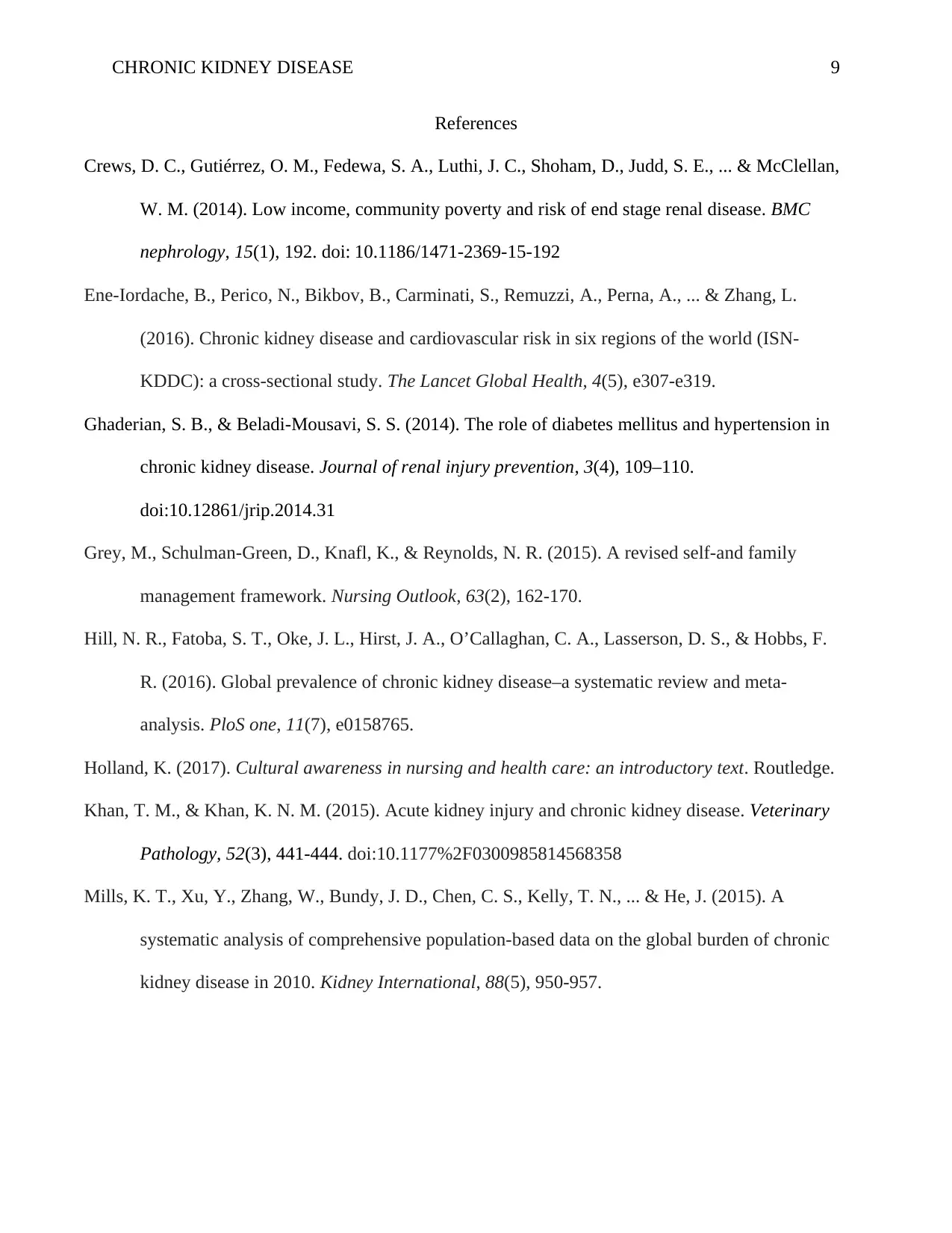
References
Crews, D. C., Gutiérrez, O. M., Fedewa, S. A., Luthi, J. C., Shoham, D., Judd, S. E., ... & McClellan,
W. M. (2014). Low income, community poverty and risk of end stage renal disease. BMC
nephrology, 15(1), 192. doi: 10.1186/1471-2369-15-192
Ene-Iordache, B., Perico, N., Bikbov, B., Carminati, S., Remuzzi, A., Perna, A., ... & Zhang, L.
(2016). Chronic kidney disease and cardiovascular risk in six regions of the world (ISN-
KDDC): a cross-sectional study. The Lancet Global Health, 4(5), e307-e319.
Ghaderian, S. B., & Beladi-Mousavi, S. S. (2014). The role of diabetes mellitus and hypertension in
chronic kidney disease. Journal of renal injury prevention, 3(4), 109–110.
doi:10.12861/jrip.2014.31
Grey, M., Schulman-Green, D., Knafl, K., & Reynolds, N. R. (2015). A revised self-and family
management framework. Nursing Outlook, 63(2), 162-170.
Hill, N. R., Fatoba, S. T., Oke, J. L., Hirst, J. A., O’Callaghan, C. A., Lasserson, D. S., & Hobbs, F.
R. (2016). Global prevalence of chronic kidney disease–a systematic review and meta-
analysis. PloS one, 11(7), e0158765.
Holland, K. (2017). Cultural awareness in nursing and health care: an introductory text. Routledge.
Khan, T. M., & Khan, K. N. M. (2015). Acute kidney injury and chronic kidney disease. Veterinary
Pathology, 52(3), 441-444. doi:10.1177%2F0300985814568358
Mills, K. T., Xu, Y., Zhang, W., Bundy, J. D., Chen, C. S., Kelly, T. N., ... & He, J. (2015). A
systematic analysis of comprehensive population-based data on the global burden of chronic
kidney disease in 2010. Kidney International, 88(5), 950-957.
References
Crews, D. C., Gutiérrez, O. M., Fedewa, S. A., Luthi, J. C., Shoham, D., Judd, S. E., ... & McClellan,
W. M. (2014). Low income, community poverty and risk of end stage renal disease. BMC
nephrology, 15(1), 192. doi: 10.1186/1471-2369-15-192
Ene-Iordache, B., Perico, N., Bikbov, B., Carminati, S., Remuzzi, A., Perna, A., ... & Zhang, L.
(2016). Chronic kidney disease and cardiovascular risk in six regions of the world (ISN-
KDDC): a cross-sectional study. The Lancet Global Health, 4(5), e307-e319.
Ghaderian, S. B., & Beladi-Mousavi, S. S. (2014). The role of diabetes mellitus and hypertension in
chronic kidney disease. Journal of renal injury prevention, 3(4), 109–110.
doi:10.12861/jrip.2014.31
Grey, M., Schulman-Green, D., Knafl, K., & Reynolds, N. R. (2015). A revised self-and family
management framework. Nursing Outlook, 63(2), 162-170.
Hill, N. R., Fatoba, S. T., Oke, J. L., Hirst, J. A., O’Callaghan, C. A., Lasserson, D. S., & Hobbs, F.
R. (2016). Global prevalence of chronic kidney disease–a systematic review and meta-
analysis. PloS one, 11(7), e0158765.
Holland, K. (2017). Cultural awareness in nursing and health care: an introductory text. Routledge.
Khan, T. M., & Khan, K. N. M. (2015). Acute kidney injury and chronic kidney disease. Veterinary
Pathology, 52(3), 441-444. doi:10.1177%2F0300985814568358
Mills, K. T., Xu, Y., Zhang, W., Bundy, J. D., Chen, C. S., Kelly, T. N., ... & He, J. (2015). A
systematic analysis of comprehensive population-based data on the global burden of chronic
kidney disease in 2010. Kidney International, 88(5), 950-957.
⊘ This is a preview!⊘
Do you want full access?
Subscribe today to unlock all pages.
Trusted by 1+ million students worldwide
CHRONIC KIDNEY DISEASE 10
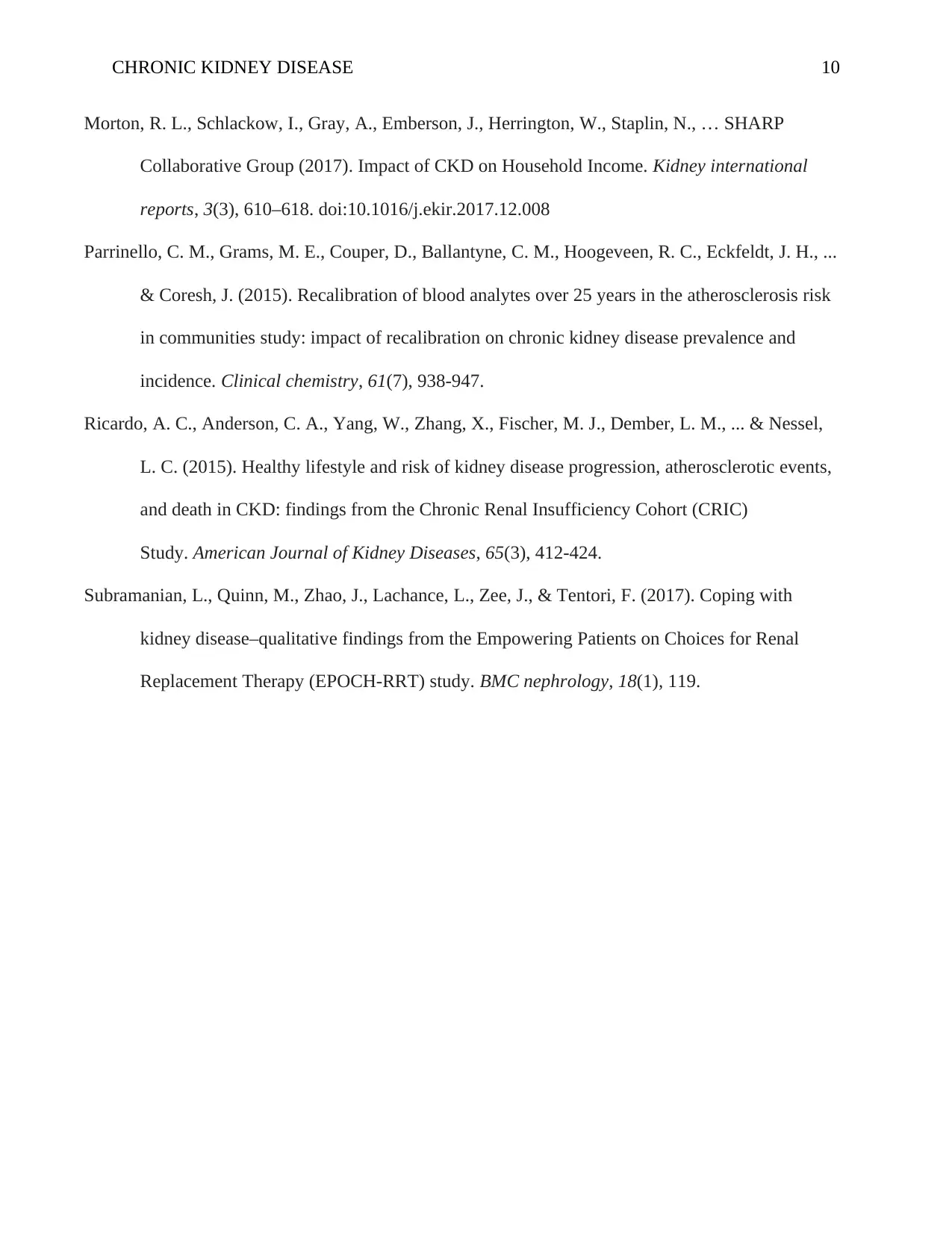
Morton, R. L., Schlackow, I., Gray, A., Emberson, J., Herrington, W., Staplin, N., … SHARP
Collaborative Group (2017). Impact of CKD on Household Income. Kidney international
reports, 3(3), 610–618. doi:10.1016/j.ekir.2017.12.008
Parrinello, C. M., Grams, M. E., Couper, D., Ballantyne, C. M., Hoogeveen, R. C., Eckfeldt, J. H., ...
& Coresh, J. (2015). Recalibration of blood analytes over 25 years in the atherosclerosis risk
in communities study: impact of recalibration on chronic kidney disease prevalence and
incidence. Clinical chemistry, 61(7), 938-947.
Ricardo, A. C., Anderson, C. A., Yang, W., Zhang, X., Fischer, M. J., Dember, L. M., ... & Nessel,
L. C. (2015). Healthy lifestyle and risk of kidney disease progression, atherosclerotic events,
and death in CKD: findings from the Chronic Renal Insufficiency Cohort (CRIC)
Study. American Journal of Kidney Diseases, 65(3), 412-424.
Subramanian, L., Quinn, M., Zhao, J., Lachance, L., Zee, J., & Tentori, F. (2017). Coping with
kidney disease–qualitative findings from the Empowering Patients on Choices for Renal
Replacement Therapy (EPOCH-RRT) study. BMC nephrology, 18(1), 119.
Morton, R. L., Schlackow, I., Gray, A., Emberson, J., Herrington, W., Staplin, N., … SHARP
Collaborative Group (2017). Impact of CKD on Household Income. Kidney international
reports, 3(3), 610–618. doi:10.1016/j.ekir.2017.12.008
Parrinello, C. M., Grams, M. E., Couper, D., Ballantyne, C. M., Hoogeveen, R. C., Eckfeldt, J. H., ...
& Coresh, J. (2015). Recalibration of blood analytes over 25 years in the atherosclerosis risk
in communities study: impact of recalibration on chronic kidney disease prevalence and
incidence. Clinical chemistry, 61(7), 938-947.
Ricardo, A. C., Anderson, C. A., Yang, W., Zhang, X., Fischer, M. J., Dember, L. M., ... & Nessel,
L. C. (2015). Healthy lifestyle and risk of kidney disease progression, atherosclerotic events,
and death in CKD: findings from the Chronic Renal Insufficiency Cohort (CRIC)
Study. American Journal of Kidney Diseases, 65(3), 412-424.
Subramanian, L., Quinn, M., Zhao, J., Lachance, L., Zee, J., & Tentori, F. (2017). Coping with
kidney disease–qualitative findings from the Empowering Patients on Choices for Renal
Replacement Therapy (EPOCH-RRT) study. BMC nephrology, 18(1), 119.

1 out of 10


Related Documents


Your All-in-One AI-Powered Toolkit for Academic Success.
+13062052269
info@desklib.com
Available 24*7 on WhatsApp / Email
![[object Object]](/_next/static/media/star-bottom.7253800d.svg)
Unlock your academic potential
Copyright © 2020–2026 A2Z Services. All Rights Reserved. Developed and managed by ZUCOL.