Comprehensive Report on Chronic Lymphocytic Leukemia (CLL)
VerifiedAdded on 2023/06/14
|15
|1379
|86
Report
AI Summary
This report provides a comprehensive overview of Chronic Lymphocytic Leukemia (CLL), covering its epidemiology, etiology, and pathophysiology. It details the diagnostic processes, including blood tests, flow cytometry, and genomic testing, and explores various treatment options such as chemotherapy, targeted therapy, and stem cell transplantation. The report also addresses common board-style questions related to CLL, offering insights into disease progression, treatment side effects, and goals. References to relevant research articles are included to support the information presented. Desklib offers this and many other solved assignments for students.
CHRONIC
LYMPHOCYTIC
LEUKEMIA
Name
Institution
LYMPHOCYTIC
LEUKEMIA
Name
Institution
Paraphrase This Document
Need a fresh take? Get an instant paraphrase of this document with our AI Paraphraser

1. Epidemiology
• American Cancer Society presents the following estimates for leukemia in the US for the year
2018:
• Nearly 60,300 new instances of leukemia and almost 24,370 deaths from all kinds of leukemia
• Approximately 20,940 incidences of CLL (chronic lymphocytic leukemia)
• Nearly 4,510 deaths of lymphocytic leukemia
• The CLL makes up to ¼ of the new leukemia incidences.
• The average lifetime risk of getting CLL by a person is almost 1 in 175 or 0.57 percent.
• The risk of CLL is somewhat pronounced amongst men than in women (Rawstron et al., 2015) .
• CLL mainly affects older people.
• The average age at the point of diagnosis is about seventy years.
• CLL is seldom observed in individuals below forty years and highly infrequent in kids.
• American Cancer Society presents the following estimates for leukemia in the US for the year
2018:
• Nearly 60,300 new instances of leukemia and almost 24,370 deaths from all kinds of leukemia
• Approximately 20,940 incidences of CLL (chronic lymphocytic leukemia)
• Nearly 4,510 deaths of lymphocytic leukemia
• The CLL makes up to ¼ of the new leukemia incidences.
• The average lifetime risk of getting CLL by a person is almost 1 in 175 or 0.57 percent.
• The risk of CLL is somewhat pronounced amongst men than in women (Rawstron et al., 2015) .
• CLL mainly affects older people.
• The average age at the point of diagnosis is about seventy years.
• CLL is seldom observed in individuals below forty years and highly infrequent in kids.

2. Etiology/Causes
• The real cause of incidences of CLL remains unknown.
• However, a great deal about the variations between normal lymphocytes and CLL cells have been learned.
• Healthy cells (human) grow and function primarily by information entailed in every chromosome of a cell.
• These are long DNA’s molecules.
• CCL results from a genetic mutation in DNA of blood-generating cells.
• Such mutations then cause blood cells to generate abnormal and ineffective lymphocytes.
• Apart from being inefficient, such abnormal lymphocytes endure to live and multiply, when the normal
ones would die (Abrisqueta et al., 2017).
• Abnormal lymphocytes collect in blood and some organs where they trigger complications.
• Healthy cells might then be crowded out of bone marrow and disrupt regular production of blood cells.
• The real cause of incidences of CLL remains unknown.
• However, a great deal about the variations between normal lymphocytes and CLL cells have been learned.
• Healthy cells (human) grow and function primarily by information entailed in every chromosome of a cell.
• These are long DNA’s molecules.
• CCL results from a genetic mutation in DNA of blood-generating cells.
• Such mutations then cause blood cells to generate abnormal and ineffective lymphocytes.
• Apart from being inefficient, such abnormal lymphocytes endure to live and multiply, when the normal
ones would die (Abrisqueta et al., 2017).
• Abnormal lymphocytes collect in blood and some organs where they trigger complications.
• Healthy cells might then be crowded out of bone marrow and disrupt regular production of blood cells.
⊘ This is a preview!⊘
Do you want full access?
Subscribe today to unlock all pages.

Trusted by 1+ million students worldwide

3. Pathophysiology
• CLL is amongst the chronic lymphoproliferative disorders or lymphoid
neoplasms. WHO classification indicate that B cell CLL is regarded to
be identical that is a single illness with various manifestations to
mature/peripheral B cells neoplasm small lymphocytic lymphoma (SLL).
It is indicated by the progressive functionally incompetent lymphocytes
accumulation that is often monoclonal in origin (Rawstron et al., 2018).
• The CLL molecular pathogenesis is a complicated, multistep process
culminating in a malignant clone of B-lymphocytes replication. Whereas
specific step in such a pathway has already been elucidated, a
significant number remains a mystery.
• CLL is amongst the chronic lymphoproliferative disorders or lymphoid
neoplasms. WHO classification indicate that B cell CLL is regarded to
be identical that is a single illness with various manifestations to
mature/peripheral B cells neoplasm small lymphocytic lymphoma (SLL).
It is indicated by the progressive functionally incompetent lymphocytes
accumulation that is often monoclonal in origin (Rawstron et al., 2018).
• The CLL molecular pathogenesis is a complicated, multistep process
culminating in a malignant clone of B-lymphocytes replication. Whereas
specific step in such a pathway has already been elucidated, a
significant number remains a mystery.
Paraphrase This Document
Need a fresh take? Get an instant paraphrase of this document with our AI Paraphraser

3. Pathophysiology Cont.
• It is a belief that almost all CLL incidences follow a premalignant B cell proliferative
illness known as MBL.
• It has CLL-phenotype in five-fifteen percent of the population above sixty and
progresses to SLL/CLL or associated malignancy at the rate of nearly one percent
per annum (Rawstron et al., 2015)).
• The CLL pathogenesis is conceptualized as follows:
• MBL establishment-whereas the inciting event remains a mystery, MBL seems to
develop due to various factors like a response to antigenic stimulation, gene
mutations, micro-environmental support, cytogenetic abnormalities and epigenetic
modifications (Gaidano, Foà & Dalla-Favera, 2012).
• The result is a B cells clone with the CLL phenotype.
• It is a belief that almost all CLL incidences follow a premalignant B cell proliferative
illness known as MBL.
• It has CLL-phenotype in five-fifteen percent of the population above sixty and
progresses to SLL/CLL or associated malignancy at the rate of nearly one percent
per annum (Rawstron et al., 2015)).
• The CLL pathogenesis is conceptualized as follows:
• MBL establishment-whereas the inciting event remains a mystery, MBL seems to
develop due to various factors like a response to antigenic stimulation, gene
mutations, micro-environmental support, cytogenetic abnormalities and epigenetic
modifications (Gaidano, Foà & Dalla-Favera, 2012).
• The result is a B cells clone with the CLL phenotype.

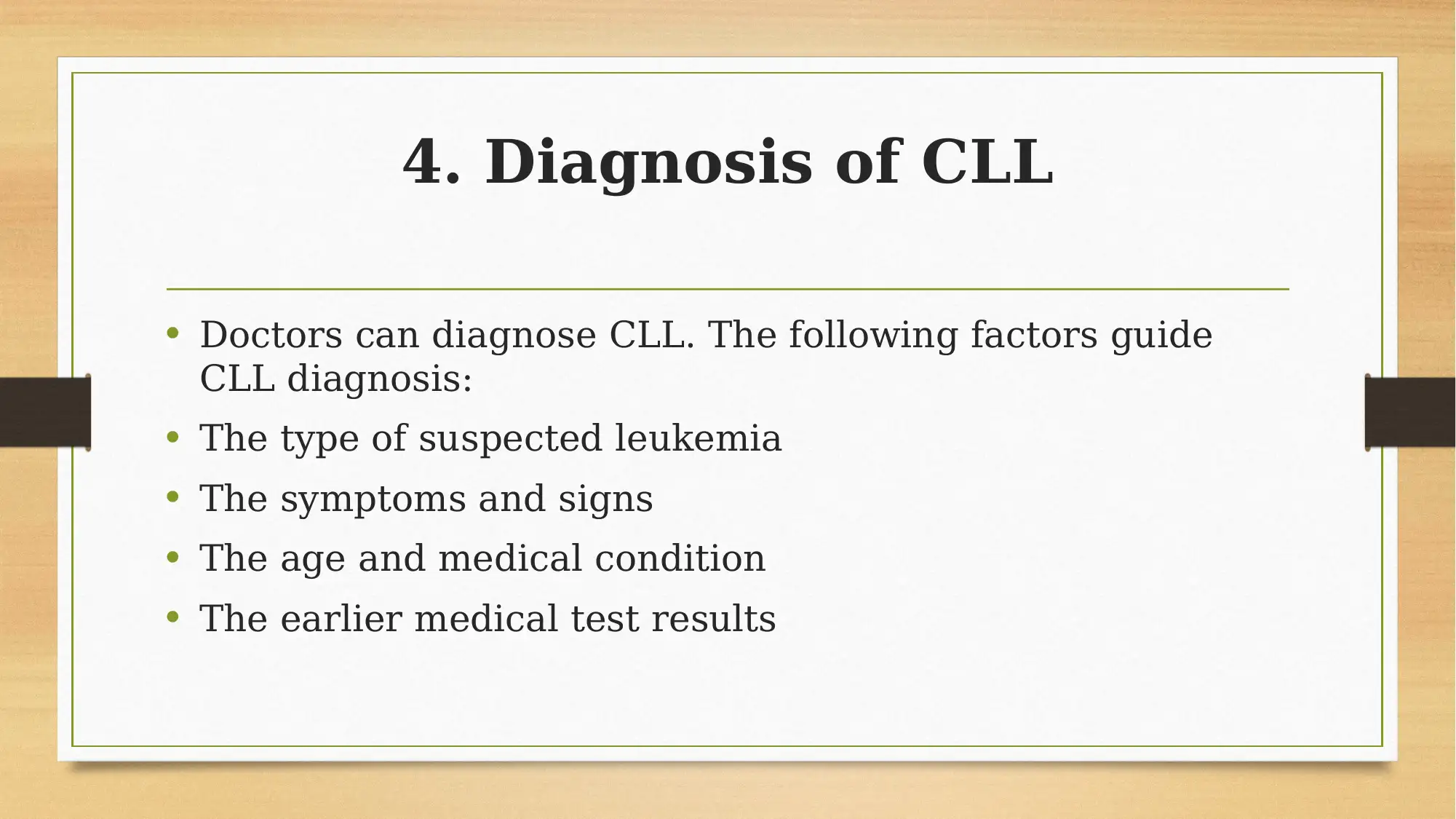
4. Diagnosis of CLL
• Doctors can diagnose CLL. The following factors guide
CLL diagnosis:
• The type of suspected leukemia
• The symptoms and signs
• The age and medical condition
• The earlier medical test results
• Doctors can diagnose CLL. The following factors guide
CLL diagnosis:
• The type of suspected leukemia
• The symptoms and signs
• The age and medical condition
• The earlier medical test results
⊘ This is a preview!⊘
Do you want full access?
Subscribe today to unlock all pages.

Trusted by 1+ million students worldwide

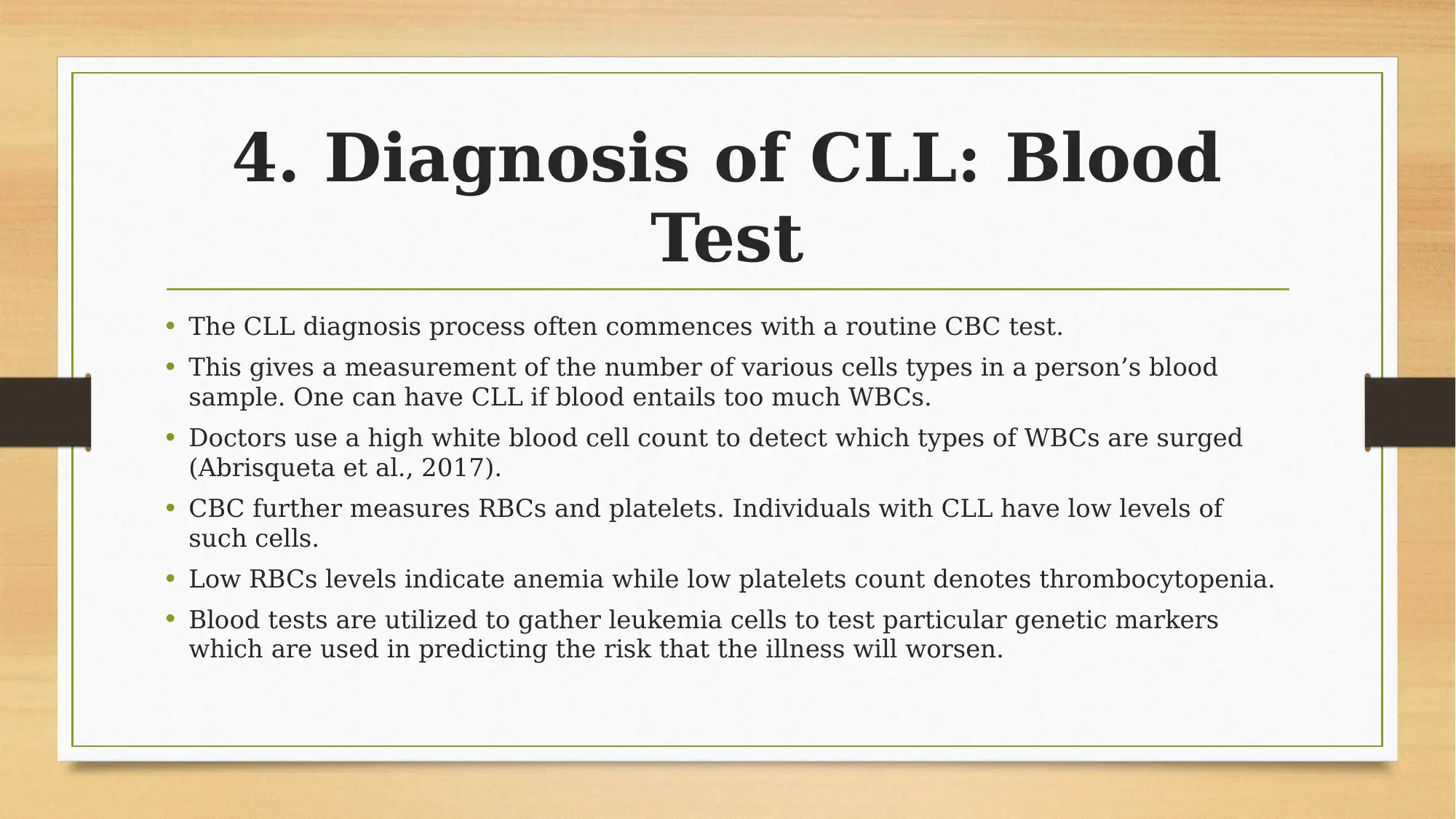
4. Diagnosis of CLL: Blood
Test
• The CLL diagnosis process often commences with a routine CBC test.
• This gives a measurement of the number of various cells types in a person’s blood
sample. One can have CLL if blood entails too much WBCs.
• Doctors use a high white blood cell count to detect which types of WBCs are surged
(Abrisqueta et al., 2017).
• CBC further measures RBCs and platelets. Individuals with CLL have low levels of
such cells.
• Low RBCs levels indicate anemia while low platelets count denotes thrombocytopenia.
• Blood tests are utilized to gather leukemia cells to test particular genetic markers
which are used in predicting the risk that the illness will worsen.
Test
• The CLL diagnosis process often commences with a routine CBC test.
• This gives a measurement of the number of various cells types in a person’s blood
sample. One can have CLL if blood entails too much WBCs.
• Doctors use a high white blood cell count to detect which types of WBCs are surged
(Abrisqueta et al., 2017).
• CBC further measures RBCs and platelets. Individuals with CLL have low levels of
such cells.
• Low RBCs levels indicate anemia while low platelets count denotes thrombocytopenia.
• Blood tests are utilized to gather leukemia cells to test particular genetic markers
which are used in predicting the risk that the illness will worsen.
Paraphrase This Document
Need a fresh take? Get an instant paraphrase of this document with our AI Paraphraser

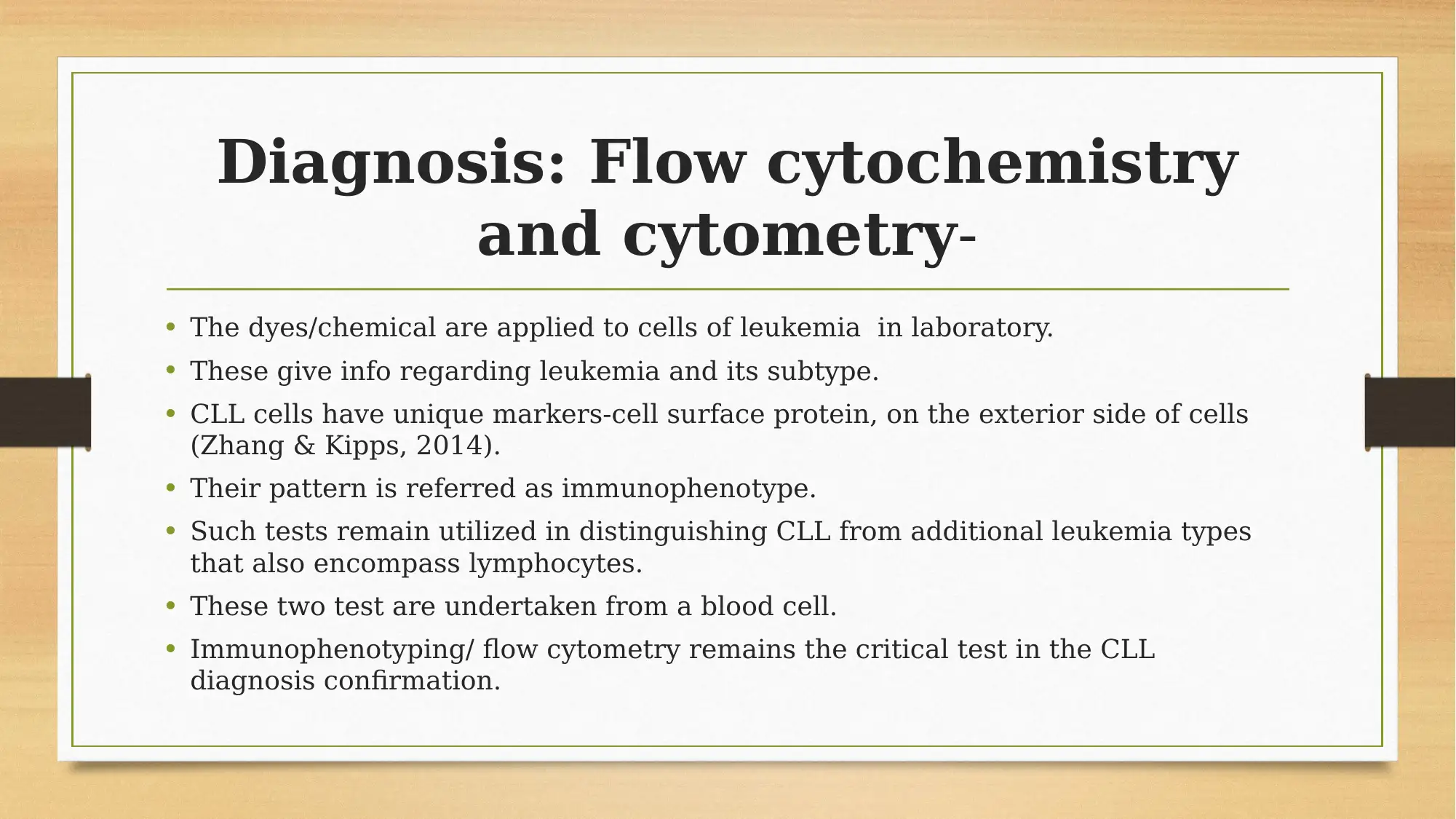
Diagnosis: Flow cytochemistry
and cytometry-
• The dyes/chemical are applied to cells of leukemia in laboratory.
• These give info regarding leukemia and its subtype.
• CLL cells have unique markers-cell surface protein, on the exterior side of cells
(Zhang & Kipps, 2014).
• Their pattern is referred as immunophenotype.
• Such tests remain utilized in distinguishing CLL from additional leukemia types
that also encompass lymphocytes.
• These two test are undertaken from a blood cell.
• Immunophenotyping/ flow cytometry remains the critical test in the CLL
diagnosis confirmation.
and cytometry-
• The dyes/chemical are applied to cells of leukemia in laboratory.
• These give info regarding leukemia and its subtype.
• CLL cells have unique markers-cell surface protein, on the exterior side of cells
(Zhang & Kipps, 2014).
• Their pattern is referred as immunophenotype.
• Such tests remain utilized in distinguishing CLL from additional leukemia types
that also encompass lymphocytes.
• These two test are undertaken from a blood cell.
• Immunophenotyping/ flow cytometry remains the critical test in the CLL
diagnosis confirmation.

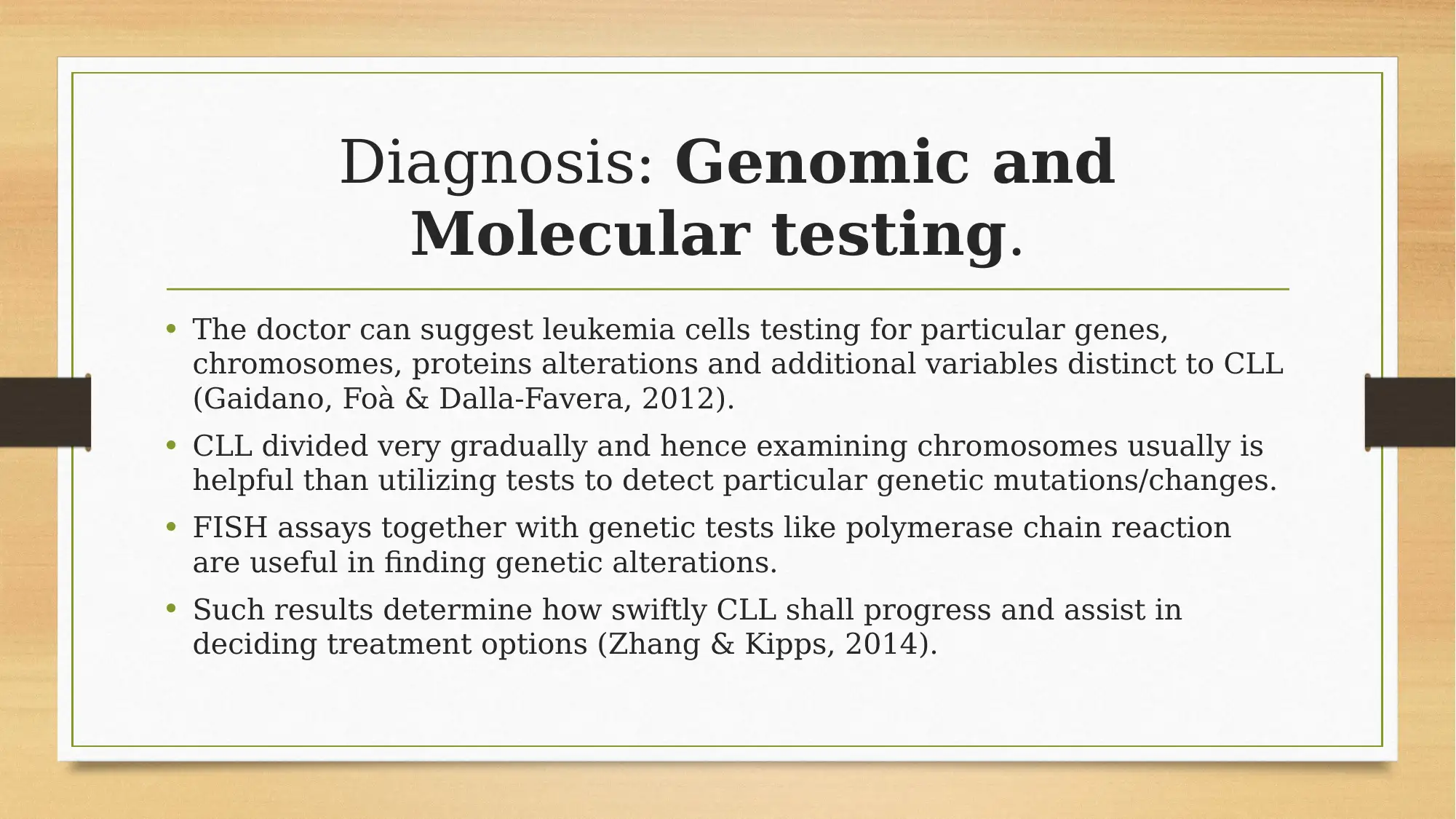
Diagnosis: Genomic and
Molecular testing.
• The doctor can suggest leukemia cells testing for particular genes,
chromosomes, proteins alterations and additional variables distinct to CLL
(Gaidano, Foà & Dalla-Favera, 2012).
• CLL divided very gradually and hence examining chromosomes usually is
helpful than utilizing tests to detect particular genetic mutations/changes.
• FISH assays together with genetic tests like polymerase chain reaction
are useful in finding genetic alterations.
• Such results determine how swiftly CLL shall progress and assist in
deciding treatment options (Zhang & Kipps, 2014).
Molecular testing.
• The doctor can suggest leukemia cells testing for particular genes,
chromosomes, proteins alterations and additional variables distinct to CLL
(Gaidano, Foà & Dalla-Favera, 2012).
• CLL divided very gradually and hence examining chromosomes usually is
helpful than utilizing tests to detect particular genetic mutations/changes.
• FISH assays together with genetic tests like polymerase chain reaction
are useful in finding genetic alterations.
• Such results determine how swiftly CLL shall progress and assist in
deciding treatment options (Zhang & Kipps, 2014).
⊘ This is a preview!⊘
Do you want full access?
Subscribe today to unlock all pages.

Trusted by 1+ million students worldwide

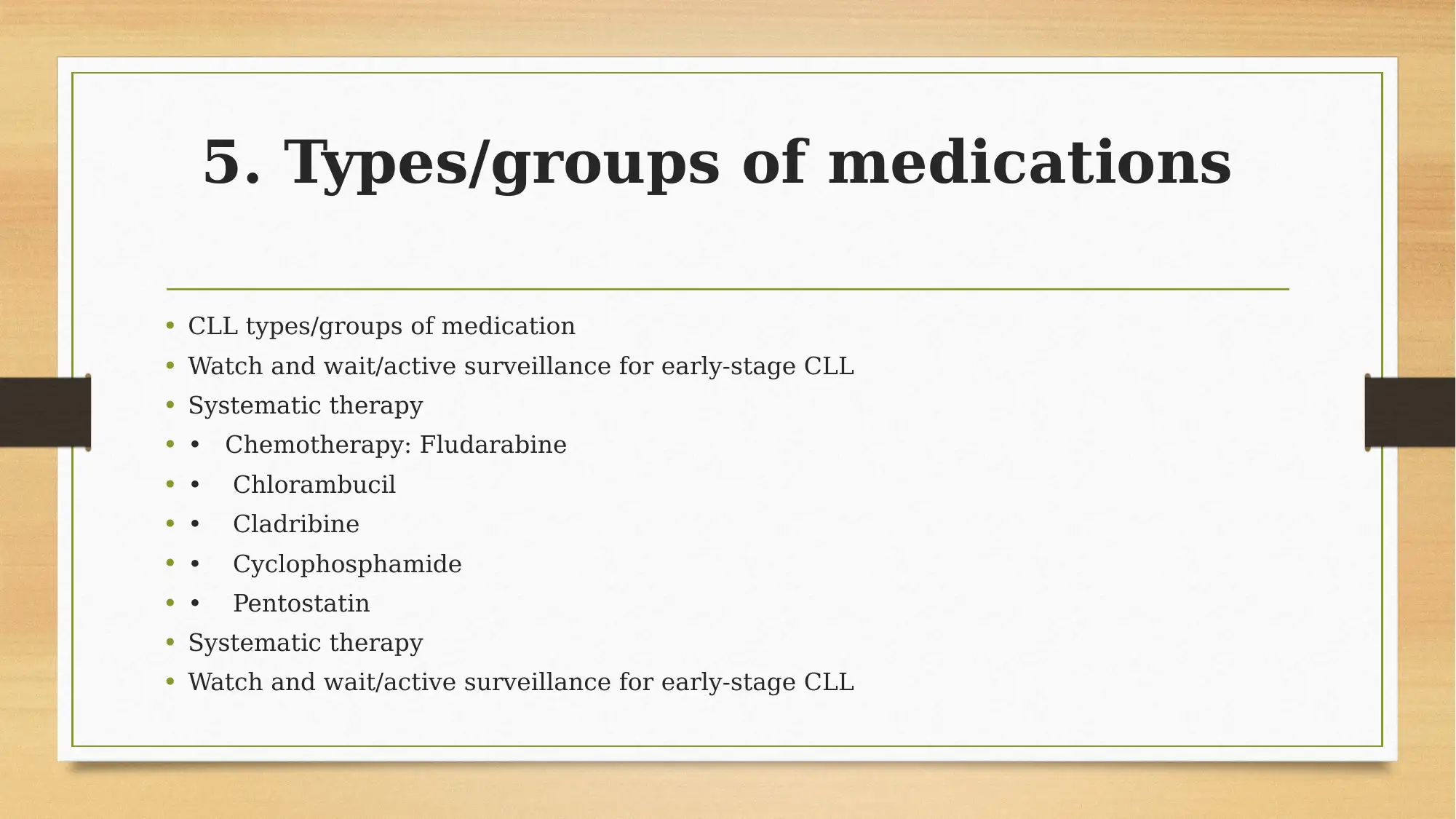
5. Types/groups of medications
• CLL types/groups of medication
• Watch and wait/active surveillance for early-stage CLL
• Systematic therapy
• • Chemotherapy: Fludarabine
• • Chlorambucil
• • Cladribine
• • Cyclophosphamide
• • Pentostatin
• Systematic therapy
• Watch and wait/active surveillance for early-stage CLL
• CLL types/groups of medication
• Watch and wait/active surveillance for early-stage CLL
• Systematic therapy
• • Chemotherapy: Fludarabine
• • Chlorambucil
• • Cladribine
• • Cyclophosphamide
• • Pentostatin
• Systematic therapy
• Watch and wait/active surveillance for early-stage CLL
Paraphrase This Document
Need a fresh take? Get an instant paraphrase of this document with our AI Paraphraser

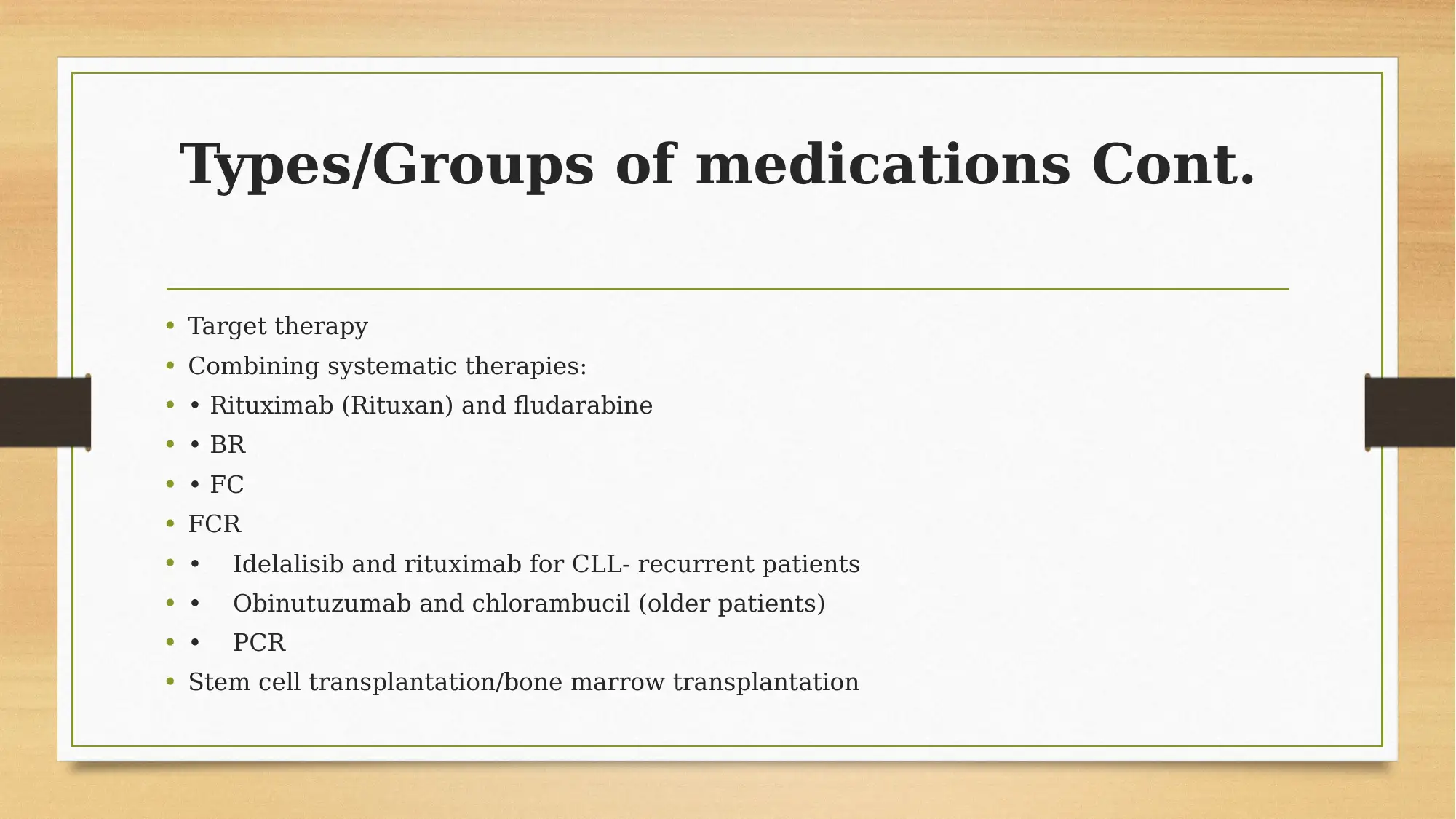
Types/Groups of medications Cont.
• Target therapy
• Combining systematic therapies:
• • Rituximab (Rituxan) and fludarabine
• • BR
• • FC
• FCR
• • Idelalisib and rituximab for CLL- recurrent patients
• • Obinutuzumab and chlorambucil (older patients)
• • PCR
• Stem cell transplantation/bone marrow transplantation
• Target therapy
• Combining systematic therapies:
• • Rituximab (Rituxan) and fludarabine
• • BR
• • FC
• FCR
• • Idelalisib and rituximab for CLL- recurrent patients
• • Obinutuzumab and chlorambucil (older patients)
• • PCR
• Stem cell transplantation/bone marrow transplantation

6. Board style questions.
• What Causes CLL?
• What Are the Symptoms of CLL?
• How Is CLL Diagnosed?
• How Does CLL Progress?
• What Causes CLL?
• What Are the Symptoms of CLL?
• How Is CLL Diagnosed?
• How Does CLL Progress?
⊘ This is a preview!⊘
Do you want full access?
Subscribe today to unlock all pages.

Trusted by 1+ million students worldwide
1 out of 15
Your All-in-One AI-Powered Toolkit for Academic Success.
+13062052269
info@desklib.com
Available 24*7 on WhatsApp / Email
Unlock your academic potential
Copyright © 2020–2025 A2Z Services. All Rights Reserved. Developed and managed by ZUCOL.