Business Structure Analysis and Recommendations for CIA: LLC Formation

Verified

Added on  2019/09/22

|3
|842
|196
Report
AI Summary
This report analyzes the business structure of the Career Institute of America (CIA), a training institute specializing in the auto industry, currently operating as a non-profit corporation. The report assesses the suitability of the current structure and recommends transitioning to a Limited Liability Company (LLC) to provide greater flexibility and address operational challenges, including high fees and paperwork. The analysis considers the implications of the Delaware Limited Liability Company Act and the loss of tax exemptions under 501(c)(3). The report also addresses the classification of workers, focusing on the IRS 20 Factor test and the Fair Labor Standards Act (FLSA) to determine if trainers can be classified as independent contractors, offering guidelines to ensure compliance. The report provides a detailed examination of relevant laws, including the General Corporation Law and the Workplace Fraud Act, and suggests specific terms for employment agreements to establish an independent contractor relationship, emphasizing the trainers' control over their work hours, equipment, and work style. The report concludes by highlighting the benefits of LLC formation in terms of taxation, contractual flexibility, and management structure.
Document Page
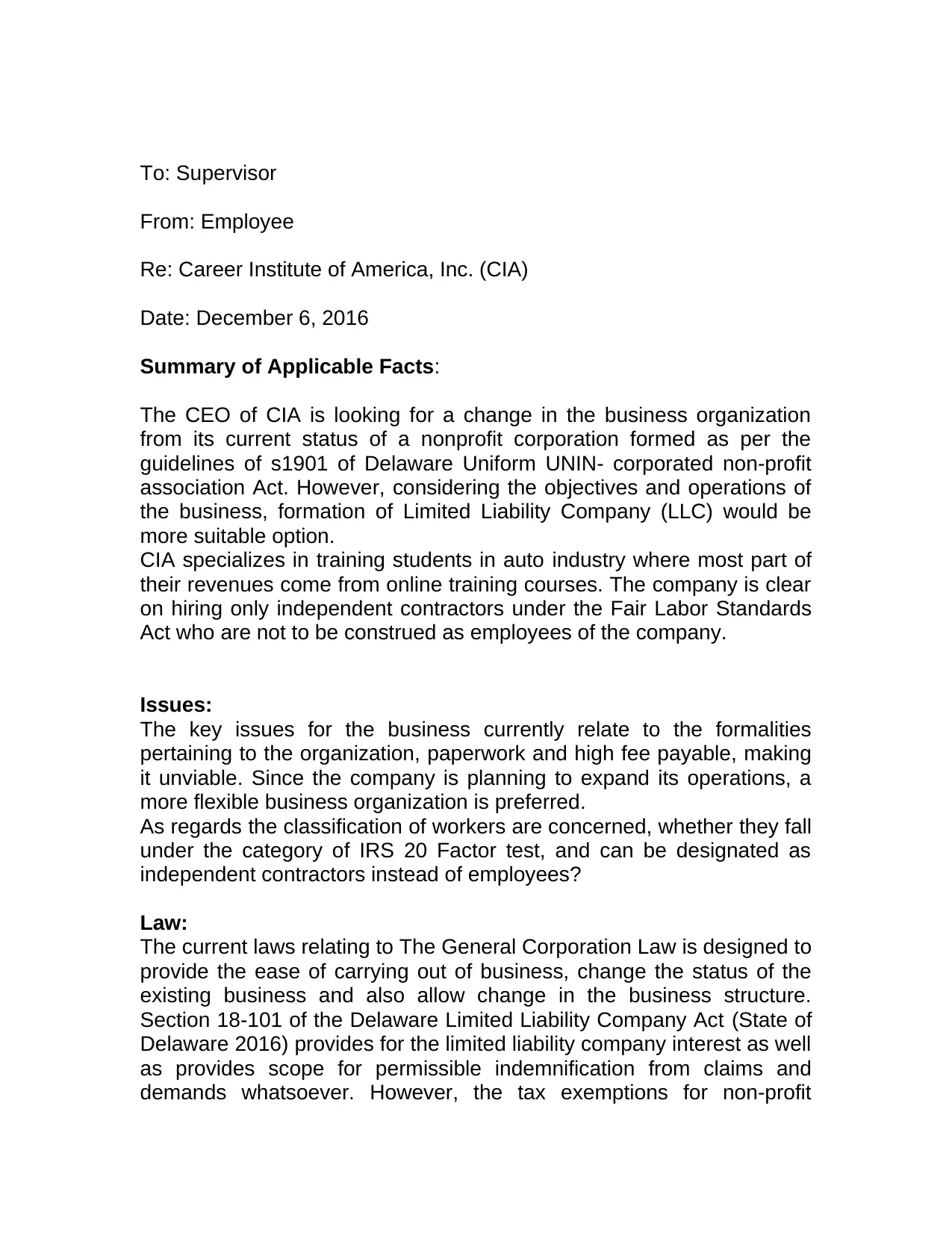
To: Supervisor
From: Employee
Re: Career Institute of America, Inc. (CIA)
Date: December 6, 2016
Summary of Applicable Facts:
The CEO of CIA is looking for a change in the business organization
from its current status of a nonprofit corporation formed as per the
guidelines of s1901 of Delaware Uniform UNIN- corporated non-profit
association Act. However, considering the objectives and operations of
the business, formation of Limited Liability Company (LLC) would be
more suitable option.
CIA specializes in training students in auto industry where most part of
their revenues come from online training courses. The company is clear
on hiring only independent contractors under the Fair Labor Standards
Act who are not to be construed as employees of the company.
Issues:
The key issues for the business currently relate to the formalities
pertaining to the organization, paperwork and high fee payable, making
it unviable. Since the company is planning to expand its operations, a
more flexible business organization is preferred.
As regards the classification of workers are concerned, whether they fall
under the category of IRS 20 Factor test, and can be designated as
independent contractors instead of employees?
Law:
The current laws relating to The General Corporation Law is designed to
provide the ease of carrying out of business, change the status of the
existing business and also allow change in the business structure.
Section 18-101 of the Delaware Limited Liability Company Act (State of
Delaware 2016) provides for the limited liability company interest as well
as provides scope for permissible indemnification from claims and
demands whatsoever. However, the tax exemptions for non-profit
tabler-icon-diamond-filled.svg

Paraphrase This Document

Need a fresh take? Get an instant paraphrase of this document with our AI Paraphraser
Document Page
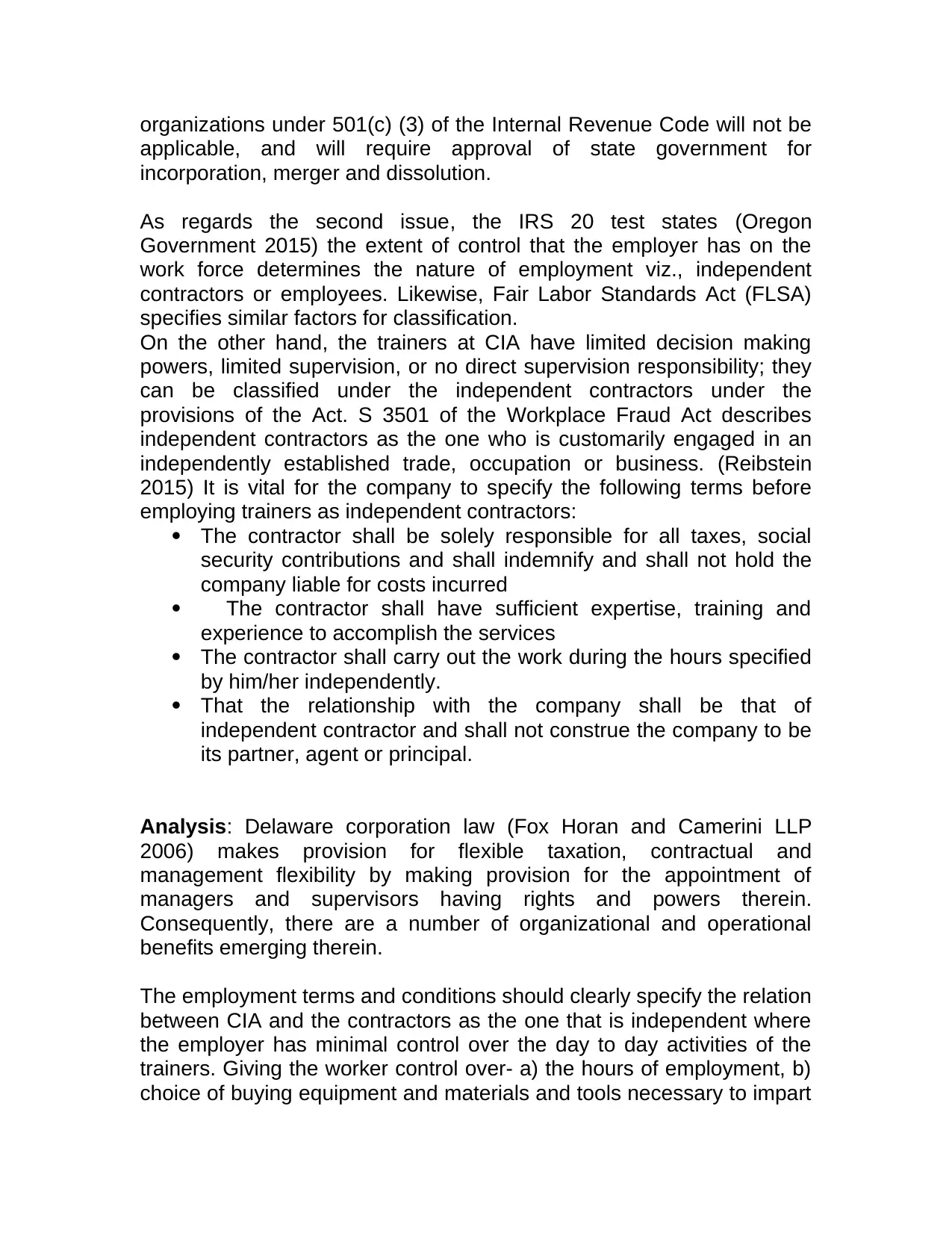
organizations under 501(c) (3) of the Internal Revenue Code will not be
applicable, and will require approval of state government for
incorporation, merger and dissolution.
As regards the second issue, the IRS 20 test states (Oregon
Government 2015) the extent of control that the employer has on the
work force determines the nature of employment viz., independent
contractors or employees. Likewise, Fair Labor Standards Act (FLSA)
specifies similar factors for classification.
On the other hand, the trainers at CIA have limited decision making
powers, limited supervision, or no direct supervision responsibility; they
can be classified under the independent contractors under the
provisions of the Act. S 3501 of the Workplace Fraud Act describes
independent contractors as the one who is customarily engaged in an
independently established trade, occupation or business. (Reibstein
2015) It is vital for the company to specify the following terms before
employing trainers as independent contractors:
The contractor shall be solely responsible for all taxes, social
security contributions and shall indemnify and shall not hold the
company liable for costs incurred
The contractor shall have sufficient expertise, training and
experience to accomplish the services
The contractor shall carry out the work during the hours specified
by him/her independently.
That the relationship with the company shall be that of
independent contractor and shall not construe the company to be
its partner, agent or principal.
Analysis: Delaware corporation law (Fox Horan and Camerini LLP
2006) makes provision for flexible taxation, contractual and
management flexibility by making provision for the appointment of
managers and supervisors having rights and powers therein.
Consequently, there are a number of organizational and operational
benefits emerging therein.
The employment terms and conditions should clearly specify the relation
between CIA and the contractors as the one that is independent where
the employer has minimal control over the day to day activities of the
trainers. Giving the worker control over- a) the hours of employment, b)
choice of buying equipment and materials and tools necessary to impart
Document Page
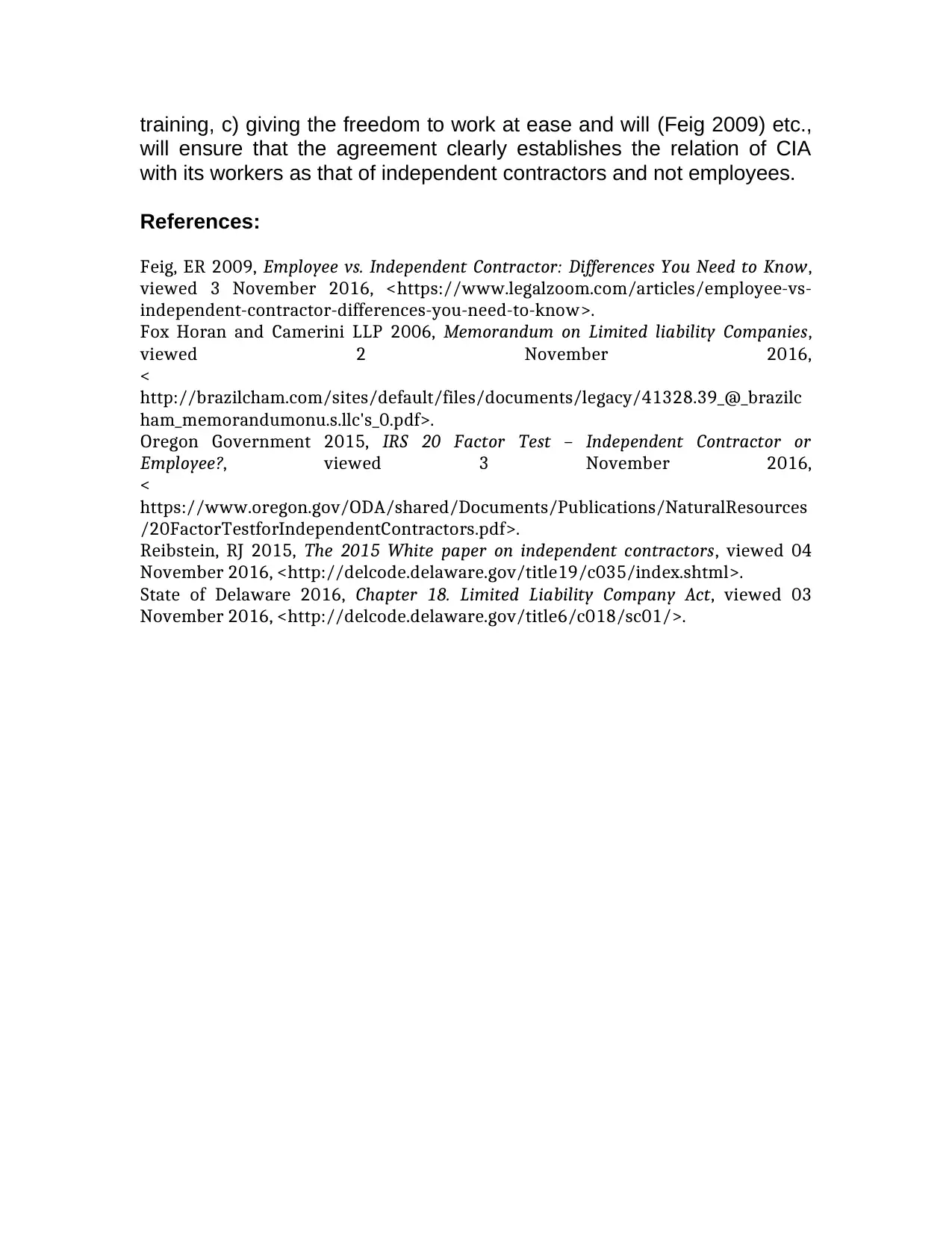
training, c) giving the freedom to work at ease and will (Feig 2009) etc.,
will ensure that the agreement clearly establishes the relation of CIA
with its workers as that of independent contractors and not employees.
References:
Feig, ER 2009, Employee vs. Independent Contractor: Differences You Need to Know,
viewed 3 November 2016, <https://www.legalzoom.com/articles/employee-vs-
independent-contractor-differences-you-need-to-know>.
Fox Horan and Camerini LLP 2006, Memorandum on Limited liability Companies,
viewed 2 November 2016,
<
http://brazilcham.com/sites/default/files/documents/legacy/41328.39_@_brazilc
ham_memorandumonu.s.llc's_0.pdf>.
Oregon Government 2015, IRS 20 Factor Test Independent Contractor or
Employee?, viewed 3 November 2016,
<
https://www.oregon.gov/ODA/shared/Documents/Publications/NaturalResources
/20FactorTestforIndependentContractors.pdf>.
Reibstein, RJ 2015, The 2015 White paper on independent contractors, viewed 04
November 2016, <http://delcode.delaware.gov/title19/c035/index.shtml>.
State of Delaware 2016, Chapter 18. Limited Liability Company Act, viewed 03
November 2016, <http://delcode.delaware.gov/title6/c018/sc01/>.
chevron_up_icon
1 out of 3
circle_padding
hide_on_mobile
zoom_out_icon
[object Object]