Exploring Cigarette Demand and Elasticity in the Australian Market
VerifiedAdded on 2023/06/12
|18
|3380
|497
Essay
AI Summary
This essay examines the economic concepts behind the demand and price elasticity of demand for cigarettes in the Australian market. It analyzes the changes in demand over time and the dynamics in price elasticity among different populations. The essay discusses the inverse relationship between the price of tobacco products and their demand in Australia, attributing this to taxes imposed by the government. It also explores how the elasticity of demand varies across different age groups and income levels, with lower-income groups being more sensitive to price changes. The study uses the theory of demand and supply and the concept of price elasticity to explain consumption patterns, highlighting the impact of government policies and individual preferences on tobacco consumption in Australia. Desklib provides a platform for students to access similar solved assignments and study resources.
Running head: HEALTH ECONOMICS
Health Economics
Name of the Student
Name of the University
Author Note
Health Economics
Name of the Student
Name of the University
Author Note

Paraphrase This Document
Need a fresh take? Get an instant paraphrase of this document with our AI Paraphraser
2HEALTH ECONOMICS
Introduction
Of the primary theoretical and conceptual framework of economics, the most eminent
ones are the concepts of demand and supply and also the notion of price elasticity of demand.
In economics the concept of marker refers to the open platform where the buyer and the
sellers of different products or services interact with one another to decide on the price and
quantity of the concerned product or service. While the buyers represent the demand forces,
the sellers are the supply side players in a market and the interaction and dynamics of these
two forces determine the equilibrium in the market. However, the demand and supply of
different products also vary depending upon the differences in the price elasticity of demand
of the products (Nicholson & Snyder, 2014).
In this context, it can be mentioned that for necessary commodities as well as for
commodities of addiction, the demand does not vary much due to the changes in the price as
people tent to keep their consumption more or less same, even by compromising on other
aspects. Tobacco and related commodities like cigarettes also fall in this category, which
thereby, usually have a non-elastic type of demand and low-price elasticity in a general
framework. However, these trends may vary from place to place and between different types
of individuals.
Keeping into consideration these conceptual frameworks of economics, the concerned
essay tries discuss the economic concepts behind the demand and price elasticity of demand
for cigarettes, the changes in the demand for the same with time and also the dynamics in the
price elasticity of demand for cigarettes among the different populations, thereby highlighting
the policies present in this aspect and their weaknesses and strength, in the Australian market
framework.
Market for Cigarettes
Introduction
Of the primary theoretical and conceptual framework of economics, the most eminent
ones are the concepts of demand and supply and also the notion of price elasticity of demand.
In economics the concept of marker refers to the open platform where the buyer and the
sellers of different products or services interact with one another to decide on the price and
quantity of the concerned product or service. While the buyers represent the demand forces,
the sellers are the supply side players in a market and the interaction and dynamics of these
two forces determine the equilibrium in the market. However, the demand and supply of
different products also vary depending upon the differences in the price elasticity of demand
of the products (Nicholson & Snyder, 2014).
In this context, it can be mentioned that for necessary commodities as well as for
commodities of addiction, the demand does not vary much due to the changes in the price as
people tent to keep their consumption more or less same, even by compromising on other
aspects. Tobacco and related commodities like cigarettes also fall in this category, which
thereby, usually have a non-elastic type of demand and low-price elasticity in a general
framework. However, these trends may vary from place to place and between different types
of individuals.
Keeping into consideration these conceptual frameworks of economics, the concerned
essay tries discuss the economic concepts behind the demand and price elasticity of demand
for cigarettes, the changes in the demand for the same with time and also the dynamics in the
price elasticity of demand for cigarettes among the different populations, thereby highlighting
the policies present in this aspect and their weaknesses and strength, in the Australian market
framework.
Market for Cigarettes

3HEALTH ECONOMICS
Cigarettes and other tobacco products have experienced considerable increase in the
demand over the last few decades, barring the last few years, after 2013, which can be seen
from the following figure, which shows the increase in the consumption of cigarettes alone in
the global framework:
Figure 1: Increase in the consumption of cigarettes (in billions) in the world over the years
(Source: Statista.com, 2018)
[Retrieved from: https://www.statista.com/statistics/279577/global-consumption-of-
cigarettes-since-1880/]
As is evident from the above figure, with time the global consumption of cigarettes
has increased considerably with strikingly high rates of increase in the last decade. The level
has been however seen to decrease to some extent from 2014, although the numbers of
cigarettes consumed globally still remains high (Tollison & Wagner, 2012).
Cigarettes and other tobacco products have experienced considerable increase in the
demand over the last few decades, barring the last few years, after 2013, which can be seen
from the following figure, which shows the increase in the consumption of cigarettes alone in
the global framework:
Figure 1: Increase in the consumption of cigarettes (in billions) in the world over the years
(Source: Statista.com, 2018)
[Retrieved from: https://www.statista.com/statistics/279577/global-consumption-of-
cigarettes-since-1880/]
As is evident from the above figure, with time the global consumption of cigarettes
has increased considerably with strikingly high rates of increase in the last decade. The level
has been however seen to decrease to some extent from 2014, although the numbers of
cigarettes consumed globally still remains high (Tollison & Wagner, 2012).
⊘ This is a preview!⊘
Do you want full access?
Subscribe today to unlock all pages.

Trusted by 1+ million students worldwide
4HEALTH ECONOMICS
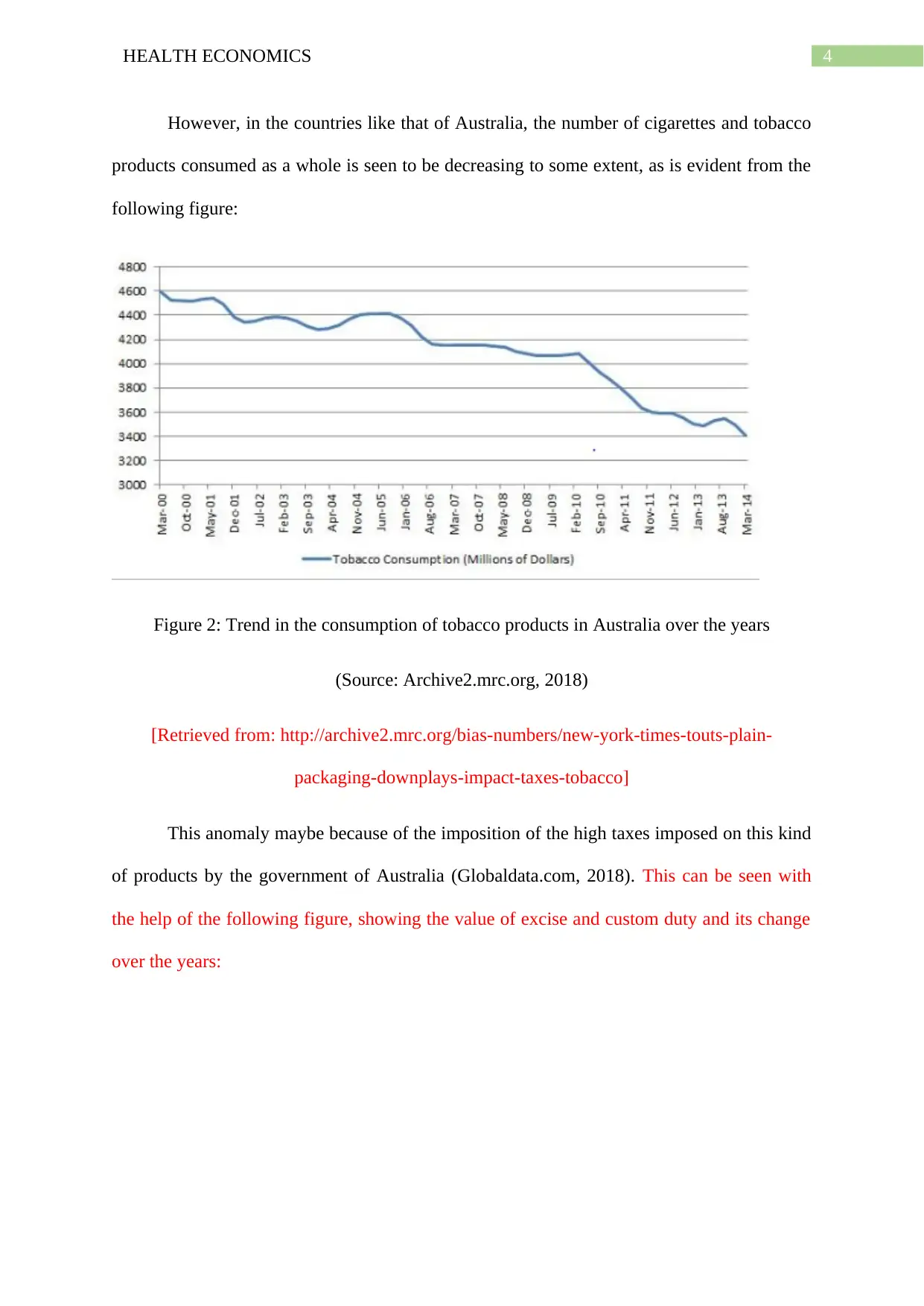
However, in the countries like that of Australia, the number of cigarettes and tobacco
products consumed as a whole is seen to be decreasing to some extent, as is evident from the
following figure:
Figure 2: Trend in the consumption of tobacco products in Australia over the years
(Source: Archive2.mrc.org, 2018)
[Retrieved from: http://archive2.mrc.org/bias-numbers/new-york-times-touts-plain-
packaging-downplays-impact-taxes-tobacco]
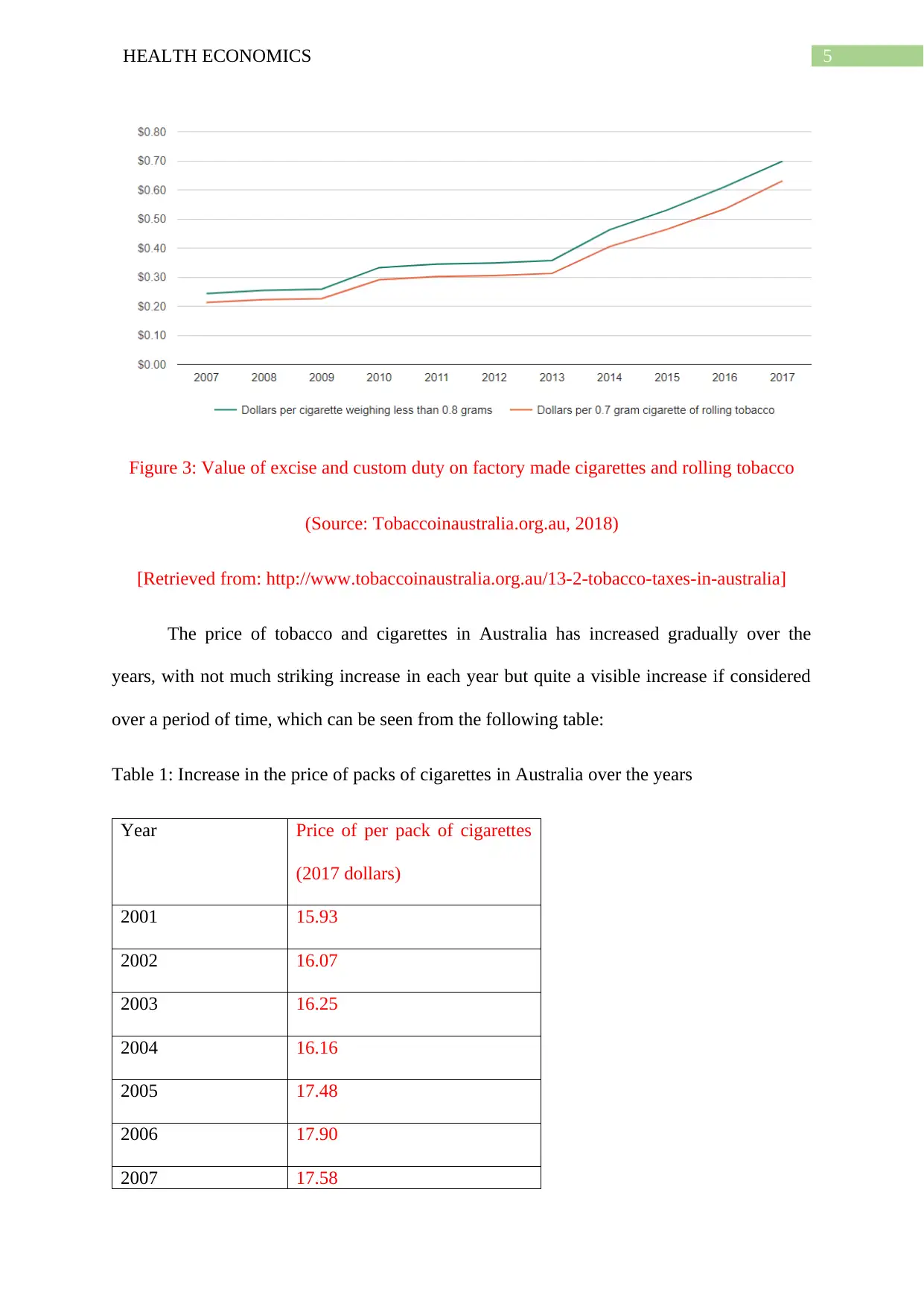
This anomaly maybe because of the imposition of the high taxes imposed on this kind
of products by the government of Australia (Globaldata.com, 2018). This can be seen with
the help of the following figure, showing the value of excise and custom duty and its change
over the years:
However, in the countries like that of Australia, the number of cigarettes and tobacco
products consumed as a whole is seen to be decreasing to some extent, as is evident from the
following figure:
Figure 2: Trend in the consumption of tobacco products in Australia over the years
(Source: Archive2.mrc.org, 2018)
[Retrieved from: http://archive2.mrc.org/bias-numbers/new-york-times-touts-plain-
packaging-downplays-impact-taxes-tobacco]
This anomaly maybe because of the imposition of the high taxes imposed on this kind
of products by the government of Australia (Globaldata.com, 2018). This can be seen with
the help of the following figure, showing the value of excise and custom duty and its change
over the years:
Paraphrase This Document
Need a fresh take? Get an instant paraphrase of this document with our AI Paraphraser
5HEALTH ECONOMICS
Figure 3: Value of excise and custom duty on factory made cigarettes and rolling tobacco
(Source: Tobaccoinaustralia.org.au, 2018)
[Retrieved from: http://www.tobaccoinaustralia.org.au/13-2-tobacco-taxes-in-australia]
The price of tobacco and cigarettes in Australia has increased gradually over the
years, with not much striking increase in each year but quite a visible increase if considered
over a period of time, which can be seen from the following table:
Table 1: Increase in the price of packs of cigarettes in Australia over the years
Year Price of per pack of cigarettes
(2017 dollars)
2001 15.93
2002 16.07
2003 16.25
2004 16.16
2005 17.48
2006 17.90
2007 17.58
Figure 3: Value of excise and custom duty on factory made cigarettes and rolling tobacco
(Source: Tobaccoinaustralia.org.au, 2018)
[Retrieved from: http://www.tobaccoinaustralia.org.au/13-2-tobacco-taxes-in-australia]
The price of tobacco and cigarettes in Australia has increased gradually over the
years, with not much striking increase in each year but quite a visible increase if considered
over a period of time, which can be seen from the following table:
Table 1: Increase in the price of packs of cigarettes in Australia over the years
Year Price of per pack of cigarettes
(2017 dollars)
2001 15.93
2002 16.07
2003 16.25
2004 16.16
2005 17.48
2006 17.90
2007 17.58
6HEALTH ECONOMICS
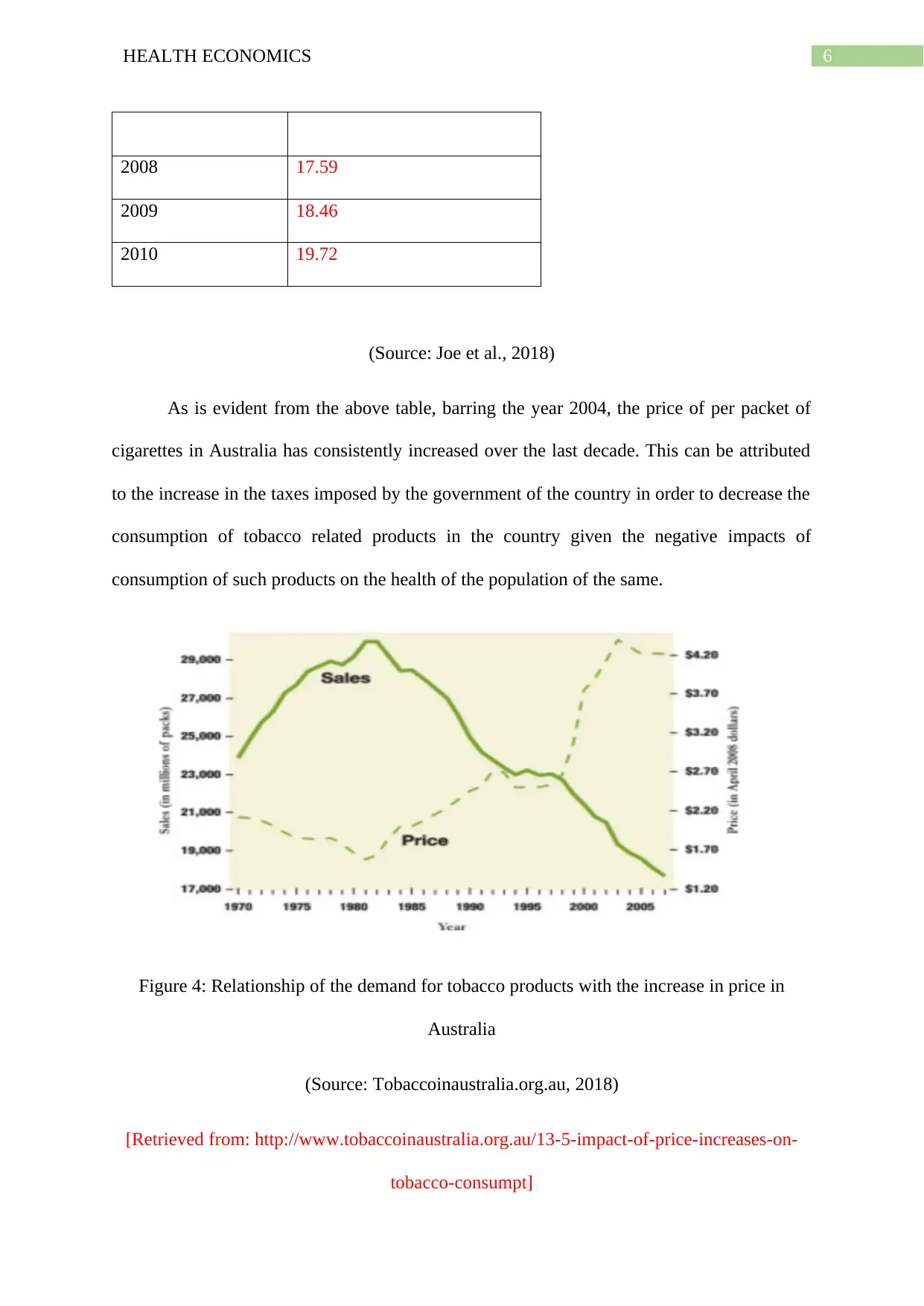
2008 17.59
2009 18.46
2010 19.72
(Source: Joe et al., 2018)
As is evident from the above table, barring the year 2004, the price of per packet of
cigarettes in Australia has consistently increased over the last decade. This can be attributed
to the increase in the taxes imposed by the government of the country in order to decrease the
consumption of tobacco related products in the country given the negative impacts of
consumption of such products on the health of the population of the same.
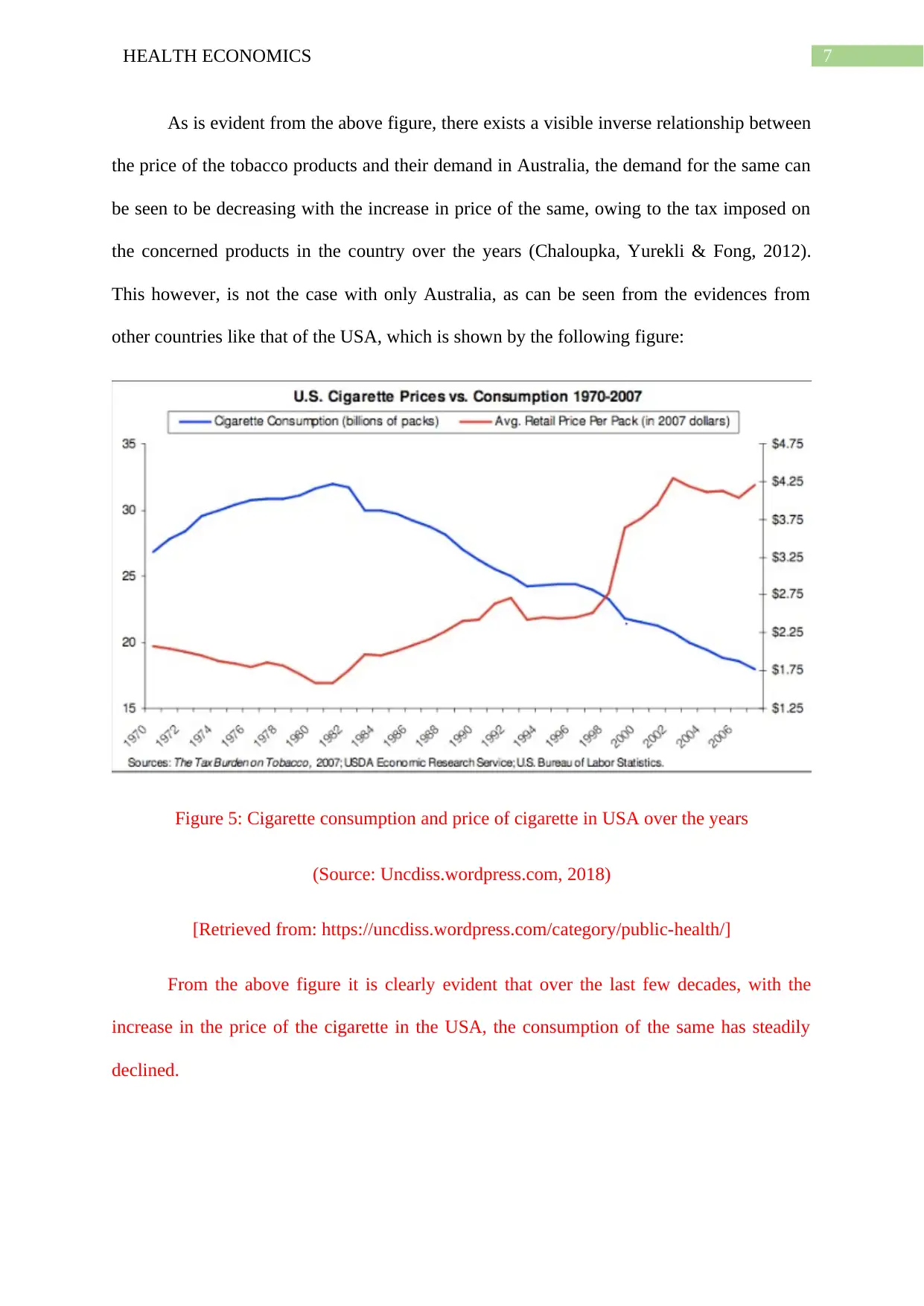
Figure 4: Relationship of the demand for tobacco products with the increase in price in
Australia
(Source: Tobaccoinaustralia.org.au, 2018)
[Retrieved from: http://www.tobaccoinaustralia.org.au/13-5-impact-of-price-increases-on-
tobacco-consumpt]
2008 17.59
2009 18.46
2010 19.72
(Source: Joe et al., 2018)
As is evident from the above table, barring the year 2004, the price of per packet of
cigarettes in Australia has consistently increased over the last decade. This can be attributed
to the increase in the taxes imposed by the government of the country in order to decrease the
consumption of tobacco related products in the country given the negative impacts of
consumption of such products on the health of the population of the same.
Figure 4: Relationship of the demand for tobacco products with the increase in price in
Australia
(Source: Tobaccoinaustralia.org.au, 2018)
[Retrieved from: http://www.tobaccoinaustralia.org.au/13-5-impact-of-price-increases-on-
tobacco-consumpt]
⊘ This is a preview!⊘
Do you want full access?
Subscribe today to unlock all pages.
Trusted by 1+ million students worldwide
7HEALTH ECONOMICS
As is evident from the above figure, there exists a visible inverse relationship between
the price of the tobacco products and their demand in Australia, the demand for the same can
be seen to be decreasing with the increase in price of the same, owing to the tax imposed on
the concerned products in the country over the years (Chaloupka, Yurekli & Fong, 2012).
This however, is not the case with only Australia, as can be seen from the evidences from
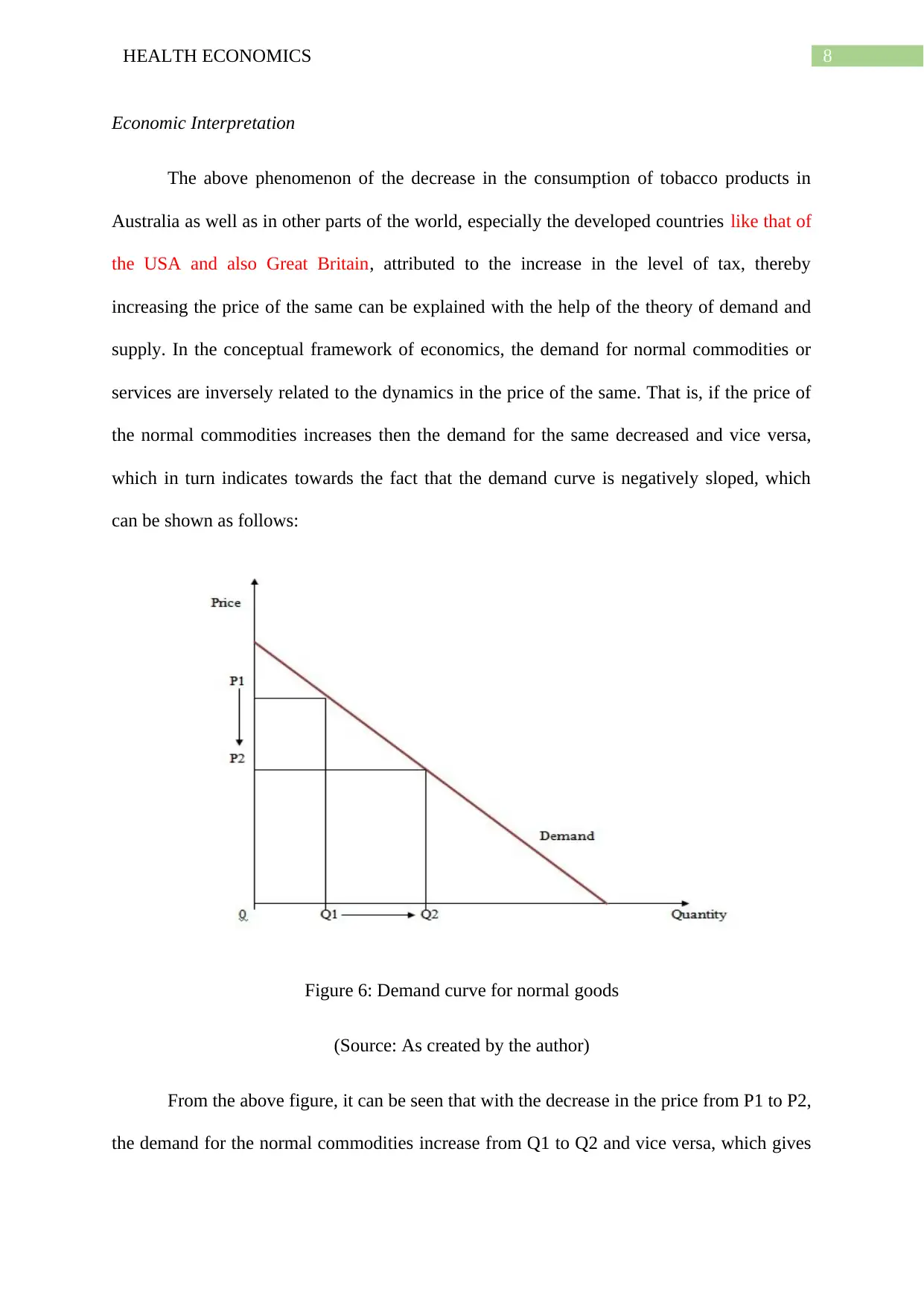
other countries like that of the USA, which is shown by the following figure:
Figure 5: Cigarette consumption and price of cigarette in USA over the years
(Source: Uncdiss.wordpress.com, 2018)
[Retrieved from: https://uncdiss.wordpress.com/category/public-health/]
From the above figure it is clearly evident that over the last few decades, with the
increase in the price of the cigarette in the USA, the consumption of the same has steadily
declined.
As is evident from the above figure, there exists a visible inverse relationship between
the price of the tobacco products and their demand in Australia, the demand for the same can
be seen to be decreasing with the increase in price of the same, owing to the tax imposed on
the concerned products in the country over the years (Chaloupka, Yurekli & Fong, 2012).
This however, is not the case with only Australia, as can be seen from the evidences from
other countries like that of the USA, which is shown by the following figure:
Figure 5: Cigarette consumption and price of cigarette in USA over the years
(Source: Uncdiss.wordpress.com, 2018)
[Retrieved from: https://uncdiss.wordpress.com/category/public-health/]
From the above figure it is clearly evident that over the last few decades, with the
increase in the price of the cigarette in the USA, the consumption of the same has steadily
declined.
Paraphrase This Document
Need a fresh take? Get an instant paraphrase of this document with our AI Paraphraser
8HEALTH ECONOMICS
Economic Interpretation
The above phenomenon of the decrease in the consumption of tobacco products in
Australia as well as in other parts of the world, especially the developed countries like that of
the USA and also Great Britain, attributed to the increase in the level of tax, thereby
increasing the price of the same can be explained with the help of the theory of demand and
supply. In the conceptual framework of economics, the demand for normal commodities or
services are inversely related to the dynamics in the price of the same. That is, if the price of
the normal commodities increases then the demand for the same decreased and vice versa,
which in turn indicates towards the fact that the demand curve is negatively sloped, which
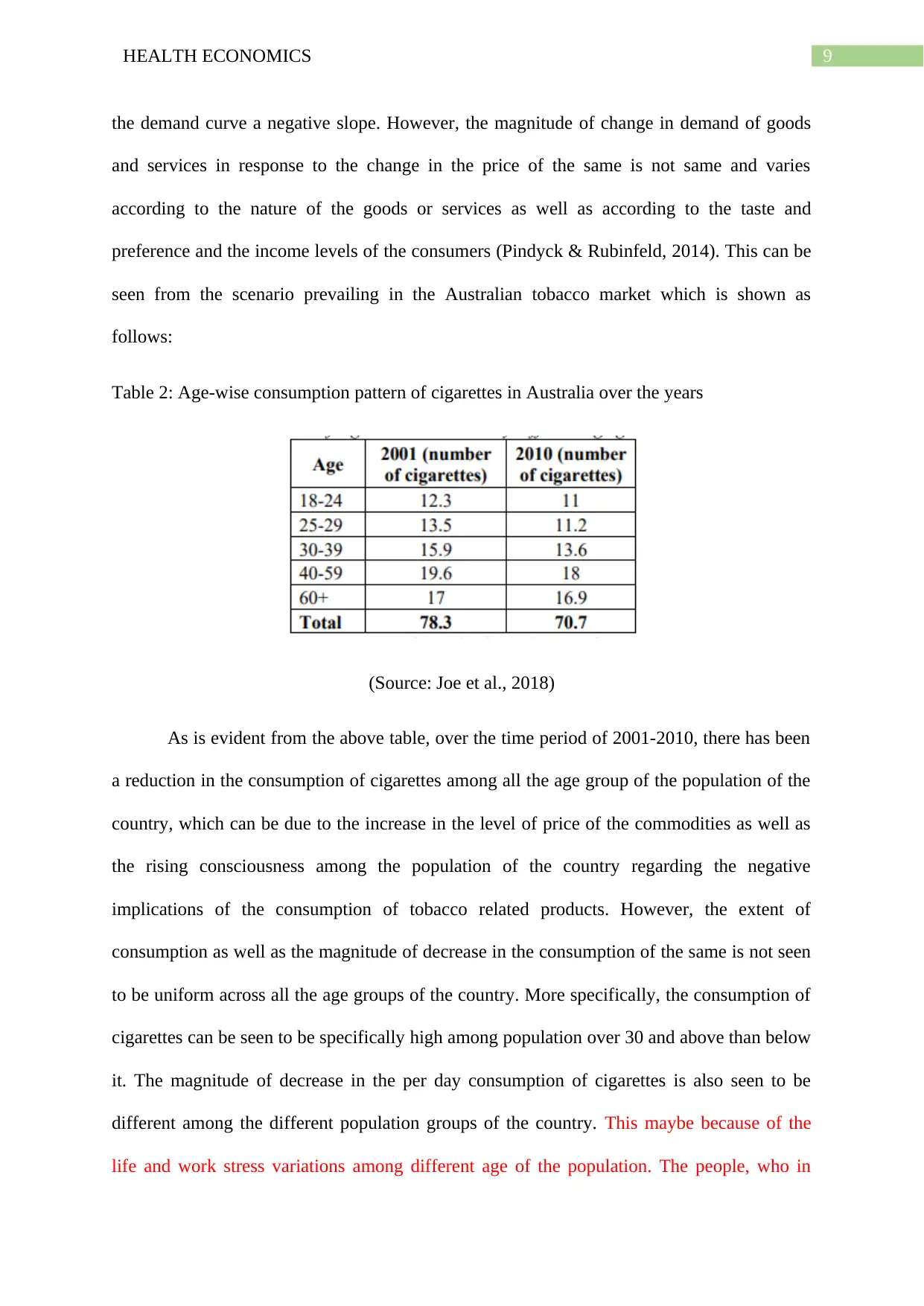
can be shown as follows:
Figure 6: Demand curve for normal goods
(Source: As created by the author)
From the above figure, it can be seen that with the decrease in the price from P1 to P2,
the demand for the normal commodities increase from Q1 to Q2 and vice versa, which gives
Economic Interpretation
The above phenomenon of the decrease in the consumption of tobacco products in
Australia as well as in other parts of the world, especially the developed countries like that of
the USA and also Great Britain, attributed to the increase in the level of tax, thereby
increasing the price of the same can be explained with the help of the theory of demand and
supply. In the conceptual framework of economics, the demand for normal commodities or
services are inversely related to the dynamics in the price of the same. That is, if the price of
the normal commodities increases then the demand for the same decreased and vice versa,
which in turn indicates towards the fact that the demand curve is negatively sloped, which
can be shown as follows:
Figure 6: Demand curve for normal goods
(Source: As created by the author)
From the above figure, it can be seen that with the decrease in the price from P1 to P2,
the demand for the normal commodities increase from Q1 to Q2 and vice versa, which gives
9HEALTH ECONOMICS
the demand curve a negative slope. However, the magnitude of change in demand of goods
and services in response to the change in the price of the same is not same and varies
according to the nature of the goods or services as well as according to the taste and
preference and the income levels of the consumers (Pindyck & Rubinfeld, 2014). This can be
seen from the scenario prevailing in the Australian tobacco market which is shown as
follows:
Table 2: Age-wise consumption pattern of cigarettes in Australia over the years
(Source: Joe et al., 2018)
As is evident from the above table, over the time period of 2001-2010, there has been
a reduction in the consumption of cigarettes among all the age group of the population of the
country, which can be due to the increase in the level of price of the commodities as well as
the rising consciousness among the population of the country regarding the negative
implications of the consumption of tobacco related products. However, the extent of
consumption as well as the magnitude of decrease in the consumption of the same is not seen
to be uniform across all the age groups of the country. More specifically, the consumption of
cigarettes can be seen to be specifically high among population over 30 and above than below
it. The magnitude of decrease in the per day consumption of cigarettes is also seen to be
different among the different population groups of the country. This maybe because of the
life and work stress variations among different age of the population. The people, who in
the demand curve a negative slope. However, the magnitude of change in demand of goods
and services in response to the change in the price of the same is not same and varies
according to the nature of the goods or services as well as according to the taste and
preference and the income levels of the consumers (Pindyck & Rubinfeld, 2014). This can be
seen from the scenario prevailing in the Australian tobacco market which is shown as
follows:
Table 2: Age-wise consumption pattern of cigarettes in Australia over the years
(Source: Joe et al., 2018)
As is evident from the above table, over the time period of 2001-2010, there has been
a reduction in the consumption of cigarettes among all the age group of the population of the
country, which can be due to the increase in the level of price of the commodities as well as
the rising consciousness among the population of the country regarding the negative
implications of the consumption of tobacco related products. However, the extent of
consumption as well as the magnitude of decrease in the consumption of the same is not seen
to be uniform across all the age groups of the country. More specifically, the consumption of
cigarettes can be seen to be specifically high among population over 30 and above than below
it. The magnitude of decrease in the per day consumption of cigarettes is also seen to be
different among the different population groups of the country. This maybe because of the
life and work stress variations among different age of the population. The people, who in
⊘ This is a preview!⊘
Do you want full access?
Subscribe today to unlock all pages.
Trusted by 1+ million students worldwide
10HEALTH ECONOMICS
general have a stressful life tend to rely on smoking as a stressbuster and cannot let go off the
same very easily, compared to others who do not tend to view cigarettes and reliefs to their
work tensions.
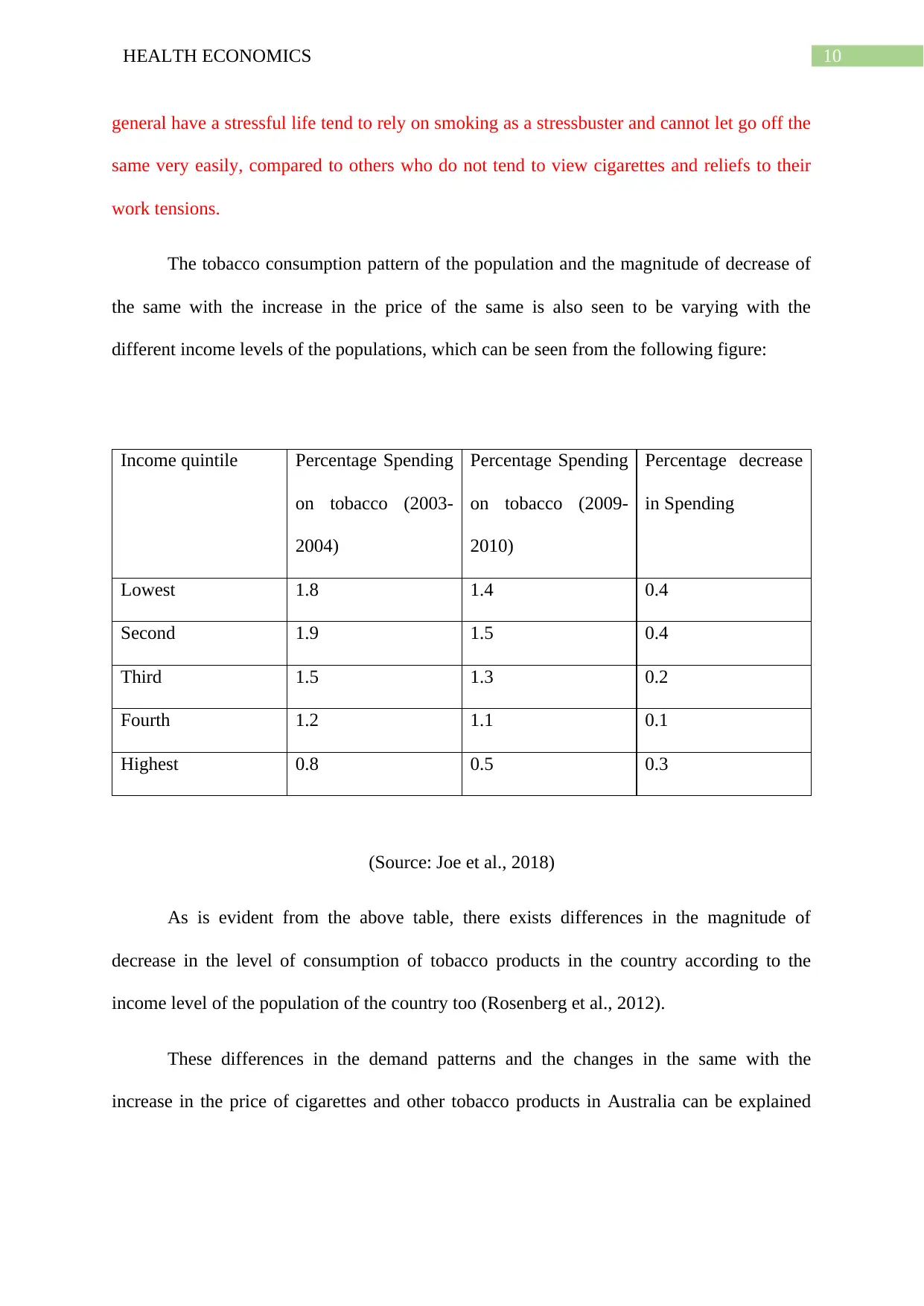
The tobacco consumption pattern of the population and the magnitude of decrease of
the same with the increase in the price of the same is also seen to be varying with the
different income levels of the populations, which can be seen from the following figure:
Income quintile Percentage Spending
on tobacco (2003-
2004)
Percentage Spending
on tobacco (2009-
2010)
Percentage decrease
in Spending
Lowest 1.8 1.4 0.4
Second 1.9 1.5 0.4
Third 1.5 1.3 0.2
Fourth 1.2 1.1 0.1
Highest 0.8 0.5 0.3
(Source: Joe et al., 2018)
As is evident from the above table, there exists differences in the magnitude of
decrease in the level of consumption of tobacco products in the country according to the
income level of the population of the country too (Rosenberg et al., 2012).
These differences in the demand patterns and the changes in the same with the
increase in the price of cigarettes and other tobacco products in Australia can be explained
general have a stressful life tend to rely on smoking as a stressbuster and cannot let go off the
same very easily, compared to others who do not tend to view cigarettes and reliefs to their
work tensions.
The tobacco consumption pattern of the population and the magnitude of decrease of
the same with the increase in the price of the same is also seen to be varying with the
different income levels of the populations, which can be seen from the following figure:
Income quintile Percentage Spending
on tobacco (2003-
2004)
Percentage Spending
on tobacco (2009-
2010)
Percentage decrease
in Spending
Lowest 1.8 1.4 0.4
Second 1.9 1.5 0.4
Third 1.5 1.3 0.2
Fourth 1.2 1.1 0.1
Highest 0.8 0.5 0.3
(Source: Joe et al., 2018)
As is evident from the above table, there exists differences in the magnitude of
decrease in the level of consumption of tobacco products in the country according to the
income level of the population of the country too (Rosenberg et al., 2012).
These differences in the demand patterns and the changes in the same with the
increase in the price of cigarettes and other tobacco products in Australia can be explained
Paraphrase This Document
Need a fresh take? Get an instant paraphrase of this document with our AI Paraphraser
11HEALTH ECONOMICS
with the help of the concept of elasticity of demand which is one of the most widely used
concept in the economic theoretical framework.
Price elasticity of demand: Concept and Application
In the conceptual framework of economics, there exist the theory of price elasticity of
demand as has been discussed in the above sections of the essay. The own price elasticity of
demand of a commodity, thus, shows the change in the quantity demand of the product due to
one-unit change in the price of the same (Rios, McConnell & Brue, 2013).
The elasticity of demand for products, vary according to the nature of the
commodities as well as according to the demand and preference patterns of different people
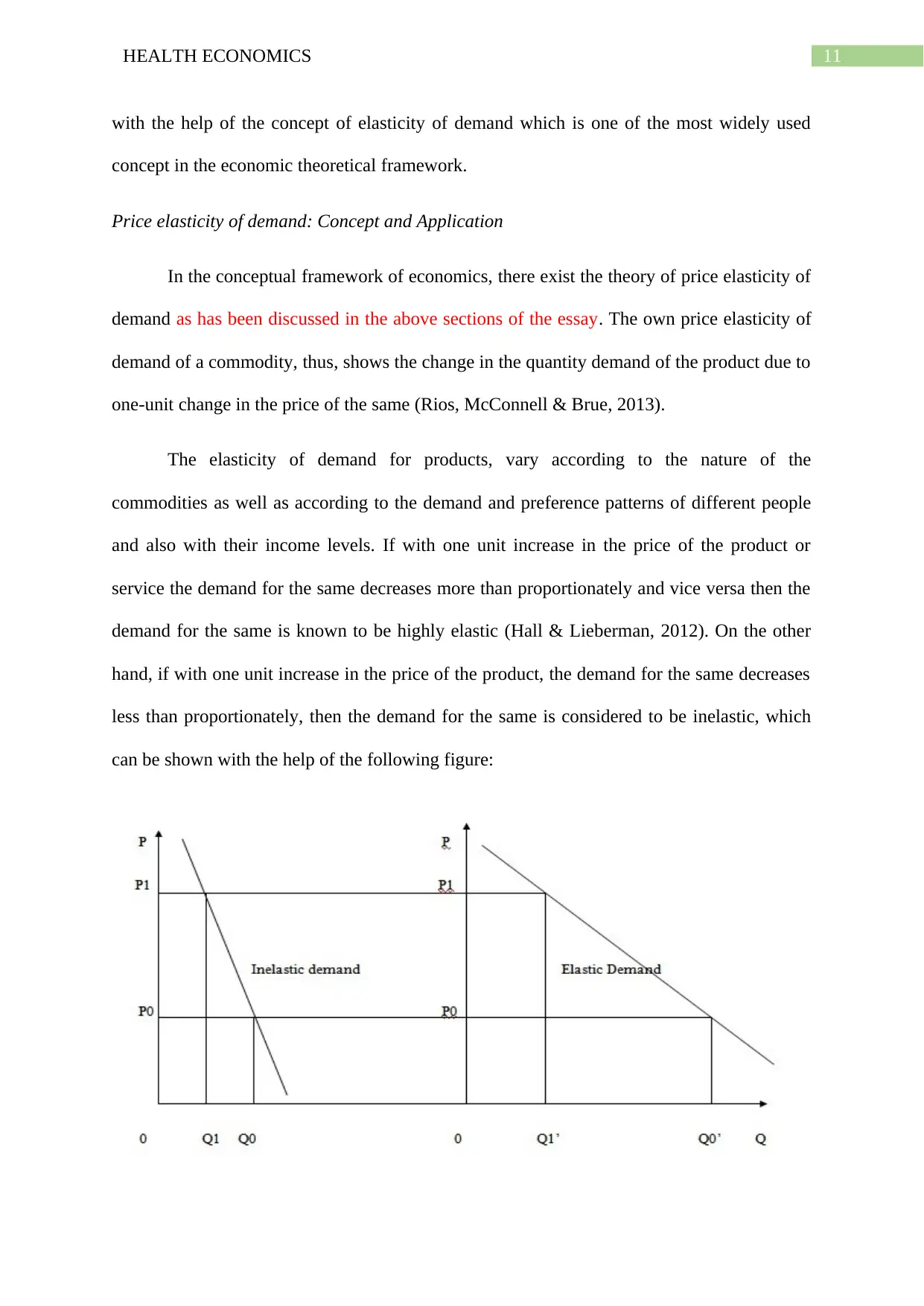
and also with their income levels. If with one unit increase in the price of the product or
service the demand for the same decreases more than proportionately and vice versa then the
demand for the same is known to be highly elastic (Hall & Lieberman, 2012). On the other
hand, if with one unit increase in the price of the product, the demand for the same decreases
less than proportionately, then the demand for the same is considered to be inelastic, which
can be shown with the help of the following figure:
with the help of the concept of elasticity of demand which is one of the most widely used
concept in the economic theoretical framework.
Price elasticity of demand: Concept and Application
In the conceptual framework of economics, there exist the theory of price elasticity of
demand as has been discussed in the above sections of the essay. The own price elasticity of
demand of a commodity, thus, shows the change in the quantity demand of the product due to
one-unit change in the price of the same (Rios, McConnell & Brue, 2013).
The elasticity of demand for products, vary according to the nature of the
commodities as well as according to the demand and preference patterns of different people
and also with their income levels. If with one unit increase in the price of the product or
service the demand for the same decreases more than proportionately and vice versa then the
demand for the same is known to be highly elastic (Hall & Lieberman, 2012). On the other
hand, if with one unit increase in the price of the product, the demand for the same decreases
less than proportionately, then the demand for the same is considered to be inelastic, which
can be shown with the help of the following figure:
12HEALTH ECONOMICS
Figure 7: Elastic and Inelastic demand for commodities
(Source: As created by the author)
As is evident from the above figure, with the same increase in the price levels, the
extent of decrease in the demand for the commodity for those with inelastic demand for the
same is much lesser then the decrease in the demand for the commodity for those with elastic
demand.
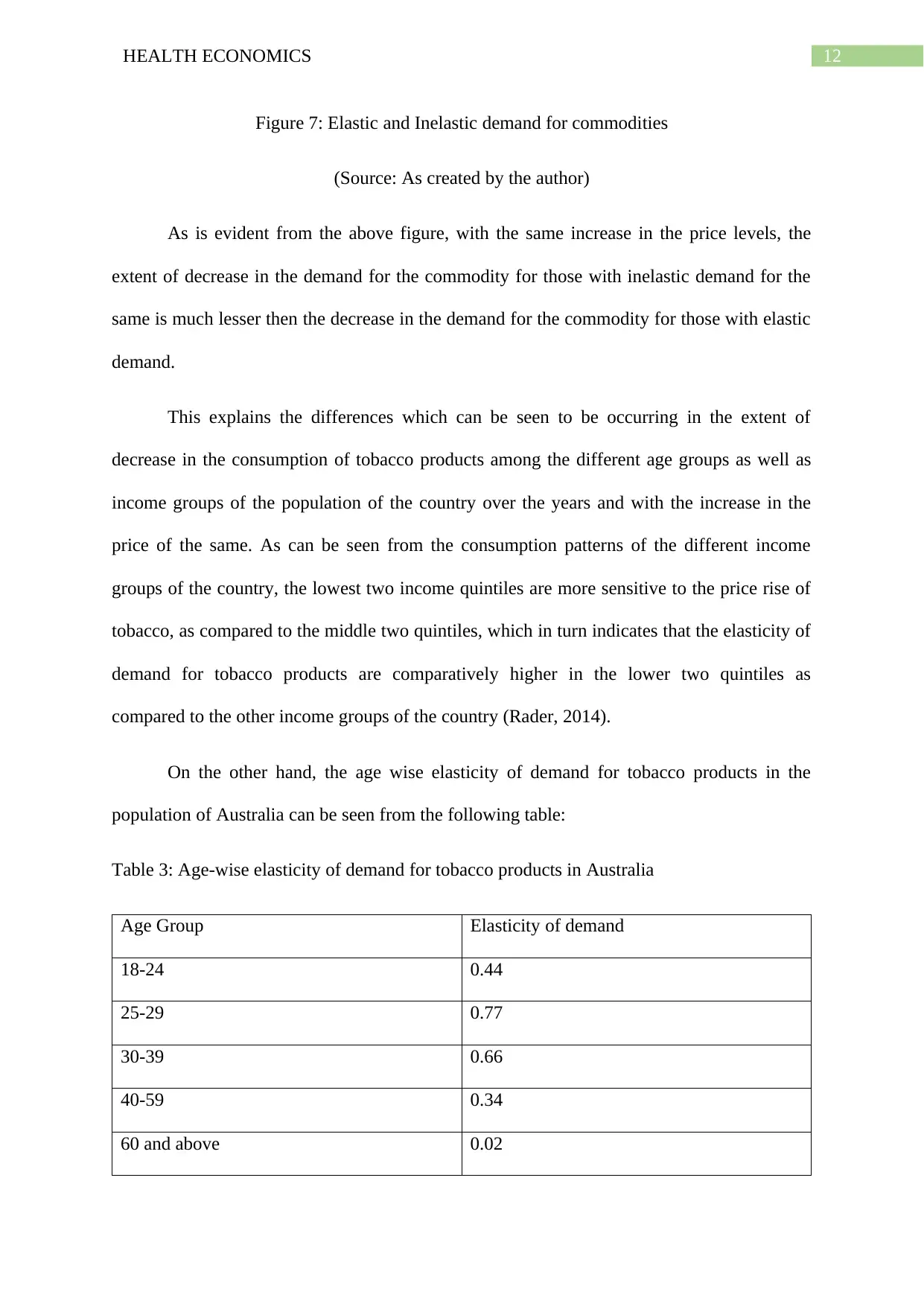
This explains the differences which can be seen to be occurring in the extent of
decrease in the consumption of tobacco products among the different age groups as well as
income groups of the population of the country over the years and with the increase in the
price of the same. As can be seen from the consumption patterns of the different income
groups of the country, the lowest two income quintiles are more sensitive to the price rise of
tobacco, as compared to the middle two quintiles, which in turn indicates that the elasticity of
demand for tobacco products are comparatively higher in the lower two quintiles as
compared to the other income groups of the country (Rader, 2014).
On the other hand, the age wise elasticity of demand for tobacco products in the
population of Australia can be seen from the following table:
Table 3: Age-wise elasticity of demand for tobacco products in Australia
Age Group Elasticity of demand
18-24 0.44
25-29 0.77
30-39 0.66
40-59 0.34
60 and above 0.02
Figure 7: Elastic and Inelastic demand for commodities
(Source: As created by the author)
As is evident from the above figure, with the same increase in the price levels, the
extent of decrease in the demand for the commodity for those with inelastic demand for the
same is much lesser then the decrease in the demand for the commodity for those with elastic
demand.
This explains the differences which can be seen to be occurring in the extent of
decrease in the consumption of tobacco products among the different age groups as well as
income groups of the population of the country over the years and with the increase in the
price of the same. As can be seen from the consumption patterns of the different income
groups of the country, the lowest two income quintiles are more sensitive to the price rise of
tobacco, as compared to the middle two quintiles, which in turn indicates that the elasticity of
demand for tobacco products are comparatively higher in the lower two quintiles as
compared to the other income groups of the country (Rader, 2014).
On the other hand, the age wise elasticity of demand for tobacco products in the
population of Australia can be seen from the following table:
Table 3: Age-wise elasticity of demand for tobacco products in Australia
Age Group Elasticity of demand
18-24 0.44
25-29 0.77
30-39 0.66
40-59 0.34
60 and above 0.02
⊘ This is a preview!⊘
Do you want full access?
Subscribe today to unlock all pages.
Trusted by 1+ million students worldwide

1 out of 18


Related Documents


Your All-in-One AI-Powered Toolkit for Academic Success.
+13062052269
info@desklib.com
Available 24*7 on WhatsApp / Email
![[object Object]](/_next/static/media/star-bottom.7253800d.svg)
Unlock your academic potential
Copyright © 2020–2026 A2Z Services. All Rights Reserved. Developed and managed by ZUCOL.