CIO Attributes in IT: Examining Fundamental Roles and Attitudes in AU
VerifiedAdded on 2023/06/11
|10
|2196
|119
Essay
AI Summary
This essay explores the fundamental attributes of a Chief Information Officer (CIO) within the IT industry, emphasizing the importance of aligning IT strategies with business goals. It identifies key attributes such as time management, flexibility, IT education in a business context, and effective budget and strategy implementation. The essay uses Craig Wishart, CIO of KPMG Australia, as a real-world example to illustrate these attributes. It highlights the need for CIOs to possess not only technical expertise but also strong communication and collaboration skills to drive digital transformation and achieve organizational objectives. The analysis concludes that these attributes are essential for CIOs to effectively manage IT initiatives, enhance business growth, and gain a competitive advantage in the market.
Running Head: CIO ATTRIBUTES IN IT INDUSTRY
CIO attributes in IT industry
Fundamental roles and attitudes of CIOs
Australia
6/13/2018
CIO attributes in IT industry
Fundamental roles and attitudes of CIOs
Australia
6/13/2018

Paraphrase This Document
Need a fresh take? Get an instant paraphrase of this document with our AI Paraphraser
CIO ATTRIBUTES IN IT INDUSTRY 1
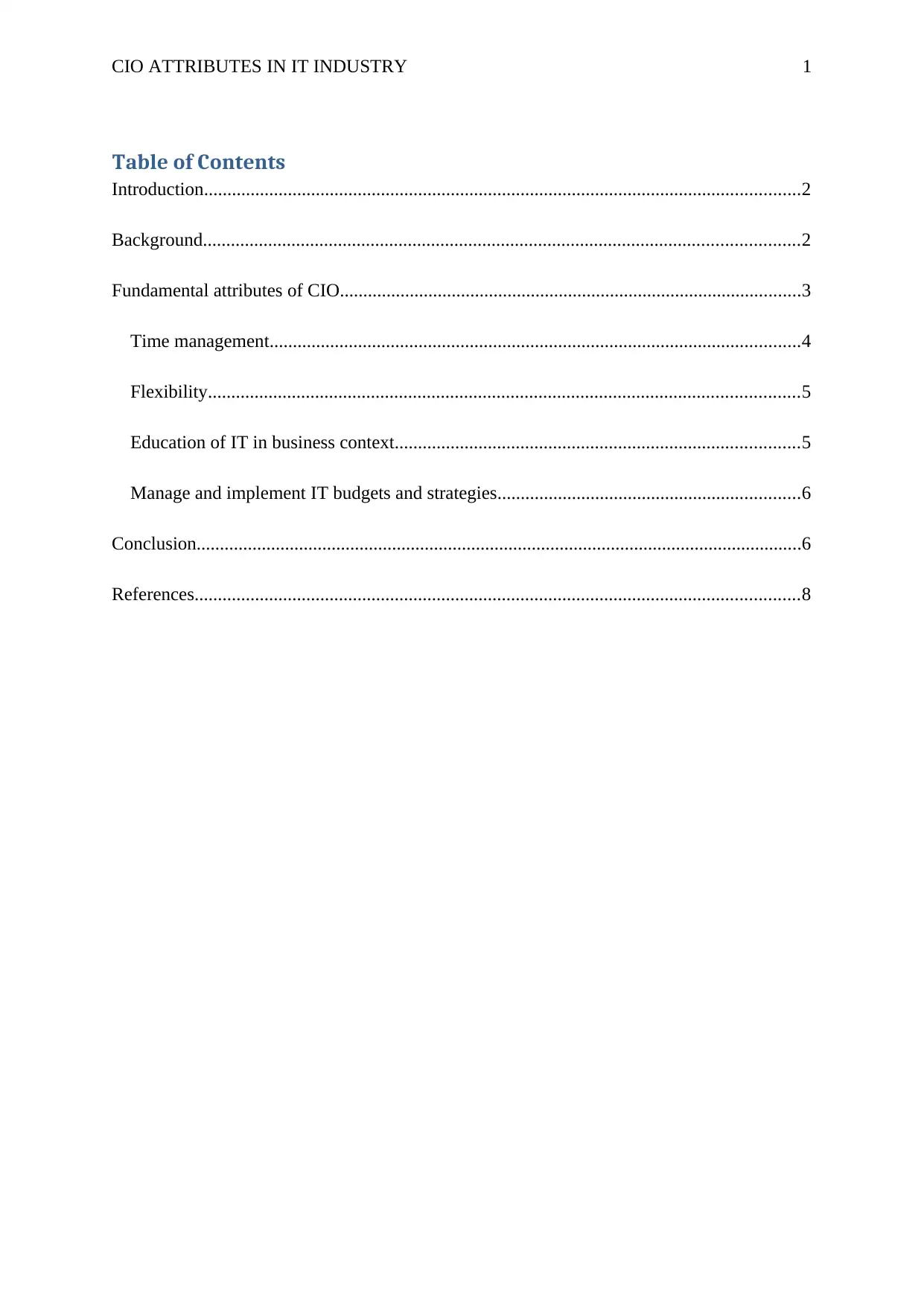
Table of Contents
Introduction................................................................................................................................2
Background................................................................................................................................2
Fundamental attributes of CIO...................................................................................................3
Time management..................................................................................................................4
Flexibility...............................................................................................................................5
Education of IT in business context.......................................................................................5
Manage and implement IT budgets and strategies.................................................................6
Conclusion..................................................................................................................................6
References..................................................................................................................................8
Table of Contents
Introduction................................................................................................................................2
Background................................................................................................................................2
Fundamental attributes of CIO...................................................................................................3
Time management..................................................................................................................4
Flexibility...............................................................................................................................5
Education of IT in business context.......................................................................................5
Manage and implement IT budgets and strategies.................................................................6
Conclusion..................................................................................................................................6
References..................................................................................................................................8
CIO ATTRIBUTES IN IT INDUSTRY 2
Introduction
Chief information officer (CIO) of an organization is defined as the top level executive of
information technology. This position was emerged in 1980s and intended to reflect that CIO
should be on the board of corporate managers (Chun, and Mooney, 2009). Being at the top
most position they are responsible for every decision of information technology system of the
organization. This responsibility requires some fundamental attributes to be considered for
CIO of an organization. In this report different attributes of CIO roles in an organization are
described briefly (Carter, Grover, and Thatcher, 2011). These roles and attributes being
fundamental are essential to have by a CIO working in any organization. When it comes to
the real life evidences, Craig Wishart CIO of KPMG, leading the Digital Services of the firm.
This report explains the role and attributes of Craig as an example for the understanding of
fundamental attributes of a CIO in any organization.
Background
The idea to align business and IT is persistent and pervasive challenge to the CEOs of
organization for more than 30 years. In many studies researchers have studied this alignment
from various perspectives. Studies after analysing global survey responses of 1,659 IT
executives have confirmed that this alignment of IT and Business is top management concern
(Weill, and Woerner, 2013). Organization’s digital transformation relies on effective
implementation of IT and CIO of the organization is the leader with such credibility to
implements such digital initiatives (Gerow, Grover, and Thatcher, 2012). In this way CIO
must concentrate on achieving the goals and objectives of the organization rather than that of
the available technology. This states that CIO of an organization need not to be expert only in
information technology but he or she must also be understood that how an effective
Introduction
Chief information officer (CIO) of an organization is defined as the top level executive of
information technology. This position was emerged in 1980s and intended to reflect that CIO
should be on the board of corporate managers (Chun, and Mooney, 2009). Being at the top
most position they are responsible for every decision of information technology system of the
organization. This responsibility requires some fundamental attributes to be considered for
CIO of an organization. In this report different attributes of CIO roles in an organization are
described briefly (Carter, Grover, and Thatcher, 2011). These roles and attributes being
fundamental are essential to have by a CIO working in any organization. When it comes to
the real life evidences, Craig Wishart CIO of KPMG, leading the Digital Services of the firm.
This report explains the role and attributes of Craig as an example for the understanding of
fundamental attributes of a CIO in any organization.
Background
The idea to align business and IT is persistent and pervasive challenge to the CEOs of
organization for more than 30 years. In many studies researchers have studied this alignment
from various perspectives. Studies after analysing global survey responses of 1,659 IT
executives have confirmed that this alignment of IT and Business is top management concern
(Weill, and Woerner, 2013). Organization’s digital transformation relies on effective
implementation of IT and CIO of the organization is the leader with such credibility to
implements such digital initiatives (Gerow, Grover, and Thatcher, 2012). In this way CIO
must concentrate on achieving the goals and objectives of the organization rather than that of
the available technology. This states that CIO of an organization need not to be expert only in
information technology but he or she must also be understood that how an effective
⊘ This is a preview!⊘
Do you want full access?
Subscribe today to unlock all pages.

Trusted by 1+ million students worldwide
CIO ATTRIBUTES IN IT INDUSTRY 3
implementation of IT can enhance the business. This requires them to collaborate and
communicate effectively with non-IT executives as well.
Mr. Craig has joined KPMG as new chief information office by replacing Anthony Stevens.
Craig leads Digital Services of the firm in the new role of chief digital officer created by the
firm (KPMG, 2016). Craig has an experience of leading large scale business transformations,
service operations, and implementation of cloud services. Before this he was appointed as
CIO and CTO of UXC Limited where he has worked for ICT functions of the company. Prior
to this he has worked at various IT executive positions in ANZ Bank, Telstra, Sensis, and Rio
Tinto. Craig is also an advisory board member of CIO executive council of New Zealand/
Australia. This much experience is much beneficial to the organization as experience is most
required for the understanding of roles of CIO in an organization (Connolly, 2016).
Fundamental attributes of CIO
CIO of an organization is the key person for all the IT initiative implementations that
enhances the organization business. CIO must have some of basic attitudes towards the
organization that are essential to make a good business for the organization. Some of these
fundamental attributes are as
1) Time management
2) Flexibility
3) Education of IT in business context
4) Manage the IT budgets projects efficiently, Define, update and implement the IT
strategy (Johnson, and Lederer, 2010).
implementation of IT can enhance the business. This requires them to collaborate and
communicate effectively with non-IT executives as well.
Mr. Craig has joined KPMG as new chief information office by replacing Anthony Stevens.
Craig leads Digital Services of the firm in the new role of chief digital officer created by the
firm (KPMG, 2016). Craig has an experience of leading large scale business transformations,
service operations, and implementation of cloud services. Before this he was appointed as
CIO and CTO of UXC Limited where he has worked for ICT functions of the company. Prior
to this he has worked at various IT executive positions in ANZ Bank, Telstra, Sensis, and Rio
Tinto. Craig is also an advisory board member of CIO executive council of New Zealand/
Australia. This much experience is much beneficial to the organization as experience is most
required for the understanding of roles of CIO in an organization (Connolly, 2016).
Fundamental attributes of CIO
CIO of an organization is the key person for all the IT initiative implementations that
enhances the organization business. CIO must have some of basic attitudes towards the
organization that are essential to make a good business for the organization. Some of these
fundamental attributes are as
1) Time management
2) Flexibility
3) Education of IT in business context
4) Manage the IT budgets projects efficiently, Define, update and implement the IT
strategy (Johnson, and Lederer, 2010).
Paraphrase This Document
Need a fresh take? Get an instant paraphrase of this document with our AI Paraphraser
CIO ATTRIBUTES IN IT INDUSTRY 4
Time management
Time is referred to a continuous and indefinite process of events that are irreversibly
succeeding from past through the present and will finally lead to the future. Time is crucial to
provide opportunities to human being so that they can think of their situation, status,
environment, and make and create change to the existing system to make them more effective
and efficient (Lawry, and Waddell, 2008). In quality measurement time management is an
important component to measure timing of various events in order to compare intervals and
duration to evaluate the change in quantities of time taken by the events in reality and in the
conscious experience. Time management is the most important attribute a CIO should have.
CIO implements and operates all the IT initiatives. This responsibility requires time
punctuality as well as its effective management to make such initiatives effective and
efficient. There are few tips to be followed by CIOs to make their time management much
effective that are as following
Planning is important
Set objectives and assign them with a desired deadline
Monitor the time they spent
Prioritize things to do according their importance
Eliminate distractions
Don’t procrastinate
These tips shows that time management of a CIO must be effective and work oriented not
personal duty oriented (Sayeed, and Gill, 2009). In this order Mr. Craig manages his time
very well and always try to reduce the time taken for an individual event to be completed. For
example, while working for Service Stream he has initiated a mobility strategy in order to
reduce the work cycle times. Craig has also moved some of the core platforms of the
Time management
Time is referred to a continuous and indefinite process of events that are irreversibly
succeeding from past through the present and will finally lead to the future. Time is crucial to
provide opportunities to human being so that they can think of their situation, status,
environment, and make and create change to the existing system to make them more effective
and efficient (Lawry, and Waddell, 2008). In quality measurement time management is an
important component to measure timing of various events in order to compare intervals and
duration to evaluate the change in quantities of time taken by the events in reality and in the
conscious experience. Time management is the most important attribute a CIO should have.
CIO implements and operates all the IT initiatives. This responsibility requires time
punctuality as well as its effective management to make such initiatives effective and
efficient. There are few tips to be followed by CIOs to make their time management much
effective that are as following
Planning is important
Set objectives and assign them with a desired deadline
Monitor the time they spent
Prioritize things to do according their importance
Eliminate distractions
Don’t procrastinate
These tips shows that time management of a CIO must be effective and work oriented not
personal duty oriented (Sayeed, and Gill, 2009). In this order Mr. Craig manages his time
very well and always try to reduce the time taken for an individual event to be completed. For
example, while working for Service Stream he has initiated a mobility strategy in order to
reduce the work cycle times. Craig has also moved some of the core platforms of the
CIO ATTRIBUTES IN IT INDUSTRY 5
company including field service management system of the company to the cloud so that
workers could be mobile.
Flexibility
IT organizations being associated with the uncertainty and complexity accelerated by the
continuous change in technology, IT alliances, increased outsourcing, and compressed
product life cycles are difficult to manage. This industry has completely changed the business
companies used to do before IT industry introduction. IT organization and their structure
affect the sustainability of organizations, their competitive edge, and business growth as well.
This requires a flexible attitude of the industry to modify its response to the market changes
to sustain its objectives and goals set for tong time run (Luftman, and Ben-Zvi, 2011).
Flexibility is must for a CIO to achieve the organization goals and objectives successfully.
Craig Wishart has an extensive experience and a cross-industry exposure that shows that he is
flexible with his work and duties that make his a desirable candidate to be appointed at the
position of CIO (KPMG, 2016). Flexible attitude of Craig is the major element that made him
successful in earning the experience of cross-industry exposure.
Education of IT in business context
CIOs have mush responsibilities or we can say they are the operators of the business in IT
sector of an organization they must have a deep knowledge of IT in context of business. This
educations importance in business context is essential as they are responsible for business
growth of the organization so they have to show a significant growth in terms of business of
their organization. Although IT knowledge is must for IT CIOs, being a CIO this educational
knowledge of the IT field must be utilized in business context to enhance the organization’s
business growth rate significantly Washburn, et al, 2009). Craig having a wide range industry
experience is capable to show such kind of attitude towards the organization business. Also
company including field service management system of the company to the cloud so that
workers could be mobile.
Flexibility
IT organizations being associated with the uncertainty and complexity accelerated by the
continuous change in technology, IT alliances, increased outsourcing, and compressed
product life cycles are difficult to manage. This industry has completely changed the business
companies used to do before IT industry introduction. IT organization and their structure
affect the sustainability of organizations, their competitive edge, and business growth as well.
This requires a flexible attitude of the industry to modify its response to the market changes
to sustain its objectives and goals set for tong time run (Luftman, and Ben-Zvi, 2011).
Flexibility is must for a CIO to achieve the organization goals and objectives successfully.
Craig Wishart has an extensive experience and a cross-industry exposure that shows that he is
flexible with his work and duties that make his a desirable candidate to be appointed at the
position of CIO (KPMG, 2016). Flexible attitude of Craig is the major element that made him
successful in earning the experience of cross-industry exposure.
Education of IT in business context
CIOs have mush responsibilities or we can say they are the operators of the business in IT
sector of an organization they must have a deep knowledge of IT in context of business. This
educations importance in business context is essential as they are responsible for business
growth of the organization so they have to show a significant growth in terms of business of
their organization. Although IT knowledge is must for IT CIOs, being a CIO this educational
knowledge of the IT field must be utilized in business context to enhance the organization’s
business growth rate significantly Washburn, et al, 2009). Craig having a wide range industry
experience is capable to show such kind of attitude towards the organization business. Also
⊘ This is a preview!⊘
Do you want full access?
Subscribe today to unlock all pages.
Trusted by 1+ million students worldwide
CIO ATTRIBUTES IN IT INDUSTRY 6
he has worked in cross-industries that make him understood of different business
requirements. This diverse industry knowledge differentiates him and makes a successful
CIO to implement IT initiatives effectively to make a good business for the organization.
Manage and implement IT budgets and strategies
Implementation and management of strategies and budget is the most important challenge of
a CIO as he is the only responsible person for such implementations (Porter, and Siggelkow,
2008). Today globalising business has made CIOs to reach at a certain level where they can
manage and modify their departmental budget according the needs to make the organization
business grow significantly and take a competitive advantage in the market. Such attributes
are required essentially to manage the financial situation of the organization and help the
organization to reduce its cost of work without affecting the business growth of the
organization. Craig’s experience in different industries makes him well understood about
budget management and strategy implementations for the organization (Peppard, Edwards,
and Lambert, 2011). Joining KPMG as a CIO would be beneficial for the company to utilise
this much experience Craig have about budget management and strategy implementation.
Strategy implementation requires a definite procedure of defining and preparing the strategy
for the business growth of the organization. This whole process of strategy planning and
implementation is essential for a CIO of any organization.
Conclusion
Above analysis of different attributes or attitude of CIOs towards the organization and their
work it is concluded that CIOs must have some essential fundamental attitude towards their
work. These fundamental attributes are beneficial for them as well as their organization to
achieve its goals and objectives. This analysis concludes that time management and strategy
and budget management are the most essential attributes a CIO should have. These attributes
he has worked in cross-industries that make him understood of different business
requirements. This diverse industry knowledge differentiates him and makes a successful
CIO to implement IT initiatives effectively to make a good business for the organization.
Manage and implement IT budgets and strategies
Implementation and management of strategies and budget is the most important challenge of
a CIO as he is the only responsible person for such implementations (Porter, and Siggelkow,
2008). Today globalising business has made CIOs to reach at a certain level where they can
manage and modify their departmental budget according the needs to make the organization
business grow significantly and take a competitive advantage in the market. Such attributes
are required essentially to manage the financial situation of the organization and help the
organization to reduce its cost of work without affecting the business growth of the
organization. Craig’s experience in different industries makes him well understood about
budget management and strategy implementations for the organization (Peppard, Edwards,
and Lambert, 2011). Joining KPMG as a CIO would be beneficial for the company to utilise
this much experience Craig have about budget management and strategy implementation.
Strategy implementation requires a definite procedure of defining and preparing the strategy
for the business growth of the organization. This whole process of strategy planning and
implementation is essential for a CIO of any organization.
Conclusion
Above analysis of different attributes or attitude of CIOs towards the organization and their
work it is concluded that CIOs must have some essential fundamental attitude towards their
work. These fundamental attributes are beneficial for them as well as their organization to
achieve its goals and objectives. This analysis concludes that time management and strategy
and budget management are the most essential attributes a CIO should have. These attributes
Paraphrase This Document
Need a fresh take? Get an instant paraphrase of this document with our AI Paraphraser
CIO ATTRIBUTES IN IT INDUSTRY 7
are the differentiating factors among different CIOs working in different industries. This
discussion also explains that Craig Wishat, newly appointed CIO of KPMG Australia has all
these attributes and is most suitable for the position. Craig got so much success in his career
is all because of his understanding of such fundamental attitudes he has towards his roles and
duties for the organization he worked for. This conclusion supports the importance of such
attitude of people to be on the top most position of the IT department of an organization.
are the differentiating factors among different CIOs working in different industries. This
discussion also explains that Craig Wishat, newly appointed CIO of KPMG Australia has all
these attributes and is most suitable for the position. Craig got so much success in his career
is all because of his understanding of such fundamental attitudes he has towards his roles and
duties for the organization he worked for. This conclusion supports the importance of such
attitude of people to be on the top most position of the IT department of an organization.
CIO ATTRIBUTES IN IT INDUSTRY 8
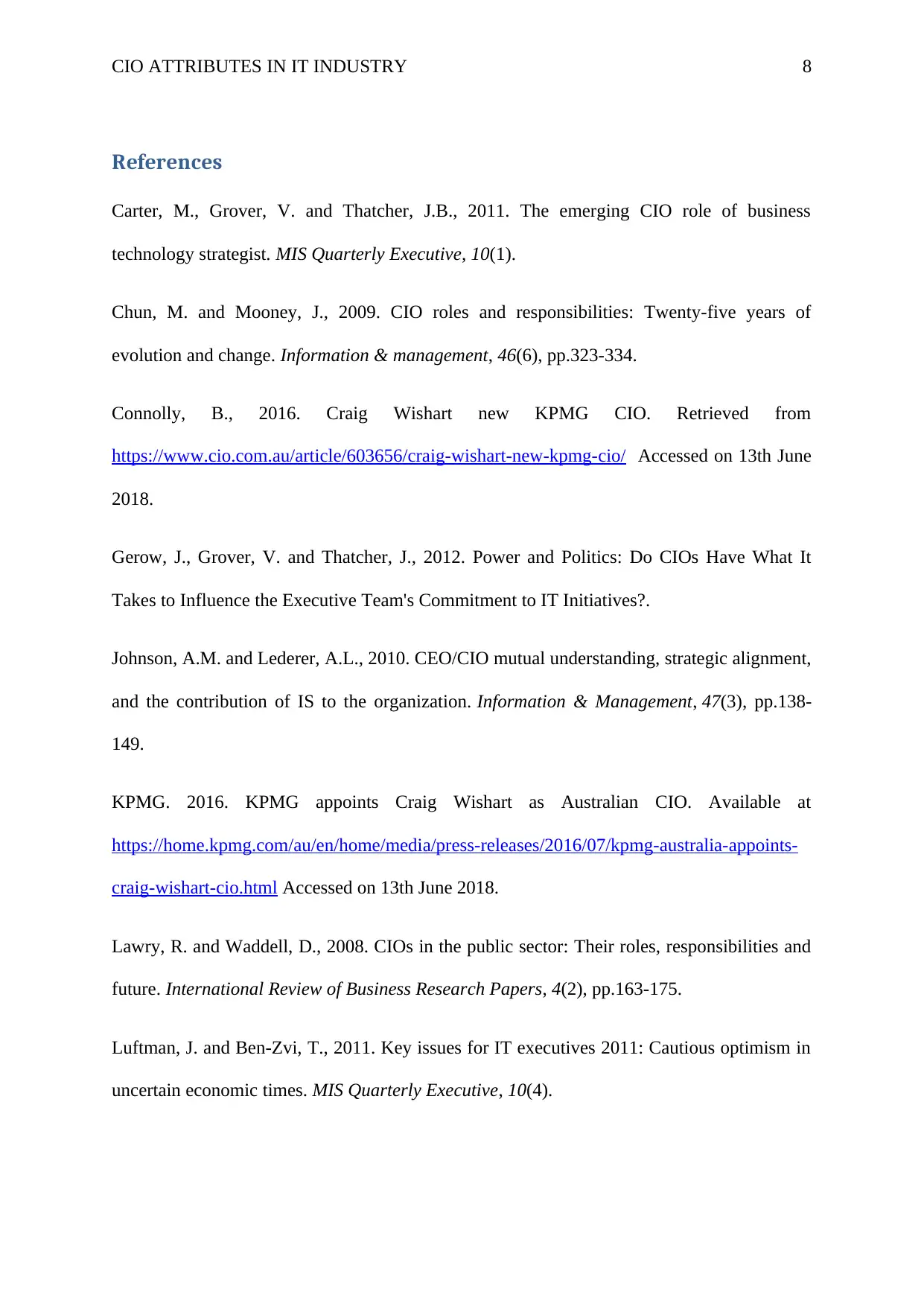
References
Carter, M., Grover, V. and Thatcher, J.B., 2011. The emerging CIO role of business
technology strategist. MIS Quarterly Executive, 10(1).
Chun, M. and Mooney, J., 2009. CIO roles and responsibilities: Twenty-five years of
evolution and change. Information & management, 46(6), pp.323-334.
Connolly, B., 2016. Craig Wishart new KPMG CIO. Retrieved from
https://www.cio.com.au/article/603656/craig-wishart-new-kpmg-cio/ Accessed on 13th June
2018.
Gerow, J., Grover, V. and Thatcher, J., 2012. Power and Politics: Do CIOs Have What It
Takes to Influence the Executive Team's Commitment to IT Initiatives?.
Johnson, A.M. and Lederer, A.L., 2010. CEO/CIO mutual understanding, strategic alignment,
and the contribution of IS to the organization. Information & Management, 47(3), pp.138-
149.
KPMG. 2016. KPMG appoints Craig Wishart as Australian CIO. Available at
https://home.kpmg.com/au/en/home/media/press-releases/2016/07/kpmg-australia-appoints-
craig-wishart-cio.html Accessed on 13th June 2018.
Lawry, R. and Waddell, D., 2008. CIOs in the public sector: Their roles, responsibilities and
future. International Review of Business Research Papers, 4(2), pp.163-175.
Luftman, J. and Ben-Zvi, T., 2011. Key issues for IT executives 2011: Cautious optimism in
uncertain economic times. MIS Quarterly Executive, 10(4).
References
Carter, M., Grover, V. and Thatcher, J.B., 2011. The emerging CIO role of business
technology strategist. MIS Quarterly Executive, 10(1).
Chun, M. and Mooney, J., 2009. CIO roles and responsibilities: Twenty-five years of
evolution and change. Information & management, 46(6), pp.323-334.
Connolly, B., 2016. Craig Wishart new KPMG CIO. Retrieved from
https://www.cio.com.au/article/603656/craig-wishart-new-kpmg-cio/ Accessed on 13th June
2018.
Gerow, J., Grover, V. and Thatcher, J., 2012. Power and Politics: Do CIOs Have What It
Takes to Influence the Executive Team's Commitment to IT Initiatives?.
Johnson, A.M. and Lederer, A.L., 2010. CEO/CIO mutual understanding, strategic alignment,
and the contribution of IS to the organization. Information & Management, 47(3), pp.138-
149.
KPMG. 2016. KPMG appoints Craig Wishart as Australian CIO. Available at
https://home.kpmg.com/au/en/home/media/press-releases/2016/07/kpmg-australia-appoints-
craig-wishart-cio.html Accessed on 13th June 2018.
Lawry, R. and Waddell, D., 2008. CIOs in the public sector: Their roles, responsibilities and
future. International Review of Business Research Papers, 4(2), pp.163-175.
Luftman, J. and Ben-Zvi, T., 2011. Key issues for IT executives 2011: Cautious optimism in
uncertain economic times. MIS Quarterly Executive, 10(4).
⊘ This is a preview!⊘
Do you want full access?
Subscribe today to unlock all pages.
Trusted by 1+ million students worldwide
CIO ATTRIBUTES IN IT INDUSTRY 9
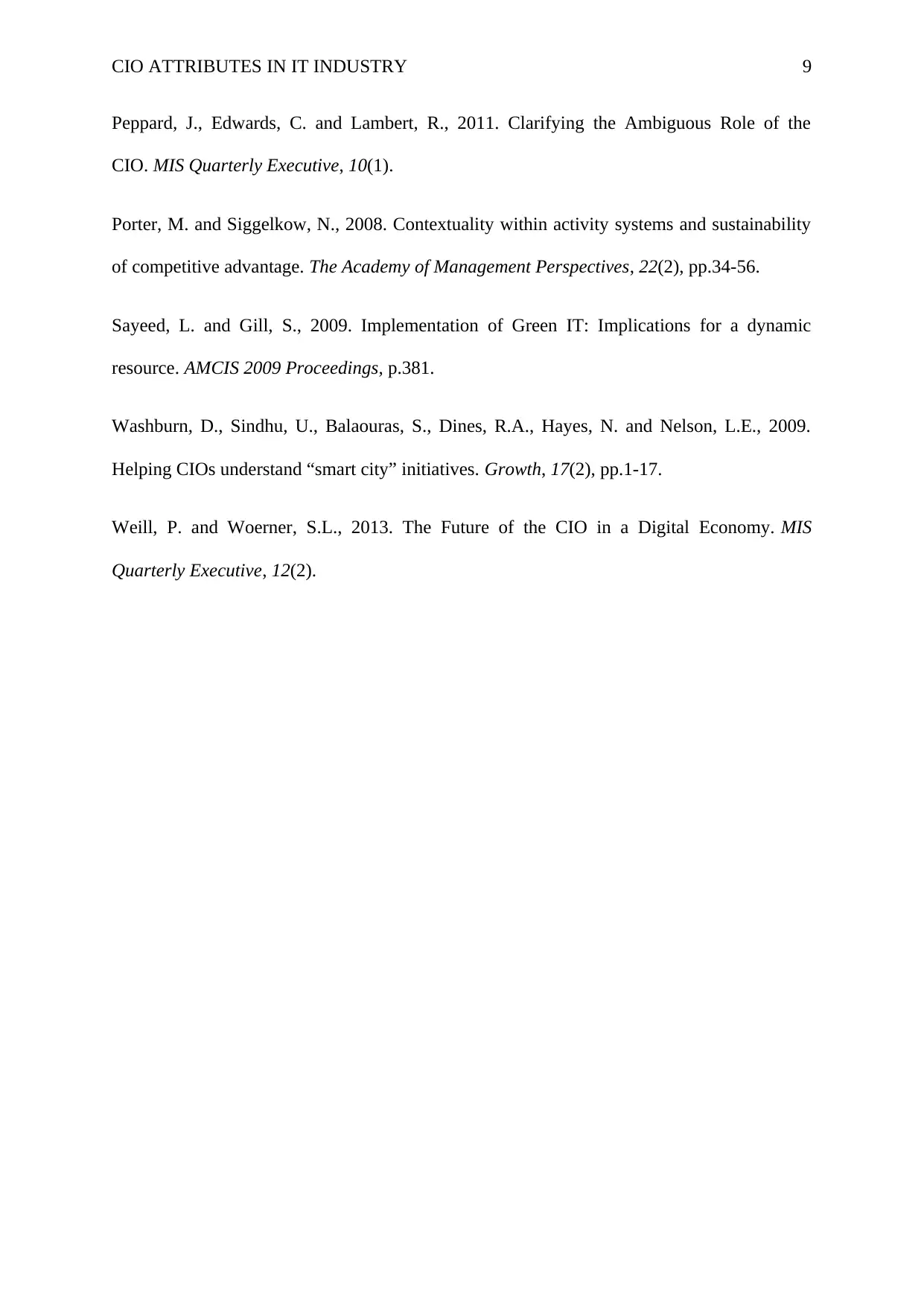
Peppard, J., Edwards, C. and Lambert, R., 2011. Clarifying the Ambiguous Role of the
CIO. MIS Quarterly Executive, 10(1).
Porter, M. and Siggelkow, N., 2008. Contextuality within activity systems and sustainability
of competitive advantage. The Academy of Management Perspectives, 22(2), pp.34-56.
Sayeed, L. and Gill, S., 2009. Implementation of Green IT: Implications for a dynamic
resource. AMCIS 2009 Proceedings, p.381.
Washburn, D., Sindhu, U., Balaouras, S., Dines, R.A., Hayes, N. and Nelson, L.E., 2009.
Helping CIOs understand “smart city” initiatives. Growth, 17(2), pp.1-17.
Weill, P. and Woerner, S.L., 2013. The Future of the CIO in a Digital Economy. MIS
Quarterly Executive, 12(2).
Peppard, J., Edwards, C. and Lambert, R., 2011. Clarifying the Ambiguous Role of the
CIO. MIS Quarterly Executive, 10(1).
Porter, M. and Siggelkow, N., 2008. Contextuality within activity systems and sustainability
of competitive advantage. The Academy of Management Perspectives, 22(2), pp.34-56.
Sayeed, L. and Gill, S., 2009. Implementation of Green IT: Implications for a dynamic
resource. AMCIS 2009 Proceedings, p.381.
Washburn, D., Sindhu, U., Balaouras, S., Dines, R.A., Hayes, N. and Nelson, L.E., 2009.
Helping CIOs understand “smart city” initiatives. Growth, 17(2), pp.1-17.
Weill, P. and Woerner, S.L., 2013. The Future of the CIO in a Digital Economy. MIS
Quarterly Executive, 12(2).

1 out of 10


Related Documents


Your All-in-One AI-Powered Toolkit for Academic Success.
+13062052269
info@desklib.com
Available 24*7 on WhatsApp / Email
![[object Object]](/_next/static/media/star-bottom.7253800d.svg)
Unlock your academic potential
Copyright © 2020–2026 A2Z Services. All Rights Reserved. Developed and managed by ZUCOL.