ENGT5220 - Circular Economy for Electric Motorcycles
VerifiedAdded on 2022/09/22
|20
|5106
|19
Report
AI Summary
This report, prepared for the Low-Impact Manufacturing module (ENGT5220) at De Montfort University, examines the application of the circular economy to electric motorcycles. It provides an executive summary, a detailed description of various motorcycle components (structural, electrical, and miscellaneous) and their potential for circular economy integration, and an analysis of the product lifecycle stages within a sustainable industrial system. The report emphasizes the reuse and recycling of materials like steel, aluminum, and lithium-ion batteries, and it proposes short-term and long-term sustainability strategies for the company. It also addresses relevant policies, standards, and regulations for achieving a successful circular economy in the context of electric motorcycle manufacturing, highlighting the importance of reducing waste and promoting a regenerative economic model.
Module Name: Low-Impact Manufacturing
Module Code: ENGT5220
Assignment Title: The Circular Economy
1 | P a g e
Module Code: ENGT5220
Assignment Title: The Circular Economy
1 | P a g e

Paraphrase This Document
Need a fresh take? Get an instant paraphrase of this document with our AI Paraphraser
Executive summary:
Electric fuelled bikes may not be set up for prime time in the bike business, however it
appears to be evident that they are ready to wind up aggressive with portions of the market
sooner rather than later. In this assignment a complete description of the circular economy
has been done as well as the concept of the circular economy has been portrayed in a
systematic manner. E-motorcycle is in the top position in the market as per the consumer
demand and for that it is a big part of the circular economy. This assignment completely
reflect the interrelation of the various parts of the e- motorcycle and its application to the
circular economy. Also stage of the product lifecycle has been elaborated with authentic
information and also the future development process has been discussed.
2 | P a g e
Electric fuelled bikes may not be set up for prime time in the bike business, however it
appears to be evident that they are ready to wind up aggressive with portions of the market
sooner rather than later. In this assignment a complete description of the circular economy
has been done as well as the concept of the circular economy has been portrayed in a
systematic manner. E-motorcycle is in the top position in the market as per the consumer
demand and for that it is a big part of the circular economy. This assignment completely
reflect the interrelation of the various parts of the e- motorcycle and its application to the
circular economy. Also stage of the product lifecycle has been elaborated with authentic
information and also the future development process has been discussed.
2 | P a g e
Table of Contents
1.0 Introduction.....................................................................................................................4
1.1 Report Background..........................................................................................................4
1.2 Circular Economy Concept..............................................................................................4
1.3 Key Goals.........................................................................................................................4
2.0 Description of the Different Parts and their Application in Circular Economy...................5
2.1 Structural Parts.................................................................................................................5
2.2 Electrical Parts.................................................................................................................8
2.3 Miscellaneous Parts........................................................................................................10
3.0 Stages of Product Life Cycle in a Future Sustainable Industrial System...........................11
3.1 Raw Materials Stage......................................................................................................11
3.1.1 Increasing the Recycling of Motorcycle Parts........................................................11
3.1.2 Preventing Depletion of Natural Resources............................................................12
3.1.3 Saving Energy Resources on Processing................................................................12
3.2 Production Stage............................................................................................................12
3.2.1 Preventing Green House Gas Emissions.................................................................12
3.2.2 Preventing Air Pollution and Its Impact on the Ecosystem....................................12
3.3 Use Stage........................................................................................................................13
3.3.1 Greenhouse Gas Emissions.....................................................................................13
3.3.2 Battery Recharge Stations.......................................................................................13
3.4. Vehicle End of Life Stage.............................................................................................13
3.4.1 Health Impact..........................................................................................................13
4.0 Future Short-Term and Long-Term Steps for Achieving Sustainability...........................14
4.1 Short and Long Terms Steps of the Company Regarding Various Components...........14
4.2 Policies, Standards and Regulations..............................................................................15
Conclusion................................................................................................................................15
Reference List..........................................................................................................................16
3 | P a g e
1.0 Introduction.....................................................................................................................4
1.1 Report Background..........................................................................................................4
1.2 Circular Economy Concept..............................................................................................4
1.3 Key Goals.........................................................................................................................4
2.0 Description of the Different Parts and their Application in Circular Economy...................5
2.1 Structural Parts.................................................................................................................5
2.2 Electrical Parts.................................................................................................................8
2.3 Miscellaneous Parts........................................................................................................10
3.0 Stages of Product Life Cycle in a Future Sustainable Industrial System...........................11
3.1 Raw Materials Stage......................................................................................................11
3.1.1 Increasing the Recycling of Motorcycle Parts........................................................11
3.1.2 Preventing Depletion of Natural Resources............................................................12
3.1.3 Saving Energy Resources on Processing................................................................12
3.2 Production Stage............................................................................................................12
3.2.1 Preventing Green House Gas Emissions.................................................................12
3.2.2 Preventing Air Pollution and Its Impact on the Ecosystem....................................12
3.3 Use Stage........................................................................................................................13
3.3.1 Greenhouse Gas Emissions.....................................................................................13
3.3.2 Battery Recharge Stations.......................................................................................13
3.4. Vehicle End of Life Stage.............................................................................................13
3.4.1 Health Impact..........................................................................................................13
4.0 Future Short-Term and Long-Term Steps for Achieving Sustainability...........................14
4.1 Short and Long Terms Steps of the Company Regarding Various Components...........14
4.2 Policies, Standards and Regulations..............................................................................15
Conclusion................................................................................................................................15
Reference List..........................................................................................................................16
3 | P a g e
⊘ This is a preview!⊘
Do you want full access?
Subscribe today to unlock all pages.

Trusted by 1+ million students worldwide
Appendix 1: Circular Economy Concept.................................................................................18
Appendix 2: Electric Motorcycle Chassis................................................................................18
Appendix 3: Stages of Product Life Cycle...............................................................................19
4 | P a g e
Appendix 2: Electric Motorcycle Chassis................................................................................18
Appendix 3: Stages of Product Life Cycle...............................................................................19
4 | P a g e
Paraphrase This Document
Need a fresh take? Get an instant paraphrase of this document with our AI Paraphraser
1.0 Introduction
1.1 Report Background
The report has been presented from the perspective of a sustainability manager of electric
motorcycle manufacturer to transform the linear flow of material and energy to a circular
economy. The application of circular economy concept in the company and its products
involves reusing and recycling of the structural, electrical and miscellaneous components of
electric motorcycles to ensure a sustainable future. The various components of electric
motorcycle and the degree to which their design might affect their sustainability for circular
economy have been included in the report. Additionally, the life cycle stages of the
company’s product for a future sustainable industrial system has also been proposed. Finally,
the company’s future short-term and long-term plan for each of the components to achieve
sustainability has been mentioned along with the policies, standards and regulations the
company should implement to achieve a successful circular economy.
1.2 Circular Economy Concept
A circular economy is a financial framework where items and administrations are exchanged
shut circles or 'cycles'. A circular economy is described as an economy which is regenerative
by structure, with the plan to hold however much incentive as could be expected of items,
parts, and materials. This implies the point ought to be to make a framework that considers
the long life, ideal reuse, renovation, remanufacturing and reuse of items and materials.
(Bocken et al., 2018). In a circular economy material cycles are shut by following the case of
common environments, in this way harmful substances are killed and there is no waste since
every single lingering stream are significant as an asset (refer to appendix 1). Additionally,
items are reclaimed after use for fix and remanufacturing so as to reuse the items a second,
third or fourth time, and leftover streams are isolated in a natural and specialized cycle
(Potential for Denmark as a circular economy, 2015).
1.3 Key Goals
The key goals of this report are to:
● Bring together existing proof on the natural effect of Battery Electric Vehicles over
the existence cycle stages.
● Consider how a transition to a round economy could decrease these present effects.
5 | P a g e
1.1 Report Background
The report has been presented from the perspective of a sustainability manager of electric
motorcycle manufacturer to transform the linear flow of material and energy to a circular
economy. The application of circular economy concept in the company and its products
involves reusing and recycling of the structural, electrical and miscellaneous components of
electric motorcycles to ensure a sustainable future. The various components of electric
motorcycle and the degree to which their design might affect their sustainability for circular
economy have been included in the report. Additionally, the life cycle stages of the
company’s product for a future sustainable industrial system has also been proposed. Finally,
the company’s future short-term and long-term plan for each of the components to achieve
sustainability has been mentioned along with the policies, standards and regulations the
company should implement to achieve a successful circular economy.
1.2 Circular Economy Concept
A circular economy is a financial framework where items and administrations are exchanged
shut circles or 'cycles'. A circular economy is described as an economy which is regenerative
by structure, with the plan to hold however much incentive as could be expected of items,
parts, and materials. This implies the point ought to be to make a framework that considers
the long life, ideal reuse, renovation, remanufacturing and reuse of items and materials.
(Bocken et al., 2018). In a circular economy material cycles are shut by following the case of
common environments, in this way harmful substances are killed and there is no waste since
every single lingering stream are significant as an asset (refer to appendix 1). Additionally,
items are reclaimed after use for fix and remanufacturing so as to reuse the items a second,
third or fourth time, and leftover streams are isolated in a natural and specialized cycle
(Potential for Denmark as a circular economy, 2015).
1.3 Key Goals
The key goals of this report are to:
● Bring together existing proof on the natural effect of Battery Electric Vehicles over
the existence cycle stages.
● Consider how a transition to a round economy could decrease these present effects.
5 | P a g e
● Research discoveries on natural effects from the distinctive life cycle phases of
electric vehicles are united with regards to the circular economy.
● Recommendations to guarantee that electric vehicles contribute their actual potential
to natural objectives. This is especially appropriate given the desires that electric
vehicles will accomplish air quality and environmental change objectives.
These proposals think about how a transition to a roundabout economy could lessen these
effects. Existing cooperative energies and regions where there are further open doors are
featured (European environment agency, 2018).
2.0 Description of the Different Parts and their Application in Circular Economy
2.1 Structural Parts
Presently, the electric motorcycle manufacturing company is following a linear material and
energy flow where none of its components are reused or recycled. For this reason, the
industrial wastage of the company is very high and cannot be considered a sustainable
industrial system (De Jesus et al., 2018). Of the various types of components, the structural
and miscellaneous parts are manufactured by the company and should be applied in the
circular economy. Most of the electric parts, however, are manufactured by the suppliers and
assembled in the factory. Therefore, not much can be done to include them in the circular
economy as the company does not have any waste product from them. Moreover, as the
company does not manufacture these parts, old products cannot be recycled to manufacture
new products and the company prefers to send them back to the suppliers who can probably
recycle them in their own sustainable industrial system for manufacturing new products. The
various components of the electric motorcycle and their design that might affect the
sustainability in the circular economy has been described below.
6 | P a g e
electric vehicles are united with regards to the circular economy.
● Recommendations to guarantee that electric vehicles contribute their actual potential
to natural objectives. This is especially appropriate given the desires that electric
vehicles will accomplish air quality and environmental change objectives.
These proposals think about how a transition to a roundabout economy could lessen these
effects. Existing cooperative energies and regions where there are further open doors are
featured (European environment agency, 2018).
2.0 Description of the Different Parts and their Application in Circular Economy
2.1 Structural Parts
Presently, the electric motorcycle manufacturing company is following a linear material and
energy flow where none of its components are reused or recycled. For this reason, the
industrial wastage of the company is very high and cannot be considered a sustainable
industrial system (De Jesus et al., 2018). Of the various types of components, the structural
and miscellaneous parts are manufactured by the company and should be applied in the
circular economy. Most of the electric parts, however, are manufactured by the suppliers and
assembled in the factory. Therefore, not much can be done to include them in the circular
economy as the company does not have any waste product from them. Moreover, as the
company does not manufacture these parts, old products cannot be recycled to manufacture
new products and the company prefers to send them back to the suppliers who can probably
recycle them in their own sustainable industrial system for manufacturing new products. The
various components of the electric motorcycle and their design that might affect the
sustainability in the circular economy has been described below.
6 | P a g e
⊘ This is a preview!⊘
Do you want full access?
Subscribe today to unlock all pages.
Trusted by 1+ million students worldwide
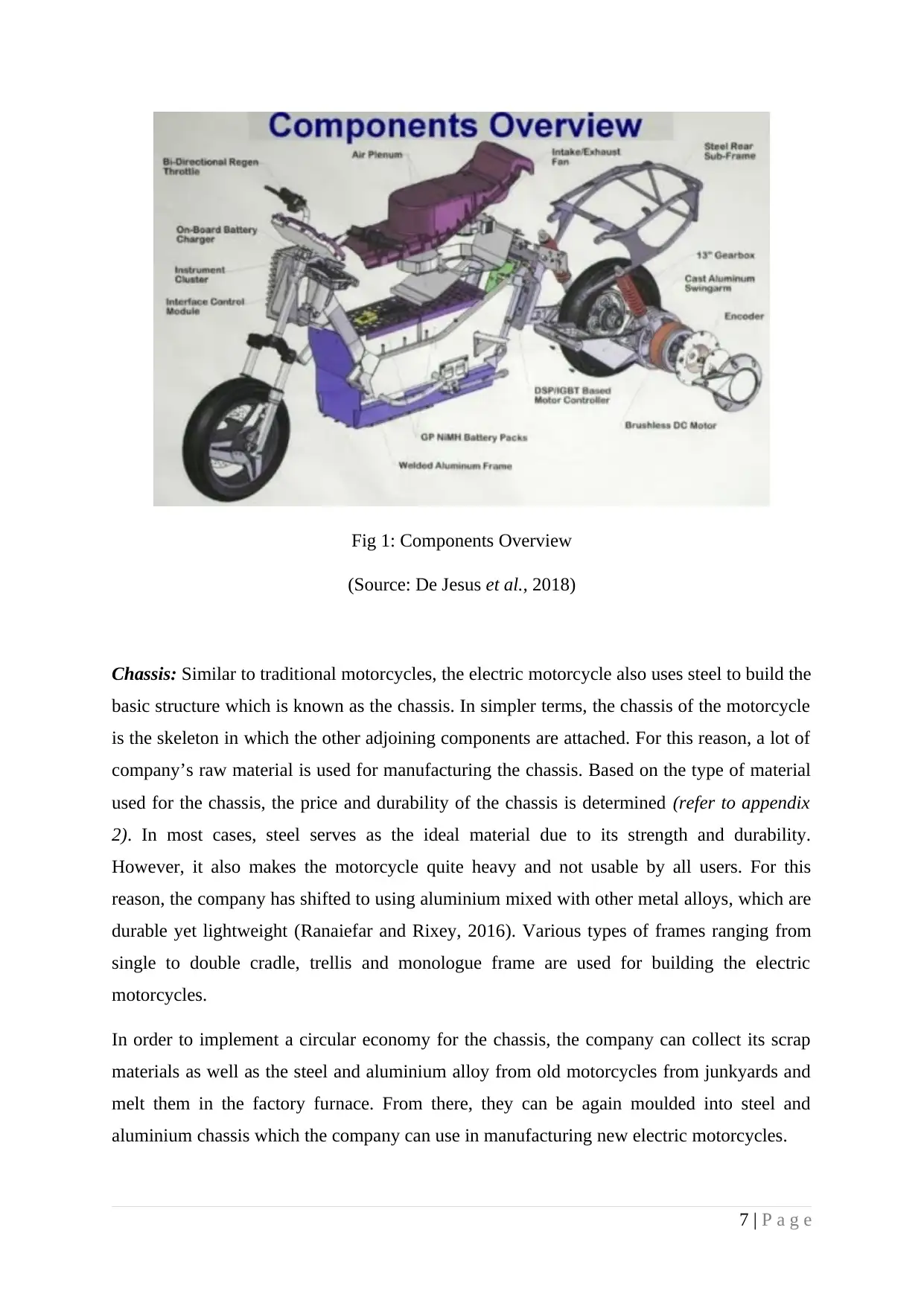
Fig 1: Components Overview
(Source: De Jesus et al., 2018)
Chassis: Similar to traditional motorcycles, the electric motorcycle also uses steel to build the
basic structure which is known as the chassis. In simpler terms, the chassis of the motorcycle
is the skeleton in which the other adjoining components are attached. For this reason, a lot of
company’s raw material is used for manufacturing the chassis. Based on the type of material
used for the chassis, the price and durability of the chassis is determined (refer to appendix
2). In most cases, steel serves as the ideal material due to its strength and durability.
However, it also makes the motorcycle quite heavy and not usable by all users. For this
reason, the company has shifted to using aluminium mixed with other metal alloys, which are
durable yet lightweight (Ranaiefar and Rixey, 2016). Various types of frames ranging from
single to double cradle, trellis and monologue frame are used for building the electric
motorcycles.
In order to implement a circular economy for the chassis, the company can collect its scrap
materials as well as the steel and aluminium alloy from old motorcycles from junkyards and
melt them in the factory furnace. From there, they can be again moulded into steel and
aluminium chassis which the company can use in manufacturing new electric motorcycles.
7 | P a g e
(Source: De Jesus et al., 2018)
Chassis: Similar to traditional motorcycles, the electric motorcycle also uses steel to build the
basic structure which is known as the chassis. In simpler terms, the chassis of the motorcycle
is the skeleton in which the other adjoining components are attached. For this reason, a lot of
company’s raw material is used for manufacturing the chassis. Based on the type of material
used for the chassis, the price and durability of the chassis is determined (refer to appendix
2). In most cases, steel serves as the ideal material due to its strength and durability.
However, it also makes the motorcycle quite heavy and not usable by all users. For this
reason, the company has shifted to using aluminium mixed with other metal alloys, which are
durable yet lightweight (Ranaiefar and Rixey, 2016). Various types of frames ranging from
single to double cradle, trellis and monologue frame are used for building the electric
motorcycles.
In order to implement a circular economy for the chassis, the company can collect its scrap
materials as well as the steel and aluminium alloy from old motorcycles from junkyards and
melt them in the factory furnace. From there, they can be again moulded into steel and
aluminium chassis which the company can use in manufacturing new electric motorcycles.
7 | P a g e
Paraphrase This Document
Need a fresh take? Get an instant paraphrase of this document with our AI Paraphraser
Wheels:Similar to the chassis, the company is also using aluminium alloys to manufacture
the wheel hubs to make it lighter yet durable. However, instead of using aluminium rims, the
company has decided to stick to steel rims which increase the wheels’ capacity to withstand
more stress on road (Semanticscholar, 2019). The company was planning to shift to carbon-
fibre materials similar to sports bikes but that exceeded the company’s sustainable model as
they are very expensive.
Similar to the chassis, the wheel hubs and rims can be recycled from old motorcycles and
left-over materials to manufacture new and customized wheels for new company products.
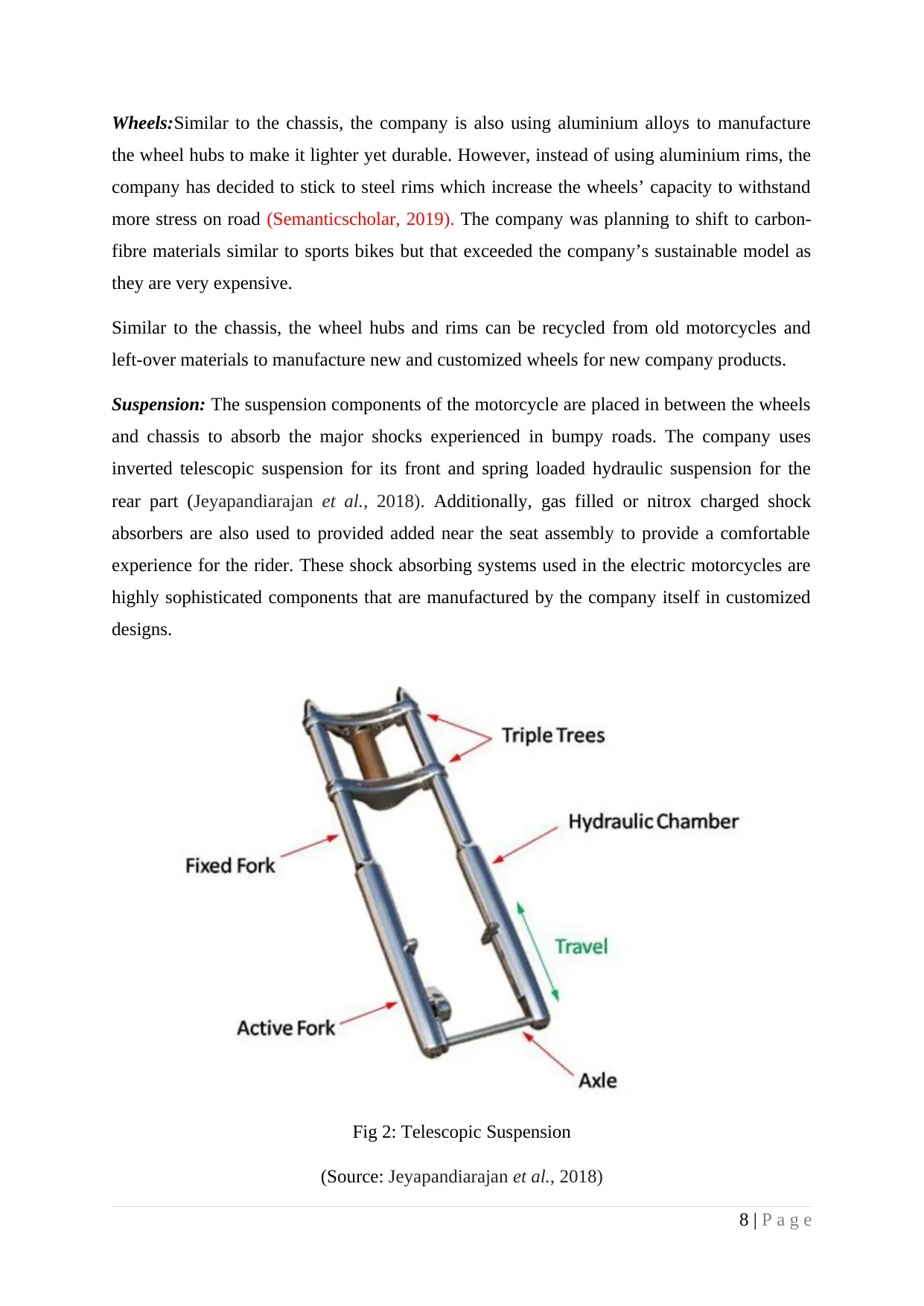
Suspension: The suspension components of the motorcycle are placed in between the wheels
and chassis to absorb the major shocks experienced in bumpy roads. The company uses
inverted telescopic suspension for its front and spring loaded hydraulic suspension for the
rear part (Jeyapandiarajan et al., 2018). Additionally, gas filled or nitrox charged shock
absorbers are also used to provided added near the seat assembly to provide a comfortable
experience for the rider. These shock absorbing systems used in the electric motorcycles are
highly sophisticated components that are manufactured by the company itself in customized
designs.
Fig 2: Telescopic Suspension
(Source: Jeyapandiarajan et al., 2018)
8 | P a g e
the wheel hubs to make it lighter yet durable. However, instead of using aluminium rims, the
company has decided to stick to steel rims which increase the wheels’ capacity to withstand
more stress on road (Semanticscholar, 2019). The company was planning to shift to carbon-
fibre materials similar to sports bikes but that exceeded the company’s sustainable model as
they are very expensive.
Similar to the chassis, the wheel hubs and rims can be recycled from old motorcycles and
left-over materials to manufacture new and customized wheels for new company products.
Suspension: The suspension components of the motorcycle are placed in between the wheels
and chassis to absorb the major shocks experienced in bumpy roads. The company uses
inverted telescopic suspension for its front and spring loaded hydraulic suspension for the
rear part (Jeyapandiarajan et al., 2018). Additionally, gas filled or nitrox charged shock
absorbers are also used to provided added near the seat assembly to provide a comfortable
experience for the rider. These shock absorbing systems used in the electric motorcycles are
highly sophisticated components that are manufactured by the company itself in customized
designs.
Fig 2: Telescopic Suspension
(Source: Jeyapandiarajan et al., 2018)
8 | P a g e
The suspension systems used by the company are state-of-the-art technology which the
company doesn’t manufacture themselves. They are being supplied by suspension specialist
firms and assembled in company warehouses. The best way to implement them in the circular
economy is by sending old suspension systems back to the suppliers who can recycle them to
make new suspension systems.
Seat Assembly: Known as the ‘saddle’ in some regions, the seat assembly is designed just
behind the fuel tank of the electric motorcycle. The seat assembly can be either solo or dual
saddle, but the most common type is the dual model which is used by the company
(Pencilkings 2019). The seat assembly is made comfortable by adding sponge and lining it
with either rexine or leather.
The company manufactures the seat assembly structure but uses leather and rexine from
suppliers to cover the seat assembly. The only way to include this component in the circular
economy is to reuse seat assembly structure and leave the lining materials for the suppliers to
provide.
2.2 Electrical Parts
Motors: The main electrical component of the electric motorcycle is the motor which is
attached below the fuel tank and seat assembly and connected with the wheels with the help
of pistons and levers. As the component that helps the motorcycle to move forwards, the
company uses 350W motors with 2400RPM capacity and a torque of 3Nm (Jeyapandiarajan
et al., 2018)
9 | P a g e
company doesn’t manufacture themselves. They are being supplied by suspension specialist
firms and assembled in company warehouses. The best way to implement them in the circular
economy is by sending old suspension systems back to the suppliers who can recycle them to
make new suspension systems.
Seat Assembly: Known as the ‘saddle’ in some regions, the seat assembly is designed just
behind the fuel tank of the electric motorcycle. The seat assembly can be either solo or dual
saddle, but the most common type is the dual model which is used by the company
(Pencilkings 2019). The seat assembly is made comfortable by adding sponge and lining it
with either rexine or leather.
The company manufactures the seat assembly structure but uses leather and rexine from
suppliers to cover the seat assembly. The only way to include this component in the circular
economy is to reuse seat assembly structure and leave the lining materials for the suppliers to
provide.
2.2 Electrical Parts
Motors: The main electrical component of the electric motorcycle is the motor which is
attached below the fuel tank and seat assembly and connected with the wheels with the help
of pistons and levers. As the component that helps the motorcycle to move forwards, the
company uses 350W motors with 2400RPM capacity and a torque of 3Nm (Jeyapandiarajan
et al., 2018)
9 | P a g e
⊘ This is a preview!⊘
Do you want full access?
Subscribe today to unlock all pages.
Trusted by 1+ million students worldwide
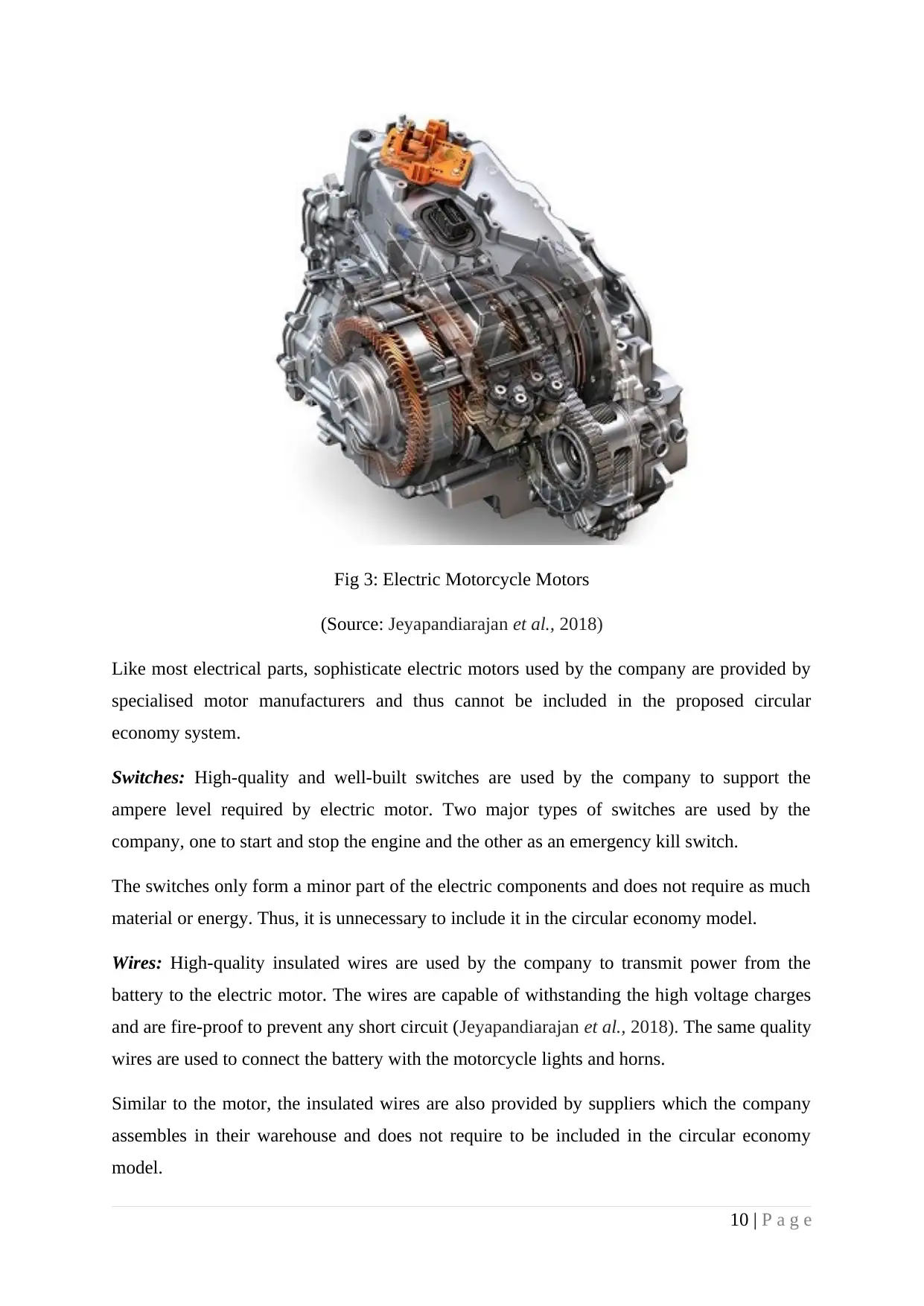
Fig 3: Electric Motorcycle Motors
(Source: Jeyapandiarajan et al., 2018)
Like most electrical parts, sophisticate electric motors used by the company are provided by
specialised motor manufacturers and thus cannot be included in the proposed circular
economy system.
Switches: High-quality and well-built switches are used by the company to support the
ampere level required by electric motor. Two major types of switches are used by the
company, one to start and stop the engine and the other as an emergency kill switch.
The switches only form a minor part of the electric components and does not require as much
material or energy. Thus, it is unnecessary to include it in the circular economy model.
Wires: High-quality insulated wires are used by the company to transmit power from the
battery to the electric motor. The wires are capable of withstanding the high voltage charges
and are fire-proof to prevent any short circuit (Jeyapandiarajan et al., 2018). The same quality
wires are used to connect the battery with the motorcycle lights and horns.
Similar to the motor, the insulated wires are also provided by suppliers which the company
assembles in their warehouse and does not require to be included in the circular economy
model.
10 | P a g e
(Source: Jeyapandiarajan et al., 2018)
Like most electrical parts, sophisticate electric motors used by the company are provided by
specialised motor manufacturers and thus cannot be included in the proposed circular
economy system.
Switches: High-quality and well-built switches are used by the company to support the
ampere level required by electric motor. Two major types of switches are used by the
company, one to start and stop the engine and the other as an emergency kill switch.
The switches only form a minor part of the electric components and does not require as much
material or energy. Thus, it is unnecessary to include it in the circular economy model.
Wires: High-quality insulated wires are used by the company to transmit power from the
battery to the electric motor. The wires are capable of withstanding the high voltage charges
and are fire-proof to prevent any short circuit (Jeyapandiarajan et al., 2018). The same quality
wires are used to connect the battery with the motorcycle lights and horns.
Similar to the motor, the insulated wires are also provided by suppliers which the company
assembles in their warehouse and does not require to be included in the circular economy
model.
10 | P a g e
Paraphrase This Document
Need a fresh take? Get an instant paraphrase of this document with our AI Paraphraser
Circuit Boards: Silicon wired circuit boards are used by the company as they are more
sustainable for the company’s business. The circuit and PCB boards are used to connect the
internal wiring with the respective motorcycle components that require power from the
battery.
The company has contracted circuit board manufacturers that supply special customized
circuit boards based on the company’s requirements. However, the company can send back
faulty and old circuit boards to their suppliers for recycling them for future use.
Batteries: Lithium-ion rechargeable batteries with voltages varying from 24-60V are used by
the company with about 10-45 Ah capacity (Hanifah et al., 2019). These batteries provide an
average speed of 25-50 Km/hr and can hold charge for up to 60-100 kms in one charge cycle.
The electric vehicle battery is a completely separate sub-industry within the automobile
industry and requires a lot of technological and innovative research. The company cannot
recycle them but can send back old batteries which can be used by the suppliers for extracting
the acid and electrodes for future use.
2.3 Miscellaneous Parts
Tyres: Customized gripped tyres are supplied by tyre manufacturers that the company
assembles around their metal wheels. This is necessary as specialist tyre manufacturers
ensures safe road experience without the risk of skidding or bursting due to friction.
Tyres are one of the most reused and recycled motorbike components and the company can
actively participate in circular economy by providing used old tyres in return of discount on
new tyres from the suppliers.
Transmission: Quartz transmission systems are used by the company to provide high throttle
and motor functions in their electric motorcycles. This type of secured transmission system is
necessary for stable and longer performances (Hanifah et al., 2019). In addition to the
increased life span, the quartz transmission system also helps the electric motorcycle achieve
high torque.
The transmission system is taken from other suppliers and cannot be included in the circular
economy system.
11 | P a g e
sustainable for the company’s business. The circuit and PCB boards are used to connect the
internal wiring with the respective motorcycle components that require power from the
battery.
The company has contracted circuit board manufacturers that supply special customized
circuit boards based on the company’s requirements. However, the company can send back
faulty and old circuit boards to their suppliers for recycling them for future use.
Batteries: Lithium-ion rechargeable batteries with voltages varying from 24-60V are used by
the company with about 10-45 Ah capacity (Hanifah et al., 2019). These batteries provide an
average speed of 25-50 Km/hr and can hold charge for up to 60-100 kms in one charge cycle.
The electric vehicle battery is a completely separate sub-industry within the automobile
industry and requires a lot of technological and innovative research. The company cannot
recycle them but can send back old batteries which can be used by the suppliers for extracting
the acid and electrodes for future use.
2.3 Miscellaneous Parts
Tyres: Customized gripped tyres are supplied by tyre manufacturers that the company
assembles around their metal wheels. This is necessary as specialist tyre manufacturers
ensures safe road experience without the risk of skidding or bursting due to friction.
Tyres are one of the most reused and recycled motorbike components and the company can
actively participate in circular economy by providing used old tyres in return of discount on
new tyres from the suppliers.
Transmission: Quartz transmission systems are used by the company to provide high throttle
and motor functions in their electric motorcycles. This type of secured transmission system is
necessary for stable and longer performances (Hanifah et al., 2019). In addition to the
increased life span, the quartz transmission system also helps the electric motorcycle achieve
high torque.
The transmission system is taken from other suppliers and cannot be included in the circular
economy system.
11 | P a g e
Bodywork: The Company manufactures their own body work and assembles them over the
chassis and other components. This is necessary so that company can produce its own style
and design of body work which is also very durable.
The company can recycle their own unused body parts and industrial waste for
remanufacturing the bodywork and can achieve a sustainable business model due to the
circular material and energy flow.
Upholstery: These components includes the fabrics and dash boards used in the electric
motorcycle and are manufactured by the company itself. This can be included in the circular
economy model as the company gets a lot customer servicing that requires changing of such
damaged upholstery components (Rieger et al., 2016). The company can use their spare
upholstery parts for repairing customer damaged motorcycles to generate some extra revenue
for the sustainable business model.
3.0 Stages of Product Life Cycle in a Future Sustainable Industrial System
In the future sustainable industrial system, the various life cycle stages of the company’
products play a key role in energy and material flow in the circular economy model. The
impacts of these life cycle stages can be seen on climate change, ozone depletion, resource
depletion, Eco toxicity and also health impacts in humans (Li et al., 2014). The major life
cycle stages in the future sustainable industrial system include the raw material stage,
production stage, use stage and vehicle end of life stage. Of these, the raw material stage can
be further divided in mining of raw materials and processing them to their usable forms
(refer to appendix 3). Also, the production stage is subdivided into manufacturing of
components and production of the electric motorcycle itself. Each of the product life cycle
stages has been explained in details on how they can contribute to the circular economy and
reduce the material and energy flow of the company.
3.1 Raw Materials Stage
The circular economy can be implemented in the raw material stage with the help some of the
innovative approach mentioned below.
3.1.1 Increasing the Recycling of Motorcycle Parts
The company should include all its suppliers and manufacturing partners in increasing the
recycle of spare and scrape parts of old products. Even the waste materials from the
manufacturing factories can be reused in producing future components by refining them in
12 | P a g e
chassis and other components. This is necessary so that company can produce its own style
and design of body work which is also very durable.
The company can recycle their own unused body parts and industrial waste for
remanufacturing the bodywork and can achieve a sustainable business model due to the
circular material and energy flow.
Upholstery: These components includes the fabrics and dash boards used in the electric
motorcycle and are manufactured by the company itself. This can be included in the circular
economy model as the company gets a lot customer servicing that requires changing of such
damaged upholstery components (Rieger et al., 2016). The company can use their spare
upholstery parts for repairing customer damaged motorcycles to generate some extra revenue
for the sustainable business model.
3.0 Stages of Product Life Cycle in a Future Sustainable Industrial System
In the future sustainable industrial system, the various life cycle stages of the company’
products play a key role in energy and material flow in the circular economy model. The
impacts of these life cycle stages can be seen on climate change, ozone depletion, resource
depletion, Eco toxicity and also health impacts in humans (Li et al., 2014). The major life
cycle stages in the future sustainable industrial system include the raw material stage,
production stage, use stage and vehicle end of life stage. Of these, the raw material stage can
be further divided in mining of raw materials and processing them to their usable forms
(refer to appendix 3). Also, the production stage is subdivided into manufacturing of
components and production of the electric motorcycle itself. Each of the product life cycle
stages has been explained in details on how they can contribute to the circular economy and
reduce the material and energy flow of the company.
3.1 Raw Materials Stage
The circular economy can be implemented in the raw material stage with the help some of the
innovative approach mentioned below.
3.1.1 Increasing the Recycling of Motorcycle Parts
The company should include all its suppliers and manufacturing partners in increasing the
recycle of spare and scrape parts of old products. Even the waste materials from the
manufacturing factories can be reused in producing future components by refining them in
12 | P a g e
⊘ This is a preview!⊘
Do you want full access?
Subscribe today to unlock all pages.
Trusted by 1+ million students worldwide

1 out of 20


Related Documents


Your All-in-One AI-Powered Toolkit for Academic Success.
+13062052269
info@desklib.com
Available 24*7 on WhatsApp / Email
![[object Object]](/_next/static/media/star-bottom.7253800d.svg)
Unlock your academic potential
Copyright © 2020–2026 A2Z Services. All Rights Reserved. Developed and managed by ZUCOL.