City Hospital: Operations, Logistics, Supply Chain Management Report
VerifiedAdded on 2023/01/17
|13
|3809
|52
Report
AI Summary
This report provides an analysis of City Hospital's operational challenges, focusing on issues within urgent and emergency services, as well as services for children and young people. The report explores the application of operational management principles, logistics, and supply chain management to improve the hospital's performance. It highlights the use of Total Quality Management (TQM) to enhance the quality of services provided to young patients, detailing the implementation of TQM principles such as customer focus, employee involvement, process-centered approach, integrated system, strategic approach, continual improvement, fact-based decision making, and communication. Furthermore, the report suggests the use of Just-in-Time (JIT) approach to improve the efficiency of urgent and emergency services. The report provides practical recommendations for City Hospital to address its shortcomings, improve patient care, and achieve its goals by implementing these strategies.
Understanding Operations,
Logistics and Supply Chain
Management
Logistics and Supply Chain
Management

Paraphrase This Document
Need a fresh take? Get an instant paraphrase of this document with our AI Paraphraser
Table of Contents
Exploring issues regarding City Hospital and implementing ways.................................................3
REFERENCES..............................................................................................................................11
Exploring issues regarding City Hospital and implementing ways.................................................3
REFERENCES..............................................................................................................................11
Exploring issues regarding City Hospital and implementing ways
Operation management is defined as an administrative practice of business which is used
for the creation of high-level efficiency within a business. This is concerned about the
conversion of materials and labour into products and services for high profits margins. An
organization needs to have a proper system to manage all its activities and operations effectively
and efficiently (Brett and et. al., 2014). With the help of such system, an organisation can gain
desired profit easily. Along with this, logistics and supply chain management plays an effective
role in managing work in every industry to achieve better results. The hospital chosen for this
essay is City Hospital which was founded in 1887 in England, United Kingdom. This provides
specialist and general hospital services to patients. With change in time and situation, it has faced
issues in terms of services that is provided to children & young people and urgent & emergency
services. Moreover, these issues are also impacting on brand value as well as image of respective
hospital. These are the major issues which created problems in achievement of hospital goal and
objectives. In this report, the improvement ways which are required to be adopted by City
Hospital are discussed. The methods through which problems can be resolved are TQM (Total
Quality Management) and JIT (Just in Time). Here, TQM assist in providing high quality service
to patient and JIT leads to provide timely services. This includes improvement in terms of safe,
caring, responsive, well-led, urgent & emergency, children and young people services.
It is very important for an organisation to adopt various techniques and tools in order to
avoid adverse situations or problems that impact their performance. In the current scenario,
several issues are faced by hospital that creates problems for them to attain their set goals and
objectives. The respective hospital requires improvement in various areas in order to provide
high quality treatment to their service users in a positive and effective manner (Cameron and et.
al., 2014). As per the rating is given by Care Quality Commission (CQC), the areas which they
found for improvement are services for young & children people as well as urgent & emergency
services. The critical care, surgery and maternity, outpatients and diagnostic imaging rated as
good and end of life care as outstanding. With the areas of improvement, it will be able to
provide high quality of services to people and patients. The Report is provided by Sandwell and
West Birmingham Hospital NHS trust to City Hospital in order to do an inspection for
improvements in a particular area. Respective hospital provides medical care services and
treatments to a large number of specialties such as gastroenterology, cardiology, respiratory,
Operation management is defined as an administrative practice of business which is used
for the creation of high-level efficiency within a business. This is concerned about the
conversion of materials and labour into products and services for high profits margins. An
organization needs to have a proper system to manage all its activities and operations effectively
and efficiently (Brett and et. al., 2014). With the help of such system, an organisation can gain
desired profit easily. Along with this, logistics and supply chain management plays an effective
role in managing work in every industry to achieve better results. The hospital chosen for this
essay is City Hospital which was founded in 1887 in England, United Kingdom. This provides
specialist and general hospital services to patients. With change in time and situation, it has faced
issues in terms of services that is provided to children & young people and urgent & emergency
services. Moreover, these issues are also impacting on brand value as well as image of respective
hospital. These are the major issues which created problems in achievement of hospital goal and
objectives. In this report, the improvement ways which are required to be adopted by City
Hospital are discussed. The methods through which problems can be resolved are TQM (Total
Quality Management) and JIT (Just in Time). Here, TQM assist in providing high quality service
to patient and JIT leads to provide timely services. This includes improvement in terms of safe,
caring, responsive, well-led, urgent & emergency, children and young people services.
It is very important for an organisation to adopt various techniques and tools in order to
avoid adverse situations or problems that impact their performance. In the current scenario,
several issues are faced by hospital that creates problems for them to attain their set goals and
objectives. The respective hospital requires improvement in various areas in order to provide
high quality treatment to their service users in a positive and effective manner (Cameron and et.
al., 2014). As per the rating is given by Care Quality Commission (CQC), the areas which they
found for improvement are services for young & children people as well as urgent & emergency
services. The critical care, surgery and maternity, outpatients and diagnostic imaging rated as
good and end of life care as outstanding. With the areas of improvement, it will be able to
provide high quality of services to people and patients. The Report is provided by Sandwell and
West Birmingham Hospital NHS trust to City Hospital in order to do an inspection for
improvements in a particular area. Respective hospital provides medical care services and
treatments to a large number of specialties such as gastroenterology, cardiology, respiratory,
⊘ This is a preview!⊘
Do you want full access?
Subscribe today to unlock all pages.

Trusted by 1+ million students worldwide
elderly medicine and others. Therefore, the inspection was performed without providing notice to
City Hospital in order to check their actual condition in terms of providing treatment and health
care services to patients. They recommend that City hospital needs to implement operation,
logistics and supply chain management theories in order to improve services of young & children
as well as urgent & emergency along with their critical analytic discussion with examples.
In order to improve services for children and young people, managing quality approaches
is used with the help of total quality management theory. City Hospital has received a review in
the context of managing quality where Total Quality Management (TQM) is defined as a
structured approach in order to manage overall practices of firm in an effective and efficient
manner (WHAT IS TOTAL QUALITY MANAGEMENT (TQM)? 2019). The main focus of the
respective theory is to improve quality of organization in terms of their services through possible
solutions on continuous basis of internal practices. It is a long term success approach that used to
provide customer satisfaction through improvement in goods, culture, services. TQM uses data,
communication, strategy in order to integrate the discipline of quality into activities and culture
of enterprise. Here, City Hospital needs to improve their services that they provide to young and
children by using TQM theory or approach. There are eight principles which should be followed
by respective hospital for improving themselves in an effective and efficient manner.
City Hospital in order to check their actual condition in terms of providing treatment and health
care services to patients. They recommend that City hospital needs to implement operation,
logistics and supply chain management theories in order to improve services of young & children
as well as urgent & emergency along with their critical analytic discussion with examples.
In order to improve services for children and young people, managing quality approaches
is used with the help of total quality management theory. City Hospital has received a review in
the context of managing quality where Total Quality Management (TQM) is defined as a
structured approach in order to manage overall practices of firm in an effective and efficient
manner (WHAT IS TOTAL QUALITY MANAGEMENT (TQM)? 2019). The main focus of the
respective theory is to improve quality of organization in terms of their services through possible
solutions on continuous basis of internal practices. It is a long term success approach that used to
provide customer satisfaction through improvement in goods, culture, services. TQM uses data,
communication, strategy in order to integrate the discipline of quality into activities and culture
of enterprise. Here, City Hospital needs to improve their services that they provide to young and
children by using TQM theory or approach. There are eight principles which should be followed
by respective hospital for improving themselves in an effective and efficient manner.
Paraphrase This Document
Need a fresh take? Get an instant paraphrase of this document with our AI Paraphraser
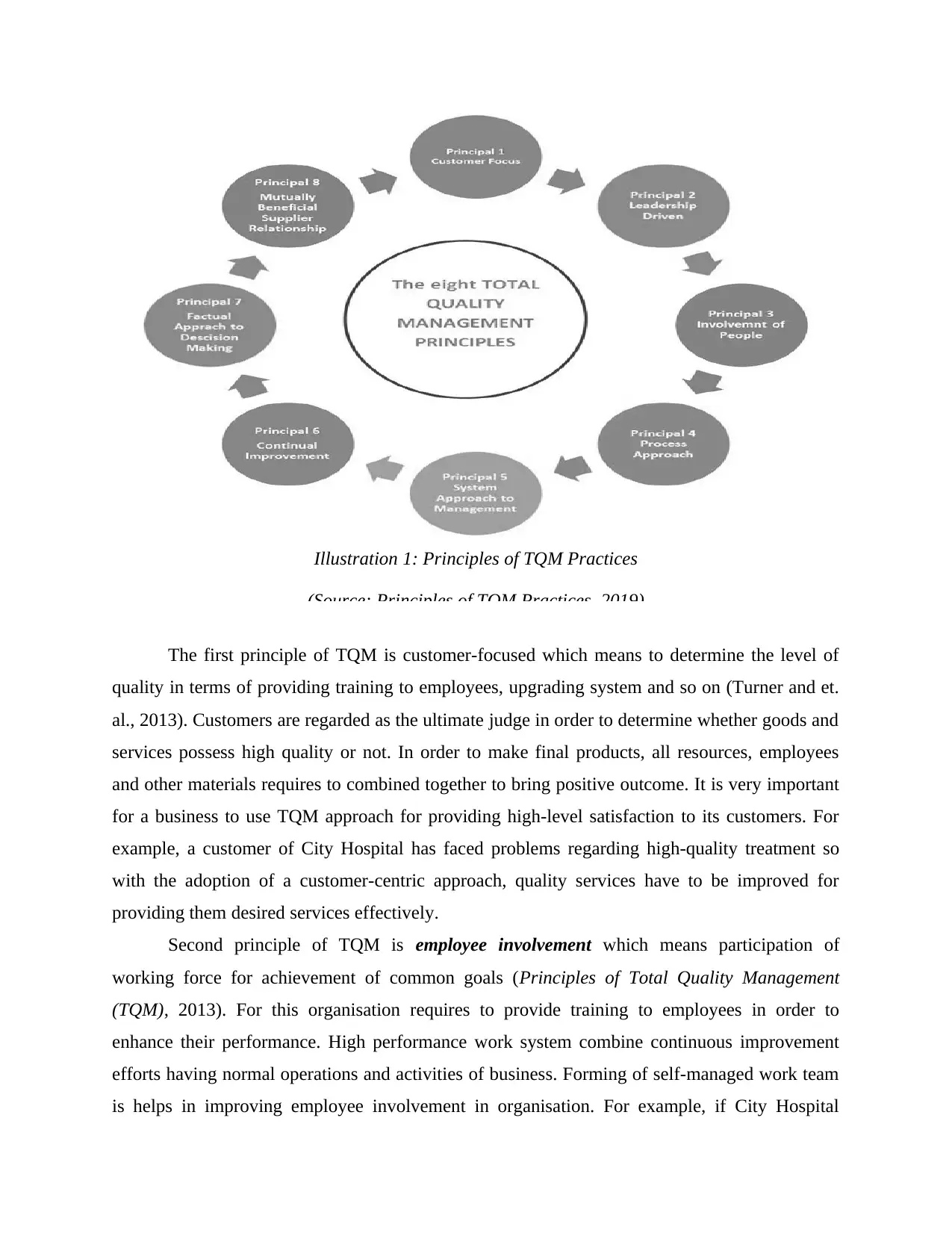
The first principle of TQM is customer-focused which means to determine the level of
quality in terms of providing training to employees, upgrading system and so on (Turner and et.
al., 2013). Customers are regarded as the ultimate judge in order to determine whether goods and
services possess high quality or not. In order to make final products, all resources, employees
and other materials requires to combined together to bring positive outcome. It is very important
for a business to use TQM approach for providing high-level satisfaction to its customers. For
example, a customer of City Hospital has faced problems regarding high-quality treatment so
with the adoption of a customer-centric approach, quality services have to be improved for
providing them desired services effectively.
Second principle of TQM is employee involvement which means participation of
working force for achievement of common goals (Principles of Total Quality Management
(TQM), 2013). For this organisation requires to provide training to employees in order to
enhance their performance. High performance work system combine continuous improvement
efforts having normal operations and activities of business. Forming of self-managed work team
is helps in improving employee involvement in organisation. For example, if City Hospital
Illustration 1: Principles of TQM Practices
(Source: Principles of TQM Practices, 2019)
quality in terms of providing training to employees, upgrading system and so on (Turner and et.
al., 2013). Customers are regarded as the ultimate judge in order to determine whether goods and
services possess high quality or not. In order to make final products, all resources, employees
and other materials requires to combined together to bring positive outcome. It is very important
for a business to use TQM approach for providing high-level satisfaction to its customers. For
example, a customer of City Hospital has faced problems regarding high-quality treatment so
with the adoption of a customer-centric approach, quality services have to be improved for
providing them desired services effectively.
Second principle of TQM is employee involvement which means participation of
working force for achievement of common goals (Principles of Total Quality Management
(TQM), 2013). For this organisation requires to provide training to employees in order to
enhance their performance. High performance work system combine continuous improvement
efforts having normal operations and activities of business. Forming of self-managed work team
is helps in improving employee involvement in organisation. For example, if City Hospital
Illustration 1: Principles of TQM Practices
(Source: Principles of TQM Practices, 2019)
include their employees in decision making then they can feel free to discuss particular issues
and its solution as well. It is possible by adopting employee involvement approach in respective
organisation to provide high quality services to patients in positive manner.
Third principle of TQM is process-centred which focuses on process thinking. Here, the
process is defined as a stage or steps which take inputs in order to transform them into outputs
that are delivered to customers (Copacino, 2019). In this approach, a process that needs to be
carried out is defined and measuring performance on a continuous basis to detect unexpected
variation. For instance, as City Hospital requires to do improvement in young and children
services therefore they have to adopt process principles. Through this the can identify disease or
issues faced by service users, analysing each report and providing them high-quality treatment
and recover them.
Fourth principle of Total Quality Management is an Integrated System that means to
combine all functional and operational activities of organization in an effective and efficient
manner. This contains several departments having functional purposes and interconnection with
the horizontal process of business. It is important to have a proper understanding of quality
objectives, processes, standards and so on. For working in an organization, there should be a
good work culture that aims to achieve customer expectations by providing them excellence
services. This also helps in gaining a competitive edge of business in an effective and efficient
manner. City Hospital has to adopt an integrated system principle for various departments such
as emergency, Neurology, Cardiology, Intensive Care Unit and so on in order to provide
treatment to all young and children people.
Fifth principle is a systematic and strategic approach which is regarded a critical section
of managing quality in order to achieve mission, vision, goals and objectives (Gligor and
Holcomb, 2012). Such process is known as strategic planning or strategic management that
includes the formulation of a plan in order to integrate quality at organisation. The strategic plan
is very important in order to ensure quality and becoming a major aspect of the process of
organisation. For example, it is very important for City Hospital to make strategy in order to
improve the condition of children and young people at a hospital in a systematic manner. With
the implementation of such principle, they can resolve their issues for their patients and people.
Sixth principle of Total Quality Management is continual improvement which means to
do improvement on continuous basis. The continual improvement drives enterprise in both
and its solution as well. It is possible by adopting employee involvement approach in respective
organisation to provide high quality services to patients in positive manner.
Third principle of TQM is process-centred which focuses on process thinking. Here, the
process is defined as a stage or steps which take inputs in order to transform them into outputs
that are delivered to customers (Copacino, 2019). In this approach, a process that needs to be
carried out is defined and measuring performance on a continuous basis to detect unexpected
variation. For instance, as City Hospital requires to do improvement in young and children
services therefore they have to adopt process principles. Through this the can identify disease or
issues faced by service users, analysing each report and providing them high-quality treatment
and recover them.
Fourth principle of Total Quality Management is an Integrated System that means to
combine all functional and operational activities of organization in an effective and efficient
manner. This contains several departments having functional purposes and interconnection with
the horizontal process of business. It is important to have a proper understanding of quality
objectives, processes, standards and so on. For working in an organization, there should be a
good work culture that aims to achieve customer expectations by providing them excellence
services. This also helps in gaining a competitive edge of business in an effective and efficient
manner. City Hospital has to adopt an integrated system principle for various departments such
as emergency, Neurology, Cardiology, Intensive Care Unit and so on in order to provide
treatment to all young and children people.
Fifth principle is a systematic and strategic approach which is regarded a critical section
of managing quality in order to achieve mission, vision, goals and objectives (Gligor and
Holcomb, 2012). Such process is known as strategic planning or strategic management that
includes the formulation of a plan in order to integrate quality at organisation. The strategic plan
is very important in order to ensure quality and becoming a major aspect of the process of
organisation. For example, it is very important for City Hospital to make strategy in order to
improve the condition of children and young people at a hospital in a systematic manner. With
the implementation of such principle, they can resolve their issues for their patients and people.
Sixth principle of Total Quality Management is continual improvement which means to
do improvement on continuous basis. The continual improvement drives enterprise in both
⊘ This is a preview!⊘
Do you want full access?
Subscribe today to unlock all pages.
Trusted by 1+ million students worldwide
creative and analytical terms in order to finds methods to become efficient and competitive to
meet expectation of stakeholders. This will lead to high quality process and improved way. It
assists City Hospital for finding new ways and techniques to provide high quality products,
services in order to be more competitive and meeting expectation of customers. For example,
respective hospital requires improvement in services of children and young people so they
require improvement on continuous basis to achieve positive outcomes.
The seventh principle of Total Quality Management is fact based decision making. It
means to know how well enterprise is performing their activities and operations at organisation
(Graham and Varghese, 2012). TQM need organisation in order to collect data and information
on continuous basis and analysing those for improving decision making to be accurate, achieving
consensus and prediction based upon historical record. Decision making of organisation should
be situational based and statistically for avoiding emotional based decisions. In context of City
Hospital, it requires improvement in services provided to young and children people so that they
get proper treatment and recover themselves. For better improvement, decision should be made
in respect of health care services so that they live and prosperous life.
Last principle of TQM is communication which means there should be proper flow of
data and information from one person to another with help of communication channels (Heizer,
Render and Munson, 2017). This consists of method, strategies and timeliness. It plays crucial
role in TQM as it assists in motivating employees and improving their morale towards daily
operations and activities. It is important for staffs to includes themselves in daily activities and
operations for making decision to provide sense of empowerment. This leads to create
environment of unity and success in order to drive results results of TQM process. City Hospital
has to adopt respective principle in their business as each and every employee such as staff,
doctors, nurse, care taker should be able to communicate with their people and patients so that
better treatment can be provided for recovery of their health.
After analysis of each and every principles of Total Quality Management for managing
operations and activities in an organisation, City Hospital has to adopt employee involvement,
continual improvement, decision making and communication to get positive outcomes. The main
area for improvement is to provide services to young and children people by including
employees in revealing their issues in front of manager to solve it in best possible manner.
Continual improvement leads to improve activities and operations on continuous basis for
meet expectation of stakeholders. This will lead to high quality process and improved way. It
assists City Hospital for finding new ways and techniques to provide high quality products,
services in order to be more competitive and meeting expectation of customers. For example,
respective hospital requires improvement in services of children and young people so they
require improvement on continuous basis to achieve positive outcomes.
The seventh principle of Total Quality Management is fact based decision making. It
means to know how well enterprise is performing their activities and operations at organisation
(Graham and Varghese, 2012). TQM need organisation in order to collect data and information
on continuous basis and analysing those for improving decision making to be accurate, achieving
consensus and prediction based upon historical record. Decision making of organisation should
be situational based and statistically for avoiding emotional based decisions. In context of City
Hospital, it requires improvement in services provided to young and children people so that they
get proper treatment and recover themselves. For better improvement, decision should be made
in respect of health care services so that they live and prosperous life.
Last principle of TQM is communication which means there should be proper flow of
data and information from one person to another with help of communication channels (Heizer,
Render and Munson, 2017). This consists of method, strategies and timeliness. It plays crucial
role in TQM as it assists in motivating employees and improving their morale towards daily
operations and activities. It is important for staffs to includes themselves in daily activities and
operations for making decision to provide sense of empowerment. This leads to create
environment of unity and success in order to drive results results of TQM process. City Hospital
has to adopt respective principle in their business as each and every employee such as staff,
doctors, nurse, care taker should be able to communicate with their people and patients so that
better treatment can be provided for recovery of their health.
After analysis of each and every principles of Total Quality Management for managing
operations and activities in an organisation, City Hospital has to adopt employee involvement,
continual improvement, decision making and communication to get positive outcomes. The main
area for improvement is to provide services to young and children people by including
employees in revealing their issues in front of manager to solve it in best possible manner.
Continual improvement leads to improve activities and operations on continuous basis for
Paraphrase This Document
Need a fresh take? Get an instant paraphrase of this document with our AI Paraphraser
positive manner. Similarly, each and every employees working in organisation has to
communicate with each other to make best decision in order to accomplish goal and objectives in
best manner. Therefore, in this way, City Hospital can improve their issue or drawback which
they have faced in their hospital by using above principle of total quality management.
In order to improve issue of urgent and emergency service, just in Time (JIT) approach is
used (Li and et. al., 2013). It is defined as inventory strategy in which material are ordered and
received that are required in production process. In context of hospital term, JIT is defined as
approach in which treatment should be provided to patient or people whenever requires to them
without any delays. The main aim of such method is reducing time of people to avail services or
products which is required to them in best possible manner. In order to measure JIT approach,
City Hospital has to improve their urgent and emergency services. This approach is mainly used
in manufacturing sector for getting timely of products and services in effective way.
Just in Time (JIT) is also called Just in Time Production which focus on reducing times
within providing services to people without any delay (Wang, Chen and Chen, 2012). Such
approach was originated from Japan in 1960s and 1970s. This is called management strategy
which aligns services to people from emergency to highly required services whenever required to
them. It helping in analysing forecasting of demand in terms of providing services to people. It
also helps in minimizing time period for providing services and increasing their efficiency.
Success of such approach totally depends upon how, where and when services is provided. This
is called management philosophy and not technique (JIT Just-in-Time manufacturing, 2016). It is
originated to meet demand of patient in terms of quantity, quality and time. There are different
types of elements which are included in JIT.
The first is continuous improvement where City Hospital has to focus on solving
fundamental problems, devising system for identification of problems, striving towards
simplicity, controlling of quality and preventing measures. They have to make improvement in
making separate department to provide urgent and emergency services to people and patients so
that they can recover or cure without any delays.
Second element is eliminating wastes in terms of processing, waste of waiting time, over
services, transportation waste and so on. In context of hospital sector, waste can be reduced for
making separate department for providing male and female services to eliminate long waiting
queue and using equipment’s properly so that proper treatment could be provided.
communicate with each other to make best decision in order to accomplish goal and objectives in
best manner. Therefore, in this way, City Hospital can improve their issue or drawback which
they have faced in their hospital by using above principle of total quality management.
In order to improve issue of urgent and emergency service, just in Time (JIT) approach is
used (Li and et. al., 2013). It is defined as inventory strategy in which material are ordered and
received that are required in production process. In context of hospital term, JIT is defined as
approach in which treatment should be provided to patient or people whenever requires to them
without any delays. The main aim of such method is reducing time of people to avail services or
products which is required to them in best possible manner. In order to measure JIT approach,
City Hospital has to improve their urgent and emergency services. This approach is mainly used
in manufacturing sector for getting timely of products and services in effective way.
Just in Time (JIT) is also called Just in Time Production which focus on reducing times
within providing services to people without any delay (Wang, Chen and Chen, 2012). Such
approach was originated from Japan in 1960s and 1970s. This is called management strategy
which aligns services to people from emergency to highly required services whenever required to
them. It helping in analysing forecasting of demand in terms of providing services to people. It
also helps in minimizing time period for providing services and increasing their efficiency.
Success of such approach totally depends upon how, where and when services is provided. This
is called management philosophy and not technique (JIT Just-in-Time manufacturing, 2016). It is
originated to meet demand of patient in terms of quantity, quality and time. There are different
types of elements which are included in JIT.
The first is continuous improvement where City Hospital has to focus on solving
fundamental problems, devising system for identification of problems, striving towards
simplicity, controlling of quality and preventing measures. They have to make improvement in
making separate department to provide urgent and emergency services to people and patients so
that they can recover or cure without any delays.
Second element is eliminating wastes in terms of processing, waste of waiting time, over
services, transportation waste and so on. In context of hospital sector, waste can be reduced for
making separate department for providing male and female services to eliminate long waiting
queue and using equipment’s properly so that proper treatment could be provided.
Third element is housekeeping which includes that workplace should be cleaned and
healthy for work performance. City Hospital should be very neat and clean as untidy and
unhealthy environment create problem for patient to get fast recovery and survive at dirty place.
With application of such principle at respective hospital will leads to increase large footfall of
patients to avail services.
Fourth element is setting up time reduction techniques which assist in increasing
flexibility and creation of small batches (O’Brien and et. al., 2016). City Hospital has to provide
attention to each and every people individually so that they get healthy treatment and service.
Multi batch will creates problems for both individual and patients or service taker.
Fifth element is levelled services which means to flow of work in smooth and diligent
manner at workplace (Oven and et. al., 2012). City Hospital requires to provide smooth flowing
of services to their patient so that they can get urgent and emergency services in an effective and
efficient way.
Sixth element is Kanbans which is a process that is used for pulling products and
components through a tool. With use of such tool, City Hospital can make effective decisions
regarding providing of services in case of emergency and urgent situations.
Last elements of JIT is Andon which means to provide corrective action to arise problem.
It is very important for City Hospital to provide solution for emergency and urgent services to
their patients and people so that each and every individual can get proper treatment.
After analysing all elements of JIT, it has concluded that City Hospital has to follow
eliminating waste and good housekeeping so that timely or urgent and emergency services could
be provided and following of hygiene at place.
There is some recommendation which are provided to City Hospital in terms of young &
children people for providing urgent and emergency services. As they have to manage quality by
following Total Quality Management (TQM) techniques and Just in Time approach so that
improvement can be made in best possible manner. As these are major issues which are faced by
respective Hospital so it requires proper approach to overcome the arise issue or problems. TQM
is applied for effective decision making, communication, employee involvement so that better
services could be provided to young and children people. Similarly, JIT is applied to provide
urgent and emergency services whenever required to patient or people so that they can recover
and improve their health condition in proper manner. Apart from these approaches, respective
healthy for work performance. City Hospital should be very neat and clean as untidy and
unhealthy environment create problem for patient to get fast recovery and survive at dirty place.
With application of such principle at respective hospital will leads to increase large footfall of
patients to avail services.
Fourth element is setting up time reduction techniques which assist in increasing
flexibility and creation of small batches (O’Brien and et. al., 2016). City Hospital has to provide
attention to each and every people individually so that they get healthy treatment and service.
Multi batch will creates problems for both individual and patients or service taker.
Fifth element is levelled services which means to flow of work in smooth and diligent
manner at workplace (Oven and et. al., 2012). City Hospital requires to provide smooth flowing
of services to their patient so that they can get urgent and emergency services in an effective and
efficient way.
Sixth element is Kanbans which is a process that is used for pulling products and
components through a tool. With use of such tool, City Hospital can make effective decisions
regarding providing of services in case of emergency and urgent situations.
Last elements of JIT is Andon which means to provide corrective action to arise problem.
It is very important for City Hospital to provide solution for emergency and urgent services to
their patients and people so that each and every individual can get proper treatment.
After analysing all elements of JIT, it has concluded that City Hospital has to follow
eliminating waste and good housekeeping so that timely or urgent and emergency services could
be provided and following of hygiene at place.
There is some recommendation which are provided to City Hospital in terms of young &
children people for providing urgent and emergency services. As they have to manage quality by
following Total Quality Management (TQM) techniques and Just in Time approach so that
improvement can be made in best possible manner. As these are major issues which are faced by
respective Hospital so it requires proper approach to overcome the arise issue or problems. TQM
is applied for effective decision making, communication, employee involvement so that better
services could be provided to young and children people. Similarly, JIT is applied to provide
urgent and emergency services whenever required to patient or people so that they can recover
and improve their health condition in proper manner. Apart from these approaches, respective
⊘ This is a preview!⊘
Do you want full access?
Subscribe today to unlock all pages.
Trusted by 1+ million students worldwide
hospital can adopt Triple Bottom Line approach which has three elements such as social,
environmental and financial. Firstly they have to analyse need of their patient such as diagnosing
disease, treatments and so on. After that they have to provide them proper medicine and cure
without harming environment within their budget so that they will recover within time and live
as well as prosperous life.
The above-presented report concluded that operation management is very important to
carry out business activities and operations in a positive manner. This report is based on
improving services for young & children people and urgent and emergency services. With the
use of TQM and JIT approach, these issues can be solved in an effective and efficient manner.
These techniques are applied by organization to accomplish and attain set goals and objectives
easily. TQM is mainly used for quality management that is required in each and every business
to gain positive outcomes by following principles in carrying out work and operations. Similarly,
JIT approach means Just in Time which means to deliver products as well as services whenever
required to people or individuals in effectively. Thus, with such approach, positive results are
achieved in the best manner. Apart from these two approaches, other is triple bottom line that has
three elements such as social, environmental and financial view. While solving issues, people of
society should get proper treatment without harming environment within their budget so that
they can recover their health in appropriate manner. It is very important for organisation to use
these methods in their hospital in proper manner to cure their patients. This also helps in
enhancement of brand value as well as goodwill of hospital at marketplace. This is the
responsibility of service provider to analyse problems or issues of patient and accordingly search
best method to provide them with proper care and treatment so that they will recover as soon as
possible.
environmental and financial. Firstly they have to analyse need of their patient such as diagnosing
disease, treatments and so on. After that they have to provide them proper medicine and cure
without harming environment within their budget so that they will recover within time and live
as well as prosperous life.
The above-presented report concluded that operation management is very important to
carry out business activities and operations in a positive manner. This report is based on
improving services for young & children people and urgent and emergency services. With the
use of TQM and JIT approach, these issues can be solved in an effective and efficient manner.
These techniques are applied by organization to accomplish and attain set goals and objectives
easily. TQM is mainly used for quality management that is required in each and every business
to gain positive outcomes by following principles in carrying out work and operations. Similarly,
JIT approach means Just in Time which means to deliver products as well as services whenever
required to people or individuals in effectively. Thus, with such approach, positive results are
achieved in the best manner. Apart from these two approaches, other is triple bottom line that has
three elements such as social, environmental and financial view. While solving issues, people of
society should get proper treatment without harming environment within their budget so that
they can recover their health in appropriate manner. It is very important for organisation to use
these methods in their hospital in proper manner to cure their patients. This also helps in
enhancement of brand value as well as goodwill of hospital at marketplace. This is the
responsibility of service provider to analyse problems or issues of patient and accordingly search
best method to provide them with proper care and treatment so that they will recover as soon as
possible.
Paraphrase This Document
Need a fresh take? Get an instant paraphrase of this document with our AI Paraphraser
REFERENCES
Books and Journals
Brett, J. and et. al., 2014. Mapping the impact of patient and public involvement on health and
social care research: a systematic review. Health Expectations. 17(5). pp.637-650.
Cameron, A. and et. al., 2014. Factors that promote and hinder joint and integrated working
between health and social care services: a review of research literature. Health & social
care in the community. 22(3). pp.225-233.
Copacino, W. C., 2019. Supply chain management: The basics and beyond. Routledge.
Gligor, D. M. and Holcomb, M. C., 2012. Understanding the role of logistics capabilities in
achieving supply chain agility: a systematic literature review. Supply Chain
Management: An International Journal. 17(4). pp.438-453.
Graham, W. J. and Varghese, B., 2012. Quality, quality, quality: gaps in the continuum of
care. The Lancet. 379(9811). pp.e5-e6.
Heizer, J., Render, B. and Munson, C., 2017. Operations management. Sustainability and Supply
Chain Management, 12th Ed., USA.
Li, W. and et. al., 2013. Timing of high-quality child care and cognitive, language, and
preacademic development. Developmental psychology. 49(8). p.1440.
O’Brien, D. and et. al., 2016. Barriers to managing child and adolescent mental health problems:
a systematic review of primary care practitioners’ perceptions. Br J Gen Pract. 66(651).
pp.e693-e707.
Oven, K. J. and et. al., 2012. Climate change and health and social care: Defining future hazard,
vulnerability and risk for infrastructure systems supporting older people’s health care in
England. Applied Geography. 33. pp.16-24.
Turner, J. and et. al., 2013. Impact of the urgent care telephone service NHS 111 pilot sites: a
controlled before and after study. Bmj Open. 3(11). p.e003451.
Van Wassenhove, L. N. and Pedraza Martinez, A. J., 2012. Using OR to adapt supply chain
management best practices to humanitarian logistics. International Transactions in
Operational Research. 19(1-2). pp.307-322.
Wang, C. H., Chen, K. Y. and Chen, S. C., 2012. Total quality management, market orientation
and hotel performance: The moderating effects of external environmental
factors. International Journal of Hospitality Management. 31(1). pp.119-129.
Online
JIT Just-in-Time manufacturing. 2016. [Online]. Available through:
<https://www.ifm.eng.cam.ac.uk/research/dstools/jit-just-in-time-manufacturing/>.
Principles of Total Quality Management (TQM). 2013. [Online]. Available through:
<https://www.etechgs.com/blog/principles-total-quality-management-tqm/>.
WHAT IS TOTAL QUALITY MANAGEMENT (TQM)?. 2019. [Online]. Available through:
<https://asq.org/quality-resources/total-quality-management>.
Principles of TQM practices. 2019. [Online]. Available through:
<https://www.researchgate.net/figure/Principles-of-TQM-practices-source-Northlink-
College-2015_fig1_294886200>.
Books and Journals
Brett, J. and et. al., 2014. Mapping the impact of patient and public involvement on health and
social care research: a systematic review. Health Expectations. 17(5). pp.637-650.
Cameron, A. and et. al., 2014. Factors that promote and hinder joint and integrated working
between health and social care services: a review of research literature. Health & social
care in the community. 22(3). pp.225-233.
Copacino, W. C., 2019. Supply chain management: The basics and beyond. Routledge.
Gligor, D. M. and Holcomb, M. C., 2012. Understanding the role of logistics capabilities in
achieving supply chain agility: a systematic literature review. Supply Chain
Management: An International Journal. 17(4). pp.438-453.
Graham, W. J. and Varghese, B., 2012. Quality, quality, quality: gaps in the continuum of
care. The Lancet. 379(9811). pp.e5-e6.
Heizer, J., Render, B. and Munson, C., 2017. Operations management. Sustainability and Supply
Chain Management, 12th Ed., USA.
Li, W. and et. al., 2013. Timing of high-quality child care and cognitive, language, and
preacademic development. Developmental psychology. 49(8). p.1440.
O’Brien, D. and et. al., 2016. Barriers to managing child and adolescent mental health problems:
a systematic review of primary care practitioners’ perceptions. Br J Gen Pract. 66(651).
pp.e693-e707.
Oven, K. J. and et. al., 2012. Climate change and health and social care: Defining future hazard,
vulnerability and risk for infrastructure systems supporting older people’s health care in
England. Applied Geography. 33. pp.16-24.
Turner, J. and et. al., 2013. Impact of the urgent care telephone service NHS 111 pilot sites: a
controlled before and after study. Bmj Open. 3(11). p.e003451.
Van Wassenhove, L. N. and Pedraza Martinez, A. J., 2012. Using OR to adapt supply chain
management best practices to humanitarian logistics. International Transactions in
Operational Research. 19(1-2). pp.307-322.
Wang, C. H., Chen, K. Y. and Chen, S. C., 2012. Total quality management, market orientation
and hotel performance: The moderating effects of external environmental
factors. International Journal of Hospitality Management. 31(1). pp.119-129.
Online
JIT Just-in-Time manufacturing. 2016. [Online]. Available through:
<https://www.ifm.eng.cam.ac.uk/research/dstools/jit-just-in-time-manufacturing/>.
Principles of Total Quality Management (TQM). 2013. [Online]. Available through:
<https://www.etechgs.com/blog/principles-total-quality-management-tqm/>.
WHAT IS TOTAL QUALITY MANAGEMENT (TQM)?. 2019. [Online]. Available through:
<https://asq.org/quality-resources/total-quality-management>.
Principles of TQM practices. 2019. [Online]. Available through:
<https://www.researchgate.net/figure/Principles-of-TQM-practices-source-Northlink-
College-2015_fig1_294886200>.

⊘ This is a preview!⊘
Do you want full access?
Subscribe today to unlock all pages.
Trusted by 1+ million students worldwide

1 out of 13


Related Documents


Your All-in-One AI-Powered Toolkit for Academic Success.
+13062052269
info@desklib.com
Available 24*7 on WhatsApp / Email
![[object Object]](/_next/static/media/star-bottom.7253800d.svg)
Unlock your academic potential
Copyright © 2020–2026 A2Z Services. All Rights Reserved. Developed and managed by ZUCOL.