Advanced Technician Diploma in Civil Engineering: Unit 526 Report
VerifiedAdded on 2021/10/14
|14
|4562
|335
Report
AI Summary
This report, prepared for the Level 5 Advanced Technician Diploma in Civil Engineering, focuses on Unit 526, "Measurement, Costing, and Contracts for Civil Engineers." It begins with an overview of the Civil Engineering Work Measurement System (CESMM), detailing its procedures, purpose, and measurement procedures. The report then defines various contractual arrangements, including lump sum, measurement, cost reimbursement, and design-build contracts, outlining their advantages and disadvantages. It also delves into estimating procedures, covering provisional sums, preambles, and overhead costs in construction contracts. The report offers a comprehensive understanding of the key elements in civil engineering contracts, measurement, and costing, including tender contracts and the CESMM standard.
UNIT : Unit 526 Measurement Costing and
Contracts for Civil Engineers (2021)
TASK : Task 01
CANDIDATE NAME : Mr Kasun Jayasingha
ENR NO : 509251
STUDENT ID : 509251
BATCH NO : 908
DATE OF SUBMISSION : 10/10/2021
Level 5
Advanced Technician Diploma
in Civil Engineering
9208-13
Contracts for Civil Engineers (2021)
TASK : Task 01
CANDIDATE NAME : Mr Kasun Jayasingha
ENR NO : 509251
STUDENT ID : 509251
BATCH NO : 908
DATE OF SUBMISSION : 10/10/2021
Level 5
Advanced Technician Diploma
in Civil Engineering
9208-13

Paraphrase This Document
Need a fresh take? Get an instant paraphrase of this document with our AI Paraphraser
1.1 The standard method of measurement civil engineering
The Civil Engineering Work Measurement System - CESMM - has been well established for over 20
years as the standard for formulating size bills in civil engineering work. This coveted fourth edition,
CESMM4, adapts to changes in industrial use and extends its use to all new areas.
Measurement of civil Engineering work
The civil Work measurement eferred to a Document called “civil Engineering Standard method of
measurement (CESMM).
Before this document is produced the party who responsible for the working measurement refers to
the method adopted in the United Kingdom named ‘CESMM 2nd edition or 3rd Edition
There are large party of the measurement refer to methods used in Building works or more
Unfortunate they use their own measurement system. This led to inconsistencies in measurement
procedures. As a result, Contractor have Dassault to appreciate the tender.
The actual measurement work must take into account the level of complexity of work is also closely
related to the methodology and construction activities.
1.1.1 Procedures and practices of CESMM
Include the Scope of most project management Such as:
• Selection Types of of Contracts
• Documentation
• Preparation of drawings
• Specification
• Project information
• Contract terms and list of Quantities
• Preparation of list of material Requirement / Quantities,
• Method Statement – Detailed list of Detailed construction work with Short explanation with
Quantity measured by CESMM
• Explanation on the scope of work that will be implemented by the Contractor and then be the
basic for pricing the tender
1.1.2 Propose of CESMM
The main purpose of the measurement basic on CESMM is for Coordinating and planning of the
Quantity list, to list the details of work to ensure Consistency and Systematic and to State the new
techniques of Construction Clearly
1.1.3 Measurement Procedures
• In any measurement there are a number of essential Factors that Should always be Considered
and applied to follow good established practice as follows: -
Examine the drawing carefully to become familiar with the work and to identify any parts
where information is lacking.
• Interred carefully and apply in a Sound and logical way of provisions in standard method of
measurement of Building works (SMM).
• Ensure a Hight Standard of accuracy in dimensions.
• Make full use of sub- Heading throughout the dimensions to facilitate identification and waste
to preliminary calculations, Explanatory notes and location description.
• All descriptions should be adequate, concise and written in a logical easily understood format
following the Sequence adopted in SMM
• Adopt a logical Sequence of item so that each one following the preceding one in natural
progression.
• See to achieve a good standard of presentation
The Civil Engineering Work Measurement System - CESMM - has been well established for over 20
years as the standard for formulating size bills in civil engineering work. This coveted fourth edition,
CESMM4, adapts to changes in industrial use and extends its use to all new areas.
Measurement of civil Engineering work
The civil Work measurement eferred to a Document called “civil Engineering Standard method of
measurement (CESMM).
Before this document is produced the party who responsible for the working measurement refers to
the method adopted in the United Kingdom named ‘CESMM 2nd edition or 3rd Edition
There are large party of the measurement refer to methods used in Building works or more
Unfortunate they use their own measurement system. This led to inconsistencies in measurement
procedures. As a result, Contractor have Dassault to appreciate the tender.
The actual measurement work must take into account the level of complexity of work is also closely
related to the methodology and construction activities.
1.1.1 Procedures and practices of CESMM
Include the Scope of most project management Such as:
• Selection Types of of Contracts
• Documentation
• Preparation of drawings
• Specification
• Project information
• Contract terms and list of Quantities
• Preparation of list of material Requirement / Quantities,
• Method Statement – Detailed list of Detailed construction work with Short explanation with
Quantity measured by CESMM
• Explanation on the scope of work that will be implemented by the Contractor and then be the
basic for pricing the tender
1.1.2 Propose of CESMM
The main purpose of the measurement basic on CESMM is for Coordinating and planning of the
Quantity list, to list the details of work to ensure Consistency and Systematic and to State the new
techniques of Construction Clearly
1.1.3 Measurement Procedures
• In any measurement there are a number of essential Factors that Should always be Considered
and applied to follow good established practice as follows: -
Examine the drawing carefully to become familiar with the work and to identify any parts
where information is lacking.
• Interred carefully and apply in a Sound and logical way of provisions in standard method of
measurement of Building works (SMM).
• Ensure a Hight Standard of accuracy in dimensions.
• Make full use of sub- Heading throughout the dimensions to facilitate identification and waste
to preliminary calculations, Explanatory notes and location description.
• All descriptions should be adequate, concise and written in a logical easily understood format
following the Sequence adopted in SMM
• Adopt a logical Sequence of item so that each one following the preceding one in natural
progression.
• See to achieve a good standard of presentation
1.2 Definitions of contractual arrangements
Contractual arrangements are written mutual agreements, enforceable by law, between two or more
parties that something shall be done by one or both. There are two major classes of contract which
governments use in the management and administration of public forest lands. The first types of
contract are resource utilization contracts. In various countries they are called forest tenure
arrangements, forest concessions, forest management agreements, etc. They involve governments
granting harvesting or use rights to parties to utilize or exploit forest resources for timber, other forest
products, gathering of non-timber forest products, or use of the forest for other purposes such as
hunting, watershed use, recreation or ecotourism. Resource utilization contracts govern the rights of
owners, users and others over forest land, timber and/or other assets by defining the way forests are
held and utilized. They define the rights, duties and responsibilities of the two parties to the contract:
the owners of the resource (the government in the case of public forest lands) and the user, the
contractor. The rights, duties and responsibilities can vary widely under different forms of contract.
For example, timber concessions can provide long-term rights to the current forest, rights to other
forest land uses, and rights to the next harvest. A fuelwood contract may only provide rights to gather
firewood for one year.
The second types of contract are procurement contracts, or goods and services contracts. In these
contracts, governments enter into agreements with other parties to provide goods or services for the
management and administration of public forests; for example, for forest inventories, forest
management activities, forest certification, tree planting, fire protection, etc.
Often forest contractual arrangements can involve both types of contract, granting the party harvesting
or use rights - but also requiring them to undertake forest management activities - reforestation,
environmental protection, etc. The type of forest management agreements found in many countries are
of this nature, granting harvesting rights but requiring forest management.
The following are the various types of contracts, for execution of civil engineering works:
1. Lump Sum or Fixed Price Contract
2. Measurement contract
3. cost reimbursement
4. Design and Build
1. Lump Sum or Fixed Price Contract
Under a Lump Sum or Fixed Price Contract, the contractor agrees to perform the work specified and
described in the contract for a fixed price. The price of a fixed contract can only be changed upon the
execution of a change order, under which the owner and the contractor either
Agree for the contractor to perform additional work that falls outside the scope of the original work
for an agreed upon extra compensation or
Agree to remove certain work from the original scope of work and reduce the price of the contract in
proportion to the work that the contractor no longer has to perform.
These types of contracts are appropriate when a clear scope and a defined schedule have been
reviewed and agreed upon.
Contractual arrangements are written mutual agreements, enforceable by law, between two or more
parties that something shall be done by one or both. There are two major classes of contract which
governments use in the management and administration of public forest lands. The first types of
contract are resource utilization contracts. In various countries they are called forest tenure
arrangements, forest concessions, forest management agreements, etc. They involve governments
granting harvesting or use rights to parties to utilize or exploit forest resources for timber, other forest
products, gathering of non-timber forest products, or use of the forest for other purposes such as
hunting, watershed use, recreation or ecotourism. Resource utilization contracts govern the rights of
owners, users and others over forest land, timber and/or other assets by defining the way forests are
held and utilized. They define the rights, duties and responsibilities of the two parties to the contract:
the owners of the resource (the government in the case of public forest lands) and the user, the
contractor. The rights, duties and responsibilities can vary widely under different forms of contract.
For example, timber concessions can provide long-term rights to the current forest, rights to other
forest land uses, and rights to the next harvest. A fuelwood contract may only provide rights to gather
firewood for one year.
The second types of contract are procurement contracts, or goods and services contracts. In these
contracts, governments enter into agreements with other parties to provide goods or services for the
management and administration of public forests; for example, for forest inventories, forest
management activities, forest certification, tree planting, fire protection, etc.
Often forest contractual arrangements can involve both types of contract, granting the party harvesting
or use rights - but also requiring them to undertake forest management activities - reforestation,
environmental protection, etc. The type of forest management agreements found in many countries are
of this nature, granting harvesting rights but requiring forest management.
The following are the various types of contracts, for execution of civil engineering works:
1. Lump Sum or Fixed Price Contract
2. Measurement contract
3. cost reimbursement
4. Design and Build
1. Lump Sum or Fixed Price Contract
Under a Lump Sum or Fixed Price Contract, the contractor agrees to perform the work specified and
described in the contract for a fixed price. The price of a fixed contract can only be changed upon the
execution of a change order, under which the owner and the contractor either
Agree for the contractor to perform additional work that falls outside the scope of the original work
for an agreed upon extra compensation or
Agree to remove certain work from the original scope of work and reduce the price of the contract in
proportion to the work that the contractor no longer has to perform.
These types of contracts are appropriate when a clear scope and a defined schedule have been
reviewed and agreed upon.
⊘ This is a preview!⊘
Do you want full access?
Subscribe today to unlock all pages.

Trusted by 1+ million students worldwide
Advantages:
1. Lower financial risk to Employer.
2. Higher financial risk to Contractor.
3. Minimum Owner supervision related to quality and schedule.
4. Contractor has higher incentive to achieve earlier completion and better performance.
5. Contractor selection is relatively easy.
Disadvantages:
1. Changes difficult and costly. (but it usually is)
2. Need to substantially complete design prior to bidding.
3. Contractor inclined to choose lowest methods / materials to comply with specification.
4. Hard to build relationship. Each project is unique.
5. Bidding expensive and lengthy.
6. Contractors may include high contingency within each Schedule of Rate item
2. Measurement contract
Measurement contracts (sometimes called “re-measurement” or ‘measure and value’ contracts)
contains a Bill of Quantities ( BOQ ) provided by the employer or its consultants, can be used in
situations where the design (or type of works) can be described in reasonable detail, but the amount
cannot. The contractor will quote against each BOQ item and enter a unit rate or unit price to build up
the total contract price on basis of those BOQ quantities. During the construction period, the actual
quantity of works executed under each BOQ item will be jointly measured and valued at the quoted
rate for interim payment purpose.
A measurement contract might also be appropriate on projects where the design has not been
completed in sufficient detail for bills of quantities to be produced.
It should be possible to describe the works in sufficient detail to determine a programme and to obtain
rates from tenderers. Generally tenderers rates will be based on drawings and approximate quantities.
The actual contract sum (sometimes called the ‘ascertained final sum’) cannot be determined when
the contract is entered into, but is calculated on completion, based on “re-measurement” of the actual
work carried out and the rates tendered.
Measurement contracts can allow an early start on site, before design is complete, and they can allow
changes to be made to the works relatively easily. However, there is inevitably some risk for
the client as the cost of the works is not known. In effect, the client is taking the risk for any
‘unknowns’, and whilst this can result in competitive prices from contractors, the level of uncertainty
for the client means that measurement contracts are rare other than on civil engineering projects.
03.cost reimbursement
A cost reimbursement contract is an agreement between parties in a construction project that
guarantees the owner reimburses the contractor for costs incurred while they work on the project.
Reimbursement, however, is not unlimited. There is a ceiling.
The contractor is not paid solely for the costs, but is also guaranteed an additional payment. This
additional payment will be the contractor’s profit. The contract will still include an estimate for the
total cost of the project.Unlike a fixed-price contract where the overall price for the project is agreed
on before the work starts and the price is final (and thus, the risk lies mostly with the contractor,) the
cost reimbursement contract places risk more squarely on the project owner. That doesn’t mean there
aren’t other risks, such as scope creep, where requirements are unclear
04.Design-build
1. Lower financial risk to Employer.
2. Higher financial risk to Contractor.
3. Minimum Owner supervision related to quality and schedule.
4. Contractor has higher incentive to achieve earlier completion and better performance.
5. Contractor selection is relatively easy.
Disadvantages:
1. Changes difficult and costly. (but it usually is)
2. Need to substantially complete design prior to bidding.
3. Contractor inclined to choose lowest methods / materials to comply with specification.
4. Hard to build relationship. Each project is unique.
5. Bidding expensive and lengthy.
6. Contractors may include high contingency within each Schedule of Rate item
2. Measurement contract
Measurement contracts (sometimes called “re-measurement” or ‘measure and value’ contracts)
contains a Bill of Quantities ( BOQ ) provided by the employer or its consultants, can be used in
situations where the design (or type of works) can be described in reasonable detail, but the amount
cannot. The contractor will quote against each BOQ item and enter a unit rate or unit price to build up
the total contract price on basis of those BOQ quantities. During the construction period, the actual
quantity of works executed under each BOQ item will be jointly measured and valued at the quoted
rate for interim payment purpose.
A measurement contract might also be appropriate on projects where the design has not been
completed in sufficient detail for bills of quantities to be produced.
It should be possible to describe the works in sufficient detail to determine a programme and to obtain
rates from tenderers. Generally tenderers rates will be based on drawings and approximate quantities.
The actual contract sum (sometimes called the ‘ascertained final sum’) cannot be determined when
the contract is entered into, but is calculated on completion, based on “re-measurement” of the actual
work carried out and the rates tendered.
Measurement contracts can allow an early start on site, before design is complete, and they can allow
changes to be made to the works relatively easily. However, there is inevitably some risk for
the client as the cost of the works is not known. In effect, the client is taking the risk for any
‘unknowns’, and whilst this can result in competitive prices from contractors, the level of uncertainty
for the client means that measurement contracts are rare other than on civil engineering projects.
03.cost reimbursement
A cost reimbursement contract is an agreement between parties in a construction project that
guarantees the owner reimburses the contractor for costs incurred while they work on the project.
Reimbursement, however, is not unlimited. There is a ceiling.
The contractor is not paid solely for the costs, but is also guaranteed an additional payment. This
additional payment will be the contractor’s profit. The contract will still include an estimate for the
total cost of the project.Unlike a fixed-price contract where the overall price for the project is agreed
on before the work starts and the price is final (and thus, the risk lies mostly with the contractor,) the
cost reimbursement contract places risk more squarely on the project owner. That doesn’t mean there
aren’t other risks, such as scope creep, where requirements are unclear
04.Design-build
Paraphrase This Document
Need a fresh take? Get an instant paraphrase of this document with our AI Paraphraser
Desing & Build is a method of project delivery in which one entity - the design-build team - works
under a single contract with the project owner to provide design and construction services. One entity,
one contract, one unified flow of work from initial concept through completion. Design-build is also
known as design/construct and single-source responsibility. Across the country and around the world,
design-build successfully delivers office buildings, schools, stadiums, transportation and water
infrastructure projects with superior results.
Design-build is an alternative to design-bid-build. Under the latter approach, design and construction
are split - separate entities, separate contracts, separate work.
Design-build, design-bid-build and construction management are the three project delivery systems
most commonly employed in North America. Over the past 15 years, use of design-build has greatly
accelerated in the United States, making this delivery method one of the most significant trends in
design and construction today
1.3 estimating procedures
1.3.1 Provisional Sums
Measurement of completed work Appropriate provisions of this section shall also apply to the
measurement of completed work. provisional sum is an amount allocated for a specialized work by a
specialized firm, for which the details are not available at the time of tender. The provisional sum
amount will be a best guess at the time of tender by the employer or contractor depending upon the
type of provisional sum. Hence claim made by the contractor need not necessarily be the exact
amount mentioned in the contract.
1.3.2 Preamble
The Preamble shall state the methods of measurement other than CESMM4, if any, which have been
adopted in the preparation of the Bill of Quantities and are to be used for the measurement of any part
of the works. Such methods of measurement shall comprise those adopted and to be used for any
work not covered by CESMM4 and any amendments to CESMM4 which have been adopted and are
to be used. Amendments comprising abbreviation of CESMM4 are usually necessary for contractor-
designed work and work which is intended to involve selection between alternatives at the discretion
of the contractor. The extent of the work affected by all amendments to CESMM4 shall be stated in
the Preamble.
Provision for contingencies shall be made by giving Provisional Sums in the Bill of Quantities and not
by increasing the quantities beyond those of the work expected to be required. Provisional Sums for
Defined Work shall be included where work is known to be required but the scope of the work cannot
be completely designed but the scope can be defined
1.3.3 Over head
In construction contracts, overheads are often priced proportionately against a project and are the
calculated costs of running the company contracted to carry out a project. Often these costs are
described as head office administrative costs (in some cases there may also be factory or
manufacturing overheads)
under a single contract with the project owner to provide design and construction services. One entity,
one contract, one unified flow of work from initial concept through completion. Design-build is also
known as design/construct and single-source responsibility. Across the country and around the world,
design-build successfully delivers office buildings, schools, stadiums, transportation and water
infrastructure projects with superior results.
Design-build is an alternative to design-bid-build. Under the latter approach, design and construction
are split - separate entities, separate contracts, separate work.
Design-build, design-bid-build and construction management are the three project delivery systems
most commonly employed in North America. Over the past 15 years, use of design-build has greatly
accelerated in the United States, making this delivery method one of the most significant trends in
design and construction today
1.3 estimating procedures
1.3.1 Provisional Sums
Measurement of completed work Appropriate provisions of this section shall also apply to the
measurement of completed work. provisional sum is an amount allocated for a specialized work by a
specialized firm, for which the details are not available at the time of tender. The provisional sum
amount will be a best guess at the time of tender by the employer or contractor depending upon the
type of provisional sum. Hence claim made by the contractor need not necessarily be the exact
amount mentioned in the contract.
1.3.2 Preamble
The Preamble shall state the methods of measurement other than CESMM4, if any, which have been
adopted in the preparation of the Bill of Quantities and are to be used for the measurement of any part
of the works. Such methods of measurement shall comprise those adopted and to be used for any
work not covered by CESMM4 and any amendments to CESMM4 which have been adopted and are
to be used. Amendments comprising abbreviation of CESMM4 are usually necessary for contractor-
designed work and work which is intended to involve selection between alternatives at the discretion
of the contractor. The extent of the work affected by all amendments to CESMM4 shall be stated in
the Preamble.
Provision for contingencies shall be made by giving Provisional Sums in the Bill of Quantities and not
by increasing the quantities beyond those of the work expected to be required. Provisional Sums for
Defined Work shall be included where work is known to be required but the scope of the work cannot
be completely designed but the scope can be defined
1.3.3 Over head
In construction contracts, overheads are often priced proportionately against a project and are the
calculated costs of running the company contracted to carry out a project. Often these costs are
described as head office administrative costs (in some cases there may also be factory or
manufacturing overheads)
3.1 Type of tender contracts
This Standard Tender Document (STD) is to be used for establishing a Framework Agreement for the
procurement of Goods using National Competitive Tendering Procedures. The subsequent
procurement of Goods is undertaken through a Secondary Procurement process and the award of a
Call-off Contract.
ICTAD/SBD/01
ICTAD/SBD/02
ICTAD/SBD/03
FDIC 01
3.2 methods of tendering
A tender is a submission made by a prospective supplier in response to an invitation to tender. It
makes an offer for the supply of goods or services. As procurement routes have become more
complex, tenders may be sought for a wide range of goods and services (for example, on a
construction mañagement contract the works are constructed by a number of different trade
contractors each contracted to the client) and contractors may take on additional functions such as
design and management.
The 4 main types of tenders are:
1. Open tender •
2. Selective tender •
3. Negotiated tender
4. Single-stage and two-stage tender
Open tender
Open tender Open tendering is the main tendering procedures employed by both the government and
private sector. Open tendering allows anyone to submit a tender to supply the goods or services
required and offers an equal opportunity to any organization to submit a tender. This type of tender is
most common for the engineering and construction industry. Open tendering provides the greatest
competition among suppliers and has the advantage of creating opportunities for new or emerging
suppliers to try to secure work. Had ever, not all those who bid may be suitable for the contract and
more time is required to evaluate the tenders.
Selective tender
selective tendering only allows suppliers to submit tenders by invitation. These suppliers are those
who are known by their track record to be suitable for a contract of that size, nature and complexity
required. Selective tendering gives clients greater confidence that their requirements will be satisfied.
It tay be particularly appropriate for specialist or complex contracts, or contracts where there are only
a few suitable firms. However, it can ‘exclude smaller suppliers or those trying to establish
themselves in a new market.
This Standard Tender Document (STD) is to be used for establishing a Framework Agreement for the
procurement of Goods using National Competitive Tendering Procedures. The subsequent
procurement of Goods is undertaken through a Secondary Procurement process and the award of a
Call-off Contract.
ICTAD/SBD/01
ICTAD/SBD/02
ICTAD/SBD/03
FDIC 01
3.2 methods of tendering
A tender is a submission made by a prospective supplier in response to an invitation to tender. It
makes an offer for the supply of goods or services. As procurement routes have become more
complex, tenders may be sought for a wide range of goods and services (for example, on a
construction mañagement contract the works are constructed by a number of different trade
contractors each contracted to the client) and contractors may take on additional functions such as
design and management.
The 4 main types of tenders are:
1. Open tender •
2. Selective tender •
3. Negotiated tender
4. Single-stage and two-stage tender
Open tender
Open tender Open tendering is the main tendering procedures employed by both the government and
private sector. Open tendering allows anyone to submit a tender to supply the goods or services
required and offers an equal opportunity to any organization to submit a tender. This type of tender is
most common for the engineering and construction industry. Open tendering provides the greatest
competition among suppliers and has the advantage of creating opportunities for new or emerging
suppliers to try to secure work. Had ever, not all those who bid may be suitable for the contract and
more time is required to evaluate the tenders.
Selective tender
selective tendering only allows suppliers to submit tenders by invitation. These suppliers are those
who are known by their track record to be suitable for a contract of that size, nature and complexity
required. Selective tendering gives clients greater confidence that their requirements will be satisfied.
It tay be particularly appropriate for specialist or complex contracts, or contracts where there are only
a few suitable firms. However, it can ‘exclude smaller suppliers or those trying to establish
themselves in a new market.
⊘ This is a preview!⊘
Do you want full access?
Subscribe today to unlock all pages.
Trusted by 1+ million students worldwide
Negotiated tender
Negotiated tenders are extensively used in the engineering and construction industry commencing
from tendering till dispute resolutions. Negotiating with a single supplier may be appropriate for
highly specialist contracts, or for extending the scope of an existing contract. Costs are reduced and
allows early contractor involvement. Since the contractor is part of the project team at a very stage of
the project, this better communication and information flow.
Single-stage and two-stage tender
Single-stage two-stage tender Single-stage tendering is used when all the information necessary to
calculate a realistic price is available when tendering commences. An invitation to tender is issued to
prospective suppliers, tenders are prepared and retuned, a preferred tenderer is selected and following
negotiations they may be appointed. Two-stage tendering is used to allow early appointment of a
supplier, prior to the completion of all the information required to enable them to offer a fixed price,
In the first stage, a limited appointment is agreed to allow work to begin and in the second stage a
fixed price is negotiated for the contract. Other types of tender include serial tendering, framework
tendering and public procurement. Serial tendering involves the preparation of tenders based on a
typical or notional bill of quantities or schedule of works. Framework tendering allow the client to
invite tenders from suppliers of goods and services to be carried out over a period on a call-off basis
as and when required. Lastly, public procurement is for public projects held by the government.
3.3 CONTENTS OF TENDER DOCUMENT
• Instructions to Tenderers
• Form of Tender
• Contract Data
• Scope of Services
• Personal, Equipment and services of others to be provided by Client
• Price Schedule
• Company Information
• Confirmation of non-Collusion
• Evaluation Matrix
❖ INSTRUCTIONS TO TENDERERS
▪ Public Access to Information
▪ Time:( TENDERS MUST BE PLACED IN THE TENDER BOX IN THE RECEPTION
AREA OF THE MINISTRY OF WORKS AND ENGINEERING, NO LATER THAN
THE TIME AND DATE SPECIFIED IN 1 (a) ABOVE. LATE SUBMISSION WILL
NOT BE CONSIDERED)
▪ Description of Works
▪ Eligibility and Qualification Requirements
▪ Cost of Tendering
❖ TENDER DOCUMENTS
▪ Content of the Tender Documents\
Negotiated tenders are extensively used in the engineering and construction industry commencing
from tendering till dispute resolutions. Negotiating with a single supplier may be appropriate for
highly specialist contracts, or for extending the scope of an existing contract. Costs are reduced and
allows early contractor involvement. Since the contractor is part of the project team at a very stage of
the project, this better communication and information flow.
Single-stage and two-stage tender
Single-stage two-stage tender Single-stage tendering is used when all the information necessary to
calculate a realistic price is available when tendering commences. An invitation to tender is issued to
prospective suppliers, tenders are prepared and retuned, a preferred tenderer is selected and following
negotiations they may be appointed. Two-stage tendering is used to allow early appointment of a
supplier, prior to the completion of all the information required to enable them to offer a fixed price,
In the first stage, a limited appointment is agreed to allow work to begin and in the second stage a
fixed price is negotiated for the contract. Other types of tender include serial tendering, framework
tendering and public procurement. Serial tendering involves the preparation of tenders based on a
typical or notional bill of quantities or schedule of works. Framework tendering allow the client to
invite tenders from suppliers of goods and services to be carried out over a period on a call-off basis
as and when required. Lastly, public procurement is for public projects held by the government.
3.3 CONTENTS OF TENDER DOCUMENT
• Instructions to Tenderers
• Form of Tender
• Contract Data
• Scope of Services
• Personal, Equipment and services of others to be provided by Client
• Price Schedule
• Company Information
• Confirmation of non-Collusion
• Evaluation Matrix
❖ INSTRUCTIONS TO TENDERERS
▪ Public Access to Information
▪ Time:( TENDERS MUST BE PLACED IN THE TENDER BOX IN THE RECEPTION
AREA OF THE MINISTRY OF WORKS AND ENGINEERING, NO LATER THAN
THE TIME AND DATE SPECIFIED IN 1 (a) ABOVE. LATE SUBMISSION WILL
NOT BE CONSIDERED)
▪ Description of Works
▪ Eligibility and Qualification Requirements
▪ Cost of Tendering
❖ TENDER DOCUMENTS
▪ Content of the Tender Documents\
Paraphrase This Document
Need a fresh take? Get an instant paraphrase of this document with our AI Paraphraser
▪ Clarification of Tender Document
▪ Amendment of Tender Documents
❖ PREPARATION OF TENDER
▪ Language of the Tender
▪ Documents Comprising the Tender
▪ Tender Prices
▪ Special Requirements
▪ Currencies of Tender
▪ Tender Validity
▪ Format and Signing of Tenders
▪ Safety and Health
▪ Insurance
▪ Confidentiality Agreement:
❖ SUBMISSION OF TENDERS
▪ Sealing and Marking of Tenders
▪ Deadline for Submission of Tenders
▪ Late Tenders
▪ Modifications and Withdrawal of Tenders
❖ TENDER OPENING AND EVALUATION
▪ Tender Opening
▪ Process to be Confidential
▪ Clarification of Tenders
▪ Preliminary Examination - Determination of Responsiveness
▪ Correction of Errors
▪ Evaluation and Comparison of Tenders
❖ AWARD OF CONTRACT
▪ Award Criteria
▪ Notification of Award
▪ Signing of Contract Agreement (Within 7 days of receipt of the Form of Agreement, the
successful Tenderer shall sign the Form and return it to the Government)
▪ Insurance and Liabilities to Third Parties
.
3.4 Procedure for the preparation of tender
Tender preparation process is becoming increasingly complex, frequently requiring numerous
attachments, the use of graphics and pictures and using special layouts and formatting.
▪ Amendment of Tender Documents
❖ PREPARATION OF TENDER
▪ Language of the Tender
▪ Documents Comprising the Tender
▪ Tender Prices
▪ Special Requirements
▪ Currencies of Tender
▪ Tender Validity
▪ Format and Signing of Tenders
▪ Safety and Health
▪ Insurance
▪ Confidentiality Agreement:
❖ SUBMISSION OF TENDERS
▪ Sealing and Marking of Tenders
▪ Deadline for Submission of Tenders
▪ Late Tenders
▪ Modifications and Withdrawal of Tenders
❖ TENDER OPENING AND EVALUATION
▪ Tender Opening
▪ Process to be Confidential
▪ Clarification of Tenders
▪ Preliminary Examination - Determination of Responsiveness
▪ Correction of Errors
▪ Evaluation and Comparison of Tenders
❖ AWARD OF CONTRACT
▪ Award Criteria
▪ Notification of Award
▪ Signing of Contract Agreement (Within 7 days of receipt of the Form of Agreement, the
successful Tenderer shall sign the Form and return it to the Government)
▪ Insurance and Liabilities to Third Parties
.
3.4 Procedure for the preparation of tender
Tender preparation process is becoming increasingly complex, frequently requiring numerous
attachments, the use of graphics and pictures and using special layouts and formatting.
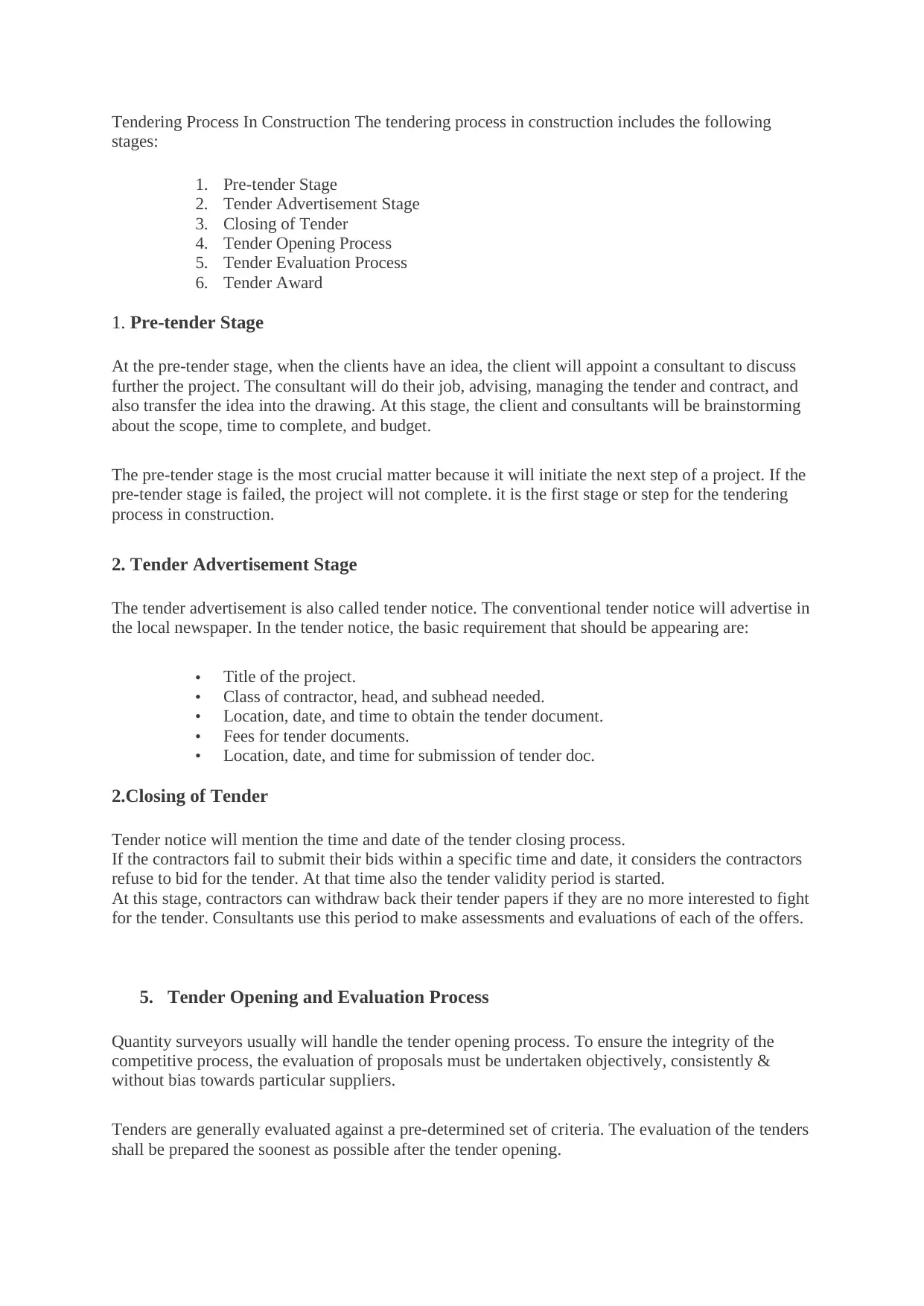
Tendering Process In Construction The tendering process in construction includes the following
stages:
1. Pre-tender Stage
2. Tender Advertisement Stage
3. Closing of Tender
4. Tender Opening Process
5. Tender Evaluation Process
6. Tender Award
1. Pre-tender Stage
At the pre-tender stage, when the clients have an idea, the client will appoint a consultant to discuss
further the project. The consultant will do their job, advising, managing the tender and contract, and
also transfer the idea into the drawing. At this stage, the client and consultants will be brainstorming
about the scope, time to complete, and budget.
The pre-tender stage is the most crucial matter because it will initiate the next step of a project. If the
pre-tender stage is failed, the project will not complete. it is the first stage or step for the tendering
process in construction.
2. Tender Advertisement Stage
The tender advertisement is also called tender notice. The conventional tender notice will advertise in
the local newspaper. In the tender notice, the basic requirement that should be appearing are:
• Title of the project.
• Class of contractor, head, and subhead needed.
• Location, date, and time to obtain the tender document.
• Fees for tender documents.
• Location, date, and time for submission of tender doc.
2.Closing of Tender
Tender notice will mention the time and date of the tender closing process.
If the contractors fail to submit their bids within a specific time and date, it considers the contractors
refuse to bid for the tender. At that time also the tender validity period is started.
At this stage, contractors can withdraw back their tender papers if they are no more interested to fight
for the tender. Consultants use this period to make assessments and evaluations of each of the offers.
5. Tender Opening and Evaluation Process
Quantity surveyors usually will handle the tender opening process. To ensure the integrity of the
competitive process, the evaluation of proposals must be undertaken objectively, consistently &
without bias towards particular suppliers.
Tenders are generally evaluated against a pre-determined set of criteria. The evaluation of the tenders
shall be prepared the soonest as possible after the tender opening.
stages:
1. Pre-tender Stage
2. Tender Advertisement Stage
3. Closing of Tender
4. Tender Opening Process
5. Tender Evaluation Process
6. Tender Award
1. Pre-tender Stage
At the pre-tender stage, when the clients have an idea, the client will appoint a consultant to discuss
further the project. The consultant will do their job, advising, managing the tender and contract, and
also transfer the idea into the drawing. At this stage, the client and consultants will be brainstorming
about the scope, time to complete, and budget.
The pre-tender stage is the most crucial matter because it will initiate the next step of a project. If the
pre-tender stage is failed, the project will not complete. it is the first stage or step for the tendering
process in construction.
2. Tender Advertisement Stage
The tender advertisement is also called tender notice. The conventional tender notice will advertise in
the local newspaper. In the tender notice, the basic requirement that should be appearing are:
• Title of the project.
• Class of contractor, head, and subhead needed.
• Location, date, and time to obtain the tender document.
• Fees for tender documents.
• Location, date, and time for submission of tender doc.
2.Closing of Tender
Tender notice will mention the time and date of the tender closing process.
If the contractors fail to submit their bids within a specific time and date, it considers the contractors
refuse to bid for the tender. At that time also the tender validity period is started.
At this stage, contractors can withdraw back their tender papers if they are no more interested to fight
for the tender. Consultants use this period to make assessments and evaluations of each of the offers.
5. Tender Opening and Evaluation Process
Quantity surveyors usually will handle the tender opening process. To ensure the integrity of the
competitive process, the evaluation of proposals must be undertaken objectively, consistently &
without bias towards particular suppliers.
Tenders are generally evaluated against a pre-determined set of criteria. The evaluation of the tenders
shall be prepared the soonest as possible after the tender opening.
⊘ This is a preview!⊘
Do you want full access?
Subscribe today to unlock all pages.
Trusted by 1+ million students worldwide
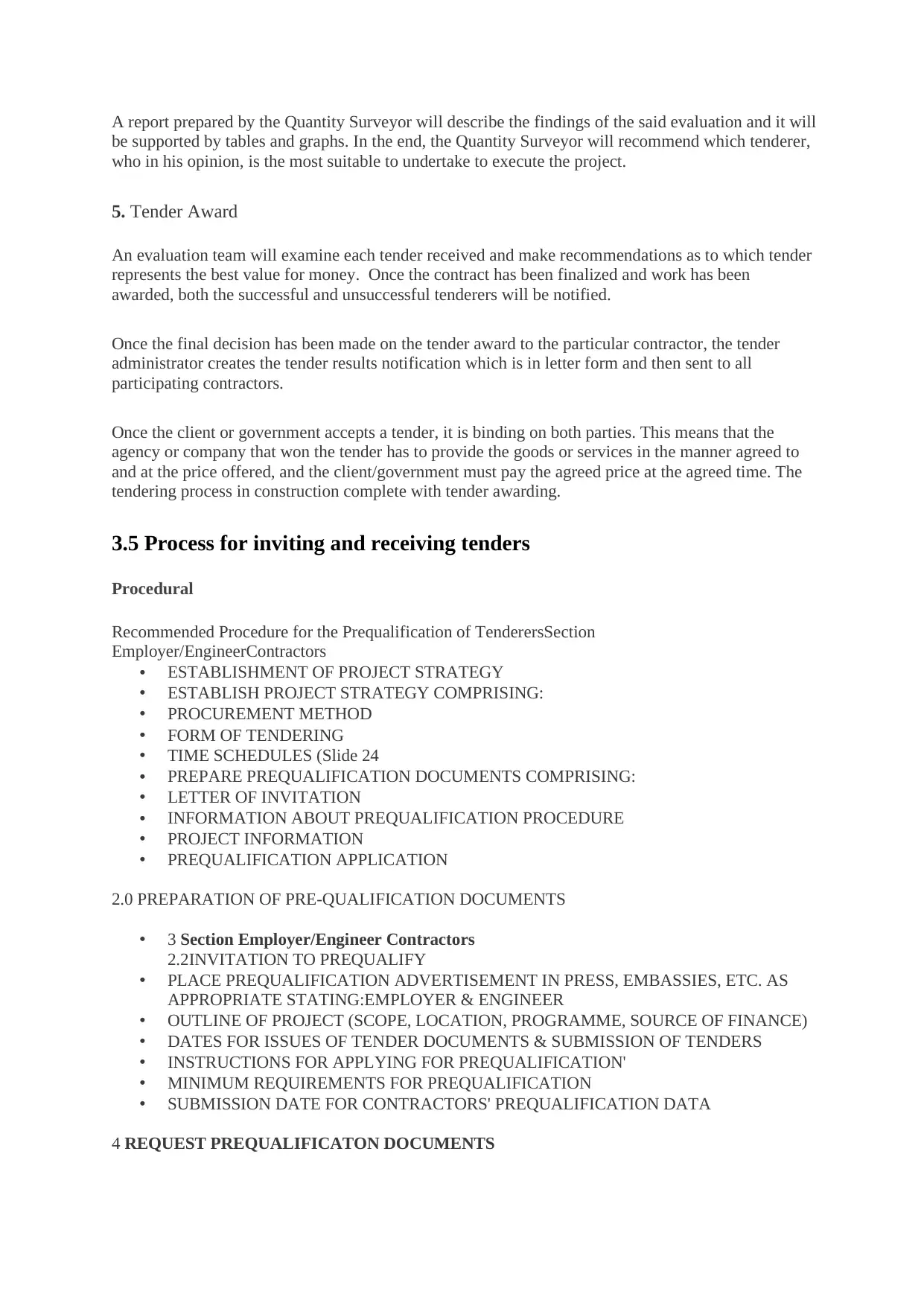
A report prepared by the Quantity Surveyor will describe the findings of the said evaluation and it will
be supported by tables and graphs. In the end, the Quantity Surveyor will recommend which tenderer,
who in his opinion, is the most suitable to undertake to execute the project.
5. Tender Award
An evaluation team will examine each tender received and make recommendations as to which tender
represents the best value for money. Once the contract has been finalized and work has been
awarded, both the successful and unsuccessful tenderers will be notified.
Once the final decision has been made on the tender award to the particular contractor, the tender
administrator creates the tender results notification which is in letter form and then sent to all
participating contractors.
Once the client or government accepts a tender, it is binding on both parties. This means that the
agency or company that won the tender has to provide the goods or services in the manner agreed to
and at the price offered, and the client/government must pay the agreed price at the agreed time. The
tendering process in construction complete with tender awarding.
3.5 Process for inviting and receiving tenders
Procedural
Recommended Procedure for the Prequalification of TenderersSection
Employer/EngineerContractors
• ESTABLISHMENT OF PROJECT STRATEGY
• ESTABLISH PROJECT STRATEGY COMPRISING:
• PROCUREMENT METHOD
• FORM OF TENDERING
• TIME SCHEDULES (Slide 24
• PREPARE PREQUALIFICATION DOCUMENTS COMPRISING:
• LETTER OF INVITATION
• INFORMATION ABOUT PREQUALIFICATION PROCEDURE
• PROJECT INFORMATION
• PREQUALIFICATION APPLICATION
2.0 PREPARATION OF PRE-QUALIFICATION DOCUMENTS
• 3 Section Employer/Engineer Contractors
2.2INVITATION TO PREQUALIFY
• PLACE PREQUALIFICATION ADVERTISEMENT IN PRESS, EMBASSIES, ETC. AS
APPROPRIATE STATING:EMPLOYER & ENGINEER
• OUTLINE OF PROJECT (SCOPE, LOCATION, PROGRAMME, SOURCE OF FINANCE)
• DATES FOR ISSUES OF TENDER DOCUMENTS & SUBMISSION OF TENDERS
• INSTRUCTIONS FOR APPLYING FOR PREQUALIFICATION'
• MINIMUM REQUIREMENTS FOR PREQUALIFICATION
• SUBMISSION DATE FOR CONTRACTORS' PREQUALIFICATION DATA
4 REQUEST PREQUALIFICATON DOCUMENTS
be supported by tables and graphs. In the end, the Quantity Surveyor will recommend which tenderer,
who in his opinion, is the most suitable to undertake to execute the project.
5. Tender Award
An evaluation team will examine each tender received and make recommendations as to which tender
represents the best value for money. Once the contract has been finalized and work has been
awarded, both the successful and unsuccessful tenderers will be notified.
Once the final decision has been made on the tender award to the particular contractor, the tender
administrator creates the tender results notification which is in letter form and then sent to all
participating contractors.
Once the client or government accepts a tender, it is binding on both parties. This means that the
agency or company that won the tender has to provide the goods or services in the manner agreed to
and at the price offered, and the client/government must pay the agreed price at the agreed time. The
tendering process in construction complete with tender awarding.
3.5 Process for inviting and receiving tenders
Procedural
Recommended Procedure for the Prequalification of TenderersSection
Employer/EngineerContractors
• ESTABLISHMENT OF PROJECT STRATEGY
• ESTABLISH PROJECT STRATEGY COMPRISING:
• PROCUREMENT METHOD
• FORM OF TENDERING
• TIME SCHEDULES (Slide 24
• PREPARE PREQUALIFICATION DOCUMENTS COMPRISING:
• LETTER OF INVITATION
• INFORMATION ABOUT PREQUALIFICATION PROCEDURE
• PROJECT INFORMATION
• PREQUALIFICATION APPLICATION
2.0 PREPARATION OF PRE-QUALIFICATION DOCUMENTS
• 3 Section Employer/Engineer Contractors
2.2INVITATION TO PREQUALIFY
• PLACE PREQUALIFICATION ADVERTISEMENT IN PRESS, EMBASSIES, ETC. AS
APPROPRIATE STATING:EMPLOYER & ENGINEER
• OUTLINE OF PROJECT (SCOPE, LOCATION, PROGRAMME, SOURCE OF FINANCE)
• DATES FOR ISSUES OF TENDER DOCUMENTS & SUBMISSION OF TENDERS
• INSTRUCTIONS FOR APPLYING FOR PREQUALIFICATION'
• MINIMUM REQUIREMENTS FOR PREQUALIFICATION
• SUBMISSION DATE FOR CONTRACTORS' PREQUALIFICATION DATA
4 REQUEST PREQUALIFICATON DOCUMENTS
Paraphrase This Document
Need a fresh take? Get an instant paraphrase of this document with our AI Paraphraser
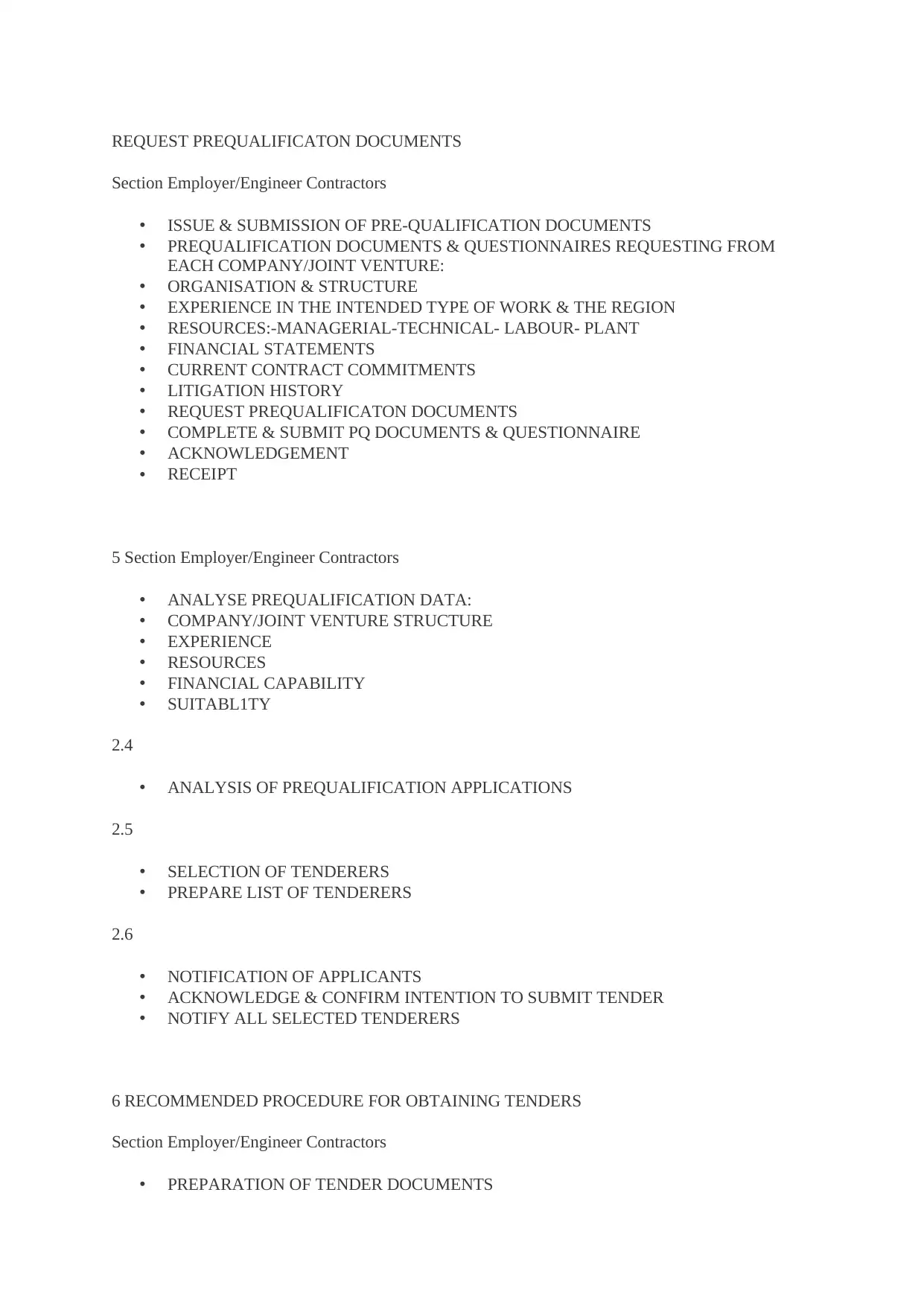
REQUEST PREQUALIFICATON DOCUMENTS
Section Employer/Engineer Contractors
• ISSUE & SUBMISSION OF PRE-QUALIFICATION DOCUMENTS
• PREQUALIFICATION DOCUMENTS & QUESTIONNAIRES REQUESTING FROM
EACH COMPANY/JOINT VENTURE:
• ORGANISATION & STRUCTURE
• EXPERIENCE IN THE INTENDED TYPE OF WORK & THE REGION
• RESOURCES:-MANAGERIAL-TECHNICAL- LABOUR- PLANT
• FINANCIAL STATEMENTS
• CURRENT CONTRACT COMMITMENTS
• LITIGATION HISTORY
• REQUEST PREQUALIFICATON DOCUMENTS
• COMPLETE & SUBMIT PQ DOCUMENTS & QUESTIONNAIRE
• ACKNOWLEDGEMENT
• RECEIPT
5 Section Employer/Engineer Contractors
• ANALYSE PREQUALIFICATION DATA:
• COMPANY/JOINT VENTURE STRUCTURE
• EXPERIENCE
• RESOURCES
• FINANCIAL CAPABILITY
• SUITABL1TY
2.4
• ANALYSIS OF PREQUALIFICATION APPLICATIONS
2.5
• SELECTION OF TENDERERS
• PREPARE LIST OF TENDERERS
2.6
• NOTIFICATION OF APPLICANTS
• ACKNOWLEDGE & CONFIRM INTENTION TO SUBMIT TENDER
• NOTIFY ALL SELECTED TENDERERS
6 RECOMMENDED PROCEDURE FOR OBTAINING TENDERS
Section Employer/Engineer Contractors
• PREPARATION OF TENDER DOCUMENTS
Section Employer/Engineer Contractors
• ISSUE & SUBMISSION OF PRE-QUALIFICATION DOCUMENTS
• PREQUALIFICATION DOCUMENTS & QUESTIONNAIRES REQUESTING FROM
EACH COMPANY/JOINT VENTURE:
• ORGANISATION & STRUCTURE
• EXPERIENCE IN THE INTENDED TYPE OF WORK & THE REGION
• RESOURCES:-MANAGERIAL-TECHNICAL- LABOUR- PLANT
• FINANCIAL STATEMENTS
• CURRENT CONTRACT COMMITMENTS
• LITIGATION HISTORY
• REQUEST PREQUALIFICATON DOCUMENTS
• COMPLETE & SUBMIT PQ DOCUMENTS & QUESTIONNAIRE
• ACKNOWLEDGEMENT
• RECEIPT
5 Section Employer/Engineer Contractors
• ANALYSE PREQUALIFICATION DATA:
• COMPANY/JOINT VENTURE STRUCTURE
• EXPERIENCE
• RESOURCES
• FINANCIAL CAPABILITY
• SUITABL1TY
2.4
• ANALYSIS OF PREQUALIFICATION APPLICATIONS
2.5
• SELECTION OF TENDERERS
• PREPARE LIST OF TENDERERS
2.6
• NOTIFICATION OF APPLICANTS
• ACKNOWLEDGE & CONFIRM INTENTION TO SUBMIT TENDER
• NOTIFY ALL SELECTED TENDERERS
6 RECOMMENDED PROCEDURE FOR OBTAINING TENDERS
Section Employer/Engineer Contractors
• PREPARATION OF TENDER DOCUMENTS
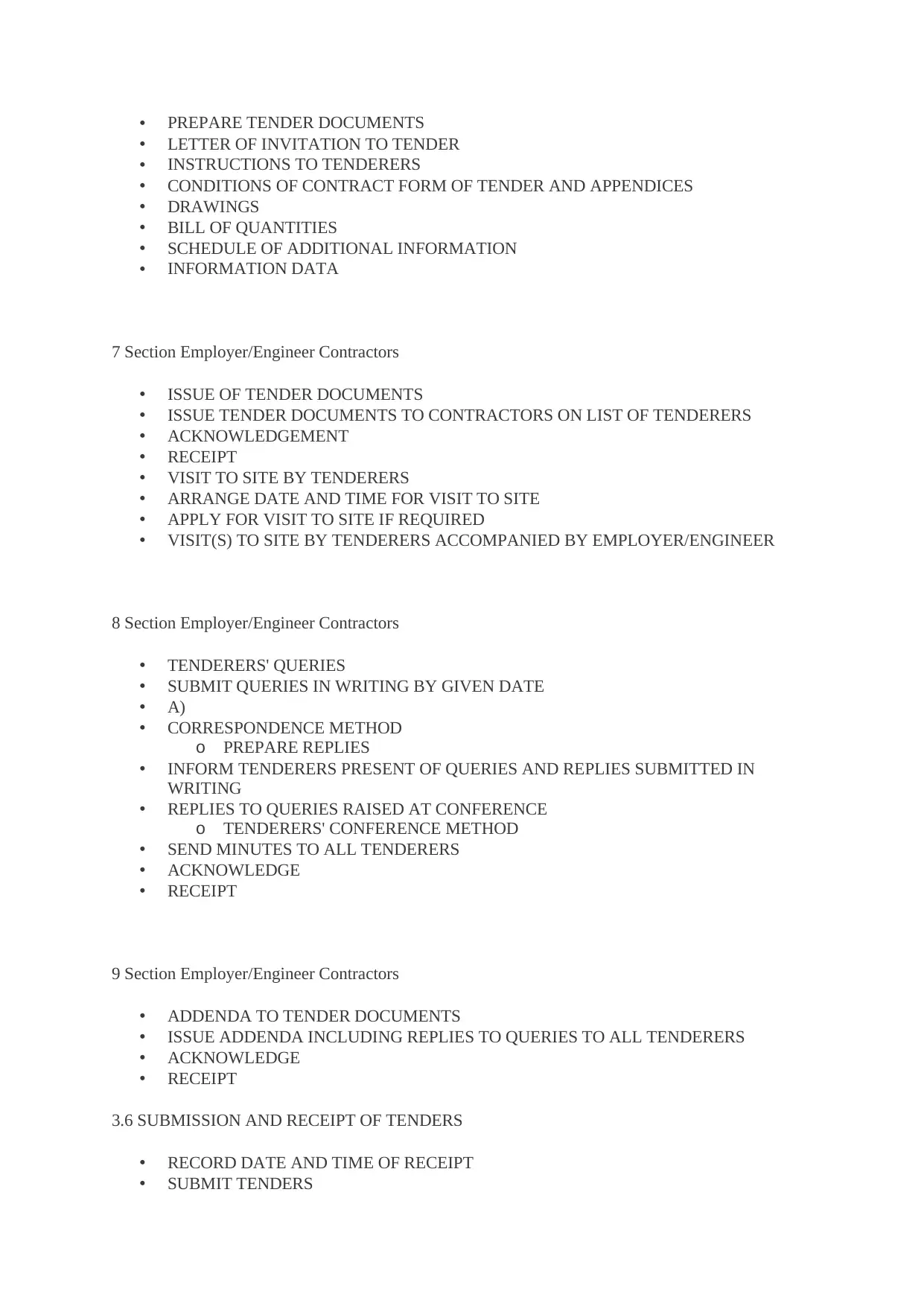
• PREPARE TENDER DOCUMENTS
• LETTER OF INVITATION TO TENDER
• INSTRUCTIONS TO TENDERERS
• CONDITIONS OF CONTRACT FORM OF TENDER AND APPENDICES
• DRAWINGS
• BILL OF QUANTITIES
• SCHEDULE OF ADDITIONAL INFORMATION
• INFORMATION DATA
7 Section Employer/Engineer Contractors
• ISSUE OF TENDER DOCUMENTS
• ISSUE TENDER DOCUMENTS TO CONTRACTORS ON LIST OF TENDERERS
• ACKNOWLEDGEMENT
• RECEIPT
• VISIT TO SITE BY TENDERERS
• ARRANGE DATE AND TIME FOR VISIT TO SITE
• APPLY FOR VISIT TO SITE IF REQUIRED
• VISIT(S) TO SITE BY TENDERERS ACCOMPANIED BY EMPLOYER/ENGINEER
8 Section Employer/Engineer Contractors
• TENDERERS' QUERIES
• SUBMIT QUERIES IN WRITING BY GIVEN DATE
• A)
• CORRESPONDENCE METHOD
o PREPARE REPLIES
• INFORM TENDERERS PRESENT OF QUERIES AND REPLIES SUBMITTED IN
WRITING
• REPLIES TO QUERIES RAISED AT CONFERENCE
o TENDERERS' CONFERENCE METHOD
• SEND MINUTES TO ALL TENDERERS
• ACKNOWLEDGE
• RECEIPT
9 Section Employer/Engineer Contractors
• ADDENDA TO TENDER DOCUMENTS
• ISSUE ADDENDA INCLUDING REPLIES TO QUERIES TO ALL TENDERERS
• ACKNOWLEDGE
• RECEIPT
3.6 SUBMISSION AND RECEIPT OF TENDERS
• RECORD DATE AND TIME OF RECEIPT
• SUBMIT TENDERS
• LETTER OF INVITATION TO TENDER
• INSTRUCTIONS TO TENDERERS
• CONDITIONS OF CONTRACT FORM OF TENDER AND APPENDICES
• DRAWINGS
• BILL OF QUANTITIES
• SCHEDULE OF ADDITIONAL INFORMATION
• INFORMATION DATA
7 Section Employer/Engineer Contractors
• ISSUE OF TENDER DOCUMENTS
• ISSUE TENDER DOCUMENTS TO CONTRACTORS ON LIST OF TENDERERS
• ACKNOWLEDGEMENT
• RECEIPT
• VISIT TO SITE BY TENDERERS
• ARRANGE DATE AND TIME FOR VISIT TO SITE
• APPLY FOR VISIT TO SITE IF REQUIRED
• VISIT(S) TO SITE BY TENDERERS ACCOMPANIED BY EMPLOYER/ENGINEER
8 Section Employer/Engineer Contractors
• TENDERERS' QUERIES
• SUBMIT QUERIES IN WRITING BY GIVEN DATE
• A)
• CORRESPONDENCE METHOD
o PREPARE REPLIES
• INFORM TENDERERS PRESENT OF QUERIES AND REPLIES SUBMITTED IN
WRITING
• REPLIES TO QUERIES RAISED AT CONFERENCE
o TENDERERS' CONFERENCE METHOD
• SEND MINUTES TO ALL TENDERERS
• ACKNOWLEDGE
• RECEIPT
9 Section Employer/Engineer Contractors
• ADDENDA TO TENDER DOCUMENTS
• ISSUE ADDENDA INCLUDING REPLIES TO QUERIES TO ALL TENDERERS
• ACKNOWLEDGE
• RECEIPT
3.6 SUBMISSION AND RECEIPT OF TENDERS
• RECORD DATE AND TIME OF RECEIPT
• SUBMIT TENDERS
⊘ This is a preview!⊘
Do you want full access?
Subscribe today to unlock all pages.
Trusted by 1+ million students worldwide

1 out of 14


Related Documents


Your All-in-One AI-Powered Toolkit for Academic Success.
+13062052269
info@desklib.com
Available 24*7 on WhatsApp / Email
![[object Object]](/_next/static/media/star-bottom.7253800d.svg)
Unlock your academic potential
Copyright © 2020–2026 A2Z Services. All Rights Reserved. Developed and managed by ZUCOL.