Civil Engineering: Detailed Workplace Health and Safety Policy Report

Verified

Added on  2023/04/21

|19
|2830
|132
Report
AI Summary
This report presents a comprehensive analysis of workplace health and safety (WHS) in a civil engineering context. It begins with an overview of WHS policy documents, outlining the roles and responsibilities of employers, employees, and key personnel such as WHS representatives, first aid officers, and fire wardens. The report then defines and categorizes various types of workplace hazards, including biological, physical, ergonomic, chemical, work organization, psychological, and safety hazards. It also explains risk assessment methodologies, including hazard identification and risk evaluation, and details the hierarchy of risk control, illustrating its application in a workplace setting. The second part of the report includes a hazard checklist, assessing potential hazards related to fire protection, electricity, machinery, building structures, air conditioning, lighting, cabling, environment, windows/doors, emergency procedures, first aid, and storage areas. The checklist details potential hazards, assesses risks, and outlines action plans for mitigation. The report also addresses the frequency of hazard checks, record-keeping procedures, legislative compliance, and sources of expert WHS advice. Finally, the report outlines a WHS training session plan for new employees, including learning objectives, handouts, and program structure.
Document Page
CIVIL ENGINEERING
By Name

Course

Instructor

Institution

Location

Date
tabler-icon-diamond-filled.svg

Paraphrase This Document

Need a fresh take? Get an instant paraphrase of this document with our AI Paraphraser
Document Page
Task One
Part A

(1)
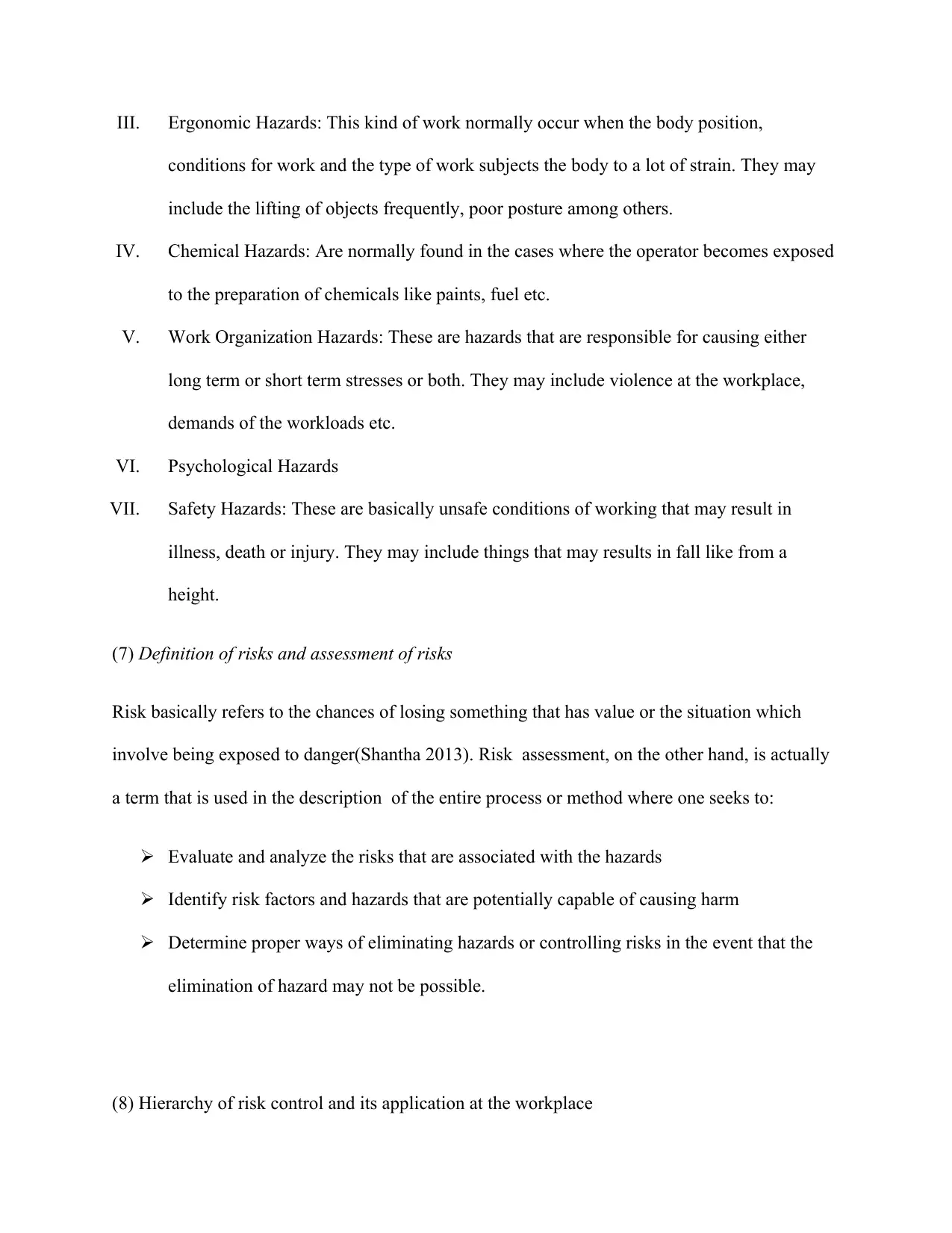
The policy document is normally placed on an area that is open to all. This may include
pinning on the notice board. Here is a sample of the WHS policy document.

Figure 1: Sample of policy document(Pouliakas and Theodossiou 2013)

(2) Role of employers and employees in health and safety

According to the policies of this particular company or health facility, it is the duty of the

employer to protect safety, welfare and health of their employees and other members of the

public who may be in one way or the other affected by the business. Employees, on the other

hand, have full responsibilities of engaging into those activities that promote safety in the

workplace and report any suspicious phenomenon to their supervisors.
Document Page
(3) In the chosen health facility or company there was a company representative of WHS. This
was basically an individual who has been selected or elected to represent the interest of workers

within their groups in relation to safety and health(Pouliakas and Theodossiou 2013).

(4) First aid officer refers to an individual whose key responsibilities is maintenance and

monitoring of the facilities of first aid in their offices, assisting the officer in charge of WHS in

the site and administering first aid. Considering that accident normally occurs unannounced and

demand quick attention, it is important that first aid kits be located in places that are known to all

and easily accessible(Smith and Eastman 2012).

(5) A fire warden refers to a designated individual within administration whose allocated

responsibilities include assisting in the management of fire safety. This is achieved through

contribution to the safety of people in case of fire incidences(Landsbergis, Grzywacz and

LaMontagne 2014).

(6) Hazard definition and identification of types of Hazards

Any possible source of danger at the workplace is called hazard. There are actually 7 types of

Hazards. These include the following:

I.
Biological Hazards: They include exposure to harm as a result of working with people,
animals, and infectious plant species. They may include body fluids and blood, insect

bites among others.

II.
Physical Hazards: Refers to those factors that can potentially harm the body without
necessarily touching it although it is within the environment. They may include extreme

temperature, high radiation among others.
Document Page
III. Ergonomic Hazards: This kind of work normally occur when the body position,
conditions for work and the type of work subjects the body to a lot of strain. They may

include the lifting of objects frequently, poor posture among others.

IV.
Chemical Hazards: Are normally found in the cases where the operator becomes exposed
to the preparation of chemicals like paints, fuel etc.

V.
Work Organization Hazards: These are hazards that are responsible for causing either
long term or short term stresses or both. They may include violence at the workplace,

demands of the workloads etc.

VI.
Psychological Hazards
VII.
Safety Hazards: These are basically unsafe conditions of working that may result in
illness, death or injury. They may include things that may results in fall like from a

height.

(7)
Definition of risks and assessment of risks
Risk basically refers to the chances of losing something that has value or the situation which

involve being exposed to danger(Shantha 2013). Risk assessment, on the other hand, is actually

a term that is used in the description of the entire process or method where one seeks to:


Evaluate and analyze the risks that are associated with the hazards

Identify risk factors and hazards that are potentially capable of causing harm

Determine proper ways of eliminating hazards or controlling risks in the event that the
elimination of hazard may not be possible.

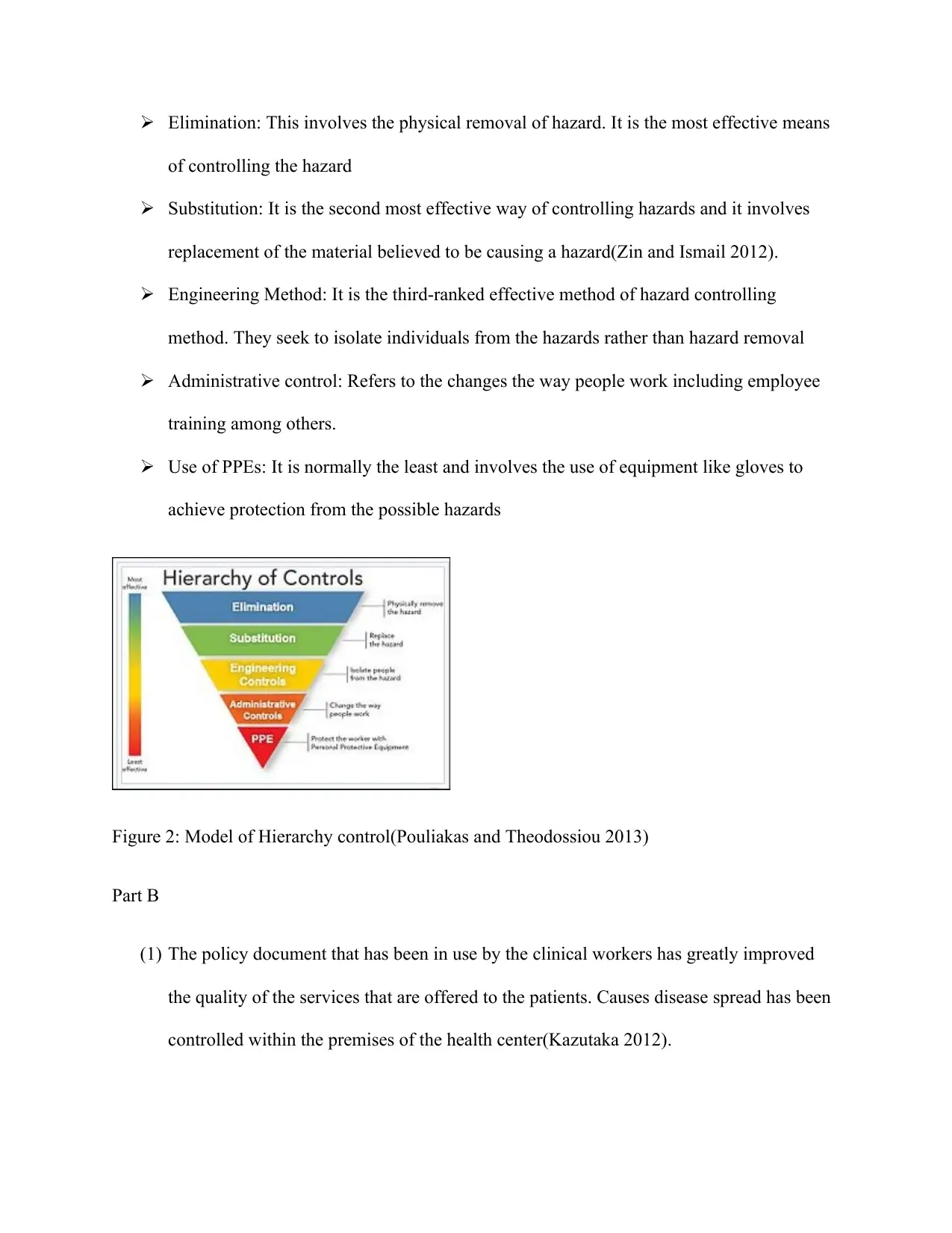
(8) Hierarchy of risk control and its application at the workplace
tabler-icon-diamond-filled.svg

Paraphrase This Document

Need a fresh take? Get an instant paraphrase of this document with our AI Paraphraser
Document Page
 Elimination: This involves the physical removal of hazard. It is the most effective means
of controlling the hazard


Substitution: It is the second most effective way of controlling hazards and it involves
replacement of the material believed to be causing a hazard(Zin and Ismail 2012).


Engineering Method: It is the third-ranked effective method of hazard controlling
method. They seek to isolate individuals from the hazards rather than hazard removal


Administrative control: Refers to the changes the way people work including employee
training among others.


Use of PPEs: It is normally the least and involves the use of equipment like gloves to
achieve protection from the possible hazards

Figure 2: Model of Hierarchy control(Pouliakas and Theodossiou 2013)

Part B

(1)
The policy document that has been in use by the clinical workers has greatly improved
the quality of the services that are offered to the patients. Causes disease spread has been

controlled within the premises of the health center(Kazutaka 2012).
Document Page
(2) It is recommended that the copies of the policy document be produced on leaflets and be
issued to the patients who may visit the place next time. This will at least help them

familiarize with the policies.

Task Two

Part A

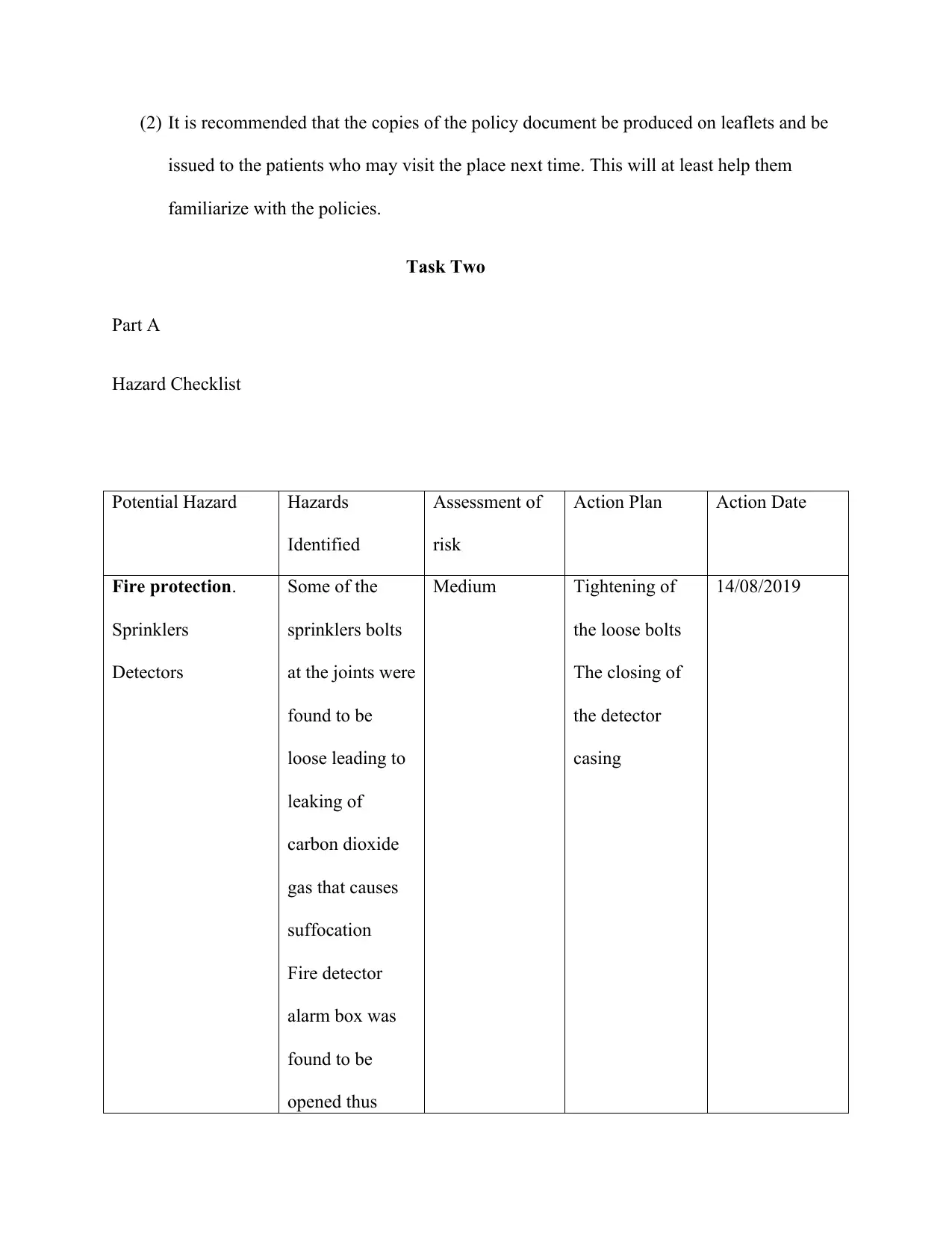
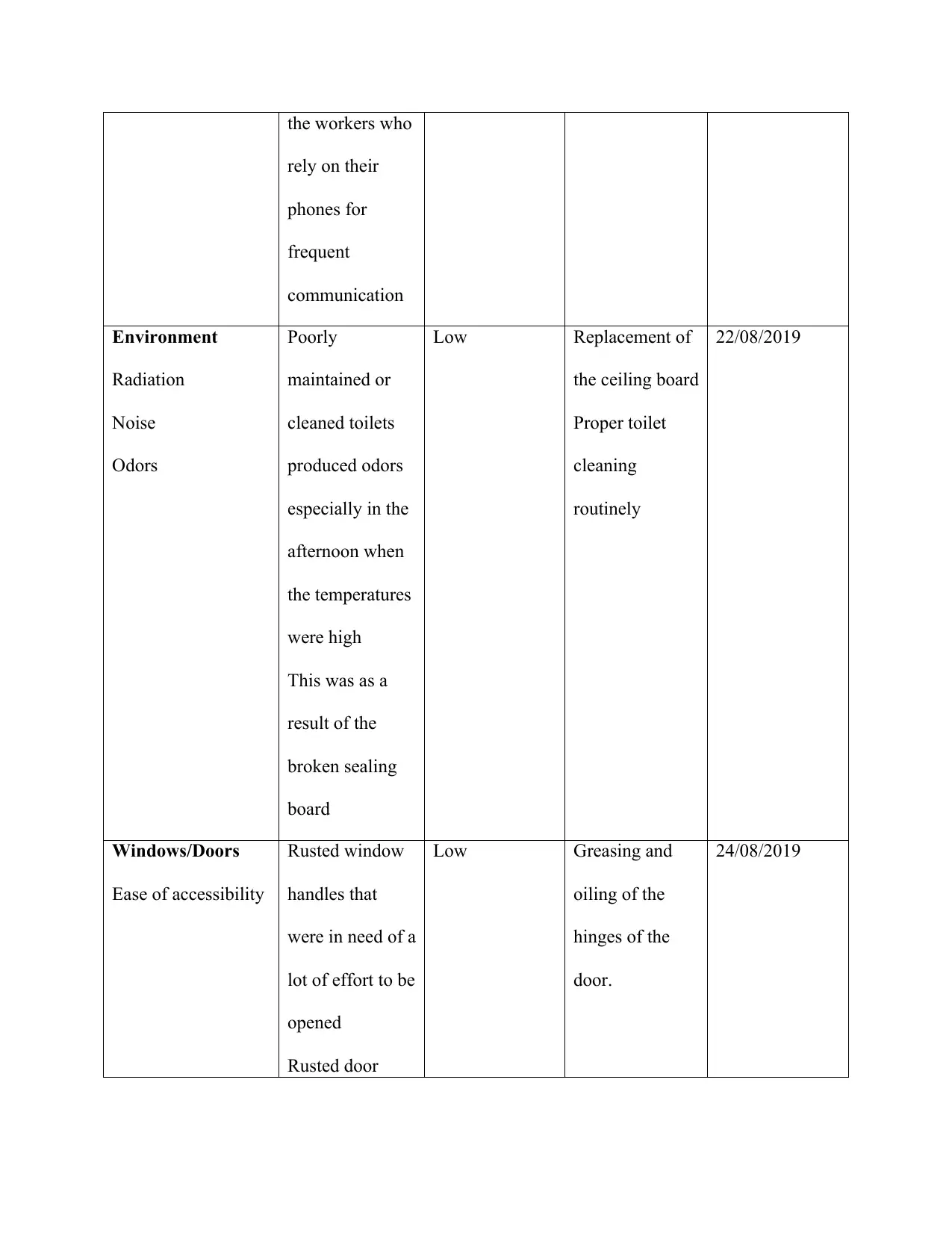
Hazard Checklist

Potential Hazard
Hazards
Identified

Assessment of

risk

Action Plan
Action Date
Fire protection
.
Sprinklers

Detectors

Some of the

sprinklers bolts

at the joints were

found to be

loose leading to

leaking of

carbon dioxide

gas that causes

suffocation

Fire detector

alarm box was

found to be

opened thus

Medium
Tightening of
the loose bolts

The closing of

the detector

casing

14/08/2019
Document Page
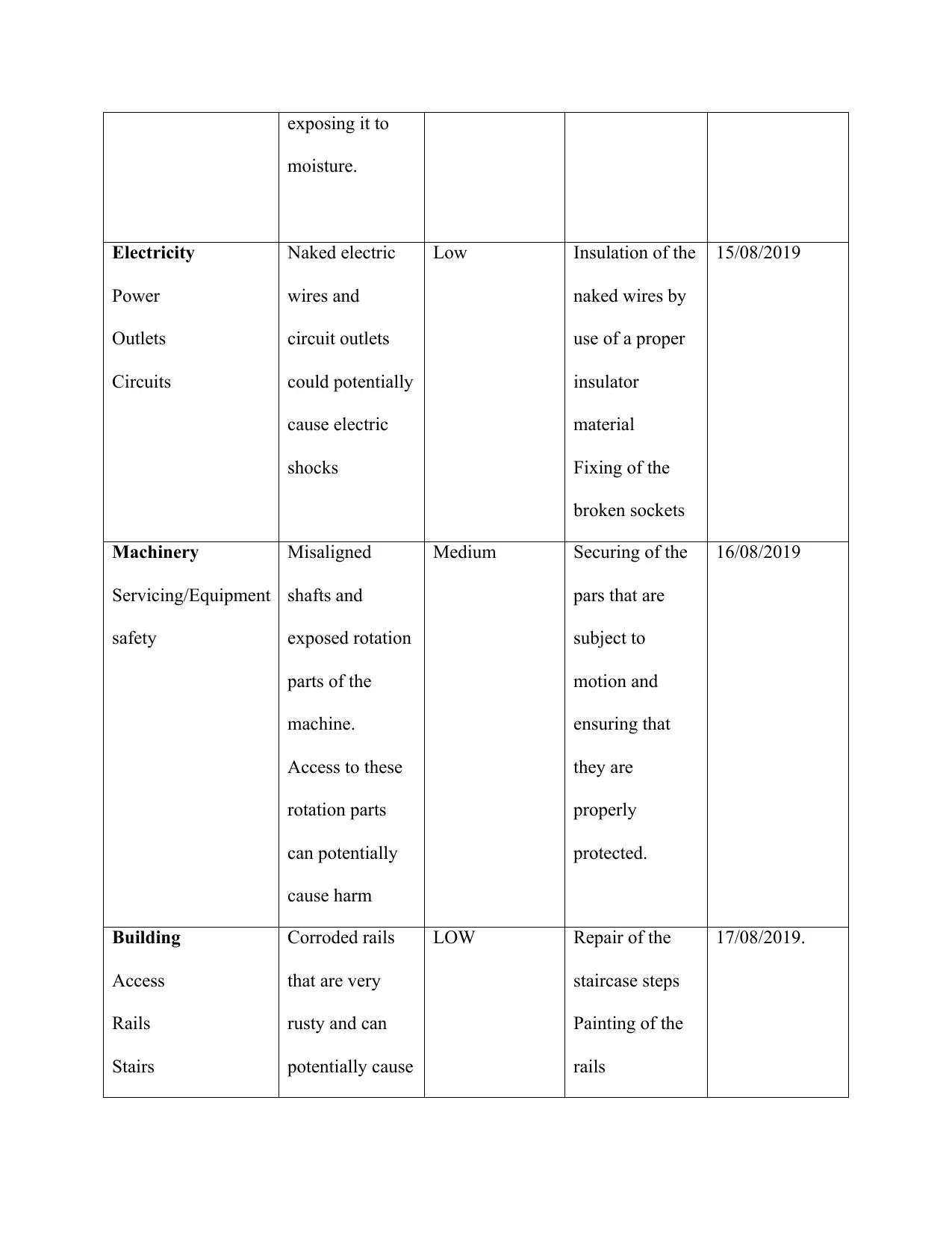
exposing it to
moisture.

Electricity

Power

Outlets

Circuits

Naked electric

wires and

circuit outlets

could potentially

cause electric

shocks

Low
Insulation of the
naked wires by

use of a proper

insulator

material

Fixing of the

broken sockets

15/08/2019

Machinery

Servicing/Equipment

safety

Misaligned

shafts and

exposed rotation

parts of the

machine.

Access to these

rotation parts

can potentially

cause harm

Medium
Securing of the
pars that are

subject to

motion and

ensuring that

they are

properly

protected.

16/08/2019

Building

Access

Rails

Stairs

Corroded rails

that are very

rusty and can

potentially cause

LOW
Repair of the
staircase steps

Painting of the

rails

17/08/2019.
tabler-icon-diamond-filled.svg

Paraphrase This Document

Need a fresh take? Get an instant paraphrase of this document with our AI Paraphraser
Document Page
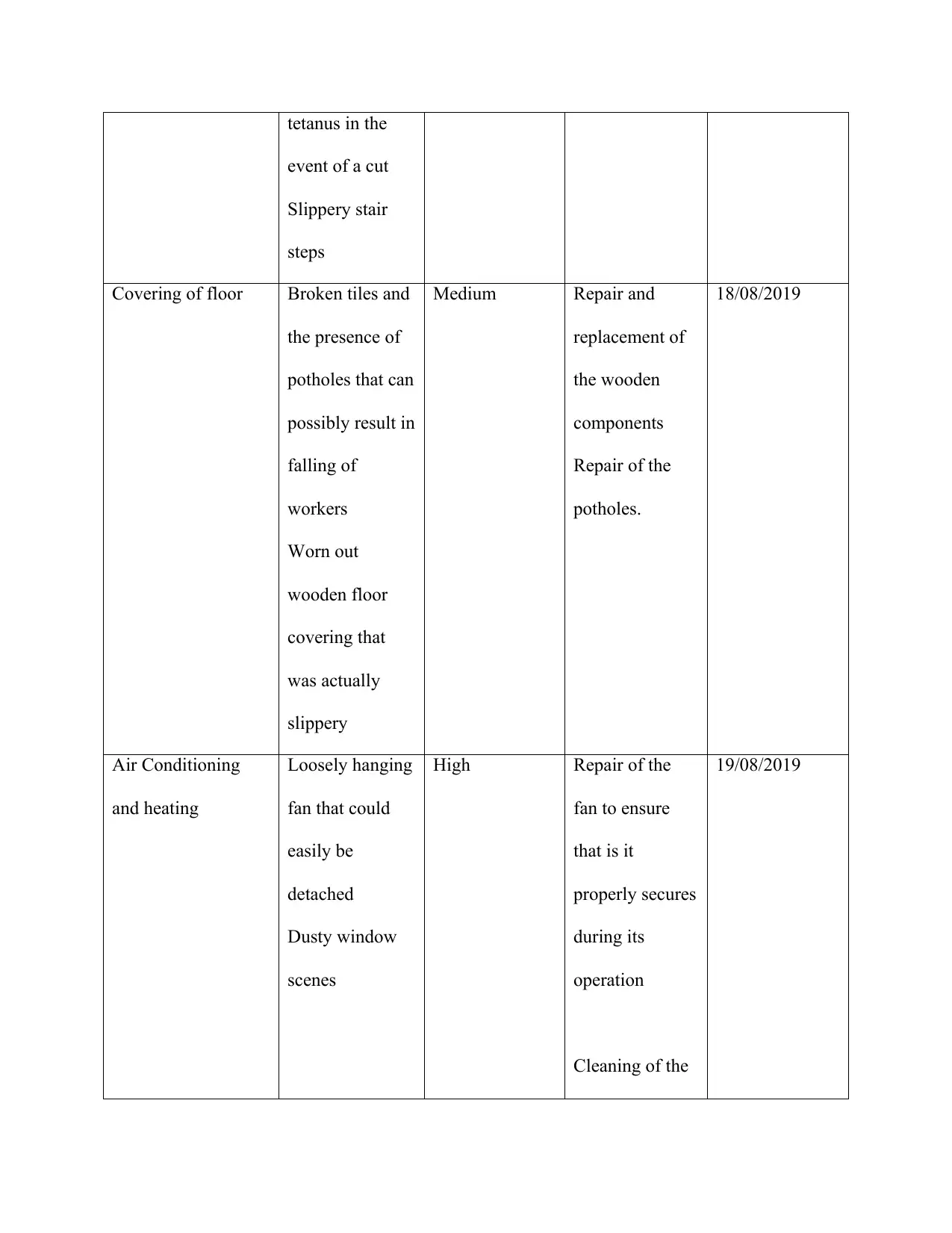
tetanus in the
event of a cut

Slippery stair

steps

Covering of floor
Broken tiles and
the presence of

potholes that can

possibly result in

falling of

workers

Worn out

wooden floor

covering that

was actually

slippery

Medium
Repair and
replacement of

the wooden

components

Repair of the

potholes.

18/08/2019

Air Conditioning

and heating

Loosely hanging

fan that could

easily be

detached

Dusty window

scenes

High
Repair of the
fan to ensure

that is it

properly secures

during its

operation

Cleaning of the

19/08/2019
Document Page
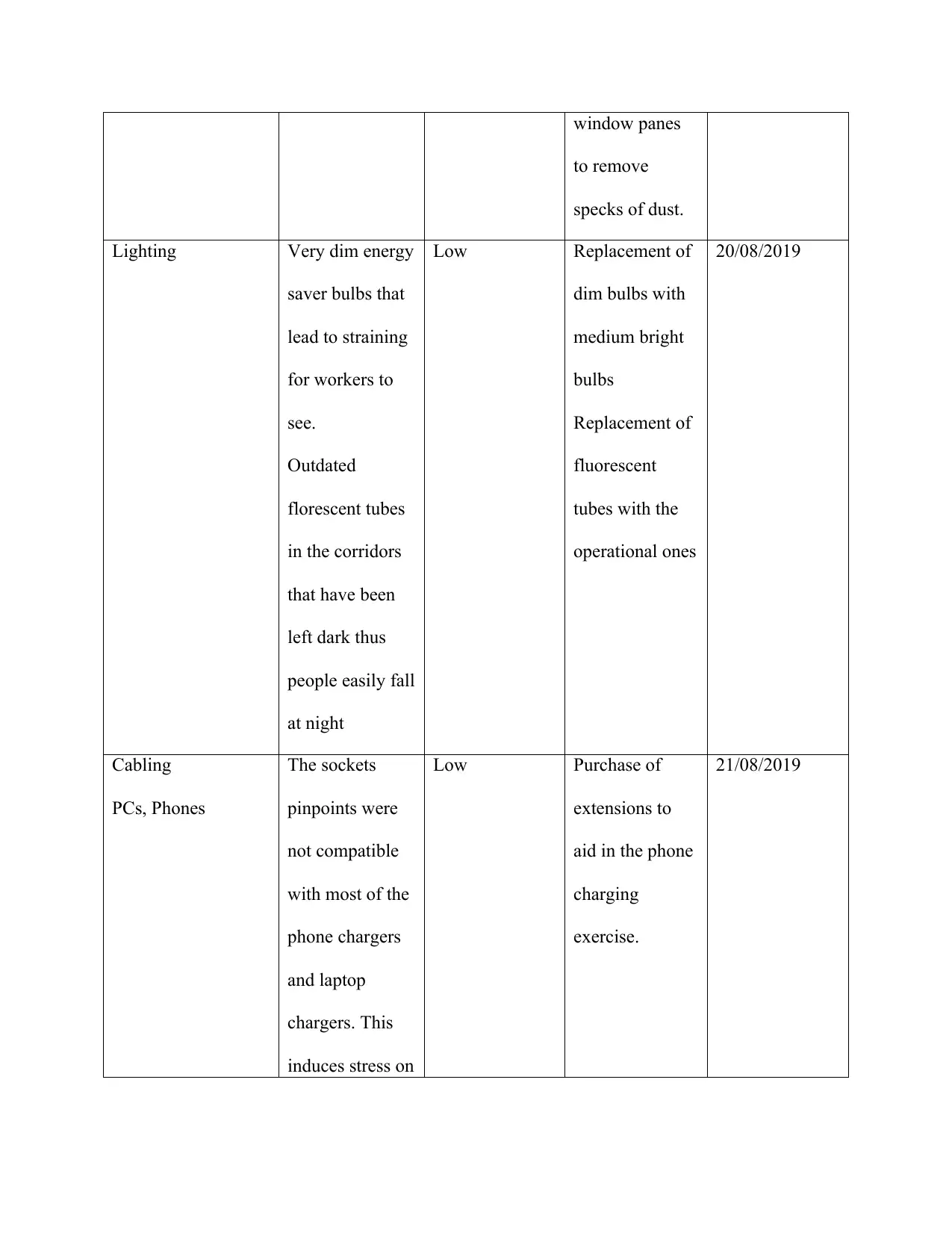
window panes
to remove

specks of dust.

Lighting
Very dim energy
saver bulbs that

lead to straining

for workers to

see.

Outdated

florescent tubes

in the corridors

that have been

left dark thus

people easily fall

at night

Low
Replacement of
dim bulbs with

medium bright

bulbs

Replacement of

fluorescent

tubes with the

operational ones

20/08/2019

Cabling

PCs, Phones

The sockets

pinpoints were

not compatible

with most of the

phone chargers

and laptop

chargers. This

induces stress on

Low
Purchase of
extensions to

aid in the phone

charging

exercise.

21/08/2019
Document Page
the workers who
rely on their

phones for

frequent

communication

Environment

Radiation

Noise

Odors

Poorly

maintained or

cleaned toilets

produced odors

especially in the

afternoon when

the temperatures

were high

This was as a

result of the

broken sealing

board

Low
Replacement of
the ceiling board

Proper toilet

cleaning

routinely

22/08/2019

Windows/Doors

Ease of accessibility

Rusted window

handles that

were in need of a

lot of effort to be

opened

Rusted door

Low
Greasing and
oiling of the

hinges of the

door.

24/08/2019
tabler-icon-diamond-filled.svg

Paraphrase This Document

Need a fresh take? Get an instant paraphrase of this document with our AI Paraphraser
Document Page
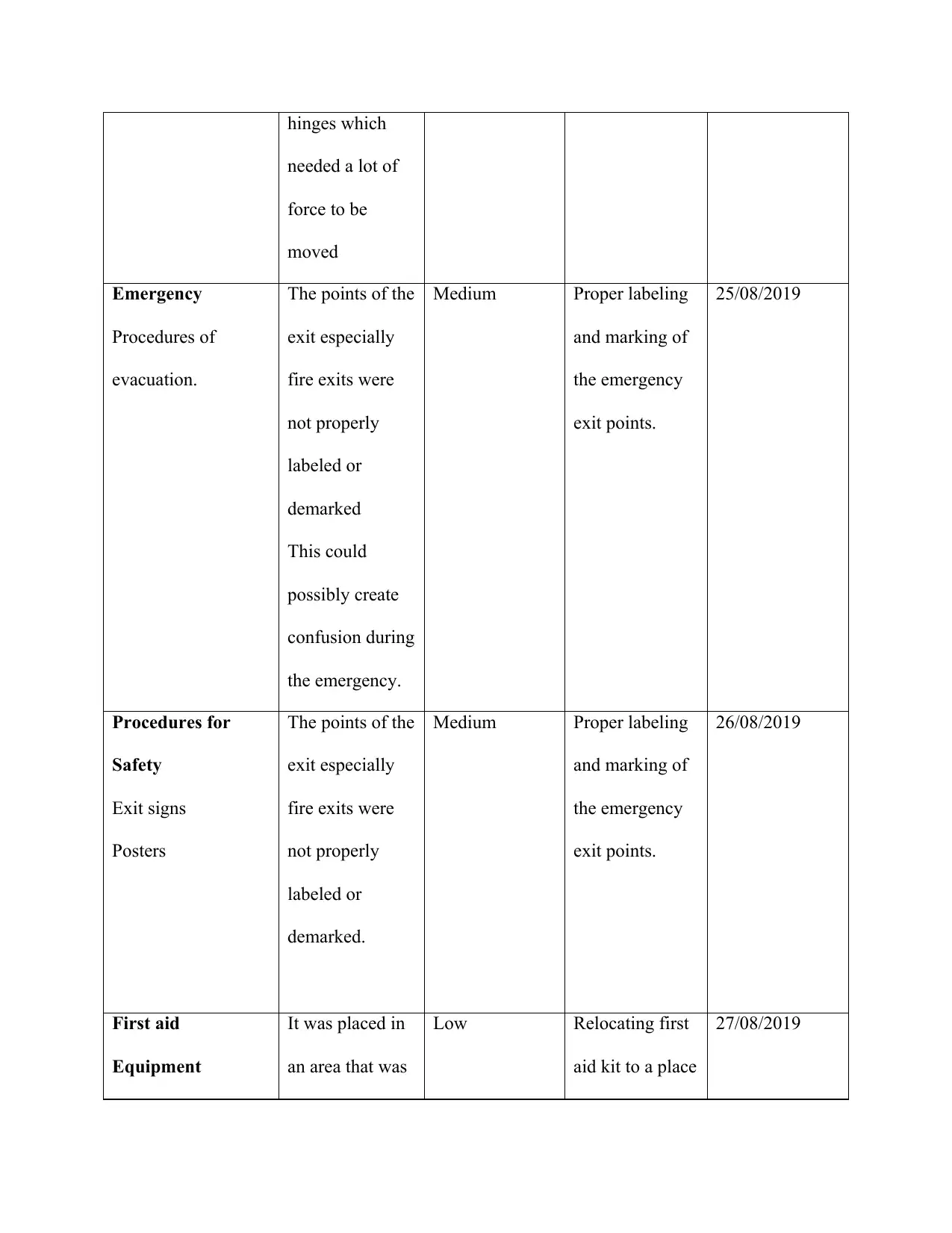
hinges which
needed a lot of

force to be

moved

Emergency

Procedures of

evacuation.

The points of the

exit especially

fire exits were

not properly

labeled or

demarked

This could

possibly create

confusion during

the emergency.

Medium
Proper labeling
and marking of

the emergency

exit points.

25/08/2019

Procedures for

Safety

Exit signs

Posters

The points of the

exit especially

fire exits were

not properly

labeled or

demarked.

Medium
Proper labeling
and marking of

the emergency

exit points.

26/08/2019

First aid

Equipment

It was placed in

an area that was

Low
Relocating first
aid kit to a place

27/08/2019
Document Page
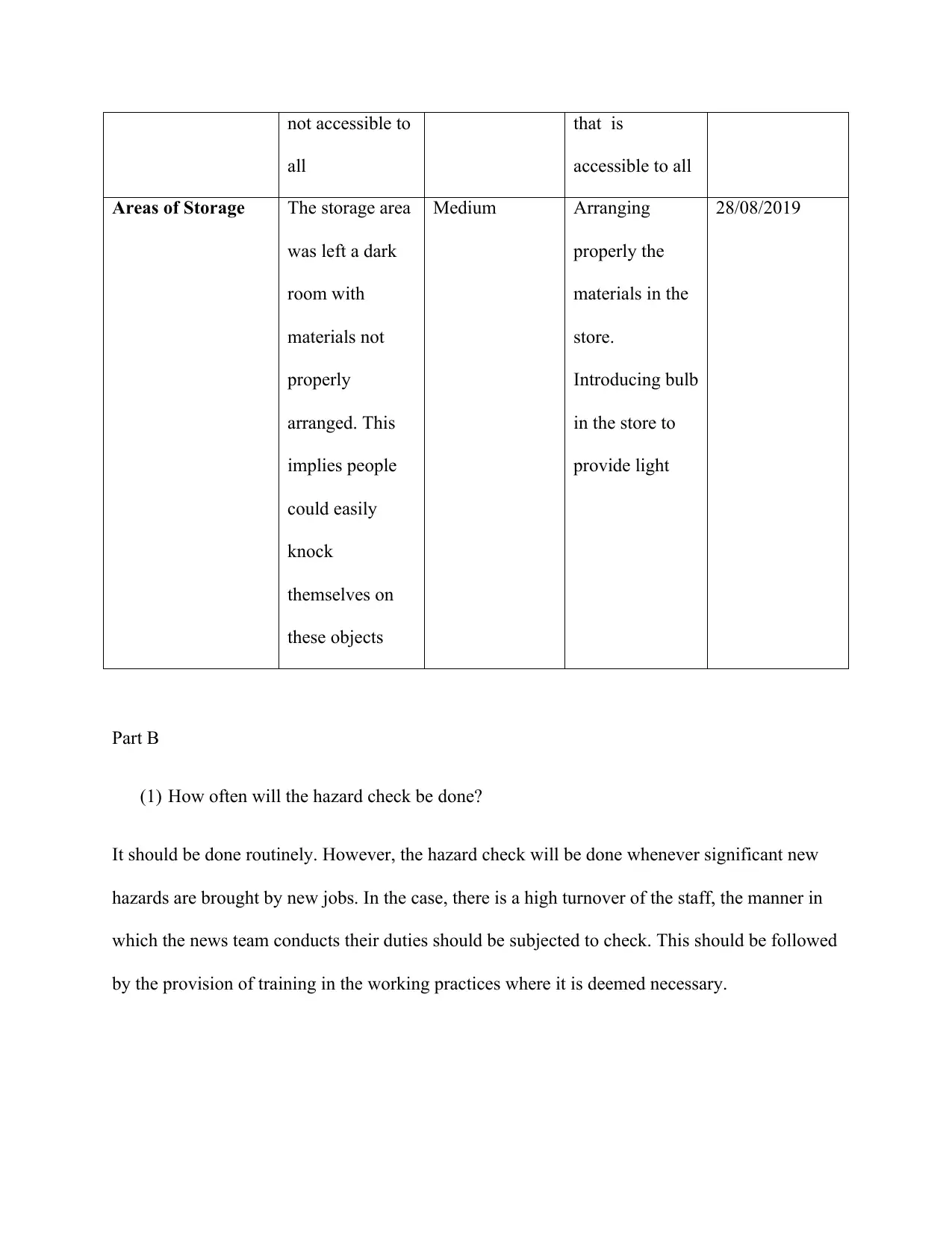
not accessible to
all

that is

accessible to all

Areas of Storage
The storage area
was left a dark

room with

materials not

properly

arranged. This

implies people

could easily

knock

themselves on

these objects

Medium
Arranging
properly the

materials in the

store.

Introducing bulb

in the store to

provide light

28/08/2019

Part B

(1)
How often will the hazard check be done?
It should be done routinely. However, the hazard check will be done whenever significant new

hazards are brought by new jobs. In the case, there is a high turnover of the staff, the manner in

which the news team conducts their duties should be subjected to check. This should be followed

by the provision of training in the working practices where it is deemed necessary.
chevron_up_icon
1 out of 19
circle_padding
hide_on_mobile
zoom_out_icon
[object Object]