ACC717: Civil Law Report on Communication and Media
VerifiedAdded on 2022/10/06
|12
|3602
|44
Report
AI Summary
This report, prepared for ACC717, delves into the crucial intersection of civil law, media, and communication, examining two distinct case studies to illustrate the significance of legal considerations in professional practice. The first case study focuses on media freedom and the use of confidential sources/whistleblowers, analyzing the legal protections afforded to whistleblowers and the challenges that arise in safeguarding their identities and information. The second case study explores Domino's Pizza's crisis communication strategies, examining the legal implications of public relations and how companies navigate communication breakdowns. The report emphasizes the importance of ethical communication, legal compliance, and strategic management of information in maintaining a company's reputation and ensuring responsible professional conduct, drawing from reflective practices and the application of legal principles to real-world scenarios.
Running Head: Civil Law
0
Law, media and communication
9/29/2019
0
Law, media and communication
9/29/2019

Paraphrase This Document
Need a fresh take? Get an instant paraphrase of this document with our AI Paraphraser
Civil Law
1
Contents
Introduction......................................................................................................................................2
Case study 1: Media freedom and the use of confidential sources/whistleblowers........................2
Protection of the Whistleblowers and Law......................................................................................3
Issues raised in the protection of the sources...................................................................................3
Recommendation.............................................................................................................................4
Reflective practices from this case study.........................................................................................4
Case study 2: Domino’s Pizza’s Crisis Communication Strategies................................................5
Introduction......................................................................................................................................5
Laws in relation to the public relation.............................................................................................5
Issue arises in communicating with the stakeholders......................................................................5
Recommendation.............................................................................................................................6
Reflection.........................................................................................................................................6
Conclusion.......................................................................................................................................7
References........................................................................................................................................9
1
Contents
Introduction......................................................................................................................................2
Case study 1: Media freedom and the use of confidential sources/whistleblowers........................2
Protection of the Whistleblowers and Law......................................................................................3
Issues raised in the protection of the sources...................................................................................3
Recommendation.............................................................................................................................4
Reflective practices from this case study.........................................................................................4
Case study 2: Domino’s Pizza’s Crisis Communication Strategies................................................5
Introduction......................................................................................................................................5
Laws in relation to the public relation.............................................................................................5
Issue arises in communicating with the stakeholders......................................................................5
Recommendation.............................................................................................................................6
Reflection.........................................................................................................................................6
Conclusion.......................................................................................................................................7
References........................................................................................................................................9
Civil Law
2
Introduction
Communication media and law are very important factor in any company as it helps in receiving
and delivering the data or the information in the company. For the transmission and the data
storage, the communication channel and the media are used in the company which transmission
the data to the other person. The legal regulation of the communication is the media law which is
essential in very organization as it helps in exploring the competing with the interest and the
rights and helps in keeping the information confidential so that privacy can be maintained. In this
report the two case studies have been selected which will tell us the importance of the legal
communication. Media and communication is effective in passing the important information but
law helps in providing the right information in the interest of the person.
The assignment is engaged in relation with the two case studies and what those case studies
teaches which will be implemented in the professional practices. In this report the one case study
will be related to the public relation in whom the information is spread between the
organizations. PR is the strategic communication in which relationship is maintained within
company and their publics. The second case study is related to the whistle blower where person
should communicate if anything illegal or unethical things happen in the company. When any
information is disclosed in the good faith to protect any disclosers then it is the whistleblower
communication.
Case study 1: Media freedom and the use of confidential sources/whistleblowers
Introduction of the case study
2
Introduction
Communication media and law are very important factor in any company as it helps in receiving
and delivering the data or the information in the company. For the transmission and the data
storage, the communication channel and the media are used in the company which transmission
the data to the other person. The legal regulation of the communication is the media law which is
essential in very organization as it helps in exploring the competing with the interest and the
rights and helps in keeping the information confidential so that privacy can be maintained. In this
report the two case studies have been selected which will tell us the importance of the legal
communication. Media and communication is effective in passing the important information but
law helps in providing the right information in the interest of the person.
The assignment is engaged in relation with the two case studies and what those case studies
teaches which will be implemented in the professional practices. In this report the one case study
will be related to the public relation in whom the information is spread between the
organizations. PR is the strategic communication in which relationship is maintained within
company and their publics. The second case study is related to the whistle blower where person
should communicate if anything illegal or unethical things happen in the company. When any
information is disclosed in the good faith to protect any disclosers then it is the whistleblower
communication.
Case study 1: Media freedom and the use of confidential sources/whistleblowers
Introduction of the case study
⊘ This is a preview!⊘
Do you want full access?
Subscribe today to unlock all pages.

Trusted by 1+ million students worldwide
Civil Law
3
APC is the nonprofit organization and an international network which uses the technologies of
the computers. The company advocates everyone for the justice and helps in improving the life
of the people by giving them the free and open internet. This company has put the major focus
on the right of the freedom of the opinion and the expression and also put the protection of the
sources. In October 2015 the company has welcomes the opportunity of the whistleblowers.
If in the company there were any misconduct or any professional risk then whistleblower helps
in revealing those misconducts (Jothi, et al., 2011). The misconduct happens in the subject of the
job termination, harassment, physical attracts for conducting something wrong, etc. So the strong
legal protection is required in the company in relation to the whistleblower which will enable the
offense freely and safely.
Protection of the Whistleblowers and Law
Under the article 19, Whistleblower is the integral part which has some standards against the
Corruption. The communication in the organization should be free from any miss material. The
communication in the company should be free and clear but it does not mean that any personal
information should be used against any misconduct (Cammaerts, 2017). There are the general
rules which are protecting the Human rights and the confidentiality of the journalist. With the
whistleblower law any false claims or any fraud and misconduct in the communication ‘can be
put into the lawsuit. The whistleblowing program should be properly communicated among the
employees then only people take action regarding the misconduct.
Issues raised in the protection of the sources
The meeting is held on the 6 June, 2015 of the members of the APC in Sofia Bugaria. The public
meeting was held for the journalist in which the protection of the sources and the whistleblowing
is was discussed. Issues generally raised in the media of the journalist where the mediator
discloses the information. Due to the lack of understanding in the company and due to the lack of
the proper communication also issues arises in the company (Srikanth and Puranam, 2011).
Sometimes the whistleblower discloses the privacy information which creates the issues in the
company as certain risk arises. The whistleblower has to power in the company that when to
disclose and where to disclose the information.
3
APC is the nonprofit organization and an international network which uses the technologies of
the computers. The company advocates everyone for the justice and helps in improving the life
of the people by giving them the free and open internet. This company has put the major focus
on the right of the freedom of the opinion and the expression and also put the protection of the
sources. In October 2015 the company has welcomes the opportunity of the whistleblowers.
If in the company there were any misconduct or any professional risk then whistleblower helps
in revealing those misconducts (Jothi, et al., 2011). The misconduct happens in the subject of the
job termination, harassment, physical attracts for conducting something wrong, etc. So the strong
legal protection is required in the company in relation to the whistleblower which will enable the
offense freely and safely.
Protection of the Whistleblowers and Law
Under the article 19, Whistleblower is the integral part which has some standards against the
Corruption. The communication in the organization should be free from any miss material. The
communication in the company should be free and clear but it does not mean that any personal
information should be used against any misconduct (Cammaerts, 2017). There are the general
rules which are protecting the Human rights and the confidentiality of the journalist. With the
whistleblower law any false claims or any fraud and misconduct in the communication ‘can be
put into the lawsuit. The whistleblowing program should be properly communicated among the
employees then only people take action regarding the misconduct.
Issues raised in the protection of the sources
The meeting is held on the 6 June, 2015 of the members of the APC in Sofia Bugaria. The public
meeting was held for the journalist in which the protection of the sources and the whistleblowing
is was discussed. Issues generally raised in the media of the journalist where the mediator
discloses the information. Due to the lack of understanding in the company and due to the lack of
the proper communication also issues arises in the company (Srikanth and Puranam, 2011).
Sometimes the whistleblower discloses the privacy information which creates the issues in the
company as certain risk arises. The whistleblower has to power in the company that when to
disclose and where to disclose the information.
Paraphrase This Document
Need a fresh take? Get an instant paraphrase of this document with our AI Paraphraser
Civil Law
4
The major communication source in the company is the internet so it should be protected by the
companies in such a way that any important materials should not be open by any employee.
There should be some proper security on internet so that no critical content or debate in regards
with the social and political thing can be occurred (Coombs, 2010). Every employee in the
company is free to use the internet but they should not violate the rights which create the major
problem in leaking the useful information. The issues were in the online digital media where the
network of the communication is tracked and confidential sources get leaked.
Recommendation
As per the case study to improve the condition of the company, they have to make some
international protection which will lead them the security in the company in the effective
manner. When the communication happens in the company it should be accurate related to any
matter and the information of any updating in the company should be made to the other
departments too and at the international level also. In electronic communication in the company
online privacy has to be maintaining as it helps in keeping the privacy confidential. The company
has to establish the secure protocols so that online information can be secured with the
confidential sources (Macnamara and Zerfass, 2012).
Reflective practices from this case study
From the case study of the whistle blower communication I have analyzed that while doing the
communication in the company to keep the information confidential is also very necessary. But
sometimes some information has to be reveal which are from the fraud or the misconduct. In this
case study due to the online internet communication the company APC was facing certain issues
as their confidential materials are disclosing which was creating the problems. There are some
employees in the company who are using that personal materials of the company and are using
them against the wrong practices. They are making some fraud and misconduct in the company
which was illegal. So the law is prepared that the whish blower will be person who will intimate
the company quickly when they access any kind of the fraud or misconduct. If they fail to do the
report on time and they are aware about that act and they area also responsible for the same thing
and they may also suit against the law (Hanna, et al., 2011).
4
The major communication source in the company is the internet so it should be protected by the
companies in such a way that any important materials should not be open by any employee.
There should be some proper security on internet so that no critical content or debate in regards
with the social and political thing can be occurred (Coombs, 2010). Every employee in the
company is free to use the internet but they should not violate the rights which create the major
problem in leaking the useful information. The issues were in the online digital media where the
network of the communication is tracked and confidential sources get leaked.
Recommendation
As per the case study to improve the condition of the company, they have to make some
international protection which will lead them the security in the company in the effective
manner. When the communication happens in the company it should be accurate related to any
matter and the information of any updating in the company should be made to the other
departments too and at the international level also. In electronic communication in the company
online privacy has to be maintaining as it helps in keeping the privacy confidential. The company
has to establish the secure protocols so that online information can be secured with the
confidential sources (Macnamara and Zerfass, 2012).
Reflective practices from this case study
From the case study of the whistle blower communication I have analyzed that while doing the
communication in the company to keep the information confidential is also very necessary. But
sometimes some information has to be reveal which are from the fraud or the misconduct. In this
case study due to the online internet communication the company APC was facing certain issues
as their confidential materials are disclosing which was creating the problems. There are some
employees in the company who are using that personal materials of the company and are using
them against the wrong practices. They are making some fraud and misconduct in the company
which was illegal. So the law is prepared that the whish blower will be person who will intimate
the company quickly when they access any kind of the fraud or misconduct. If they fail to do the
report on time and they are aware about that act and they area also responsible for the same thing
and they may also suit against the law (Hanna, et al., 2011).
Civil Law
5
From this case study I have also analyzed that legal consideration in everything is very essential.
So in the communication also legal consideration requires. I have learned that communication
should be ethical so that the decision should be made in the company free from any misconduct.
There are many cannels of the communication in the company such as media, Journalism,
culture, etc. which helps in developing the relationship. For the integrity of the communication in
the company the accuracy, trustworthiness, honesty are essential (Goodman, et al., 2014). I have
learned that ethical communication is very essential in the company as it helps in interacting with
the public and the customers too.
Case study 2: Domino’s Pizza’s Crisis Communication Strategies
Introduction
The communication problem has also raised in one of the reputed company Domino’s Pizza’s.
The flow of the communication between the companies has disrupted due to the crisis event. The
executives and the PR actioners of the company Dominos has to find the difficulty in crafting the
message and to maintain the public relation. All the media communication channels such as
Internet, Facebook, YouTube and Twitter, etc. was getting disrupted. The two route employees
of the Dominos pizzas have posted the adulterated food on the YouTube. Through the social
media this impact was increased and leads to the change in the strategies of the company so that
the efficiency in the best practices can be developed (Golob, et al., 2013).
Laws in relation to the public relation
As per the law the company has to maintain the good public relationship with the customers so
for that they have to give the right description of the product and should make the product with
the higher quality and cleanliness. As per the law the things used while making the product
should be effective which does not harm the other person. In the company Dominos the laws
related to the public relations are have to be maintained so that issues in the privacy can be
controlled. Litigations public relations has to follow in the company to maintain the reputation of
the company effectively. The outcomes of the company resulted in the ethical, disciplined,
5
From this case study I have also analyzed that legal consideration in everything is very essential.
So in the communication also legal consideration requires. I have learned that communication
should be ethical so that the decision should be made in the company free from any misconduct.
There are many cannels of the communication in the company such as media, Journalism,
culture, etc. which helps in developing the relationship. For the integrity of the communication in
the company the accuracy, trustworthiness, honesty are essential (Goodman, et al., 2014). I have
learned that ethical communication is very essential in the company as it helps in interacting with
the public and the customers too.
Case study 2: Domino’s Pizza’s Crisis Communication Strategies
Introduction
The communication problem has also raised in one of the reputed company Domino’s Pizza’s.
The flow of the communication between the companies has disrupted due to the crisis event. The
executives and the PR actioners of the company Dominos has to find the difficulty in crafting the
message and to maintain the public relation. All the media communication channels such as
Internet, Facebook, YouTube and Twitter, etc. was getting disrupted. The two route employees
of the Dominos pizzas have posted the adulterated food on the YouTube. Through the social
media this impact was increased and leads to the change in the strategies of the company so that
the efficiency in the best practices can be developed (Golob, et al., 2013).
Laws in relation to the public relation
As per the law the company has to maintain the good public relationship with the customers so
for that they have to give the right description of the product and should make the product with
the higher quality and cleanliness. As per the law the things used while making the product
should be effective which does not harm the other person. In the company Dominos the laws
related to the public relations are have to be maintained so that issues in the privacy can be
controlled. Litigations public relations has to follow in the company to maintain the reputation of
the company effectively. The outcomes of the company resulted in the ethical, disciplined,
⊘ This is a preview!⊘
Do you want full access?
Subscribe today to unlock all pages.
Trusted by 1+ million students worldwide
Civil Law
6
honest, integrity and manner other manner. The law related to the public relation helps in
maintaining the quality product and goes the customer the basis of the trust.
Issue arises in communicating with the stakeholders.
The communication in the company with the stakeholders has been done through the social
media as all the regular updates have been uploaded over the social media platforms so that the
stakeholders can evaluate the information and consistency. There are many stakeholders who get
impacted and affected through the span of the social media and the cyberspace. The company put
the major focus on the social media users join attracting the customers (Coombs and Holladay,
2018).
Due to the digital media the reputation of the dominos has converted into the unsuspected
victims. The two store employees of the company contaminated customer food orders and they
were seen as joking with the unsanitary stunts. It was the nightmare public relation for the
Dominos as one of the employees of the company was just putting their nose in the food in
which he was making (Berthon, et al., 2012). It loses up the employees trust over the company.
The company should monitor the social media in the effective manner to track the information
and eh conservation happens over there as it leads to the potential crisis for the company. The
company has to face the lack of the factual communication which resulted in the declining their
reputation from the market (Schultz, et al., 2011).
Recommendation
In this case study it is recommended that social media has to be monitored on the regular basis as
it is best way of the communication so if any crisis arises in the company then it has to be sorted
by communicating effectively. The two employees has made some food and their put their nose
in that which spoil the food so it was affecting the company reputation but if the company check
out their employers on the regular basis and they had given them the proper training and teach
them about the self-discipline then this incident will not occur. The company has to
communicate with their employees in the very effective manner that they should follow the
proper recruitment process (Aula, 2010). Any misbehavior at the working place is not tolerated
6
honest, integrity and manner other manner. The law related to the public relation helps in
maintaining the quality product and goes the customer the basis of the trust.
Issue arises in communicating with the stakeholders.
The communication in the company with the stakeholders has been done through the social
media as all the regular updates have been uploaded over the social media platforms so that the
stakeholders can evaluate the information and consistency. There are many stakeholders who get
impacted and affected through the span of the social media and the cyberspace. The company put
the major focus on the social media users join attracting the customers (Coombs and Holladay,
2018).
Due to the digital media the reputation of the dominos has converted into the unsuspected
victims. The two store employees of the company contaminated customer food orders and they
were seen as joking with the unsanitary stunts. It was the nightmare public relation for the
Dominos as one of the employees of the company was just putting their nose in the food in
which he was making (Berthon, et al., 2012). It loses up the employees trust over the company.
The company should monitor the social media in the effective manner to track the information
and eh conservation happens over there as it leads to the potential crisis for the company. The
company has to face the lack of the factual communication which resulted in the declining their
reputation from the market (Schultz, et al., 2011).
Recommendation
In this case study it is recommended that social media has to be monitored on the regular basis as
it is best way of the communication so if any crisis arises in the company then it has to be sorted
by communicating effectively. The two employees has made some food and their put their nose
in that which spoil the food so it was affecting the company reputation but if the company check
out their employers on the regular basis and they had given them the proper training and teach
them about the self-discipline then this incident will not occur. The company has to
communicate with their employees in the very effective manner that they should follow the
proper recruitment process (Aula, 2010). Any misbehavior at the working place is not tolerated
Paraphrase This Document
Need a fresh take? Get an instant paraphrase of this document with our AI Paraphraser
Civil Law
7
so if any employees does this the company has to take so strict actions and stop the license of
those employees for making the food.
Reflection
I have learned from this case study, that employees in the company should not indulge in any
misbehavior or any activities that ruin the reputation of the company. The things through which
sometimes we make fun or joke, it only causes harm to the company. As the employees were just
making the fun in the company and they put their noes in the food which seem like they were
making food in such as dishonored way. So I have learned that never to make fun videos or jokes
at the working place and never to use the property of the company in making the fun of the
things. The communication spread over the social media are very fast so to access the news over
this feeds are essential to analyses what is happening (Liu, et al., 2011). I have also learned that
the discipline should be there in the company then only the good public relationship are
maintained (Van Dijck and Poell, 2015). To maintain the customer relationship and to attain their
confidence it is important to serve the good quality of the product. By communicating with the
employees and by promoting the thing on the social media ta the large scale the company can
earn the huge profit and they can lead to more profit. I have also learned that employees are the
assets of the company so to communicate with theme in the effective manner is required in the
company. The employees required the proper training so that they cannot make such unethical
behavior in the company.
Conclusion
From the above report it is concluded that communication is very essential in very organization
for maintain the good relationship. The communication should be effective and appropriate so
that more god relations can be maintained. In this report the two case studies are taken in which
one is related to the Media freedom and the use of confidential sources/whistleblowers and the
other is Domino’s Pizza’s Crisis Communication Strategies. From both the case studied it has
analyzed that laws and rules are very essential any organization as it helps in running the
business in the effective way. The business can also lead to the good growth when the
communication is effective and the company maintains the good relationship with the
employees.
7
so if any employees does this the company has to take so strict actions and stop the license of
those employees for making the food.
Reflection
I have learned from this case study, that employees in the company should not indulge in any
misbehavior or any activities that ruin the reputation of the company. The things through which
sometimes we make fun or joke, it only causes harm to the company. As the employees were just
making the fun in the company and they put their noes in the food which seem like they were
making food in such as dishonored way. So I have learned that never to make fun videos or jokes
at the working place and never to use the property of the company in making the fun of the
things. The communication spread over the social media are very fast so to access the news over
this feeds are essential to analyses what is happening (Liu, et al., 2011). I have also learned that
the discipline should be there in the company then only the good public relationship are
maintained (Van Dijck and Poell, 2015). To maintain the customer relationship and to attain their
confidence it is important to serve the good quality of the product. By communicating with the
employees and by promoting the thing on the social media ta the large scale the company can
earn the huge profit and they can lead to more profit. I have also learned that employees are the
assets of the company so to communicate with theme in the effective manner is required in the
company. The employees required the proper training so that they cannot make such unethical
behavior in the company.
Conclusion
From the above report it is concluded that communication is very essential in very organization
for maintain the good relationship. The communication should be effective and appropriate so
that more god relations can be maintained. In this report the two case studies are taken in which
one is related to the Media freedom and the use of confidential sources/whistleblowers and the
other is Domino’s Pizza’s Crisis Communication Strategies. From both the case studied it has
analyzed that laws and rules are very essential any organization as it helps in running the
business in the effective way. The business can also lead to the good growth when the
communication is effective and the company maintains the good relationship with the
employees.
Civil Law
8
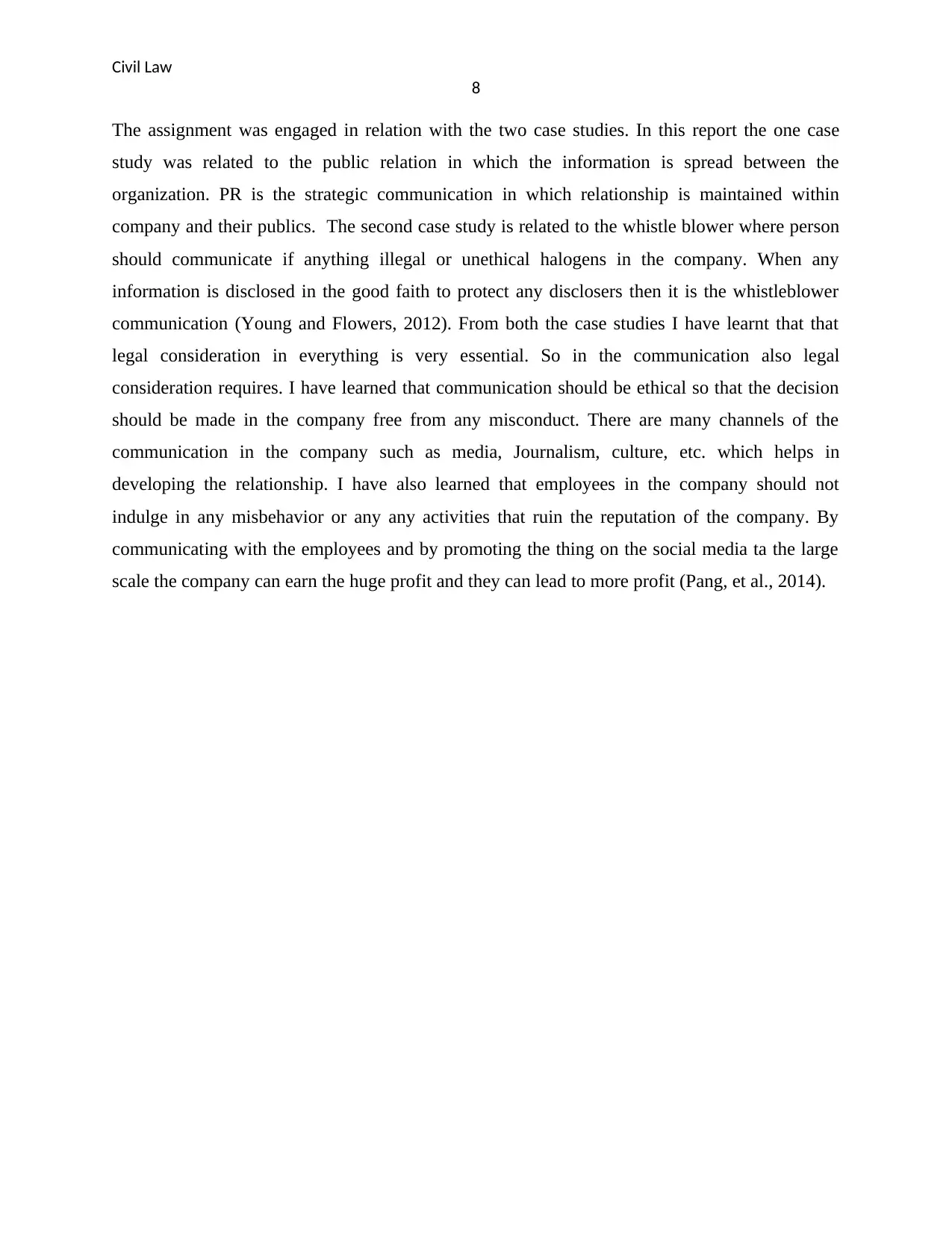
The assignment was engaged in relation with the two case studies. In this report the one case
study was related to the public relation in which the information is spread between the
organization. PR is the strategic communication in which relationship is maintained within
company and their publics. The second case study is related to the whistle blower where person
should communicate if anything illegal or unethical halogens in the company. When any
information is disclosed in the good faith to protect any disclosers then it is the whistleblower
communication (Young and Flowers, 2012). From both the case studies I have learnt that that
legal consideration in everything is very essential. So in the communication also legal
consideration requires. I have learned that communication should be ethical so that the decision
should be made in the company free from any misconduct. There are many channels of the
communication in the company such as media, Journalism, culture, etc. which helps in
developing the relationship. I have also learned that employees in the company should not
indulge in any misbehavior or any any activities that ruin the reputation of the company. By
communicating with the employees and by promoting the thing on the social media ta the large
scale the company can earn the huge profit and they can lead to more profit (Pang, et al., 2014).
8
The assignment was engaged in relation with the two case studies. In this report the one case
study was related to the public relation in which the information is spread between the
organization. PR is the strategic communication in which relationship is maintained within
company and their publics. The second case study is related to the whistle blower where person
should communicate if anything illegal or unethical halogens in the company. When any
information is disclosed in the good faith to protect any disclosers then it is the whistleblower
communication (Young and Flowers, 2012). From both the case studies I have learnt that that
legal consideration in everything is very essential. So in the communication also legal
consideration requires. I have learned that communication should be ethical so that the decision
should be made in the company free from any misconduct. There are many channels of the
communication in the company such as media, Journalism, culture, etc. which helps in
developing the relationship. I have also learned that employees in the company should not
indulge in any misbehavior or any any activities that ruin the reputation of the company. By
communicating with the employees and by promoting the thing on the social media ta the large
scale the company can earn the huge profit and they can lead to more profit (Pang, et al., 2014).
⊘ This is a preview!⊘
Do you want full access?
Subscribe today to unlock all pages.
Trusted by 1+ million students worldwide
Civil Law
9
References
Aula, P., 2010. Social media, reputation risk and ambient publicity management. Strategy &
Leadership, 38(6), pp.43-49.
Berthon, P.R., Pitt, L.F., Plangger, K. and Shapiro, D., 2012. Marketing meets Web 2.0, social
media, and creative consumers: Implications for international marketing strategy. Business
horizons, 55(3), pp.261-271.
Brønn, P.S., 2014. Corporate communication. Corporate Communications: An International
Journal.
Cammaerts, B., 2017. Media and communication strategies of glocalized activists: beyond
media-centric thinking.
Coombs, W.T. and Holladay, S.J., 2018. Comparing apology to equivalent crisis response
strategies: Clarifying apology's role and value in crisis communication. Public Relations
Review, 34(3), pp.252-257.
Coombs, W.T., 2010. Parameters for crisis communication. The handbook of crisis
communication, pp.17-53.
Golob, U., Elving, W.J., Nielsen, A.E., Thomsen, C., Schultz, F., Podnar, K. and Colleoni, E.,
2013. CSR communication strategies for organizational legitimacy in social media. Corporate
Communications: an international journal.
Goodman, M., Romenti, S., Murtarelli, G. and Valentini, C., 2014. Organisations' conversations
in social media: applying dialogue strategies in times of crises. Corporate Communications: An
International Journal.
Goodman, M., Romenti, S., Murtarelli, G. and Valentini, C., 2014. Organisations' conversations
in social media: applying dialogue strategies in times of crises. Corporate Communications: An
International Journal.
9
References
Aula, P., 2010. Social media, reputation risk and ambient publicity management. Strategy &
Leadership, 38(6), pp.43-49.
Berthon, P.R., Pitt, L.F., Plangger, K. and Shapiro, D., 2012. Marketing meets Web 2.0, social
media, and creative consumers: Implications for international marketing strategy. Business
horizons, 55(3), pp.261-271.
Brønn, P.S., 2014. Corporate communication. Corporate Communications: An International
Journal.
Cammaerts, B., 2017. Media and communication strategies of glocalized activists: beyond
media-centric thinking.
Coombs, W.T. and Holladay, S.J., 2018. Comparing apology to equivalent crisis response
strategies: Clarifying apology's role and value in crisis communication. Public Relations
Review, 34(3), pp.252-257.
Coombs, W.T., 2010. Parameters for crisis communication. The handbook of crisis
communication, pp.17-53.
Golob, U., Elving, W.J., Nielsen, A.E., Thomsen, C., Schultz, F., Podnar, K. and Colleoni, E.,
2013. CSR communication strategies for organizational legitimacy in social media. Corporate
Communications: an international journal.
Goodman, M., Romenti, S., Murtarelli, G. and Valentini, C., 2014. Organisations' conversations
in social media: applying dialogue strategies in times of crises. Corporate Communications: An
International Journal.
Goodman, M., Romenti, S., Murtarelli, G. and Valentini, C., 2014. Organisations' conversations
in social media: applying dialogue strategies in times of crises. Corporate Communications: An
International Journal.
Paraphrase This Document
Need a fresh take? Get an instant paraphrase of this document with our AI Paraphraser
Civil Law
10
Hanna, R., Rohm, A. and Crittenden, V.L., 2011. We’re all connected: The power of the social
media ecosystem. Business horizons, 54(3), pp.265-273.
Hosseinali-Mirza, V., de Marcellis-Warin, N. and Warin, T., 2015. Crisis Communication
Strategies and Reputation Risk in the Online Social Media Environment. International Journal
of Business and Social Science, 6(5), pp.7-21.
Hosseinali-Mirza, V., de Marcellis-Warin, N. and Warin, T., 2015. Crisis Communication
Strategies and Reputation Risk in the Online Social Media Environment. International Journal
of Business and Social Science, 6(5), pp.7-21.
Jothi, P.S., Neelamalar, M. and Prasad, R.S., 2011. Analysis of social networking sites: A study
on effective communication strategy in developing brand communication. Journal of media and
communication studies, 3(7), pp.234-242.
Liu, B.F., Austin, L. and Jin, Y., 2011. How publics respond to crisis communication strategies:
The interplay of information form and source. Public Relations Review, 37(4), pp.345-353.
Macnamara, J. and Zerfass, A., 2012. Social media communication in organizations: The
challenges of balancing openness, strategy, and management. International Journal of Strategic
Communication, 6(4), pp.287-308.
Pang, A., Begam Binte Abul Hassan, N. and Chee Yang Chong, A., 2014. Negotiating crisis in
the social media environment: Evolution of crises online, gaining credibility offline. Corporate
Communications: An International Journal, 19(1), pp.96-118.
Raghunath, M., 2017. Investigative journalism and whistleblowers: the ethical handling of
sources in the “Inkathagate” and “Vlakplaas” newspaper exposes’ (Doctoral dissertation).
Schultz, F., Utz, S. and Göritz, A., 2011. Is the medium the message? Perceptions of and
reactions to crisis communication via twitter, blogs and traditional media. Public relations
review, 37(1), pp.20-27.
Srikanth, K. and Puranam, P., 2011. Integrating distributed work: comparing task design,
communication, and tacit coordination mechanisms. Strategic Management Journal, 32(8),
pp.849-875.
10
Hanna, R., Rohm, A. and Crittenden, V.L., 2011. We’re all connected: The power of the social
media ecosystem. Business horizons, 54(3), pp.265-273.
Hosseinali-Mirza, V., de Marcellis-Warin, N. and Warin, T., 2015. Crisis Communication
Strategies and Reputation Risk in the Online Social Media Environment. International Journal
of Business and Social Science, 6(5), pp.7-21.
Hosseinali-Mirza, V., de Marcellis-Warin, N. and Warin, T., 2015. Crisis Communication
Strategies and Reputation Risk in the Online Social Media Environment. International Journal
of Business and Social Science, 6(5), pp.7-21.
Jothi, P.S., Neelamalar, M. and Prasad, R.S., 2011. Analysis of social networking sites: A study
on effective communication strategy in developing brand communication. Journal of media and
communication studies, 3(7), pp.234-242.
Liu, B.F., Austin, L. and Jin, Y., 2011. How publics respond to crisis communication strategies:
The interplay of information form and source. Public Relations Review, 37(4), pp.345-353.
Macnamara, J. and Zerfass, A., 2012. Social media communication in organizations: The
challenges of balancing openness, strategy, and management. International Journal of Strategic
Communication, 6(4), pp.287-308.
Pang, A., Begam Binte Abul Hassan, N. and Chee Yang Chong, A., 2014. Negotiating crisis in
the social media environment: Evolution of crises online, gaining credibility offline. Corporate
Communications: An International Journal, 19(1), pp.96-118.
Raghunath, M., 2017. Investigative journalism and whistleblowers: the ethical handling of
sources in the “Inkathagate” and “Vlakplaas” newspaper exposes’ (Doctoral dissertation).
Schultz, F., Utz, S. and Göritz, A., 2011. Is the medium the message? Perceptions of and
reactions to crisis communication via twitter, blogs and traditional media. Public relations
review, 37(1), pp.20-27.
Srikanth, K. and Puranam, P., 2011. Integrating distributed work: comparing task design,
communication, and tacit coordination mechanisms. Strategic Management Journal, 32(8),
pp.849-875.
Civil Law
11
Van Dijck, J. and Poell, T., 2015. Making public television social? Public service broadcasting
and the challenges of social media. Television & New Media, 16(2), pp.148-164.
Voorhoof, D., 2014. The right to freedom of expression and information under the European
Human Rights system: towards a more transparent democratic society.
Voorhoof, D., 2015. Freedom of expression and information and the case law of the European
Court of Human Rights and the Court of Justice of the EU: overview and highlights 2014.
In Justice for Free Expression in 2014, A review of global freedom of expression jurisprudence
in 2014 (pp. 1-55). Columbia University.
Young, C. L., and Flowers, A. 2012. Fight viral with viral: A case study of Domino’s Pizza’s
crisis communication strategies. Case Studies in Strategic Communication, 1(6), 93-106.
11
Van Dijck, J. and Poell, T., 2015. Making public television social? Public service broadcasting
and the challenges of social media. Television & New Media, 16(2), pp.148-164.
Voorhoof, D., 2014. The right to freedom of expression and information under the European
Human Rights system: towards a more transparent democratic society.
Voorhoof, D., 2015. Freedom of expression and information and the case law of the European
Court of Human Rights and the Court of Justice of the EU: overview and highlights 2014.
In Justice for Free Expression in 2014, A review of global freedom of expression jurisprudence
in 2014 (pp. 1-55). Columbia University.
Young, C. L., and Flowers, A. 2012. Fight viral with viral: A case study of Domino’s Pizza’s
crisis communication strategies. Case Studies in Strategic Communication, 1(6), 93-106.
⊘ This is a preview!⊘
Do you want full access?
Subscribe today to unlock all pages.
Trusted by 1+ million students worldwide

1 out of 12


Related Documents


Your All-in-One AI-Powered Toolkit for Academic Success.
+13062052269
info@desklib.com
Available 24*7 on WhatsApp / Email
![[object Object]](/_next/static/media/star-bottom.7253800d.svg)
Unlock your academic potential
Copyright © 2020–2026 A2Z Services. All Rights Reserved. Developed and managed by ZUCOL.