Civil Engineering Homework: Rock Mechanics, Soil and Stress Analysis

Verified

Added on  2022/09/08

|7
|612
|101
Homework Assignment
AI Summary
This civil engineering assignment solution addresses three key problems. The first problem involves calculating principal stresses at different depths, considering breakdown and shut-in pressures, and applying the pressure coefficient formula. The second problem focuses on determining the maximum height using soil cohesion and weight. The third problem delves into the concept of plane strain, deriving relationships between elastic modulus, shear modulus, and bulk modulus. It also covers the Hoek-Brown criterion for underground excavation design. The solution provides detailed calculations and explanations, offering a comprehensive understanding of the concepts.
Document Page
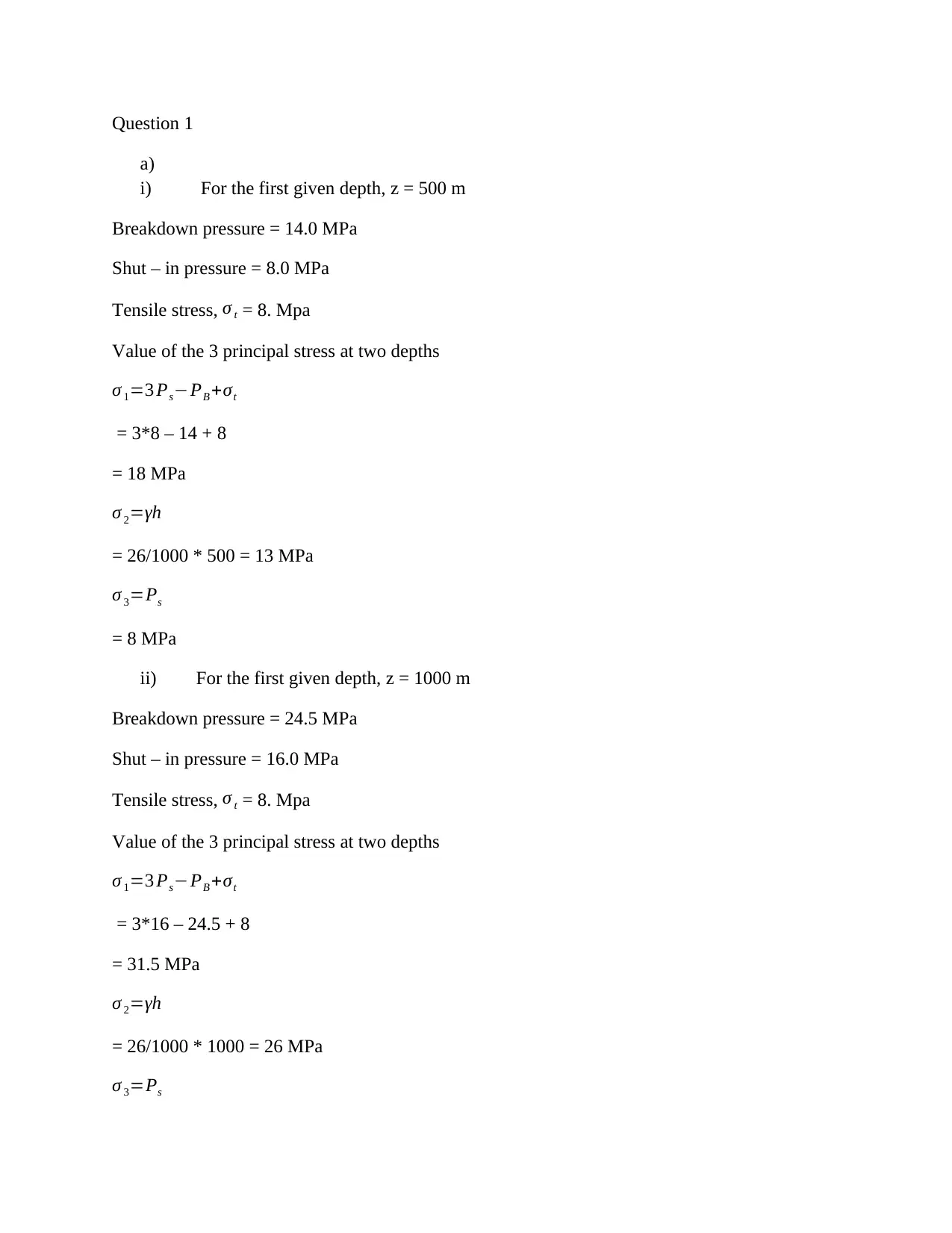
Question 1
a)
i) For the first given depth, z = 500 m
Breakdown pressure = 14.0 MPa
Shut – in pressure = 8.0 MPa
Tensile stress, σ t = 8. Mpa
Value of the 3 principal stress at two depths
σ 1=3 PsPB +σt
= 3*8 – 14 + 8
= 18 MPa
σ 2=γh
= 26/1000 * 500 = 13 MPa
σ 3=Ps
= 8 MPa
ii) For the first given depth, z = 1000 m
Breakdown pressure = 24.5 MPa
Shut – in pressure = 16.0 MPa
Tensile stress, σ t = 8. Mpa
Value of the 3 principal stress at two depths
σ 1=3 PsPB +σt
= 3*16 – 24.5 + 8
= 31.5 MPa
σ 2=γh
= 26/1000 * 1000 = 26 MPa
σ 3=Ps
tabler-icon-diamond-filled.svg

Paraphrase This Document

Need a fresh take? Get an instant paraphrase of this document with our AI Paraphraser
Document Page
= 16 MPa
b)
i) Pressure coefficient for 500 m
K =
σmax + σmin
2
γ
=
18+ 8
2
26
= 0.5
ii) Pressure coefficient for 1000 m
K =
σmax + σmin
2
γ
=
31.5+16
2
26
= 0.91
c) Assumptions
The principle axis are vertical and horizontal
The equations were used since water the water has to be pressurized to a value that would
overcome the stresses concentration of the three time minor horizontal principal stress
and the tensile strength
The maximum horizontal principles stress would appear as a unit negative stress
concentration since it helps in breakdown pressure.
d) Discussion of the two test results
For 500 m
0.3 + 100/z = 0.3 + 100/500 = 0.5
0.5 + (1000 + 500)/2 = 0.5 + 1500/500 = 3.5
Therefore, k = 0.5 will be stable
For 1000 m
Document Page
0.3 + 100/z = 0.3 + 100/1000 = 0.5
0.5 + (1000 + 500)/2 = 0.5 + 1500/1000 = 2.0
Therefore, k = 0.91 will be stable
Q2)
a)
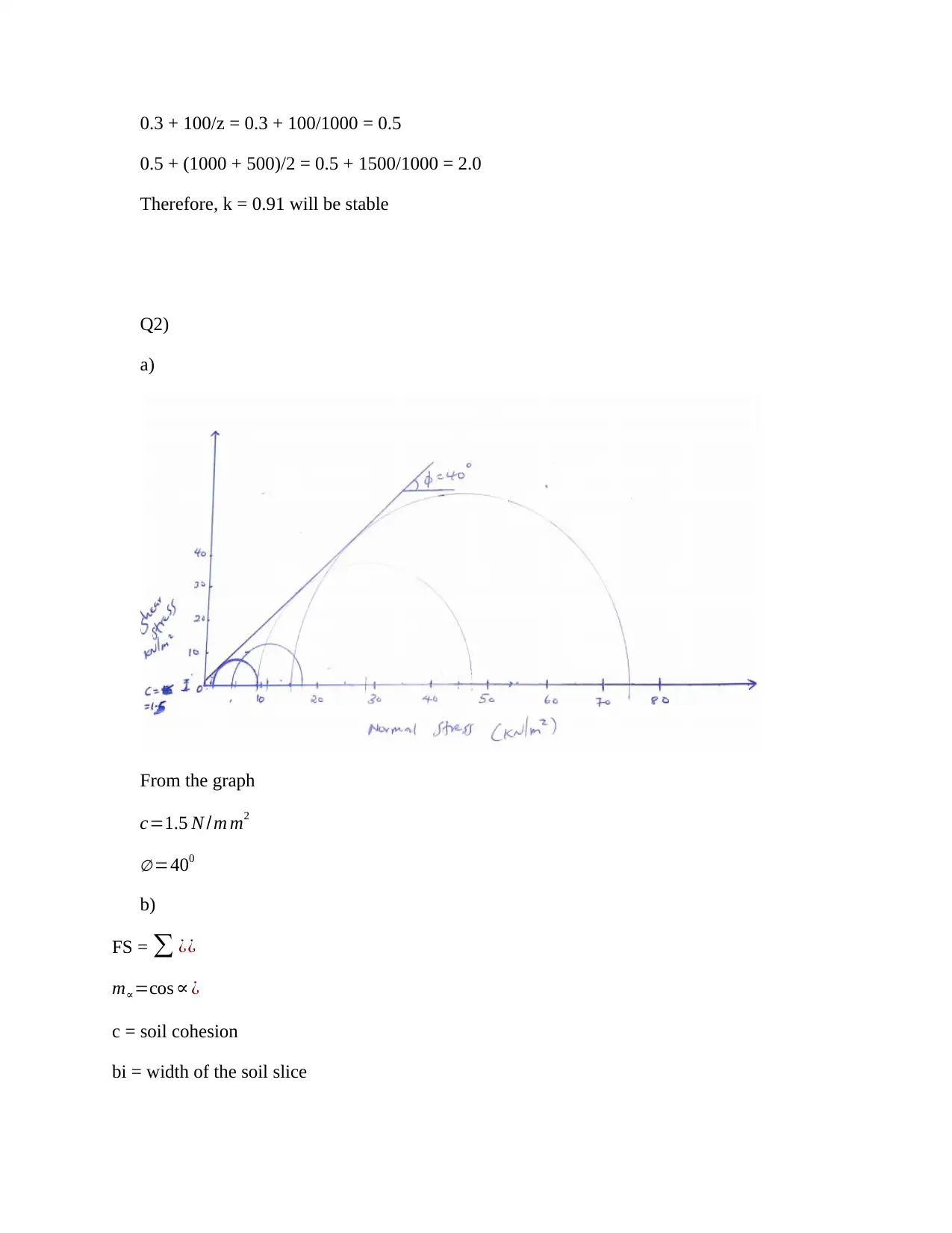
From the graph
c=1.5 N /m m2
=400
b)
FS = ¿¿
m=cos ¿
c = soil cohesion
bi = width of the soil slice
Document Page
wi = weight odf the soil slice
=angle of friction
c) Maximum height
H = 4C
γ ka
=
41.5103
24
1sin 400
1+sin 400
= 536.13 m
Q3)
a)
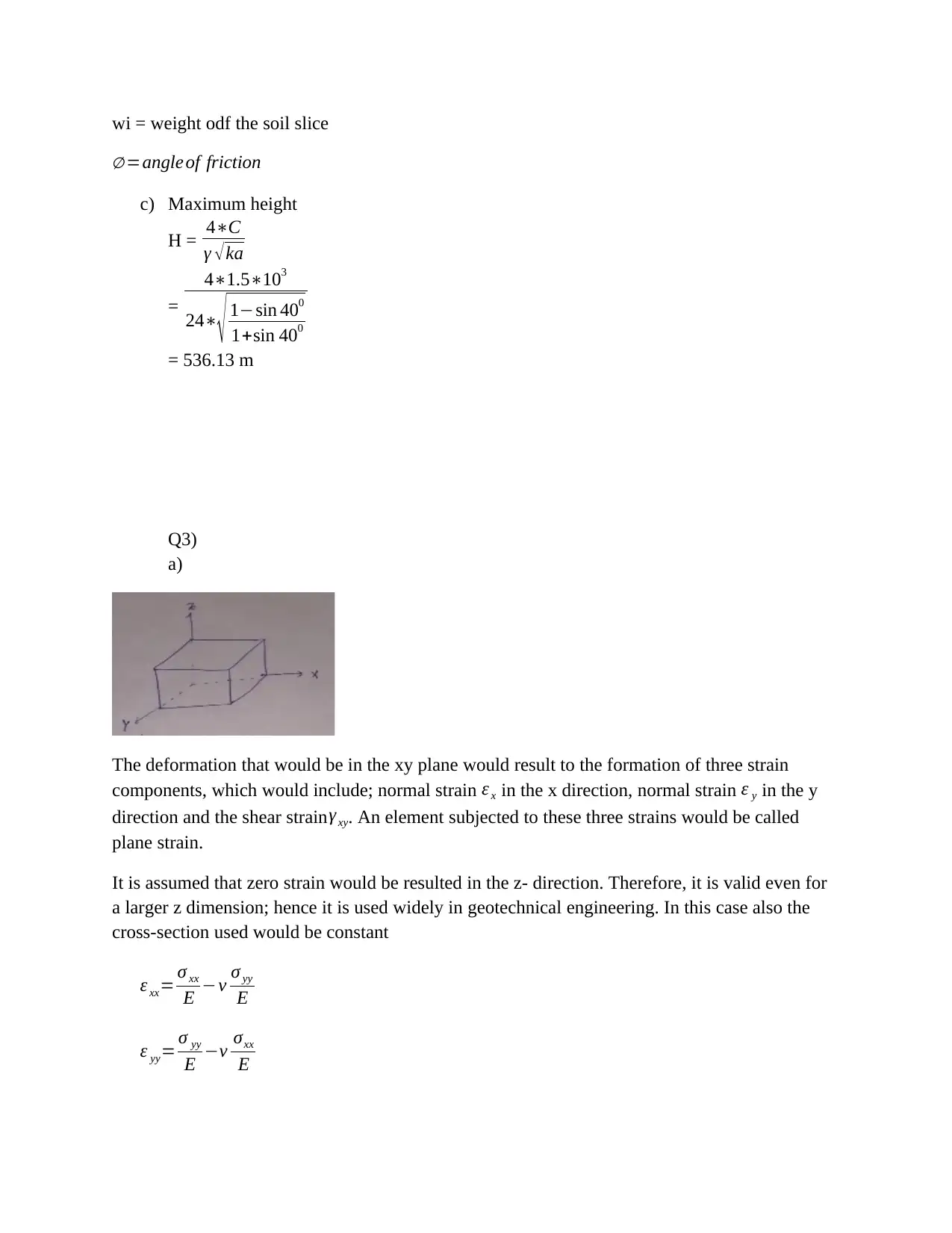
The deformation that would be in the xy plane would result to the formation of three strain
components, which would include; normal strain ε x in the x direction, normal strain ε y in the y
direction and the shear strainγ xy. An element subjected to these three strains would be called
plane strain.
It is assumed that zero strain would be resulted in the z- direction. Therefore, it is valid even for
a larger z dimension; hence it is used widely in geotechnical engineering. In this case also the
cross-section used would be constant
ε xx= σ xx
E v σ yy
E
ε yy= σ yy
E v σxx
E
tabler-icon-diamond-filled.svg

Paraphrase This Document

Need a fresh take? Get an instant paraphrase of this document with our AI Paraphraser
Document Page
ε xy= σ xy
G
b) Given, E = 50 GPa, v = 0.3 GPa
The relationship between E, v and G
E = 2*G(1 + v)
Substituting
50 = 2*G(1 + 0.3)
G = 19.23
For bulk modulus
B = ¿
3 ( 3 GE ) = E
3(12 v)
B = 50
3(120.3)
= 41.67
c)
Document Page
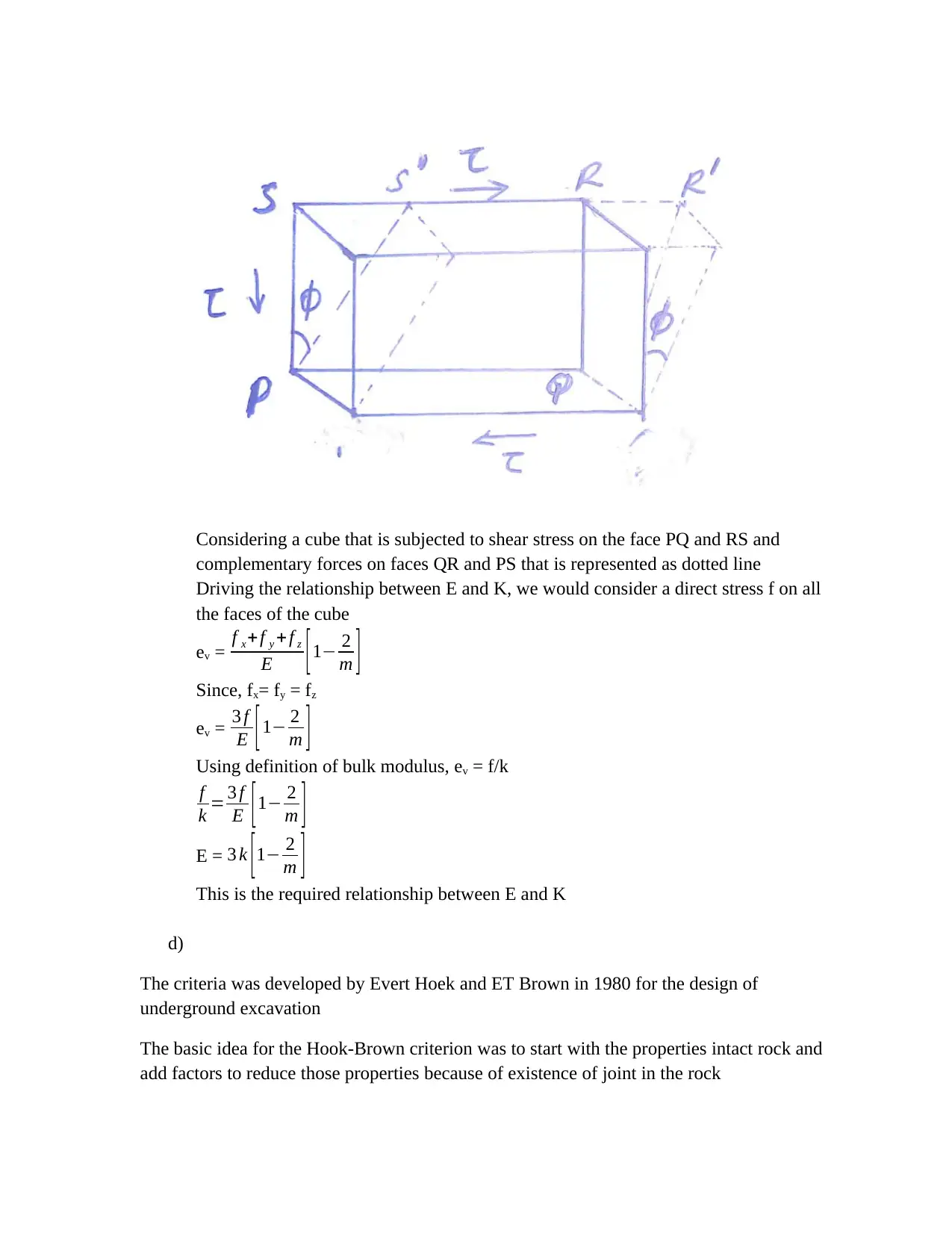
Considering a cube that is subjected to shear stress on the face PQ and RS and
complementary forces on faces QR and PS that is represented as dotted line
Driving the relationship between E and K, we would consider a direct stress f on all
the faces of the cube
ev = f x+f y + f z
E [1 2
m ]
Since, fx= fy = fz
ev = 3 f
E [ 1 2
m ]
Using definition of bulk modulus, ev = f/k
f
k = 3 f
E [1 2
m ]
E = 3 k [1 2
m ]
This is the required relationship between E and K
d)
The criteria was developed by Evert Hoek and ET Brown in 1980 for the design of
underground excavation
The basic idea for the Hook-Brown criterion was to start with the properties intact rock and
add factors to reduce those properties because of existence of joint in the rock
Document Page
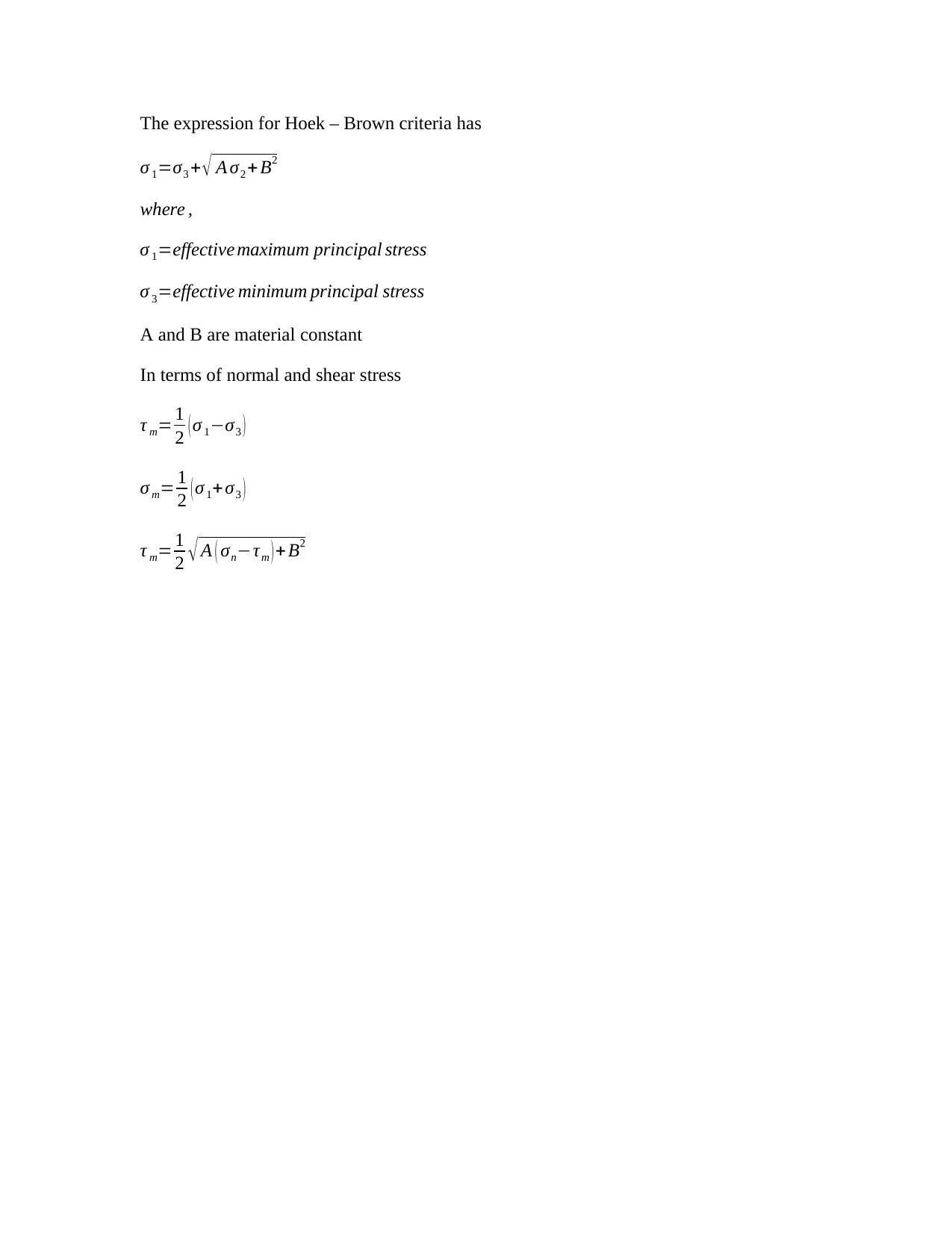
The expression for Hoek – Brown criteria has
σ 1=σ3 + A σ2 +B2
where ,
σ 1=effective maximum principal stress
σ 3=effective minimum principal stress
A and B are material constant
In terms of normal and shear stress
τ m= 1
2 ( σ 1σ3 )
σ m= 1
2 ( σ 1+ σ3 )
τ m= 1
2 A ( σnτm ) +B2
chevron_up_icon
1 out of 7
circle_padding
hide_on_mobile
zoom_out_icon
[object Object]