Desklib: Unit Plan for Class 8 Mathematics, Secondary Teachers

Verified

Added on  2023/04/11

|20
|2951
|319
Homework Assignment
AI Summary
This document presents a comprehensive unit plan for an 8th-grade mathematics course, focusing on data representation and interpretation within the framework of the Australian Curriculum. The plan utilizes the Understanding by Design (UbD) framework, outlining desired results, assessment evidence, and a detailed learning plan. The unit aims to develop students' abilities to independently use their learning, incorporating elements of statistics and probability. It includes established goals aligned with the Australian Curriculum, emphasizing the integration of ICT, ethical understanding, and intercultural perspectives. The plan details enduring understandings, essential questions, and cross-curricular priorities, as well as general capabilities. It outlines knowledge and skills students will acquire, performance tasks, and assessment strategies. The learning plan includes teaching and learning experiences, resource utilization, and considerations for the learning environment. The unit also addresses individual student needs and incorporates various assessment methods, including formative and summative assessments, to ensure student achievement. The document also details the GRASPS elements of the performance task, the rubric, and the other evidence used for assessment. The unit plan provides a structured approach to teaching and learning, ensuring alignment with curriculum standards and promoting student engagement and understanding. This unit plan is a valuable resource for educators seeking to design effective and engaging mathematics lessons.
Document Page
Understanding By Design Unit Template for M.Teach Secondary Teachers
Title of Unit Curriculum & Assessment in Secondary
Teaching Grade Level
Subject Understanding Mathematics in class 8 Time Frame 6 weeks
Developed By
Stage 1 - Identify Desired Results
ESTABLISHED GOALS: TRANSFER
Learning Areas (from the
Australian Curriculum)
How is the learning areas incorporated
into this unit?
Learning areas should have
pictorial representation of
formulas such formulas for
finding perimeter and area of
different shapes such as circles
Students will be able to independently use their learning to…
To understand how to handle problems involving ratios, profits and loss, areas and perimeters
and also common shapes by use of Venn diagrams.
To conduct and investigate their own data and handle concepts related to Australian
Curriculum in mathematics for class 8 (Chalmers, Carter, Cooper & Nason, 2017).
Familiarize themselves on calculating simple decimals, indices and integers, factorizing and
simplifying the basic algebraic.
To understand properties of triangles, estimating mean and proportions of population.
tabler-icon-diamond-filled.svg

Paraphrase This Document

Need a fresh take? Get an instant paraphrase of this document with our AI Paraphraser
Document Page
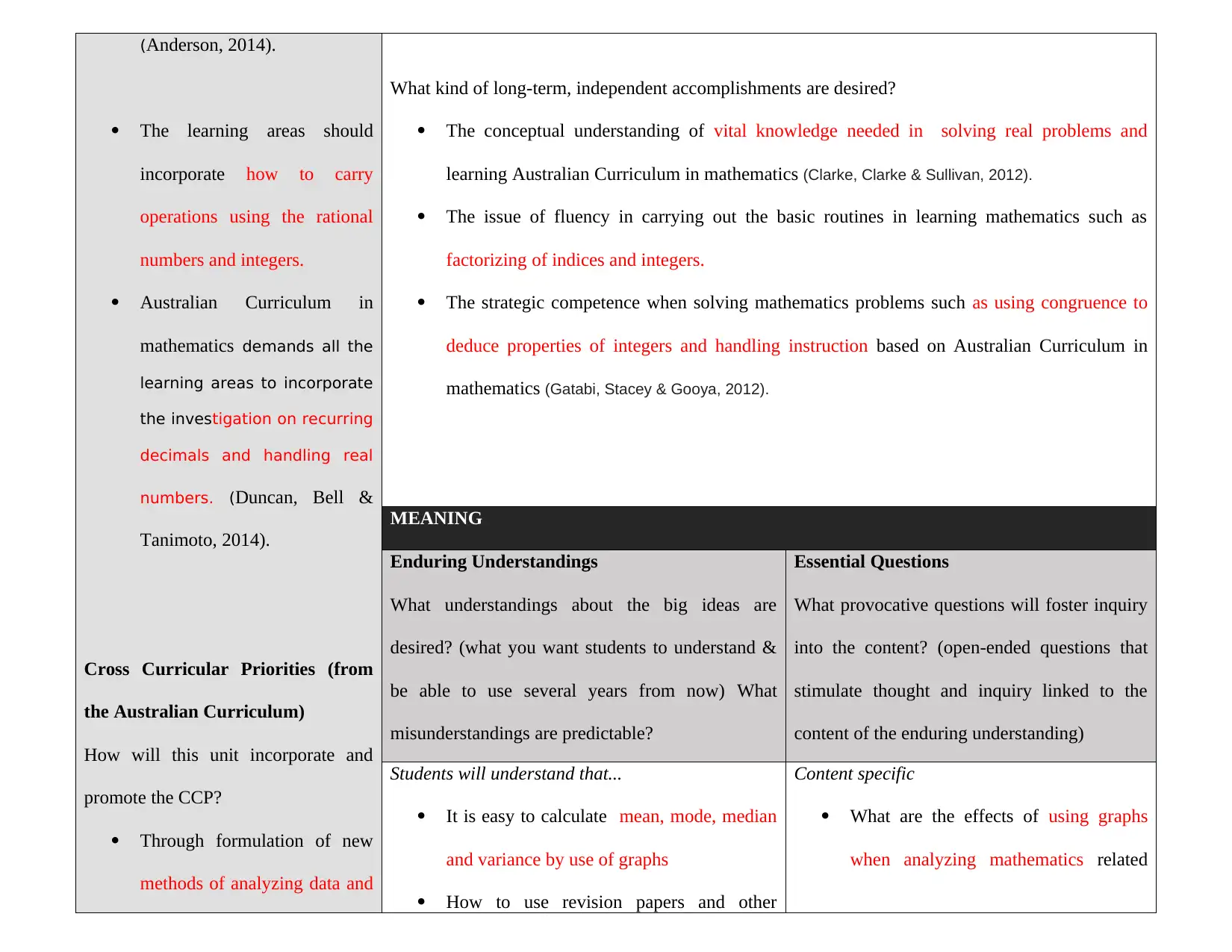
(Anderson, 2014).
The learning areas should
incorporate how to carry
operations using the rational
numbers and integers.
Australian Curriculum in
mathematics demands all the
learning areas to incorporate
the investigation on recurring
decimals and handling real
numbers. (Duncan, Bell &
Tanimoto, 2014).
Cross Curricular Priorities (from
the Australian Curriculum)
How will this unit incorporate and
promote the CCP?
Through formulation of new
methods of analyzing data and
What kind of long-term, independent accomplishments are desired?
The conceptual understanding of vital knowledge needed in solving real problems and
learning Australian Curriculum in mathematics (Clarke, Clarke & Sullivan, 2012).
The issue of fluency in carrying out the basic routines in learning mathematics such as
factorizing of indices and integers.
The strategic competence when solving mathematics problems such as using congruence to
deduce properties of integers and handling instruction based on Australian Curriculum in
mathematics (Gatabi, Stacey & Gooya, 2012).
MEANING
Enduring Understandings
What understandings about the big ideas are
desired? (what you want students to understand &
be able to use several years from now) What
misunderstandings are predictable?
Essential Questions
What provocative questions will foster inquiry
into the content? (open-ended questions that
stimulate thought and inquiry linked to the
content of the enduring understanding)
Students will understand that...
It is easy to calculate mean, mode, median
and variance by use of graphs
How to use revision papers and other
Content specific
What are the effects of using graphs
when analyzing mathematics related
Document Page
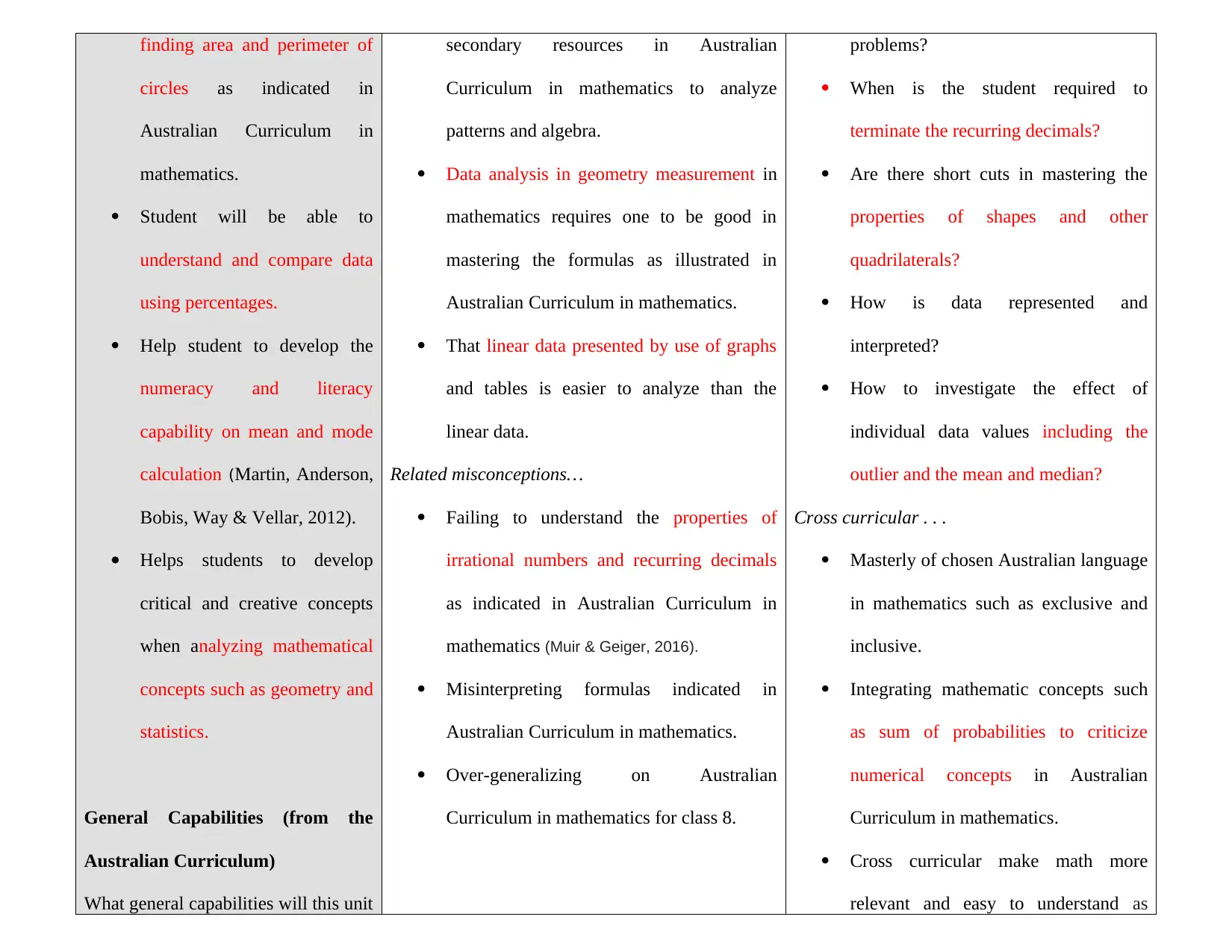
finding area and perimeter of
circles as indicated in
Australian Curriculum in
mathematics.
Student will be able to
understand and compare data
using percentages.
Help student to develop the
numeracy and literacy
capability on mean and mode
calculation (Martin, Anderson,
Bobis, Way & Vellar, 2012).
Helps students to develop
critical and creative concepts
when analyzing mathematical
concepts such as geometry and
statistics.
General Capabilities (from the
Australian Curriculum)
What general capabilities will this unit
secondary resources in Australian
Curriculum in mathematics to analyze
patterns and algebra.
Data analysis in geometry measurement in
mathematics requires one to be good in
mastering the formulas as illustrated in
Australian Curriculum in mathematics.
That linear data presented by use of graphs
and tables is easier to analyze than the
linear data.
Related misconceptions…
Failing to understand the properties of
irrational numbers and recurring decimals
as indicated in Australian Curriculum in
mathematics (Muir & Geiger, 2016).
Misinterpreting formulas indicated in
Australian Curriculum in mathematics.
Over-generalizing on Australian
Curriculum in mathematics for class 8.
problems?
When is the student required to
terminate the recurring decimals?
Are there short cuts in mastering the
properties of shapes and other
quadrilaterals?
How is data represented and
interpreted?
How to investigate the effect of
individual data values including the
outlier and the mean and median?
Cross curricular . . .
Masterly of chosen Australian language
in mathematics such as exclusive and
inclusive.
Integrating mathematic concepts such
as sum of probabilities to criticize
numerical concepts in Australian
Curriculum in mathematics.
Cross curricular make math more
relevant and easy to understand as
Document Page
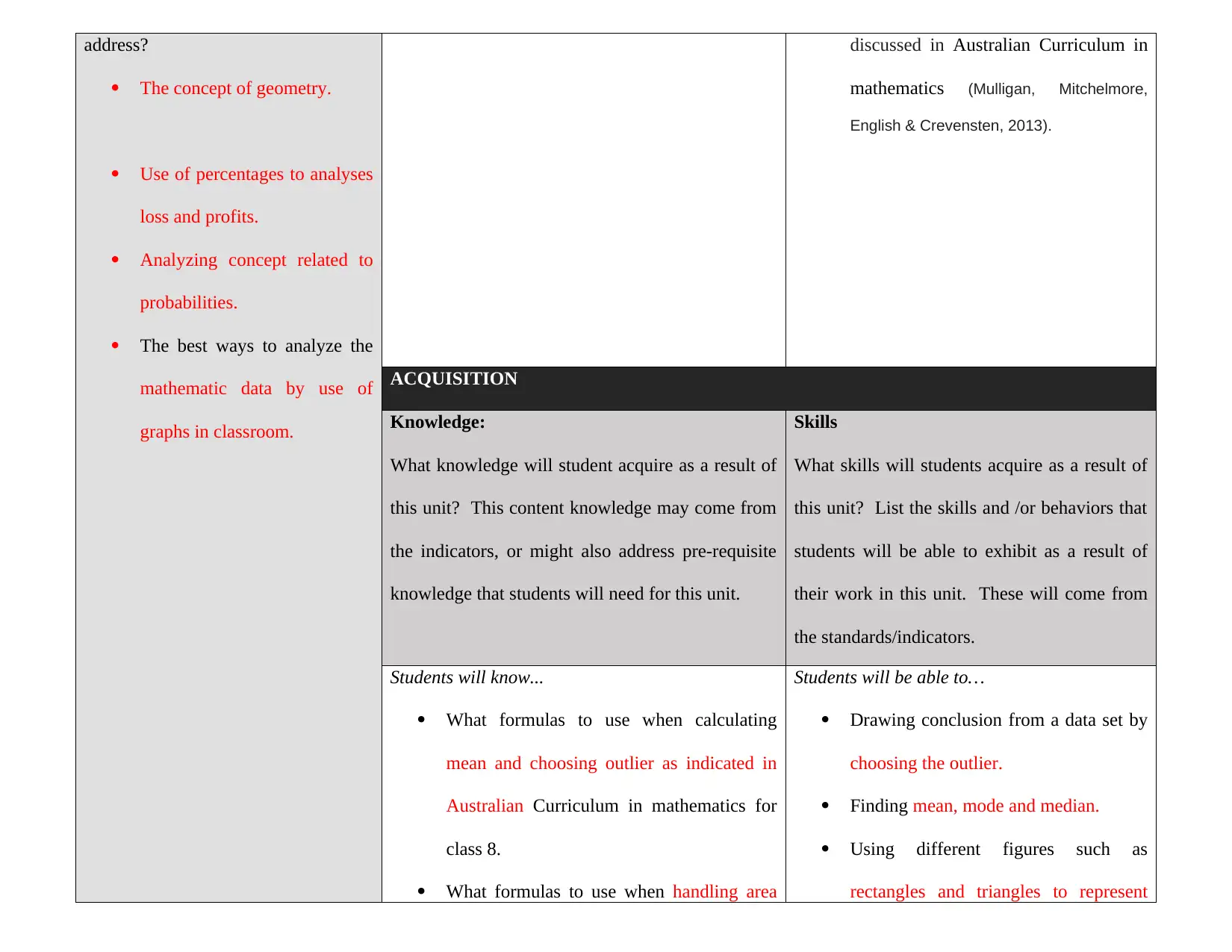
address?
The concept of geometry.
Use of percentages to analyses
loss and profits.
Analyzing concept related to
probabilities.
The best ways to analyze the
mathematic data by use of
graphs in classroom.
discussed in Australian Curriculum in
mathematics (Mulligan, Mitchelmore,
English & Crevensten, 2013).
ACQUISITION
Knowledge:
What knowledge will student acquire as a result of
this unit? This content knowledge may come from
the indicators, or might also address pre-requisite
knowledge that students will need for this unit.
Skills
What skills will students acquire as a result of
this unit? List the skills and /or behaviors that
students will be able to exhibit as a result of
their work in this unit. These will come from
the standards/indicators.
Students will know...
What formulas to use when calculating
mean and choosing outlier as indicated in
Australian Curriculum in mathematics for
class 8.
What formulas to use when handling area
Students will be able to…
Drawing conclusion from a data set by
choosing the outlier.
Finding mean, mode and median.
Using different figures such as
rectangles and triangles to represent
tabler-icon-diamond-filled.svg

Paraphrase This Document

Need a fresh take? Get an instant paraphrase of this document with our AI Paraphraser
Document Page
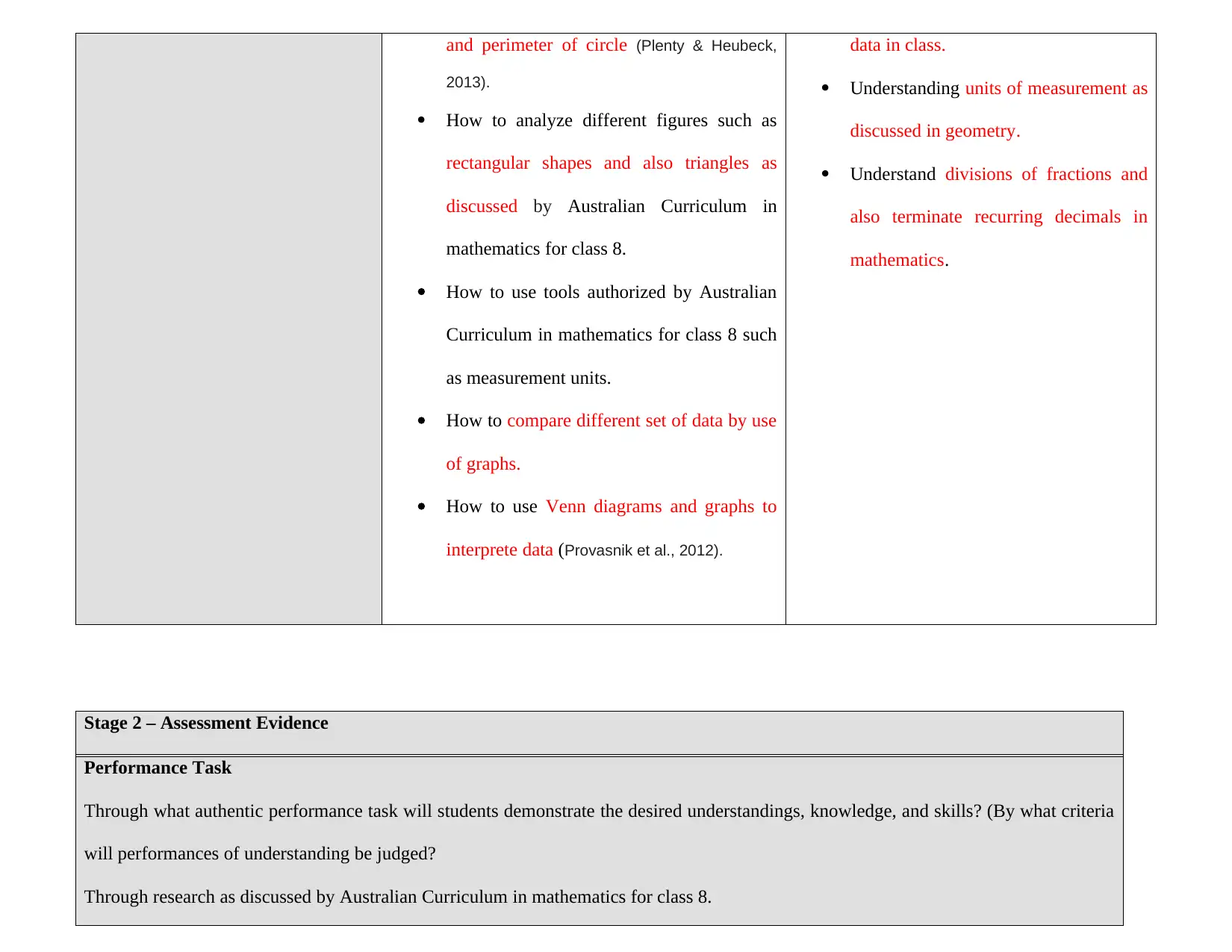
and perimeter of circle (Plenty & Heubeck,
2013).
How to analyze different figures such as
rectangular shapes and also triangles as
discussed by Australian Curriculum in
mathematics for class 8.
How to use tools authorized by Australian
Curriculum in mathematics for class 8 such
as measurement units.
How to compare different set of data by use
of graphs.
How to use Venn diagrams and graphs to
interprete data (Provasnik et al., 2012).
data in class.
Understanding units of measurement as
discussed in geometry.
Understand divisions of fractions and
also terminate recurring decimals in
mathematics.
Stage 2 – Assessment Evidence
Performance Task
Through what authentic performance task will students demonstrate the desired understandings, knowledge, and skills? (By what criteria
will performances of understanding be judged?
Through research as discussed by Australian Curriculum in mathematics for class 8.
Document Page
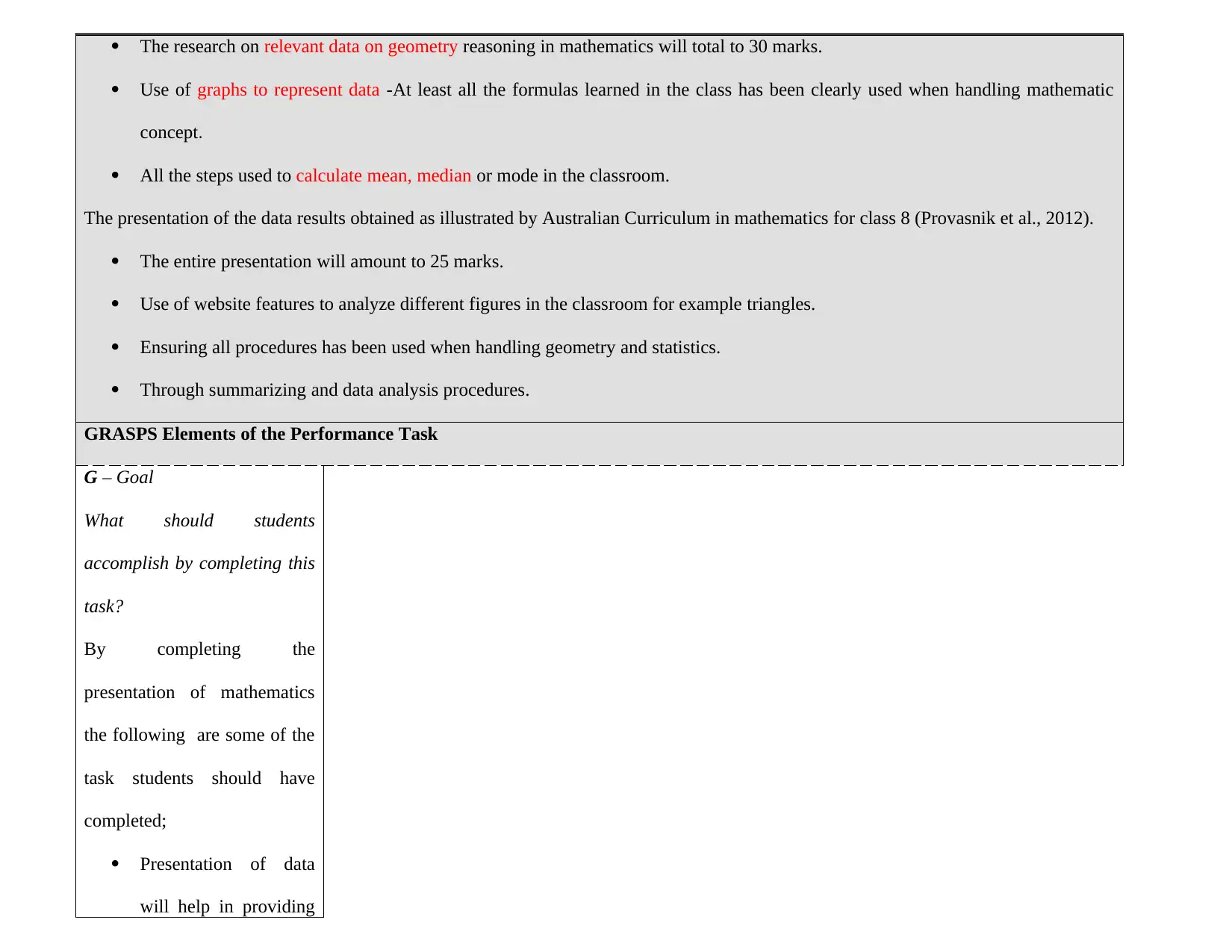
The research on relevant data on geometry reasoning in mathematics will total to 30 marks.
Use of graphs to represent data -At least all the formulas learned in the class has been clearly used when handling mathematic
concept.
All the steps used to calculate mean, median or mode in the classroom.
The presentation of the data results obtained as illustrated by Australian Curriculum in mathematics for class 8 (Provasnik et al., 2012).
The entire presentation will amount to 25 marks.
Use of website features to analyze different figures in the classroom for example triangles.
Ensuring all procedures has been used when handling geometry and statistics.
Through summarizing and data analysis procedures.
GRASPS Elements of the Performance Task
G – Goal
What should students
accomplish by completing this
task?
By completing the
presentation of mathematics
the following are some of the
task students should have
completed;
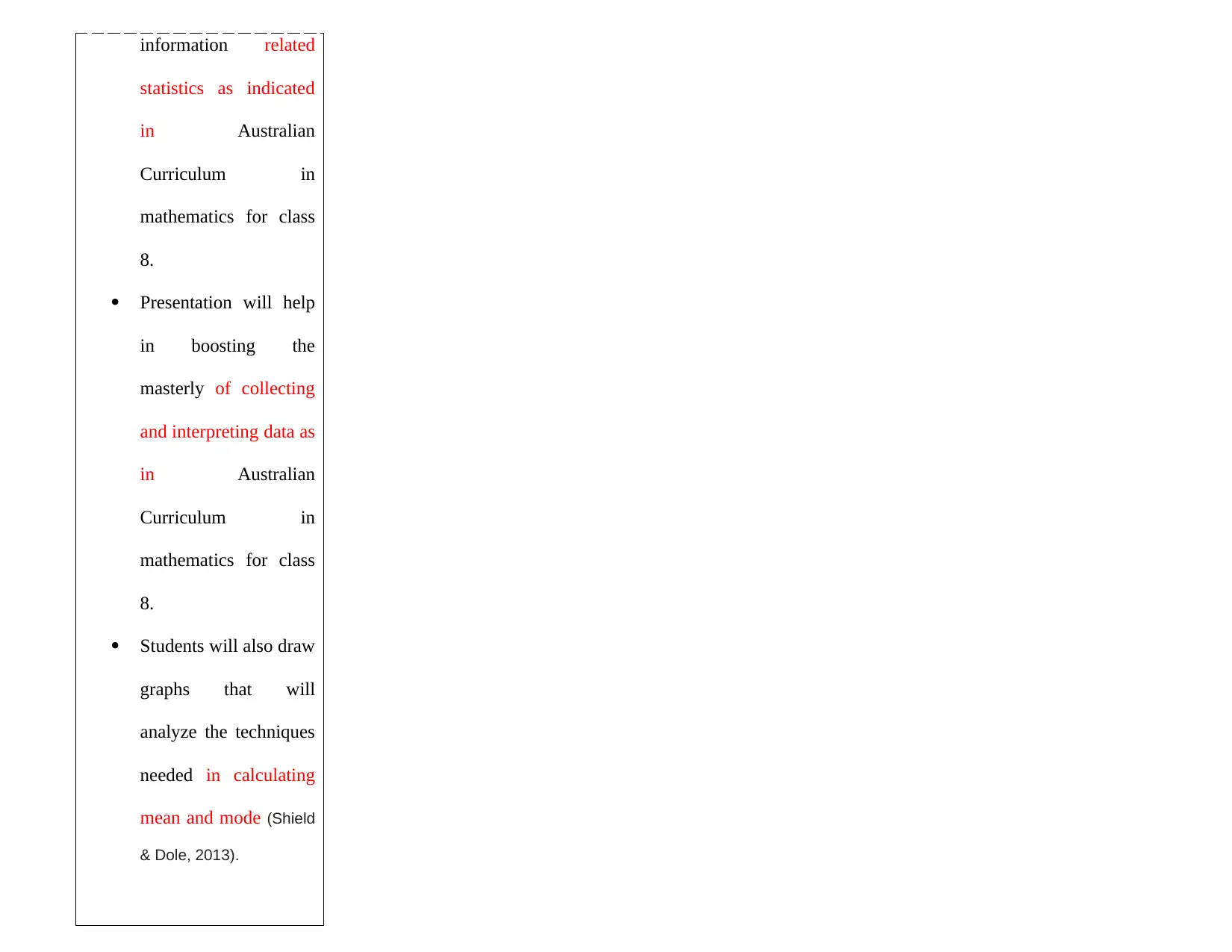
Presentation of data
will help in providing
Document Page
information related
statistics as indicated
in Australian
Curriculum in
mathematics for class
8.
Presentation will help
in boosting the
masterly of collecting
and interpreting data as
in Australian
Curriculum in
mathematics for class
8.
Students will also draw
graphs that will
analyze the techniques
needed in calculating
mean and mode (Shield
& Dole, 2013).
tabler-icon-diamond-filled.svg

Paraphrase This Document

Need a fresh take? Get an instant paraphrase of this document with our AI Paraphraser
Document Page
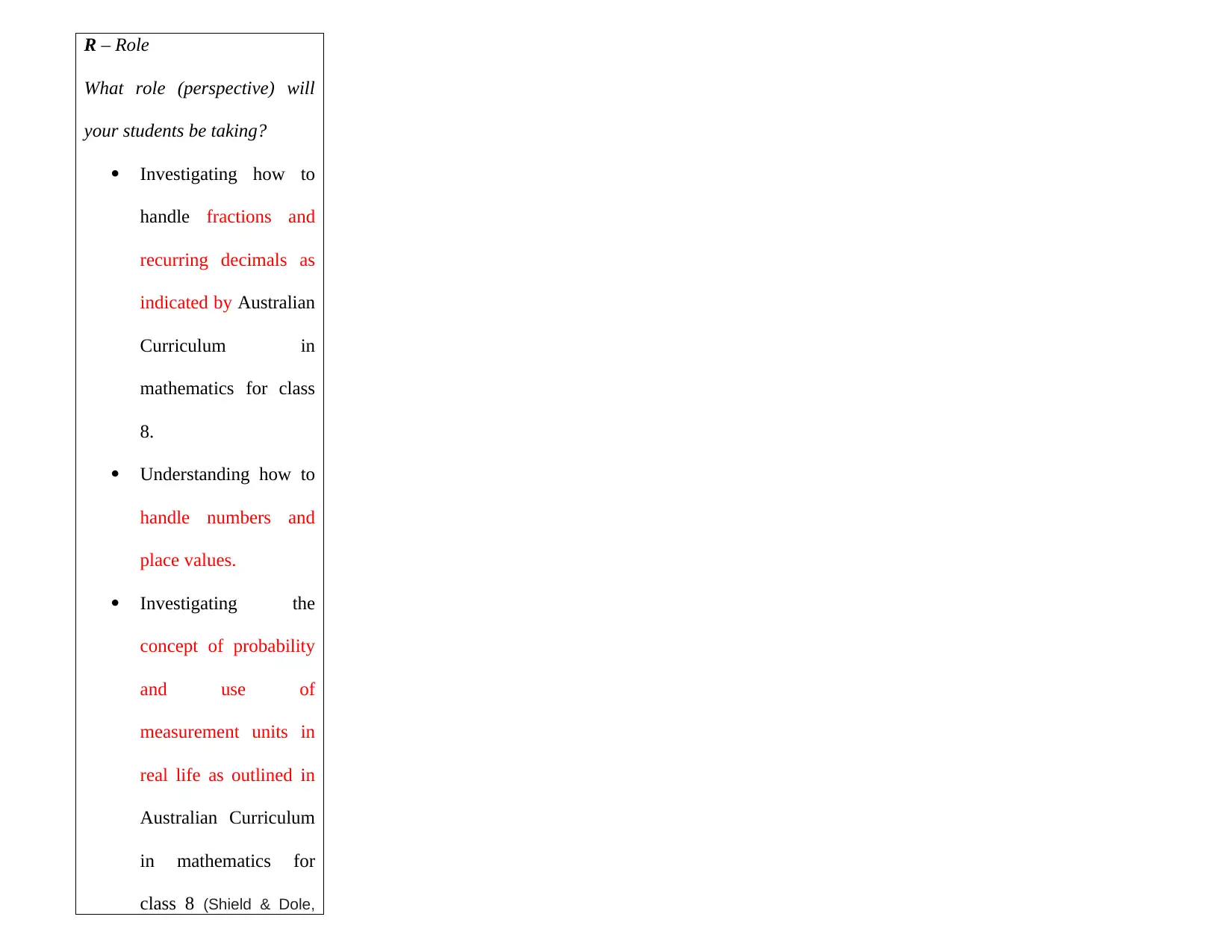
R – Role
What role (perspective) will
your students be taking?
Investigating how to
handle fractions and
recurring decimals as
indicated by Australian
Curriculum in
mathematics for class
8.
Understanding how to
handle numbers and
place values.
Investigating the
concept of probability
and use of
measurement units in
real life as outlined in
Australian Curriculum
in mathematics for
class 8 (Shield & Dole,
Document Page
2013).
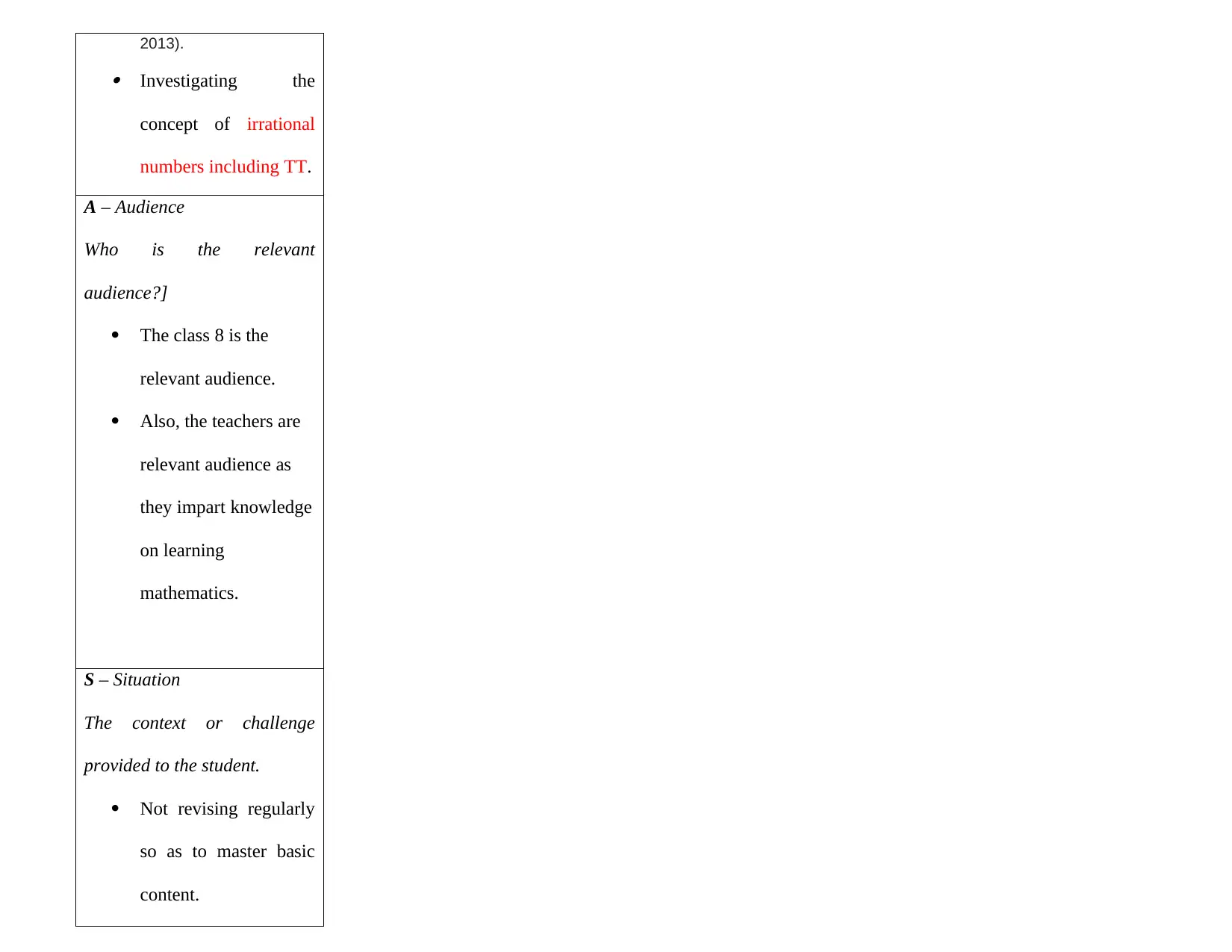
Investigating the
concept of irrational
numbers including TT.
A – Audience
Who is the relevant
audience?]
The class 8 is the
relevant audience.
Also, the teachers are
relevant audience as
they impart knowledge
on learning
mathematics.
S – Situation
The context or challenge
provided to the student.
Not revising regularly
so as to master basic
content.
Document Page
Not following rules
when handling algebra.
Lack of maximum
cooperation when
learning mathematics
concepts.
Failure to master
formulas and sketches
needed when handling
figures (Shield & Dole,
2013).
P – Product, Performance
What product/performance
will the student
Create?
The performance on analyzing
data based on Australian
Curriculum in
mathematics for class 8.
Solving problems
related to use of
tabler-icon-diamond-filled.svg

Paraphrase This Document

Need a fresh take? Get an instant paraphrase of this document with our AI Paraphraser
Document Page
percentages that’s
percentage increase
and decrease without
use of digital
technology.
Issue of manipulating
data to calculate mean
and mode.
Simplifying the
expressions involving
the use of the four
operations in the
algebraic (Shield &
Dole, 2013).
S – Standards & Criteria for
Success
Create the rubric for the
Performance Task
Research on data analysis
based on Australian
Curriculum in
Attach your rubric to Unit Plan
Document Page
mathematics for class 8.
Understanding concept
of numbers and place
value 30 marks.
Understanding the
measurement and
geometry 40 marks.
Mastering the statistics
and probability 30
marks.
chevron_up_icon
1 out of 20
circle_padding
hide_on_mobile
zoom_out_icon
[object Object]