School Based Research Report: Improving Class Engagement in School
VerifiedAdded on 2020/05/28
|24
|6449
|114
Report
AI Summary
This school-based research report, conducted at Middlesex University, investigates the effectiveness of school reward systems in improving class engagement and student behavior in Class 7P. The study explores the implementation of various reward methods, including verbal praise, written praise, and departmental awards, to address the lack of engagement and good behavior observed in the class. The research utilizes an action plan approach, gathering data from teachers and students through questionnaires and interviews to analyze the impact of different reward systems. The findings suggest that the appropriate utilization of reward systems can significantly enhance student motivation and participation in classroom activities. The report also includes an abstract, introduction, research planning details, ethical considerations, findings, analysis, conclusion, and ways forward, along with references and appendices, offering a comprehensive analysis of the topic and providing valuable insights for educators seeking to enhance classroom dynamics.

2017-
2018
School Based Research
Middlesex university
Khadra Ahmed Abdurahman
2018
School Based Research
Middlesex university
Khadra Ahmed Abdurahman

Paraphrase This Document
Need a fresh take? Get an instant paraphrase of this document with our AI Paraphraser
1
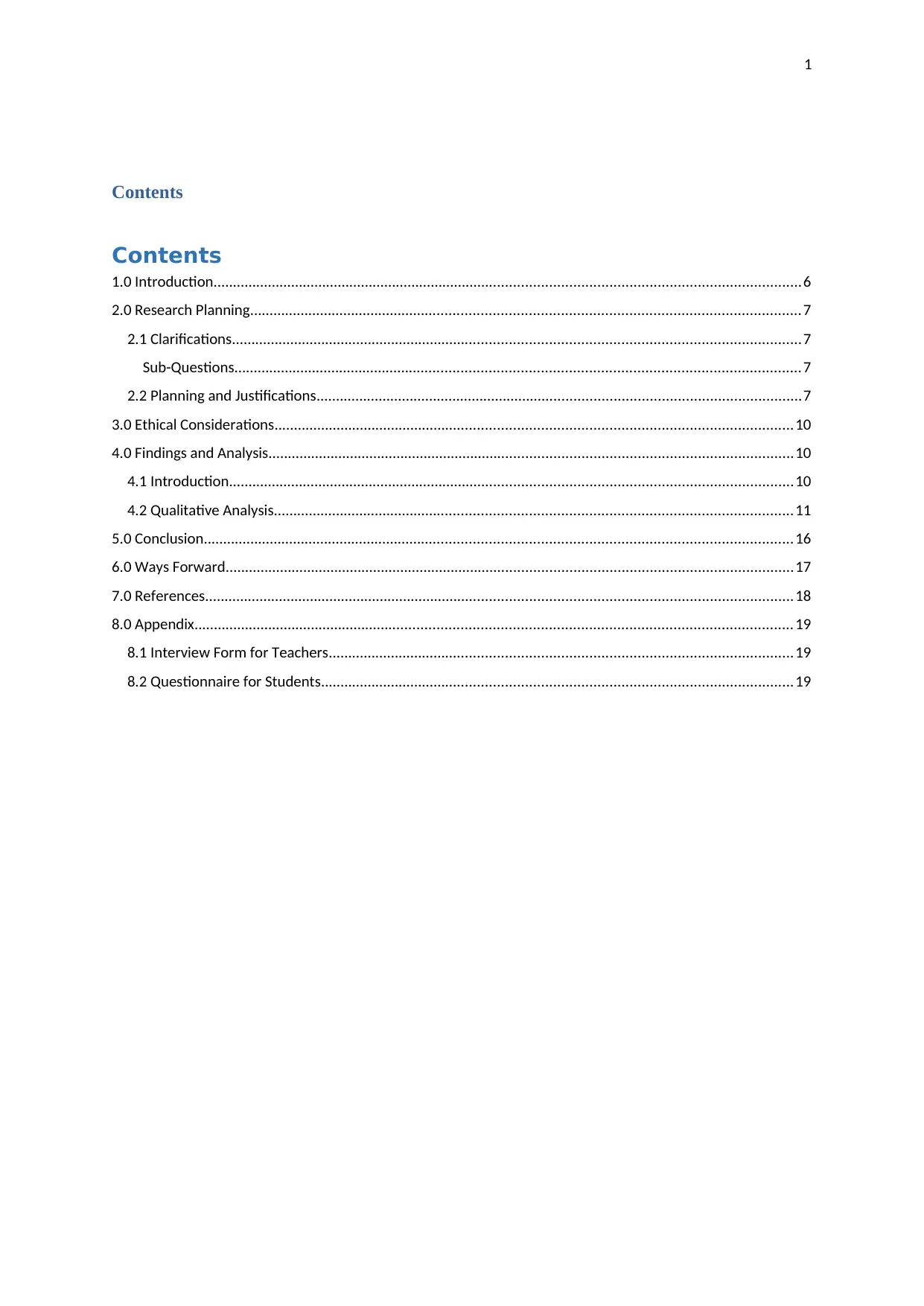
Contents
Contents
1.0 Introduction.....................................................................................................................................................6
2.0 Research Planning...........................................................................................................................................7
2.1 Clarifications................................................................................................................................................7
Sub-Questions...............................................................................................................................................7
2.2 Planning and Justifications...........................................................................................................................7
3.0 Ethical Considerations...................................................................................................................................10
4.0 Findings and Analysis.....................................................................................................................................10
4.1 Introduction...............................................................................................................................................10
4.2 Qualitative Analysis...................................................................................................................................11
5.0 Conclusion.....................................................................................................................................................16
6.0 Ways Forward................................................................................................................................................17
7.0 References.....................................................................................................................................................18
8.0 Appendix....................................................................................................................................................... 19
8.1 Interview Form for Teachers.....................................................................................................................19
8.2 Questionnaire for Students.......................................................................................................................19
Contents
Contents
1.0 Introduction.....................................................................................................................................................6
2.0 Research Planning...........................................................................................................................................7
2.1 Clarifications................................................................................................................................................7
Sub-Questions...............................................................................................................................................7
2.2 Planning and Justifications...........................................................................................................................7
3.0 Ethical Considerations...................................................................................................................................10
4.0 Findings and Analysis.....................................................................................................................................10
4.1 Introduction...............................................................................................................................................10
4.2 Qualitative Analysis...................................................................................................................................11
5.0 Conclusion.....................................................................................................................................................16
6.0 Ways Forward................................................................................................................................................17
7.0 References.....................................................................................................................................................18
8.0 Appendix....................................................................................................................................................... 19
8.1 Interview Form for Teachers.....................................................................................................................19
8.2 Questionnaire for Students.......................................................................................................................19
1
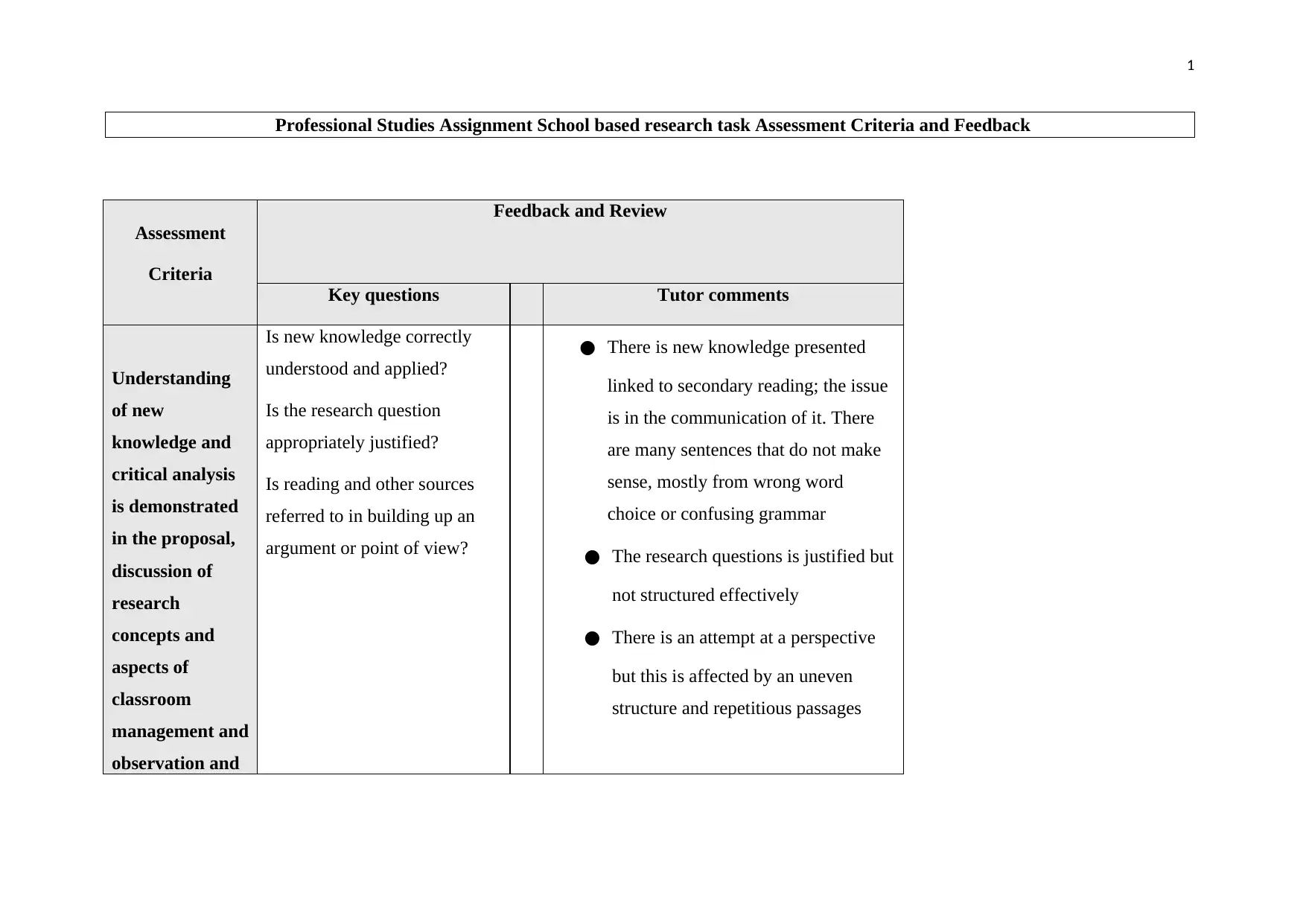
Professional Studies Assignment School based research task Assessment Criteria and Feedback
Assessment
Criteria
Feedback and Review
Key questions Tutor comments
Understanding
of new
knowledge and
critical analysis
is demonstrated
in the proposal,
discussion of
research
concepts and
aspects of
classroom
management and
observation and
Is new knowledge correctly
understood and applied?
Is the research question
appropriately justified?
Is reading and other sources
referred to in building up an
argument or point of view?
● There is new knowledge presented
linked to secondary reading; the issue
is in the communication of it. There
are many sentences that do not make
sense, mostly from wrong word
choice or confusing grammar
● The research questions is justified but
not structured effectively
● There is an attempt at a perspective
but this is affected by an uneven
structure and repetitious passages
Professional Studies Assignment School based research task Assessment Criteria and Feedback
Assessment
Criteria
Feedback and Review
Key questions Tutor comments
Understanding
of new
knowledge and
critical analysis
is demonstrated
in the proposal,
discussion of
research
concepts and
aspects of
classroom
management and
observation and
Is new knowledge correctly
understood and applied?
Is the research question
appropriately justified?
Is reading and other sources
referred to in building up an
argument or point of view?
● There is new knowledge presented
linked to secondary reading; the issue
is in the communication of it. There
are many sentences that do not make
sense, mostly from wrong word
choice or confusing grammar
● The research questions is justified but
not structured effectively
● There is an attempt at a perspective
but this is affected by an uneven
structure and repetitious passages
⊘ This is a preview!⊘
Do you want full access?
Subscribe today to unlock all pages.

Trusted by 1+ million students worldwide
2
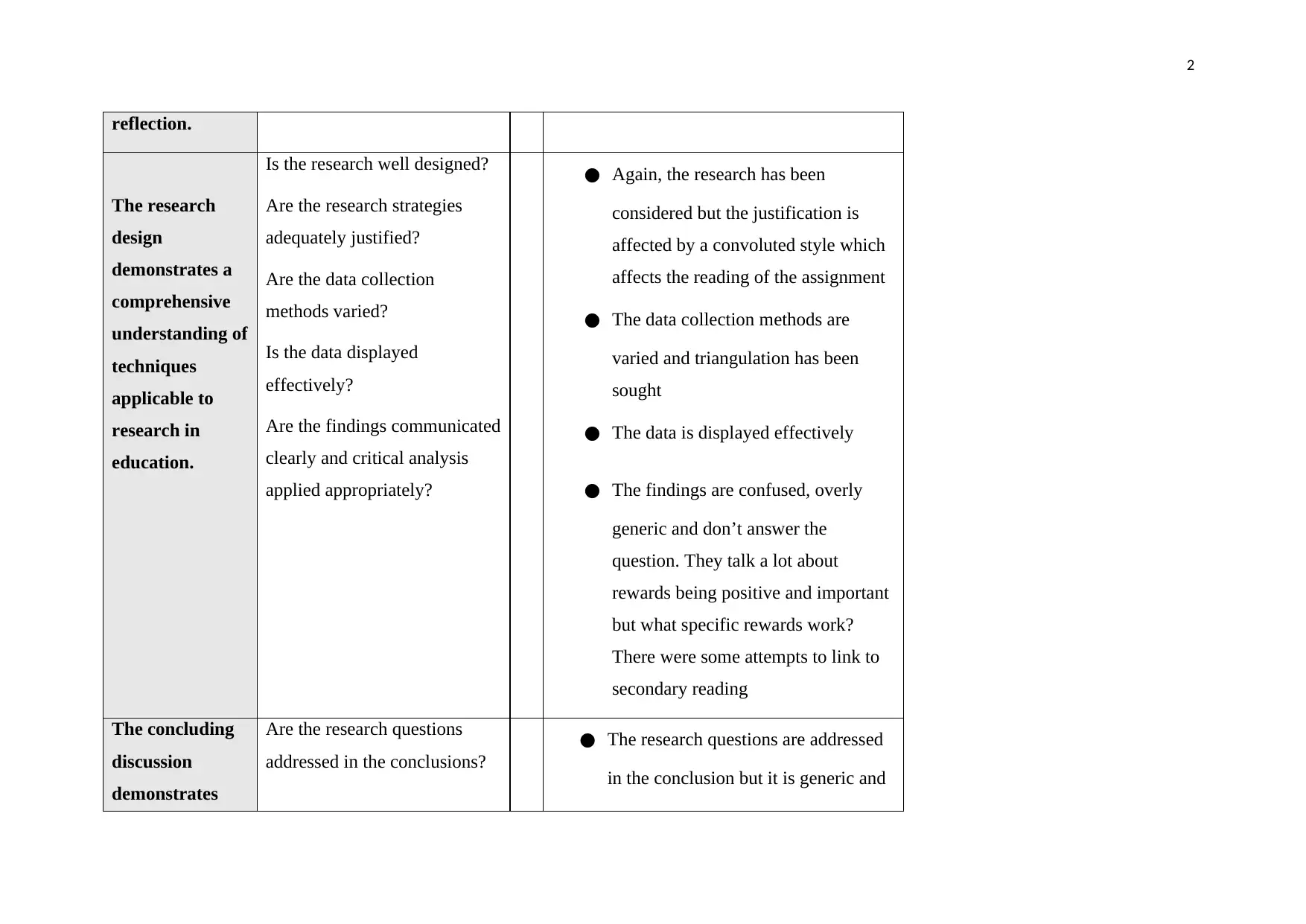
reflection.
The research
design
demonstrates a
comprehensive
understanding of
techniques
applicable to
research in
education.
Is the research well designed?
Are the research strategies
adequately justified?
Are the data collection
methods varied?
Is the data displayed
effectively?
Are the findings communicated
clearly and critical analysis
applied appropriately?
● Again, the research has been
considered but the justification is
affected by a convoluted style which
affects the reading of the assignment
● The data collection methods are
varied and triangulation has been
sought
● The data is displayed effectively
● The findings are confused, overly
generic and don’t answer the
question. They talk a lot about
rewards being positive and important
but what specific rewards work?
There were some attempts to link to
secondary reading
The concluding
discussion
demonstrates
Are the research questions
addressed in the conclusions?
● The research questions are addressed
in the conclusion but it is generic and
reflection.
The research
design
demonstrates a
comprehensive
understanding of
techniques
applicable to
research in
education.
Is the research well designed?
Are the research strategies
adequately justified?
Are the data collection
methods varied?
Is the data displayed
effectively?
Are the findings communicated
clearly and critical analysis
applied appropriately?
● Again, the research has been
considered but the justification is
affected by a convoluted style which
affects the reading of the assignment
● The data collection methods are
varied and triangulation has been
sought
● The data is displayed effectively
● The findings are confused, overly
generic and don’t answer the
question. They talk a lot about
rewards being positive and important
but what specific rewards work?
There were some attempts to link to
secondary reading
The concluding
discussion
demonstrates
Are the research questions
addressed in the conclusions?
● The research questions are addressed
in the conclusion but it is generic and
Paraphrase This Document
Need a fresh take? Get an instant paraphrase of this document with our AI Paraphraser
3
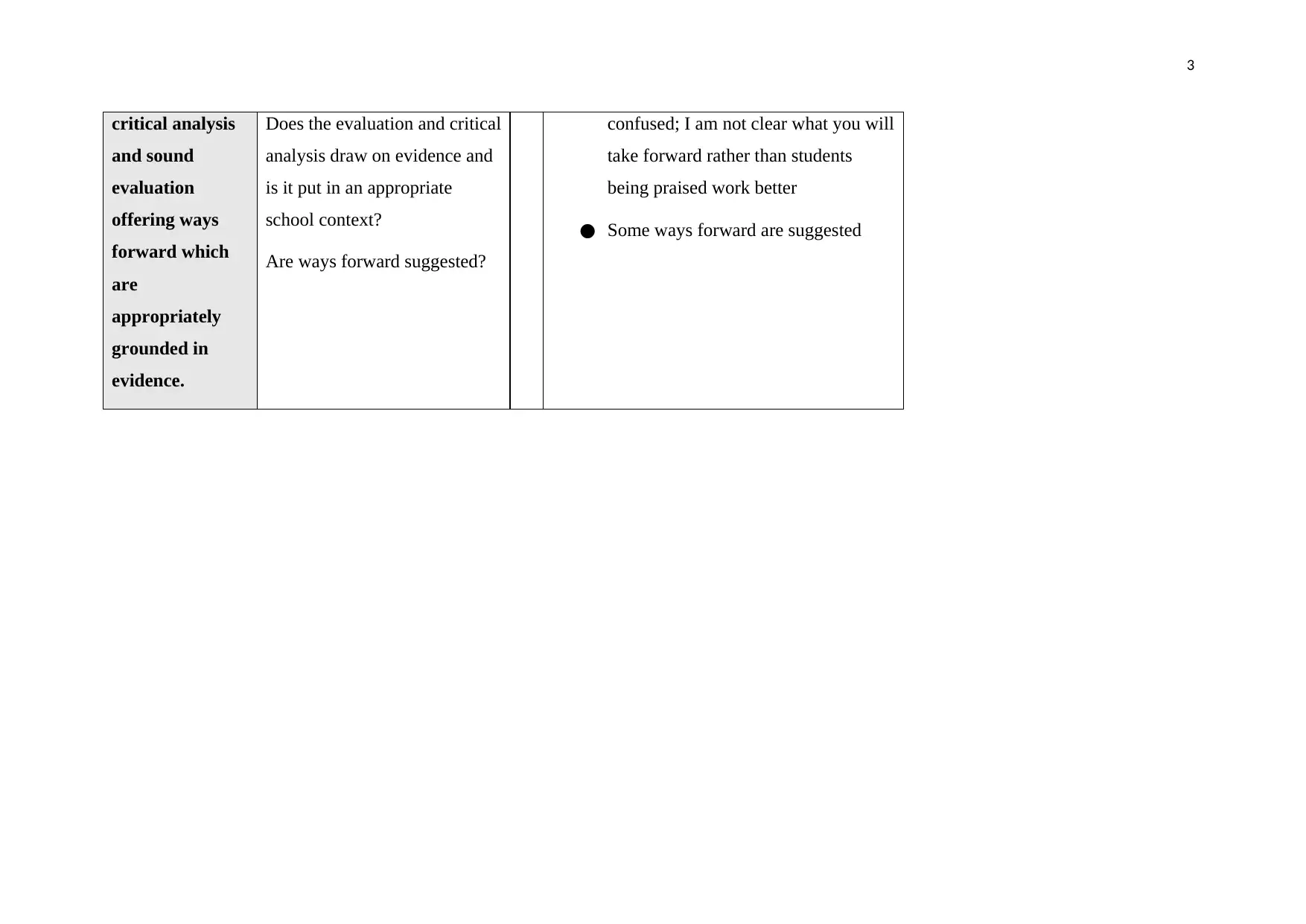
critical analysis
and sound
evaluation
offering ways
forward which
are
appropriately
grounded in
evidence.
Does the evaluation and critical
analysis draw on evidence and
is it put in an appropriate
school context?
Are ways forward suggested?
confused; I am not clear what you will
take forward rather than students
being praised work better
● Some ways forward are suggested
critical analysis
and sound
evaluation
offering ways
forward which
are
appropriately
grounded in
evidence.
Does the evaluation and critical
analysis draw on evidence and
is it put in an appropriate
school context?
Are ways forward suggested?
confused; I am not clear what you will
take forward rather than students
being praised work better
● Some ways forward are suggested
1
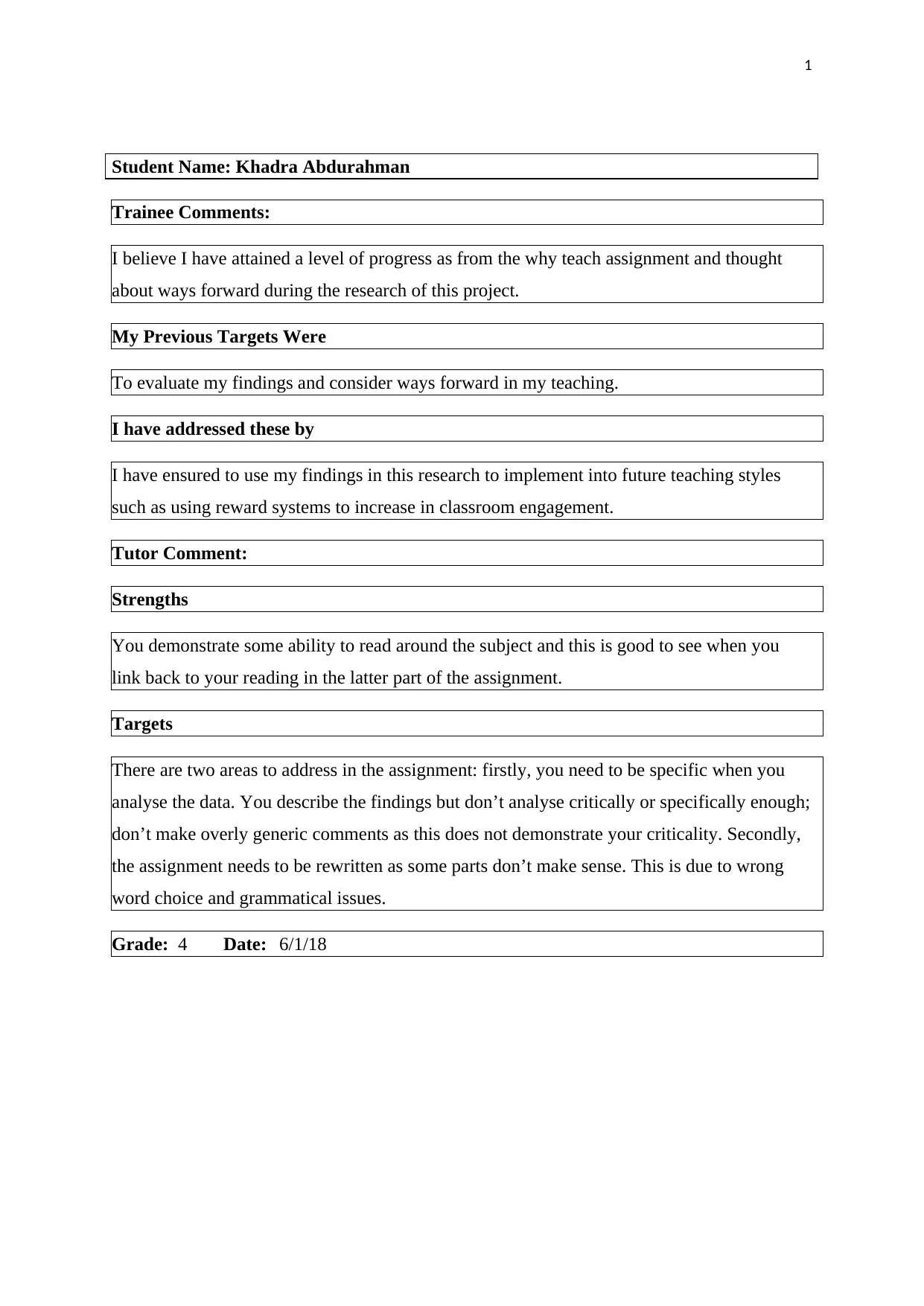
Student Name: Khadra Abdurahman
Trainee Comments:
I believe I have attained a level of progress as from the why teach assignment and thought
about ways forward during the research of this project.
My Previous Targets Were
To evaluate my findings and consider ways forward in my teaching.
I have addressed these by
I have ensured to use my findings in this research to implement into future teaching styles
such as using reward systems to increase in classroom engagement.
Tutor Comment:
Strengths
You demonstrate some ability to read around the subject and this is good to see when you
link back to your reading in the latter part of the assignment.
Targets
There are two areas to address in the assignment: firstly, you need to be specific when you
analyse the data. You describe the findings but don’t analyse critically or specifically enough;
don’t make overly generic comments as this does not demonstrate your criticality. Secondly,
the assignment needs to be rewritten as some parts don’t make sense. This is due to wrong
word choice and grammatical issues.
Grade: 4 Date: 6/1/18
Student Name: Khadra Abdurahman
Trainee Comments:
I believe I have attained a level of progress as from the why teach assignment and thought
about ways forward during the research of this project.
My Previous Targets Were
To evaluate my findings and consider ways forward in my teaching.
I have addressed these by
I have ensured to use my findings in this research to implement into future teaching styles
such as using reward systems to increase in classroom engagement.
Tutor Comment:
Strengths
You demonstrate some ability to read around the subject and this is good to see when you
link back to your reading in the latter part of the assignment.
Targets
There are two areas to address in the assignment: firstly, you need to be specific when you
analyse the data. You describe the findings but don’t analyse critically or specifically enough;
don’t make overly generic comments as this does not demonstrate your criticality. Secondly,
the assignment needs to be rewritten as some parts don’t make sense. This is due to wrong
word choice and grammatical issues.
Grade: 4 Date: 6/1/18
⊘ This is a preview!⊘
Do you want full access?
Subscribe today to unlock all pages.
Trusted by 1+ million students worldwide
2
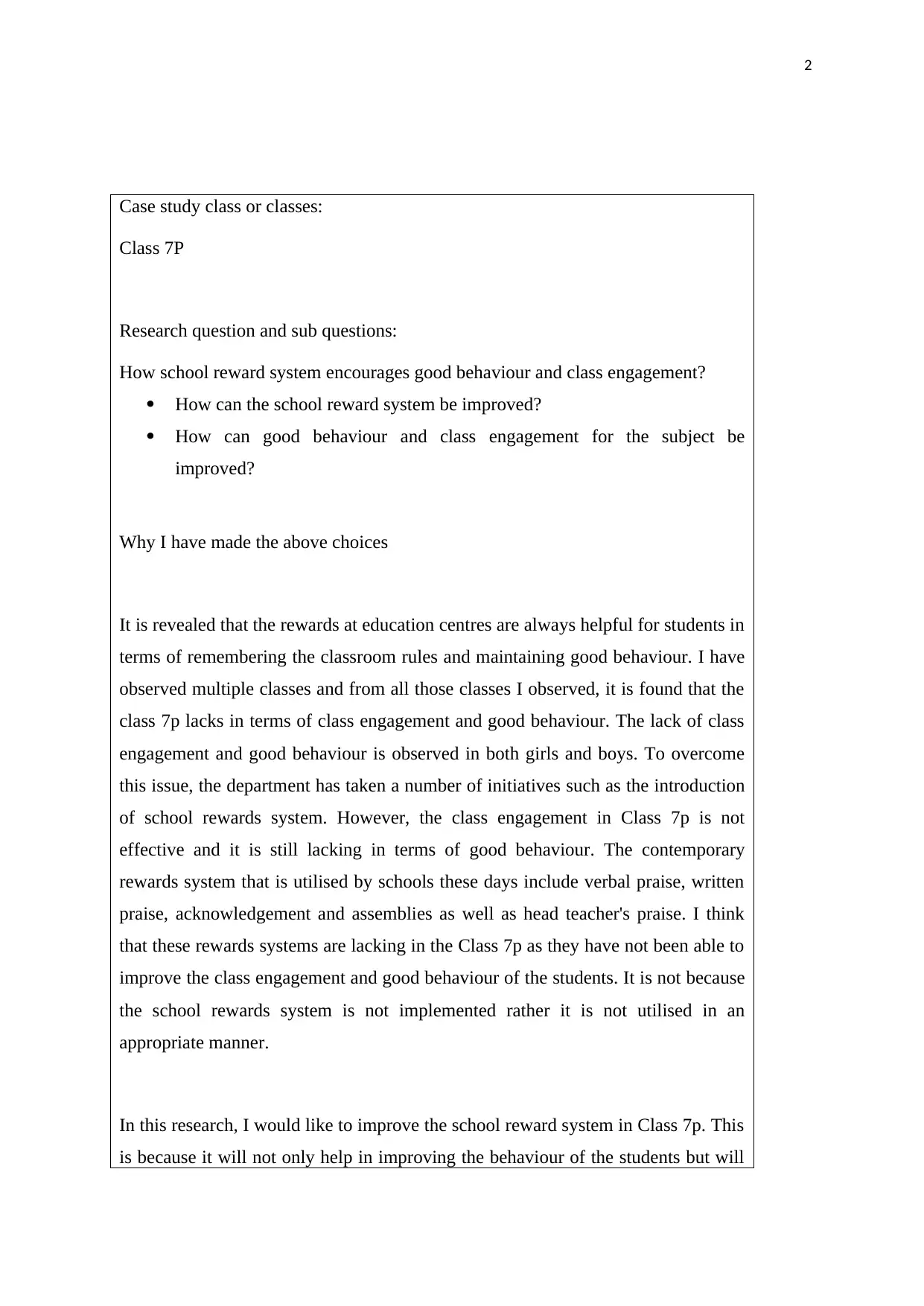
Case study class or classes:
Class 7P
Research question and sub questions:
How school reward system encourages good behaviour and class engagement?
How can the school reward system be improved?
How can good behaviour and class engagement for the subject be
improved?
Why I have made the above choices
It is revealed that the rewards at education centres are always helpful for students in
terms of remembering the classroom rules and maintaining good behaviour. I have
observed multiple classes and from all those classes I observed, it is found that the
class 7p lacks in terms of class engagement and good behaviour. The lack of class
engagement and good behaviour is observed in both girls and boys. To overcome
this issue, the department has taken a number of initiatives such as the introduction
of school rewards system. However, the class engagement in Class 7p is not
effective and it is still lacking in terms of good behaviour. The contemporary
rewards system that is utilised by schools these days include verbal praise, written
praise, acknowledgement and assemblies as well as head teacher's praise. I think
that these rewards systems are lacking in the Class 7p as they have not been able to
improve the class engagement and good behaviour of the students. It is not because
the school rewards system is not implemented rather it is not utilised in an
appropriate manner.
In this research, I would like to improve the school reward system in Class 7p. This
is because it will not only help in improving the behaviour of the students but will
Case study class or classes:
Class 7P
Research question and sub questions:
How school reward system encourages good behaviour and class engagement?
How can the school reward system be improved?
How can good behaviour and class engagement for the subject be
improved?
Why I have made the above choices
It is revealed that the rewards at education centres are always helpful for students in
terms of remembering the classroom rules and maintaining good behaviour. I have
observed multiple classes and from all those classes I observed, it is found that the
class 7p lacks in terms of class engagement and good behaviour. The lack of class
engagement and good behaviour is observed in both girls and boys. To overcome
this issue, the department has taken a number of initiatives such as the introduction
of school rewards system. However, the class engagement in Class 7p is not
effective and it is still lacking in terms of good behaviour. The contemporary
rewards system that is utilised by schools these days include verbal praise, written
praise, acknowledgement and assemblies as well as head teacher's praise. I think
that these rewards systems are lacking in the Class 7p as they have not been able to
improve the class engagement and good behaviour of the students. It is not because
the school rewards system is not implemented rather it is not utilised in an
appropriate manner.
In this research, I would like to improve the school reward system in Class 7p. This
is because it will not only help in improving the behaviour of the students but will
Paraphrase This Document
Need a fresh take? Get an instant paraphrase of this document with our AI Paraphraser
3
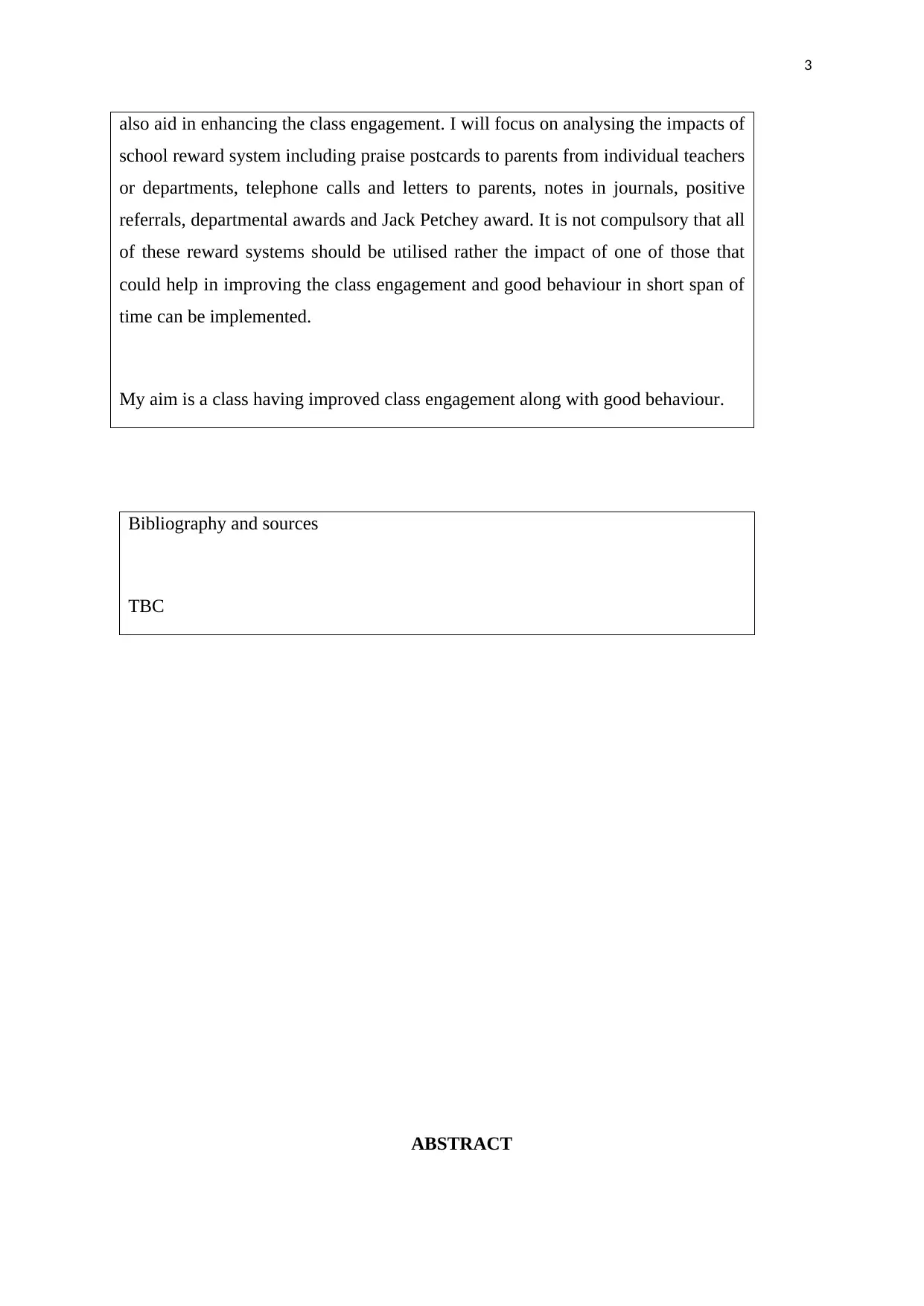
also aid in enhancing the class engagement. I will focus on analysing the impacts of
school reward system including praise postcards to parents from individual teachers
or departments, telephone calls and letters to parents, notes in journals, positive
referrals, departmental awards and Jack Petchey award. It is not compulsory that all
of these reward systems should be utilised rather the impact of one of those that
could help in improving the class engagement and good behaviour in short span of
time can be implemented.
My aim is a class having improved class engagement along with good behaviour.
Bibliography and sources
TBC
ABSTRACT
also aid in enhancing the class engagement. I will focus on analysing the impacts of
school reward system including praise postcards to parents from individual teachers
or departments, telephone calls and letters to parents, notes in journals, positive
referrals, departmental awards and Jack Petchey award. It is not compulsory that all
of these reward systems should be utilised rather the impact of one of those that
could help in improving the class engagement and good behaviour in short span of
time can be implemented.
My aim is a class having improved class engagement along with good behaviour.
Bibliography and sources
TBC
ABSTRACT
4
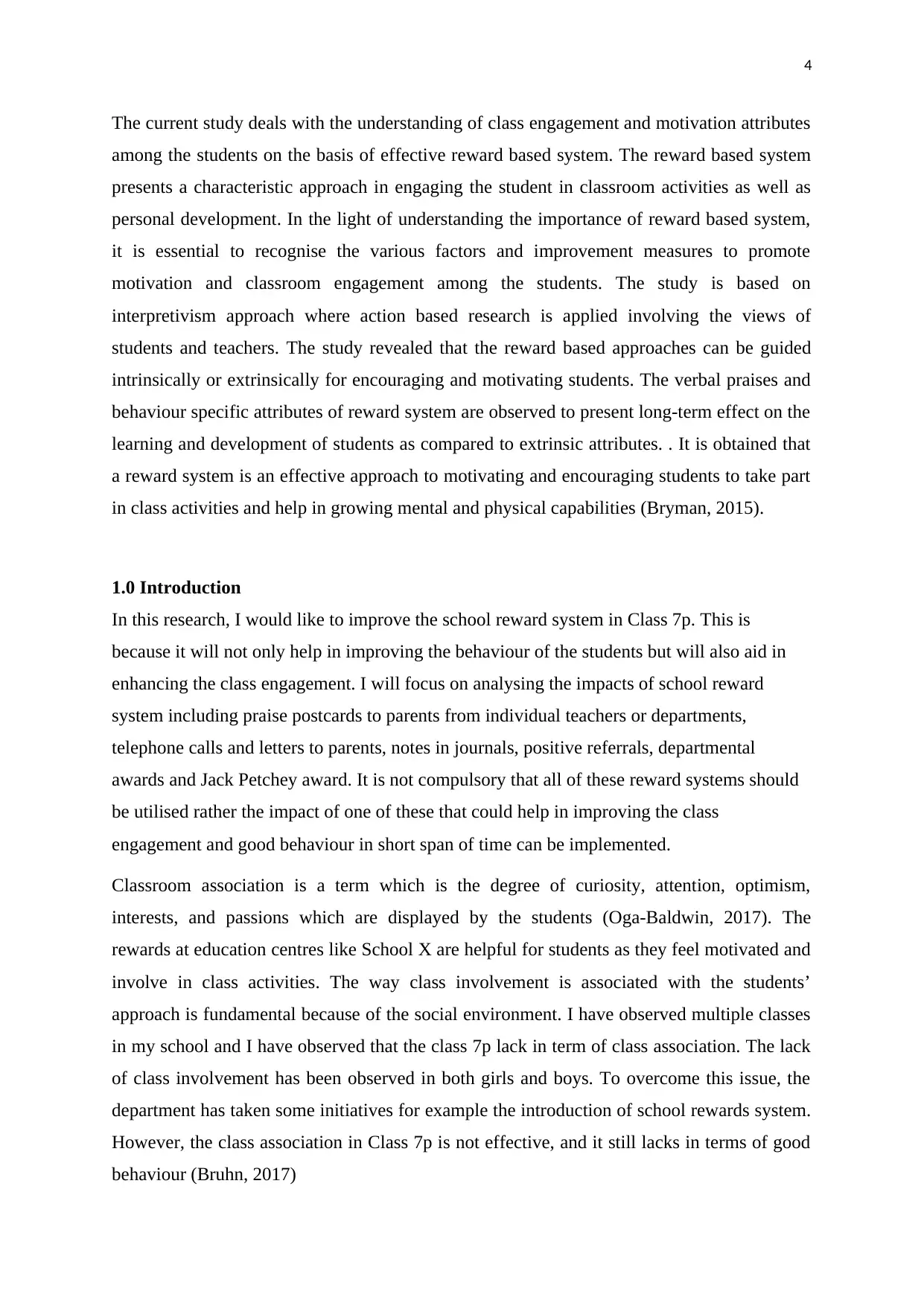
The current study deals with the understanding of class engagement and motivation attributes
among the students on the basis of effective reward based system. The reward based system
presents a characteristic approach in engaging the student in classroom activities as well as
personal development. In the light of understanding the importance of reward based system,
it is essential to recognise the various factors and improvement measures to promote
motivation and classroom engagement among the students. The study is based on
interpretivism approach where action based research is applied involving the views of
students and teachers. The study revealed that the reward based approaches can be guided
intrinsically or extrinsically for encouraging and motivating students. The verbal praises and
behaviour specific attributes of reward system are observed to present long-term effect on the
learning and development of students as compared to extrinsic attributes. . It is obtained that
a reward system is an effective approach to motivating and encouraging students to take part
in class activities and help in growing mental and physical capabilities (Bryman, 2015).
1.0 Introduction
In this research, I would like to improve the school reward system in Class 7p. This is
because it will not only help in improving the behaviour of the students but will also aid in
enhancing the class engagement. I will focus on analysing the impacts of school reward
system including praise postcards to parents from individual teachers or departments,
telephone calls and letters to parents, notes in journals, positive referrals, departmental
awards and Jack Petchey award. It is not compulsory that all of these reward systems should
be utilised rather the impact of one of these that could help in improving the class
engagement and good behaviour in short span of time can be implemented.
Classroom association is a term which is the degree of curiosity, attention, optimism,
interests, and passions which are displayed by the students (Oga-Baldwin, 2017). The
rewards at education centres like School X are helpful for students as they feel motivated and
involve in class activities. The way class involvement is associated with the students’
approach is fundamental because of the social environment. I have observed multiple classes
in my school and I have observed that the class 7p lack in term of class association. The lack
of class involvement has been observed in both girls and boys. To overcome this issue, the
department has taken some initiatives for example the introduction of school rewards system.
However, the class association in Class 7p is not effective, and it still lacks in terms of good
behaviour (Bruhn, 2017)
The current study deals with the understanding of class engagement and motivation attributes
among the students on the basis of effective reward based system. The reward based system
presents a characteristic approach in engaging the student in classroom activities as well as
personal development. In the light of understanding the importance of reward based system,
it is essential to recognise the various factors and improvement measures to promote
motivation and classroom engagement among the students. The study is based on
interpretivism approach where action based research is applied involving the views of
students and teachers. The study revealed that the reward based approaches can be guided
intrinsically or extrinsically for encouraging and motivating students. The verbal praises and
behaviour specific attributes of reward system are observed to present long-term effect on the
learning and development of students as compared to extrinsic attributes. . It is obtained that
a reward system is an effective approach to motivating and encouraging students to take part
in class activities and help in growing mental and physical capabilities (Bryman, 2015).
1.0 Introduction
In this research, I would like to improve the school reward system in Class 7p. This is
because it will not only help in improving the behaviour of the students but will also aid in
enhancing the class engagement. I will focus on analysing the impacts of school reward
system including praise postcards to parents from individual teachers or departments,
telephone calls and letters to parents, notes in journals, positive referrals, departmental
awards and Jack Petchey award. It is not compulsory that all of these reward systems should
be utilised rather the impact of one of these that could help in improving the class
engagement and good behaviour in short span of time can be implemented.
Classroom association is a term which is the degree of curiosity, attention, optimism,
interests, and passions which are displayed by the students (Oga-Baldwin, 2017). The
rewards at education centres like School X are helpful for students as they feel motivated and
involve in class activities. The way class involvement is associated with the students’
approach is fundamental because of the social environment. I have observed multiple classes
in my school and I have observed that the class 7p lack in term of class association. The lack
of class involvement has been observed in both girls and boys. To overcome this issue, the
department has taken some initiatives for example the introduction of school rewards system.
However, the class association in Class 7p is not effective, and it still lacks in terms of good
behaviour (Bruhn, 2017)
⊘ This is a preview!⊘
Do you want full access?
Subscribe today to unlock all pages.
Trusted by 1+ million students worldwide
5
If only one student is appreciated, then this may divert their engagement from the
lesson and opens up the route of bad behaviour for the other students. In the quest for
negative practices, the lower involvement of the students in the 7p class is associated with the
teachers. The contemporary rewards system which is utilised by School X includes verbal
praise, written praise, acknowledgement and assemblies as well as head teacher's praise. I
think that these rewards systems are lacking in the Class 7p as they have not been able to
improve the class association in terms of the good behaviour of the students. It is not because
the school rewards system is not implemented but that it’s not utilised in an appropriate
manner (Caldarella, 2016).
Ineffective class association of the students may also be due to the absence of the
effective appraisal by the teachers (Dumas, 2017). This is also linked with the teachers as
they can motivate and praise the students in an efficient manner. The teacher's praise may
also lead to the sceptical or negative behaviour patterns, while the students can be engaged in
the classroom by considering the positive approach by detailing the written praise. With the
involvement of teacher's praise and the school reward systems, the students of class 7p may
start to take interest in the lessons more effectively. By considering the teachers’ attitude and
adaptation of the school reward systems as suggested by (Oga-Baldwin, 2017), this research
can enhance and support the engagement of the students of class 7p in the school.
2.0 Research Planning
2.1 Clarifications
For my school-based research project, I intend to undertake and implement research
for the following research question:
If only one student is appreciated, then this may divert their engagement from the
lesson and opens up the route of bad behaviour for the other students. In the quest for
negative practices, the lower involvement of the students in the 7p class is associated with the
teachers. The contemporary rewards system which is utilised by School X includes verbal
praise, written praise, acknowledgement and assemblies as well as head teacher's praise. I
think that these rewards systems are lacking in the Class 7p as they have not been able to
improve the class association in terms of the good behaviour of the students. It is not because
the school rewards system is not implemented but that it’s not utilised in an appropriate
manner (Caldarella, 2016).
Ineffective class association of the students may also be due to the absence of the
effective appraisal by the teachers (Dumas, 2017). This is also linked with the teachers as
they can motivate and praise the students in an efficient manner. The teacher's praise may
also lead to the sceptical or negative behaviour patterns, while the students can be engaged in
the classroom by considering the positive approach by detailing the written praise. With the
involvement of teacher's praise and the school reward systems, the students of class 7p may
start to take interest in the lessons more effectively. By considering the teachers’ attitude and
adaptation of the school reward systems as suggested by (Oga-Baldwin, 2017), this research
can enhance and support the engagement of the students of class 7p in the school.
2.0 Research Planning
2.1 Clarifications
For my school-based research project, I intend to undertake and implement research
for the following research question:
Paraphrase This Document
Need a fresh take? Get an instant paraphrase of this document with our AI Paraphraser
6
● How can school reward system encourage class engagement?
Sub-Questions
● How can school reward system be improved?
● How can class engagement be improved with the use of school X’s behaviour policy?
In this research, I would like to improve the school reward system in Class 7p. This is
because it would not only help in developing the behaviour of the students but would also aid
in enhancing the class engagement. I will be focussing on analysing the impacts of school
reward system including praise postcards to parents from individual teachers or departments,
telephone calls and letters to parents, notes in journals, positive referrals, departmental
awards and Jack Petchey award. Any one of the above mentioned ways can help in improving
the class engagement in short span of time and can be implemented.
2.2 Planning and Justifications
This enables the researcher to accumulate the information to see how to enhance the
class engagement of the students in the class 7p. The inquiry is the part that you plan to find
out about the subject. I would make use of the Action plan research because I believe that I
will get an accurate amount of data and information. This will guide me and will help me in
structuring the choice of information that would be gathered and investigated. As suggested
by (Dumas, 2017), I would endeavour to have different approaches toward the start of the
lesson, which would utilise all concepts. I would concentrate on the feedback of the teachers
along with the departments, letters and telephone calls. I would also consider the positive
referrals, and Jack Petchey award. My planning of the research and practice would work with
techniques to find ways that will help in maintaining an effective class engagement. I want to
attempt distinctive methods like the ones specified above. Similarly, I want to affect Class 7
p’s ability to think in a positive manner.
To undergo this research and to make the most of the Action planning methods, I
would concentrate on the use of interpretative information. With respect to (Bryman, 2016),
Action research encompasses the operations concerning the reality and grasps the complexity
of social conditions. Interpretivism information enables me to have the correct outcomes. The
● How can school reward system encourage class engagement?
Sub-Questions
● How can school reward system be improved?
● How can class engagement be improved with the use of school X’s behaviour policy?
In this research, I would like to improve the school reward system in Class 7p. This is
because it would not only help in developing the behaviour of the students but would also aid
in enhancing the class engagement. I will be focussing on analysing the impacts of school
reward system including praise postcards to parents from individual teachers or departments,
telephone calls and letters to parents, notes in journals, positive referrals, departmental
awards and Jack Petchey award. Any one of the above mentioned ways can help in improving
the class engagement in short span of time and can be implemented.
2.2 Planning and Justifications
This enables the researcher to accumulate the information to see how to enhance the
class engagement of the students in the class 7p. The inquiry is the part that you plan to find
out about the subject. I would make use of the Action plan research because I believe that I
will get an accurate amount of data and information. This will guide me and will help me in
structuring the choice of information that would be gathered and investigated. As suggested
by (Dumas, 2017), I would endeavour to have different approaches toward the start of the
lesson, which would utilise all concepts. I would concentrate on the feedback of the teachers
along with the departments, letters and telephone calls. I would also consider the positive
referrals, and Jack Petchey award. My planning of the research and practice would work with
techniques to find ways that will help in maintaining an effective class engagement. I want to
attempt distinctive methods like the ones specified above. Similarly, I want to affect Class 7
p’s ability to think in a positive manner.
To undergo this research and to make the most of the Action planning methods, I
would concentrate on the use of interpretative information. With respect to (Bryman, 2016),
Action research encompasses the operations concerning the reality and grasps the complexity
of social conditions. Interpretivism information enables me to have the correct outcomes. The
7
majority of the information would be interpretivism as it gives the data to achieve a
satisfactory conclusion. I will have the quantitative information so that a lot of facts can be
concluded. As a constituent of the school's regulations, I would start to discover
interpretivism learning from the information I would gather. I will make use of the open and
close-ended questionnaires; I will make use of the Interviews in this case. As per (Caldarella,
2016), open-ended questions for interviews and close-ended questionnaires for surveys can
help to get detailed data. These three research techniques will enable me to obtain the critical
information to achieve a decision about “How school reward system encourages class
engagement?” The questionnaire will allow an individual to gain insight on the student’s
thoughts about the reward systems. This will also make one understand whether these reward
systems are increasing the level of engagement or not.
The goal of my research technique is to create the proposal for good practices which
can tackle an issue or enhance the implementation of school reward system. With reference to
(Menzies, 2016), Action Planning integrates the arrangements, actions, observations and
reflections. This specific procedure includes the Interpretivism approach in which the
consequences of changes are found, yet they are actualised and assessed. This research will
also make use of the systematic observations concerning the school's reward systems along
with the class engagement of the students (class 7p) (Hansen, 2017). The action planning
approach given by (Bryman, 2016) will help me in this research to consider the arrangements,
activity, perception and reflection to acquire the required information and learning.
To complete and actualise the primary period of the research I would start to design
the data collection techniques by making use of the questionnaires, because they help the
researchers to gain the in-depth information and analysis in an effective manner. The primary
approach for data collection techniques that I might want to utilise is the perception in the
classroom with an emphasis on teacher's praise. As reported by (Silverman, 2016), the
prompt learning of the Interpretivism approach and Action planning perceptions enables the
study to be more legitimate and considerable for its outcomes. I would mention my research
objectives in demonstrating the teacher’s approaches, and whether the use of innovation and
school reward systems influences the engagement of the students. Concerning (Bryman,
2016), from the use of Interviews and Questionnaires, this would create a data and it would
be easy to discover the relationship between the school reward system and class engagement.
After the planning of the research, I would utilise the data collection techniques for
the interviews. I will also use a progression of open-ended and close-ended questionnaires to
get the adequate information concerning the class engagement of Class 7p. According to
majority of the information would be interpretivism as it gives the data to achieve a
satisfactory conclusion. I will have the quantitative information so that a lot of facts can be
concluded. As a constituent of the school's regulations, I would start to discover
interpretivism learning from the information I would gather. I will make use of the open and
close-ended questionnaires; I will make use of the Interviews in this case. As per (Caldarella,
2016), open-ended questions for interviews and close-ended questionnaires for surveys can
help to get detailed data. These three research techniques will enable me to obtain the critical
information to achieve a decision about “How school reward system encourages class
engagement?” The questionnaire will allow an individual to gain insight on the student’s
thoughts about the reward systems. This will also make one understand whether these reward
systems are increasing the level of engagement or not.
The goal of my research technique is to create the proposal for good practices which
can tackle an issue or enhance the implementation of school reward system. With reference to
(Menzies, 2016), Action Planning integrates the arrangements, actions, observations and
reflections. This specific procedure includes the Interpretivism approach in which the
consequences of changes are found, yet they are actualised and assessed. This research will
also make use of the systematic observations concerning the school's reward systems along
with the class engagement of the students (class 7p) (Hansen, 2017). The action planning
approach given by (Bryman, 2016) will help me in this research to consider the arrangements,
activity, perception and reflection to acquire the required information and learning.
To complete and actualise the primary period of the research I would start to design
the data collection techniques by making use of the questionnaires, because they help the
researchers to gain the in-depth information and analysis in an effective manner. The primary
approach for data collection techniques that I might want to utilise is the perception in the
classroom with an emphasis on teacher's praise. As reported by (Silverman, 2016), the
prompt learning of the Interpretivism approach and Action planning perceptions enables the
study to be more legitimate and considerable for its outcomes. I would mention my research
objectives in demonstrating the teacher’s approaches, and whether the use of innovation and
school reward systems influences the engagement of the students. Concerning (Bryman,
2016), from the use of Interviews and Questionnaires, this would create a data and it would
be easy to discover the relationship between the school reward system and class engagement.
After the planning of the research, I would utilise the data collection techniques for
the interviews. I will also use a progression of open-ended and close-ended questionnaires to
get the adequate information concerning the class engagement of Class 7p. According to
⊘ This is a preview!⊘
Do you want full access?
Subscribe today to unlock all pages.
Trusted by 1+ million students worldwide

1 out of 24


Your All-in-One AI-Powered Toolkit for Academic Success.
+13062052269
info@desklib.com
Available 24*7 on WhatsApp / Email
![[object Object]](/_next/static/media/star-bottom.7253800d.svg)
Unlock your academic potential
Copyright © 2020–2026 A2Z Services. All Rights Reserved. Developed and managed by ZUCOL.