Spanish Guitar: History, Construction, and Socioeconomic Factors
VerifiedAdded on 2021/11/16
|9
|1847
|161
Report
AI Summary
This report delves into the rich history and technical aspects of the Spanish guitar, a globally recognized musical instrument. It explores the guitar's origins, tracing its evolution from Persia to its establishment in Spain during the 20th century. The report examines the construction techniques, materials, and craftsmanship involved in creating the instrument, referencing key resources like Bogdanovich's manual on classical guitar making. It also provides insights into the socioeconomic conditions and working lives of guitar makers, drawing from historical bibliographies and dictionaries of instrument makers. The report covers the contributions of notable composers and artisans, the evolution of guitar design, and the instrument's cultural impact, making it a comprehensive resource for anyone interested in the Spanish guitar's history and development.
SPANISH GUITAR 1
Spanish Guitar
Student’s Name
Professor’s Name
Course
Date
Spanish Guitar
Student’s Name
Professor’s Name
Course
Date

Paraphrase This Document
Need a fresh take? Get an instant paraphrase of this document with our AI Paraphraser
SPANISH GUITAR 2
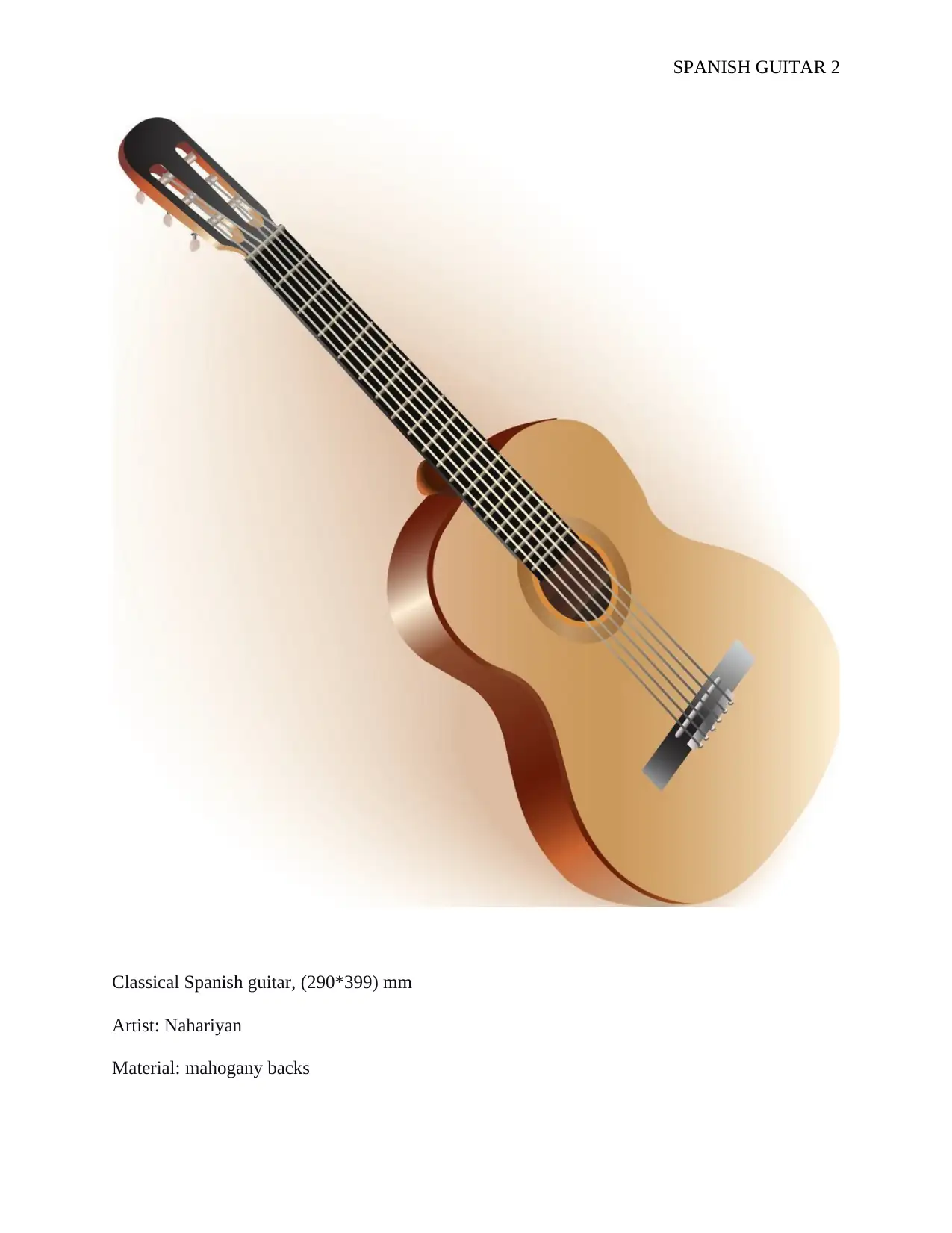
Classical Spanish guitar, (290*399) mm
Artist: Nahariyan
Material: mahogany backs
Classical Spanish guitar, (290*399) mm
Artist: Nahariyan
Material: mahogany backs
SPANISH GUITAR 3
Spanish Guitar
Classical guitar is one of the famous, multi-stringed musical appliances and it is well
known worldwide. Classical guitar is used primarily as an auxiliary instrument in most melodic
methods. It is said to have originated from Persia but eventually reached Spain during the 20th
century, where its resourcefulness both as a solo and accompanying instrument was established.
It is made of a hollow body with the top and back constructed from pieces of wood that have
been carved and shaped to give a traditional figure. This paper is mainly keen to look at the
Spanish guitar's concise history, the technology used during the construction, and the craftsmen's
socio, economic, and working conditions.
Bogdanovich, John S. Classical guitar making: a modern approach to traditional design.
Sterling Publishing Company, Inc., 2007.
John Bogdanovich, a familiar craftsman, and a guitarist in his richly illustrated instruction
manual, demonstrates clearly and logically ways to build a beautiful classical guitar by
employing conventional and time-tested methods. 1Ideally, the author is keen to discuss the
structure of the classical guitar, sounds, preference when choosing the instruments, the
fundamental woodworking practices, preparations, and the templates.2 In not less than 300 pages
of texts, john thoroughly brings out the details in the guitars' production, starting assembling the
neckline, faces, and mounting both the fingerboard and the bridge. The writer portrays an
exceptional blend of skills to his craftwork, being a design engineer and a performer, and a
craftsman. The article provides the construction details and the ideal and essential preferences
1 Bogdanovich, John S. Classical guitar making: a modern approach to traditional design. Sterling Publishing
Company, Inc., 2007.
2 Westbrook, James. The century that shaped the guitar. 2005.
Spanish Guitar
Classical guitar is one of the famous, multi-stringed musical appliances and it is well
known worldwide. Classical guitar is used primarily as an auxiliary instrument in most melodic
methods. It is said to have originated from Persia but eventually reached Spain during the 20th
century, where its resourcefulness both as a solo and accompanying instrument was established.
It is made of a hollow body with the top and back constructed from pieces of wood that have
been carved and shaped to give a traditional figure. This paper is mainly keen to look at the
Spanish guitar's concise history, the technology used during the construction, and the craftsmen's
socio, economic, and working conditions.
Bogdanovich, John S. Classical guitar making: a modern approach to traditional design.
Sterling Publishing Company, Inc., 2007.
John Bogdanovich, a familiar craftsman, and a guitarist in his richly illustrated instruction
manual, demonstrates clearly and logically ways to build a beautiful classical guitar by
employing conventional and time-tested methods. 1Ideally, the author is keen to discuss the
structure of the classical guitar, sounds, preference when choosing the instruments, the
fundamental woodworking practices, preparations, and the templates.2 In not less than 300 pages
of texts, john thoroughly brings out the details in the guitars' production, starting assembling the
neckline, faces, and mounting both the fingerboard and the bridge. The writer portrays an
exceptional blend of skills to his craftwork, being a design engineer and a performer, and a
craftsman. The article provides the construction details and the ideal and essential preferences
1 Bogdanovich, John S. Classical guitar making: a modern approach to traditional design. Sterling Publishing
Company, Inc., 2007.
2 Westbrook, James. The century that shaped the guitar. 2005.
⊘ This is a preview!⊘
Do you want full access?
Subscribe today to unlock all pages.

Trusted by 1+ million students worldwide
SPANISH GUITAR 4
when selecting the classical guitar; therefore, it is suitable for anyone interested in both the
performance and construction part.
Boye, Gary R. "An Annotated Bibliography of Guitar Methods, 1760-1860. (Organologia:
Musical Instruments and Performance Practice, no. 4)." (2011): 403-405.
The comprehensive bibliography study describes more than 300 different methods for the
classical guitar. 3It covers about 100 years that begins with the earliest guitar methods written in
staff notations .the author includes the works of well-known guitarists and the lesser-known ones
and provides brief information about their life. 4The catalog tends to bring along a whole text of
the original title page, thereby providing the grounds for the reader to make his/her comparisons
with other publications. The author also provides a concise explanation of each section's contents
and its relationship with other works. Besides, the author also offers bibliographical details
inclusive of printing techniques. Erik's book is thus a handy resource to the guitarists interested
in history and the vast and general audience of music librarians, musicologists.
Page, Christopher. "The Spanish Guitar in the Newspapers, Novels, Drama and Verse of
Eighteenth-Century England." Royal Musical Association Research Chronicle 44, no. 1
(2013): 1-18.
About Paul Sparks, the Spanish guitar account during the eighteenth century appears to have no
record totally. However, there was less effort involving Samuel Pepys with the nineteenth
century's commencement when this guitar with six strings seemed like parlor instrumentalist's
favored tool. Generally, it is thought that this gut-strung quieter be modestly put in practice in
England in anticipation of foreign performers jointly with Fernando Sor made it fashionable in
the decades after 1815. This editorial recommends approving the well-established analysis with a
3 Romanillos, José L. Antonio de Torres, guitar maker: his life and work. Bold Strummer Limited, 1997.
4 La Chitarra, Quattro secoli di Capolavori (The Guitar: Four centuries of Masterpieces) by Giovanni Accornero, Ivan Epicoco
and Eraldo Guerc
when selecting the classical guitar; therefore, it is suitable for anyone interested in both the
performance and construction part.
Boye, Gary R. "An Annotated Bibliography of Guitar Methods, 1760-1860. (Organologia:
Musical Instruments and Performance Practice, no. 4)." (2011): 403-405.
The comprehensive bibliography study describes more than 300 different methods for the
classical guitar. 3It covers about 100 years that begins with the earliest guitar methods written in
staff notations .the author includes the works of well-known guitarists and the lesser-known ones
and provides brief information about their life. 4The catalog tends to bring along a whole text of
the original title page, thereby providing the grounds for the reader to make his/her comparisons
with other publications. The author also provides a concise explanation of each section's contents
and its relationship with other works. Besides, the author also offers bibliographical details
inclusive of printing techniques. Erik's book is thus a handy resource to the guitarists interested
in history and the vast and general audience of music librarians, musicologists.
Page, Christopher. "The Spanish Guitar in the Newspapers, Novels, Drama and Verse of
Eighteenth-Century England." Royal Musical Association Research Chronicle 44, no. 1
(2013): 1-18.
About Paul Sparks, the Spanish guitar account during the eighteenth century appears to have no
record totally. However, there was less effort involving Samuel Pepys with the nineteenth
century's commencement when this guitar with six strings seemed like parlor instrumentalist's
favored tool. Generally, it is thought that this gut-strung quieter be modestly put in practice in
England in anticipation of foreign performers jointly with Fernando Sor made it fashionable in
the decades after 1815. This editorial recommends approving the well-established analysis with a
3 Romanillos, José L. Antonio de Torres, guitar maker: his life and work. Bold Strummer Limited, 1997.
4 La Chitarra, Quattro secoli di Capolavori (The Guitar: Four centuries of Masterpieces) by Giovanni Accornero, Ivan Epicoco
and Eraldo Guerc
Paraphrase This Document
Need a fresh take? Get an instant paraphrase of this document with our AI Paraphraser
SPANISH GUITAR 5
sequential schedule of the matter intensely. A lot of it disclosed in a relationship, for the first
instance that light up guitar’s luck during the eighteenth century.
Vega, José L. Romanillos, and Marian Harris Winspear. The vihuela de mano and the
Spanish guitar: a dictionary of the makers of plucked and bowed musical instruments of
Spain (1200-2002): string makers, shops, dealers & factories. Sanguino Press, 2002.
With more than 1500 entries to his first dictionary regarding the classical guitar makers, José L.
Romanillos provides his readers with a sensational five centuries of musical instrument making
in Spain. He offers to his readers the several dynasties that made the musical instruments and the
areas and avenues they stayed and did their jobs, not forgetting societal circumstances. He
illustrates the laws that governed instrument makers, a complete detail on the construction of the
guitars, given names of besides the masters and trainees together with their emergence, the
functioning states at the time, examination certificates, workshops inventories that lists the
tooling and the implementation of the crafts and the pricing of the equipment and instruments.
Besides, he provides an insight into the development of this Spanish musical instrument. This
will be an essential orientation manuscript, more so, those who study and write about the past,
collectors of musical instruments, instrument makers, and guitar enthusiasts alike.
Wade, Graham. A concise history of the classical guitar. Mel Bay Publications, 2010.
According to Wade Graham, the article discusses the classical guitar's olden times from the
sixteenth century to the current day. 5With his solid evaluation of the instruments within five
centuries, the author is particularly interested in the vihuela within the country of Spain, the the
past of both the four and five-course guitars, tablature development, and the evolution of six-
stringed guitar back in the nineteenth century. His works also encompass the significant
5 Hemmy, Christine, Philippe Bruguière, and Jean-Philippe Echard. "New Insights into the Life and Instruments of Gérard Joseph
Deleplanque, Maker in Eighteenth-Century Lille." Galpin Society Journal 71 (2018): 5-273.
sequential schedule of the matter intensely. A lot of it disclosed in a relationship, for the first
instance that light up guitar’s luck during the eighteenth century.
Vega, José L. Romanillos, and Marian Harris Winspear. The vihuela de mano and the
Spanish guitar: a dictionary of the makers of plucked and bowed musical instruments of
Spain (1200-2002): string makers, shops, dealers & factories. Sanguino Press, 2002.
With more than 1500 entries to his first dictionary regarding the classical guitar makers, José L.
Romanillos provides his readers with a sensational five centuries of musical instrument making
in Spain. He offers to his readers the several dynasties that made the musical instruments and the
areas and avenues they stayed and did their jobs, not forgetting societal circumstances. He
illustrates the laws that governed instrument makers, a complete detail on the construction of the
guitars, given names of besides the masters and trainees together with their emergence, the
functioning states at the time, examination certificates, workshops inventories that lists the
tooling and the implementation of the crafts and the pricing of the equipment and instruments.
Besides, he provides an insight into the development of this Spanish musical instrument. This
will be an essential orientation manuscript, more so, those who study and write about the past,
collectors of musical instruments, instrument makers, and guitar enthusiasts alike.
Wade, Graham. A concise history of the classical guitar. Mel Bay Publications, 2010.
According to Wade Graham, the article discusses the classical guitar's olden times from the
sixteenth century to the current day. 5With his solid evaluation of the instruments within five
centuries, the author is particularly interested in the vihuela within the country of Spain, the the
past of both the four and five-course guitars, tablature development, and the evolution of six-
stringed guitar back in the nineteenth century. His works also encompass the significant
5 Hemmy, Christine, Philippe Bruguière, and Jean-Philippe Echard. "New Insights into the Life and Instruments of Gérard Joseph
Deleplanque, Maker in Eighteenth-Century Lille." Galpin Society Journal 71 (2018): 5-273.
SPANISH GUITAR 6
contributions of the top composers and artisans of the twentieth century and examine the world's
famous guitarists' influences. The book is clearly of benefit to the general public and the guitar
students as it provides an interpretative history of the classical guitar. The valuable resource,
which is 223 pages overall, is an in-depth analysis and classical guitar study. Supplemented with
both black and white photos inclusive of the workshops and the guitar's dimensions with a list of
materials used, the book is eagerly appreciated by all instrument lovers.
Wade, Graham. Traditions of the classical guitar. Alma Books, 2018.
In his book, the author Wade Graham tries to look at in detail the several traditions of one
of the very famous musical appliances in recent times, classical guitar. With the authors'
main aim on Andre’s revolutionary work to establish the classical guitar as a global
concert instrument, it proceeds to further examine in greater detail the succeeding
improvements about great artists like William and Diaz. Traditions of the classical guitar
by graham have continued to be a classic of the 20th-century scholarship. It offers and
provides a challenging evaluation of views of the classical guitar developments
throughout the ages. Besides, it is a timely reminder of Andre's concert career. The book
is of the essence to any interested party as it provides knowledge on the development of
the classical guitar in practical points.
Westbrook, James. The century that shaped the guitar. 2005.
Westbrook James, in his book, explores the history of the nineteenth-century classical
guitar by examining nine special instruments from his collection. The book, which was
beautifully produced and well-illustrated, contains a segment on dendrochronology. In
this practice, the wood used in the classical guitars' manufacture can be analyzed and
approximately dated. 6Being 180 pages long, the book also contains several pictures of
6 Dawe, Kevin, and Moira Dawe. "Handmade in Spain: The culture of guitar making." Guitar cultures (2001): 63-87.
contributions of the top composers and artisans of the twentieth century and examine the world's
famous guitarists' influences. The book is clearly of benefit to the general public and the guitar
students as it provides an interpretative history of the classical guitar. The valuable resource,
which is 223 pages overall, is an in-depth analysis and classical guitar study. Supplemented with
both black and white photos inclusive of the workshops and the guitar's dimensions with a list of
materials used, the book is eagerly appreciated by all instrument lovers.
Wade, Graham. Traditions of the classical guitar. Alma Books, 2018.
In his book, the author Wade Graham tries to look at in detail the several traditions of one
of the very famous musical appliances in recent times, classical guitar. With the authors'
main aim on Andre’s revolutionary work to establish the classical guitar as a global
concert instrument, it proceeds to further examine in greater detail the succeeding
improvements about great artists like William and Diaz. Traditions of the classical guitar
by graham have continued to be a classic of the 20th-century scholarship. It offers and
provides a challenging evaluation of views of the classical guitar developments
throughout the ages. Besides, it is a timely reminder of Andre's concert career. The book
is of the essence to any interested party as it provides knowledge on the development of
the classical guitar in practical points.
Westbrook, James. The century that shaped the guitar. 2005.
Westbrook James, in his book, explores the history of the nineteenth-century classical
guitar by examining nine special instruments from his collection. The book, which was
beautifully produced and well-illustrated, contains a segment on dendrochronology. In
this practice, the wood used in the classical guitars' manufacture can be analyzed and
approximately dated. 6Being 180 pages long, the book also contains several pictures of
6 Dawe, Kevin, and Moira Dawe. "Handmade in Spain: The culture of guitar making." Guitar cultures (2001): 63-87.
⊘ This is a preview!⊘
Do you want full access?
Subscribe today to unlock all pages.
Trusted by 1+ million students worldwide
SPANISH GUITAR 7
guitars from the nineteenth century and data on structure with the past. The reader might
be of use to any individual interested in the history f classical guitars and might want to
venture into the construction.
Yakeley, M. June. "New sources of Spanish music for the five-course guitar." Revista de
musicologia (1996): 267-286.
Majority of current early music professionals like actors and actresses, teachers, and even
archivists primarily learned tablature details for the Lute people and the Viuela. They
afterward came across music for the early guitar; they did so from their individual
preceding knowledge and thus misunderstood numerous guitar, notations repertoires, and
purposes. The biographer embraces a short explanation of the earlier undisclosed Spanish
guitar music resource and a reinterpretation of many key recognized sources. This goes
together with annotations and assessments of this innovative material, emphasizing
screening the guitar within the suitable musical, artistic and communal backgrounds.
In conclusion, it is clearly seen that this Spanish classical guitar during the early times
was and continues to be an essential musical instrument since time immemorial in the music
industry. However, the technology involved in constructing the agency, the narration that
revolves around the manufacture of the Spanish guitar, the working conditions, and the lives that
the craftsmen lived is worth noting by everybody. It is imperative to any interested party,
musicologist, or people who deal with history. Furthermore, besides offering and providing a
challenging evaluation of views of the classical guitar developments throughout the ages, it
provides detailed criteria when selecting the instrument over other musical instruments.
guitars from the nineteenth century and data on structure with the past. The reader might
be of use to any individual interested in the history f classical guitars and might want to
venture into the construction.
Yakeley, M. June. "New sources of Spanish music for the five-course guitar." Revista de
musicologia (1996): 267-286.
Majority of current early music professionals like actors and actresses, teachers, and even
archivists primarily learned tablature details for the Lute people and the Viuela. They
afterward came across music for the early guitar; they did so from their individual
preceding knowledge and thus misunderstood numerous guitar, notations repertoires, and
purposes. The biographer embraces a short explanation of the earlier undisclosed Spanish
guitar music resource and a reinterpretation of many key recognized sources. This goes
together with annotations and assessments of this innovative material, emphasizing
screening the guitar within the suitable musical, artistic and communal backgrounds.
In conclusion, it is clearly seen that this Spanish classical guitar during the early times
was and continues to be an essential musical instrument since time immemorial in the music
industry. However, the technology involved in constructing the agency, the narration that
revolves around the manufacture of the Spanish guitar, the working conditions, and the lives that
the craftsmen lived is worth noting by everybody. It is imperative to any interested party,
musicologist, or people who deal with history. Furthermore, besides offering and providing a
challenging evaluation of views of the classical guitar developments throughout the ages, it
provides detailed criteria when selecting the instrument over other musical instruments.
Paraphrase This Document
Need a fresh take? Get an instant paraphrase of this document with our AI Paraphraser

SPANISH GUITAR 8
Bibliographies
Bibliographies
SPANISH GUITAR 9
Bogdanovich, John S. Classical guitar making: a modern approach to traditional design.
Sterling Publishing Company, Inc., 2007.
Boye, Gary R. "An Annotated Bibliography of Guitar Methods, 1760-1860. (Organologia:
Musical Instruments and Performance Practice, no. 4)." (2011): 403-405.
Dawe, Kevin, and Moira Dawe. "Handmade in Spain: The culture of guitar making." Guitar
cultures (2001): 63-87.
Romanillos, José L. Antonio de Torres, guitar maker: his life and work. Bold Strummer Limited,
1997.
Vega, José L. Romanillos, and Marian Harris Winspear. The vihuela de mano and the Spanish
guitar: a dictionary of the makers of plucked and bowed musical instruments of Spain
(1200-2002): string makers, shops, dealers & factories. Sanguino Press, 2002.
Wade, Graham. A concise history of the classical guitar. Mel Bay Publications, 2010.
Wade, Graham. Traditions of the classical guitar. Alma Books, 2018.
Westbrook, James. The century that shaped the guitar. 2005.
Bogdanovich, John S. Classical guitar making: a modern approach to traditional design.
Sterling Publishing Company, Inc., 2007.
Boye, Gary R. "An Annotated Bibliography of Guitar Methods, 1760-1860. (Organologia:
Musical Instruments and Performance Practice, no. 4)." (2011): 403-405.
Dawe, Kevin, and Moira Dawe. "Handmade in Spain: The culture of guitar making." Guitar
cultures (2001): 63-87.
Romanillos, José L. Antonio de Torres, guitar maker: his life and work. Bold Strummer Limited,
1997.
Vega, José L. Romanillos, and Marian Harris Winspear. The vihuela de mano and the Spanish
guitar: a dictionary of the makers of plucked and bowed musical instruments of Spain
(1200-2002): string makers, shops, dealers & factories. Sanguino Press, 2002.
Wade, Graham. A concise history of the classical guitar. Mel Bay Publications, 2010.
Wade, Graham. Traditions of the classical guitar. Alma Books, 2018.
Westbrook, James. The century that shaped the guitar. 2005.
⊘ This is a preview!⊘
Do you want full access?
Subscribe today to unlock all pages.
Trusted by 1+ million students worldwide

1 out of 9


Your All-in-One AI-Powered Toolkit for Academic Success.
+13062052269
info@desklib.com
Available 24*7 on WhatsApp / Email
![[object Object]](/_next/static/media/star-bottom.7253800d.svg)
Unlock your academic potential
Copyright © 2020–2026 A2Z Services. All Rights Reserved. Developed and managed by ZUCOL.