Management Theories: Classical versus Human Relations Comparison

Verified

Added on  2022/11/29

|4
|727
|167
Essay
AI Summary
This essay provides a comparative analysis of classical and human relation management theories. It begins by outlining the context of management theory development, highlighting the need for improved understanding between executives and employees in the wake of industrialization. The essay then delves into the characteristics of the classical approach, emphasizing its focus on efficiency, specialization, and the division of labor, as well as the use of economic incentives to motivate workers. In contrast, the human relations theory is presented as a departure from the classical model, emphasizing the importance of employee value, positive social interactions, and team building as key motivators. The essay concludes by acknowledging the common goal of both approaches: to enhance worker productivity and control, while highlighting their differing perspectives on employee motivation and organizational dynamics. The essay references several academic sources to support its arguments.
Document Page
CLASSICAL AND HUMAN RELATION MANAGEMENT 1
Compare and Contrast Classical and Human Relation Management
Student’s Name
Professor’s Name
Course
Institutional Affiliation
Date
tabler-icon-diamond-filled.svg

Paraphrase This Document

Need a fresh take? Get an instant paraphrase of this document with our AI Paraphraser
Document Page
CLASSICAL AND HUMAN RELATION MANAGEMENT 2
Compare and Contrast Classical and Human Relation Management
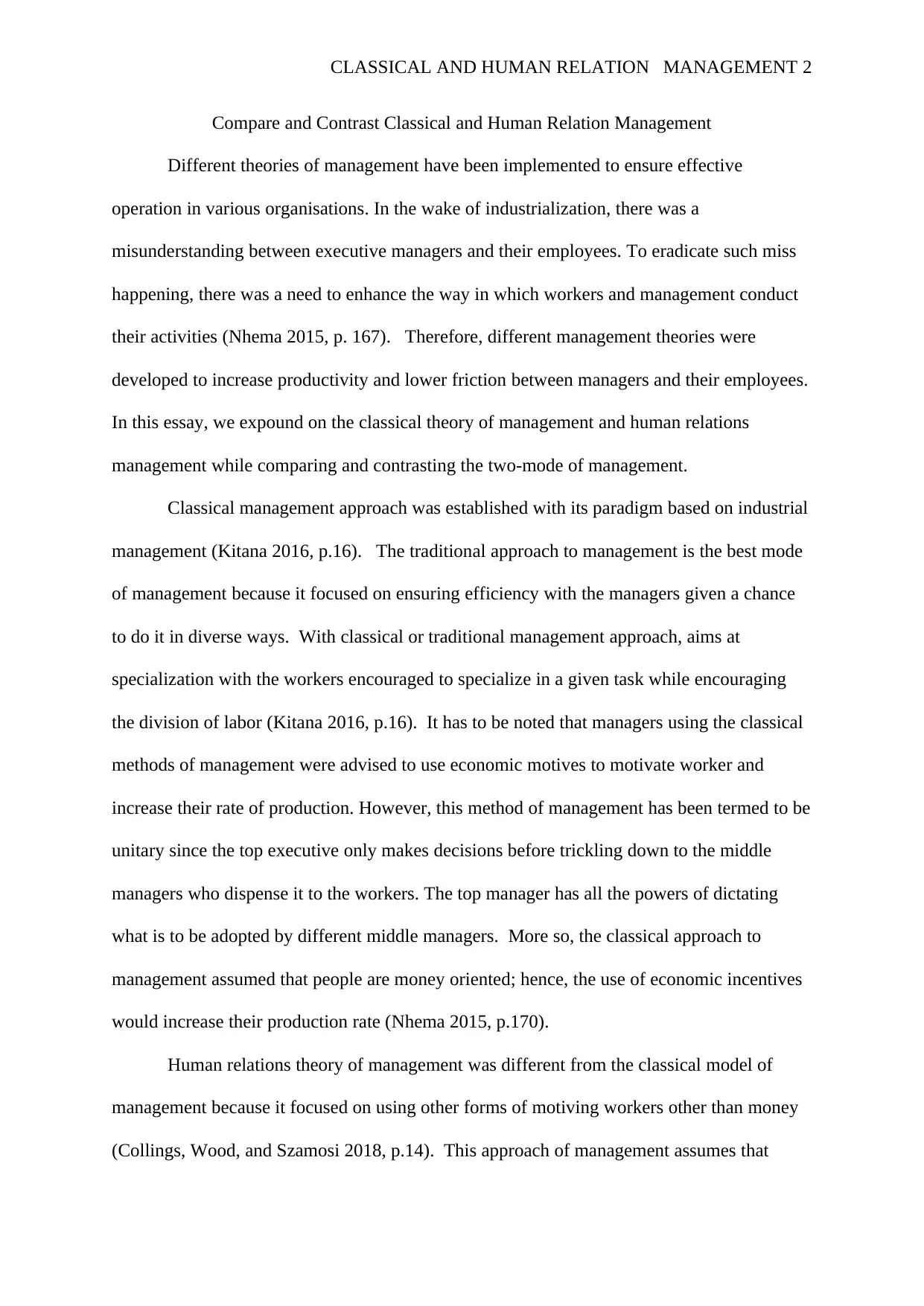
Different theories of management have been implemented to ensure effective
operation in various organisations. In the wake of industrialization, there was a
misunderstanding between executive managers and their employees. To eradicate such miss
happening, there was a need to enhance the way in which workers and management conduct
their activities (Nhema 2015, p. 167). Therefore, different management theories were
developed to increase productivity and lower friction between managers and their employees.
In this essay, we expound on the classical theory of management and human relations
management while comparing and contrasting the two-mode of management.
Classical management approach was established with its paradigm based on industrial
management (Kitana 2016, p.16). The traditional approach to management is the best mode
of management because it focused on ensuring efficiency with the managers given a chance
to do it in diverse ways. With classical or traditional management approach, aims at
specialization with the workers encouraged to specialize in a given task while encouraging
the division of labor (Kitana 2016, p.16). It has to be noted that managers using the classical
methods of management were advised to use economic motives to motivate worker and
increase their rate of production. However, this method of management has been termed to be
unitary since the top executive only makes decisions before trickling down to the middle
managers who dispense it to the workers. The top manager has all the powers of dictating
what is to be adopted by different middle managers. More so, the classical approach to
management assumed that people are money oriented; hence, the use of economic incentives
would increase their production rate (Nhema 2015, p.170).
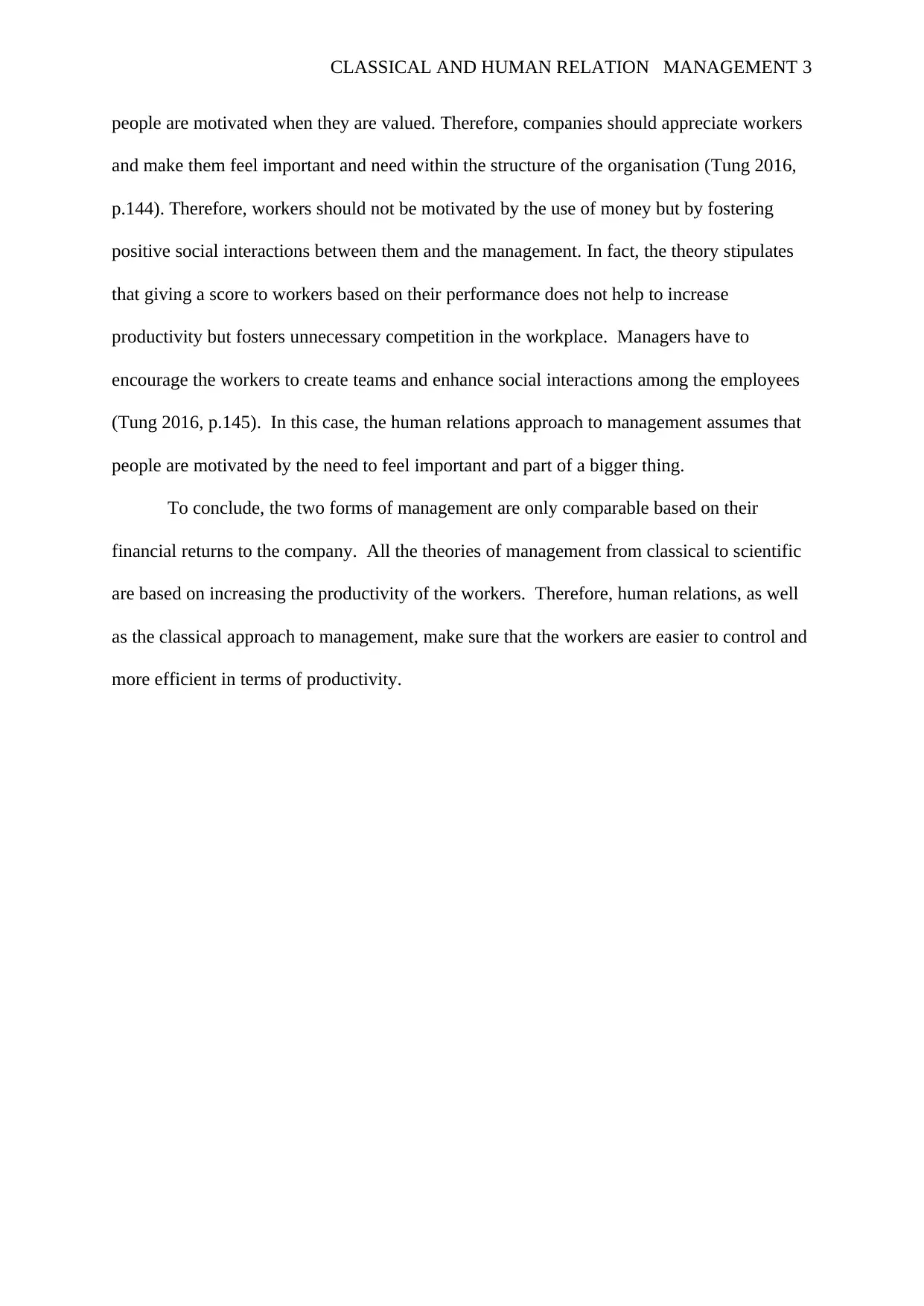
Human relations theory of management was different from the classical model of
management because it focused on using other forms of motiving workers other than money
(Collings, Wood, and Szamosi 2018, p.14). This approach of management assumes that
Document Page
CLASSICAL AND HUMAN RELATION MANAGEMENT 3
people are motivated when they are valued. Therefore, companies should appreciate workers
and make them feel important and need within the structure of the organisation (Tung 2016,
p.144). Therefore, workers should not be motivated by the use of money but by fostering
positive social interactions between them and the management. In fact, the theory stipulates
that giving a score to workers based on their performance does not help to increase
productivity but fosters unnecessary competition in the workplace. Managers have to
encourage the workers to create teams and enhance social interactions among the employees
(Tung 2016, p.145). In this case, the human relations approach to management assumes that
people are motivated by the need to feel important and part of a bigger thing.
To conclude, the two forms of management are only comparable based on their
financial returns to the company. All the theories of management from classical to scientific
are based on increasing the productivity of the workers. Therefore, human relations, as well
as the classical approach to management, make sure that the workers are easier to control and
more efficient in terms of productivity.
Document Page
CLASSICAL AND HUMAN RELATION MANAGEMENT 4
References
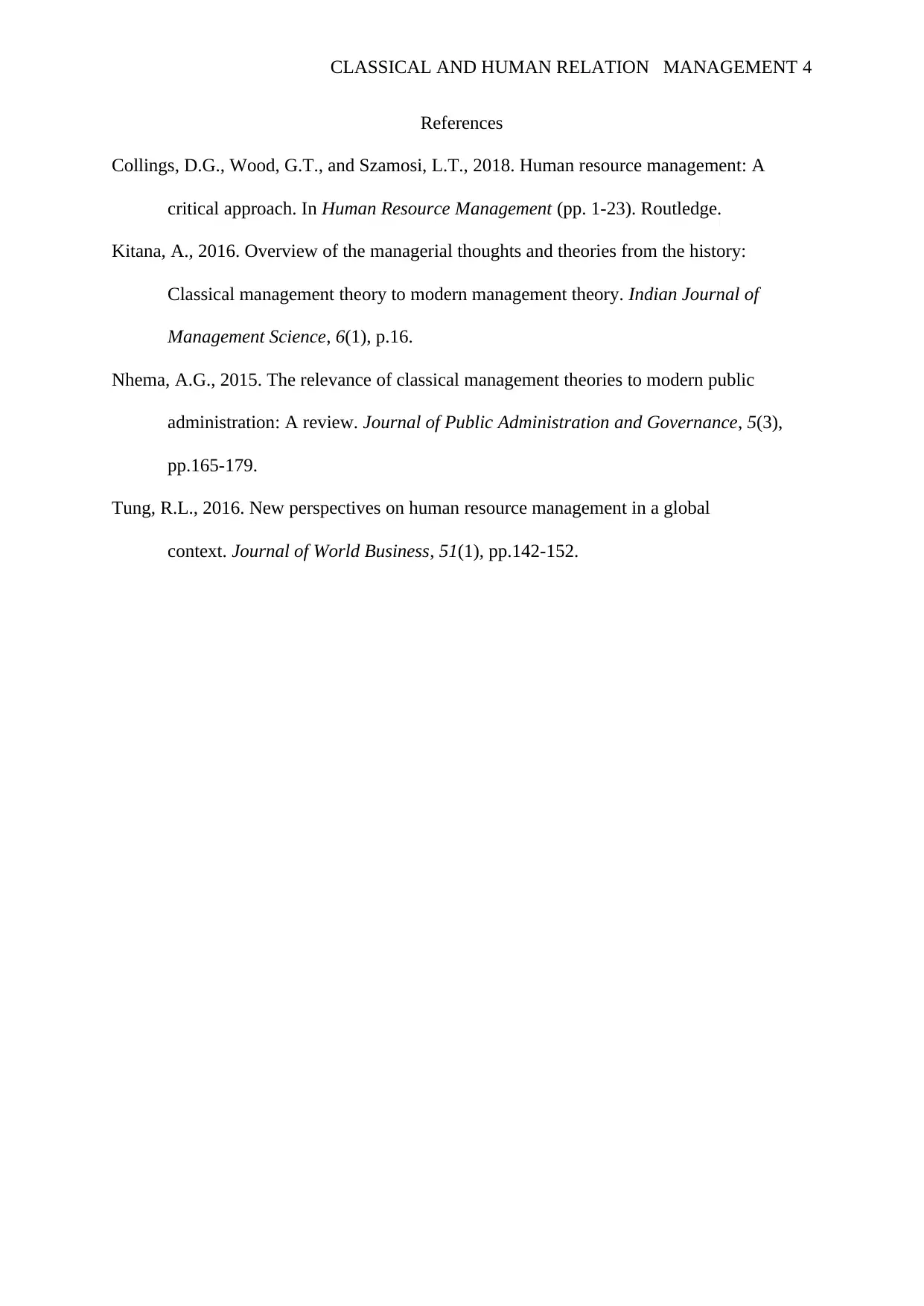
Collings, D.G., Wood, G.T., and Szamosi, L.T., 2018. Human resource management: A
critical approach. In Human Resource Management (pp. 1-23). Routledge.
Kitana, A., 2016. Overview of the managerial thoughts and theories from the history:
Classical management theory to modern management theory. Indian Journal of
Management Science, 6(1), p.16.
Nhema, A.G., 2015. The relevance of classical management theories to modern public
administration: A review. Journal of Public Administration and Governance, 5(3),
pp.165-179.
Tung, R.L., 2016. New perspectives on human resource management in a global
context. Journal of World Business, 51(1), pp.142-152.
chevron_up_icon
1 out of 4
circle_padding
hide_on_mobile
zoom_out_icon
[object Object]