Analysis of Class Dynamics for Effective Learning Environments
VerifiedAdded on 2023/06/10
|15
|5403
|79
Report
AI Summary
This report delves into the intricacies of class dynamics, examining the characteristics of group environments that facilitate learning and development, and evaluating strategies for effective group management. It explores ways to involve learners in managing their own learning, addressing barriers to individual learning, and analyzing the impact of classroom dynamics on learning outcomes. The report further explains methods to facilitate collaboration, motivational approaches, and behavior management solutions. It also covers the support of learner rights, risk minimization, confidentiality management, and record-keeping, along with tools for assessing classroom dynamics and utilizing peer observation for feedback. The report offers a comprehensive overview of how to create and maintain a positive and effective learning environment.
Management of Class
Dynamics
Dynamics

Paraphrase This Document
Need a fresh take? Get an instant paraphrase of this document with our AI Paraphraser
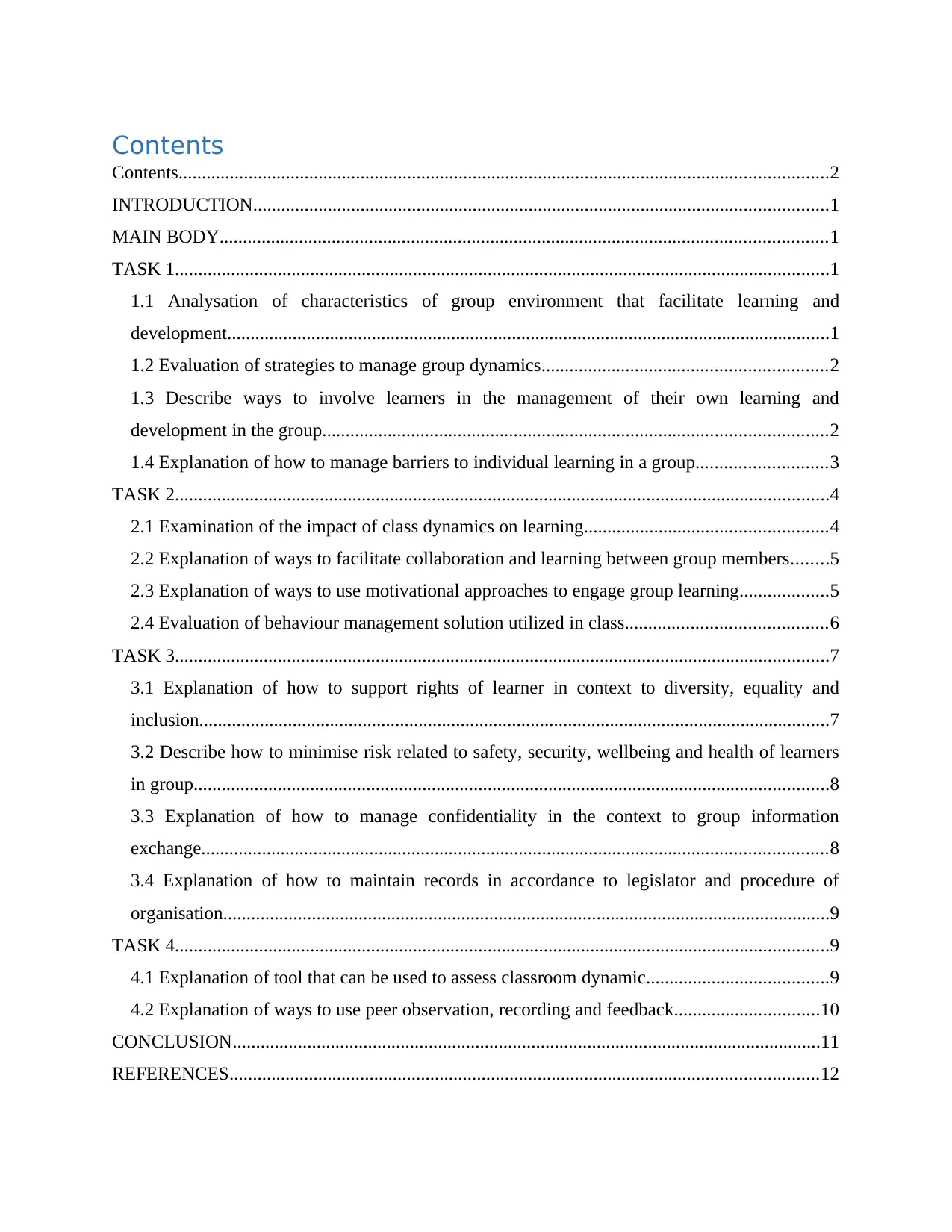
Contents
Contents...........................................................................................................................................2
INTRODUCTION...........................................................................................................................1
MAIN BODY..................................................................................................................................1
TASK 1............................................................................................................................................1
1.1 Analysation of characteristics of group environment that facilitate learning and
development.................................................................................................................................1
1.2 Evaluation of strategies to manage group dynamics.............................................................2
1.3 Describe ways to involve learners in the management of their own learning and
development in the group............................................................................................................2
1.4 Explanation of how to manage barriers to individual learning in a group............................3
TASK 2............................................................................................................................................4
2.1 Examination of the impact of class dynamics on learning....................................................4
2.2 Explanation of ways to facilitate collaboration and learning between group members........5
2.3 Explanation of ways to use motivational approaches to engage group learning...................5
2.4 Evaluation of behaviour management solution utilized in class...........................................6
TASK 3............................................................................................................................................7
3.1 Explanation of how to support rights of learner in context to diversity, equality and
inclusion.......................................................................................................................................7
3.2 Describe how to minimise risk related to safety, security, wellbeing and health of learners
in group........................................................................................................................................8
3.3 Explanation of how to manage confidentiality in the context to group information
exchange......................................................................................................................................8
3.4 Explanation of how to maintain records in accordance to legislator and procedure of
organisation..................................................................................................................................9
TASK 4............................................................................................................................................9
4.1 Explanation of tool that can be used to assess classroom dynamic.......................................9
4.2 Explanation of ways to use peer observation, recording and feedback...............................10
CONCLUSION..............................................................................................................................11
REFERENCES..............................................................................................................................12
Contents...........................................................................................................................................2
INTRODUCTION...........................................................................................................................1
MAIN BODY..................................................................................................................................1
TASK 1............................................................................................................................................1
1.1 Analysation of characteristics of group environment that facilitate learning and
development.................................................................................................................................1
1.2 Evaluation of strategies to manage group dynamics.............................................................2
1.3 Describe ways to involve learners in the management of their own learning and
development in the group............................................................................................................2
1.4 Explanation of how to manage barriers to individual learning in a group............................3
TASK 2............................................................................................................................................4
2.1 Examination of the impact of class dynamics on learning....................................................4
2.2 Explanation of ways to facilitate collaboration and learning between group members........5
2.3 Explanation of ways to use motivational approaches to engage group learning...................5
2.4 Evaluation of behaviour management solution utilized in class...........................................6
TASK 3............................................................................................................................................7
3.1 Explanation of how to support rights of learner in context to diversity, equality and
inclusion.......................................................................................................................................7
3.2 Describe how to minimise risk related to safety, security, wellbeing and health of learners
in group........................................................................................................................................8
3.3 Explanation of how to manage confidentiality in the context to group information
exchange......................................................................................................................................8
3.4 Explanation of how to maintain records in accordance to legislator and procedure of
organisation..................................................................................................................................9
TASK 4............................................................................................................................................9
4.1 Explanation of tool that can be used to assess classroom dynamic.......................................9
4.2 Explanation of ways to use peer observation, recording and feedback...............................10
CONCLUSION..............................................................................................................................11
REFERENCES..............................................................................................................................12
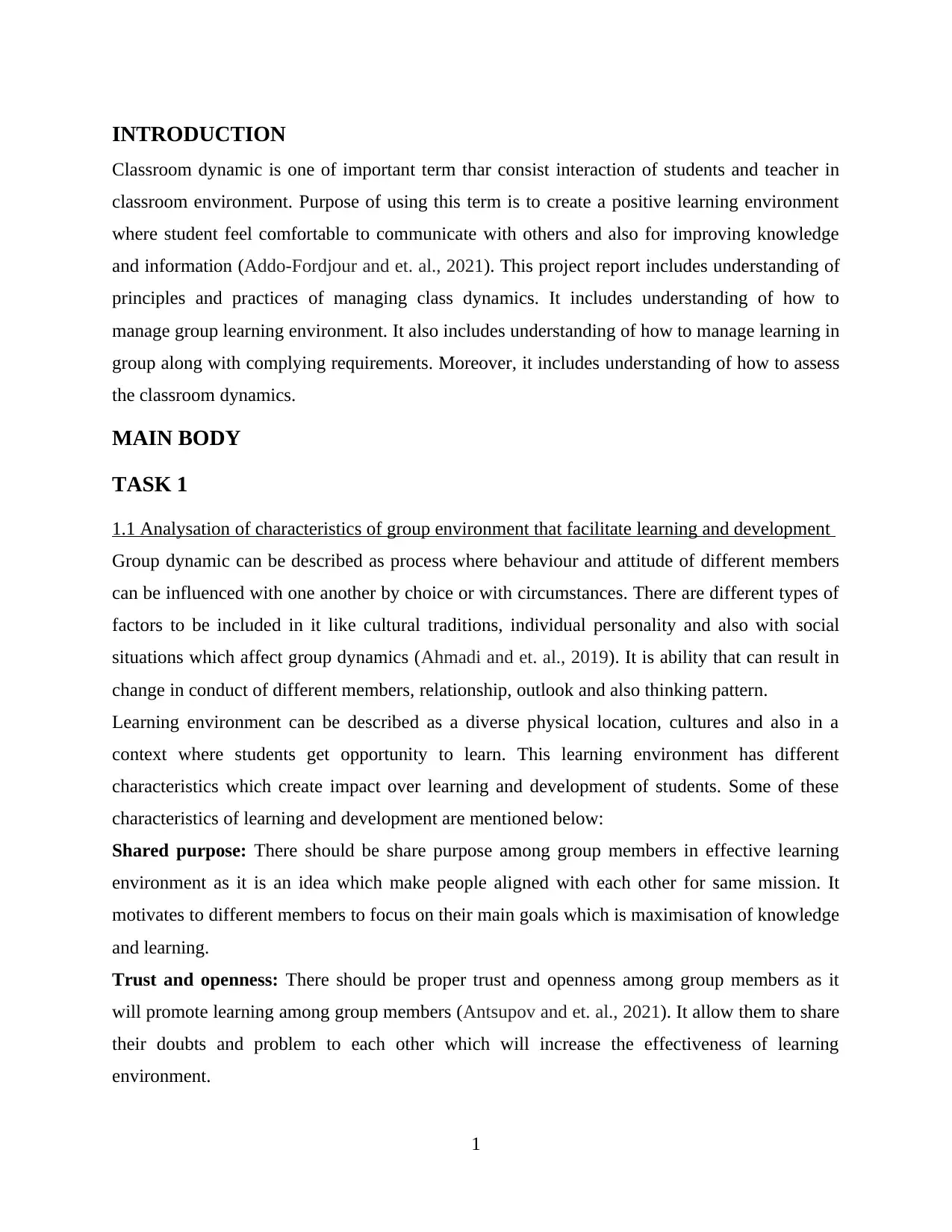
INTRODUCTION
Classroom dynamic is one of important term thar consist interaction of students and teacher in
classroom environment. Purpose of using this term is to create a positive learning environment
where student feel comfortable to communicate with others and also for improving knowledge
and information (Addo-Fordjour and et. al., 2021). This project report includes understanding of
principles and practices of managing class dynamics. It includes understanding of how to
manage group learning environment. It also includes understanding of how to manage learning in
group along with complying requirements. Moreover, it includes understanding of how to assess
the classroom dynamics.
MAIN BODY
TASK 1
1.1 Analysation of characteristics of group environment that facilitate learning and development
Group dynamic can be described as process where behaviour and attitude of different members
can be influenced with one another by choice or with circumstances. There are different types of
factors to be included in it like cultural traditions, individual personality and also with social
situations which affect group dynamics (Ahmadi and et. al., 2019). It is ability that can result in
change in conduct of different members, relationship, outlook and also thinking pattern.
Learning environment can be described as a diverse physical location, cultures and also in a
context where students get opportunity to learn. This learning environment has different
characteristics which create impact over learning and development of students. Some of these
characteristics of learning and development are mentioned below:
Shared purpose: There should be share purpose among group members in effective learning
environment as it is an idea which make people aligned with each other for same mission. It
motivates to different members to focus on their main goals which is maximisation of knowledge
and learning.
Trust and openness: There should be proper trust and openness among group members as it
will promote learning among group members (Antsupov and et. al., 2021). It allow them to share
their doubts and problem to each other which will increase the effectiveness of learning
environment.
1
Classroom dynamic is one of important term thar consist interaction of students and teacher in
classroom environment. Purpose of using this term is to create a positive learning environment
where student feel comfortable to communicate with others and also for improving knowledge
and information (Addo-Fordjour and et. al., 2021). This project report includes understanding of
principles and practices of managing class dynamics. It includes understanding of how to
manage group learning environment. It also includes understanding of how to manage learning in
group along with complying requirements. Moreover, it includes understanding of how to assess
the classroom dynamics.
MAIN BODY
TASK 1
1.1 Analysation of characteristics of group environment that facilitate learning and development
Group dynamic can be described as process where behaviour and attitude of different members
can be influenced with one another by choice or with circumstances. There are different types of
factors to be included in it like cultural traditions, individual personality and also with social
situations which affect group dynamics (Ahmadi and et. al., 2019). It is ability that can result in
change in conduct of different members, relationship, outlook and also thinking pattern.
Learning environment can be described as a diverse physical location, cultures and also in a
context where students get opportunity to learn. This learning environment has different
characteristics which create impact over learning and development of students. Some of these
characteristics of learning and development are mentioned below:
Shared purpose: There should be share purpose among group members in effective learning
environment as it is an idea which make people aligned with each other for same mission. It
motivates to different members to focus on their main goals which is maximisation of knowledge
and learning.
Trust and openness: There should be proper trust and openness among group members as it
will promote learning among group members (Antsupov and et. al., 2021). It allow them to share
their doubts and problem to each other which will increase the effectiveness of learning
environment.
1
⊘ This is a preview!⊘
Do you want full access?
Subscribe today to unlock all pages.

Trusted by 1+ million students worldwide
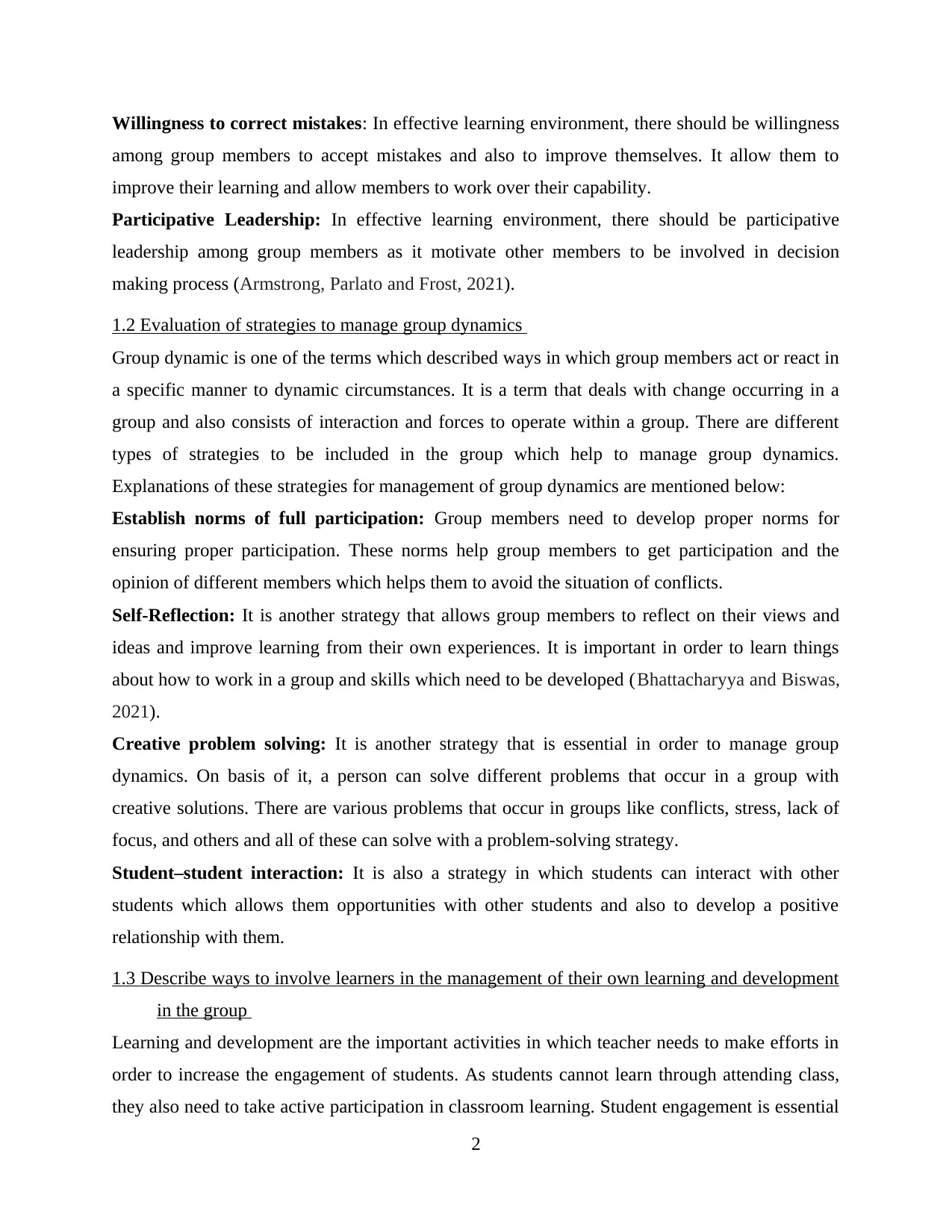
Willingness to correct mistakes: In effective learning environment, there should be willingness
among group members to accept mistakes and also to improve themselves. It allow them to
improve their learning and allow members to work over their capability.
Participative Leadership: In effective learning environment, there should be participative
leadership among group members as it motivate other members to be involved in decision
making process (Armstrong, Parlato and Frost, 2021).
1.2 Evaluation of strategies to manage group dynamics
Group dynamic is one of the terms which described ways in which group members act or react in
a specific manner to dynamic circumstances. It is a term that deals with change occurring in a
group and also consists of interaction and forces to operate within a group. There are different
types of strategies to be included in the group which help to manage group dynamics.
Explanations of these strategies for management of group dynamics are mentioned below:
Establish norms of full participation: Group members need to develop proper norms for
ensuring proper participation. These norms help group members to get participation and the
opinion of different members which helps them to avoid the situation of conflicts.
Self-Reflection: It is another strategy that allows group members to reflect on their views and
ideas and improve learning from their own experiences. It is important in order to learn things
about how to work in a group and skills which need to be developed (Bhattacharyya and Biswas,
2021).
Creative problem solving: It is another strategy that is essential in order to manage group
dynamics. On basis of it, a person can solve different problems that occur in a group with
creative solutions. There are various problems that occur in groups like conflicts, stress, lack of
focus, and others and all of these can solve with a problem-solving strategy.
Student–student interaction: It is also a strategy in which students can interact with other
students which allows them opportunities with other students and also to develop a positive
relationship with them.
1.3 Describe ways to involve learners in the management of their own learning and development
in the group
Learning and development are the important activities in which teacher needs to make efforts in
order to increase the engagement of students. As students cannot learn through attending class,
they also need to take active participation in classroom learning. Student engagement is essential
2
among group members to accept mistakes and also to improve themselves. It allow them to
improve their learning and allow members to work over their capability.
Participative Leadership: In effective learning environment, there should be participative
leadership among group members as it motivate other members to be involved in decision
making process (Armstrong, Parlato and Frost, 2021).
1.2 Evaluation of strategies to manage group dynamics
Group dynamic is one of the terms which described ways in which group members act or react in
a specific manner to dynamic circumstances. It is a term that deals with change occurring in a
group and also consists of interaction and forces to operate within a group. There are different
types of strategies to be included in the group which help to manage group dynamics.
Explanations of these strategies for management of group dynamics are mentioned below:
Establish norms of full participation: Group members need to develop proper norms for
ensuring proper participation. These norms help group members to get participation and the
opinion of different members which helps them to avoid the situation of conflicts.
Self-Reflection: It is another strategy that allows group members to reflect on their views and
ideas and improve learning from their own experiences. It is important in order to learn things
about how to work in a group and skills which need to be developed (Bhattacharyya and Biswas,
2021).
Creative problem solving: It is another strategy that is essential in order to manage group
dynamics. On basis of it, a person can solve different problems that occur in a group with
creative solutions. There are various problems that occur in groups like conflicts, stress, lack of
focus, and others and all of these can solve with a problem-solving strategy.
Student–student interaction: It is also a strategy in which students can interact with other
students which allows them opportunities with other students and also to develop a positive
relationship with them.
1.3 Describe ways to involve learners in the management of their own learning and development
in the group
Learning and development are the important activities in which teacher needs to make efforts in
order to increase the engagement of students. As students cannot learn through attending class,
they also need to take active participation in classroom learning. Student engagement is essential
2
Paraphrase This Document
Need a fresh take? Get an instant paraphrase of this document with our AI Paraphraser
in order to increase the effectiveness of learning. Engagement is essential for learning and active
student needs to focus on increasing knowledge and also need to prepare themselves for
developing better life. There are different ways in which a student can increase engagement of
students which are mentioned below:
Tap into students’ prior knowledge: In order to increase the engagement of students, it is
important for the teacher to tap into the existing knowledge of students which helps them to
increase their interest as they get the opportunity to share their prior knowledge with others. It
will also boost the confidence of students and motivate them to focus on their learning.
Learn students’ interests: For purpose of increasing the engagement of students, the teacher
also needs to learn about the interests of students as a person more likely to participate in things
that are of their interest (Ejegu and Yegizaw, 2020). For purpose of increasing the participation
of students, teachers can link learning with their field of interest.
Organize classroom discussions: It is also important for teachers to organize learning
discussions conducted in the classroom in an effective format that allows students to learn things
quickly and take more interest in classroom activities.
Design highly relevant learning activities: Teachers should only include important and
relevant activities in the classroom which will improve the learning of students.
Integrate Modern Technology: Technology is one of the important tools which helps teachers
to increase the interest of students as these teachers can use videos and pictures with help of
technology for gaining the attention of students.
1.4 Explanation of how to manage barriers to individual learning in a group
Barriers to learning can be described as a problem as well as a situation that helps to prevent the
learner from a different program and make the process of learning difficult in class and does not
allow learners to concentrate and learn (Gamboa and et. al., 2020). There are different strategies
to be adopted by a person in order to overcome barriers to learning. Some of these strategies to
overcome barriers to learning are mentioned below:
Environment: An environment that is full of noise does not allow a person to focus on learning.
In a noisy environment learning process become more difficult for learner. So, it is important for
teachers to ensure that environment of the classroom is without noise.
Instruction: It is another way to overcome learning as it is important for a person to ensure that
learning should be precise and short and only one instruction can be given at one time.
3
student needs to focus on increasing knowledge and also need to prepare themselves for
developing better life. There are different ways in which a student can increase engagement of
students which are mentioned below:
Tap into students’ prior knowledge: In order to increase the engagement of students, it is
important for the teacher to tap into the existing knowledge of students which helps them to
increase their interest as they get the opportunity to share their prior knowledge with others. It
will also boost the confidence of students and motivate them to focus on their learning.
Learn students’ interests: For purpose of increasing the engagement of students, the teacher
also needs to learn about the interests of students as a person more likely to participate in things
that are of their interest (Ejegu and Yegizaw, 2020). For purpose of increasing the participation
of students, teachers can link learning with their field of interest.
Organize classroom discussions: It is also important for teachers to organize learning
discussions conducted in the classroom in an effective format that allows students to learn things
quickly and take more interest in classroom activities.
Design highly relevant learning activities: Teachers should only include important and
relevant activities in the classroom which will improve the learning of students.
Integrate Modern Technology: Technology is one of the important tools which helps teachers
to increase the interest of students as these teachers can use videos and pictures with help of
technology for gaining the attention of students.
1.4 Explanation of how to manage barriers to individual learning in a group
Barriers to learning can be described as a problem as well as a situation that helps to prevent the
learner from a different program and make the process of learning difficult in class and does not
allow learners to concentrate and learn (Gamboa and et. al., 2020). There are different strategies
to be adopted by a person in order to overcome barriers to learning. Some of these strategies to
overcome barriers to learning are mentioned below:
Environment: An environment that is full of noise does not allow a person to focus on learning.
In a noisy environment learning process become more difficult for learner. So, it is important for
teachers to ensure that environment of the classroom is without noise.
Instruction: It is another way to overcome learning as it is important for a person to ensure that
learning should be precise and short and only one instruction can be given at one time.
3
Respect: It is also important for the teacher to not force people to work in a group in which they
are uncomfortable to work. It is essential for teachers to respect the differences and also make
students aware of different social networks during learning sessions.
Noncurricular activities: In order to overcome learning barriers, there will be a problem-
solving session in order to overcome doubts. There should be noncurricular activities that also
help to find out the new situation to develop skills.
Improve communication skills: communication skills allow teachers to share their knowledge
in clear words with students and also help students to share their problems with teachers in a
clear manner (Gao and Zhao, 2020).
Timely feedback: It is another situation that will help to improve the learning process in which,
it is essential for teachers to be aware of learning progress and also take timely feedback from
them.
TASK 2
2.1 Examination of the impact of class dynamics on learning
Classroom dynamics can be considered an important term that consists involvement of
interaction of both teacher and students. The purpose of this, is to learn ways to develop a
positive atmosphere in the classroom where learners feel comfortable for communicate and learn
with other students and teachers. Positive classroom dynamics is one of the situations that
involve the engagement of a different person in a classroom. It is not a natural situation and also
needs to be set according to a specific plan (Hill and Wang, 2018). Classroom dynamic is
creating impact over learning in a different manner as it helps to provide support to learning and
also build confidence among learners. Some of these impacts of class dynamics are mentioned
below:
Supporting learning: Class dynamic is one of the terms which assists to create a situation where
students can be involved in learning. On basis of it, students can get comfortable in the learning
environment and can focus in class.
Building confidence: On basis of it, students can interact with teachers and other students which
helps them to overcome their hesitation and also to boost their confidence. It allows them to
speak without any fear and also to raise questions in class.
4
are uncomfortable to work. It is essential for teachers to respect the differences and also make
students aware of different social networks during learning sessions.
Noncurricular activities: In order to overcome learning barriers, there will be a problem-
solving session in order to overcome doubts. There should be noncurricular activities that also
help to find out the new situation to develop skills.
Improve communication skills: communication skills allow teachers to share their knowledge
in clear words with students and also help students to share their problems with teachers in a
clear manner (Gao and Zhao, 2020).
Timely feedback: It is another situation that will help to improve the learning process in which,
it is essential for teachers to be aware of learning progress and also take timely feedback from
them.
TASK 2
2.1 Examination of the impact of class dynamics on learning
Classroom dynamics can be considered an important term that consists involvement of
interaction of both teacher and students. The purpose of this, is to learn ways to develop a
positive atmosphere in the classroom where learners feel comfortable for communicate and learn
with other students and teachers. Positive classroom dynamics is one of the situations that
involve the engagement of a different person in a classroom. It is not a natural situation and also
needs to be set according to a specific plan (Hill and Wang, 2018). Classroom dynamic is
creating impact over learning in a different manner as it helps to provide support to learning and
also build confidence among learners. Some of these impacts of class dynamics are mentioned
below:
Supporting learning: Class dynamic is one of the terms which assists to create a situation where
students can be involved in learning. On basis of it, students can get comfortable in the learning
environment and can focus in class.
Building confidence: On basis of it, students can interact with teachers and other students which
helps them to overcome their hesitation and also to boost their confidence. It allows them to
speak without any fear and also to raise questions in class.
4
⊘ This is a preview!⊘
Do you want full access?
Subscribe today to unlock all pages.
Trusted by 1+ million students worldwide
Source of guidance: It is one of the sources for guiding the actions of students on different
things. It helps teachers to provide the right guidance to students and also to help them for the
purpose of moving on the right path.
Facilitating skill and knowledge development: Class dynamics improve the engagement of
students with learning which helps students to focus on their learning capabilities (Lemmer and
et. al., 2021). It allows them to develop new skills and knowledge in the classroom that is
essential to being an effective student.
2.2 Explanation of ways to facilitate collaboration and learning between group members
Collaborative learning can be defined as an educational approach that consists of the use of
groups for purpose of enhancing learning with work together. Two or more learners form groups
in order to solve problems, learn new concepts and also for completing a task. It is an approach
that consists of learners working together in different learning tasks and activities in the group to
ensure the participation of different participants. Different learners can contribute for purpose of
attaining different outcomes (Li, 2020). There are different types of collaborative learning
approaches used by a person in order to improve learning. Explanations of some of these
approaches are mentioned below:
Use of listening skills: Listening skills are essential for purpose of ensuring collaborative
learning as they allow people to listen to others. It is important for purpose of understanding
other views as knowledge of a person is limited and they can also learn new things by listening
to others.
Observation: It is another thing which is important for collaborative learning as a person can
also learn things by observing others. It allows them to learn new ways of doing things.
Models of communication: In order to ensure collaborative learning, it is essential for learners
to use different models of communication. Ensuring the free flow of communication is one of
important tasks as it allows the learner to communicate with each other and also to share
information (Magalhães and et. al., 2018). It also allows them to communicate with teachers and
other people to understand complex things.
2.3 Explanation of ways to use motivational approaches to engage group learning
It is essential for teachers to use the motivational approach in order to increase engagement in
group learning. There are different steps to be included in this in order to motivate candidates.
Some of these approaches used by a person are mentioned below:
5
things. It helps teachers to provide the right guidance to students and also to help them for the
purpose of moving on the right path.
Facilitating skill and knowledge development: Class dynamics improve the engagement of
students with learning which helps students to focus on their learning capabilities (Lemmer and
et. al., 2021). It allows them to develop new skills and knowledge in the classroom that is
essential to being an effective student.
2.2 Explanation of ways to facilitate collaboration and learning between group members
Collaborative learning can be defined as an educational approach that consists of the use of
groups for purpose of enhancing learning with work together. Two or more learners form groups
in order to solve problems, learn new concepts and also for completing a task. It is an approach
that consists of learners working together in different learning tasks and activities in the group to
ensure the participation of different participants. Different learners can contribute for purpose of
attaining different outcomes (Li, 2020). There are different types of collaborative learning
approaches used by a person in order to improve learning. Explanations of some of these
approaches are mentioned below:
Use of listening skills: Listening skills are essential for purpose of ensuring collaborative
learning as they allow people to listen to others. It is important for purpose of understanding
other views as knowledge of a person is limited and they can also learn new things by listening
to others.
Observation: It is another thing which is important for collaborative learning as a person can
also learn things by observing others. It allows them to learn new ways of doing things.
Models of communication: In order to ensure collaborative learning, it is essential for learners
to use different models of communication. Ensuring the free flow of communication is one of
important tasks as it allows the learner to communicate with each other and also to share
information (Magalhães and et. al., 2018). It also allows them to communicate with teachers and
other people to understand complex things.
2.3 Explanation of ways to use motivational approaches to engage group learning
It is essential for teachers to use the motivational approach in order to increase engagement in
group learning. There are different steps to be included in this in order to motivate candidates.
Some of these approaches used by a person are mentioned below:
5
Paraphrase This Document
Need a fresh take? Get an instant paraphrase of this document with our AI Paraphraser
Setting clear goals is important for learners as it helps them to understand what is
expected to them in the context of learning.
In order to motivate, it is also important for the teachers to make the learning process
more convenient for students. It can be done by providing them notes which are easily
understood by them and also in easy to understand language.
Using creative content is also important in order to make learning more interesting and
also to engage students. Boredom does not allow individuals to engage in course content.
Teachers should also provide a reward to different learners in order to increase their
engagement with classroom activities (Ni, Dai and Liu, 2022).
Creating an open communication channel is also an important activity in the learning
process. As it allows teachers to share information and knowledge with their students in
clear words.
There are also different types of motivational approaches in order to increase engagement in
group learning. It is an approach which includes relevance, confidence, attention and satisfaction.
All these are important for learners in order to improve their engagement and learning.
2.4 Evaluation of behaviour management solution utilized in class
Behaviour management is important in classroom in order to ensure effective learning. It is one
of important approach which can be used in class with application of different model and
theories in behaviour management and learning. All these solutions helps to manage behaviour
of learning in class. Explanations of these solutions are mentioned below:
Application of theories and model: There are different types of theories and models that can be
used by teachers in order to ensure effective learning. These theories include classical
conditioning, observational learning and operant conditioning (Nwozor and Olanrewaju, 2022).
All of these helps teachers in order to understand the behaviour of students and allow them to
adopt learning style according to that.
Giving feedback to learner: Feedback is one of important thing which is essential for purpose
of improving learning. Teachers need to give proper feedback to the learner which helps them for
purpose of improving the process of learning.
Application of theoretical concept into teaching practice: It is another important component
that is essential in order to improve the learning process. It allows teachers to imply different
theoretical concepts into practice and improve their teaching practice.
6
expected to them in the context of learning.
In order to motivate, it is also important for the teachers to make the learning process
more convenient for students. It can be done by providing them notes which are easily
understood by them and also in easy to understand language.
Using creative content is also important in order to make learning more interesting and
also to engage students. Boredom does not allow individuals to engage in course content.
Teachers should also provide a reward to different learners in order to increase their
engagement with classroom activities (Ni, Dai and Liu, 2022).
Creating an open communication channel is also an important activity in the learning
process. As it allows teachers to share information and knowledge with their students in
clear words.
There are also different types of motivational approaches in order to increase engagement in
group learning. It is an approach which includes relevance, confidence, attention and satisfaction.
All these are important for learners in order to improve their engagement and learning.
2.4 Evaluation of behaviour management solution utilized in class
Behaviour management is important in classroom in order to ensure effective learning. It is one
of important approach which can be used in class with application of different model and
theories in behaviour management and learning. All these solutions helps to manage behaviour
of learning in class. Explanations of these solutions are mentioned below:
Application of theories and model: There are different types of theories and models that can be
used by teachers in order to ensure effective learning. These theories include classical
conditioning, observational learning and operant conditioning (Nwozor and Olanrewaju, 2022).
All of these helps teachers in order to understand the behaviour of students and allow them to
adopt learning style according to that.
Giving feedback to learner: Feedback is one of important thing which is essential for purpose
of improving learning. Teachers need to give proper feedback to the learner which helps them for
purpose of improving the process of learning.
Application of theoretical concept into teaching practice: It is another important component
that is essential in order to improve the learning process. It allows teachers to imply different
theoretical concepts into practice and improve their teaching practice.
6
In order to provide an effective behavioural management solution, the teacher needs to identify
the root cause that creates a positive impact on behavioural strategy. There are five models which
helps to understand behaviour of a child. Explanations of these models are mentioned below:
Biological: Children interact in an environment where different factors create influence over
them. On basis of research, it has been identified that twins separated at time of birth or during
early infancy (Samanta and Jana, 2022). It reflect both nurture and nature in development which
helps them to deal with behaviour attention and also helps them to create a positive environment
and experience in order to promote good behaviour.
Behavioural: It is a model that can be modified with conditioning and can be attained by
following different actions. There are basically two types of conditioning including classical
conditioning and operant conditioning.
Cognitive: It is an approach that allows to judge a child and also provide the reason for
developing perception about different surrounding. It also provides ways that create influence
with thinking.
Systematic: It is an approach that targets individual behaviour present in a system. It consists
family, friends, classmates, community, school clubs and other things. Quality of system in this
create influence over behaviour of a child (Simoy, Simoy and Canziani, 2021).
Psychodynamic: It is an approach which can be used in a clinical setting and also focuses on
understanding and intervening from past conscious and also over unconscious experiences to
allow them to deal with child.
TASK 3
3.1 Explanation of how to support rights of learner in context to diversity, equality and inclusion
There are different types of rights for learner which helps them to improve their learning without
any problems. These rights of a person includes feeling safe, get support from teachers, study
and learn, get respect, right to speak, get right treatment, feedback, access to get right
information and other things (Sokolov and et. al., 2019). In order to reduce chances of
discrimination, a person needs to adopt new ways which helps them to promote inclusion,
equality and diversity. For this, different strategies to be adopted by teachers which are
mentioned below:
7
the root cause that creates a positive impact on behavioural strategy. There are five models which
helps to understand behaviour of a child. Explanations of these models are mentioned below:
Biological: Children interact in an environment where different factors create influence over
them. On basis of research, it has been identified that twins separated at time of birth or during
early infancy (Samanta and Jana, 2022). It reflect both nurture and nature in development which
helps them to deal with behaviour attention and also helps them to create a positive environment
and experience in order to promote good behaviour.
Behavioural: It is a model that can be modified with conditioning and can be attained by
following different actions. There are basically two types of conditioning including classical
conditioning and operant conditioning.
Cognitive: It is an approach that allows to judge a child and also provide the reason for
developing perception about different surrounding. It also provides ways that create influence
with thinking.
Systematic: It is an approach that targets individual behaviour present in a system. It consists
family, friends, classmates, community, school clubs and other things. Quality of system in this
create influence over behaviour of a child (Simoy, Simoy and Canziani, 2021).
Psychodynamic: It is an approach which can be used in a clinical setting and also focuses on
understanding and intervening from past conscious and also over unconscious experiences to
allow them to deal with child.
TASK 3
3.1 Explanation of how to support rights of learner in context to diversity, equality and inclusion
There are different types of rights for learner which helps them to improve their learning without
any problems. These rights of a person includes feeling safe, get support from teachers, study
and learn, get respect, right to speak, get right treatment, feedback, access to get right
information and other things (Sokolov and et. al., 2019). In order to reduce chances of
discrimination, a person needs to adopt new ways which helps them to promote inclusion,
equality and diversity. For this, different strategies to be adopted by teachers which are
mentioned below:
7
⊘ This is a preview!⊘
Do you want full access?
Subscribe today to unlock all pages.
Trusted by 1+ million students worldwide
Respect diversity in classroom among learner and also provide them centred care which
allow them to improve their knowledge and focus on themselves.
Treat different types of individual in unique manner in compare to threat them in same
manner as all learners are unique in their own ways.
It is also important for teachers to work in a non judgemental manner as it make learner
afraid to ask questions to teachers.
Teachers also needs to develop an environment which is free from discrimination. It
sometimes create negative feelings among learner and does not allow them to focus on
learning capabilities (Vyas and et. al., 2022).
Teachers also needs to be confident enough to be overcome of challenges and also to
avoid discriminator practices in organisation.
3.2 Describe how to minimise risk related to safety, security, wellbeing and health of learners in
group
There are different types of laws and legislation in UK which are providing support to inclusive
education along with ensuring well being and safety. THERE are different types of legislation in
UK which helps to prohibit discrimination and also provide support to education. UK is
following international human rights laws for purpose of inclusive education to different children
living in their country. Some of these laws includes Equality act 2010, Health and safety act
1974, general data protection regulation 2018, welfare policy and also risk assessment policy,
children and social work act 2017 and the children act 2004.
All these act provide guidance to a person to focus and allow them to focuses on legal
requirement by making it clear about what organisation, individual as well as other agencies
needs to do keep their children safe (Watters and et. al., 2021). It is also important as it emphasis
on safeguarding things by putting different children at centre system and providing them right to
education.
3.3 Explanation of how to manage confidentiality in the context to group information exchange
Confidential information can be described as information that cannot be accessed by the general
public. It is one of policy that is made in order to control the disclosure of information. It is
important for making some information confidential at the time of working in a group. In order
to maintain confidentiality of information, a person needs to take various steps which are
mentioned below:
8
allow them to improve their knowledge and focus on themselves.
Treat different types of individual in unique manner in compare to threat them in same
manner as all learners are unique in their own ways.
It is also important for teachers to work in a non judgemental manner as it make learner
afraid to ask questions to teachers.
Teachers also needs to develop an environment which is free from discrimination. It
sometimes create negative feelings among learner and does not allow them to focus on
learning capabilities (Vyas and et. al., 2022).
Teachers also needs to be confident enough to be overcome of challenges and also to
avoid discriminator practices in organisation.
3.2 Describe how to minimise risk related to safety, security, wellbeing and health of learners in
group
There are different types of laws and legislation in UK which are providing support to inclusive
education along with ensuring well being and safety. THERE are different types of legislation in
UK which helps to prohibit discrimination and also provide support to education. UK is
following international human rights laws for purpose of inclusive education to different children
living in their country. Some of these laws includes Equality act 2010, Health and safety act
1974, general data protection regulation 2018, welfare policy and also risk assessment policy,
children and social work act 2017 and the children act 2004.
All these act provide guidance to a person to focus and allow them to focuses on legal
requirement by making it clear about what organisation, individual as well as other agencies
needs to do keep their children safe (Watters and et. al., 2021). It is also important as it emphasis
on safeguarding things by putting different children at centre system and providing them right to
education.
3.3 Explanation of how to manage confidentiality in the context to group information exchange
Confidential information can be described as information that cannot be accessed by the general
public. It is one of policy that is made in order to control the disclosure of information. It is
important for making some information confidential at the time of working in a group. In order
to maintain confidentiality of information, a person needs to take various steps which are
mentioned below:
8
Paraphrase This Document
Need a fresh take? Get an instant paraphrase of this document with our AI Paraphraser
Safe storage of reports and records: It is important to ensure safe storage of reports and
records in order to protect it from others. It is important in order to safeguard identify of
learners from others.
used only for specified purpose: Confidential information of learners can be used for only
specified purpose and cannot be shared to others. These information cannot used by
teachers for other purpose.
Kept for an identified amount of time: It is also important for teachers to kept these
information of learner for specific period of time and should not be kept it for long term.
3.4 Explanation of how to maintain records in accordance to legislator and procedure of
organisation
In order to maintain and retain records according to legislation and procedure, different steps to
be followed. These steps to be taken in the context of learning process are mentioned below:
Set up records retention schedule: It is important for a person to setting up of records and
also retaining it for specific period of time.
Policy and procedure: there is specific policy and procedure to maintain records of
information of different learners (Xu, L., and et. al.,2018).
Accessibility, Indexing, and Storage: In this stage, a person needs to save information
which can be easily accessible by them and also can be retained by them.
Compliance Auditing: In order to maintain compliance with records and information, this
information can be checked and modified on a timely basis.
Disposal of Obsolete Records: It is the last stage in which obsolete information can be
dispose of by the organisation.
TASK 4
4.1 Explanation of tool that can be used to assess classroom dynamic
There are different types of tools to be used in order to assess classroom dynamics and allow
teacher to increase engagement of students. Some of these tool used by teachers are mentioned
below:
Identification of learning needs: In this, teachers needs to identify different types of learning
needs of a person. It is important for teachers in order in order to prepare learning plan according
to requirement of learners.
9
records in order to protect it from others. It is important in order to safeguard identify of
learners from others.
used only for specified purpose: Confidential information of learners can be used for only
specified purpose and cannot be shared to others. These information cannot used by
teachers for other purpose.
Kept for an identified amount of time: It is also important for teachers to kept these
information of learner for specific period of time and should not be kept it for long term.
3.4 Explanation of how to maintain records in accordance to legislator and procedure of
organisation
In order to maintain and retain records according to legislation and procedure, different steps to
be followed. These steps to be taken in the context of learning process are mentioned below:
Set up records retention schedule: It is important for a person to setting up of records and
also retaining it for specific period of time.
Policy and procedure: there is specific policy and procedure to maintain records of
information of different learners (Xu, L., and et. al.,2018).
Accessibility, Indexing, and Storage: In this stage, a person needs to save information
which can be easily accessible by them and also can be retained by them.
Compliance Auditing: In order to maintain compliance with records and information, this
information can be checked and modified on a timely basis.
Disposal of Obsolete Records: It is the last stage in which obsolete information can be
dispose of by the organisation.
TASK 4
4.1 Explanation of tool that can be used to assess classroom dynamic
There are different types of tools to be used in order to assess classroom dynamics and allow
teacher to increase engagement of students. Some of these tool used by teachers are mentioned
below:
Identification of learning needs: In this, teachers needs to identify different types of learning
needs of a person. It is important for teachers in order in order to prepare learning plan according
to requirement of learners.
9
Plan and design learning: In this step, teachers needs to develop different types of learning
objectives and also needs to identify needs of learners. In this, different types of strategies also
develop by teacher to ensure effective learning.
Deliver learning: In this stage, learning is to be provided to learner for purpose of improving
their knowledge and also for develop new skills.
Diverse learning resources: There are different types of learning resources which can be used
by a person. These learning resources can include picture, audio, video and others. It is important
for teachers to diverse learning process in effective manner for purpose of ensuring effective
learning.
Evaluate learning outcomes: In this stage, teachers needs to analyse learning outcomes in order
to ensure further process. It can be done through analysation of the contribution of students,
learning environment, quality of content delivery and other things.
4.2 Explanation of ways to use peer observation, recording and feedback
Peer observation in process of education is important as in this a teacher can observe another
teacher for purpose of classroom practice. A peer is one who provides support to their colleague
in order to improve their teaching practices. These colleagues can be in different departments or
recently join teaching. In order to use peer observation, recoding and students feedback, different
steps can be taken by a person which are mentioned below:
Use of learning need analysis: In order to use peer observation, teacher first needs to analyse
learning needs. It helps them to understand area in which improvement in required.
Training needs analysis: it is another stage in which needs of training needs to be analysed which
helps teacher to understand whether they require proper training or not.
Questionnaire: questionnaire is one of method which consist numbers of question and other
person needs to answer to that. These questionnaires can be fulfilled by students which help
teachers to understand in which area they needs to improve their learning.
Feedback: Students feedback is also essential as it helps the teacher to get a review of students
regarding to teaching process and allow them to make improvement.
Monitoring: It is a stage in which students need to monitor ways of teaching others. It is also
important for them in order to learn new ways of teaching and also to make improvements in
their process.
10
objectives and also needs to identify needs of learners. In this, different types of strategies also
develop by teacher to ensure effective learning.
Deliver learning: In this stage, learning is to be provided to learner for purpose of improving
their knowledge and also for develop new skills.
Diverse learning resources: There are different types of learning resources which can be used
by a person. These learning resources can include picture, audio, video and others. It is important
for teachers to diverse learning process in effective manner for purpose of ensuring effective
learning.
Evaluate learning outcomes: In this stage, teachers needs to analyse learning outcomes in order
to ensure further process. It can be done through analysation of the contribution of students,
learning environment, quality of content delivery and other things.
4.2 Explanation of ways to use peer observation, recording and feedback
Peer observation in process of education is important as in this a teacher can observe another
teacher for purpose of classroom practice. A peer is one who provides support to their colleague
in order to improve their teaching practices. These colleagues can be in different departments or
recently join teaching. In order to use peer observation, recoding and students feedback, different
steps can be taken by a person which are mentioned below:
Use of learning need analysis: In order to use peer observation, teacher first needs to analyse
learning needs. It helps them to understand area in which improvement in required.
Training needs analysis: it is another stage in which needs of training needs to be analysed which
helps teacher to understand whether they require proper training or not.
Questionnaire: questionnaire is one of method which consist numbers of question and other
person needs to answer to that. These questionnaires can be fulfilled by students which help
teachers to understand in which area they needs to improve their learning.
Feedback: Students feedback is also essential as it helps the teacher to get a review of students
regarding to teaching process and allow them to make improvement.
Monitoring: It is a stage in which students need to monitor ways of teaching others. It is also
important for them in order to learn new ways of teaching and also to make improvements in
their process.
10
⊘ This is a preview!⊘
Do you want full access?
Subscribe today to unlock all pages.
Trusted by 1+ million students worldwide

1 out of 15


Related Documents

Your All-in-One AI-Powered Toolkit for Academic Success.
+13062052269
info@desklib.com
Available 24*7 on WhatsApp / Email
![[object Object]](/_next/static/media/star-bottom.7253800d.svg)
Unlock your academic potential
Copyright © 2020–2026 A2Z Services. All Rights Reserved. Developed and managed by ZUCOL.