Essay: Clausewitz's 'On War' and Military Strategic Insights

Verified

Added on  2023/06/05

|4
|815
|480
Essay
AI Summary
This essay provides an analysis of Carl von Clausewitz's military treatise, 'On War'. It delves into Clausewitz's perspectives on the nature of war, emphasizing that it is not an art but a form of business driven by human interests. The essay examines Clausewitz's insights derived from the Napoleonic Wars, particularly focusing on his ideas regarding battle strategies. It highlights the importance of identifying decisive factors, distinguishing between strategy and tactics, and the effectiveness of simple, well-executed strategies. Furthermore, it stresses the need for strategic flexibility, adaptation to the enemy's actions, and maintaining morale. The essay concludes by emphasizing the central role of a well-organized strategy in achieving victory in battle.
Document Page
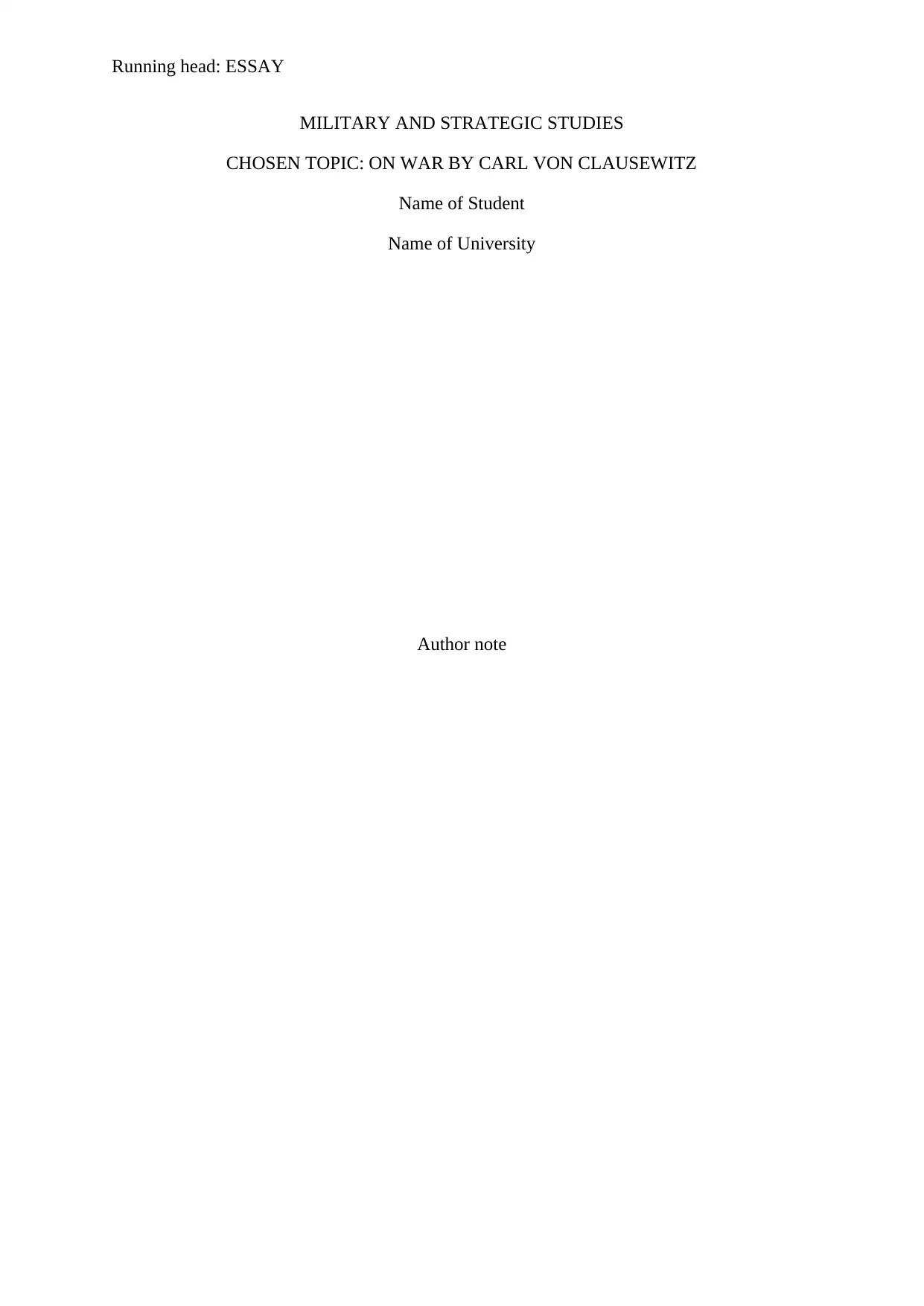
Running head: ESSAY
MILITARY AND STRATEGIC STUDIES
CHOSEN TOPIC: ON WAR BY CARL VON CLAUSEWITZ
Name of Student
Name of University
Author note
tabler-icon-diamond-filled.svg

Paraphrase This Document

Need a fresh take? Get an instant paraphrase of this document with our AI Paraphraser
Document Page
1ESSAY
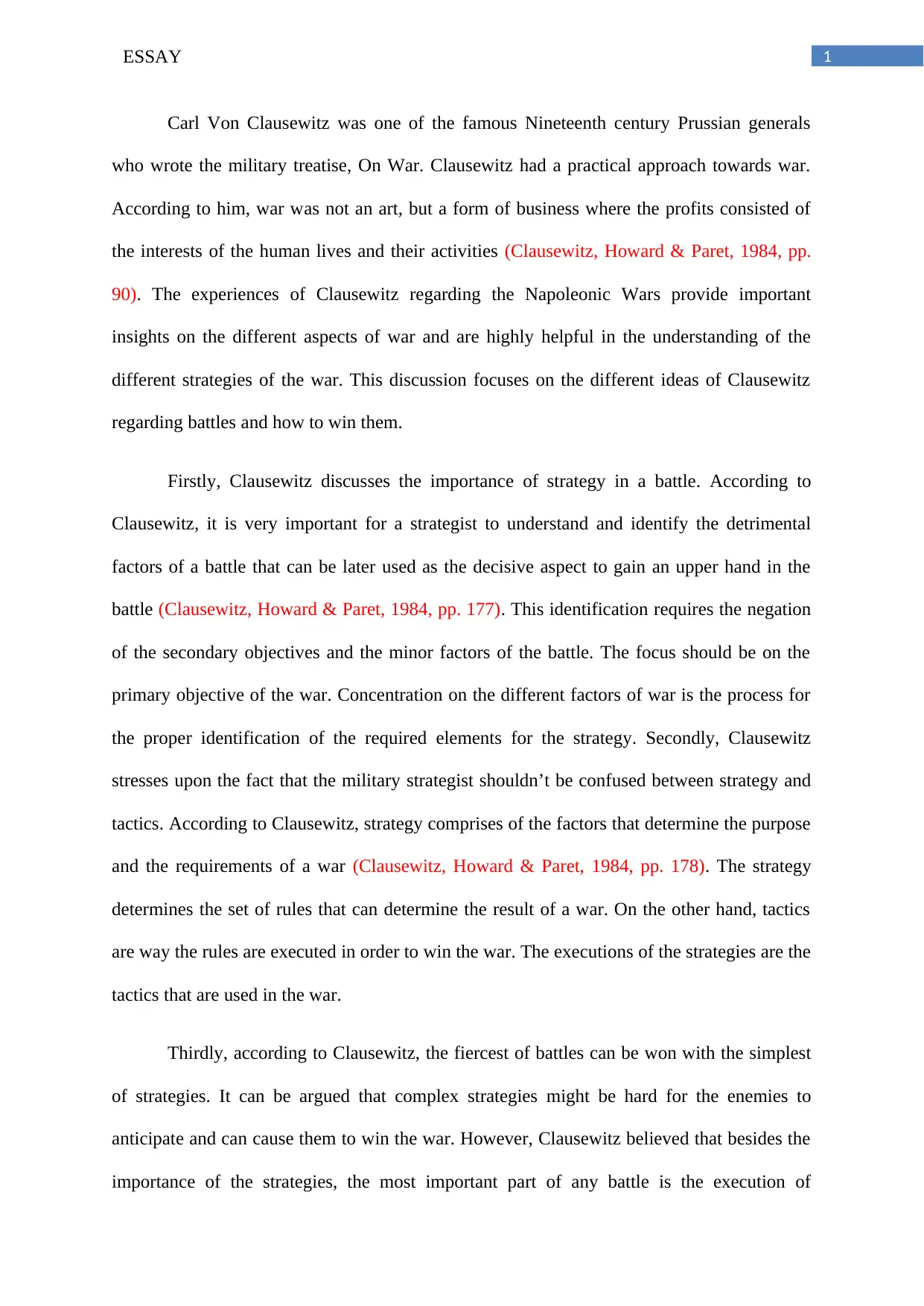
Carl Von Clausewitz was one of the famous Nineteenth century Prussian generals
who wrote the military treatise, On War. Clausewitz had a practical approach towards war.
According to him, war was not an art, but a form of business where the profits consisted of
the interests of the human lives and their activities (Clausewitz, Howard & Paret, 1984, pp.
90). The experiences of Clausewitz regarding the Napoleonic Wars provide important
insights on the different aspects of war and are highly helpful in the understanding of the
different strategies of the war. This discussion focuses on the different ideas of Clausewitz
regarding battles and how to win them.
Firstly, Clausewitz discusses the importance of strategy in a battle. According to
Clausewitz, it is very important for a strategist to understand and identify the detrimental
factors of a battle that can be later used as the decisive aspect to gain an upper hand in the
battle (Clausewitz, Howard & Paret, 1984, pp. 177). This identification requires the negation
of the secondary objectives and the minor factors of the battle. The focus should be on the
primary objective of the war. Concentration on the different factors of war is the process for
the proper identification of the required elements for the strategy. Secondly, Clausewitz
stresses upon the fact that the military strategist shouldn’t be confused between strategy and
tactics. According to Clausewitz, strategy comprises of the factors that determine the purpose
and the requirements of a war (Clausewitz, Howard & Paret, 1984, pp. 178). The strategy
determines the set of rules that can determine the result of a war. On the other hand, tactics
are way the rules are executed in order to win the war. The executions of the strategies are the
tactics that are used in the war.
Thirdly, according to Clausewitz, the fiercest of battles can be won with the simplest
of strategies. It can be argued that complex strategies might be hard for the enemies to
anticipate and can cause them to win the war. However, Clausewitz believed that besides the
importance of the strategies, the most important part of any battle is the execution of
Document Page
2ESSAY
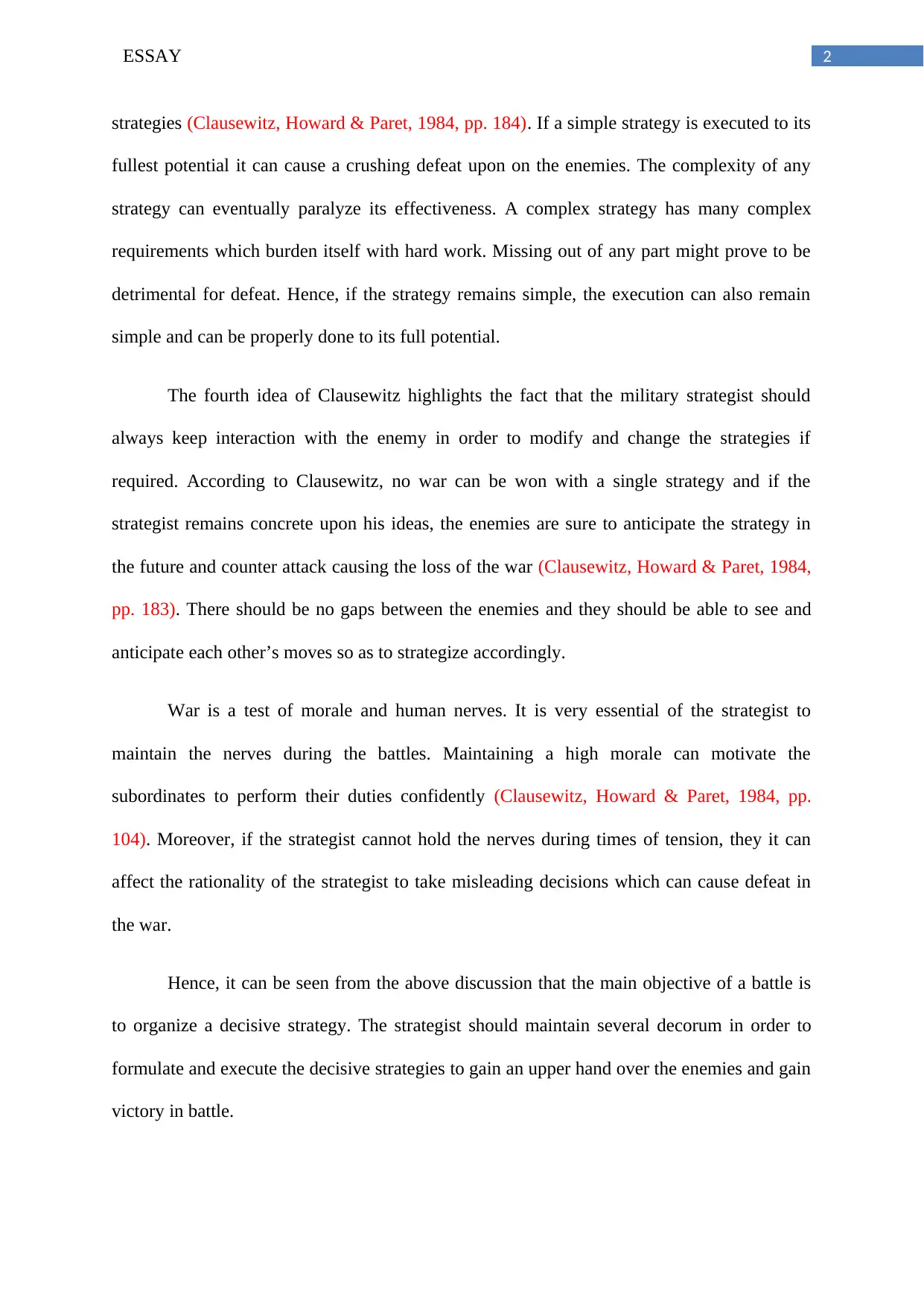
strategies (Clausewitz, Howard & Paret, 1984, pp. 184). If a simple strategy is executed to its
fullest potential it can cause a crushing defeat upon on the enemies. The complexity of any
strategy can eventually paralyze its effectiveness. A complex strategy has many complex
requirements which burden itself with hard work. Missing out of any part might prove to be
detrimental for defeat. Hence, if the strategy remains simple, the execution can also remain
simple and can be properly done to its full potential.
The fourth idea of Clausewitz highlights the fact that the military strategist should
always keep interaction with the enemy in order to modify and change the strategies if
required. According to Clausewitz, no war can be won with a single strategy and if the
strategist remains concrete upon his ideas, the enemies are sure to anticipate the strategy in
the future and counter attack causing the loss of the war (Clausewitz, Howard & Paret, 1984,
pp. 183). There should be no gaps between the enemies and they should be able to see and
anticipate each other’s moves so as to strategize accordingly.
War is a test of morale and human nerves. It is very essential of the strategist to
maintain the nerves during the battles. Maintaining a high morale can motivate the
subordinates to perform their duties confidently (Clausewitz, Howard & Paret, 1984, pp.
104). Moreover, if the strategist cannot hold the nerves during times of tension, they it can
affect the rationality of the strategist to take misleading decisions which can cause defeat in
the war.
Hence, it can be seen from the above discussion that the main objective of a battle is
to organize a decisive strategy. The strategist should maintain several decorum in order to
formulate and execute the decisive strategies to gain an upper hand over the enemies and gain
victory in battle.
Document Page
3ESSAY
Reference:
Clausewitz, C., Howard, M., & Paret, P. (1984). On War. Princetton University.
chevron_up_icon
1 out of 4
circle_padding
hide_on_mobile
zoom_out_icon
[object Object]