Clayton Copula Solution: Statistical Analysis and Likelihood

Verified

Added on  2023/01/18

|5
|933
|72
Homework Assignment
AI Summary
This document offers a comprehensive solution to a Clayton Copula assignment, addressing two key questions. The first question involves deriving the density function of the Clayton Copula, presenting detailed steps and calculations. It starts with the copula function and proceeds to calculate the first and second derivatives with respect to u and v. The solution then proceeds to derive the likelihood function, providing the product of the copula density functions and the log-likelihood function. The second question focuses on determining the left tail dependence coefficient, using the copula function to calculate the limit as u approaches 0. The solution provides the formula and the step-by-step calculation to arrive at the final answer for the tail dependence coefficient. References to relevant academic papers are included to support the analysis.
Document Page
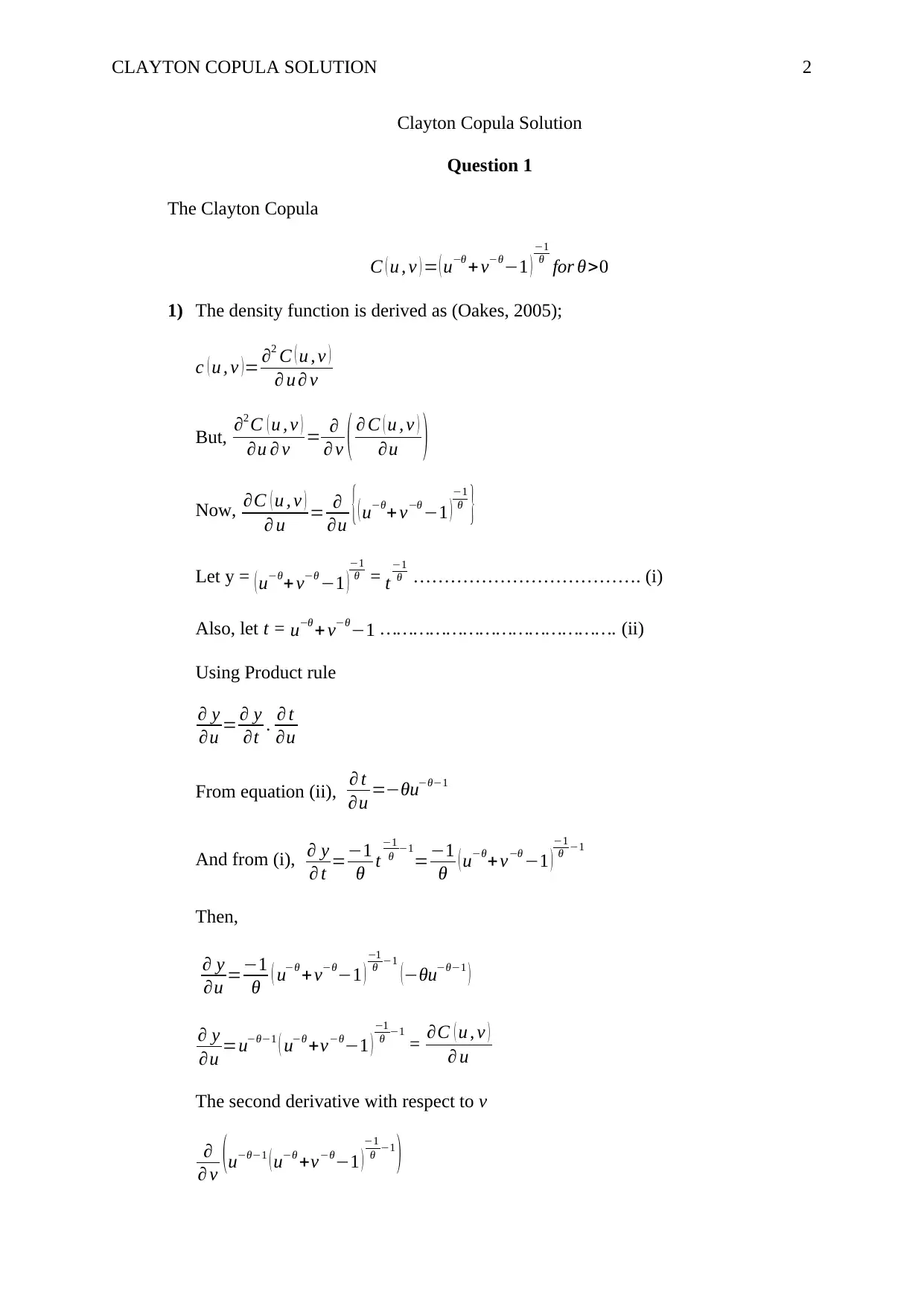
Running head: CLAYTON COPULA SOLUTION 1
Clayton Copula Solution
Name
Institution
tabler-icon-diamond-filled.svg

Paraphrase This Document

Need a fresh take? Get an instant paraphrase of this document with our AI Paraphraser
Document Page
CLAYTON COPULA SOLUTION 2
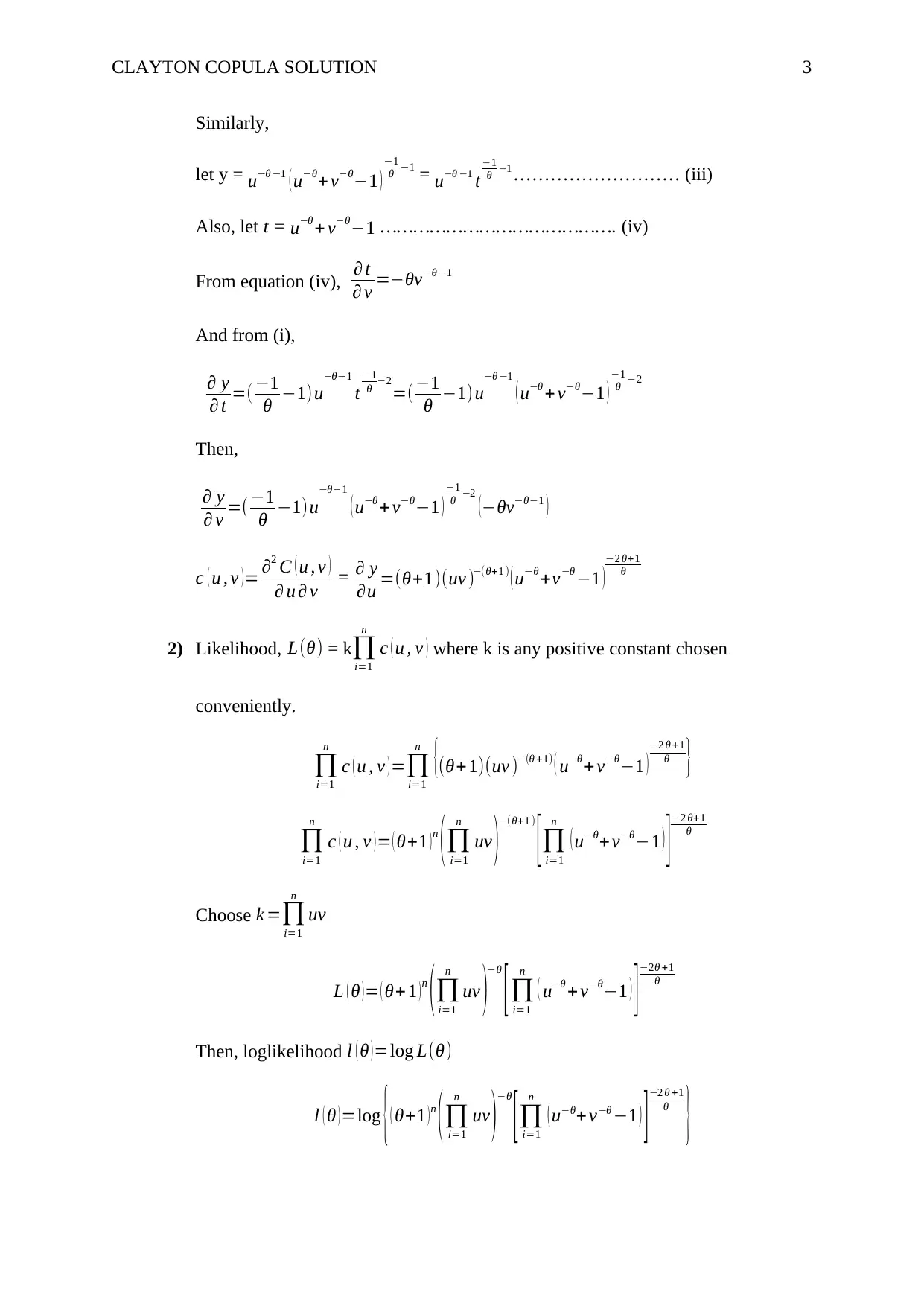
Clayton Copula Solution
Question 1
The Clayton Copula
C ( u , v ) = ( uθ + vθ1 )
1
θ for θ>0
1) The density function is derived as (Oakes, 2005);
c ( u , v ) = 2 C ( u , v )
u v
But, 2 C ( u , v )
u v =
v ( C ( u , v )
u )
Now, C ( u , v )
u =
u {( uθ+ vθ 1 )
1
θ }
Let y = ( uθ+vθ 1 )
1
θ = t
1
θ ………………………………. (i)
Also, let t = uθ + vθ1 ……………………………………. (ii)
Using Product rule
y
u = y
t . t
u
From equation (ii), t
u =θuθ1
And from (i), y
t =1
θ t
1
θ 1
=1
θ ( uθ+vθ 1 )
1
θ 1
Then,
y
u =1
θ ( uθ + vθ1 )
1
θ 1
(θuθ1 )
y
u =uθ1 ( uθ +vθ1 )
1
θ 1
= C ( u , v )
u
The second derivative with respect to v

v (uθ1 ( uθ +vθ1 )
1
θ 1
)
Document Page
CLAYTON COPULA SOLUTION 3
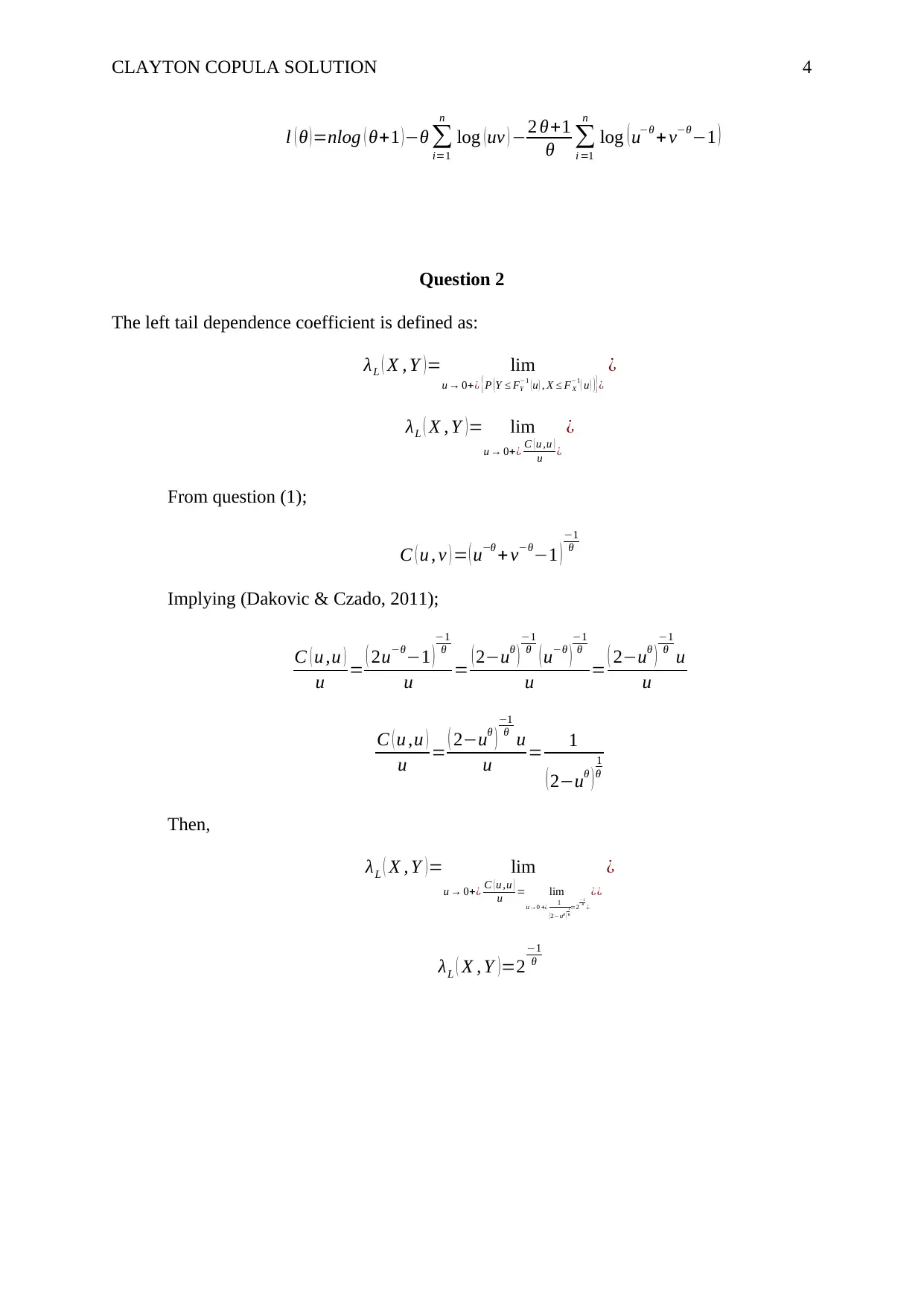
Similarly,
let y = uθ 1 ( uθ+ vθ1 )
1
θ 1 = uθ 1 t
1
θ 1……………………… (iii)
Also, let t = uθ + vθ1 ……………………………………. (iv)
From equation (iv), t
v =θvθ1
And from (i),
y
t =( 1
θ 1)u
θ1
t
1
θ 2
=( 1
θ 1)u
θ 1
( uθ + vθ1 )
1
θ 2
Then,
y
v =( 1
θ 1)u
θ1
( uθ + vθ1 )
1
θ 2
(θvθ1 )
c ( u , v ) = 2 C ( u , v )
u v = y
u =(θ+1)(uv )(θ+1 ) ( uθ +vθ 1 )
2 θ+1
θ
2) Likelihood, L(θ) = k
i=1
n
c ( u , v ) where k is any positive constant chosen
conveniently.

i=1
n
c ( u , v )=
i=1
n
{(θ+1)(uv )(θ +1) ( uθ +vθ1 )
2 θ +1
θ }

i=1
n
c ( u , v )= ( θ+1 )n
(
i=1
n
uv )(θ+1 )
[
i=1
n
( uθ+ vθ1 ) ]2 θ+1
θ
Choose k =
i=1
n
uv
L ( θ )= ( θ+ 1 )n
(
i=1
n
uv )θ
[
i=1
n
( uθ + vθ1 ) ]2θ +1
θ
Then, loglikelihood l ( θ ) =log L(θ)
l ( θ )=log {( θ+1 )n
(i=1
n
uv )θ
[i=1
n
( uθ+ vθ 1 ) ]2 θ +1
θ
}
Document Page
CLAYTON COPULA SOLUTION 4
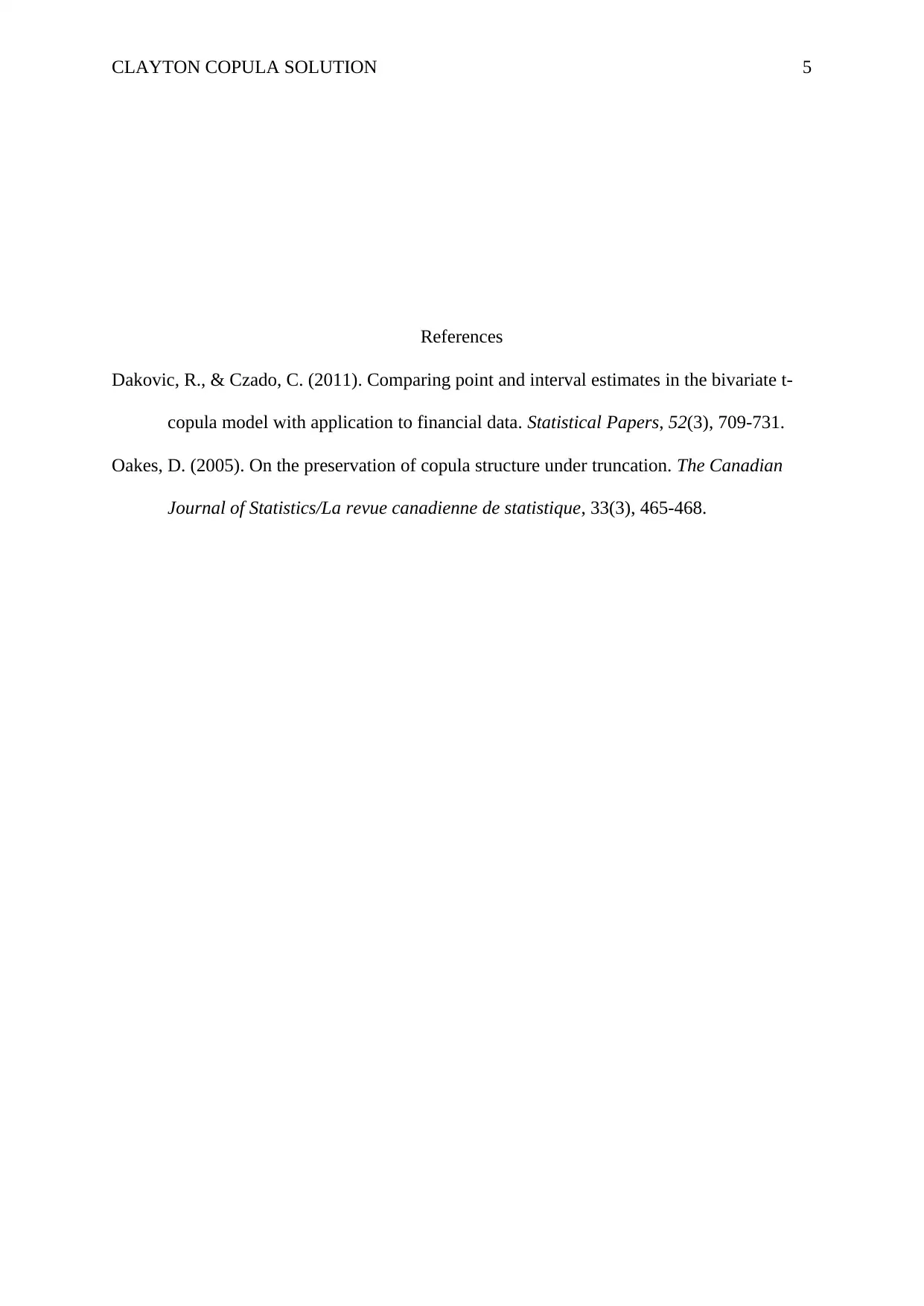
l ( θ )=nlog ( θ+1 )θ
i=1
n
log (uv ) 2 θ+1
θ
i =1
n
log ( uθ + vθ1 )
Question 2
The left tail dependence coefficient is defined as:
λL ( X , Y )= lim
u 0+¿ {P (Y FY
1 (u ) , X F X
1 ( u ) )}¿
¿
λL ( X , Y )= lim
u 0+¿ C (u ,u )
u ¿
¿
From question (1);
C ( u , v ) = ( uθ + vθ1 )
1
θ
Implying (Dakovic & Czado, 2011);
C ( u ,u )
u = ( 2uθ1 )
1
θ
u = ( 2uθ )
1
θ ( uθ )
1
θ
u = ( 2uθ )
1
θ u
u
C ( u ,u )
u = ( 2uθ )
1
θ u
u = 1
( 2uθ )
1
θ
Then,
λL ( X , Y )= lim
u 0+¿ C (u ,u )
u = lim
u0 +¿ 1
(2uθ )
1
θ
=2
1
θ ¿
¿¿
¿
λL ( X , Y )=2
1
θ
tabler-icon-diamond-filled.svg

Paraphrase This Document

Need a fresh take? Get an instant paraphrase of this document with our AI Paraphraser
Document Page
CLAYTON COPULA SOLUTION 5
References
Dakovic, R., & Czado, C. (2011). Comparing point and interval estimates in the bivariate t-
copula model with application to financial data. Statistical Papers, 52(3), 709-731.
Oakes, D. (2005). On the preservation of copula structure under truncation. The Canadian
Journal of Statistics/La revue canadienne de statistique, 33(3), 465-468.
chevron_up_icon
1 out of 5
circle_padding
hide_on_mobile
zoom_out_icon
[object Object]