Case Study: Clean Dish's New Dishwasher Models Production Analysis
VerifiedAdded on 2023/04/03
|12
|1869
|114
Case Study
AI Summary
This case study focuses on the Clean Dish Company, an Australian dishwasher manufacturer, and its introduction of new models to counter competitors. The study employs linear programming to optimize production decisions, considering resource constraints like containment units, insulation material, and labor hours. It defines decision variables, establishes an objective function to maximize profit, and sets constraints based on available resources. The analysis includes a sensitivity report and output tables that show the optimal production quantities for each model, resource utilization levels, and estimated profits. The results recommend producing 65 units of Ultra 1.0 and 35 units of Ultra 2.0, while also suggesting adjustments to resource allocation to account for production errors. In conclusion, linear programming provides optimal conditions for reduced risks and successful product launches.
CASE STUDY OF THE CLEAN DISH COMPANY’S NEW MODELS PRODUCTION
(BUSINESS ANALYTICS AND INTELLIGENCE)
(BUSINESS ANALYTICS AND INTELLIGENCE)

Paraphrase This Document
Need a fresh take? Get an instant paraphrase of this document with our AI Paraphraser
CASE STUDY OF THE CLEAN DISH COMPANY’S NEW MODELS PRODUCTION
Table of Contents
INTRODUCTION.......................................................................................................................................3
MODEL DESIGN.......................................................................................................................................5
FORMULATION OF LINEAR PROGRAMMING PROBLEM............................................................5
DECISION VARIABLES DEFINITION................................................................................................6
OBJECTIVE FUNCTION DEFINITION................................................................................................7
CONSTRAINS DEFINITION.................................................................................................................7
MODEL IMPLIMENTATION...................................................................................................................7
RESULTS................................................................................................................................................8
RECOMMENDATIONS AND CONCLUSIONS.......................................................................................9
REFERENCES..........................................................................................................................................10
APPENDIX: EXCEL OUTPUT................................................................................................................11
2
Table of Contents
INTRODUCTION.......................................................................................................................................3
MODEL DESIGN.......................................................................................................................................5
FORMULATION OF LINEAR PROGRAMMING PROBLEM............................................................5
DECISION VARIABLES DEFINITION................................................................................................6
OBJECTIVE FUNCTION DEFINITION................................................................................................7
CONSTRAINS DEFINITION.................................................................................................................7
MODEL IMPLIMENTATION...................................................................................................................7
RESULTS................................................................................................................................................8
RECOMMENDATIONS AND CONCLUSIONS.......................................................................................9
REFERENCES..........................................................................................................................................10
APPENDIX: EXCEL OUTPUT................................................................................................................11
2
CASE STUDY OF THE CLEAN DISH COMPANY’S NEW MODELS PRODUCTION
INTRODUCTION
Clean Dish is an Australian company with its headquarters in the city of Perth specializes
in the production of dish washers for distribution within Perth and across the country. The
company plans on introducing new models of dish washers with improved technology into the
market as a counter to competitors’ recent models. The release of the new models will help the
company keep up with other companies producing dish washers in Australia, in terms of
technology, competition and market share.
Companies are constantly under pressure of releasing new models. This pressure comes
from either the consumers or the competitors, or both. For industries such as the smartphone
industry, pressure primarily comes from the consumers who expect new phone models after
given periods of time (O'Malley & Lichrou, 2016). The competition from other firms also
compounds this pressure. However, in other industries such as the dish washer industry, where
the Clean Dish operates, the source of pressure is mainly competitors rather than the consumers.
Products that are not easily differentiable spur the pressure for competitors to produce
new models (Kotler, 2009). This can only be achieved through continuous innovation, and
preferably disruptive innovation, to create the product differentiation. The production and
eventual release of disruptive innovations is however a costly undertaking, especially in terms of
the cost of raw materials, in addition to the market risks, there is no guarantee that the consumers
will like and purchase the product (Farris & Neil, 2010). Thus, there is need to ensure that such
risks are significantly reduced while still allowing for the launch of the product.
In order to reduce risks, companies can apply linear programming for new product
releases. Linear programming is a mathematical method used in statistical analyses of the
3
INTRODUCTION
Clean Dish is an Australian company with its headquarters in the city of Perth specializes
in the production of dish washers for distribution within Perth and across the country. The
company plans on introducing new models of dish washers with improved technology into the
market as a counter to competitors’ recent models. The release of the new models will help the
company keep up with other companies producing dish washers in Australia, in terms of
technology, competition and market share.
Companies are constantly under pressure of releasing new models. This pressure comes
from either the consumers or the competitors, or both. For industries such as the smartphone
industry, pressure primarily comes from the consumers who expect new phone models after
given periods of time (O'Malley & Lichrou, 2016). The competition from other firms also
compounds this pressure. However, in other industries such as the dish washer industry, where
the Clean Dish operates, the source of pressure is mainly competitors rather than the consumers.
Products that are not easily differentiable spur the pressure for competitors to produce
new models (Kotler, 2009). This can only be achieved through continuous innovation, and
preferably disruptive innovation, to create the product differentiation. The production and
eventual release of disruptive innovations is however a costly undertaking, especially in terms of
the cost of raw materials, in addition to the market risks, there is no guarantee that the consumers
will like and purchase the product (Farris & Neil, 2010). Thus, there is need to ensure that such
risks are significantly reduced while still allowing for the launch of the product.
In order to reduce risks, companies can apply linear programming for new product
releases. Linear programming is a mathematical method used in statistical analyses of the
3
⊘ This is a preview!⊘
Do you want full access?
Subscribe today to unlock all pages.

Trusted by 1+ million students worldwide
CASE STUDY OF THE CLEAN DISH COMPANY’S NEW MODELS PRODUCTION
optimal utilization of input variables, optimal outcomes of processes and quality control of
processes and outputs (Hastie, Tibshir, & Jerome, 2009). Linear programming is an efficient
statistical tool for companies that are interested in launching new products or new models into
the market (Besanko, Dranove, & Shanley, 2012). It assists in determining the amount of raw
materials to be committed, production margins as well as expected profits or losses.
This study focuses on the application of linear programming methods for the case of the
Clean Dish company. The method will be used to advice on the production of the two new
models of dish washers that the company plans to introduce into the market.
PROBLEM DEFINITION
The continuous development of new technology in the dish washer industry has resulted
in pressure in the industry for the production of new models. Clean Dish has developed new
technology for its two new models of dish washers; Ultra Clean 1.0 and Ultra Clean 2.0. The
company is however faced with the challenge of determining the exact number of each of the
dish washer models for the premier phrase of production.
Clean Dish has set up a new station specifically for the production of Ultra Clean 1.0 and
Ultra Clean 2.0 models of dish washer machines. The company is however not ready to commit a
lot of resources into the production lines for the two models until product market entry statistics
are collected. Therefore, there is need to develop a strategy for the efficient utilization of the
resources provided for the premier phrase of the production of the Ultra Clean 1.0 and Ultra
Clean 2.0 models.
4
optimal utilization of input variables, optimal outcomes of processes and quality control of
processes and outputs (Hastie, Tibshir, & Jerome, 2009). Linear programming is an efficient
statistical tool for companies that are interested in launching new products or new models into
the market (Besanko, Dranove, & Shanley, 2012). It assists in determining the amount of raw
materials to be committed, production margins as well as expected profits or losses.
This study focuses on the application of linear programming methods for the case of the
Clean Dish company. The method will be used to advice on the production of the two new
models of dish washers that the company plans to introduce into the market.
PROBLEM DEFINITION
The continuous development of new technology in the dish washer industry has resulted
in pressure in the industry for the production of new models. Clean Dish has developed new
technology for its two new models of dish washers; Ultra Clean 1.0 and Ultra Clean 2.0. The
company is however faced with the challenge of determining the exact number of each of the
dish washer models for the premier phrase of production.
Clean Dish has set up a new station specifically for the production of Ultra Clean 1.0 and
Ultra Clean 2.0 models of dish washer machines. The company is however not ready to commit a
lot of resources into the production lines for the two models until product market entry statistics
are collected. Therefore, there is need to develop a strategy for the efficient utilization of the
resources provided for the premier phrase of the production of the Ultra Clean 1.0 and Ultra
Clean 2.0 models.
4
Paraphrase This Document
Need a fresh take? Get an instant paraphrase of this document with our AI Paraphraser
CASE STUDY OF THE CLEAN DISH COMPANY’S NEW MODELS PRODUCTION
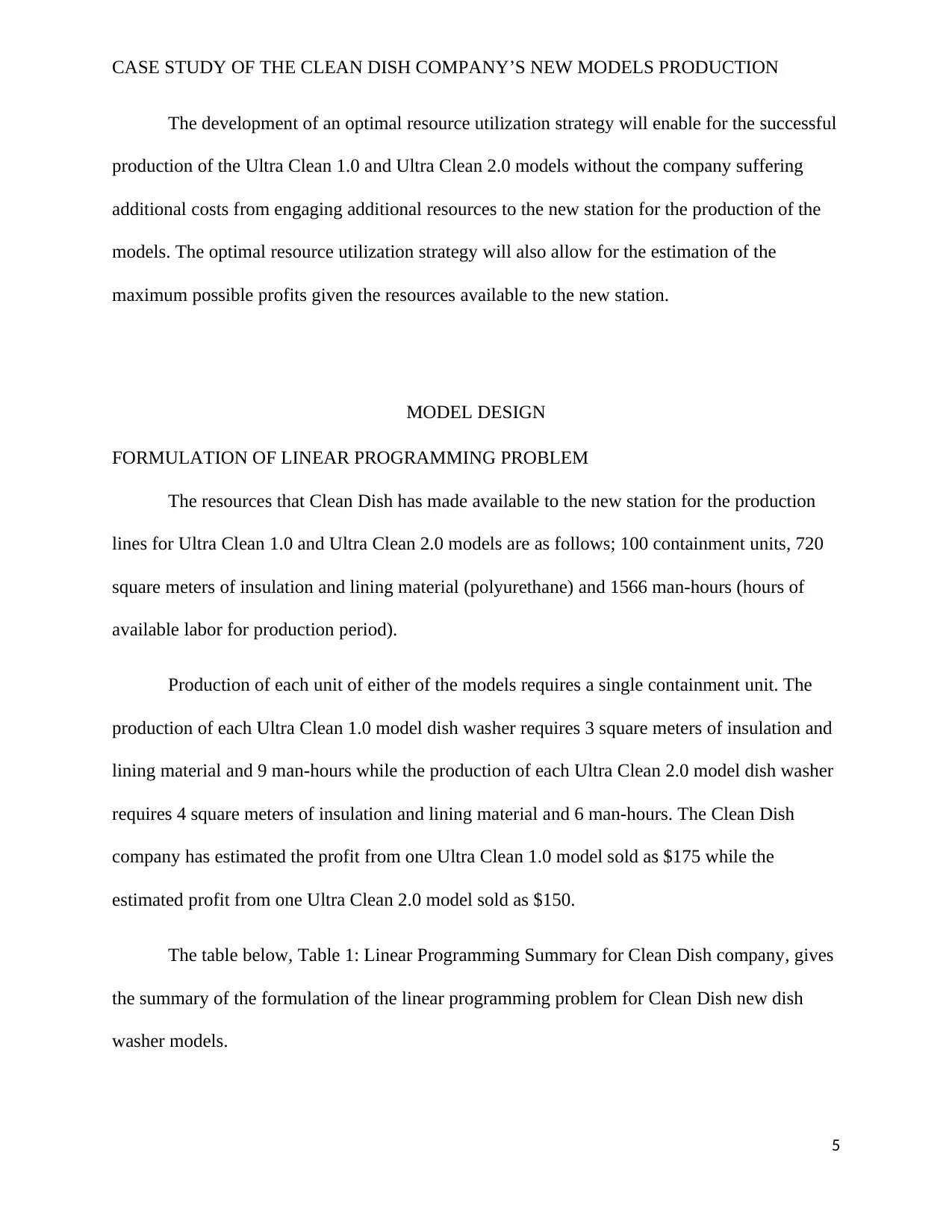
The development of an optimal resource utilization strategy will enable for the successful
production of the Ultra Clean 1.0 and Ultra Clean 2.0 models without the company suffering
additional costs from engaging additional resources to the new station for the production of the
models. The optimal resource utilization strategy will also allow for the estimation of the
maximum possible profits given the resources available to the new station.
MODEL DESIGN
FORMULATION OF LINEAR PROGRAMMING PROBLEM
The resources that Clean Dish has made available to the new station for the production
lines for Ultra Clean 1.0 and Ultra Clean 2.0 models are as follows; 100 containment units, 720
square meters of insulation and lining material (polyurethane) and 1566 man-hours (hours of
available labor for production period).
Production of each unit of either of the models requires a single containment unit. The
production of each Ultra Clean 1.0 model dish washer requires 3 square meters of insulation and
lining material and 9 man-hours while the production of each Ultra Clean 2.0 model dish washer
requires 4 square meters of insulation and lining material and 6 man-hours. The Clean Dish
company has estimated the profit from one Ultra Clean 1.0 model sold as $175 while the
estimated profit from one Ultra Clean 2.0 model sold as $150.
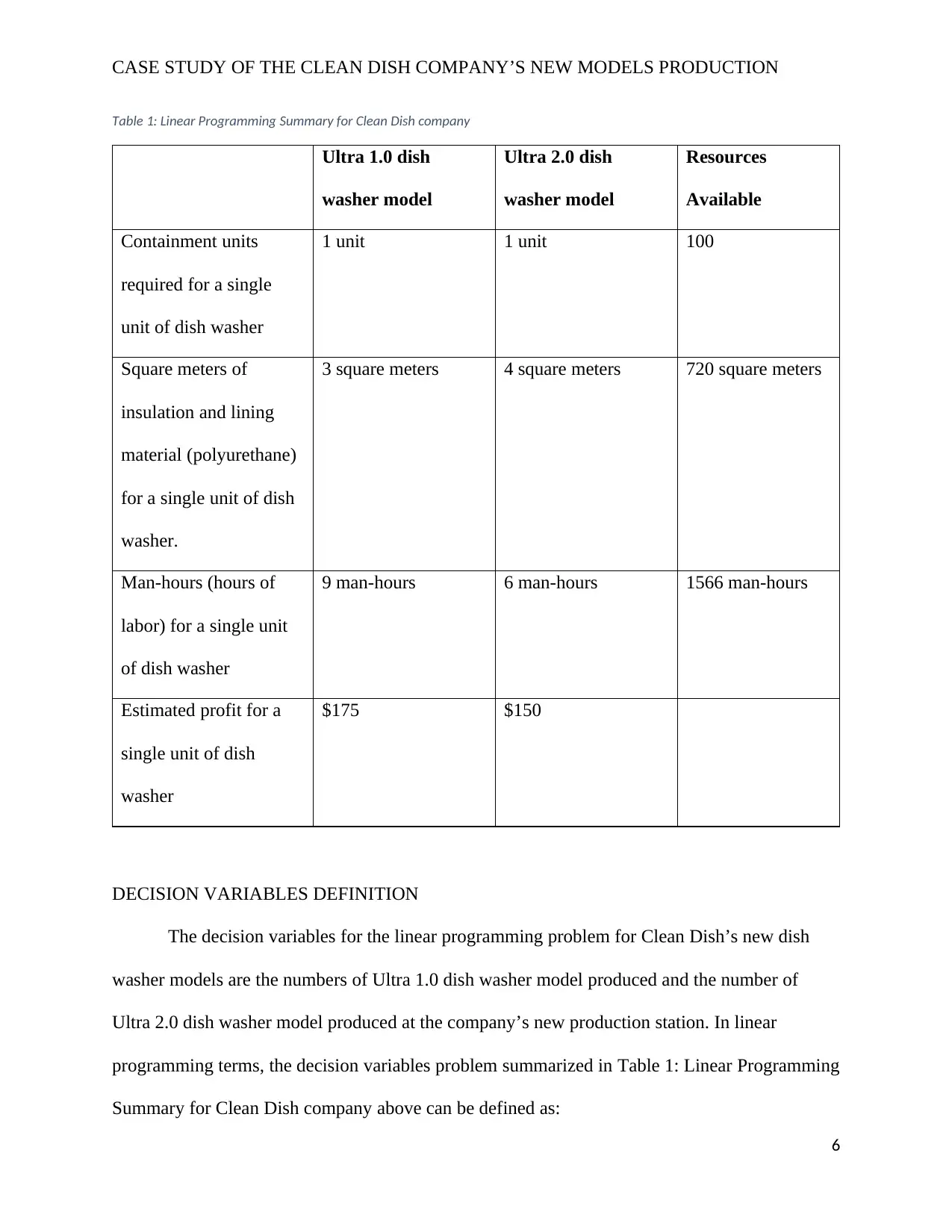
The table below, Table 1: Linear Programming Summary for Clean Dish company, gives
the summary of the formulation of the linear programming problem for Clean Dish new dish
washer models.
5
The development of an optimal resource utilization strategy will enable for the successful
production of the Ultra Clean 1.0 and Ultra Clean 2.0 models without the company suffering
additional costs from engaging additional resources to the new station for the production of the
models. The optimal resource utilization strategy will also allow for the estimation of the
maximum possible profits given the resources available to the new station.
MODEL DESIGN
FORMULATION OF LINEAR PROGRAMMING PROBLEM
The resources that Clean Dish has made available to the new station for the production
lines for Ultra Clean 1.0 and Ultra Clean 2.0 models are as follows; 100 containment units, 720
square meters of insulation and lining material (polyurethane) and 1566 man-hours (hours of
available labor for production period).
Production of each unit of either of the models requires a single containment unit. The
production of each Ultra Clean 1.0 model dish washer requires 3 square meters of insulation and
lining material and 9 man-hours while the production of each Ultra Clean 2.0 model dish washer
requires 4 square meters of insulation and lining material and 6 man-hours. The Clean Dish
company has estimated the profit from one Ultra Clean 1.0 model sold as $175 while the
estimated profit from one Ultra Clean 2.0 model sold as $150.
The table below, Table 1: Linear Programming Summary for Clean Dish company, gives
the summary of the formulation of the linear programming problem for Clean Dish new dish
washer models.
5
CASE STUDY OF THE CLEAN DISH COMPANY’S NEW MODELS PRODUCTION
Table 1: Linear Programming Summary for Clean Dish company
Ultra 1.0 dish
washer model
Ultra 2.0 dish
washer model
Resources
Available
Containment units
required for a single
unit of dish washer
1 unit 1 unit 100
Square meters of
insulation and lining
material (polyurethane)
for a single unit of dish
washer.
3 square meters 4 square meters 720 square meters
Man-hours (hours of
labor) for a single unit
of dish washer
9 man-hours 6 man-hours 1566 man-hours
Estimated profit for a
single unit of dish
washer
$175 $150
DECISION VARIABLES DEFINITION
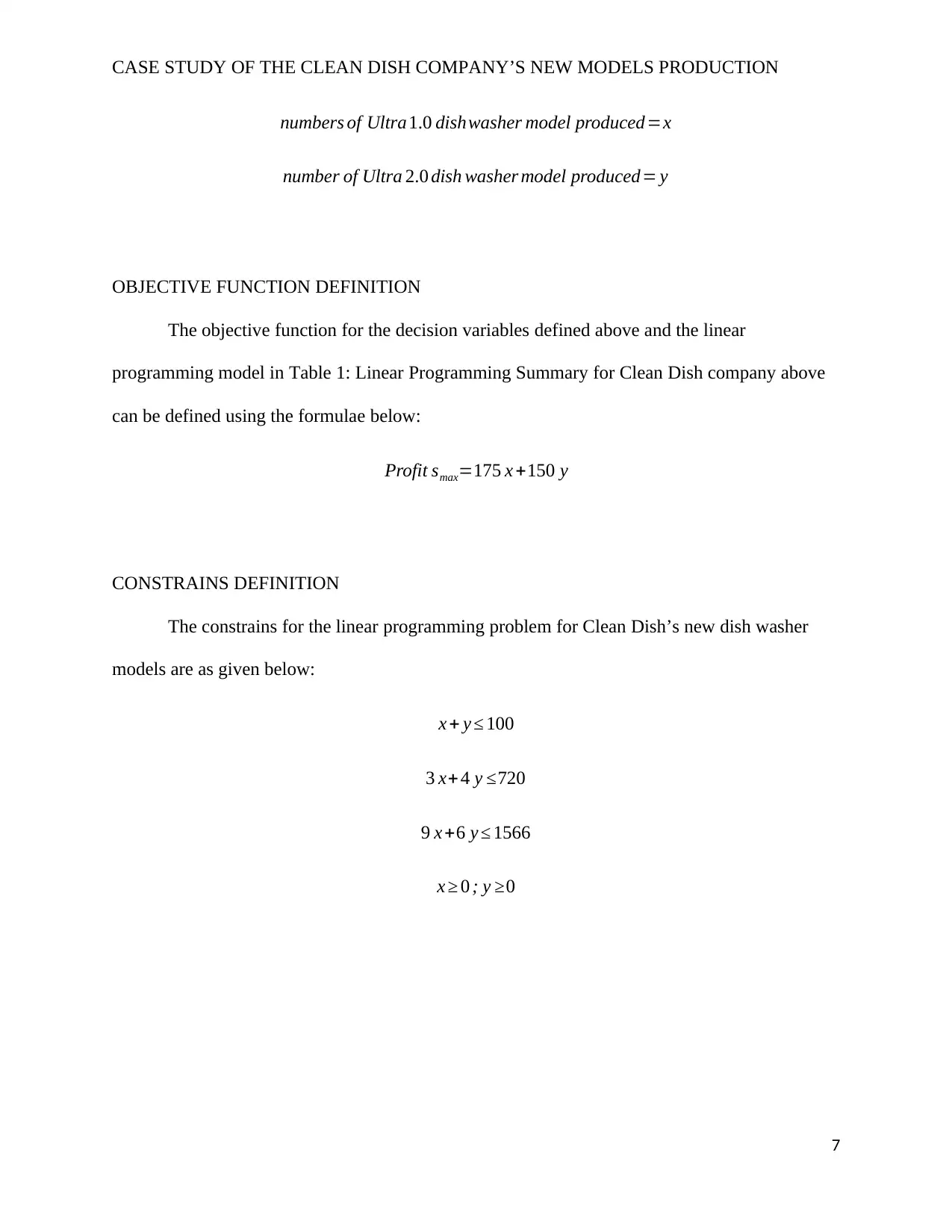
The decision variables for the linear programming problem for Clean Dish’s new dish
washer models are the numbers of Ultra 1.0 dish washer model produced and the number of
Ultra 2.0 dish washer model produced at the company’s new production station. In linear
programming terms, the decision variables problem summarized in Table 1: Linear Programming
Summary for Clean Dish company above can be defined as:
6
Table 1: Linear Programming Summary for Clean Dish company
Ultra 1.0 dish
washer model
Ultra 2.0 dish
washer model
Resources
Available
Containment units
required for a single
unit of dish washer
1 unit 1 unit 100
Square meters of
insulation and lining
material (polyurethane)
for a single unit of dish
washer.
3 square meters 4 square meters 720 square meters
Man-hours (hours of
labor) for a single unit
of dish washer
9 man-hours 6 man-hours 1566 man-hours
Estimated profit for a
single unit of dish
washer
$175 $150
DECISION VARIABLES DEFINITION
The decision variables for the linear programming problem for Clean Dish’s new dish
washer models are the numbers of Ultra 1.0 dish washer model produced and the number of
Ultra 2.0 dish washer model produced at the company’s new production station. In linear
programming terms, the decision variables problem summarized in Table 1: Linear Programming
Summary for Clean Dish company above can be defined as:
6
⊘ This is a preview!⊘
Do you want full access?
Subscribe today to unlock all pages.
Trusted by 1+ million students worldwide
CASE STUDY OF THE CLEAN DISH COMPANY’S NEW MODELS PRODUCTION
numbers of Ultra1.0 dishwasher model produced=x
number of Ultra 2.0 dish washer model produced= y
OBJECTIVE FUNCTION DEFINITION
The objective function for the decision variables defined above and the linear
programming model in Table 1: Linear Programming Summary for Clean Dish company above
can be defined using the formulae below:
Profit smax=175 x +150 y
CONSTRAINS DEFINITION
The constrains for the linear programming problem for Clean Dish’s new dish washer
models are as given below:
x + y ≤ 100
3 x+ 4 y ≤720
9 x +6 y ≤ 1566
x ≥ 0 ; y ≥0
7
numbers of Ultra1.0 dishwasher model produced=x
number of Ultra 2.0 dish washer model produced= y
OBJECTIVE FUNCTION DEFINITION
The objective function for the decision variables defined above and the linear
programming model in Table 1: Linear Programming Summary for Clean Dish company above
can be defined using the formulae below:
Profit smax=175 x +150 y
CONSTRAINS DEFINITION
The constrains for the linear programming problem for Clean Dish’s new dish washer
models are as given below:
x + y ≤ 100
3 x+ 4 y ≤720
9 x +6 y ≤ 1566
x ≥ 0 ; y ≥0
7
Paraphrase This Document
Need a fresh take? Get an instant paraphrase of this document with our AI Paraphraser
CASE STUDY OF THE CLEAN DISH COMPANY’S NEW MODELS PRODUCTION
MODEL IMPLIMENTATION
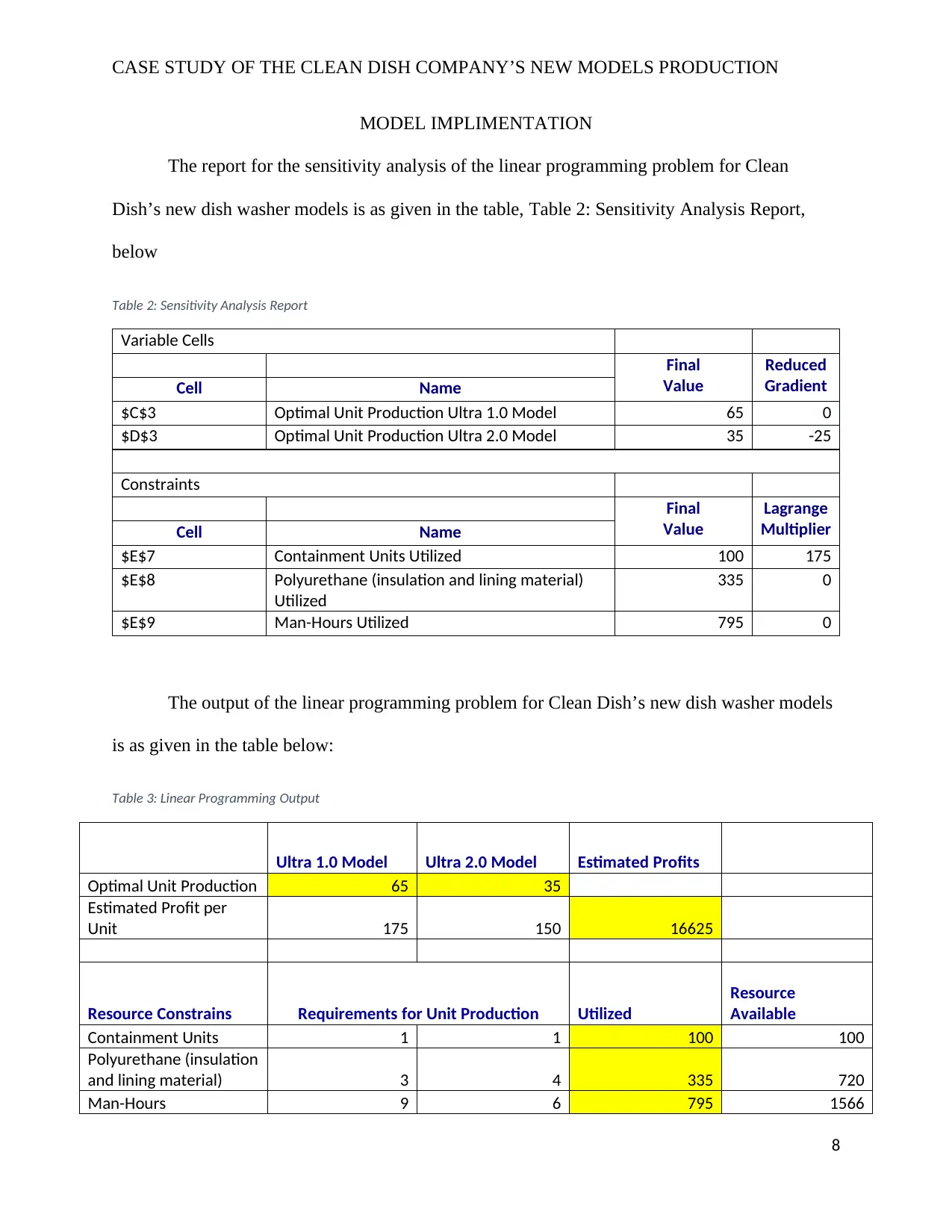
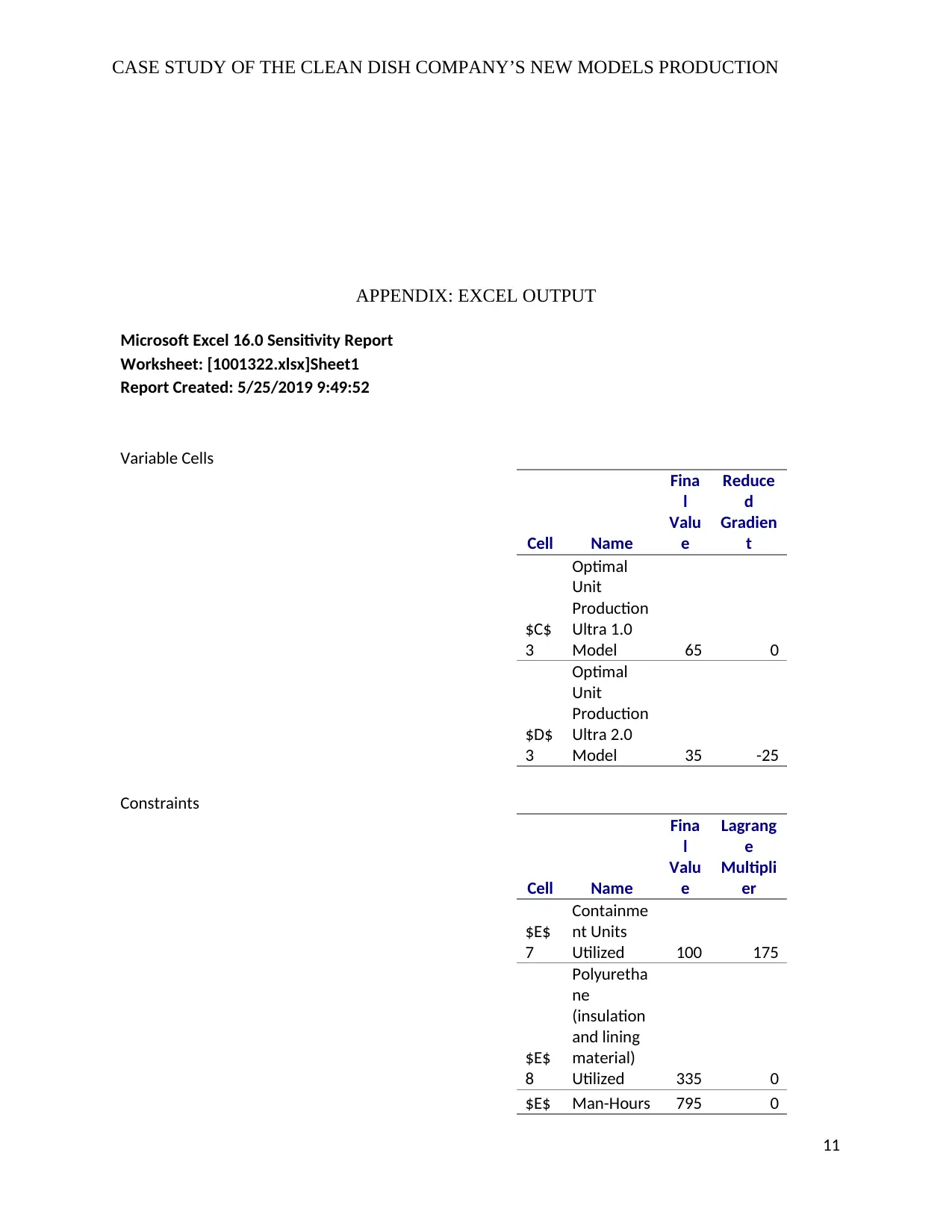
The report for the sensitivity analysis of the linear programming problem for Clean
Dish’s new dish washer models is as given in the table, Table 2: Sensitivity Analysis Report,
below
Table 2: Sensitivity Analysis Report
Variable Cells
Final
Value
Reduced
GradientCell Name
$C$3 Optimal Unit Production Ultra 1.0 Model 65 0
$D$3 Optimal Unit Production Ultra 2.0 Model 35 -25
Constraints
Final
Value
Lagrange
MultiplierCell Name
$E$7 Containment Units Utilized 100 175
$E$8 Polyurethane (insulation and lining material)
Utilized
335 0
$E$9 Man-Hours Utilized 795 0
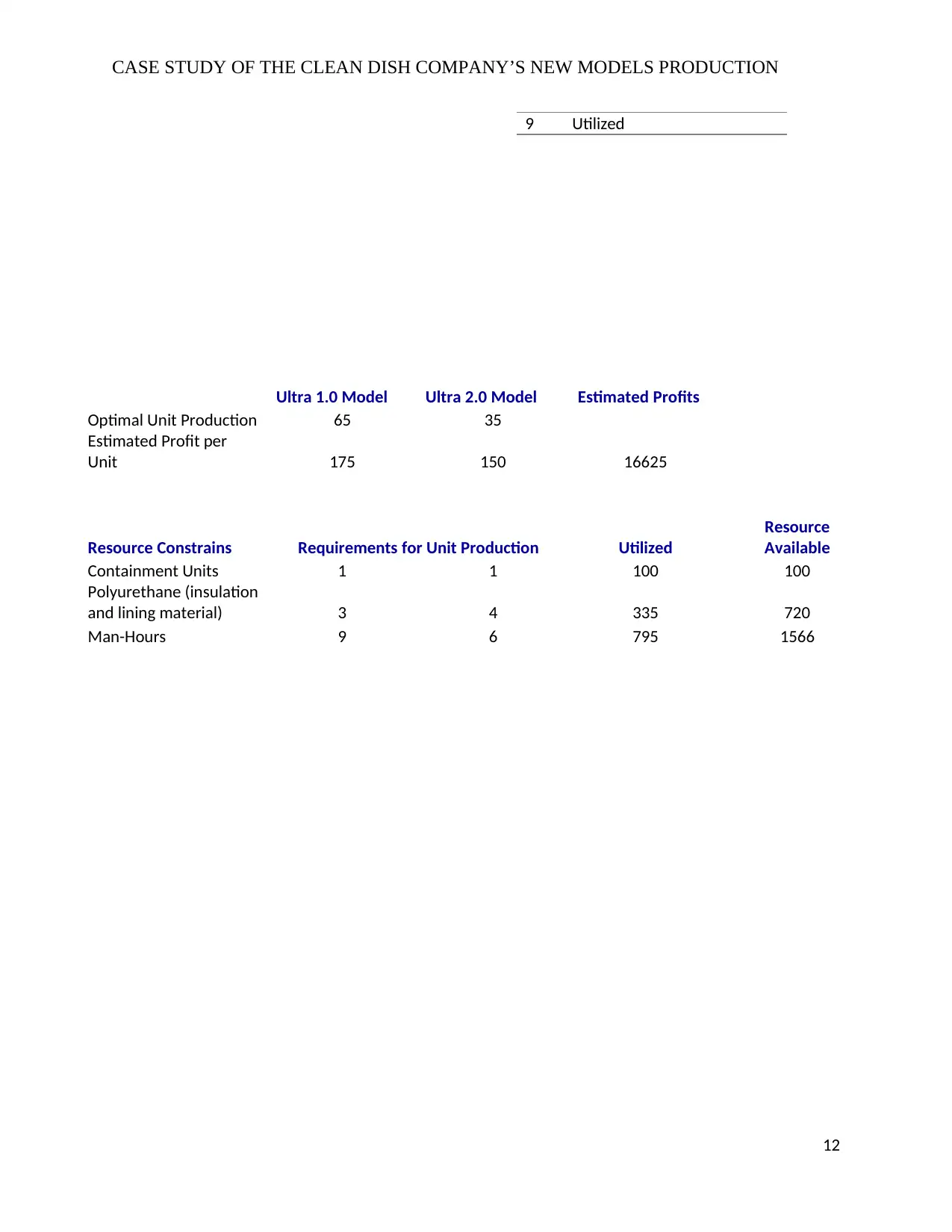
The output of the linear programming problem for Clean Dish’s new dish washer models
is as given in the table below:
Table 3: Linear Programming Output
Ultra 1.0 Model Ultra 2.0 Model Estimated Profits
Optimal Unit Production 65 35
Estimated Profit per
Unit 175 150 16625
Resource Constrains Requirements for Unit Production Utilized
Resource
Available
Containment Units 1 1 100 100
Polyurethane (insulation
and lining material) 3 4 335 720
Man-Hours 9 6 795 1566
8
MODEL IMPLIMENTATION
The report for the sensitivity analysis of the linear programming problem for Clean
Dish’s new dish washer models is as given in the table, Table 2: Sensitivity Analysis Report,
below
Table 2: Sensitivity Analysis Report
Variable Cells
Final
Value
Reduced
GradientCell Name
$C$3 Optimal Unit Production Ultra 1.0 Model 65 0
$D$3 Optimal Unit Production Ultra 2.0 Model 35 -25
Constraints
Final
Value
Lagrange
MultiplierCell Name
$E$7 Containment Units Utilized 100 175
$E$8 Polyurethane (insulation and lining material)
Utilized
335 0
$E$9 Man-Hours Utilized 795 0
The output of the linear programming problem for Clean Dish’s new dish washer models
is as given in the table below:
Table 3: Linear Programming Output
Ultra 1.0 Model Ultra 2.0 Model Estimated Profits
Optimal Unit Production 65 35
Estimated Profit per
Unit 175 150 16625
Resource Constrains Requirements for Unit Production Utilized
Resource
Available
Containment Units 1 1 100 100
Polyurethane (insulation
and lining material) 3 4 335 720
Man-Hours 9 6 795 1566
8
CASE STUDY OF THE CLEAN DISH COMPANY’S NEW MODELS PRODUCTION
RESULTS
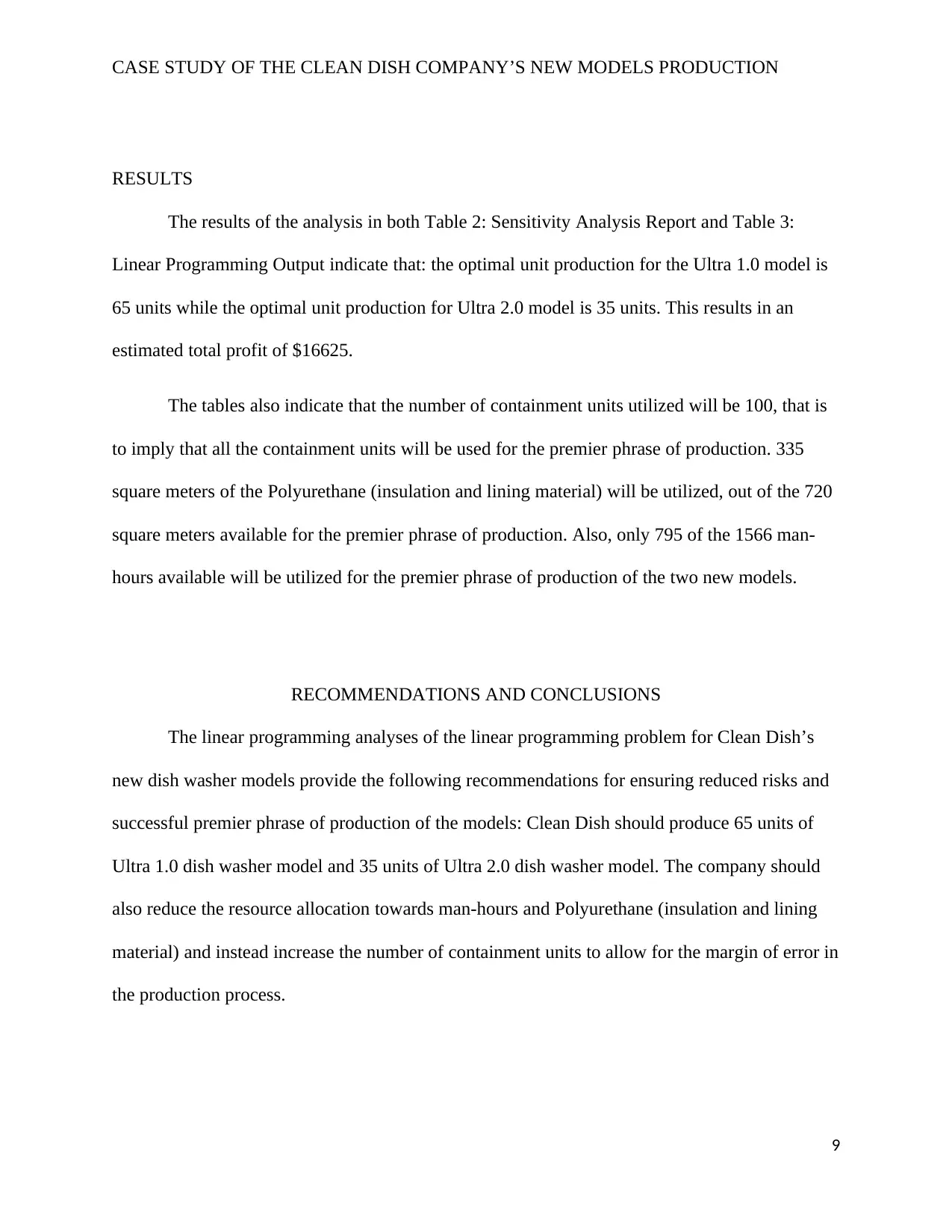
The results of the analysis in both Table 2: Sensitivity Analysis Report and Table 3:
Linear Programming Output indicate that: the optimal unit production for the Ultra 1.0 model is
65 units while the optimal unit production for Ultra 2.0 model is 35 units. This results in an
estimated total profit of $16625.
The tables also indicate that the number of containment units utilized will be 100, that is
to imply that all the containment units will be used for the premier phrase of production. 335
square meters of the Polyurethane (insulation and lining material) will be utilized, out of the 720
square meters available for the premier phrase of production. Also, only 795 of the 1566 man-
hours available will be utilized for the premier phrase of production of the two new models.
RECOMMENDATIONS AND CONCLUSIONS
The linear programming analyses of the linear programming problem for Clean Dish’s
new dish washer models provide the following recommendations for ensuring reduced risks and
successful premier phrase of production of the models: Clean Dish should produce 65 units of
Ultra 1.0 dish washer model and 35 units of Ultra 2.0 dish washer model. The company should
also reduce the resource allocation towards man-hours and Polyurethane (insulation and lining
material) and instead increase the number of containment units to allow for the margin of error in
the production process.
9
RESULTS
The results of the analysis in both Table 2: Sensitivity Analysis Report and Table 3:
Linear Programming Output indicate that: the optimal unit production for the Ultra 1.0 model is
65 units while the optimal unit production for Ultra 2.0 model is 35 units. This results in an
estimated total profit of $16625.
The tables also indicate that the number of containment units utilized will be 100, that is
to imply that all the containment units will be used for the premier phrase of production. 335
square meters of the Polyurethane (insulation and lining material) will be utilized, out of the 720
square meters available for the premier phrase of production. Also, only 795 of the 1566 man-
hours available will be utilized for the premier phrase of production of the two new models.
RECOMMENDATIONS AND CONCLUSIONS
The linear programming analyses of the linear programming problem for Clean Dish’s
new dish washer models provide the following recommendations for ensuring reduced risks and
successful premier phrase of production of the models: Clean Dish should produce 65 units of
Ultra 1.0 dish washer model and 35 units of Ultra 2.0 dish washer model. The company should
also reduce the resource allocation towards man-hours and Polyurethane (insulation and lining
material) and instead increase the number of containment units to allow for the margin of error in
the production process.
9
⊘ This is a preview!⊘
Do you want full access?
Subscribe today to unlock all pages.
Trusted by 1+ million students worldwide
CASE STUDY OF THE CLEAN DISH COMPANY’S NEW MODELS PRODUCTION
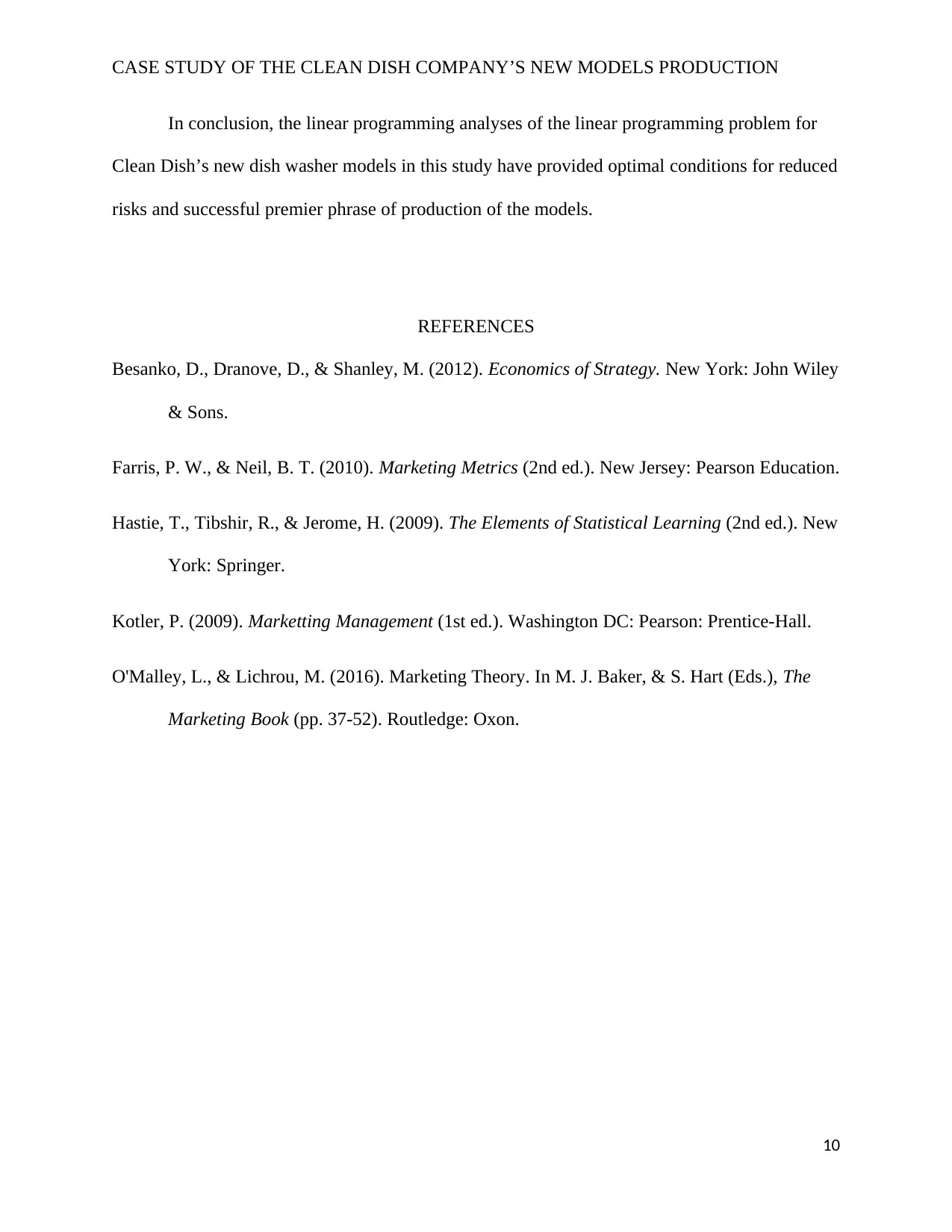
In conclusion, the linear programming analyses of the linear programming problem for
Clean Dish’s new dish washer models in this study have provided optimal conditions for reduced
risks and successful premier phrase of production of the models.
REFERENCES
Besanko, D., Dranove, D., & Shanley, M. (2012). Economics of Strategy. New York: John Wiley
& Sons.
Farris, P. W., & Neil, B. T. (2010). Marketing Metrics (2nd ed.). New Jersey: Pearson Education.
Hastie, T., Tibshir, R., & Jerome, H. (2009). The Elements of Statistical Learning (2nd ed.). New
York: Springer.
Kotler, P. (2009). Marketting Management (1st ed.). Washington DC: Pearson: Prentice-Hall.
O'Malley, L., & Lichrou, M. (2016). Marketing Theory. In M. J. Baker, & S. Hart (Eds.), The
Marketing Book (pp. 37-52). Routledge: Oxon.
10
In conclusion, the linear programming analyses of the linear programming problem for
Clean Dish’s new dish washer models in this study have provided optimal conditions for reduced
risks and successful premier phrase of production of the models.
REFERENCES
Besanko, D., Dranove, D., & Shanley, M. (2012). Economics of Strategy. New York: John Wiley
& Sons.
Farris, P. W., & Neil, B. T. (2010). Marketing Metrics (2nd ed.). New Jersey: Pearson Education.
Hastie, T., Tibshir, R., & Jerome, H. (2009). The Elements of Statistical Learning (2nd ed.). New
York: Springer.
Kotler, P. (2009). Marketting Management (1st ed.). Washington DC: Pearson: Prentice-Hall.
O'Malley, L., & Lichrou, M. (2016). Marketing Theory. In M. J. Baker, & S. Hart (Eds.), The
Marketing Book (pp. 37-52). Routledge: Oxon.
10
Paraphrase This Document
Need a fresh take? Get an instant paraphrase of this document with our AI Paraphraser
CASE STUDY OF THE CLEAN DISH COMPANY’S NEW MODELS PRODUCTION
APPENDIX: EXCEL OUTPUT
Microsoft Excel 16.0 Sensitivity Report
Worksheet: [1001322.xlsx]Sheet1
Report Created: 5/25/2019 9:49:52
Variable Cells
Fina
l
Reduce
d
Cell Name
Valu
e
Gradien
t
$C$
3
Optimal
Unit
Production
Ultra 1.0
Model 65 0
$D$
3
Optimal
Unit
Production
Ultra 2.0
Model 35 -25
Constraints
Fina
l
Lagrang
e
Cell Name
Valu
e
Multipli
er
$E$
7
Containme
nt Units
Utilized 100 175
$E$
8
Polyuretha
ne
(insulation
and lining
material)
Utilized 335 0
$E$ Man-Hours 795 0
11
APPENDIX: EXCEL OUTPUT
Microsoft Excel 16.0 Sensitivity Report
Worksheet: [1001322.xlsx]Sheet1
Report Created: 5/25/2019 9:49:52
Variable Cells
Fina
l
Reduce
d
Cell Name
Valu
e
Gradien
t
$C$
3
Optimal
Unit
Production
Ultra 1.0
Model 65 0
$D$
3
Optimal
Unit
Production
Ultra 2.0
Model 35 -25
Constraints
Fina
l
Lagrang
e
Cell Name
Valu
e
Multipli
er
$E$
7
Containme
nt Units
Utilized 100 175
$E$
8
Polyuretha
ne
(insulation
and lining
material)
Utilized 335 0
$E$ Man-Hours 795 0
11
CASE STUDY OF THE CLEAN DISH COMPANY’S NEW MODELS PRODUCTION
9 Utilized
Ultra 1.0 Model Ultra 2.0 Model Estimated Profits
Optimal Unit Production 65 35
Estimated Profit per
Unit 175 150 16625
Resource Constrains Requirements for Unit Production Utilized
Resource
Available
Containment Units 1 1 100 100
Polyurethane (insulation
and lining material) 3 4 335 720
Man-Hours 9 6 795 1566
12
9 Utilized
Ultra 1.0 Model Ultra 2.0 Model Estimated Profits
Optimal Unit Production 65 35
Estimated Profit per
Unit 175 150 16625
Resource Constrains Requirements for Unit Production Utilized
Resource
Available
Containment Units 1 1 100 100
Polyurethane (insulation
and lining material) 3 4 335 720
Man-Hours 9 6 795 1566
12
⊘ This is a preview!⊘
Do you want full access?
Subscribe today to unlock all pages.
Trusted by 1+ million students worldwide

1 out of 12


Related Documents


Your All-in-One AI-Powered Toolkit for Academic Success.
+13062052269
info@desklib.com
Available 24*7 on WhatsApp / Email
![[object Object]](/_next/static/media/star-bottom.7253800d.svg)
Unlock your academic potential
Copyright © 2020–2026 A2Z Services. All Rights Reserved. Developed and managed by ZUCOL.