Clifftop Bar & Grill: Enhancing Profitability Through Cost Controls
VerifiedAdded on 2023/06/04
|9
|1701
|86
Report
AI Summary
This report addresses the stock management issues at Clifftop Bar and Grill, where discrepancies in inventory records have led to significant financial losses. The report identifies actual and potential risks such as theft, lost inventory, damage, product lifecycle issues, and shelf-life concerns, all of which negatively impact the restaurant's profitability. It proposes mitigation strategies for internal threats to stock control, including the elimination of slow-moving goods, improved demand forecasting, and centralized inventory management. The report recommends the adoption of a Sales and Inventory System by Spark Global Tech to track deliveries, orders, and sales, reducing overstocking and outages. By implementing these recommendations, Clifftop Bar and Grill can enhance its inventory management practices, reduce financial losses, and improve overall profitability. Desklib provides access to this and other solved assignments for students.
Food and Beverage Cost Control 1
FOOD AND BEVERGE COST CONTROL
Name
Course
Tutor
University
Date
FOOD AND BEVERGE COST CONTROL
Name
Course
Tutor
University
Date
Paraphrase This Document
Need a fresh take? Get an instant paraphrase of this document with our AI Paraphraser

Food and Beverage Cost Control 2
Executive summary
This report is constructed for Clifftop Bar and Grill with respect to their stock
management process. The report covers background situation that explains the problem. Besides,
it identifies both actual and potential risks and their impact on profitability, offers solutions on
how to mitigate inventory associated risks and provides recommendation on how to solve their
inventory management problem.
Executive summary
This report is constructed for Clifftop Bar and Grill with respect to their stock
management process. The report covers background situation that explains the problem. Besides,
it identifies both actual and potential risks and their impact on profitability, offers solutions on
how to mitigate inventory associated risks and provides recommendation on how to solve their
inventory management problem.

Food and Beverage Cost Control 3
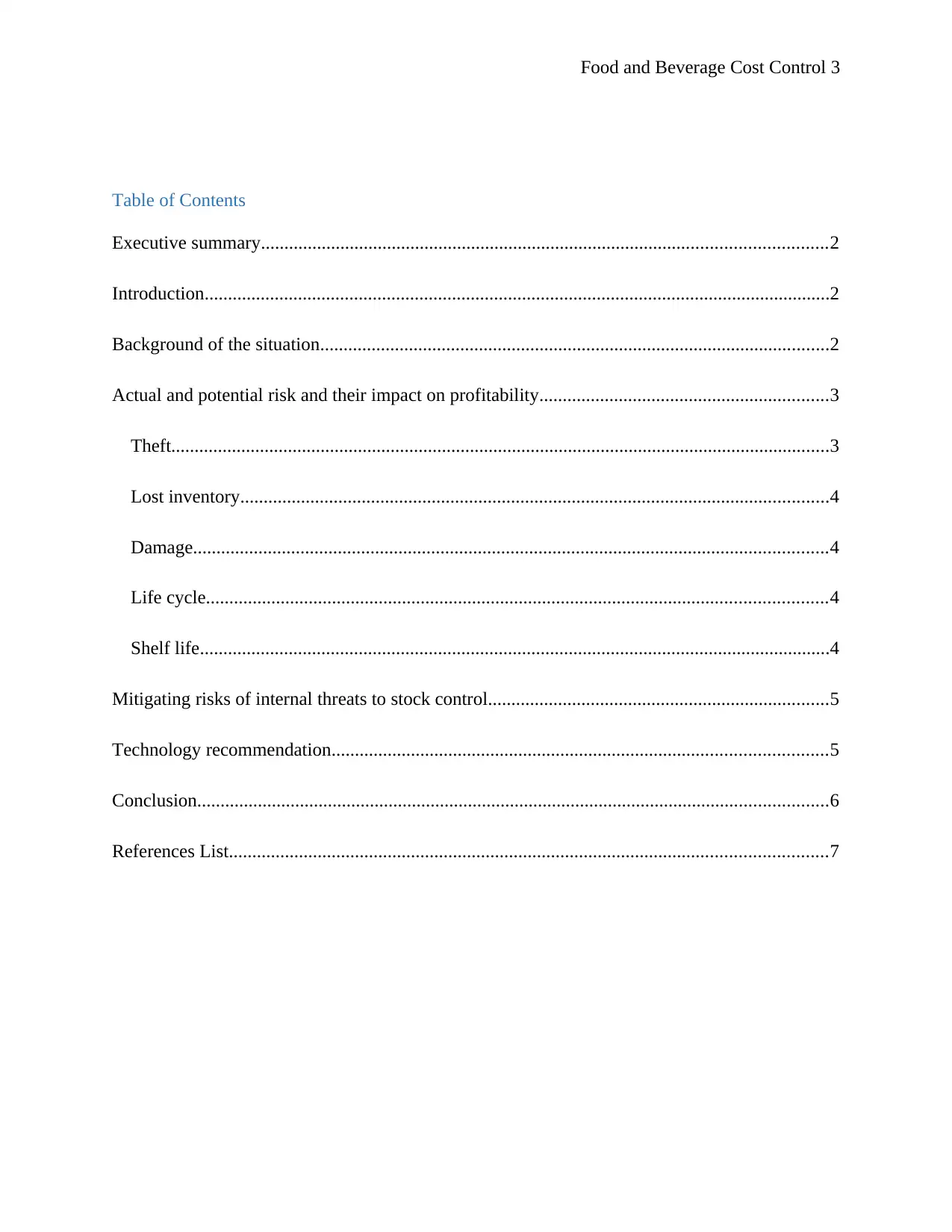
Table of Contents
Executive summary.........................................................................................................................2
Introduction......................................................................................................................................2
Background of the situation.............................................................................................................2
Actual and potential risk and their impact on profitability..............................................................3
Theft.............................................................................................................................................3
Lost inventory..............................................................................................................................4
Damage........................................................................................................................................4
Life cycle.....................................................................................................................................4
Shelf life.......................................................................................................................................4
Mitigating risks of internal threats to stock control.........................................................................5
Technology recommendation..........................................................................................................5
Conclusion.......................................................................................................................................6
References List................................................................................................................................7
Table of Contents
Executive summary.........................................................................................................................2
Introduction......................................................................................................................................2
Background of the situation.............................................................................................................2
Actual and potential risk and their impact on profitability..............................................................3
Theft.............................................................................................................................................3
Lost inventory..............................................................................................................................4
Damage........................................................................................................................................4
Life cycle.....................................................................................................................................4
Shelf life.......................................................................................................................................4
Mitigating risks of internal threats to stock control.........................................................................5
Technology recommendation..........................................................................................................5
Conclusion.......................................................................................................................................6
References List................................................................................................................................7
⊘ This is a preview!⊘
Do you want full access?
Subscribe today to unlock all pages.

Trusted by 1+ million students worldwide

Food and Beverage Cost Control 4
Introduction
The current problem at Clifftop Bar and Grill concerns the issue of stock management.
Stock or inventory management plays an important role in various sectors relating to
manufacturing, retailing and food service industries. Clifftop Bar and Grill depends on the inputs
and finished products so that it can manage to sustain its customers. The challenges as a result of
stock management can have detrimental effect on the performance of the business (Wild 2017).
Common issues in stock management are often associated to spoilage or theft. In this regard, the
problem that is facing Clifftop Bar and Grill revolves around the loss of over 2000 dollars in
missing items which implies that the issue facing the business is stock management problem that
needs improvement to ensure that the inventory is kept safe.
Background of the situation
Based on the state at Clifftop Bar and Grill, inventory management is paramount in order
for the business to operate favorably as well as become sustainable. Moreover, there is a dire
need for the business to know what items it needs to restock, purchase and at what price to sell
them in order to make profit. These are some of the factors that contribute to the need for a
reliable stock management system that is efficient. In essence, the nature of the business should
determine the kind of stock management system that a business should implement (Morton,
Cambiaghi and Radcliffe 2015). Small businesses often carry out stock management manually
while large companies depend on software to manage inventory.
There are numerous benefits that can be reaped from a reliable stock management
system. For instance, it helps to improve customers’ services by ensuring that customers get what
Introduction
The current problem at Clifftop Bar and Grill concerns the issue of stock management.
Stock or inventory management plays an important role in various sectors relating to
manufacturing, retailing and food service industries. Clifftop Bar and Grill depends on the inputs
and finished products so that it can manage to sustain its customers. The challenges as a result of
stock management can have detrimental effect on the performance of the business (Wild 2017).
Common issues in stock management are often associated to spoilage or theft. In this regard, the
problem that is facing Clifftop Bar and Grill revolves around the loss of over 2000 dollars in
missing items which implies that the issue facing the business is stock management problem that
needs improvement to ensure that the inventory is kept safe.
Background of the situation
Based on the state at Clifftop Bar and Grill, inventory management is paramount in order
for the business to operate favorably as well as become sustainable. Moreover, there is a dire
need for the business to know what items it needs to restock, purchase and at what price to sell
them in order to make profit. These are some of the factors that contribute to the need for a
reliable stock management system that is efficient. In essence, the nature of the business should
determine the kind of stock management system that a business should implement (Morton,
Cambiaghi and Radcliffe 2015). Small businesses often carry out stock management manually
while large companies depend on software to manage inventory.
There are numerous benefits that can be reaped from a reliable stock management
system. For instance, it helps to improve customers’ services by ensuring that customers get what
Paraphrase This Document
Need a fresh take? Get an instant paraphrase of this document with our AI Paraphraser

Food and Beverage Cost Control 5
they need as opposed to disappointing the customer and losing them to competition. Besides,
keeping track of inventory helps the manager to know what to order before the stock runs out.
Also, stock management is significant for Clifftop Bar and Grill for purposes of keeping track of
sales and business performance which helps to facilitate decision making.
Actual and potential risk and their impact on profitability
Several risks that are associated to inventory control and directly influences the
profitability of a business. For a business like Clifftop Bar and Grill, most of its investments goes
to inventory which is a crucial aspect of the business since the investment has to bring profits in
order to continue operations. Among the actual and potential risks to stock management include
theft, lost inventory, damage, life-cycle and shelf life (Solyalı, Cordeau and Laporte 2015).
Theft
Theft of inventory is an actual risk that is widely acknowledged by many organizations’
including multinationals. Most companies spend huge sums’ of cash to increase regulation and
prevent theft of stock but the vice continues regardless of the initiatives put in place (Gallino,
Moreno and Stamatopoulos 2016). Lost items in the inventory is likely to translate to less sales
volume of a business thereby impacting its profitability.
Lost inventory
Companies come up with numerous policies aimed at preventing loss of products and
employing qualified personnel but loss of inventory continues to become a problem in many
organizations’. Inventory is reflected in the financial statements of a company even though it is
considered as a liability. Therefore, whenever inventory is lost, a company is forced to write off
the inventory in their financial statements. However, since capital is equal to assets minus
they need as opposed to disappointing the customer and losing them to competition. Besides,
keeping track of inventory helps the manager to know what to order before the stock runs out.
Also, stock management is significant for Clifftop Bar and Grill for purposes of keeping track of
sales and business performance which helps to facilitate decision making.
Actual and potential risk and their impact on profitability
Several risks that are associated to inventory control and directly influences the
profitability of a business. For a business like Clifftop Bar and Grill, most of its investments goes
to inventory which is a crucial aspect of the business since the investment has to bring profits in
order to continue operations. Among the actual and potential risks to stock management include
theft, lost inventory, damage, life-cycle and shelf life (Solyalı, Cordeau and Laporte 2015).
Theft
Theft of inventory is an actual risk that is widely acknowledged by many organizations’
including multinationals. Most companies spend huge sums’ of cash to increase regulation and
prevent theft of stock but the vice continues regardless of the initiatives put in place (Gallino,
Moreno and Stamatopoulos 2016). Lost items in the inventory is likely to translate to less sales
volume of a business thereby impacting its profitability.
Lost inventory
Companies come up with numerous policies aimed at preventing loss of products and
employing qualified personnel but loss of inventory continues to become a problem in many
organizations’. Inventory is reflected in the financial statements of a company even though it is
considered as a liability. Therefore, whenever inventory is lost, a company is forced to write off
the inventory in their financial statements. However, since capital is equal to assets minus

Food and Beverage Cost Control 6
liability, a business equity is reduced whenever an inventory is lost and written off the books.
(Solyalı, Cordeau and Laporte 2015).
Damage
Damage is a potential risk that is tied to inventory management and reflects on the
profitability of a business. Most warehouses are known to pile up goods so as to reduce the space
of storage. Often, inventory is damaged and can no longer be sold to the consumers. This implies
that the products have to be disposed or sold at a lower price which ultimately influences the
profitability position of a company.
Life cycle
All the products in the market go through various phases which include introduction,
growth and maturity. These phases represent a products’ life cycle. As a result, a product that is
way past its maturity is likely to become a high inventory risk to a business. Businesses are
encouraged to produce goods that meet demand so as to minimize risk and increase their
profitability (Gallino, Moreno and Stamatopoulos 2016).
Shelf life
The length of time a product stays in the shelf influences inventory risk of a business.
Products that are highly perishable are considered to bare the highest inventory risk to any
business. For instance, Clifftop Bar and Grill inventory that was missing included frozen meat
and cheese. Such products are highly perishable if not stored properly. Spoiled inventory for any
business will translate to reduced revenue.
Mitigating risks of internal threats to stock control
Reducing internal threats to stock management can be a daunting task for any manager.
For this reason, there are several methods that can be used to mitigate these risks. For example,
liability, a business equity is reduced whenever an inventory is lost and written off the books.
(Solyalı, Cordeau and Laporte 2015).
Damage
Damage is a potential risk that is tied to inventory management and reflects on the
profitability of a business. Most warehouses are known to pile up goods so as to reduce the space
of storage. Often, inventory is damaged and can no longer be sold to the consumers. This implies
that the products have to be disposed or sold at a lower price which ultimately influences the
profitability position of a company.
Life cycle
All the products in the market go through various phases which include introduction,
growth and maturity. These phases represent a products’ life cycle. As a result, a product that is
way past its maturity is likely to become a high inventory risk to a business. Businesses are
encouraged to produce goods that meet demand so as to minimize risk and increase their
profitability (Gallino, Moreno and Stamatopoulos 2016).
Shelf life
The length of time a product stays in the shelf influences inventory risk of a business.
Products that are highly perishable are considered to bare the highest inventory risk to any
business. For instance, Clifftop Bar and Grill inventory that was missing included frozen meat
and cheese. Such products are highly perishable if not stored properly. Spoiled inventory for any
business will translate to reduced revenue.
Mitigating risks of internal threats to stock control
Reducing internal threats to stock management can be a daunting task for any manager.
For this reason, there are several methods that can be used to mitigate these risks. For example,
⊘ This is a preview!⊘
Do you want full access?
Subscribe today to unlock all pages.

Trusted by 1+ million students worldwide

Food and Beverage Cost Control 7
there is need for a business to eliminate goods that have stayed in the inventory for a long time
without any demand. This is crucial for any business to forecast demand of products and estimate
future sales and growth of the business (Center, Alliance and Insurance 2016).
Consequently, a business should be able to forecast accurate demand and purchase
patterns which is significant in improving strategic goals of a business through understanding
their market and consumers. Other ways to mitigate these risks involves centralizing the
inventory management and continuous analysis on ways to reduce the above risks (Feng et al
2014).
Technology recommendation
Clifftop Bar and Grill should adopt Sales and Inventory System, which is a product
developed by Spark Global Tech. The purpose of this software is to keep track of deliveries,
orders and sales. This software is primarily meant to reduce overstocking and outages. The
software is programed to match a company’s inventory system and helps the manager to know
when to order products. The software can also be used in tracking assets by utilizing barcode,
radio frequency and other mechanism used in tracking. The software is also significant because it
helps a company to attach prices to the services which reflects on the sales. Lastly, the system is
used to identify products through barcodes which increases information awareness about a
company’s inventory (Coelho and Laporte 2014).
Conclusion
Stock/inventory management is a prerequisite in most businesses because it directly
influences the profitability of a company. Based on the nature of a business, inventory
management policies and applications can be incorporated to reduce the risk associated to
inventory management. This can be realized through understanding how a business operates
there is need for a business to eliminate goods that have stayed in the inventory for a long time
without any demand. This is crucial for any business to forecast demand of products and estimate
future sales and growth of the business (Center, Alliance and Insurance 2016).
Consequently, a business should be able to forecast accurate demand and purchase
patterns which is significant in improving strategic goals of a business through understanding
their market and consumers. Other ways to mitigate these risks involves centralizing the
inventory management and continuous analysis on ways to reduce the above risks (Feng et al
2014).
Technology recommendation
Clifftop Bar and Grill should adopt Sales and Inventory System, which is a product
developed by Spark Global Tech. The purpose of this software is to keep track of deliveries,
orders and sales. This software is primarily meant to reduce overstocking and outages. The
software is programed to match a company’s inventory system and helps the manager to know
when to order products. The software can also be used in tracking assets by utilizing barcode,
radio frequency and other mechanism used in tracking. The software is also significant because it
helps a company to attach prices to the services which reflects on the sales. Lastly, the system is
used to identify products through barcodes which increases information awareness about a
company’s inventory (Coelho and Laporte 2014).
Conclusion
Stock/inventory management is a prerequisite in most businesses because it directly
influences the profitability of a company. Based on the nature of a business, inventory
management policies and applications can be incorporated to reduce the risk associated to
inventory management. This can be realized through understanding how a business operates
Paraphrase This Document
Need a fresh take? Get an instant paraphrase of this document with our AI Paraphraser

Food and Beverage Cost Control 8
from production to finished goods. Clifftop Bar and Grill should adopt software and security
systems that assist the business to manage its inventory.
from production to finished goods. Clifftop Bar and Grill should adopt software and security
systems that assist the business to manage its inventory.

Food and Beverage Cost Control 9
References List
Center, P., Alliance, A.M.A. and Insurance, A.M.A., 2016. Practice Management. Safety.
Coelho, L.C. and Laporte, G., (2014). Optimal joint replenishment, delivery and inventory
management policies for perishable products. Computers & Operations Research, 47, pp.42-52.
Feng, M., Li, C., McVay, S.E. and Skaife, H., 2014. Does ineffective internal control over
financial reporting affect a firm's operations? Evidence from firms' inventory management. The
Accounting Review, 90(2), pp.529-557.
Gallino, S., Moreno, A. and Stamatopoulos, I., 2016. Channel integration, sales dispersion, and
inventory management. Management Science, 63(9), pp.2813-2831.
Morton, J., Cambiaghi, R. and Radcliffe, N., 2015. Inventory management requires an end-to-
end approach: our consulting team defines the key concepts of inventory management and
elaborate on the decisions and cross-functional collaboration required to be more
effective. Logistics management (Highlands Ranch, Colo.: 2002).
Solyalı, O., Cordeau, J.F. and Laporte, G., 2015. The impact of modeling on robust inventory
management under demand uncertainty. Management Science, 62(4), pp.1188-1201.
Wild, T., (2017). Best practice in inventory management. Routledge.
References List
Center, P., Alliance, A.M.A. and Insurance, A.M.A., 2016. Practice Management. Safety.
Coelho, L.C. and Laporte, G., (2014). Optimal joint replenishment, delivery and inventory
management policies for perishable products. Computers & Operations Research, 47, pp.42-52.
Feng, M., Li, C., McVay, S.E. and Skaife, H., 2014. Does ineffective internal control over
financial reporting affect a firm's operations? Evidence from firms' inventory management. The
Accounting Review, 90(2), pp.529-557.
Gallino, S., Moreno, A. and Stamatopoulos, I., 2016. Channel integration, sales dispersion, and
inventory management. Management Science, 63(9), pp.2813-2831.
Morton, J., Cambiaghi, R. and Radcliffe, N., 2015. Inventory management requires an end-to-
end approach: our consulting team defines the key concepts of inventory management and
elaborate on the decisions and cross-functional collaboration required to be more
effective. Logistics management (Highlands Ranch, Colo.: 2002).
Solyalı, O., Cordeau, J.F. and Laporte, G., 2015. The impact of modeling on robust inventory
management under demand uncertainty. Management Science, 62(4), pp.1188-1201.
Wild, T., (2017). Best practice in inventory management. Routledge.
⊘ This is a preview!⊘
Do you want full access?
Subscribe today to unlock all pages.

Trusted by 1+ million students worldwide
1 out of 9
Related Documents
Your All-in-One AI-Powered Toolkit for Academic Success.
+13062052269
info@desklib.com
Available 24*7 on WhatsApp / Email
Unlock your academic potential
Copyright © 2020–2025 A2Z Services. All Rights Reserved. Developed and managed by ZUCOL.