Climate Change: Effects on Aboriginals in Australia-Envt & Develop

Verified

Added on  2023/06/14

|7
|1166
|319
Essay
AI Summary
This essay examines the impact of air pollution and global warming on the Aboriginal population of Australia, a group identified as particularly vulnerable to climate change. It addresses the poorer health conditions of Aboriginals compared to non-indigenous Australians and explores how air pollution affects their access to basic amenities like water and healthcare. The research highlights a gap in existing studies, which often focus on climate change laws and non-indigenous populations, and aims to provide a comparative analysis of the effects of air pollution and global warming on Aboriginals living in the northern territories of Australia. The essay emphasizes the potential threat to the existence of aboriginal peoples due to institutional and legal barriers.
Document Page
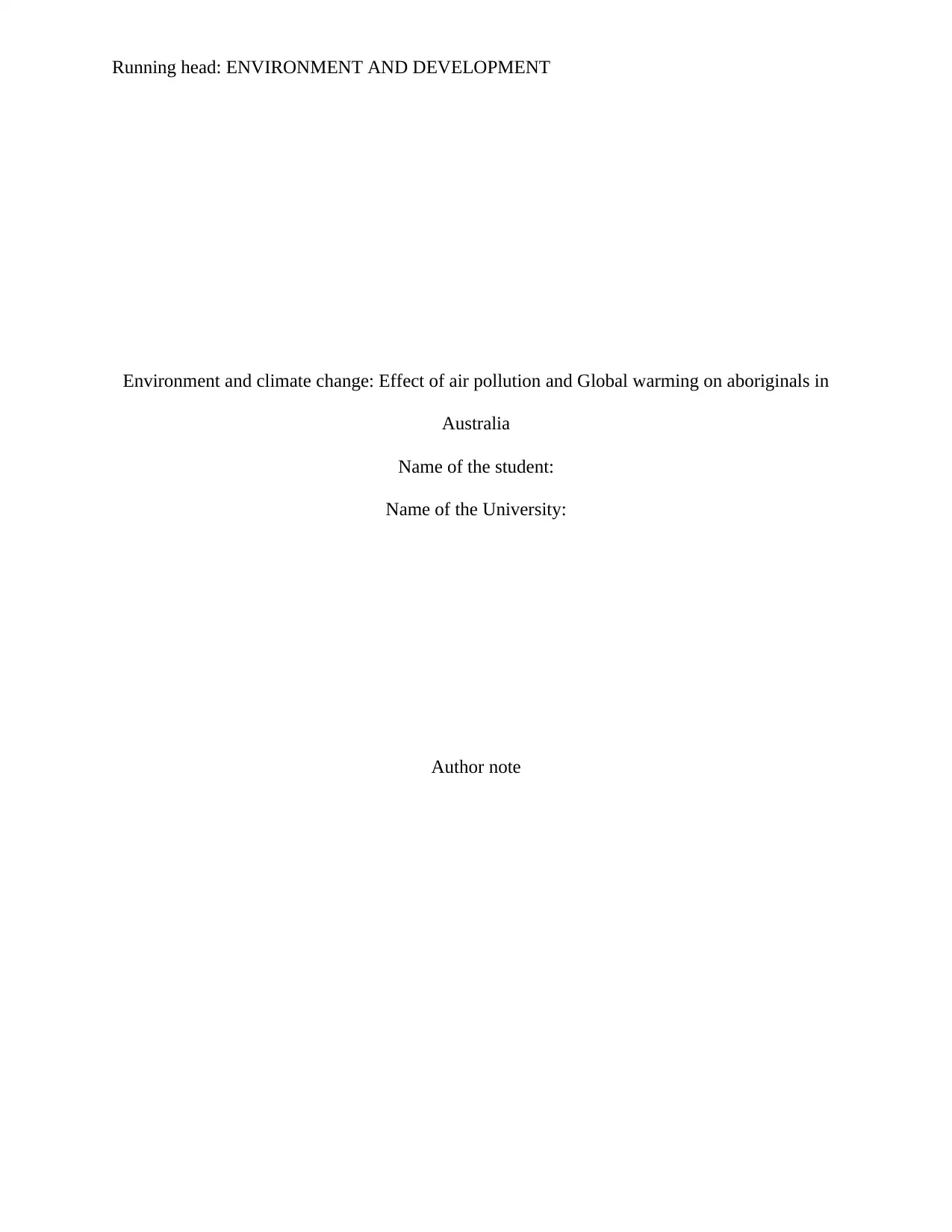
Running head: ENVIRONMENT AND DEVELOPMENT
Environment and climate change: Effect of air pollution and Global warming on aboriginals in
Australia
Name of the student:
Name of the University:
Author note
tabler-icon-diamond-filled.svg

Paraphrase This Document

Need a fresh take? Get an instant paraphrase of this document with our AI Paraphraser
Document Page
1ENVIRONMENT AND DEVELOPMENT
Table of Contents
Introduction:....................................................................................................................................2
Aim of the research:.........................................................................................................................2
Significance of the assignment........................................................................................................2
Background of the problem:............................................................................................................3
Conclusion:......................................................................................................................................3
References:......................................................................................................................................5
Future studies:..................................................................................................................................6
Document Page
2ENVIRONMENT AND DEVELOPMENT
Introduction:
Climate change is one of the issues germinated through the diabolical policy problem
around the world. Rapid growth of the industries and the capital boom in the world market has
leading to deterioration in the air pollution, which ultimately causing global warming (Knibbs
and Sly 2014). One of the most threatened groups of indigenous population lives in Australia
who is seemed to be suffering from the adverse effect of the climate change (Scarano and Ceotto
2015). Under this stringent condition of the aboriginals around the world, this report is aimed to
consider the effect of the air pollution and the global warming on the indigenous population of
the Australian population.
Aim of the research:
The research is aimed to assess the following:
The research is aimed to find whether health condition of the aboriginals is poorer than
the non indigenous population of the country
Magnitude of air pollution and global warming effect on the indigenous population
In addition to this, the report will envisage how air pollution has affected the basic
amenities like water availability; reach to health centre of the aboriginal population.
Significance of the assignment
According to the intergovernmental Panel on Climate change’s Third Assessment Report
(TAR) it has been found that the Australian aboriginals are one of the two most threatened
indigenous groups in the world that has been suffering heavily due to the adverse effect of the
climate change (Intergovernmental Panel on Climate Change 2015). Now, the irony is that, there
have been plenty of researches on the environment and development issues in Australia during
last thirteen years; however most of them are concerned about the climate change laws of
Document Page
3ENVIRONMENT AND DEVELOPMENT
Australia other than the northern territories and fragmented in nature. Previous researches have
failed to provide any long term engagement program between the community and government,
which can assess the climate change and global warming effect on the Australian aboriginals
(Race et al. 2016). Thus, this research is aimed to assess the effect of air pollution and global
warming on the aboriginal of Australia through comparative analysis of population living in
northern region of the country with the non indigenous population of Australia.
Background of the problem:
Over the time various foreign communities has came to the Australia and captured the
land of the aboriginal people during the seventeenth century (Gilbert 2016). Since then,
indigenous people have shifted to the northern territory of Australian and non indigenous
population has exploited the country’s natural resource to a great extent leading to air pollution
and global warming. According to Flora (2018), there has been various researches regarding the
challenges and issues faced by the non indigenous population due to air pollution and global
warming, however very few has addressed the case of indigenous population. There are more
than 100,000 Australian indigenous people who presently live in remote areas of the country,
whose majority section can be found in the Northern territory of the Australia and according to
the TAR report their health condition and resource availability is getting deteriorated day by day
(Intergovernmental Panel on Climate Change 2015). Under this scenario, this research is
essential for assessing the magnitude of the effect of air pollution and global warming from the
point of view of the Australian indigenous population,
Conclusion:
The potential threat to the existence of aboriginal peoples is at stake due to the
institutional and legal barriers raised through the various governmental programs regarding the
tabler-icon-diamond-filled.svg

Paraphrase This Document

Need a fresh take? Get an instant paraphrase of this document with our AI Paraphraser
Document Page
4ENVIRONMENT AND DEVELOPMENT
environment and development. Under the purview of the situation of the Australian indigenous
populations, this research is aimed to discuss the effect of air pollution and global warming on
the aboriginal population of Australia.
Document Page
5ENVIRONMENT AND DEVELOPMENT
References:
Flora, C.B., 2018. Rural communities: Legacy+ change. Routledge.
Gilbert, J., 2016. Indigenous Peoples' Land Rights under International Law. Brill.
Intergovernmental Panel on Climate Change, 2015. Climate change 2014: mitigation of climate
change (Vol. 3). Cambridge University Press.
Knibbs, L.D. and Sly, P.D., 2014. Indigenous health and environmental risk factors: an
Australian problem with global analogues?. Global health action, 7(1), p.23766.
Race, D., Mathew, S., Campbell, M. and Hampton, K., 2016. Understanding climate adaptation
investments for communities living in desert Australia: experiences of indigenous
communities. Climatic Change, 139(3-4), pp.461-475.
Scarano, F.R. and Ceotto, P., 2015. Brazilian Atlantic forest: impact, vulnerability, and
adaptation to climate change. Biodiversity and Conservation, 24(9), pp.2319-2331
Document Page
6ENVIRONMENT AND DEVELOPMENT
Future studies:
Green, D. and Minchin, L., 2014. Living on climate-changed country: Indigenous health, well-
being and climate change in remote Australian communities. EcoHealth, 11(2), pp.263-272.
Hugo, G. and Wall, J., 2015. Climate change and environmental influences on australia’s
population distribution. Health of People, Places and Planet: Reflections based on Tony
McMichael’s four decades of contribution to epidemiological understanding, p.177.
Maru, Y.T., Race, D., Sparrow, A., Mathew, S. and Chewings, V., 2015. Adaptation as a trigger
for transformation pathways in remote Indigenous communities. In Innovation in the
Rangelands, Australian Rangeland Society 18th Biennial Conference.
Schwerdtle, P., Bowen, K. and McMichael, C., 2018. The health impacts of climate-related
migration. BMC medicine, 16(1), p.1.
Spencer, B., Lawler, J., Lowe, C., Thompson, L., Hinckley, T., Kim, S.H., Bolton, S., Meschke,
S., Olden, J.D. and Voss, J., 2017. Case studies in co-benefits approaches to climate change
mitigation and adaptation. Journal of environmental planning and management, 60(4), pp.647-
667.
chevron_up_icon
1 out of 7
circle_padding
hide_on_mobile
zoom_out_icon
[object Object]