Analysis of Complex Project Management in Climate Change Projects

Verified

Added on  2023/03/17

|7
|1482
|42
Report
AI Summary
This report delves into the complexities of project management within the context of climate change, focusing on the Australian experience. It identifies multiple stakeholders (57%), including government bodies, NGOs, and international organizations, as the primary complexity driver, leading to conflicting interests and making project objectives challenging to achieve. The report emphasizes the ambiguity inherent in complex projects and the need for clear phases and adequate resources. Significant political influence (35%) and dynamic project governance are highlighted as crucial factors. Furthermore, the report examines the impact of climate change on various sectors, such as aviation, and discusses the importance of adapting to localized phenomena. It concludes by referencing the use of nuclear technologies as a potential solution for climate change mitigation and adaptation, emphasizing the need to make this concept accessible and acceptable worldwide. The report references several scholarly articles to support its findings.
Document Page
Running head: COMPLEX PROJECT MANAGEMENT
1
Complex Project Management
Name:
Institution:
Date
tabler-icon-diamond-filled.svg

Paraphrase This Document

Need a fresh take? Get an instant paraphrase of this document with our AI Paraphraser
Document Page
COMPLEX PROJECT MANAGEMENT
Introduction
In managing complex projects, climatic conditions in Australia is affected by the
following ten factors. In responding to the climatic change question in Australia, there has
been a contest on who to blame for many years. This was seen in the long struggle that took
place before the renewed policy of ecological sustainable development that was designed as a
strategic framework policy of the Australian government and adopted in 1992. The
greenhouse challenge has been the most contentious and most difficult theme in sustainability
ideas due to the coal industry special standing in Australia (Crate, & Nuttall, 2016).
Variabilities on climatic conditions have changed over time and rapid human contributions to
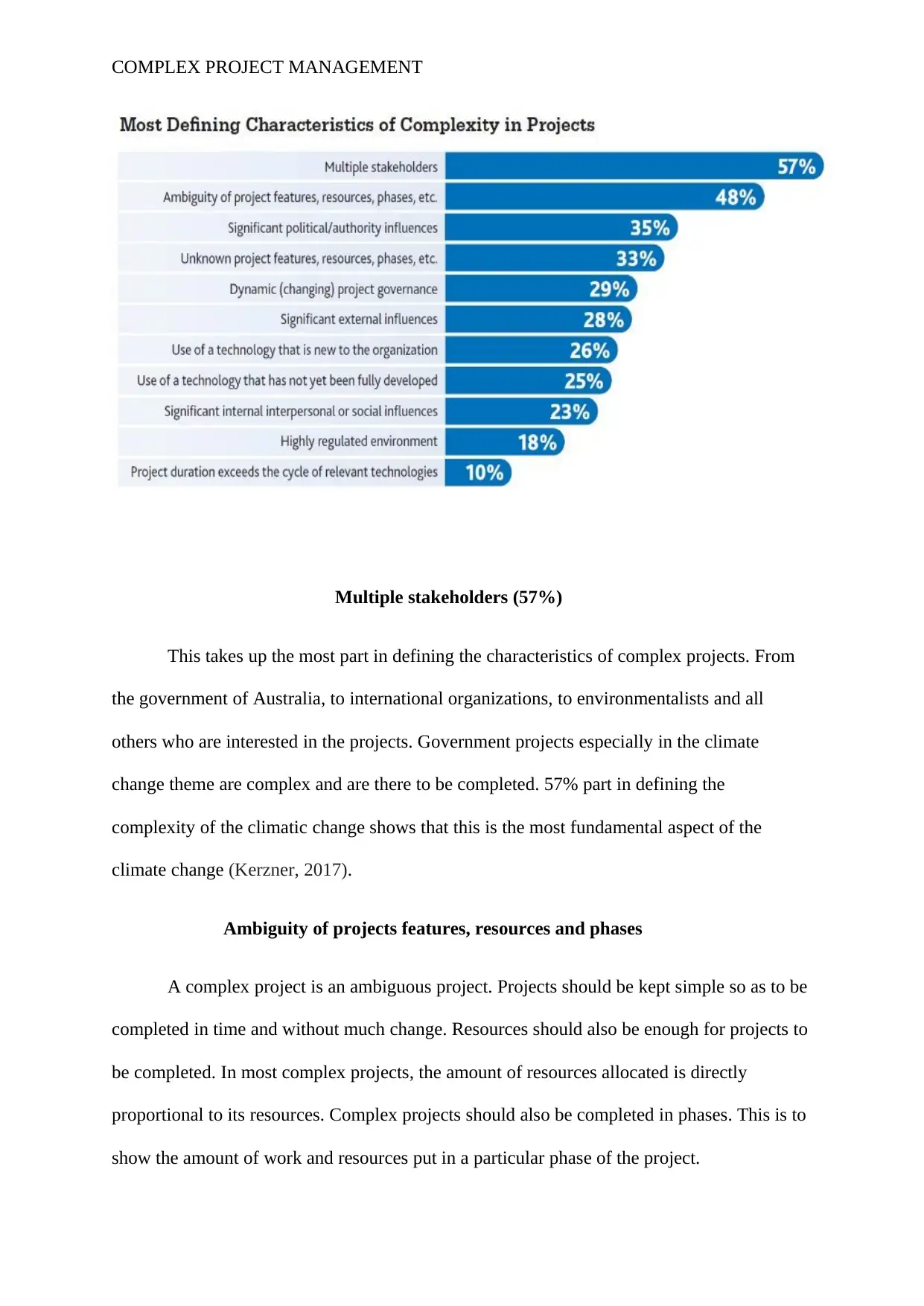
this menace. In defining the characteristics of climatic change project, the most complex is
the multiple stakeholders at 57%.
The stakeholders include the government, non-governmental organizations on
climatic change, international bodies and lobbyists who make climatic change objective not
to be reached. This has been seen as conflict of various interest by this bodies many of them
wanting to benefit from this proposed sustainability development goals (Kerzner, & Kerzner,
2017).
Document Page
COMPLEX PROJECT MANAGEMENT
Multiple stakeholders (57%)
This takes up the most part in defining the characteristics of complex projects. From
the government of Australia, to international organizations, to environmentalists and all
others who are interested in the projects. Government projects especially in the climate
change theme are complex and are there to be completed. 57% part in defining the
complexity of the climatic change shows that this is the most fundamental aspect of the
climate change (Kerzner, 2017).
Ambiguity of projects features, resources and phases
A complex project is an ambiguous project. Projects should be kept simple so as to be
completed in time and without much change. Resources should also be enough for projects to
be completed. In most complex projects, the amount of resources allocated is directly
proportional to its resources. Complex projects should also be completed in phases. This is to
show the amount of work and resources put in a particular phase of the project.
Document Page
COMPLEX PROJECT MANAGEMENT
Significant political authority and influence
There are various significant political influences that affect a project. At 35% this is
very significant to completion of the project. Since there are many stakeholders in climatic
change project, political influences play a major role. It is the work of the government in
place to set up political frameworks that will help in project management. The opposition
opposes various pro-government projects for political gain and influence. All the politics
around climate change are influenced by governments all over the world and especially the
powerful nations (Parker, Karlsson, & Hjerpe, 2017).
Dynamic changing project governance
What are the consequences of large-scale phenomena associated with a general
increase in temperature? A scientifically based fact of the effects of elevated surface
temperatures on aviation, which is based on a clear understanding of the physical processes
involved in increasing these temperatures, has been established. Estimated maximum values
of elevated temperatures, combined with elevated specific humidity in some areas, could
have a serious impact on take-off performance at high-level airports or airports with short
runways, limiting payload or fuel consumption. These impacts will require more detailed
analyzes for different regions, but they will be of particular concern to airports located on
elevated terrain in the subtropics.
Significant external influences
There are significant influences in the climate change topic. External influences are
other governments in the international community that influences the results achievable in
tabler-icon-diamond-filled.svg

Paraphrase This Document

Need a fresh take? Get an instant paraphrase of this document with our AI Paraphraser
Document Page
COMPLEX PROJECT MANAGEMENT
climatic change. The traditional method of planning long-haul departure flights for cooler
evening and night hours in some regions (highly located airports in the Middle East, Central
and South America) will be further affected by a reduction in the period of nighttime
coolness, which often has high cloudiness, partly due to long persistent condensation trails of
aircraft. In these cases, the heating effect caused by cirrus clouds due to condensation trails,
which slows down radiation cooling during the night, can be an additional problem. In some
areas, this may shorten the already limited work time (Ramazani, & Jergeas,. 2015)..
Use of technology that is new to the organization
Those associated with more intense extra-tropical cyclones will pose a threat to the
vital activity of airports in coastal areas if protective measures are not taken. Very intense
precipitation associated with cyclones can exacerbate these factors in these areas. Intensive
precipitation can lead to floods where rain flow directly encounters storm waves, such as
extreme floods that occurred in Myanmar during the passage of the tropical cyclone
(Schwalbe, 2015). Effective planning of new airports in such areas requires hydrological,
climatological and technical expertise.
Adaptation measures should take into account the future average state of the climate,
as well as local and regional extreme events that may occur in the next ten or several decades.
These extremes can already reflect typical conditions, although it was expected that such
conditions would be observed regularly only at the end of the current century.
Document Page
COMPLEX PROJECT MANAGEMENT
What can you say about the potential impacts of smaller, localized phenomena that affect
safety?
This applies to meteorological phenomena with significant effects and consequences,
such as convection and related phenomena from low-level wind shear to hail and lightning
strikes, clear sky turbulence (OR) and turbulence of orographic mountain waves, and
turbulence near the upper limit of thunderstorms, icing and low-level wind shear, poor
visibility and low cloud cover (Urry, 2015).
In a statement today at the opening of the 2018 Scientific Forum, Director General
Yukiya Amano noted that nuclear technologies play an important role in combating climate
change and the IAEA helps countries use nuclear sciences to mitigate, monitor and adapt to
global warming. We must make sure that the concept of “nuclear technologies in the fight
against climate change” is accessible and acceptable to all. Our duty is to bring it to the whole
world and tell everyone about the important role of nuclear technologies in combating
climate change.It will not be easy for the world to solve the problem of sufficient energy
supply and achieve the goal of the Paris Agreement to limit the growth of the average global
temperature by two degrees Celsius, without resorting to a more extended use of nuclear
energy (Zehr, 2016).
Lowland terrain and high population density make Australia one of the most vulnerable
countries to climate change, and the Australia Strategy for Combating Climate Change and
the Australia Action Plan include the use of nuclear technologies for both adaptation and
mitigation. “
Document Page
COMPLEX PROJECT MANAGEMENT
References
Crate, S. A., & Nuttall, M. (Eds.). (2016). Anthropology and climate change: from
encounters to actions. Routledge.
Kerzner, H., & Kerzner, H. R. (2017). Project management: a systems approach to planning,
scheduling, and controlling. John Wiley & Sons.
Kerzner, H. (2017). Project management metrics, KPIs, and dashboards: a guide to
measuring and monitoring project performance. John Wiley & Sons.
Parker, C. F., Karlsson, C., & Hjerpe, M. (2017). Assessing the European Union’s global
climate change leadership: from Copenhagen to the Paris Agreement. Journal of
European Integration, 39(2), 239-252.
Ramazani, J., & Jergeas, G. (2015). Project managers and the journey from good to great:
The benefits of investment in project management training and
education. International Journal of Project Management, 33(1), 41-52.
Schwalbe, K. (2015). Information technology project management. Cengage Learning.
Urry, J. (2015). Climate change and society. In Why the social sciences matter (pp. 45-59).
Palgrave Macmillan, London.
Zehr, S. C. (2016). Public representations of scientific uncertainty about global climate
change. Public understanding of science.
chevron_up_icon
1 out of 7
circle_padding
hide_on_mobile
zoom_out_icon
[object Object]