CQUniversity PPMP 200: Climate Change Project Management Report

Verified

Added on  2023/03/17

|8
|1614
|39
Report
AI Summary
This report delves into the complexities of project management within the context of climate change, addressing various stakeholders including governmental bodies, organizations, and local communities impacted by climate shifts. It explores the ambiguity of project features, significant political influences, and the impact of unknown project elements. The report examines dynamic project governance, significant external factors like solar energy variations and greenhouse gas effects, and the role of new technologies in addressing environmental challenges. It also considers internal influences on climate change, the implications of highly regulated environments, and includes a Rader diagram to visually represent project aspects. References to relevant academic sources are provided to support the analysis of climate change project management.
Document Page
Running head: PROJECT MANAGEMENT
PROJECT MANAGEMENT
Name of the Student
Name of the University
Author Note
tabler-icon-diamond-filled.svg

Paraphrase This Document

Need a fresh take? Get an instant paraphrase of this document with our AI Paraphraser
Document Page
PROJECT MANAGEMENT 1
Stakeholders:
There are a total 53 number of the departments, authorities, groups and the
organizations who might be the stakeholders in the climate change. Either the creeping
change or the climate change in the impact of the climate in the local communities, fauna as
well as flora. This can be used for generating a list of the stakeholders who are potential or as
the checklist if any of the lists have been missed (Prokopy et al., 2015). The focus of the list
is on the change in the climate for a list of the stakeholders that is generic.
Ambiguity of project features:
It is agreed by most of the economist that the need for controlling the emissions of the
greenhouse gases however the debate that is about how the rapids cut would be, remains
there. In the stern of the eponymous the review on the climate change economics that is
sponsored by the govt of UK (Ranger, Reeder & Lowe, 2013). This is held commonly that
the disagreement source between the Nordhaus and the Stern camps is how the consumption
can be distributed over time.
Significant political influences:
The political influence in the climate change is such an approach, which is able to
apply the thinking the political influence of the political or collective procedures for studying
the issues that are critical and surrounding the making of decisions on the change of climate
(Engels et al., 2013). The awareness of ever increasing as well as the urgency of the change
of the climate provide pressure to the scholars for exploring an understanding that is better.
Unknown project features:
The people flummoxed naturally uncertainly, at the time of facing with the decisions that are
hard, some of the people latch tightly onto the evidence and facts, graphs and numbers, data
Document Page
2PROJECT MANAGEMENT
and probabilities (Cosens, Gunderson & Chaffin, 2014). This is true that the climate change
is driven and happening by the factors of the human but the complex nature makes the
climate less clear.
Dynamic project governance:
The adoption of the change of the climate is not a technological issue only; this is one of the
matter of the governance. The adoption of the governance poses some of the challenges that
are demanding and specific like the context of the fragmentation of the institutions, as the
change in the climate includes almost all of the policies of the domain as well as the levels of
the governance (Urpelainen, 2013).
Significant external influences:
The temperature of the Earth is depending on the balance that is between the leaving the
system of the planet and the energy entering. When the energy come from the sun as soon as
that is absorbed by the system of the Earth and the warms of the Earth. However, when the
energy of the sun is reflected back to the space, then the warming is avoided by the earth
(Marvel & Bonfils, 2013). The time when the energy that was absorbed released back into the
space the earth cools down. The factors are:
Changes in reflectivity.
Variations in the energy of the sun.
Changes in the effect of the greenhouse gases.
Use of technology that is new in organization:
The role of the innovation of the technology for addressing the problems that are societal like
the air pollution as well as the water pollution is a development that is recent (Cascio &
Document Page
3PROJECT MANAGEMENT
Montealegre, 2016). The innovations in the industries like in the electronics and
pharmaceuticals, where the incoming results are new products totally the consumers desire
that. The role of the policies of the governance as well as the regulations become more and
more critical, since most of the issues that are related to the environment, needs the action
that are collective for addressing effectively the issues.
Use of a technology that is has not yet fully developed:
As the ongoing and the past emissions of the greenhouse gas take the inevitable toll of them
on the adoption and climate that refers for finding as well as implementing the ways of sound
for the adjustment to the effects of the change in the climate that are adverse (Fujimori,
Masui & Matsuoka, 2014). Most of the methods for the adoption include some form of the
technologies that are not yet developed fully. For all of those technologies the major
challenges is for ensuring that the greatest needs are served by them.
Significant internal influences:
The surface of the instrumental records of the temperature has been compiled fir the huge
parts of the earth from the last 100 years. It has shown that the northern hemisphere annual
means that the temperature has been increased about 1 degree centigrade from the year 1880
to 1940. The theory of the internal influences has been developed by Lorenz (Kay et al.,
2015). The change in the climate might just for the variations for the non-linner interactions
that are having so much complexity.
Highly regulated environment:
The interaction between the regulated entities and the enforcement agencies tend to be still
based on the approach of the carrot stick with few of the companies that local (Zhang et al.,
2013). There are no formal guidelines that are related to these kind of situations as well as
tabler-icon-diamond-filled.svg

Paraphrase This Document

Need a fresh take? Get an instant paraphrase of this document with our AI Paraphraser
Document Page
4PROJECT MANAGEMENT
rewards of absent explicit for such of the voluntary disclosers as well as the companies that
are local with lack of confidence for the approach of the enforcement agencies.
Document Page
5PROJECT MANAGEMENT
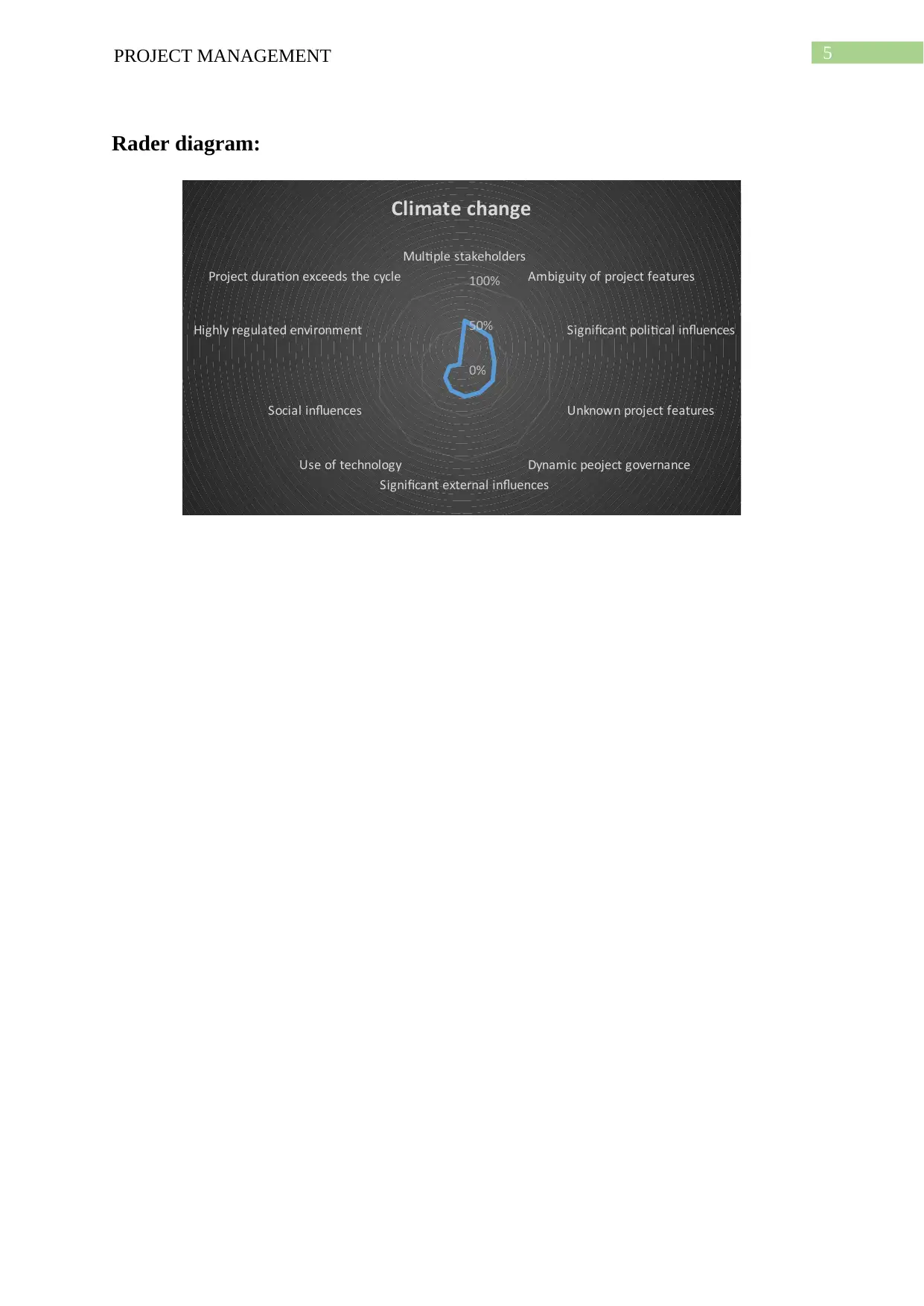
Rader diagram:
Multiple stakeholders
Ambiguity of project features
Significant political influences
Unknown project features
Dynamic peoject governance
Significant external influences
Use of technology
Social influences
Highly regulated environment
Project duration exceeds the cycle
0%
50%
100%
Climate change
Document Page
6PROJECT MANAGEMENT
References:
Prokopy, L. S., Carlton, J. S., Arbuckle, J. G., Haigh, T., Lemos, M. C., Mase, A. S., ... &
Hart, C. (2015). Extension′ s role in disseminating information about climate change to
agricultural stakeholders in the United States. Climatic Change, 130(2), 261-272.
Ranger, N., Reeder, T., & Lowe, J. (2013). Addressing ‘deep’uncertainty over long-term
climate in major infrastructure projects: four innovations of the Thames Estuary 2100
Project. EURO Journal on Decision Processes, 1(3-4), 233-262.
Engels, A., Hüther, O., Schäfer, M., & Held, H. (2013). Public climate-change skepticism,
energy preferences and political participation. Global environmental change, 23(5), 1018-
1027.
Cosens, B., Gunderson, L., & Chaffin, B. (2014). The Adaptive Water Governance Project:
Assessing Law, Resiliance and Governance in Regional Socio-Ecological Water Systems
Facing a Changing Climate. Idaho L. Rev., 51, 1.
Urpelainen, J. (2013). A model of dynamic climate governance: dream big, win
small. International Environmental Agreements: Politics, Law and Economics, 13(2), 107-
125.
Marvel, K., & Bonfils, C. (2013). Identifying external influences on global
precipitation. Proceedings of the National Academy of Sciences, 110(48), 19301-19306.
Cascio, W. F., & Montealegre, R. (2016). How technology is changing work and
organizations. Annual Review of Organizational Psychology and Organizational Behavior, 3,
349-375.
tabler-icon-diamond-filled.svg

Paraphrase This Document

Need a fresh take? Get an instant paraphrase of this document with our AI Paraphraser
Document Page
7PROJECT MANAGEMENT
Fujimori, S., Masui, T., & Matsuoka, Y. (2014). Development of a global computable general
equilibrium model coupled with detailed energy end-use technology. Applied Energy, 128,
296-306.
Kay, J. E., Deser, C., Phillips, A., Mai, A., Hannay, C., Strand, G., ... & Holland, M. (2015).
The Community Earth System Model (CESM) large ensemble project: A community
resource for studying climate change in the presence of internal climate variability. Bulletin
of the American Meteorological Society, 96(8), 1333-1349.
Zhang, Y., Xia, J., Shao, Q., & Zhai, X. (2013). Water quantity and quality simulation by
improved SWAT in highly regulated Huai River Basin of China. Stochastic Environmental
Research and Risk Assessment, 27(1), 11-27.
Westra, S., Fowler, H. J., Evans, J. P., Alexander, L. V., Berg, P., Johnson, F., ... & Roberts,
N. M. (2014). Future changes to the intensity and frequency of short‐duration extreme
rainfall. Reviews of Geophysics, 52(3), 522-555.
chevron_up_icon
1 out of 8
circle_padding
hide_on_mobile
zoom_out_icon
[object Object]