Principles of Sustainability: Climate Change Impact on India
VerifiedAdded on 2019/11/14
|12
|3404
|228
Report
AI Summary
This report comprehensively examines the multifaceted issue of climate change in India, delving into its causes, including the burning of fossil fuels, deforestation, and greenhouse gas emissions. It explores the various factors contributing to climate change in India, such as rising sea levels, changes in water conditions, and greenhouse gas emissions, and also discusses the impact of climate change on the country's environment, including its effects on agriculture, biodiversity, and human health. The report highlights the vulnerabilities of the Indian agricultural sector to changing rainfall patterns and rising temperatures. Furthermore, it emphasizes the risks to human health due to air pollution and the increased frequency of extreme weather events. The report also provides a detailed analysis of the specific changes observed over the years, like the rise in sea levels, the impacts of greenhouse gases, and solar variations, offering a holistic view of the issue and its repercussions. This report, contributed by a student, is available on Desklib, a platform providing AI-powered study tools.
Running Head: Principles of sustainability 1
Climate change in India and its impact
Climate change in India and its impact

Paraphrase This Document
Need a fresh take? Get an instant paraphrase of this document with our AI Paraphraser
Principles of sustainability 2
Contents
List of figures...................................................................................................................................2
Introduction......................................................................................................................................3
Climate change affecting world.......................................................................................................3
Factors of climate change in India...................................................................................................4
Impact of climate change on India...................................................................................................8
Climate change risk assessment.......................................................................................................9
Proposed Measurements..............................................................................................................9
Conclusion.....................................................................................................................................10
References......................................................................................................................................11
List of figures
Figure 1: Rise in sea level................................................................................................................5
Figure 2: Greenhouse emission.......................................................................................................6
Figure 3: Rise in temperature..........................................................................................................7
Contents
List of figures...................................................................................................................................2
Introduction......................................................................................................................................3
Climate change affecting world.......................................................................................................3
Factors of climate change in India...................................................................................................4
Impact of climate change on India...................................................................................................8
Climate change risk assessment.......................................................................................................9
Proposed Measurements..............................................................................................................9
Conclusion.....................................................................................................................................10
References......................................................................................................................................11
List of figures
Figure 1: Rise in sea level................................................................................................................5
Figure 2: Greenhouse emission.......................................................................................................6
Figure 3: Rise in temperature..........................................................................................................7
Principles of sustainability 3
Introduction
Climate and environment is continuously changing and it is affecting each country
significantly. There are various reasons of environmental change in the countries. Sometimes it
can be because of unnecessary and asymmetrical activities such as burning of fuel oils, coals and
usual gases, agricultural clearance etc. High level of heat in climate, melting snow, and increased
sea level globally etc. in the simple words, in current time climate change is one of the critical
issues faced by every country. In terms of definition, climate change can be described as the
differences in the climate at the global level of the earth. Climate change in the environment can
be defined in different ways. Some of the researchers have defined the climate change as the
disorder of the natural process on the earth (Bürger et al, 2012). On the other hand, some defined
the climate change as the significant change which is linked with the human activities directly or
indirectly along with the combination of natural climate variability. Now, various countries and
researchers are raising the concern about the climate changes and its impacts. Various incidents
of the climate change are recorded in all over the world. This report describes the various
changes in the climate and impact of climate change in India. Along with this, the report also
gives the probable resolutions to deal with the issue of change in environment.
Climate change affecting world
Because of climate change, not only one or two countries, but also entire world is facing
problem. The changes in the environment and climate impact on the various parts of the society
such as industries, ecosystem and communities. It is observed that heat in the environment is
continuously increasing and rainfall is decreasing gradually since last few years. Reduced
rainfall is the main cause of the climate change that is affecting overall world. Along with this, it
is also seen that there is the continuous change in the temperature, sea level and level of rainfall.
It has to be understood that the climate change is the cause of many activities in the environment.
Climate change raises the temperature in the atmosphere and with the high temperature; various
changes take place on the earth. For example, high temperature can be the cause of excessive
rain, more floods, more heat waves and droughts. Further, some changes also take place in the
ocean and glaciers i.e. glaciers are melting gradually, water in the oceans are warming and
becoming acidic, and sea levels are increasing that is affecting human on the earth. Since last few
Introduction
Climate and environment is continuously changing and it is affecting each country
significantly. There are various reasons of environmental change in the countries. Sometimes it
can be because of unnecessary and asymmetrical activities such as burning of fuel oils, coals and
usual gases, agricultural clearance etc. High level of heat in climate, melting snow, and increased
sea level globally etc. in the simple words, in current time climate change is one of the critical
issues faced by every country. In terms of definition, climate change can be described as the
differences in the climate at the global level of the earth. Climate change in the environment can
be defined in different ways. Some of the researchers have defined the climate change as the
disorder of the natural process on the earth (Bürger et al, 2012). On the other hand, some defined
the climate change as the significant change which is linked with the human activities directly or
indirectly along with the combination of natural climate variability. Now, various countries and
researchers are raising the concern about the climate changes and its impacts. Various incidents
of the climate change are recorded in all over the world. This report describes the various
changes in the climate and impact of climate change in India. Along with this, the report also
gives the probable resolutions to deal with the issue of change in environment.
Climate change affecting world
Because of climate change, not only one or two countries, but also entire world is facing
problem. The changes in the environment and climate impact on the various parts of the society
such as industries, ecosystem and communities. It is observed that heat in the environment is
continuously increasing and rainfall is decreasing gradually since last few years. Reduced
rainfall is the main cause of the climate change that is affecting overall world. Along with this, it
is also seen that there is the continuous change in the temperature, sea level and level of rainfall.
It has to be understood that the climate change is the cause of many activities in the environment.
Climate change raises the temperature in the atmosphere and with the high temperature; various
changes take place on the earth. For example, high temperature can be the cause of excessive
rain, more floods, more heat waves and droughts. Further, some changes also take place in the
ocean and glaciers i.e. glaciers are melting gradually, water in the oceans are warming and
becoming acidic, and sea levels are increasing that is affecting human on the earth. Since last few
⊘ This is a preview!⊘
Do you want full access?
Subscribe today to unlock all pages.

Trusted by 1+ million students worldwide
Principles of sustainability 4
years, these changes are frequently happening and challenging to the world and the environment
of human beings (Feyen & Dankers 2009).
Factors of climate change in India
Climate change is affecting every country in all over the world but this report is basically
covering the country India. Climate change is one of the complex issues facing mankind today.
This is the evident of various observations of increment of global air and ocean temperatures,
melting of snow and ice and raising sea level. It also increases variety of the challenges with the
wide-ranging effects. Along with this, climate change has significant impacts on the conditions
of the agriculture. Agriculture is the backbone of the Indian economy that provides food and
livelihood security to the most of the population of Indian society. Agriculture is significantly
affected not only by the increased and decreased rainfall but also shifts in the timings of the
rainfall (Dillman 2015). Changes in the patterns of rainfall are the serious threat for the
agriculture, economy and food security in India. Further, rise in the temperature also affects the
environment of India as rise in the temperature is the cause of increment in the green house gases
and affect the crops differently from region to region in the country. High level of floods,
deficiency, storms and cyclones are distressing the environment in the country India. There are
various problems in India because of climate change such as concern in the farming and
cultivation, water stress, rising sea level, issues of food security, biodiversity and risk on human
health (Kakkar, 2014). There are some climate changes that are observed during some years and
those are as follows:
Rise in sea levels-
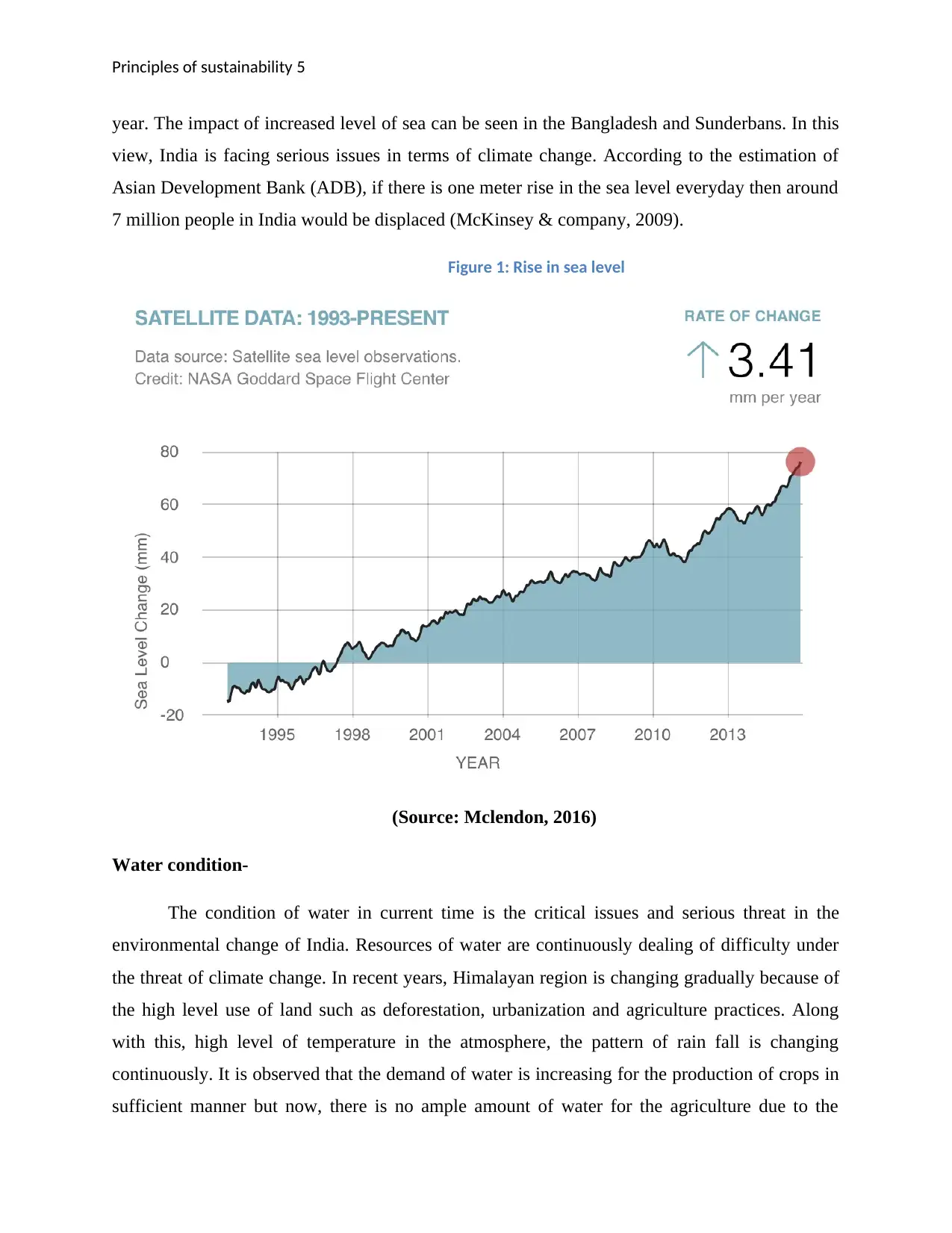
70% of earth’s surface includes of water in the form of ocean and sea. Sea level is rising
due to global warming. Sea level is rising due to thermal extension as well as melting of glaciers.
Global temperature is increasing 3 to 4 degree and the result is that 330 million people would be
permanently or temporarily relocated because of flood. There is the high level of risk due to the
rise of sea level as the result of global warming. It is predictable that the big coastal region will
be covered with the increased of sea level. These climate changes are creating problems for the
country India and cause much human hardship. The Ganges-Brahmaputra delta of India is
supposed to be extremely at risky region as water level in this area will rise in the upcoming
years, these changes are frequently happening and challenging to the world and the environment
of human beings (Feyen & Dankers 2009).
Factors of climate change in India
Climate change is affecting every country in all over the world but this report is basically
covering the country India. Climate change is one of the complex issues facing mankind today.
This is the evident of various observations of increment of global air and ocean temperatures,
melting of snow and ice and raising sea level. It also increases variety of the challenges with the
wide-ranging effects. Along with this, climate change has significant impacts on the conditions
of the agriculture. Agriculture is the backbone of the Indian economy that provides food and
livelihood security to the most of the population of Indian society. Agriculture is significantly
affected not only by the increased and decreased rainfall but also shifts in the timings of the
rainfall (Dillman 2015). Changes in the patterns of rainfall are the serious threat for the
agriculture, economy and food security in India. Further, rise in the temperature also affects the
environment of India as rise in the temperature is the cause of increment in the green house gases
and affect the crops differently from region to region in the country. High level of floods,
deficiency, storms and cyclones are distressing the environment in the country India. There are
various problems in India because of climate change such as concern in the farming and
cultivation, water stress, rising sea level, issues of food security, biodiversity and risk on human
health (Kakkar, 2014). There are some climate changes that are observed during some years and
those are as follows:
Rise in sea levels-
70% of earth’s surface includes of water in the form of ocean and sea. Sea level is rising
due to global warming. Sea level is rising due to thermal extension as well as melting of glaciers.
Global temperature is increasing 3 to 4 degree and the result is that 330 million people would be
permanently or temporarily relocated because of flood. There is the high level of risk due to the
rise of sea level as the result of global warming. It is predictable that the big coastal region will
be covered with the increased of sea level. These climate changes are creating problems for the
country India and cause much human hardship. The Ganges-Brahmaputra delta of India is
supposed to be extremely at risky region as water level in this area will rise in the upcoming
Paraphrase This Document
Need a fresh take? Get an instant paraphrase of this document with our AI Paraphraser
Principles of sustainability 5
year. The impact of increased level of sea can be seen in the Bangladesh and Sunderbans. In this
view, India is facing serious issues in terms of climate change. According to the estimation of
Asian Development Bank (ADB), if there is one meter rise in the sea level everyday then around
7 million people in India would be displaced (McKinsey & company, 2009).
Figure 1: Rise in sea level
(Source: Mclendon, 2016)
Water condition-
The condition of water in current time is the critical issues and serious threat in the
environmental change of India. Resources of water are continuously dealing of difficulty under
the threat of climate change. In recent years, Himalayan region is changing gradually because of
the high level use of land such as deforestation, urbanization and agriculture practices. Along
with this, high level of temperature in the atmosphere, the pattern of rain fall is changing
continuously. It is observed that the demand of water is increasing for the production of crops in
sufficient manner but now, there is no ample amount of water for the agriculture due to the
year. The impact of increased level of sea can be seen in the Bangladesh and Sunderbans. In this
view, India is facing serious issues in terms of climate change. According to the estimation of
Asian Development Bank (ADB), if there is one meter rise in the sea level everyday then around
7 million people in India would be displaced (McKinsey & company, 2009).
Figure 1: Rise in sea level
(Source: Mclendon, 2016)
Water condition-
The condition of water in current time is the critical issues and serious threat in the
environmental change of India. Resources of water are continuously dealing of difficulty under
the threat of climate change. In recent years, Himalayan region is changing gradually because of
the high level use of land such as deforestation, urbanization and agriculture practices. Along
with this, high level of temperature in the atmosphere, the pattern of rain fall is changing
continuously. It is observed that the demand of water is increasing for the production of crops in
sufficient manner but now, there is no ample amount of water for the agriculture due to the
Principles of sustainability 6
continuous climate change. Further, global warming is also one of the reasons that are affecting
the water security in the country. Safety of water is the critical matter in the country in terms of
the development of the agriculture (Poornima, 2015).
Greenhouse gases-
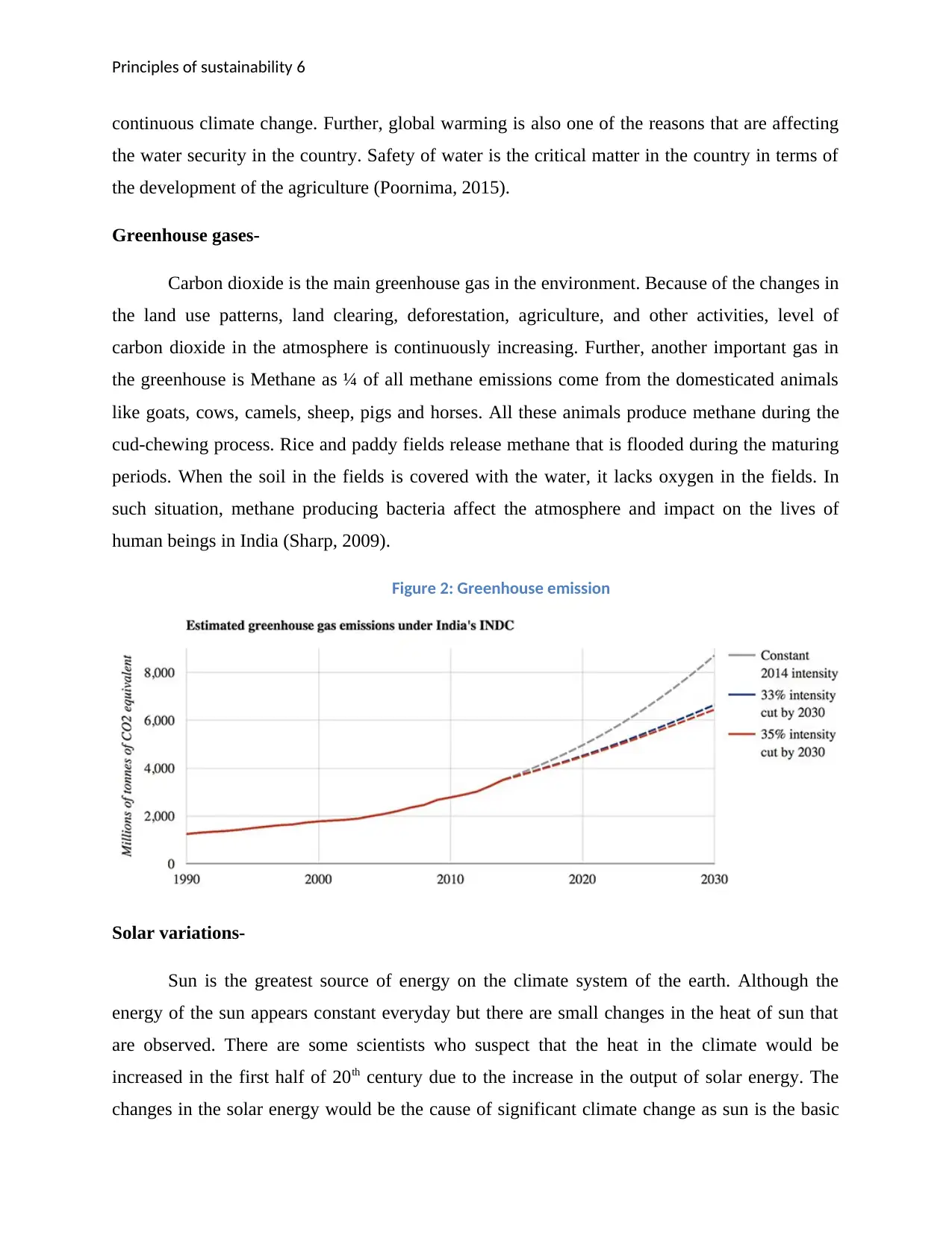
Carbon dioxide is the main greenhouse gas in the environment. Because of the changes in
the land use patterns, land clearing, deforestation, agriculture, and other activities, level of
carbon dioxide in the atmosphere is continuously increasing. Further, another important gas in
the greenhouse is Methane as ¼ of all methane emissions come from the domesticated animals
like goats, cows, camels, sheep, pigs and horses. All these animals produce methane during the
cud-chewing process. Rice and paddy fields release methane that is flooded during the maturing
periods. When the soil in the fields is covered with the water, it lacks oxygen in the fields. In
such situation, methane producing bacteria affect the atmosphere and impact on the lives of
human beings in India (Sharp, 2009).
Figure 2: Greenhouse emission
Solar variations-
Sun is the greatest source of energy on the climate system of the earth. Although the
energy of the sun appears constant everyday but there are small changes in the heat of sun that
are observed. There are some scientists who suspect that the heat in the climate would be
increased in the first half of 20th century due to the increase in the output of solar energy. The
changes in the solar energy would be the cause of significant climate change as sun is the basic
continuous climate change. Further, global warming is also one of the reasons that are affecting
the water security in the country. Safety of water is the critical matter in the country in terms of
the development of the agriculture (Poornima, 2015).
Greenhouse gases-
Carbon dioxide is the main greenhouse gas in the environment. Because of the changes in
the land use patterns, land clearing, deforestation, agriculture, and other activities, level of
carbon dioxide in the atmosphere is continuously increasing. Further, another important gas in
the greenhouse is Methane as ¼ of all methane emissions come from the domesticated animals
like goats, cows, camels, sheep, pigs and horses. All these animals produce methane during the
cud-chewing process. Rice and paddy fields release methane that is flooded during the maturing
periods. When the soil in the fields is covered with the water, it lacks oxygen in the fields. In
such situation, methane producing bacteria affect the atmosphere and impact on the lives of
human beings in India (Sharp, 2009).
Figure 2: Greenhouse emission
Solar variations-
Sun is the greatest source of energy on the climate system of the earth. Although the
energy of the sun appears constant everyday but there are small changes in the heat of sun that
are observed. There are some scientists who suspect that the heat in the climate would be
increased in the first half of 20th century due to the increase in the output of solar energy. The
changes in the solar energy would be the cause of significant climate change as sun is the basic
⊘ This is a preview!⊘
Do you want full access?
Subscribe today to unlock all pages.
Trusted by 1+ million students worldwide
Principles of sustainability 7
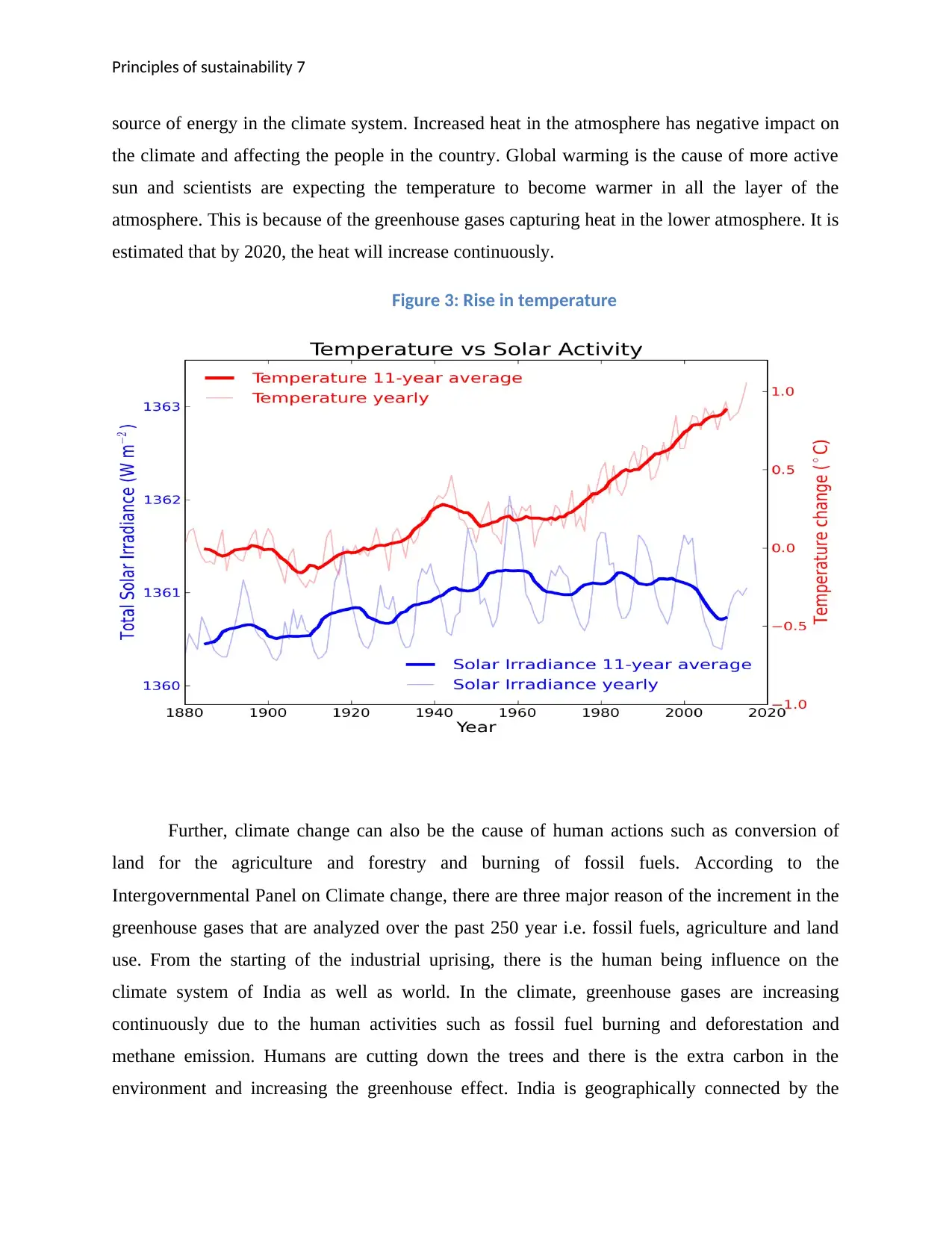
source of energy in the climate system. Increased heat in the atmosphere has negative impact on
the climate and affecting the people in the country. Global warming is the cause of more active
sun and scientists are expecting the temperature to become warmer in all the layer of the
atmosphere. This is because of the greenhouse gases capturing heat in the lower atmosphere. It is
estimated that by 2020, the heat will increase continuously.
Figure 3: Rise in temperature
Further, climate change can also be the cause of human actions such as conversion of
land for the agriculture and forestry and burning of fossil fuels. According to the
Intergovernmental Panel on Climate change, there are three major reason of the increment in the
greenhouse gases that are analyzed over the past 250 year i.e. fossil fuels, agriculture and land
use. From the starting of the industrial uprising, there is the human being influence on the
climate system of India as well as world. In the climate, greenhouse gases are increasing
continuously due to the human activities such as fossil fuel burning and deforestation and
methane emission. Humans are cutting down the trees and there is the extra carbon in the
environment and increasing the greenhouse effect. India is geographically connected by the
source of energy in the climate system. Increased heat in the atmosphere has negative impact on
the climate and affecting the people in the country. Global warming is the cause of more active
sun and scientists are expecting the temperature to become warmer in all the layer of the
atmosphere. This is because of the greenhouse gases capturing heat in the lower atmosphere. It is
estimated that by 2020, the heat will increase continuously.
Figure 3: Rise in temperature
Further, climate change can also be the cause of human actions such as conversion of
land for the agriculture and forestry and burning of fossil fuels. According to the
Intergovernmental Panel on Climate change, there are three major reason of the increment in the
greenhouse gases that are analyzed over the past 250 year i.e. fossil fuels, agriculture and land
use. From the starting of the industrial uprising, there is the human being influence on the
climate system of India as well as world. In the climate, greenhouse gases are increasing
continuously due to the human activities such as fossil fuel burning and deforestation and
methane emission. Humans are cutting down the trees and there is the extra carbon in the
environment and increasing the greenhouse effect. India is geographically connected by the
Paraphrase This Document
Need a fresh take? Get an instant paraphrase of this document with our AI Paraphraser
Principles of sustainability 8
Indian Ocean which is known as third largest ocean in the world and the climate on the India is
primarily affected by the activities within the ocean (Ravindranath, Joshi & Jayaraman, 2012).
Impact of Environmental change on India
Climate change is the serious matter in all over the world as it is creating various
challenges for every country. In such situation, India is facing some impacts on the people of
country. Country is facing some tough situations due to the climate change such as issue in the
farming, troubles of food safety, increasing of sea intensity, hazard on people wellbeing, risk of
food security etc. Climate change has high level of significance from the viewpoint of India.
Impact of the agriculture and food security-
Environmental change has negative effect on the Indian farming system. Because of
increased temperature, high level of rainfall, melting glacier, the climate change is impacting on
the production of various crops. Climate change affects the agriculture in many different ways. It
is well known that the agriculture is the crucial part of Indian economy and the source of
livelihood of people in the country. So, rainfall pattern in the country affect the productivity of
agriculture. The productivity of various crops is decreasing continuously because of the heat
waves, high temperature and scarcity of the water. There are high frequencies of overflow,
cyclones, deficiency and rainstorms impacts on the agriculture creation in the country
(Mclendon, 2016).
Impact on biodiversity-
India is the country of various culture and biodiversity regarding deserts to ice sheets. In
current time, environmental change is undermining the biological system of the country India. It
is well known that the Himalayan ecosystem is the lifeline of India. Monsoon is basically
depends upon the environment of India and monsoon is the basic need for the farming and
irrigation. Environmental change is the basic cause of varying patterns of monsoon in the
country (Dubash and Jogesh, 2014).
Impact on human health-
Indian Ocean which is known as third largest ocean in the world and the climate on the India is
primarily affected by the activities within the ocean (Ravindranath, Joshi & Jayaraman, 2012).
Impact of Environmental change on India
Climate change is the serious matter in all over the world as it is creating various
challenges for every country. In such situation, India is facing some impacts on the people of
country. Country is facing some tough situations due to the climate change such as issue in the
farming, troubles of food safety, increasing of sea intensity, hazard on people wellbeing, risk of
food security etc. Climate change has high level of significance from the viewpoint of India.
Impact of the agriculture and food security-
Environmental change has negative effect on the Indian farming system. Because of
increased temperature, high level of rainfall, melting glacier, the climate change is impacting on
the production of various crops. Climate change affects the agriculture in many different ways. It
is well known that the agriculture is the crucial part of Indian economy and the source of
livelihood of people in the country. So, rainfall pattern in the country affect the productivity of
agriculture. The productivity of various crops is decreasing continuously because of the heat
waves, high temperature and scarcity of the water. There are high frequencies of overflow,
cyclones, deficiency and rainstorms impacts on the agriculture creation in the country
(Mclendon, 2016).
Impact on biodiversity-
India is the country of various culture and biodiversity regarding deserts to ice sheets. In
current time, environmental change is undermining the biological system of the country India. It
is well known that the Himalayan ecosystem is the lifeline of India. Monsoon is basically
depends upon the environment of India and monsoon is the basic need for the farming and
irrigation. Environmental change is the basic cause of varying patterns of monsoon in the
country (Dubash and Jogesh, 2014).
Impact on human health-
Principles of sustainability 9
It is observed that the climate change is the significant impact on the human health of the
country. There is the air pollution due to the climate change that is impacting on the health of
human beings. The researchers have suggested that the health problems in the country would be
increased because of continuous climate change. Further, it is estimated that the number of death
would also be increased due to air pollution. High global temperature is the reason of increment
in the frequency of floods along with the risk of disease of infection among the people (Kumar &
Gambhir, 2013).
Climate change risk assessment
In India, impact of climate change can be seen very clearly on various parts of the
country. No any country can afford to sit on the sideline as the impact of climate change is
increasing gradually. Although India is not responsible for any kind of promise in dropping the
negative impact of greenhouse emission and climate change but the country is equally
contributing to the negotiation of climate change. According to the various researchers, there are
many developed countries that are responsible for the climate change. So, in such manner, those
developed countries should do commitments in way of decreasing the negative impact of climate
change on the people (Jha, 2014). Further, India is trying to commit to the way of sustainable
development. It is estimated that per capita emissions of the carbon gases in India is little but
country should adopt a national action plan for the climate change. India is a responsible country
in the world so, country should support at the international level in terms of economy and right to
use of technology till the year 2030 (Bal, Bhaskaran & Palanivelu, 2016). The country is
attending international conference on the concept of climate change to develop of clean
technologies in terms of environment friendly. India should try to convince the developed
nations to exchange cleaner vitality advancements that are eco-friendly sound so that developing
countries could be able to use it. India is the collaborator of Asia Pacific Partnership on clean
development and climate. By this, country should focus on the transfer of efficient and clean
technologies to deal with the issue of climate change (Ghosh & Ray, 2015).
Proposed Measurements
The contribution of the country India towards reducing the impact of negative gases is
very little and the Indian government should use various actions to enhance the condition in
terms of climate change. The department of forests and environment is the key organization in
It is observed that the climate change is the significant impact on the human health of the
country. There is the air pollution due to the climate change that is impacting on the health of
human beings. The researchers have suggested that the health problems in the country would be
increased because of continuous climate change. Further, it is estimated that the number of death
would also be increased due to air pollution. High global temperature is the reason of increment
in the frequency of floods along with the risk of disease of infection among the people (Kumar &
Gambhir, 2013).
Climate change risk assessment
In India, impact of climate change can be seen very clearly on various parts of the
country. No any country can afford to sit on the sideline as the impact of climate change is
increasing gradually. Although India is not responsible for any kind of promise in dropping the
negative impact of greenhouse emission and climate change but the country is equally
contributing to the negotiation of climate change. According to the various researchers, there are
many developed countries that are responsible for the climate change. So, in such manner, those
developed countries should do commitments in way of decreasing the negative impact of climate
change on the people (Jha, 2014). Further, India is trying to commit to the way of sustainable
development. It is estimated that per capita emissions of the carbon gases in India is little but
country should adopt a national action plan for the climate change. India is a responsible country
in the world so, country should support at the international level in terms of economy and right to
use of technology till the year 2030 (Bal, Bhaskaran & Palanivelu, 2016). The country is
attending international conference on the concept of climate change to develop of clean
technologies in terms of environment friendly. India should try to convince the developed
nations to exchange cleaner vitality advancements that are eco-friendly sound so that developing
countries could be able to use it. India is the collaborator of Asia Pacific Partnership on clean
development and climate. By this, country should focus on the transfer of efficient and clean
technologies to deal with the issue of climate change (Ghosh & Ray, 2015).
Proposed Measurements
The contribution of the country India towards reducing the impact of negative gases is
very little and the Indian government should use various actions to enhance the condition in
terms of climate change. The department of forests and environment is the key organization in
⊘ This is a preview!⊘
Do you want full access?
Subscribe today to unlock all pages.
Trusted by 1+ million students worldwide
Principles of sustainability 10
India to solve the issue of climate change. India should take new initiatives in terms climate
friendly measures to deal with the threat of climate change (Rajya Sabha secretariat, 2008). In
this manner, country should focus on the renewable energy programs. Along with this, India
should adopt a wide range of measures and approaches for creating alertness about the climate
change among the people of the country. The National Forest Policy should provide dynamic
actions to decrease the impact of carbon gases in the country. Apart from this, Indian
government should conduct various programs to protect the forests and lands in the country. The
programs should cover around six million hectare land in the country within next 10 years
(Hallegatte, 2009).
Conclusion
This report discusses about the issues of climate change that is affecting various countries
in all over the world. From the above discussion, it is observed that the continuous climate
change is the serious threat in current situation. This is the big threat in terms of advancement
and growth of every country. The danger of environmental change ought to be tended to by the
developing nations. This report basically focuses on the developing country India. From the
above discussion, it is can be said that there should be combined effort of all the developing
nations with the mutual efforts that would be helpful to deal with the issue of climate change.
Those nations should utilize another pattern in terms of economy for efficient advancement of
the atmosphere. It is estimated that current economic, ecological and demographic situation of
the overall world is quite indefensible. If the countries put efforts in limitations of the human
activities towards the environment, the impact of climate change can be reduced significantly.
Sustainable development is needed to deal with the scarce of water, land, air, energy and
biodiversity along with the more cooperative ideas and measurements by the countries.
India to solve the issue of climate change. India should take new initiatives in terms climate
friendly measures to deal with the threat of climate change (Rajya Sabha secretariat, 2008). In
this manner, country should focus on the renewable energy programs. Along with this, India
should adopt a wide range of measures and approaches for creating alertness about the climate
change among the people of the country. The National Forest Policy should provide dynamic
actions to decrease the impact of carbon gases in the country. Apart from this, Indian
government should conduct various programs to protect the forests and lands in the country. The
programs should cover around six million hectare land in the country within next 10 years
(Hallegatte, 2009).
Conclusion
This report discusses about the issues of climate change that is affecting various countries
in all over the world. From the above discussion, it is observed that the continuous climate
change is the serious threat in current situation. This is the big threat in terms of advancement
and growth of every country. The danger of environmental change ought to be tended to by the
developing nations. This report basically focuses on the developing country India. From the
above discussion, it is can be said that there should be combined effort of all the developing
nations with the mutual efforts that would be helpful to deal with the issue of climate change.
Those nations should utilize another pattern in terms of economy for efficient advancement of
the atmosphere. It is estimated that current economic, ecological and demographic situation of
the overall world is quite indefensible. If the countries put efforts in limitations of the human
activities towards the environment, the impact of climate change can be reduced significantly.
Sustainable development is needed to deal with the scarce of water, land, air, energy and
biodiversity along with the more cooperative ideas and measurements by the countries.
Paraphrase This Document
Need a fresh take? Get an instant paraphrase of this document with our AI Paraphraser
Principles of sustainability 11
References
Bal, P., Bhaskaran, B., & Palanivelu, K., (2016), Climate change projections over India by a
downscaling approach using PRECIS: Asia-Pacific Journal of Atmospheric Sciences, 52(4), pp
353–369
Bürger, G., T. Q., Murdock, A. T., Werner, S. R., & Cannon, A. J., (2012), Downscaling
extremes-an inter comparison of multiple statistical methods for present climate, 25(12), 4366–
4388
Dillman T., (2015), Climate Changes Could Affect Pacific Fisheries, Fishermen’s news
Dubash, N. K. and Jogesh, A., (2014), From Margins to Mainstream? Climate Change Planning
in India as a ‘Door Opener’ to a Sustainable future, Centre for Policy Research (CPR) Research
Report, New Delhi
Feyen, L., & Dankers R., (2009), Impact of global warming on streamflow drought in Europe,
114(D17)
Ghosh A., & Ray, S., (2015), Fixing Climate Governance through Effective Technology
Partnerships: CIGI Fixing Climate Governance Series
Hallegatte, S., (2009), Strategies to adapt to an uncertain Climate Change, Global
Environmental Change, 19(2), 240-247
Jha, V., (2014), The Coordination of Climate Finance in India: Centre for Policy Research
(CPR) & Overseas Development Institute (ODI) Research Report, United Kingdom
Kakkar, R., (2014), What are the Factors Affecting the Climate of India, accessed on 12th
September 2017 from http://www.importantindia.com/11795/what-are-the-factors-affecting-the-
climate-of-india/
Kumar, P., & Gambhir, V., (2013), How the people of India live with climate change and what
communication can do, accessed on 12th September 2017 from
http://dataportal.bbcmediaaction.org/site/assets/uploads/2016/07/India-Report.pdf
McKinsey & company, (2009), Environment and Energy Sustainability: an Approach for India,
McKinsey India
Mclendon, R., (2016), 11 alarming facts about sea-level rise, accessed on 12th September 2017
from https://www.mnn.com/earth-matters/climate-weather/blogs/facts-about-sea-level-rise
Poornima, S., (2015), Climate Change in India: Challenges and Solutions, accessed on 12th
September 2017 from http://www.mainstreamweekly.net/article6130.html
References
Bal, P., Bhaskaran, B., & Palanivelu, K., (2016), Climate change projections over India by a
downscaling approach using PRECIS: Asia-Pacific Journal of Atmospheric Sciences, 52(4), pp
353–369
Bürger, G., T. Q., Murdock, A. T., Werner, S. R., & Cannon, A. J., (2012), Downscaling
extremes-an inter comparison of multiple statistical methods for present climate, 25(12), 4366–
4388
Dillman T., (2015), Climate Changes Could Affect Pacific Fisheries, Fishermen’s news
Dubash, N. K. and Jogesh, A., (2014), From Margins to Mainstream? Climate Change Planning
in India as a ‘Door Opener’ to a Sustainable future, Centre for Policy Research (CPR) Research
Report, New Delhi
Feyen, L., & Dankers R., (2009), Impact of global warming on streamflow drought in Europe,
114(D17)
Ghosh A., & Ray, S., (2015), Fixing Climate Governance through Effective Technology
Partnerships: CIGI Fixing Climate Governance Series
Hallegatte, S., (2009), Strategies to adapt to an uncertain Climate Change, Global
Environmental Change, 19(2), 240-247
Jha, V., (2014), The Coordination of Climate Finance in India: Centre for Policy Research
(CPR) & Overseas Development Institute (ODI) Research Report, United Kingdom
Kakkar, R., (2014), What are the Factors Affecting the Climate of India, accessed on 12th
September 2017 from http://www.importantindia.com/11795/what-are-the-factors-affecting-the-
climate-of-india/
Kumar, P., & Gambhir, V., (2013), How the people of India live with climate change and what
communication can do, accessed on 12th September 2017 from
http://dataportal.bbcmediaaction.org/site/assets/uploads/2016/07/India-Report.pdf
McKinsey & company, (2009), Environment and Energy Sustainability: an Approach for India,
McKinsey India
Mclendon, R., (2016), 11 alarming facts about sea-level rise, accessed on 12th September 2017
from https://www.mnn.com/earth-matters/climate-weather/blogs/facts-about-sea-level-rise
Poornima, S., (2015), Climate Change in India: Challenges and Solutions, accessed on 12th
September 2017 from http://www.mainstreamweekly.net/article6130.html
Principles of sustainability 12
Rajya Sabha secretariat, (2008), CLIMATE CHANGE: CHALLENGES TO SUSTAINABLE
DEVELOPMENT IN INDIA, accessed on 12th September 2017 from
http://rajyasabha.nic.in/rsnew/publication_electronic/climate_change_2008.pdf
Ravindranath, N. H., Joshi, J., & Jayaraman, M., (2012), Multi-model climate change projections
for India under representative concentration pathways, accessed on 12th September 2017 from
https://www.researchgate.net/publication/279896993_Multi-
model_climate_change_projections_for_India_under_representative_concentration_pathways
Sharp, J., (2009), Low Carbon environmental goods and services: an industry analysis, UK:
BERR
Rajya Sabha secretariat, (2008), CLIMATE CHANGE: CHALLENGES TO SUSTAINABLE
DEVELOPMENT IN INDIA, accessed on 12th September 2017 from
http://rajyasabha.nic.in/rsnew/publication_electronic/climate_change_2008.pdf
Ravindranath, N. H., Joshi, J., & Jayaraman, M., (2012), Multi-model climate change projections
for India under representative concentration pathways, accessed on 12th September 2017 from
https://www.researchgate.net/publication/279896993_Multi-
model_climate_change_projections_for_India_under_representative_concentration_pathways
Sharp, J., (2009), Low Carbon environmental goods and services: an industry analysis, UK:
BERR
⊘ This is a preview!⊘
Do you want full access?
Subscribe today to unlock all pages.
Trusted by 1+ million students worldwide

1 out of 12


Related Documents


Your All-in-One AI-Powered Toolkit for Academic Success.
+13062052269
info@desklib.com
Available 24*7 on WhatsApp / Email
![[object Object]](/_next/static/media/star-bottom.7253800d.svg)
Unlock your academic potential
Copyright © 2020–2026 A2Z Services. All Rights Reserved. Developed and managed by ZUCOL.