Climate Change: Impact, Mitigation, and Government Policies Report

Verified

Added on  2023/06/03

|10
|1577
|92
Report
AI Summary
This report delves into the multifaceted issue of climate change, examining both its historical context and current manifestations. The report explores the scientific consensus behind climate change, emphasizing the role of human activity in exacerbating the greenhouse effect and global warming. It analyzes the impacts of climate change, including changes in sea surface temperatures, increased frequency of extreme weather events like heat waves and fires, and declining rainfall patterns. Furthermore, the report investigates various climate change scenarios and evaluates the government policies and management systems in place, particularly in Australia, for adaptation and mitigation. It highlights the importance of initiatives such as the Paris Agreement, emission reduction targets, and the promotion of renewable energy sources. The report concludes by emphasizing the need for technological innovation and supportive government policies to effectively address the challenges of climate change.
Document Page
Running head: Climate Change Impact And Mitigation
Climate Change Impact And Mitigation
tabler-icon-diamond-filled.svg

Paraphrase This Document

Need a fresh take? Get an instant paraphrase of this document with our AI Paraphraser
Document Page
Climate Change Impact And Mitigation 1
Contents
Blog Entry NO: 1..........................................................................................................................................2
Introduction to the issues associated with climate change.........................................................................2
Scientific Consensus behind current climate change...............................................................................2
Government policy and management systems regarding climate change adaption and mitigation
options.....................................................................................................................................................3
Conclusion...................................................................................................................................................4
Blog Entry NO: 2........................................................................................................................................5
Introduction to climate change scenarios.....................................................................................................5
Causes and impact of climate change......................................................................................................6
The policy of the government for adaption and mitigation options of climate change..........................6
Conclusion...................................................................................................................................................7
References...................................................................................................................................................8
Document Page
Climate Change Impact And Mitigation 2
Blog Entry NO: 1
Introduction to the issues associated with climate change
As per Hanna & McIver (2018), most of the climate scientists are of the opinion that the
major reason of global warming is the human expansion of the greenhouse effect. It happens
when heat radiated from the earth towards the space is trapped by the troposphere.
This blog is focused on the assessment of the range of issues associated with the past and
present climate change along with the evidence of the current climate change. The significance
of the research on climate change would be assessed. Certain climate change adaptation and
mitigation options would be applied in the context of current government policy and
management systems.
Scientific Consensus behind current climate change
The climate of the earth has altered with history. In the last 650,000 years, there have
been various cycles of glacial advances with the end of the ice age about 7,000 years ago. It has
marked the commencement of the modern climate era and of human civilization as well.
The transitions in the climate are attributed to the small differences in the trajectory of the
planet which has altered the solar energy our planet is receiving. The current trend of global
warming is due to human activity at a rate which is unpredictable.
With the help of earth orbiting satellites and other technological advances, the scientists
are able to see a big picture which has collected information about the planet. Furthermore, it has
revealed the signals of transitions in the climate.
Document Page
Climate Change Impact And Mitigation 3
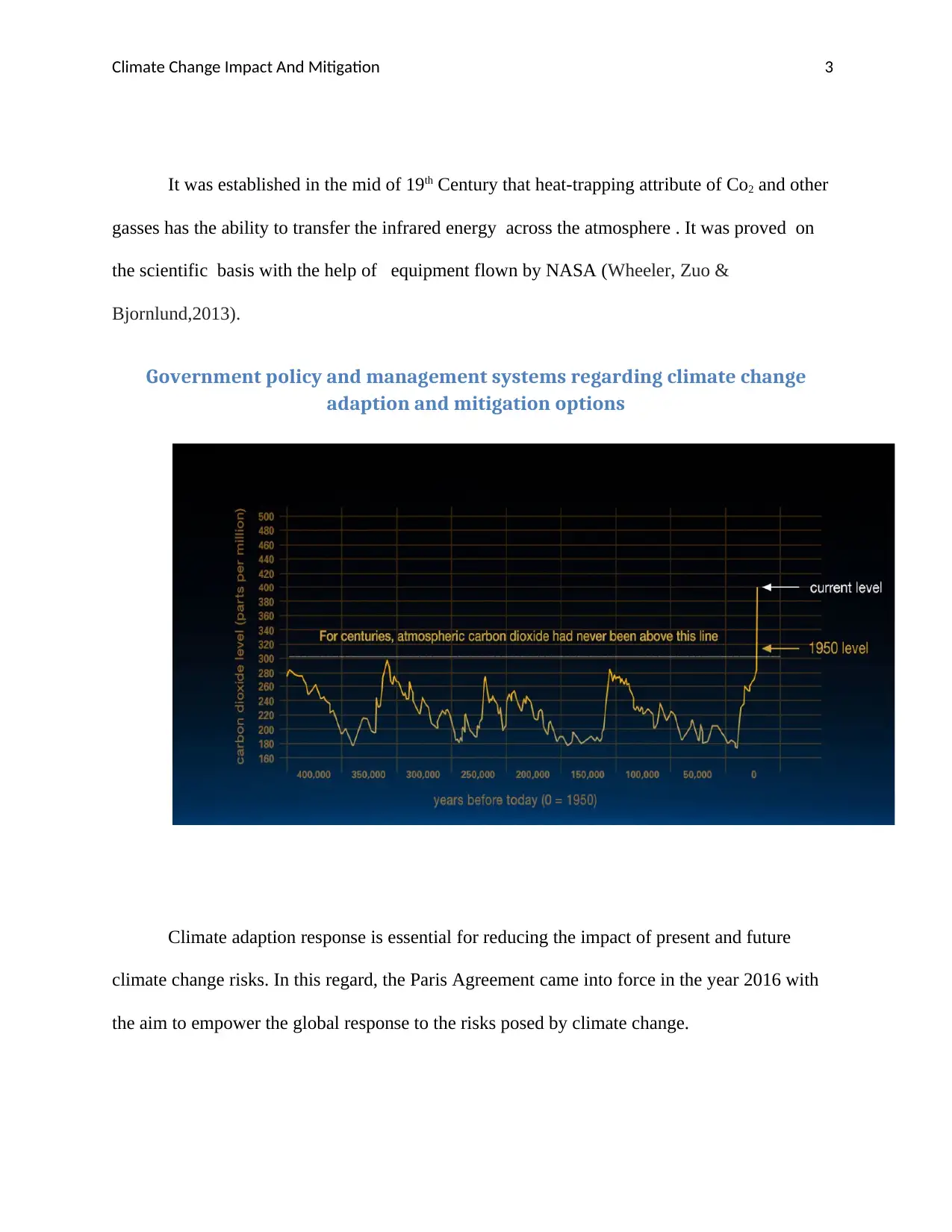
It was established in the mid of 19th Century that heat-trapping attribute of Co2 and other
gasses has the ability to transfer the infrared energy across the atmosphere . It was proved on
the scientific basis with the help of equipment flown by NASA (Wheeler, Zuo &
Bjornlund,2013).
Government policy and management systems regarding climate change
adaption and mitigation options
Climate adaption response is essential for reducing the impact of present and future
climate change risks. In this regard, the Paris Agreement came into force in the year 2016 with
the aim to empower the global response to the risks posed by climate change.
tabler-icon-diamond-filled.svg

Paraphrase This Document

Need a fresh take? Get an instant paraphrase of this document with our AI Paraphraser
Document Page
Climate Change Impact And Mitigation 4
For meeting its initial targets under the Paris Agreement, Australia has agreed to decrease
its greenhouse gas emissions by 26 to 28 % below 2005 levels by the year 2030. A number of
key mitigation measures have been adopted by The Australian Academy of Technology and
Engineering (Poloczanska et al., 2013).
As per Field (2014), it includes an adaptation of zero and low emission of energy
resources like solar and wind energies. It also comprises of innovative measures taken for energy
efficiency such as intelligent grid technology which reduces and manages the load on energy
supply system.
Conclusion
Hence to conclude, it can be said that the mitigation and adaptation efforts regarding
climate change will enhance the adoption and advancement of science and technological
innovations. It is supported by the government policy settings which encourage the investments
in technology.
Document Page
Climate Change Impact And Mitigation 5
Blog Entry NO: 2
Introduction to climate change scenarios
As per Head, Adams, McGregor & Toole (2014), climate change can be referred to as the
transition in the statistical distribution of the weather patterns when the transition lasts for an
extended time such as decades to millions of years. It may be referred to change in the average
climate conditions.
The sea surface temperatures in Australia have warmed by nearly 1 °C since the year
1990. In the past 3 years from 2013-2015, it has been observed that these were the warmest years
on record. The period, intensity and frequency of heat waves have augmented across various
parts in Australia since 1950 (Leonard, Parsons, Olawsky & Kofod, 2013).
There has been an intensification in extreme weather conditions such as the breakout of
fire and a longer fire season through larger parts in Australia since 1970. There has been a
declining trend in the water rainfall in South-West Australia. Early winter rainfall has been
below average in the South- Eastern area since 1990.
So, this blog highlights the evidence of past and present climate change in Australia and
the causes for the same. It would also evaluate new climate change research with the policies of
the government formulated for climate change adaptation and mitigation options.
Document Page
Climate Change Impact And Mitigation 6
Causes and impact of climate change
It has been observed that there has been consistency between an increase in the
temperature of Australia and an increase in the greenhouse gases. The changes in the mean
temperature have been complemented by a major increase in the extreme temperatures.
Since 2001, the number of heat records has exceeded cool records by almost 3 to 1 for
maximum daytime temperatures and almost 5 to 1 for nighttime temperatures. The warm months
have increased five times in the past 15 years. At the same time, the occurrence of cold months
has decreased by one –third over the same period.
The policy of the government for adaption and mitigation options of climate
change
The government of Australia has been addressing the change in climate so that security
and affordability in energy can be ensured. Australia has been accomplishing its climate change
targets by improving is the environment and assisting its effective international response
(Australian Government b, n.d.).
On 10th November 2016, Australia has consented to adopt the Doha Amendment to the
Kyoto Protocol thereby strengthening its commitment to action on a change in the climate.
Australia has implemented policies for reducing its domestic emissions and assisting effective
global efforts.
In this regard, the government has targeted to reduce emissions by 5% below the levels of
2000 by the year 2020. It has aimed to double the renewable energy capacity of Australia by
tabler-icon-diamond-filled.svg

Paraphrase This Document

Need a fresh take? Get an instant paraphrase of this document with our AI Paraphraser
Document Page
Climate Change Impact And Mitigation 7
2020 which can be accomplished by innovation, creating jobs and providing a cleaner and
greener future (Australian Government a, n.d.).
Conclusion
It can be concluded by saying that Australia has confronted environmental and economic
impacts arising due to climate change across various sectors. So, in this regard, the government
of Australia has initiated various policies and program for mitigating the effects of climate
change. It includes a carbon neutral program, support for low emission and carbon capture and
storage.
Document Page
Climate Change Impact And Mitigation 8
References
Australian Government a(n.d.). Government and international initiatives. Retrieved 2nd
November ,2018 from http://www.environment.gov.au/climate-change/government
Australian Government b(n.d.). National Climate Resilience and Adaptation Strategy. Retrieved
2nd November ,2018 from
http://www.environment.gov.au/climate-change/adaptation/strategy
Field, C. B. (2014). Climate change 2014–Impacts, adaptation and vulnerability: Regional
aspects. Australia : Cambridge University Press. 1-10.
Hanna, E. G. & McIver, L. J. (2018). Climate change: a brief overview of the science and health
impacts for Australia. The Medical Journal of Australia, 208(7), 311-315.
Head, L., Adams, M., McGregor, H. V. & Toole, S. (2014). Climate change and Australia. Wiley
Interdisciplinary Reviews: Climate Change, 5(2), 175-197.
Leonard, S., Parsons, M., Olawsky, K. & Kofod, F. (2013). The role of culture and traditional
knowledge in climate change adaptation: Insights from East Kimberley, Australia. Global
Environmental Change, 23(3), 623-632.
Poloczanska, E. S., Brown, C. J., Sydeman, W. J., Kiessling, W., Schoeman, D. S., Moore, P. J.
& Duarte, C. M. (2013). Global imprint of climate change on marine life. Nature Climate
Change, 3(10), 919.
Document Page
Climate Change Impact And Mitigation 9
Wheeler, S., Zuo, A. & Bjornlund, H. (2013). Farmers’ climate change beliefs and adaptation
strategies for a water scarce future in Australia. Global Environmental Change, 23(2),
537-547.
chevron_up_icon
1 out of 10
circle_padding
hide_on_mobile
zoom_out_icon
[object Object]