A Clinical Guideline for Reducing Alcohol Consumption Risks
VerifiedAdded on 2021/06/17
|11
|2591
|473
Report
AI Summary
This clinical guideline addresses the major health issue of alcohol consumption and its associated risks, including accidents, injuries, and chronic diseases. It aims to provide guidance on reducing alcohol-related harms by calculating lifetime risks and offering recommendations for various groups, including adults, young individuals, and pregnant or breastfeeding women. The guideline utilizes evidence from epidemiological studies, surveys, and experimental studies to formulate recommendations. It outlines procedures such as the Australian Standard drink, risk calculations, and a population health approach. The guideline also considers the impact of alcohol on cognitive performance, the risks associated with illicit drug use, and the needs of specific populations. Recommendations are provided for health professionals to share information on alcohol guidelines with patients, emphasizing the importance of tailored advice for different groups and the need for government initiatives to reduce alcohol-related harm. The report references numerous studies and sources to support its findings and recommendations.
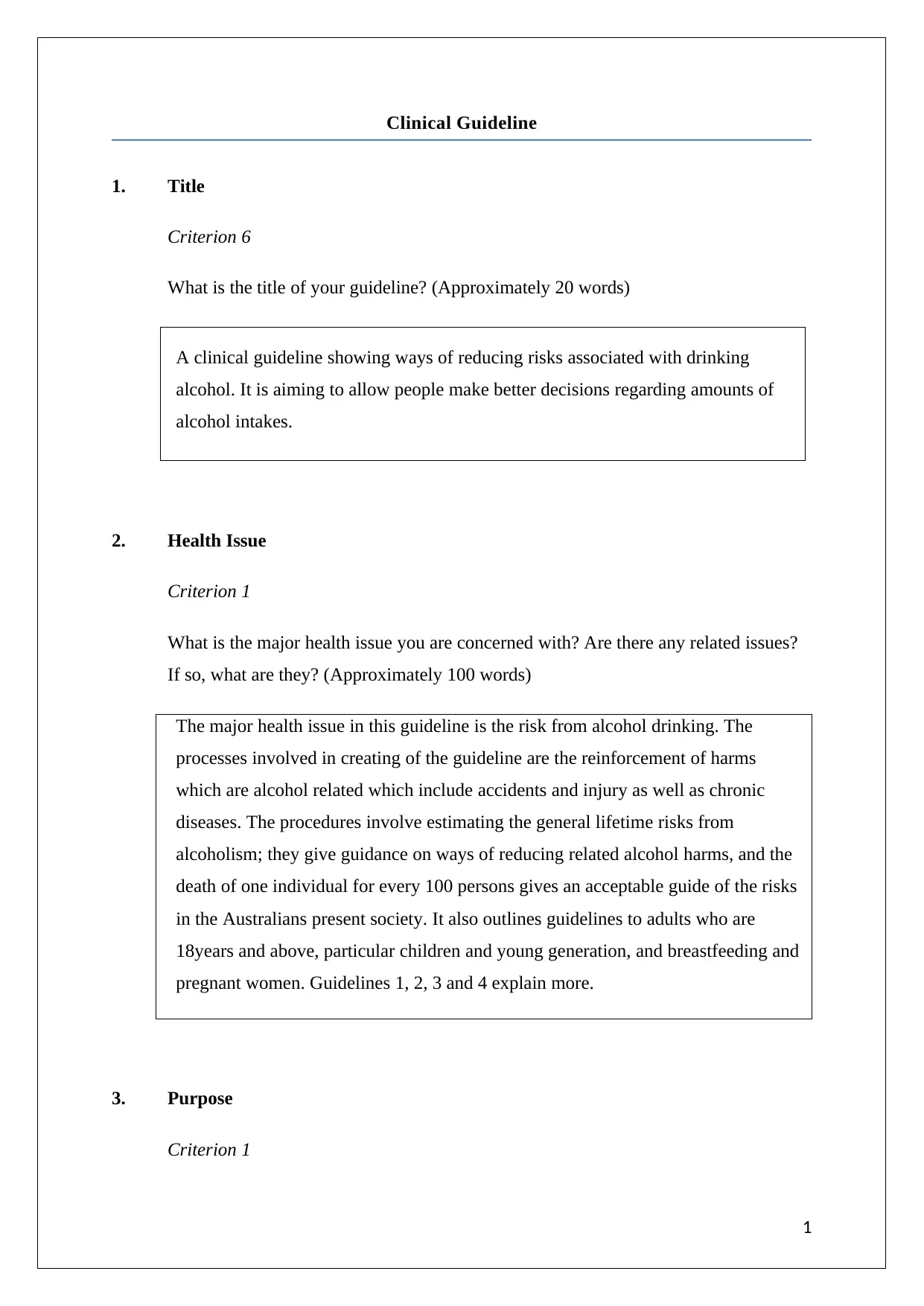
Clinical Guideline
1. Title
Criterion 6
What is the title of your guideline? (Approximately 20 words)
A clinical guideline showing ways of reducing risks associated with drinking
alcohol. It is aiming to allow people make better decisions regarding amounts of
alcohol intakes.
2. Health Issue
Criterion 1
What is the major health issue you are concerned with? Are there any related issues?
If so, what are they? (Approximately 100 words)
The major health issue in this guideline is the risk from alcohol drinking. The
processes involved in creating of the guideline are the reinforcement of harms
which are alcohol related which include accidents and injury as well as chronic
diseases. The procedures involve estimating the general lifetime risks from
alcoholism; they give guidance on ways of reducing related alcohol harms, and the
death of one individual for every 100 persons gives an acceptable guide of the risks
in the Australians present society. It also outlines guidelines to adults who are
18years and above, particular children and young generation, and breastfeeding and
pregnant women. Guidelines 1, 2, 3 and 4 explain more.
3. Purpose
Criterion 1
1
1. Title
Criterion 6
What is the title of your guideline? (Approximately 20 words)
A clinical guideline showing ways of reducing risks associated with drinking
alcohol. It is aiming to allow people make better decisions regarding amounts of
alcohol intakes.
2. Health Issue
Criterion 1
What is the major health issue you are concerned with? Are there any related issues?
If so, what are they? (Approximately 100 words)
The major health issue in this guideline is the risk from alcohol drinking. The
processes involved in creating of the guideline are the reinforcement of harms
which are alcohol related which include accidents and injury as well as chronic
diseases. The procedures involve estimating the general lifetime risks from
alcoholism; they give guidance on ways of reducing related alcohol harms, and the
death of one individual for every 100 persons gives an acceptable guide of the risks
in the Australians present society. It also outlines guidelines to adults who are
18years and above, particular children and young generation, and breastfeeding and
pregnant women. Guidelines 1, 2, 3 and 4 explain more.
3. Purpose
Criterion 1
1

Paraphrase This Document
Need a fresh take? Get an instant paraphrase of this document with our AI Paraphraser
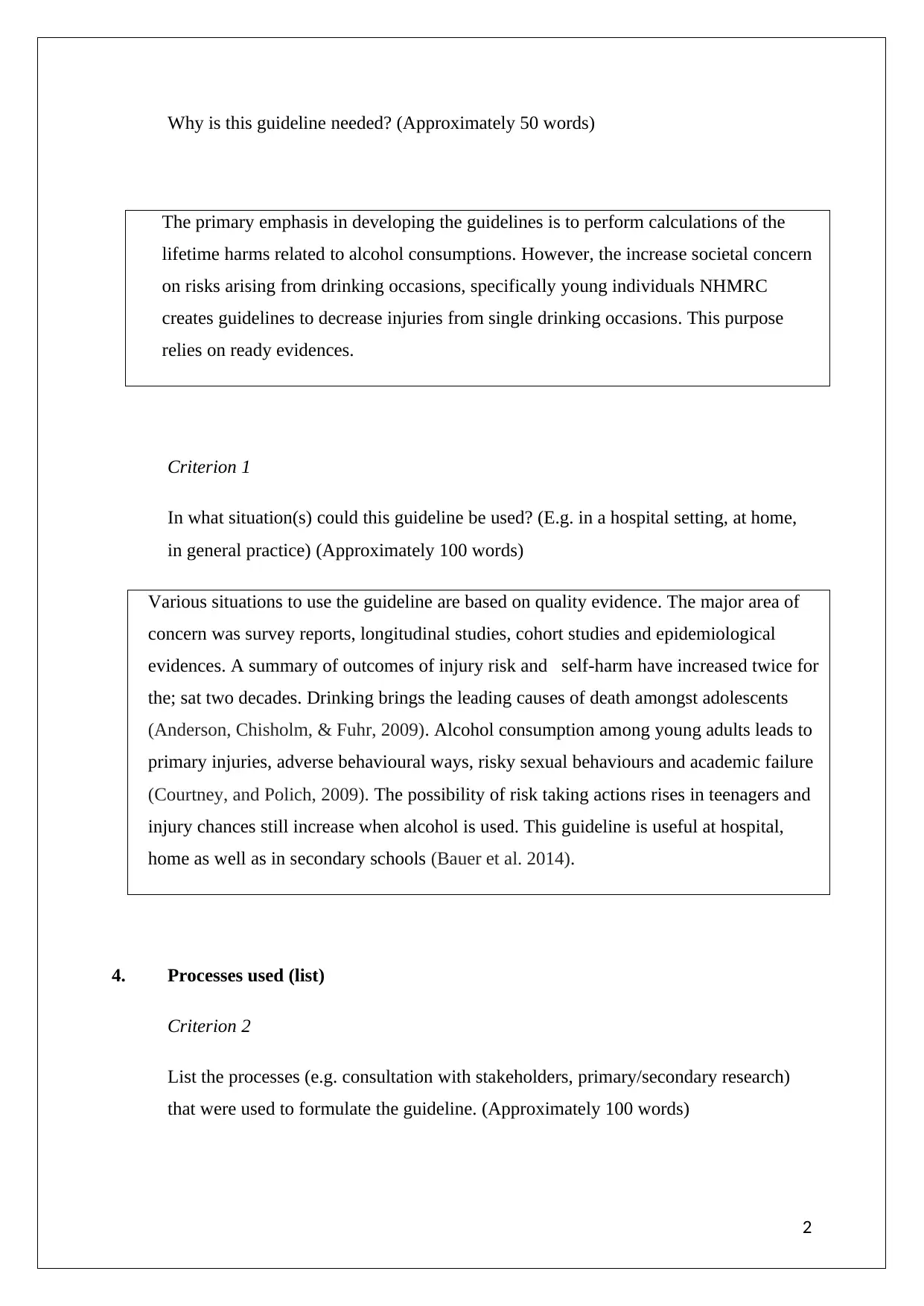
Why is this guideline needed? (Approximately 50 words)
The primary emphasis in developing the guidelines is to perform calculations of the
lifetime harms related to alcohol consumptions. However, the increase societal concern
on risks arising from drinking occasions, specifically young individuals NHMRC
creates guidelines to decrease injuries from single drinking occasions. This purpose
relies on ready evidences.
Criterion 1
In what situation(s) could this guideline be used? (E.g. in a hospital setting, at home,
in general practice) (Approximately 100 words)
Various situations to use the guideline are based on quality evidence. The major area of
concern was survey reports, longitudinal studies, cohort studies and epidemiological
evidences. A summary of outcomes of injury risk and self-harm have increased twice for
the; sat two decades. Drinking brings the leading causes of death amongst adolescents
(Anderson, Chisholm, & Fuhr, 2009). Alcohol consumption among young adults leads to
primary injuries, adverse behavioural ways, risky sexual behaviours and academic failure
(Courtney, and Polich, 2009). The possibility of risk taking actions rises in teenagers and
injury chances still increase when alcohol is used. This guideline is useful at hospital,
home as well as in secondary schools (Bauer et al. 2014).
4. Processes used (list)
Criterion 2
List the processes (e.g. consultation with stakeholders, primary/secondary research)
that were used to formulate the guideline. (Approximately 100 words)
2
The primary emphasis in developing the guidelines is to perform calculations of the
lifetime harms related to alcohol consumptions. However, the increase societal concern
on risks arising from drinking occasions, specifically young individuals NHMRC
creates guidelines to decrease injuries from single drinking occasions. This purpose
relies on ready evidences.
Criterion 1
In what situation(s) could this guideline be used? (E.g. in a hospital setting, at home,
in general practice) (Approximately 100 words)
Various situations to use the guideline are based on quality evidence. The major area of
concern was survey reports, longitudinal studies, cohort studies and epidemiological
evidences. A summary of outcomes of injury risk and self-harm have increased twice for
the; sat two decades. Drinking brings the leading causes of death amongst adolescents
(Anderson, Chisholm, & Fuhr, 2009). Alcohol consumption among young adults leads to
primary injuries, adverse behavioural ways, risky sexual behaviours and academic failure
(Courtney, and Polich, 2009). The possibility of risk taking actions rises in teenagers and
injury chances still increase when alcohol is used. This guideline is useful at hospital,
home as well as in secondary schools (Bauer et al. 2014).
4. Processes used (list)
Criterion 2
List the processes (e.g. consultation with stakeholders, primary/secondary research)
that were used to formulate the guideline. (Approximately 100 words)
2
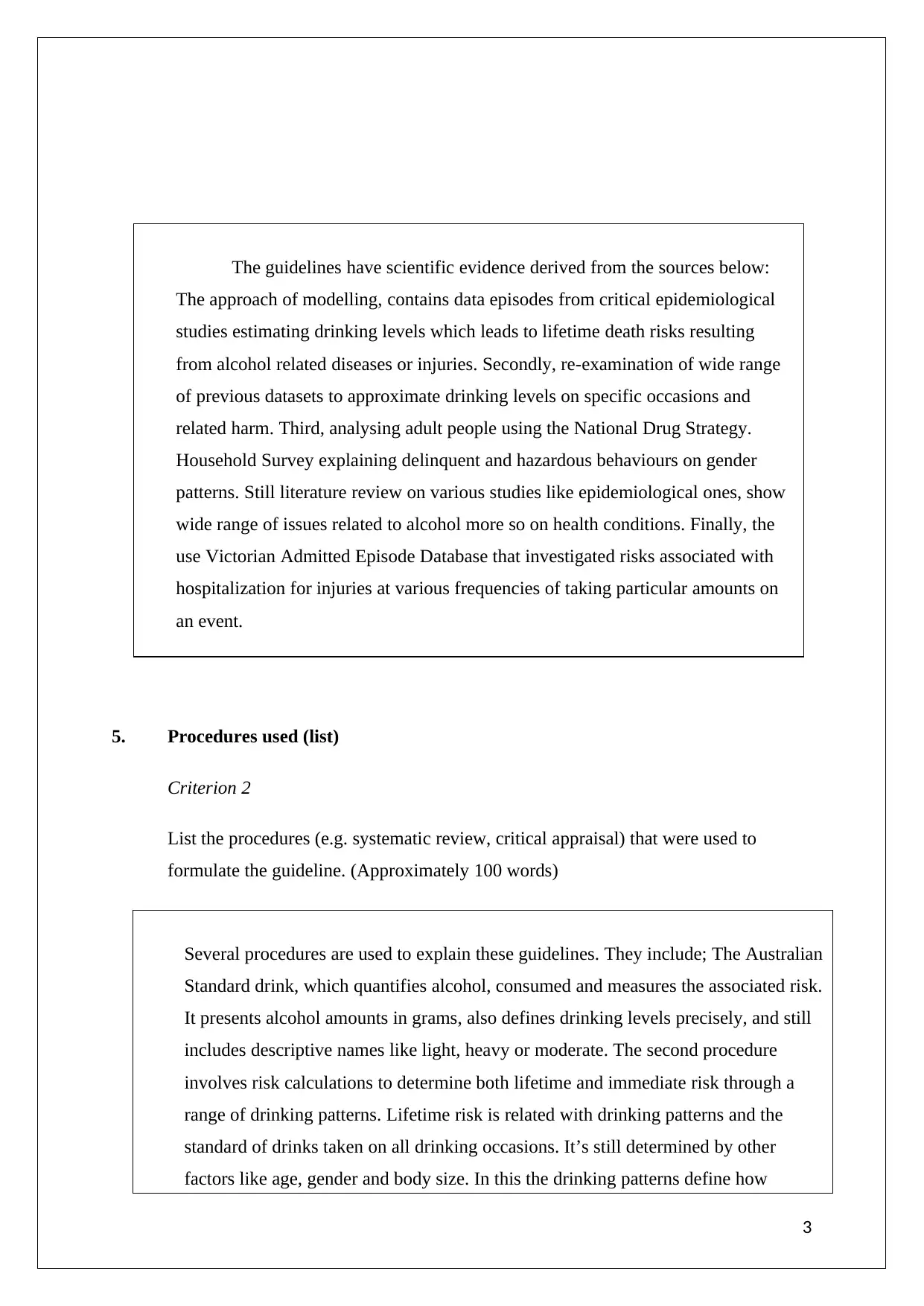
The guidelines have scientific evidence derived from the sources below:
The approach of modelling, contains data episodes from critical epidemiological
studies estimating drinking levels which leads to lifetime death risks resulting
from alcohol related diseases or injuries. Secondly, re-examination of wide range
of previous datasets to approximate drinking levels on specific occasions and
related harm. Third, analysing adult people using the National Drug Strategy.
Household Survey explaining delinquent and hazardous behaviours on gender
patterns. Still literature review on various studies like epidemiological ones, show
wide range of issues related to alcohol more so on health conditions. Finally, the
use Victorian Admitted Episode Database that investigated risks associated with
hospitalization for injuries at various frequencies of taking particular amounts on
an event.
5. Procedures used (list)
Criterion 2
List the procedures (e.g. systematic review, critical appraisal) that were used to
formulate the guideline. (Approximately 100 words)
Several procedures are used to explain these guidelines. They include; The Australian
Standard drink, which quantifies alcohol, consumed and measures the associated risk.
It presents alcohol amounts in grams, also defines drinking levels precisely, and still
includes descriptive names like light, heavy or moderate. The second procedure
involves risk calculations to determine both lifetime and immediate risk through a
range of drinking patterns. Lifetime risk is related with drinking patterns and the
standard of drinks taken on all drinking occasions. It’s still determined by other
factors like age, gender and body size. In this the drinking patterns define how
3
The approach of modelling, contains data episodes from critical epidemiological
studies estimating drinking levels which leads to lifetime death risks resulting
from alcohol related diseases or injuries. Secondly, re-examination of wide range
of previous datasets to approximate drinking levels on specific occasions and
related harm. Third, analysing adult people using the National Drug Strategy.
Household Survey explaining delinquent and hazardous behaviours on gender
patterns. Still literature review on various studies like epidemiological ones, show
wide range of issues related to alcohol more so on health conditions. Finally, the
use Victorian Admitted Episode Database that investigated risks associated with
hospitalization for injuries at various frequencies of taking particular amounts on
an event.
5. Procedures used (list)
Criterion 2
List the procedures (e.g. systematic review, critical appraisal) that were used to
formulate the guideline. (Approximately 100 words)
Several procedures are used to explain these guidelines. They include; The Australian
Standard drink, which quantifies alcohol, consumed and measures the associated risk.
It presents alcohol amounts in grams, also defines drinking levels precisely, and still
includes descriptive names like light, heavy or moderate. The second procedure
involves risk calculations to determine both lifetime and immediate risk through a
range of drinking patterns. Lifetime risk is related with drinking patterns and the
standard of drinks taken on all drinking occasions. It’s still determined by other
factors like age, gender and body size. In this the drinking patterns define how
3
⊘ This is a preview!⊘
Do you want full access?
Subscribe today to unlock all pages.

Trusted by 1+ million students worldwide
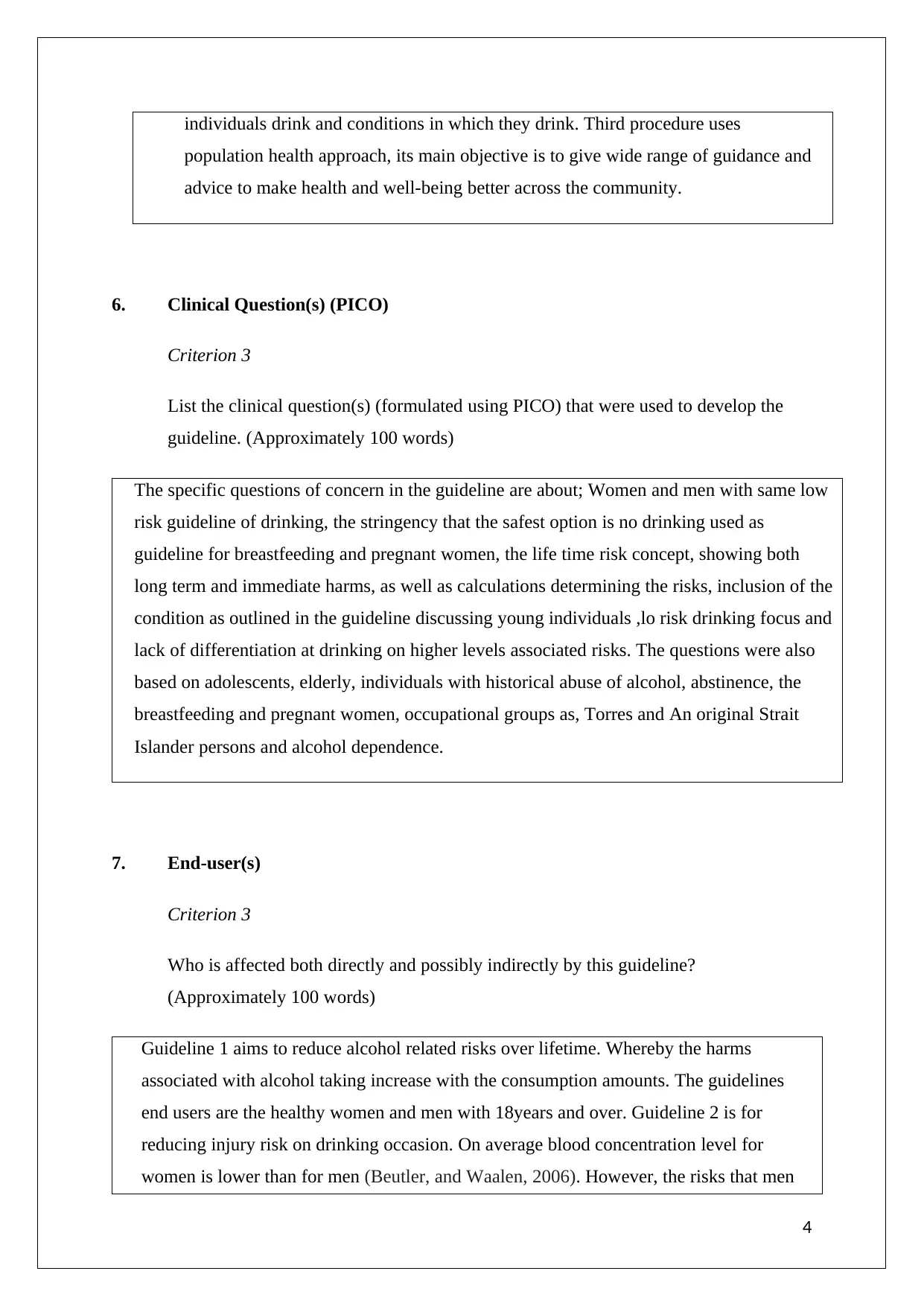
individuals drink and conditions in which they drink. Third procedure uses
population health approach, its main objective is to give wide range of guidance and
advice to make health and well-being better across the community.
6. Clinical Question(s) (PICO)
Criterion 3
List the clinical question(s) (formulated using PICO) that were used to develop the
guideline. (Approximately 100 words)
The specific questions of concern in the guideline are about; Women and men with same low
risk guideline of drinking, the stringency that the safest option is no drinking used as
guideline for breastfeeding and pregnant women, the life time risk concept, showing both
long term and immediate harms, as well as calculations determining the risks, inclusion of the
condition as outlined in the guideline discussing young individuals ,lo risk drinking focus and
lack of differentiation at drinking on higher levels associated risks. The questions were also
based on adolescents, elderly, individuals with historical abuse of alcohol, abstinence, the
breastfeeding and pregnant women, occupational groups as, Torres and An original Strait
Islander persons and alcohol dependence.
7. End-user(s)
Criterion 3
Who is affected both directly and possibly indirectly by this guideline?
(Approximately 100 words)
Guideline 1 aims to reduce alcohol related risks over lifetime. Whereby the harms
associated with alcohol taking increase with the consumption amounts. The guidelines
end users are the healthy women and men with 18years and over. Guideline 2 is for
reducing injury risk on drinking occasion. On average blood concentration level for
women is lower than for men (Beutler, and Waalen, 2006). However, the risks that men
4
population health approach, its main objective is to give wide range of guidance and
advice to make health and well-being better across the community.
6. Clinical Question(s) (PICO)
Criterion 3
List the clinical question(s) (formulated using PICO) that were used to develop the
guideline. (Approximately 100 words)
The specific questions of concern in the guideline are about; Women and men with same low
risk guideline of drinking, the stringency that the safest option is no drinking used as
guideline for breastfeeding and pregnant women, the life time risk concept, showing both
long term and immediate harms, as well as calculations determining the risks, inclusion of the
condition as outlined in the guideline discussing young individuals ,lo risk drinking focus and
lack of differentiation at drinking on higher levels associated risks. The questions were also
based on adolescents, elderly, individuals with historical abuse of alcohol, abstinence, the
breastfeeding and pregnant women, occupational groups as, Torres and An original Strait
Islander persons and alcohol dependence.
7. End-user(s)
Criterion 3
Who is affected both directly and possibly indirectly by this guideline?
(Approximately 100 words)
Guideline 1 aims to reduce alcohol related risks over lifetime. Whereby the harms
associated with alcohol taking increase with the consumption amounts. The guidelines
end users are the healthy women and men with 18years and over. Guideline 2 is for
reducing injury risk on drinking occasion. On average blood concentration level for
women is lower than for men (Beutler, and Waalen, 2006). However, the risks that men
4
Paraphrase This Document
Need a fresh take? Get an instant paraphrase of this document with our AI Paraphraser
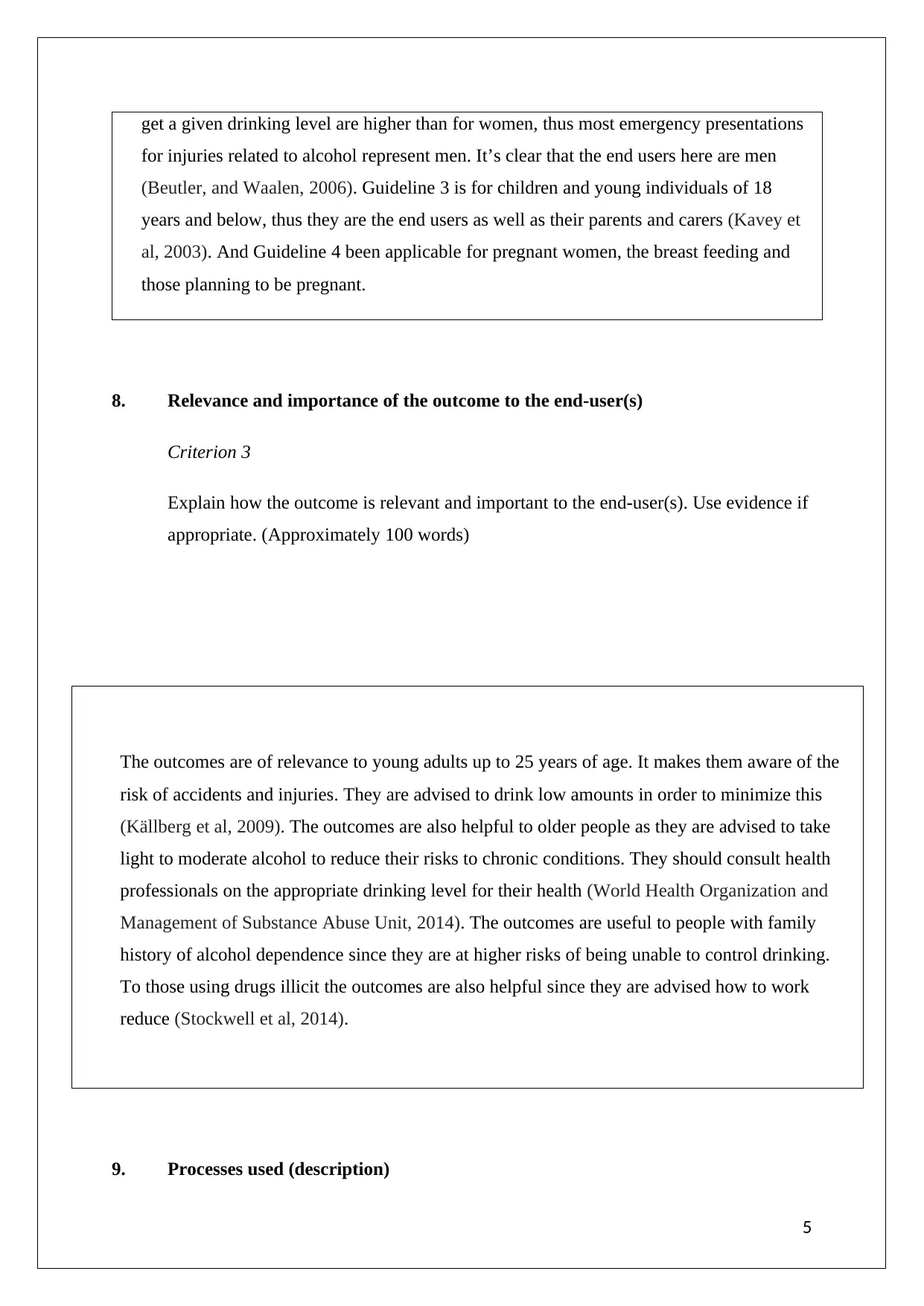
get a given drinking level are higher than for women, thus most emergency presentations
for injuries related to alcohol represent men. It’s clear that the end users here are men
(Beutler, and Waalen, 2006). Guideline 3 is for children and young individuals of 18
years and below, thus they are the end users as well as their parents and carers (Kavey et
al, 2003). And Guideline 4 been applicable for pregnant women, the breast feeding and
those planning to be pregnant.
8. Relevance and importance of the outcome to the end-user(s)
Criterion 3
Explain how the outcome is relevant and important to the end-user(s). Use evidence if
appropriate. (Approximately 100 words)
The outcomes are of relevance to young adults up to 25 years of age. It makes them aware of the
risk of accidents and injuries. They are advised to drink low amounts in order to minimize this
(Källberg et al, 2009). The outcomes are also helpful to older people as they are advised to take
light to moderate alcohol to reduce their risks to chronic conditions. They should consult health
professionals on the appropriate drinking level for their health (World Health Organization and
Management of Substance Abuse Unit, 2014). The outcomes are useful to people with family
history of alcohol dependence since they are at higher risks of being unable to control drinking.
To those using drugs illicit the outcomes are also helpful since they are advised how to work
reduce (Stockwell et al, 2014).
9. Processes used (description)
5
for injuries related to alcohol represent men. It’s clear that the end users here are men
(Beutler, and Waalen, 2006). Guideline 3 is for children and young individuals of 18
years and below, thus they are the end users as well as their parents and carers (Kavey et
al, 2003). And Guideline 4 been applicable for pregnant women, the breast feeding and
those planning to be pregnant.
8. Relevance and importance of the outcome to the end-user(s)
Criterion 3
Explain how the outcome is relevant and important to the end-user(s). Use evidence if
appropriate. (Approximately 100 words)
The outcomes are of relevance to young adults up to 25 years of age. It makes them aware of the
risk of accidents and injuries. They are advised to drink low amounts in order to minimize this
(Källberg et al, 2009). The outcomes are also helpful to older people as they are advised to take
light to moderate alcohol to reduce their risks to chronic conditions. They should consult health
professionals on the appropriate drinking level for their health (World Health Organization and
Management of Substance Abuse Unit, 2014). The outcomes are useful to people with family
history of alcohol dependence since they are at higher risks of being unable to control drinking.
To those using drugs illicit the outcomes are also helpful since they are advised how to work
reduce (Stockwell et al, 2014).
9. Processes used (description)
5
Criteria 2, 4
How did you find this evidence? (Approximately 200 words)
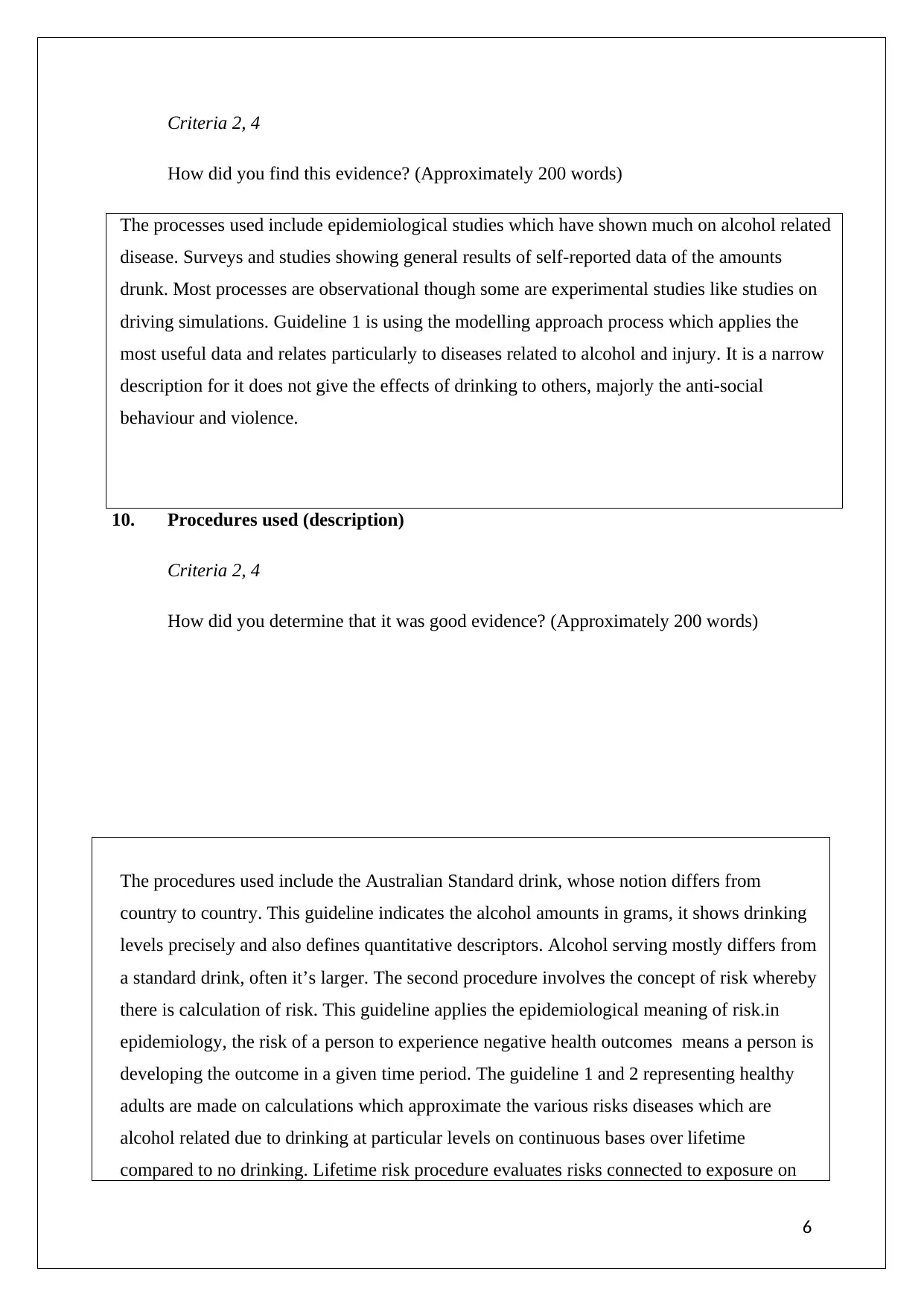
The processes used include epidemiological studies which have shown much on alcohol related
disease. Surveys and studies showing general results of self-reported data of the amounts
drunk. Most processes are observational though some are experimental studies like studies on
driving simulations. Guideline 1 is using the modelling approach process which applies the
most useful data and relates particularly to diseases related to alcohol and injury. It is a narrow
description for it does not give the effects of drinking to others, majorly the anti-social
behaviour and violence.
10. Procedures used (description)
Criteria 2, 4
How did you determine that it was good evidence? (Approximately 200 words)
The procedures used include the Australian Standard drink, whose notion differs from
country to country. This guideline indicates the alcohol amounts in grams, it shows drinking
levels precisely and also defines quantitative descriptors. Alcohol serving mostly differs from
a standard drink, often it’s larger. The second procedure involves the concept of risk whereby
there is calculation of risk. This guideline applies the epidemiological meaning of risk.in
epidemiology, the risk of a person to experience negative health outcomes means a person is
developing the outcome in a given time period. The guideline 1 and 2 representing healthy
adults are made on calculations which approximate the various risks diseases which are
alcohol related due to drinking at particular levels on continuous bases over lifetime
compared to no drinking. Lifetime risk procedure evaluates risks connected to exposure on
6
How did you find this evidence? (Approximately 200 words)
The processes used include epidemiological studies which have shown much on alcohol related
disease. Surveys and studies showing general results of self-reported data of the amounts
drunk. Most processes are observational though some are experimental studies like studies on
driving simulations. Guideline 1 is using the modelling approach process which applies the
most useful data and relates particularly to diseases related to alcohol and injury. It is a narrow
description for it does not give the effects of drinking to others, majorly the anti-social
behaviour and violence.
10. Procedures used (description)
Criteria 2, 4
How did you determine that it was good evidence? (Approximately 200 words)
The procedures used include the Australian Standard drink, whose notion differs from
country to country. This guideline indicates the alcohol amounts in grams, it shows drinking
levels precisely and also defines quantitative descriptors. Alcohol serving mostly differs from
a standard drink, often it’s larger. The second procedure involves the concept of risk whereby
there is calculation of risk. This guideline applies the epidemiological meaning of risk.in
epidemiology, the risk of a person to experience negative health outcomes means a person is
developing the outcome in a given time period. The guideline 1 and 2 representing healthy
adults are made on calculations which approximate the various risks diseases which are
alcohol related due to drinking at particular levels on continuous bases over lifetime
compared to no drinking. Lifetime risk procedure evaluates risks connected to exposure on
6
⊘ This is a preview!⊘
Do you want full access?
Subscribe today to unlock all pages.
Trusted by 1+ million students worldwide
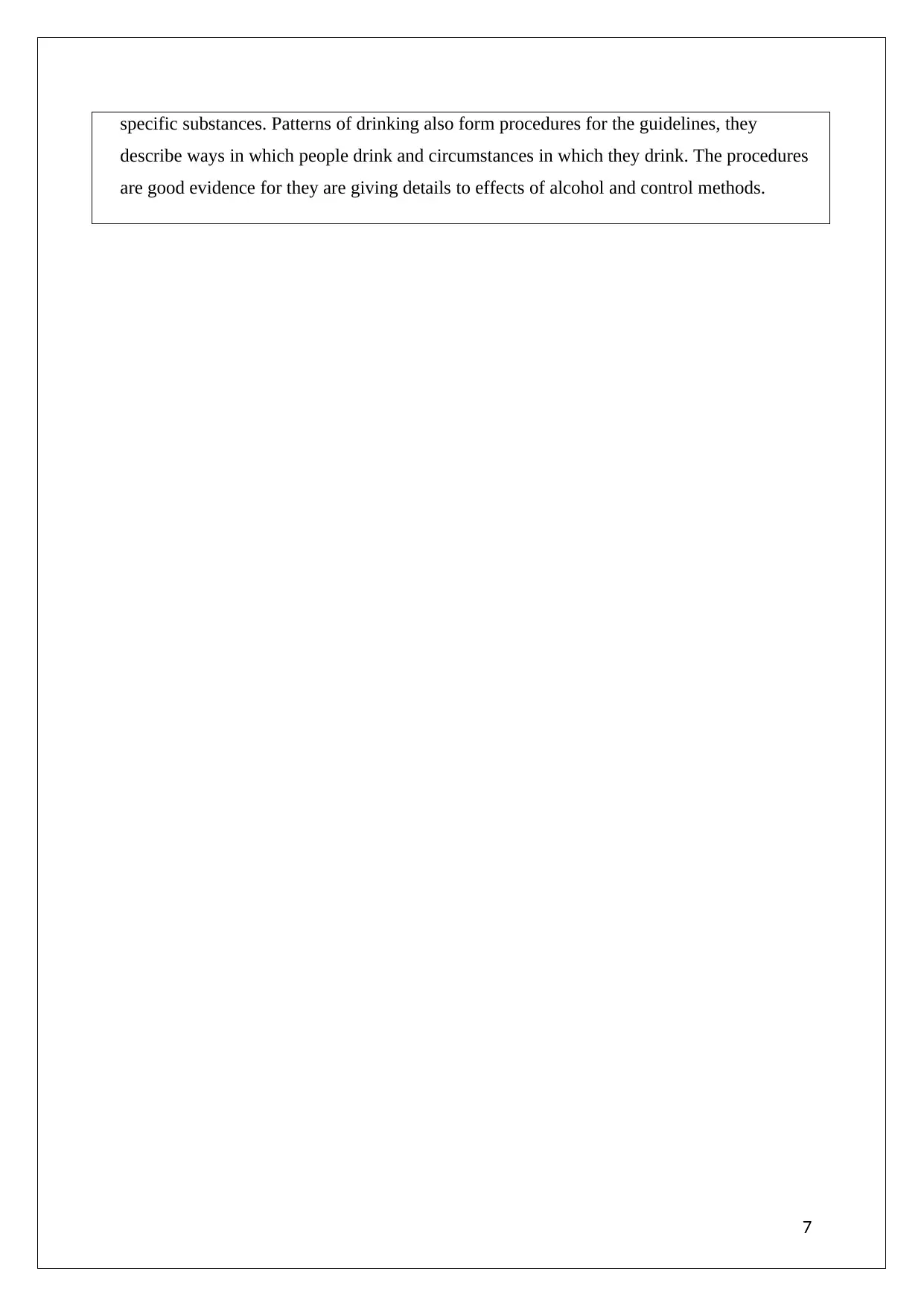
specific substances. Patterns of drinking also form procedures for the guidelines, they
describe ways in which people drink and circumstances in which they drink. The procedures
are good evidence for they are giving details to effects of alcohol and control methods.
7
describe ways in which people drink and circumstances in which they drink. The procedures
are good evidence for they are giving details to effects of alcohol and control methods.
7
Paraphrase This Document
Need a fresh take? Get an instant paraphrase of this document with our AI Paraphraser
11. Considerations
Criterion 4
What did you consider when making these recommendations? Who or what is
affected? (E.g. benefits, harms, values, preferences, resource use, acceptability)
(Approximately 200 words)
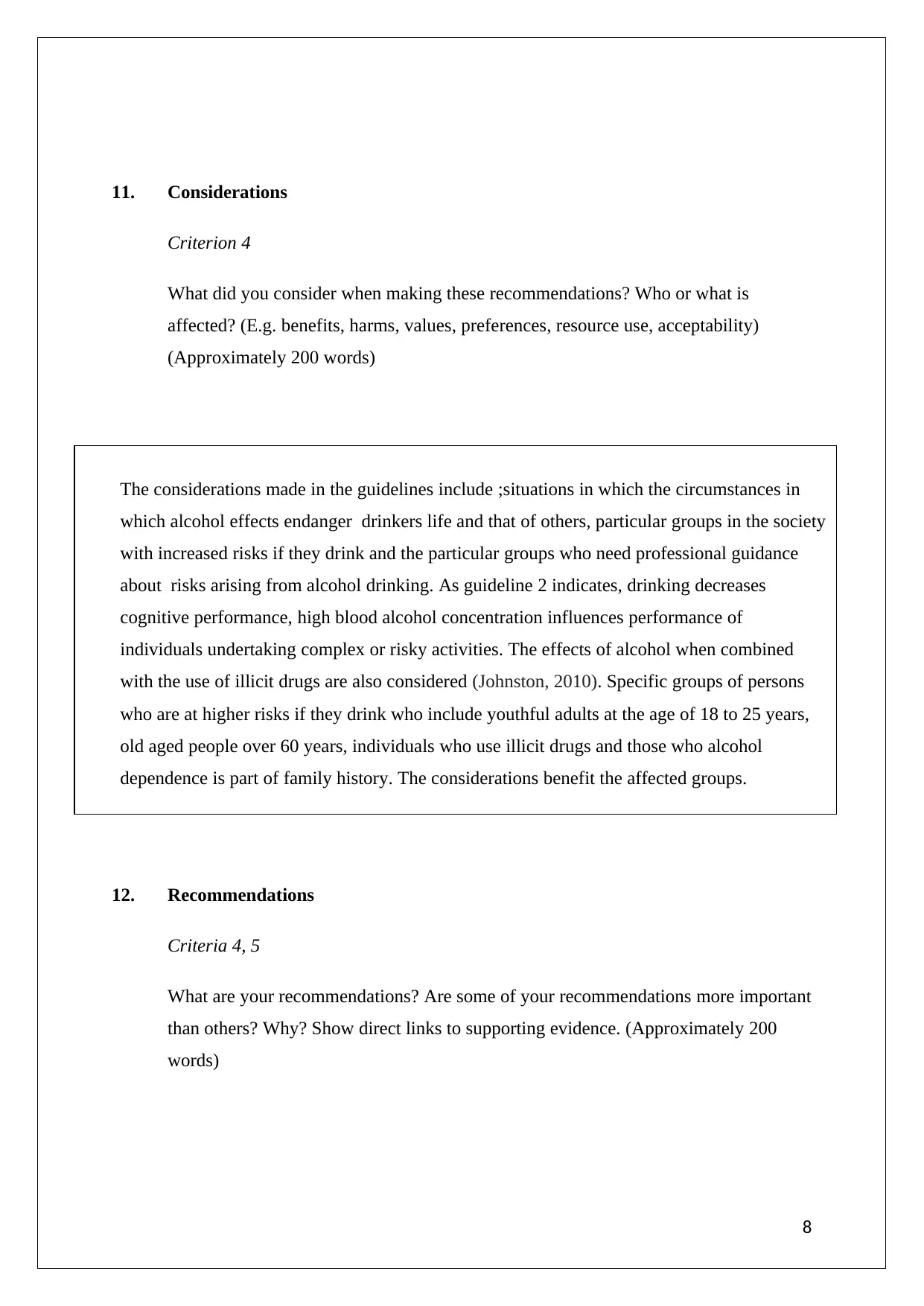
The considerations made in the guidelines include ;situations in which the circumstances in
which alcohol effects endanger drinkers life and that of others, particular groups in the society
with increased risks if they drink and the particular groups who need professional guidance
about risks arising from alcohol drinking. As guideline 2 indicates, drinking decreases
cognitive performance, high blood alcohol concentration influences performance of
individuals undertaking complex or risky activities. The effects of alcohol when combined
with the use of illicit drugs are also considered (Johnston, 2010). Specific groups of persons
who are at higher risks if they drink who include youthful adults at the age of 18 to 25 years,
old aged people over 60 years, individuals who use illicit drugs and those who alcohol
dependence is part of family history. The considerations benefit the affected groups.
12. Recommendations
Criteria 4, 5
What are your recommendations? Are some of your recommendations more important
than others? Why? Show direct links to supporting evidence. (Approximately 200
words)
8
Criterion 4
What did you consider when making these recommendations? Who or what is
affected? (E.g. benefits, harms, values, preferences, resource use, acceptability)
(Approximately 200 words)
The considerations made in the guidelines include ;situations in which the circumstances in
which alcohol effects endanger drinkers life and that of others, particular groups in the society
with increased risks if they drink and the particular groups who need professional guidance
about risks arising from alcohol drinking. As guideline 2 indicates, drinking decreases
cognitive performance, high blood alcohol concentration influences performance of
individuals undertaking complex or risky activities. The effects of alcohol when combined
with the use of illicit drugs are also considered (Johnston, 2010). Specific groups of persons
who are at higher risks if they drink who include youthful adults at the age of 18 to 25 years,
old aged people over 60 years, individuals who use illicit drugs and those who alcohol
dependence is part of family history. The considerations benefit the affected groups.
12. Recommendations
Criteria 4, 5
What are your recommendations? Are some of your recommendations more important
than others? Why? Show direct links to supporting evidence. (Approximately 200
words)
8
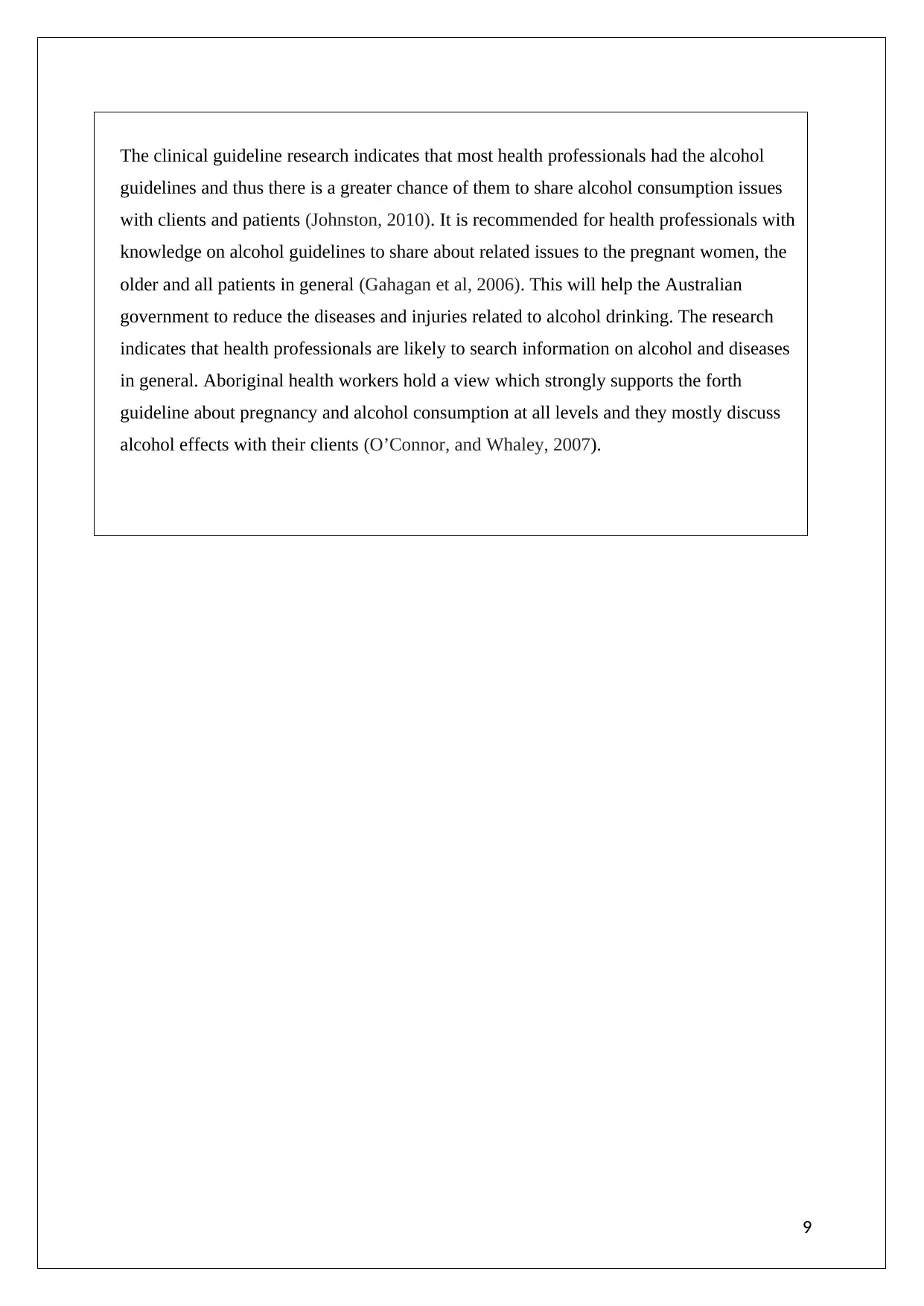
The clinical guideline research indicates that most health professionals had the alcohol
guidelines and thus there is a greater chance of them to share alcohol consumption issues
with clients and patients (Johnston, 2010). It is recommended for health professionals with
knowledge on alcohol guidelines to share about related issues to the pregnant women, the
older and all patients in general (Gahagan et al, 2006). This will help the Australian
government to reduce the diseases and injuries related to alcohol drinking. The research
indicates that health professionals are likely to search information on alcohol and diseases
in general. Aboriginal health workers hold a view which strongly supports the forth
guideline about pregnancy and alcohol consumption at all levels and they mostly discuss
alcohol effects with their clients (O’Connor, and Whaley, 2007).
9
guidelines and thus there is a greater chance of them to share alcohol consumption issues
with clients and patients (Johnston, 2010). It is recommended for health professionals with
knowledge on alcohol guidelines to share about related issues to the pregnant women, the
older and all patients in general (Gahagan et al, 2006). This will help the Australian
government to reduce the diseases and injuries related to alcohol drinking. The research
indicates that health professionals are likely to search information on alcohol and diseases
in general. Aboriginal health workers hold a view which strongly supports the forth
guideline about pregnancy and alcohol consumption at all levels and they mostly discuss
alcohol effects with their clients (O’Connor, and Whaley, 2007).
9
⊘ This is a preview!⊘
Do you want full access?
Subscribe today to unlock all pages.
Trusted by 1+ million students worldwide
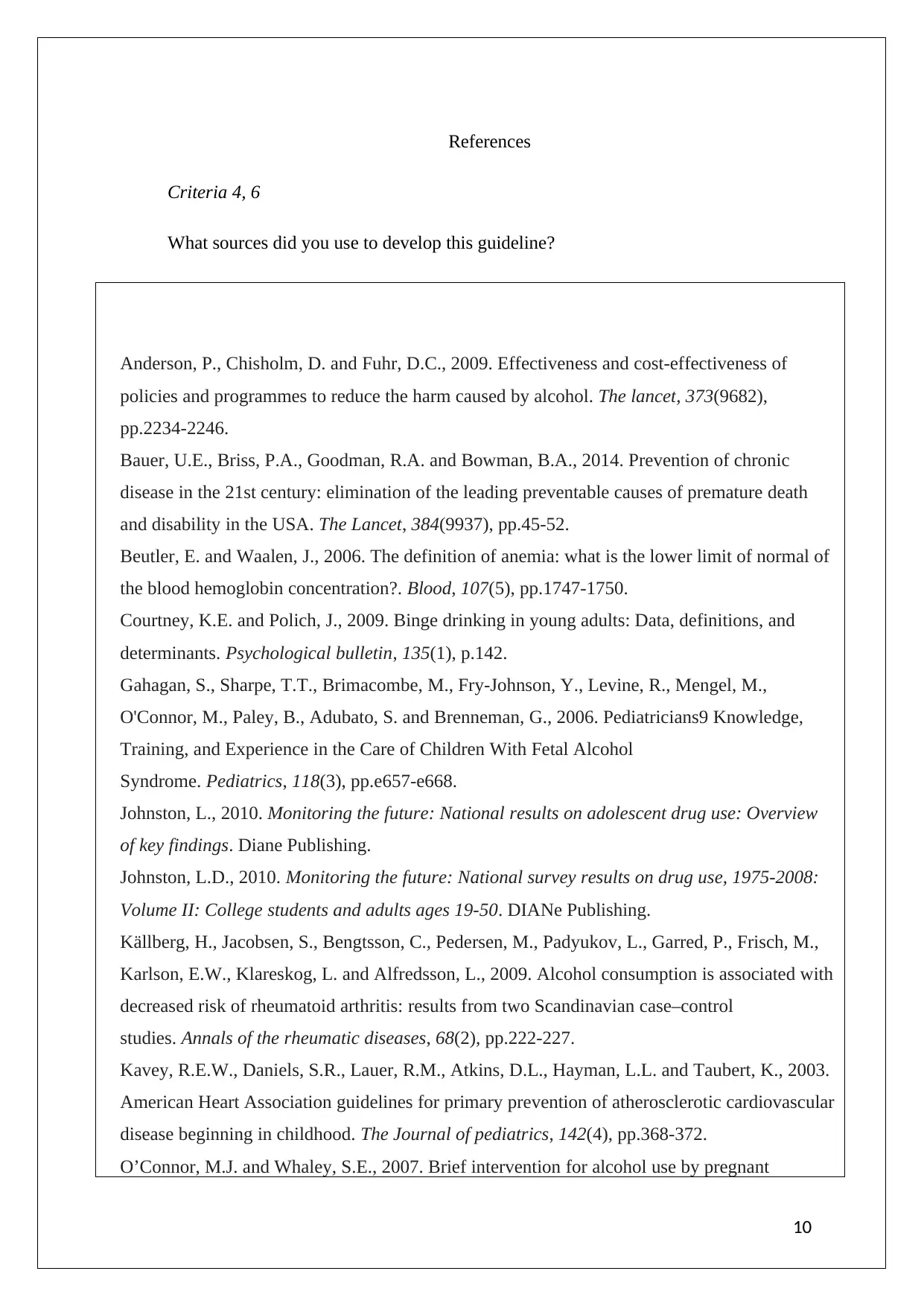
References
Criteria 4, 6
What sources did you use to develop this guideline?
Anderson, P., Chisholm, D. and Fuhr, D.C., 2009. Effectiveness and cost-effectiveness of
policies and programmes to reduce the harm caused by alcohol. The lancet, 373(9682),
pp.2234-2246.
Bauer, U.E., Briss, P.A., Goodman, R.A. and Bowman, B.A., 2014. Prevention of chronic
disease in the 21st century: elimination of the leading preventable causes of premature death
and disability in the USA. The Lancet, 384(9937), pp.45-52.
Beutler, E. and Waalen, J., 2006. The definition of anemia: what is the lower limit of normal of
the blood hemoglobin concentration?. Blood, 107(5), pp.1747-1750.
Courtney, K.E. and Polich, J., 2009. Binge drinking in young adults: Data, definitions, and
determinants. Psychological bulletin, 135(1), p.142.
Gahagan, S., Sharpe, T.T., Brimacombe, M., Fry-Johnson, Y., Levine, R., Mengel, M.,
O'Connor, M., Paley, B., Adubato, S. and Brenneman, G., 2006. Pediatricians9 Knowledge,
Training, and Experience in the Care of Children With Fetal Alcohol
Syndrome. Pediatrics, 118(3), pp.e657-e668.
Johnston, L., 2010. Monitoring the future: National results on adolescent drug use: Overview
of key findings. Diane Publishing.
Johnston, L.D., 2010. Monitoring the future: National survey results on drug use, 1975-2008:
Volume II: College students and adults ages 19-50. DIANe Publishing.
Källberg, H., Jacobsen, S., Bengtsson, C., Pedersen, M., Padyukov, L., Garred, P., Frisch, M.,
Karlson, E.W., Klareskog, L. and Alfredsson, L., 2009. Alcohol consumption is associated with
decreased risk of rheumatoid arthritis: results from two Scandinavian case–control
studies. Annals of the rheumatic diseases, 68(2), pp.222-227.
Kavey, R.E.W., Daniels, S.R., Lauer, R.M., Atkins, D.L., Hayman, L.L. and Taubert, K., 2003.
American Heart Association guidelines for primary prevention of atherosclerotic cardiovascular
disease beginning in childhood. The Journal of pediatrics, 142(4), pp.368-372.
O’Connor, M.J. and Whaley, S.E., 2007. Brief intervention for alcohol use by pregnant
10
Criteria 4, 6
What sources did you use to develop this guideline?
Anderson, P., Chisholm, D. and Fuhr, D.C., 2009. Effectiveness and cost-effectiveness of
policies and programmes to reduce the harm caused by alcohol. The lancet, 373(9682),
pp.2234-2246.
Bauer, U.E., Briss, P.A., Goodman, R.A. and Bowman, B.A., 2014. Prevention of chronic
disease in the 21st century: elimination of the leading preventable causes of premature death
and disability in the USA. The Lancet, 384(9937), pp.45-52.
Beutler, E. and Waalen, J., 2006. The definition of anemia: what is the lower limit of normal of
the blood hemoglobin concentration?. Blood, 107(5), pp.1747-1750.
Courtney, K.E. and Polich, J., 2009. Binge drinking in young adults: Data, definitions, and
determinants. Psychological bulletin, 135(1), p.142.
Gahagan, S., Sharpe, T.T., Brimacombe, M., Fry-Johnson, Y., Levine, R., Mengel, M.,
O'Connor, M., Paley, B., Adubato, S. and Brenneman, G., 2006. Pediatricians9 Knowledge,
Training, and Experience in the Care of Children With Fetal Alcohol
Syndrome. Pediatrics, 118(3), pp.e657-e668.
Johnston, L., 2010. Monitoring the future: National results on adolescent drug use: Overview
of key findings. Diane Publishing.
Johnston, L.D., 2010. Monitoring the future: National survey results on drug use, 1975-2008:
Volume II: College students and adults ages 19-50. DIANe Publishing.
Källberg, H., Jacobsen, S., Bengtsson, C., Pedersen, M., Padyukov, L., Garred, P., Frisch, M.,
Karlson, E.W., Klareskog, L. and Alfredsson, L., 2009. Alcohol consumption is associated with
decreased risk of rheumatoid arthritis: results from two Scandinavian case–control
studies. Annals of the rheumatic diseases, 68(2), pp.222-227.
Kavey, R.E.W., Daniels, S.R., Lauer, R.M., Atkins, D.L., Hayman, L.L. and Taubert, K., 2003.
American Heart Association guidelines for primary prevention of atherosclerotic cardiovascular
disease beginning in childhood. The Journal of pediatrics, 142(4), pp.368-372.
O’Connor, M.J. and Whaley, S.E., 2007. Brief intervention for alcohol use by pregnant
10
Paraphrase This Document
Need a fresh take? Get an instant paraphrase of this document with our AI Paraphraser
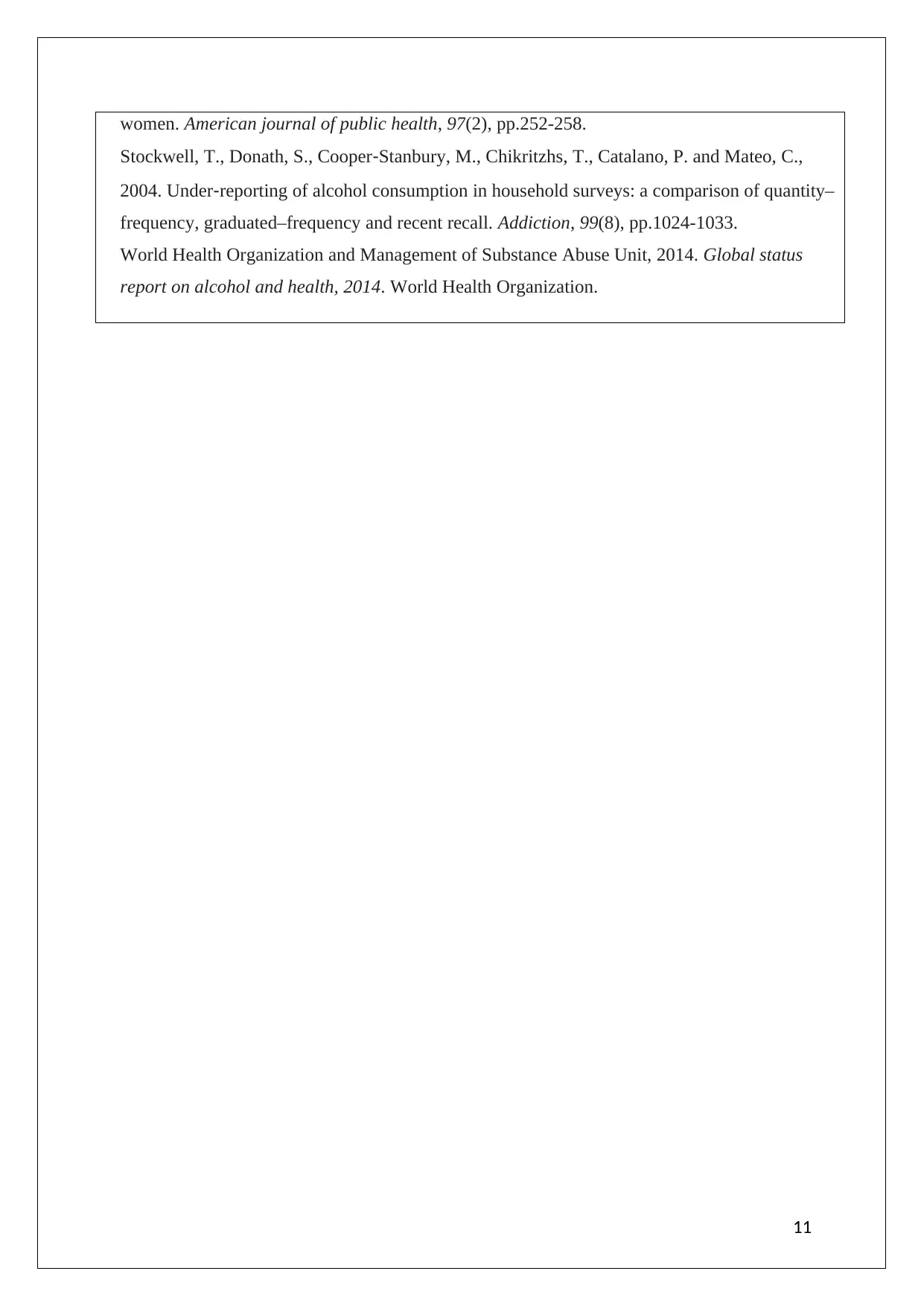
women. American journal of public health, 97(2), pp.252-258.
Stockwell, T., Donath, S., Cooper‐Stanbury, M., Chikritzhs, T., Catalano, P. and Mateo, C.,
2004. Under‐reporting of alcohol consumption in household surveys: a comparison of quantity–
frequency, graduated–frequency and recent recall. Addiction, 99(8), pp.1024-1033.
World Health Organization and Management of Substance Abuse Unit, 2014. Global status
report on alcohol and health, 2014. World Health Organization.
11
Stockwell, T., Donath, S., Cooper‐Stanbury, M., Chikritzhs, T., Catalano, P. and Mateo, C.,
2004. Under‐reporting of alcohol consumption in household surveys: a comparison of quantity–
frequency, graduated–frequency and recent recall. Addiction, 99(8), pp.1024-1033.
World Health Organization and Management of Substance Abuse Unit, 2014. Global status
report on alcohol and health, 2014. World Health Organization.
11

1 out of 11


Related Documents


Your All-in-One AI-Powered Toolkit for Academic Success.
+13062052269
info@desklib.com
Available 24*7 on WhatsApp / Email
![[object Object]](/_next/static/media/star-bottom.7253800d.svg)
Unlock your academic potential
Copyright © 2020–2026 A2Z Services. All Rights Reserved. Developed and managed by ZUCOL.