Perform Clinical Assessment and Contribute to Nursing Care Planning
VerifiedAdded on 2021/02/19
|28
|7259
|26
Homework Assignment
AI Summary
This assignment focuses on clinical assessment and nursing care planning, covering various aspects of patient care and development. The document begins with definitions of health, including physiological and psychosocial aspects, and describes the health-illness continuum. It then presents a growth and development table for individuals at different ages, from infancy to adulthood. The assignment also delves into the importance of play in child development, the impact of hospitalization on a child with a fractured femur, and the emotional and relational consequences of infertility for a couple. The document provides insights into how these factors influence patient care and well-being. Furthermore, the assignment requires the student to complete a written task and an exam. The assignment also touches upon theories of development and discusses the influence of genetics and the environment. It covers the impact of hospitalization and infertility along with theories of development including several stages and principles of health assessment.
ASSESSMENT COVER SHEET + TASKS
NATIONAL UNIT NAME/S Perform clinical assessment and contribute to
planning nursing care
ASSESSMENT DETAILS
TASK 1 Written Task
TASK 2 Examination Paper
TASK 3 Participation in Basic OSCA
TASK 4 Clinical skills assessments pages 30-32 and 70-72 TRB
· There are 4 assessment tasks for this
unit. Assessment task 1 is contained
within this document. Task 2 is an
Examination paper and Task 3 and 4
are contained within the Training Record
Book.
· This task makes up 100% of the
assessment for this unit.
· You must achieve a satisfactory grade in
each task to achieve a result of
competent for the units.
DUE DATE:
STUDENT DECLARATION
1. I declare this assessment task to be solely my own work or, I have acknowledged within my assessment if this
work was completed with a peer
2. I have notified the trainer/assessor of any special needs or requirements I have in relation to the assessment
3. I understand that my assessment will not be returned to me and I have kept a copy of my own work
4. I have read and understood the Assessment Policy provided in Every Student’s Guide to Assessment in TAFE
NSW. https://www.tafewestern.edu.au/files/dmfile/everystudentsguidetoassessment.pdf
HLTENN003 Asmt 1 of 4
Owner: Health Version: 1
Review date: Page 1 of 28
DO NOT REMOVE
Responsible for currency: VET Regulation Support Officer Last updated: 02.09.2016
Review date: 02.09.2016
NATIONAL UNIT NAME/S Perform clinical assessment and contribute to
planning nursing care
ASSESSMENT DETAILS
TASK 1 Written Task
TASK 2 Examination Paper
TASK 3 Participation in Basic OSCA
TASK 4 Clinical skills assessments pages 30-32 and 70-72 TRB
· There are 4 assessment tasks for this
unit. Assessment task 1 is contained
within this document. Task 2 is an
Examination paper and Task 3 and 4
are contained within the Training Record
Book.
· This task makes up 100% of the
assessment for this unit.
· You must achieve a satisfactory grade in
each task to achieve a result of
competent for the units.
DUE DATE:
STUDENT DECLARATION
1. I declare this assessment task to be solely my own work or, I have acknowledged within my assessment if this
work was completed with a peer
2. I have notified the trainer/assessor of any special needs or requirements I have in relation to the assessment
3. I understand that my assessment will not be returned to me and I have kept a copy of my own work
4. I have read and understood the Assessment Policy provided in Every Student’s Guide to Assessment in TAFE
NSW. https://www.tafewestern.edu.au/files/dmfile/everystudentsguidetoassessment.pdf
HLTENN003 Asmt 1 of 4
Owner: Health Version: 1
Review date: Page 1 of 28
DO NOT REMOVE
Responsible for currency: VET Regulation Support Officer Last updated: 02.09.2016
Review date: 02.09.2016

Paraphrase This Document
Need a fresh take? Get an instant paraphrase of this document with our AI Paraphraser
STUDENT NAME STUDENT SIGNATURE DATE
RTO
DECLARATION
I declare that any
workplace
information
contained in this
assessment will
remain confidential
within TAFE NSW.
TRAINER/ASSESSOR NAME TRAINER/ASSESSOR SIGNATURE DATE
1.
ASSESSMENT INSTRUCTIONS
· This assessment is to determine your competency in relation to the unit HLTENN003 – Apply
communication skills in nursing practice.
· The assessments require you to:
o Complete the following task and an Exam
o It must be completed and submitted in a professional, work processed format.
· ALWAYS keep a copy of the assessment submitted.
· Written Assessment Event is to be completed individually.
· Your assessment needs to have accurate spelling and grammar, in-text referencing, reference
list using the TAFE approved referencing system and relevant appendices
· Should you have any concerns about this assessment, please contact your trainer/assessor before
beginning the tasks.
HLTENN003 Asmt 1 of 4
Owner: Health Version: 1
Review date: Page 2 of 28
DO NOT REMOVE
Responsible for currency: VET Regulation Support Officer Last updated: 02.09.2016
Review date: 02.09.2016
RTO
DECLARATION
I declare that any
workplace
information
contained in this
assessment will
remain confidential
within TAFE NSW.
TRAINER/ASSESSOR NAME TRAINER/ASSESSOR SIGNATURE DATE
1.
ASSESSMENT INSTRUCTIONS
· This assessment is to determine your competency in relation to the unit HLTENN003 – Apply
communication skills in nursing practice.
· The assessments require you to:
o Complete the following task and an Exam
o It must be completed and submitted in a professional, work processed format.
· ALWAYS keep a copy of the assessment submitted.
· Written Assessment Event is to be completed individually.
· Your assessment needs to have accurate spelling and grammar, in-text referencing, reference
list using the TAFE approved referencing system and relevant appendices
· Should you have any concerns about this assessment, please contact your trainer/assessor before
beginning the tasks.
HLTENN003 Asmt 1 of 4
Owner: Health Version: 1
Review date: Page 2 of 28
DO NOT REMOVE
Responsible for currency: VET Regulation Support Officer Last updated: 02.09.2016
Review date: 02.09.2016
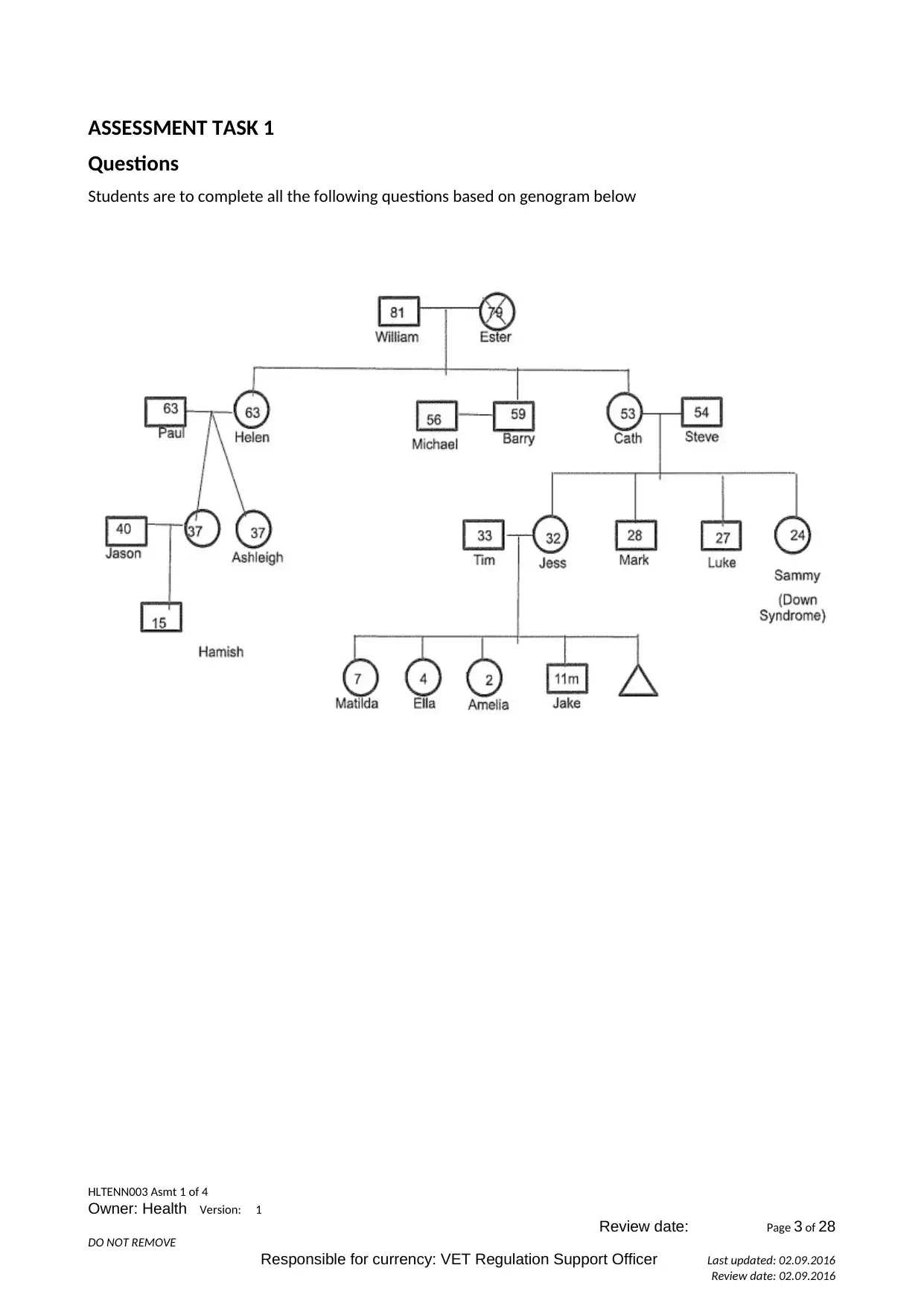
ASSESSMENT TASK 1
Questions
Students are to complete all the following questions based on genogram below
HLTENN003 Asmt 1 of 4
Owner: Health Version: 1
Review date: Page 3 of 28
DO NOT REMOVE
Responsible for currency: VET Regulation Support Officer Last updated: 02.09.2016
Review date: 02.09.2016
Questions
Students are to complete all the following questions based on genogram below
HLTENN003 Asmt 1 of 4
Owner: Health Version: 1
Review date: Page 3 of 28
DO NOT REMOVE
Responsible for currency: VET Regulation Support Officer Last updated: 02.09.2016
Review date: 02.09.2016
⊘ This is a preview!⊘
Do you want full access?
Subscribe today to unlock all pages.

Trusted by 1+ million students worldwide

HLTENN003 Asmt 1 of 4
Owner: Health Version: 1
Review date: Page 4 of 28
DO NOT REMOVE
Responsible for currency: VET Regulation Support Officer Last updated: 02.09.2016
Review date: 02.09.2016
Owner: Health Version: 1
Review date: Page 4 of 28
DO NOT REMOVE
Responsible for currency: VET Regulation Support Officer Last updated: 02.09.2016
Review date: 02.09.2016
Paraphrase This Document
Need a fresh take? Get an instant paraphrase of this document with our AI Paraphraser
Introduction
Genogram refers to a graphic representation of a family tree which shows data about relations
among individuals. It can be considered as a traditional family tree that permit user to evaluate the
hereditary patters and psychological factors that punctuate relationships. However, genogram is
helpful for care providers understand about genetically transmitted health issues in order to make
correct decisions of providing treatment or medication for their well-being. The present report has
a purpose to analyze genogram of selected family to understand their relationships and hereditary
patterns which should be considered to evaluate physiological and psychological aspects along with
health illness continuum. This assignment will focus on growth & development and importance of
play in development of a child. It will also include impact of hospitalization and infertility along with
theories of development including several stages. The influence of genetics & environment on
development and principles of health assessment is given below.
1. Define health including the physiological and psychosocial aspects. Describe the health illness
continuum.
Psycho-social health can be described as a condition in which a person is mental,
emotional, social and spiritual well being. It consist various factors like family,
friends, personal experience, heredity, hormonal function, physical fitness, learned
helplessness or optimism and personality. Physiological health refers to a situation
of an individual having normal functions of different organs and organs systems in
entire human body. Health-Illness continuum is a graphic illustration of well-being
that explain how well-being is more than simply an absence of illness along with
incorporating the individuals mental and emotional health.
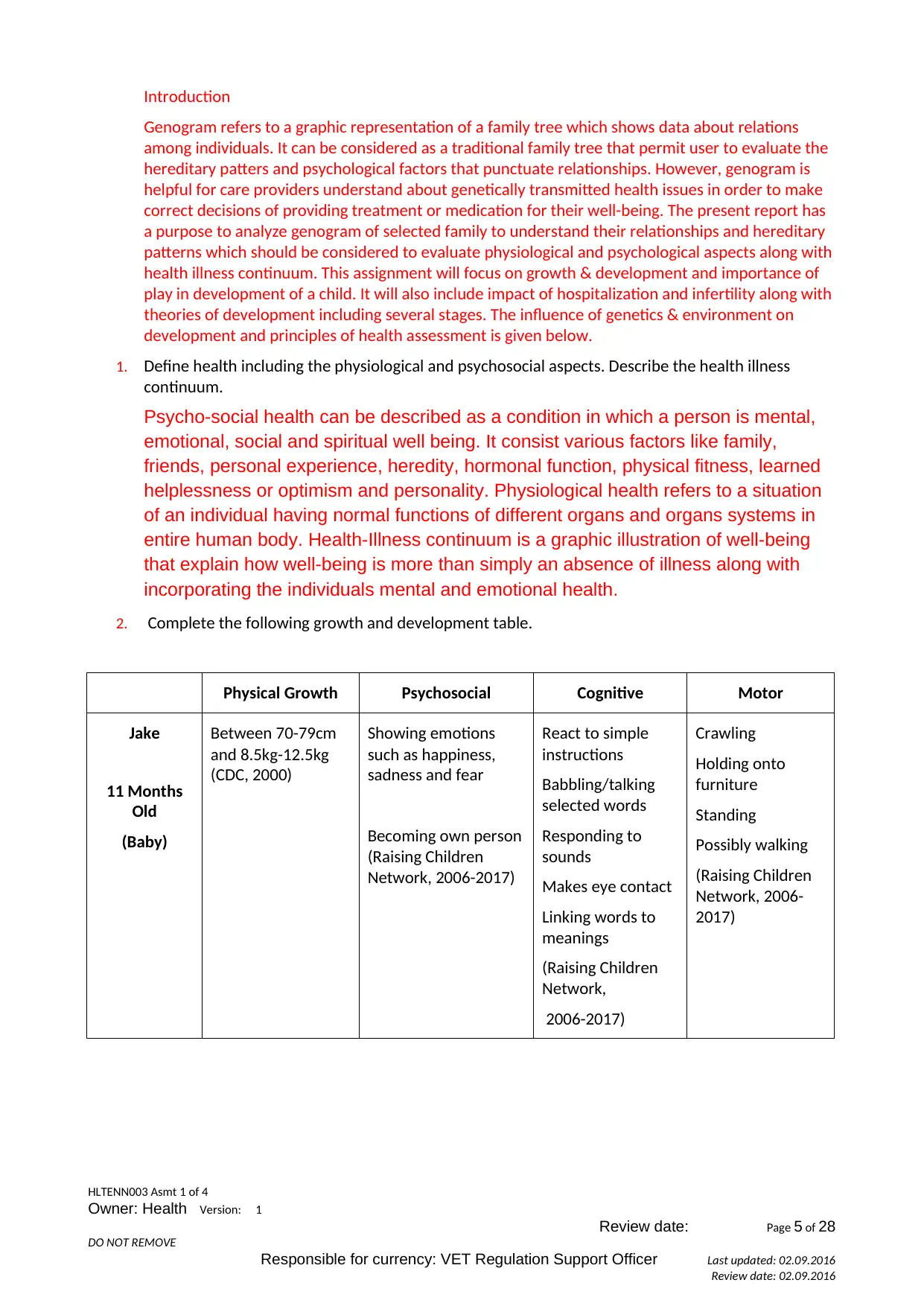
2. Complete the following growth and development table.
Physical Growth Psychosocial Cognitive Motor
Jake
11 Months
Old
(Baby)
Between 70-79cm
and 8.5kg-12.5kg
(CDC, 2000)
Showing emotions
such as happiness,
sadness and fear
Becoming own person
(Raising Children
Network, 2006-2017)
React to simple
instructions
Babbling/talking
selected words
Responding to
sounds
Makes eye contact
Linking words to
meanings
(Raising Children
Network,
2006-2017)
Crawling
Holding onto
furniture
Standing
Possibly walking
(Raising Children
Network, 2006-
2017)
HLTENN003 Asmt 1 of 4
Owner: Health Version: 1
Review date: Page 5 of 28
DO NOT REMOVE
Responsible for currency: VET Regulation Support Officer Last updated: 02.09.2016
Review date: 02.09.2016
Genogram refers to a graphic representation of a family tree which shows data about relations
among individuals. It can be considered as a traditional family tree that permit user to evaluate the
hereditary patters and psychological factors that punctuate relationships. However, genogram is
helpful for care providers understand about genetically transmitted health issues in order to make
correct decisions of providing treatment or medication for their well-being. The present report has
a purpose to analyze genogram of selected family to understand their relationships and hereditary
patterns which should be considered to evaluate physiological and psychological aspects along with
health illness continuum. This assignment will focus on growth & development and importance of
play in development of a child. It will also include impact of hospitalization and infertility along with
theories of development including several stages. The influence of genetics & environment on
development and principles of health assessment is given below.
1. Define health including the physiological and psychosocial aspects. Describe the health illness
continuum.
Psycho-social health can be described as a condition in which a person is mental,
emotional, social and spiritual well being. It consist various factors like family,
friends, personal experience, heredity, hormonal function, physical fitness, learned
helplessness or optimism and personality. Physiological health refers to a situation
of an individual having normal functions of different organs and organs systems in
entire human body. Health-Illness continuum is a graphic illustration of well-being
that explain how well-being is more than simply an absence of illness along with
incorporating the individuals mental and emotional health.
2. Complete the following growth and development table.
Physical Growth Psychosocial Cognitive Motor
Jake
11 Months
Old
(Baby)
Between 70-79cm
and 8.5kg-12.5kg
(CDC, 2000)
Showing emotions
such as happiness,
sadness and fear
Becoming own person
(Raising Children
Network, 2006-2017)
React to simple
instructions
Babbling/talking
selected words
Responding to
sounds
Makes eye contact
Linking words to
meanings
(Raising Children
Network,
2006-2017)
Crawling
Holding onto
furniture
Standing
Possibly walking
(Raising Children
Network, 2006-
2017)
HLTENN003 Asmt 1 of 4
Owner: Health Version: 1
Review date: Page 5 of 28
DO NOT REMOVE
Responsible for currency: VET Regulation Support Officer Last updated: 02.09.2016
Review date: 02.09.2016
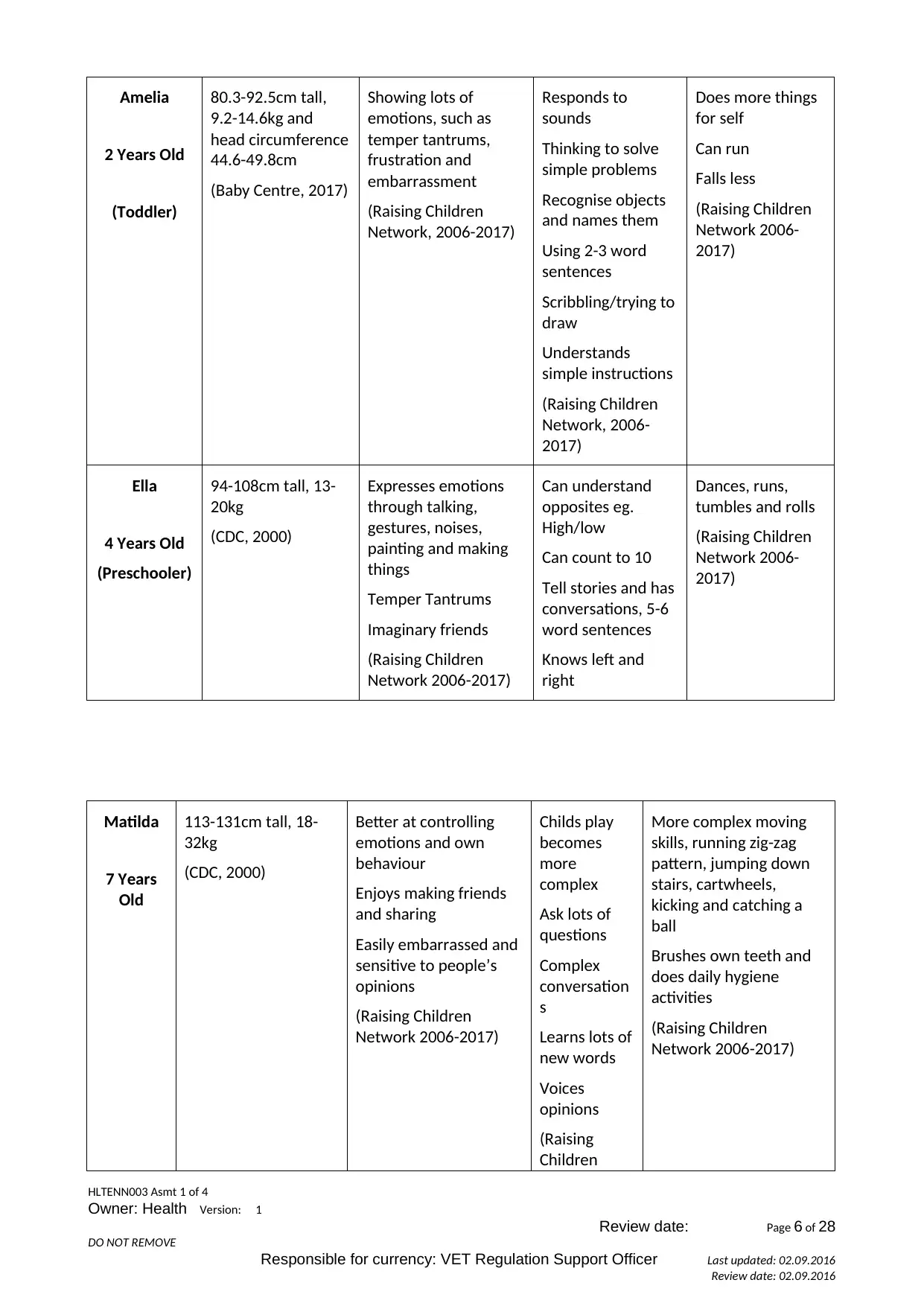
Amelia
2 Years Old
(Toddler)
80.3-92.5cm tall,
9.2-14.6kg and
head circumference
44.6-49.8cm
(Baby Centre, 2017)
Showing lots of
emotions, such as
temper tantrums,
frustration and
embarrassment
(Raising Children
Network, 2006-2017)
Responds to
sounds
Thinking to solve
simple problems
Recognise objects
and names them
Using 2-3 word
sentences
Scribbling/trying to
draw
Understands
simple instructions
(Raising Children
Network, 2006-
2017)
Does more things
for self
Can run
Falls less
(Raising Children
Network 2006-
2017)
Ella
4 Years Old
(Preschooler)
94-108cm tall, 13-
20kg
(CDC, 2000)
Expresses emotions
through talking,
gestures, noises,
painting and making
things
Temper Tantrums
Imaginary friends
(Raising Children
Network 2006-2017)
Can understand
opposites eg.
High/low
Can count to 10
Tell stories and has
conversations, 5-6
word sentences
Knows left and
right
Dances, runs,
tumbles and rolls
(Raising Children
Network 2006-
2017)
Matilda
7 Years
Old
113-131cm tall, 18-
32kg
(CDC, 2000)
Better at controlling
emotions and own
behaviour
Enjoys making friends
and sharing
Easily embarrassed and
sensitive to people’s
opinions
(Raising Children
Network 2006-2017)
Childs play
becomes
more
complex
Ask lots of
questions
Complex
conversation
s
Learns lots of
new words
Voices
opinions
(Raising
Children
More complex moving
skills, running zig-zag
pattern, jumping down
stairs, cartwheels,
kicking and catching a
ball
Brushes own teeth and
does daily hygiene
activities
(Raising Children
Network 2006-2017)
HLTENN003 Asmt 1 of 4
Owner: Health Version: 1
Review date: Page 6 of 28
DO NOT REMOVE
Responsible for currency: VET Regulation Support Officer Last updated: 02.09.2016
Review date: 02.09.2016
2 Years Old
(Toddler)
80.3-92.5cm tall,
9.2-14.6kg and
head circumference
44.6-49.8cm
(Baby Centre, 2017)
Showing lots of
emotions, such as
temper tantrums,
frustration and
embarrassment
(Raising Children
Network, 2006-2017)
Responds to
sounds
Thinking to solve
simple problems
Recognise objects
and names them
Using 2-3 word
sentences
Scribbling/trying to
draw
Understands
simple instructions
(Raising Children
Network, 2006-
2017)
Does more things
for self
Can run
Falls less
(Raising Children
Network 2006-
2017)
Ella
4 Years Old
(Preschooler)
94-108cm tall, 13-
20kg
(CDC, 2000)
Expresses emotions
through talking,
gestures, noises,
painting and making
things
Temper Tantrums
Imaginary friends
(Raising Children
Network 2006-2017)
Can understand
opposites eg.
High/low
Can count to 10
Tell stories and has
conversations, 5-6
word sentences
Knows left and
right
Dances, runs,
tumbles and rolls
(Raising Children
Network 2006-
2017)
Matilda
7 Years
Old
113-131cm tall, 18-
32kg
(CDC, 2000)
Better at controlling
emotions and own
behaviour
Enjoys making friends
and sharing
Easily embarrassed and
sensitive to people’s
opinions
(Raising Children
Network 2006-2017)
Childs play
becomes
more
complex
Ask lots of
questions
Complex
conversation
s
Learns lots of
new words
Voices
opinions
(Raising
Children
More complex moving
skills, running zig-zag
pattern, jumping down
stairs, cartwheels,
kicking and catching a
ball
Brushes own teeth and
does daily hygiene
activities
(Raising Children
Network 2006-2017)
HLTENN003 Asmt 1 of 4
Owner: Health Version: 1
Review date: Page 6 of 28
DO NOT REMOVE
Responsible for currency: VET Regulation Support Officer Last updated: 02.09.2016
Review date: 02.09.2016
⊘ This is a preview!⊘
Do you want full access?
Subscribe today to unlock all pages.
Trusted by 1+ million students worldwide
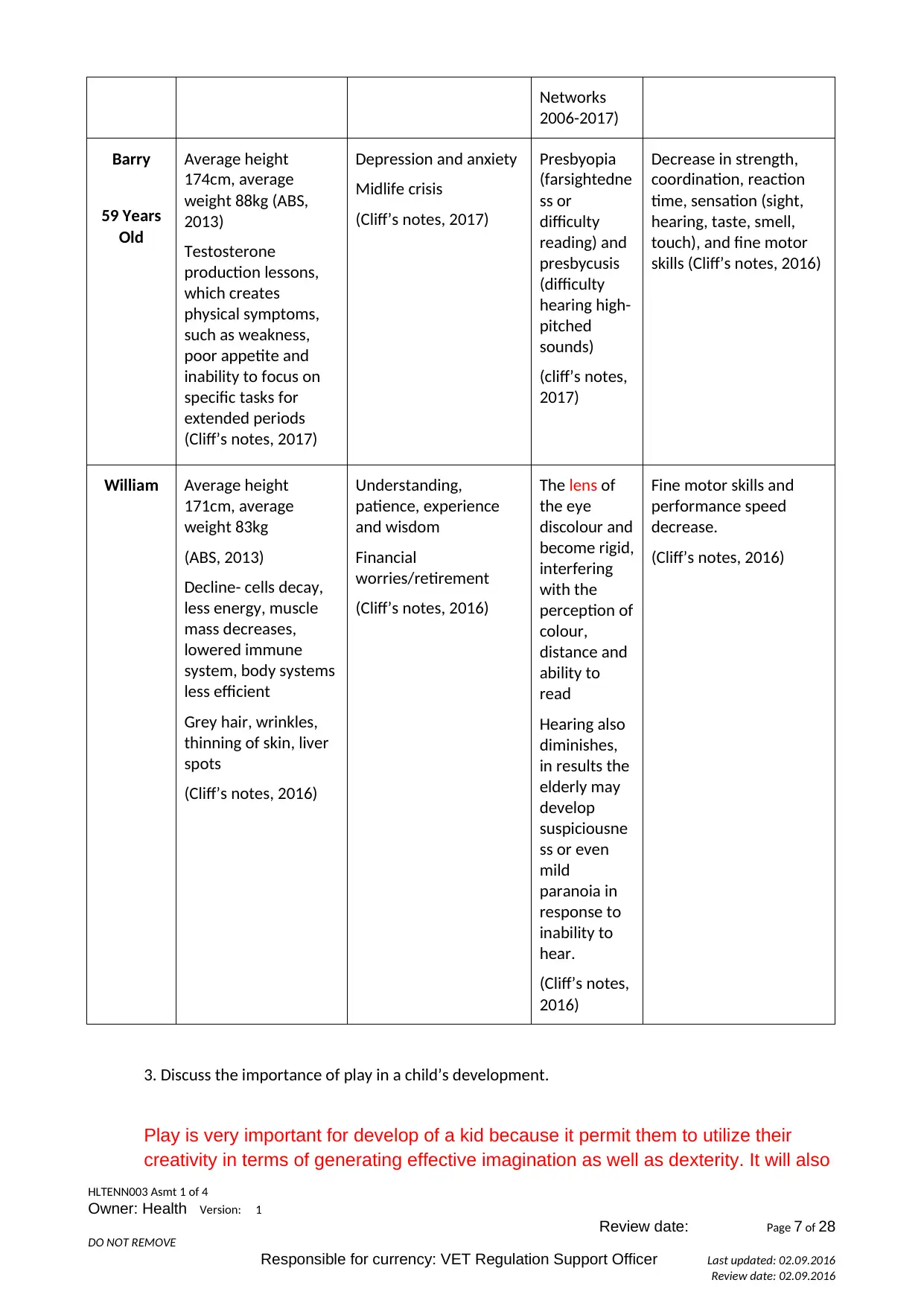
Networks
2006-2017)
Barry
59 Years
Old
Average height
174cm, average
weight 88kg (ABS,
2013)
Testosterone
production lessons,
which creates
physical symptoms,
such as weakness,
poor appetite and
inability to focus on
specific tasks for
extended periods
(Cliff’s notes, 2017)
Depression and anxiety
Midlife crisis
(Cliff’s notes, 2017)
Presbyopia
(farsightedne
ss or
difficulty
reading) and
presbycusis
(difficulty
hearing high-
pitched
sounds)
(cliff’s notes,
2017)
Decrease in strength,
coordination, reaction
time, sensation (sight,
hearing, taste, smell,
touch), and fine motor
skills (Cliff’s notes, 2016)
William Average height
171cm, average
weight 83kg
(ABS, 2013)
Decline- cells decay,
less energy, muscle
mass decreases,
lowered immune
system, body systems
less efficient
Grey hair, wrinkles,
thinning of skin, liver
spots
(Cliff’s notes, 2016)
Understanding,
patience, experience
and wisdom
Financial
worries/retirement
(Cliff’s notes, 2016)
The lens of
the eye
discolour and
become rigid,
interfering
with the
perception of
colour,
distance and
ability to
read
Hearing also
diminishes,
in results the
elderly may
develop
suspiciousne
ss or even
mild
paranoia in
response to
inability to
hear.
(Cliff’s notes,
2016)
Fine motor skills and
performance speed
decrease.
(Cliff’s notes, 2016)
3. Discuss the importance of play in a child’s development.
Play is very important for develop of a kid because it permit them to utilize their
creativity in terms of generating effective imagination as well as dexterity. It will also
HLTENN003 Asmt 1 of 4
Owner: Health Version: 1
Review date: Page 7 of 28
DO NOT REMOVE
Responsible for currency: VET Regulation Support Officer Last updated: 02.09.2016
Review date: 02.09.2016
2006-2017)
Barry
59 Years
Old
Average height
174cm, average
weight 88kg (ABS,
2013)
Testosterone
production lessons,
which creates
physical symptoms,
such as weakness,
poor appetite and
inability to focus on
specific tasks for
extended periods
(Cliff’s notes, 2017)
Depression and anxiety
Midlife crisis
(Cliff’s notes, 2017)
Presbyopia
(farsightedne
ss or
difficulty
reading) and
presbycusis
(difficulty
hearing high-
pitched
sounds)
(cliff’s notes,
2017)
Decrease in strength,
coordination, reaction
time, sensation (sight,
hearing, taste, smell,
touch), and fine motor
skills (Cliff’s notes, 2016)
William Average height
171cm, average
weight 83kg
(ABS, 2013)
Decline- cells decay,
less energy, muscle
mass decreases,
lowered immune
system, body systems
less efficient
Grey hair, wrinkles,
thinning of skin, liver
spots
(Cliff’s notes, 2016)
Understanding,
patience, experience
and wisdom
Financial
worries/retirement
(Cliff’s notes, 2016)
The lens of
the eye
discolour and
become rigid,
interfering
with the
perception of
colour,
distance and
ability to
read
Hearing also
diminishes,
in results the
elderly may
develop
suspiciousne
ss or even
mild
paranoia in
response to
inability to
hear.
(Cliff’s notes,
2016)
Fine motor skills and
performance speed
decrease.
(Cliff’s notes, 2016)
3. Discuss the importance of play in a child’s development.
Play is very important for develop of a kid because it permit them to utilize their
creativity in terms of generating effective imagination as well as dexterity. It will also
HLTENN003 Asmt 1 of 4
Owner: Health Version: 1
Review date: Page 7 of 28
DO NOT REMOVE
Responsible for currency: VET Regulation Support Officer Last updated: 02.09.2016
Review date: 02.09.2016
Paraphrase This Document
Need a fresh take? Get an instant paraphrase of this document with our AI Paraphraser
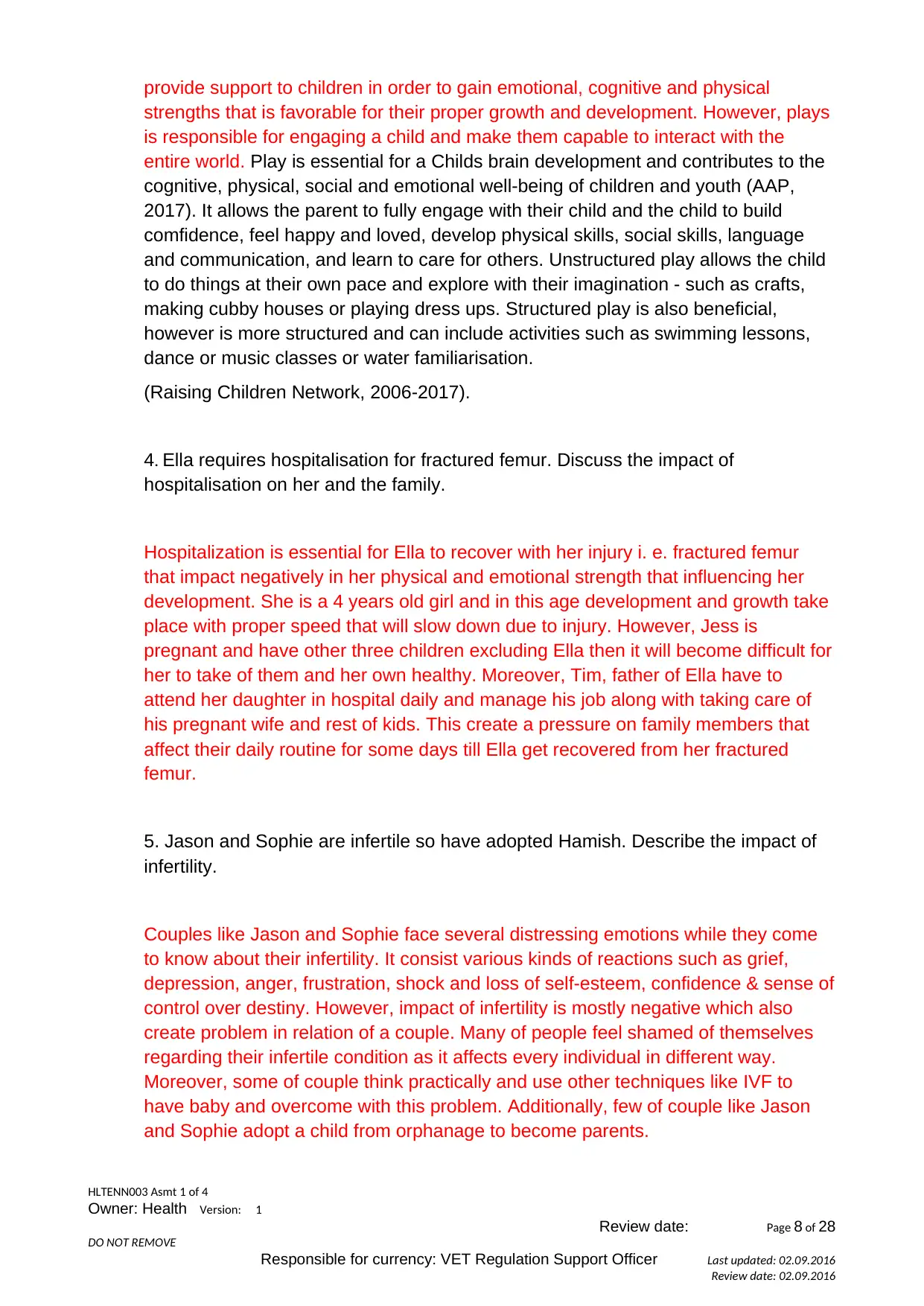
provide support to children in order to gain emotional, cognitive and physical
strengths that is favorable for their proper growth and development. However, plays
is responsible for engaging a child and make them capable to interact with the
entire world. Play is essential for a Childs brain development and contributes to the
cognitive, physical, social and emotional well-being of children and youth (AAP,
2017). It allows the parent to fully engage with their child and the child to build
comfidence, feel happy and loved, develop physical skills, social skills, language
and communication, and learn to care for others. Unstructured play allows the child
to do things at their own pace and explore with their imagination - such as crafts,
making cubby houses or playing dress ups. Structured play is also beneficial,
however is more structured and can include activities such as swimming lessons,
dance or music classes or water familiarisation.
(Raising Children Network, 2006-2017).
4. Ella requires hospitalisation for fractured femur. Discuss the impact of
hospitalisation on her and the family.
Hospitalization is essential for Ella to recover with her injury i. e. fractured femur
that impact negatively in her physical and emotional strength that influencing her
development. She is a 4 years old girl and in this age development and growth take
place with proper speed that will slow down due to injury. However, Jess is
pregnant and have other three children excluding Ella then it will become difficult for
her to take of them and her own healthy. Moreover, Tim, father of Ella have to
attend her daughter in hospital daily and manage his job along with taking care of
his pregnant wife and rest of kids. This create a pressure on family members that
affect their daily routine for some days till Ella get recovered from her fractured
femur.
5. Jason and Sophie are infertile so have adopted Hamish. Describe the impact of
infertility.
Couples like Jason and Sophie face several distressing emotions while they come
to know about their infertility. It consist various kinds of reactions such as grief,
depression, anger, frustration, shock and loss of self-esteem, confidence & sense of
control over destiny. However, impact of infertility is mostly negative which also
create problem in relation of a couple. Many of people feel shamed of themselves
regarding their infertile condition as it affects every individual in different way.
Moreover, some of couple think practically and use other techniques like IVF to
have baby and overcome with this problem. Additionally, few of couple like Jason
and Sophie adopt a child from orphanage to become parents.
HLTENN003 Asmt 1 of 4
Owner: Health Version: 1
Review date: Page 8 of 28
DO NOT REMOVE
Responsible for currency: VET Regulation Support Officer Last updated: 02.09.2016
Review date: 02.09.2016
strengths that is favorable for their proper growth and development. However, plays
is responsible for engaging a child and make them capable to interact with the
entire world. Play is essential for a Childs brain development and contributes to the
cognitive, physical, social and emotional well-being of children and youth (AAP,
2017). It allows the parent to fully engage with their child and the child to build
comfidence, feel happy and loved, develop physical skills, social skills, language
and communication, and learn to care for others. Unstructured play allows the child
to do things at their own pace and explore with their imagination - such as crafts,
making cubby houses or playing dress ups. Structured play is also beneficial,
however is more structured and can include activities such as swimming lessons,
dance or music classes or water familiarisation.
(Raising Children Network, 2006-2017).
4. Ella requires hospitalisation for fractured femur. Discuss the impact of
hospitalisation on her and the family.
Hospitalization is essential for Ella to recover with her injury i. e. fractured femur
that impact negatively in her physical and emotional strength that influencing her
development. She is a 4 years old girl and in this age development and growth take
place with proper speed that will slow down due to injury. However, Jess is
pregnant and have other three children excluding Ella then it will become difficult for
her to take of them and her own healthy. Moreover, Tim, father of Ella have to
attend her daughter in hospital daily and manage his job along with taking care of
his pregnant wife and rest of kids. This create a pressure on family members that
affect their daily routine for some days till Ella get recovered from her fractured
femur.
5. Jason and Sophie are infertile so have adopted Hamish. Describe the impact of
infertility.
Couples like Jason and Sophie face several distressing emotions while they come
to know about their infertility. It consist various kinds of reactions such as grief,
depression, anger, frustration, shock and loss of self-esteem, confidence & sense of
control over destiny. However, impact of infertility is mostly negative which also
create problem in relation of a couple. Many of people feel shamed of themselves
regarding their infertile condition as it affects every individual in different way.
Moreover, some of couple think practically and use other techniques like IVF to
have baby and overcome with this problem. Additionally, few of couple like Jason
and Sophie adopt a child from orphanage to become parents.
HLTENN003 Asmt 1 of 4
Owner: Health Version: 1
Review date: Page 8 of 28
DO NOT REMOVE
Responsible for currency: VET Regulation Support Officer Last updated: 02.09.2016
Review date: 02.09.2016
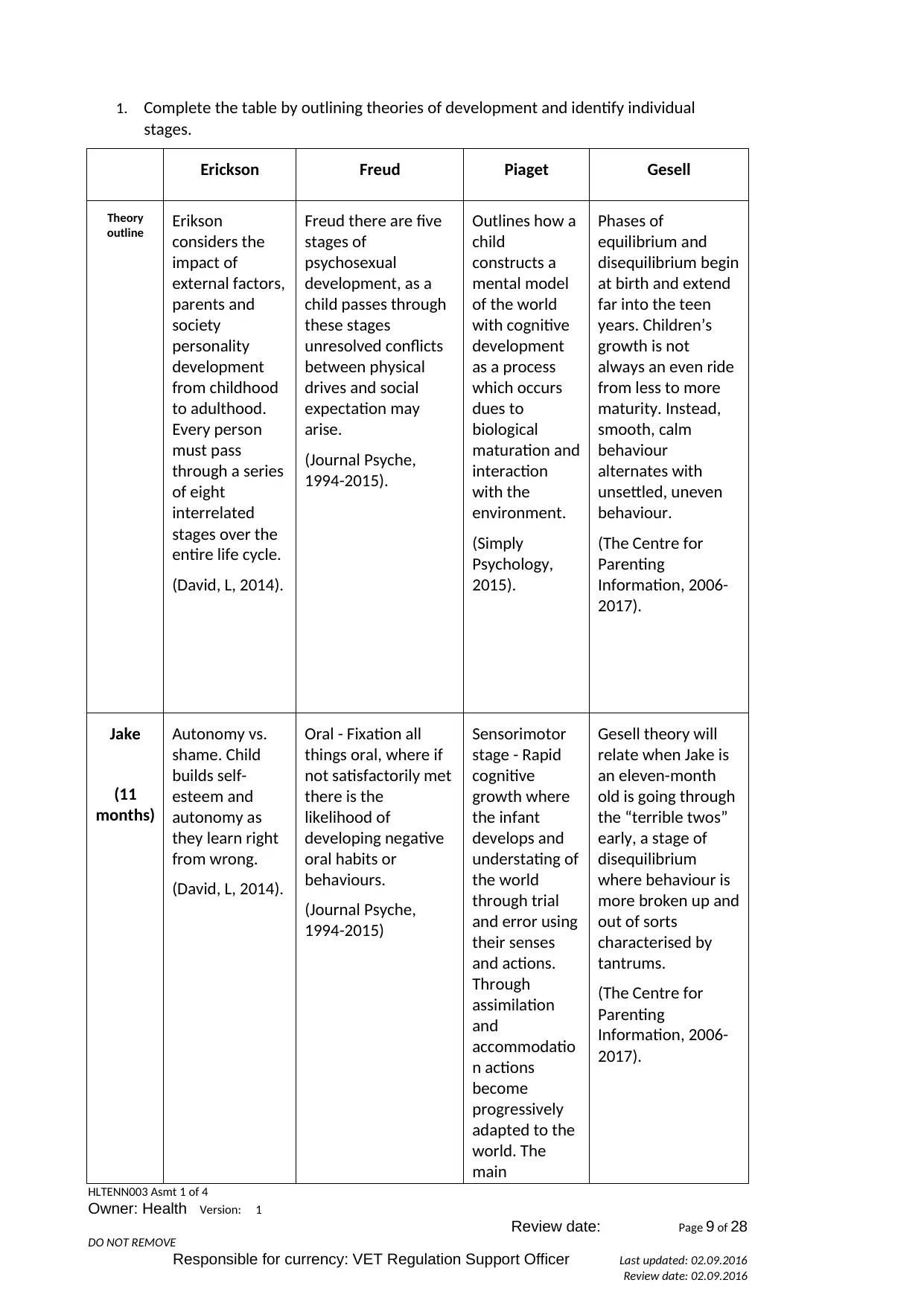
1. Complete the table by outlining theories of development and identify individual
stages.
Erickson Freud Piaget Gesell
Theory
outline Erikson
considers the
impact of
external factors,
parents and
society
personality
development
from childhood
to adulthood.
Every person
must pass
through a series
of eight
interrelated
stages over the
entire life cycle.
(David, L, 2014).
Freud there are five
stages of
psychosexual
development, as a
child passes through
these stages
unresolved conflicts
between physical
drives and social
expectation may
arise.
(Journal Psyche,
1994-2015).
Outlines how a
child
constructs a
mental model
of the world
with cognitive
development
as a process
which occurs
dues to
biological
maturation and
interaction
with the
environment.
(Simply
Psychology,
2015).
Phases of
equilibrium and
disequilibrium begin
at birth and extend
far into the teen
years. Children’s
growth is not
always an even ride
from less to more
maturity. Instead,
smooth, calm
behaviour
alternates with
unsettled, uneven
behaviour.
(The Centre for
Parenting
Information, 2006-
2017).
Jake
(11
months)
Autonomy vs.
shame. Child
builds self-
esteem and
autonomy as
they learn right
from wrong.
(David, L, 2014).
Oral - Fixation all
things oral, where if
not satisfactorily met
there is the
likelihood of
developing negative
oral habits or
behaviours.
(Journal Psyche,
1994-2015)
Sensorimotor
stage - Rapid
cognitive
growth where
the infant
develops and
understating of
the world
through trial
and error using
their senses
and actions.
Through
assimilation
and
accommodatio
n actions
become
progressively
adapted to the
world. The
main
Gesell theory will
relate when Jake is
an eleven-month
old is going through
the “terrible twos”
early, a stage of
disequilibrium
where behaviour is
more broken up and
out of sorts
characterised by
tantrums.
(The Centre for
Parenting
Information, 2006-
2017).
HLTENN003 Asmt 1 of 4
Owner: Health Version: 1
Review date: Page 9 of 28
DO NOT REMOVE
Responsible for currency: VET Regulation Support Officer Last updated: 02.09.2016
Review date: 02.09.2016
stages.
Erickson Freud Piaget Gesell
Theory
outline Erikson
considers the
impact of
external factors,
parents and
society
personality
development
from childhood
to adulthood.
Every person
must pass
through a series
of eight
interrelated
stages over the
entire life cycle.
(David, L, 2014).
Freud there are five
stages of
psychosexual
development, as a
child passes through
these stages
unresolved conflicts
between physical
drives and social
expectation may
arise.
(Journal Psyche,
1994-2015).
Outlines how a
child
constructs a
mental model
of the world
with cognitive
development
as a process
which occurs
dues to
biological
maturation and
interaction
with the
environment.
(Simply
Psychology,
2015).
Phases of
equilibrium and
disequilibrium begin
at birth and extend
far into the teen
years. Children’s
growth is not
always an even ride
from less to more
maturity. Instead,
smooth, calm
behaviour
alternates with
unsettled, uneven
behaviour.
(The Centre for
Parenting
Information, 2006-
2017).
Jake
(11
months)
Autonomy vs.
shame. Child
builds self-
esteem and
autonomy as
they learn right
from wrong.
(David, L, 2014).
Oral - Fixation all
things oral, where if
not satisfactorily met
there is the
likelihood of
developing negative
oral habits or
behaviours.
(Journal Psyche,
1994-2015)
Sensorimotor
stage - Rapid
cognitive
growth where
the infant
develops and
understating of
the world
through trial
and error using
their senses
and actions.
Through
assimilation
and
accommodatio
n actions
become
progressively
adapted to the
world. The
main
Gesell theory will
relate when Jake is
an eleven-month
old is going through
the “terrible twos”
early, a stage of
disequilibrium
where behaviour is
more broken up and
out of sorts
characterised by
tantrums.
(The Centre for
Parenting
Information, 2006-
2017).
HLTENN003 Asmt 1 of 4
Owner: Health Version: 1
Review date: Page 9 of 28
DO NOT REMOVE
Responsible for currency: VET Regulation Support Officer Last updated: 02.09.2016
Review date: 02.09.2016
⊘ This is a preview!⊘
Do you want full access?
Subscribe today to unlock all pages.
Trusted by 1+ million students worldwide
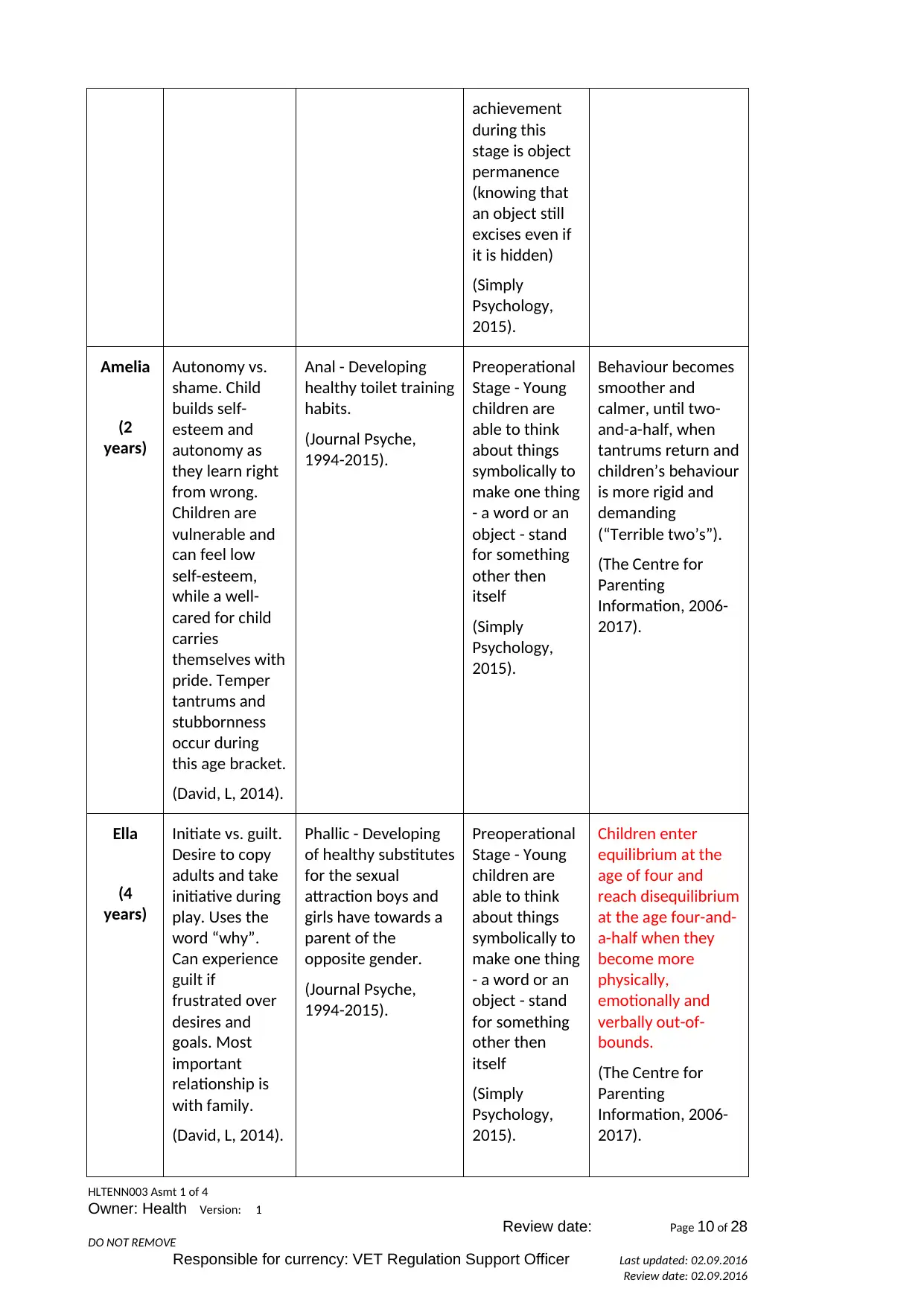
achievement
during this
stage is object
permanence
(knowing that
an object still
excises even if
it is hidden)
(Simply
Psychology,
2015).
Amelia
(2
years)
Autonomy vs.
shame. Child
builds self-
esteem and
autonomy as
they learn right
from wrong.
Children are
vulnerable and
can feel low
self-esteem,
while a well-
cared for child
carries
themselves with
pride. Temper
tantrums and
stubbornness
occur during
this age bracket.
(David, L, 2014).
Anal - Developing
healthy toilet training
habits.
(Journal Psyche,
1994-2015).
Preoperational
Stage - Young
children are
able to think
about things
symbolically to
make one thing
- a word or an
object - stand
for something
other then
itself
(Simply
Psychology,
2015).
Behaviour becomes
smoother and
calmer, until two-
and-a-half, when
tantrums return and
children’s behaviour
is more rigid and
demanding
(“Terrible two’s”).
(The Centre for
Parenting
Information, 2006-
2017).
Ella
(4
years)
Initiate vs. guilt.
Desire to copy
adults and take
initiative during
play. Uses the
word “why”.
Can experience
guilt if
frustrated over
desires and
goals. Most
important
relationship is
with family.
(David, L, 2014).
Phallic - Developing
of healthy substitutes
for the sexual
attraction boys and
girls have towards a
parent of the
opposite gender.
(Journal Psyche,
1994-2015).
Preoperational
Stage - Young
children are
able to think
about things
symbolically to
make one thing
- a word or an
object - stand
for something
other then
itself
(Simply
Psychology,
2015).
Children enter
equilibrium at the
age of four and
reach disequilibrium
at the age four-and-
a-half when they
become more
physically,
emotionally and
verbally out-of-
bounds.
(The Centre for
Parenting
Information, 2006-
2017).
HLTENN003 Asmt 1 of 4
Owner: Health Version: 1
Review date: Page 10 of 28
DO NOT REMOVE
Responsible for currency: VET Regulation Support Officer Last updated: 02.09.2016
Review date: 02.09.2016
during this
stage is object
permanence
(knowing that
an object still
excises even if
it is hidden)
(Simply
Psychology,
2015).
Amelia
(2
years)
Autonomy vs.
shame. Child
builds self-
esteem and
autonomy as
they learn right
from wrong.
Children are
vulnerable and
can feel low
self-esteem,
while a well-
cared for child
carries
themselves with
pride. Temper
tantrums and
stubbornness
occur during
this age bracket.
(David, L, 2014).
Anal - Developing
healthy toilet training
habits.
(Journal Psyche,
1994-2015).
Preoperational
Stage - Young
children are
able to think
about things
symbolically to
make one thing
- a word or an
object - stand
for something
other then
itself
(Simply
Psychology,
2015).
Behaviour becomes
smoother and
calmer, until two-
and-a-half, when
tantrums return and
children’s behaviour
is more rigid and
demanding
(“Terrible two’s”).
(The Centre for
Parenting
Information, 2006-
2017).
Ella
(4
years)
Initiate vs. guilt.
Desire to copy
adults and take
initiative during
play. Uses the
word “why”.
Can experience
guilt if
frustrated over
desires and
goals. Most
important
relationship is
with family.
(David, L, 2014).
Phallic - Developing
of healthy substitutes
for the sexual
attraction boys and
girls have towards a
parent of the
opposite gender.
(Journal Psyche,
1994-2015).
Preoperational
Stage - Young
children are
able to think
about things
symbolically to
make one thing
- a word or an
object - stand
for something
other then
itself
(Simply
Psychology,
2015).
Children enter
equilibrium at the
age of four and
reach disequilibrium
at the age four-and-
a-half when they
become more
physically,
emotionally and
verbally out-of-
bounds.
(The Centre for
Parenting
Information, 2006-
2017).
HLTENN003 Asmt 1 of 4
Owner: Health Version: 1
Review date: Page 10 of 28
DO NOT REMOVE
Responsible for currency: VET Regulation Support Officer Last updated: 02.09.2016
Review date: 02.09.2016
Paraphrase This Document
Need a fresh take? Get an instant paraphrase of this document with our AI Paraphraser
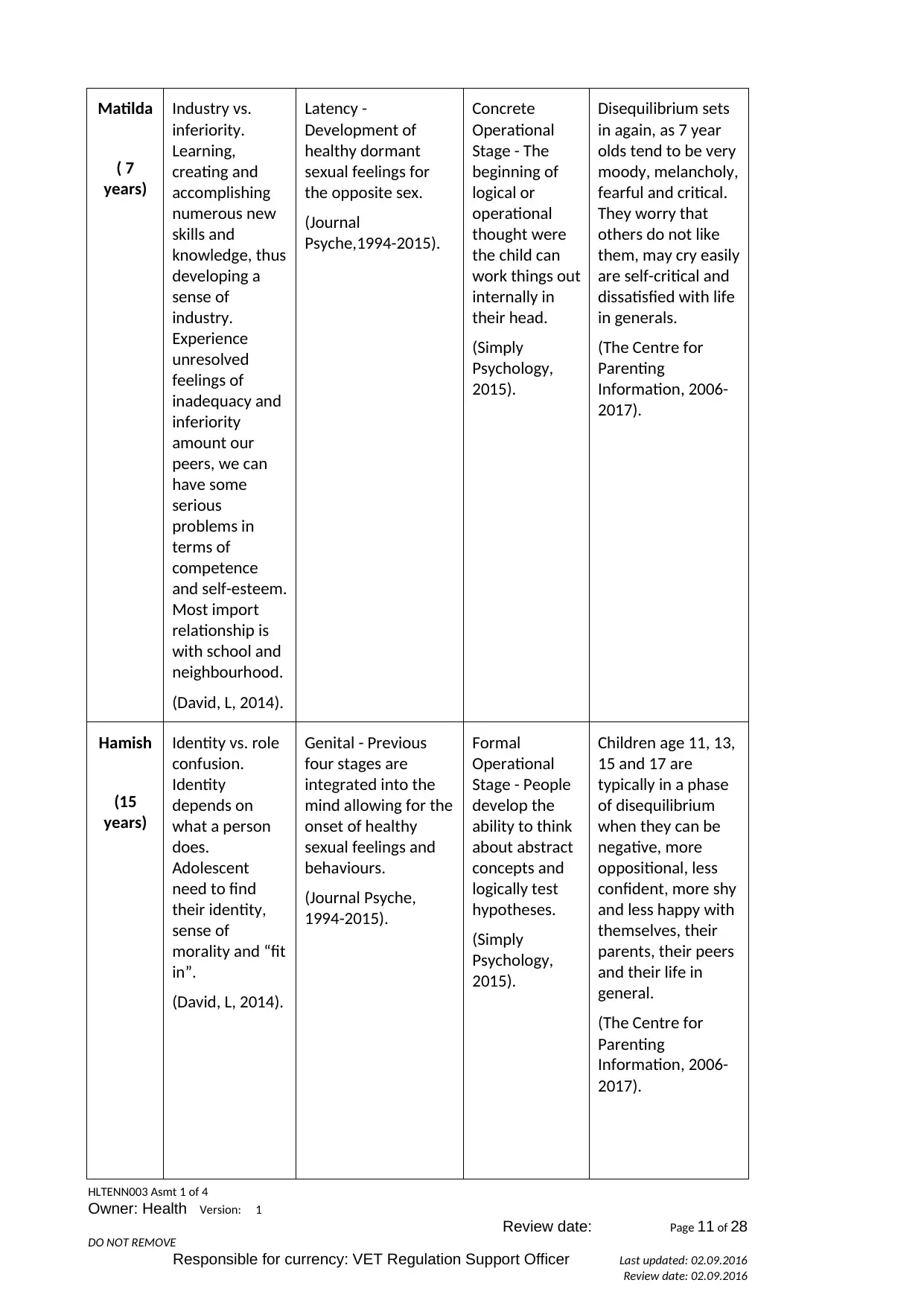
Matilda
( 7
years)
Industry vs.
inferiority.
Learning,
creating and
accomplishing
numerous new
skills and
knowledge, thus
developing a
sense of
industry.
Experience
unresolved
feelings of
inadequacy and
inferiority
amount our
peers, we can
have some
serious
problems in
terms of
competence
and self-esteem.
Most import
relationship is
with school and
neighbourhood.
(David, L, 2014).
Latency -
Development of
healthy dormant
sexual feelings for
the opposite sex.
(Journal
Psyche,1994-2015).
Concrete
Operational
Stage - The
beginning of
logical or
operational
thought were
the child can
work things out
internally in
their head.
(Simply
Psychology,
2015).
Disequilibrium sets
in again, as 7 year
olds tend to be very
moody, melancholy,
fearful and critical.
They worry that
others do not like
them, may cry easily
are self-critical and
dissatisfied with life
in generals.
(The Centre for
Parenting
Information, 2006-
2017).
Hamish
(15
years)
Identity vs. role
confusion.
Identity
depends on
what a person
does.
Adolescent
need to find
their identity,
sense of
morality and “fit
in”.
(David, L, 2014).
Genital - Previous
four stages are
integrated into the
mind allowing for the
onset of healthy
sexual feelings and
behaviours.
(Journal Psyche,
1994-2015).
Formal
Operational
Stage - People
develop the
ability to think
about abstract
concepts and
logically test
hypotheses.
(Simply
Psychology,
2015).
Children age 11, 13,
15 and 17 are
typically in a phase
of disequilibrium
when they can be
negative, more
oppositional, less
confident, more shy
and less happy with
themselves, their
parents, their peers
and their life in
general.
(The Centre for
Parenting
Information, 2006-
2017).
HLTENN003 Asmt 1 of 4
Owner: Health Version: 1
Review date: Page 11 of 28
DO NOT REMOVE
Responsible for currency: VET Regulation Support Officer Last updated: 02.09.2016
Review date: 02.09.2016
( 7
years)
Industry vs.
inferiority.
Learning,
creating and
accomplishing
numerous new
skills and
knowledge, thus
developing a
sense of
industry.
Experience
unresolved
feelings of
inadequacy and
inferiority
amount our
peers, we can
have some
serious
problems in
terms of
competence
and self-esteem.
Most import
relationship is
with school and
neighbourhood.
(David, L, 2014).
Latency -
Development of
healthy dormant
sexual feelings for
the opposite sex.
(Journal
Psyche,1994-2015).
Concrete
Operational
Stage - The
beginning of
logical or
operational
thought were
the child can
work things out
internally in
their head.
(Simply
Psychology,
2015).
Disequilibrium sets
in again, as 7 year
olds tend to be very
moody, melancholy,
fearful and critical.
They worry that
others do not like
them, may cry easily
are self-critical and
dissatisfied with life
in generals.
(The Centre for
Parenting
Information, 2006-
2017).
Hamish
(15
years)
Identity vs. role
confusion.
Identity
depends on
what a person
does.
Adolescent
need to find
their identity,
sense of
morality and “fit
in”.
(David, L, 2014).
Genital - Previous
four stages are
integrated into the
mind allowing for the
onset of healthy
sexual feelings and
behaviours.
(Journal Psyche,
1994-2015).
Formal
Operational
Stage - People
develop the
ability to think
about abstract
concepts and
logically test
hypotheses.
(Simply
Psychology,
2015).
Children age 11, 13,
15 and 17 are
typically in a phase
of disequilibrium
when they can be
negative, more
oppositional, less
confident, more shy
and less happy with
themselves, their
parents, their peers
and their life in
general.
(The Centre for
Parenting
Information, 2006-
2017).
HLTENN003 Asmt 1 of 4
Owner: Health Version: 1
Review date: Page 11 of 28
DO NOT REMOVE
Responsible for currency: VET Regulation Support Officer Last updated: 02.09.2016
Review date: 02.09.2016
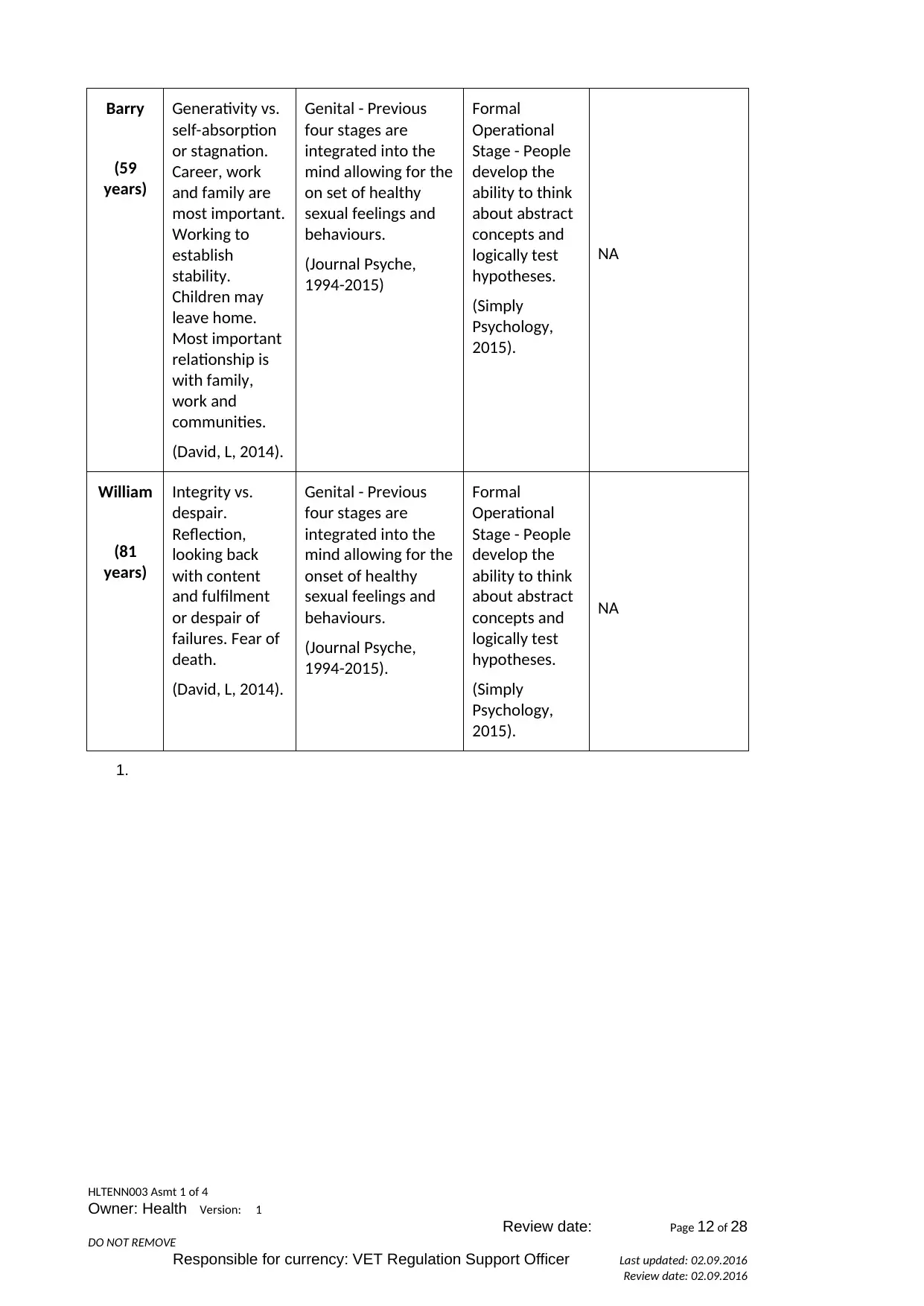
Barry
(59
years)
Generativity vs.
self-absorption
or stagnation.
Career, work
and family are
most important.
Working to
establish
stability.
Children may
leave home.
Most important
relationship is
with family,
work and
communities.
(David, L, 2014).
Genital - Previous
four stages are
integrated into the
mind allowing for the
on set of healthy
sexual feelings and
behaviours.
(Journal Psyche,
1994-2015)
Formal
Operational
Stage - People
develop the
ability to think
about abstract
concepts and
logically test
hypotheses.
(Simply
Psychology,
2015).
NA
William
(81
years)
Integrity vs.
despair.
Reflection,
looking back
with content
and fulfilment
or despair of
failures. Fear of
death.
(David, L, 2014).
Genital - Previous
four stages are
integrated into the
mind allowing for the
onset of healthy
sexual feelings and
behaviours.
(Journal Psyche,
1994-2015).
Formal
Operational
Stage - People
develop the
ability to think
about abstract
concepts and
logically test
hypotheses.
(Simply
Psychology,
2015).
NA
1.
HLTENN003 Asmt 1 of 4
Owner: Health Version: 1
Review date: Page 12 of 28
DO NOT REMOVE
Responsible for currency: VET Regulation Support Officer Last updated: 02.09.2016
Review date: 02.09.2016
(59
years)
Generativity vs.
self-absorption
or stagnation.
Career, work
and family are
most important.
Working to
establish
stability.
Children may
leave home.
Most important
relationship is
with family,
work and
communities.
(David, L, 2014).
Genital - Previous
four stages are
integrated into the
mind allowing for the
on set of healthy
sexual feelings and
behaviours.
(Journal Psyche,
1994-2015)
Formal
Operational
Stage - People
develop the
ability to think
about abstract
concepts and
logically test
hypotheses.
(Simply
Psychology,
2015).
NA
William
(81
years)
Integrity vs.
despair.
Reflection,
looking back
with content
and fulfilment
or despair of
failures. Fear of
death.
(David, L, 2014).
Genital - Previous
four stages are
integrated into the
mind allowing for the
onset of healthy
sexual feelings and
behaviours.
(Journal Psyche,
1994-2015).
Formal
Operational
Stage - People
develop the
ability to think
about abstract
concepts and
logically test
hypotheses.
(Simply
Psychology,
2015).
NA
1.
HLTENN003 Asmt 1 of 4
Owner: Health Version: 1
Review date: Page 12 of 28
DO NOT REMOVE
Responsible for currency: VET Regulation Support Officer Last updated: 02.09.2016
Review date: 02.09.2016
⊘ This is a preview!⊘
Do you want full access?
Subscribe today to unlock all pages.
Trusted by 1+ million students worldwide

1 out of 28


Related Documents


Your All-in-One AI-Powered Toolkit for Academic Success.
+13062052269
info@desklib.com
Available 24*7 on WhatsApp / Email
![[object Object]](/_next/static/media/star-bottom.7253800d.svg)
Unlock your academic potential
Copyright © 2020–2026 A2Z Services. All Rights Reserved. Developed and managed by ZUCOL.