PUBH7650 Clinical Epidemiology: Probiotics Efficacy in Children

Verified

Added on  2023/06/11

|11
|1783
|320
Report
AI Summary
This report provides a comprehensive analysis of a clinical trial and a systematic review with meta-analysis focusing on the effectiveness of probiotics in treating childhood constipation. The clinical trial by Saneian et al. (2013) comparing Lactobacillus plus mineral oil to mineral oil alone is assessed for risk of bias using the Cochrane Risk of Bias Assessment tool. The report evaluates various aspects such as random sequence allocation, allocation concealment, blinding, incomplete outcome data, and selective reporting. Furthermore, it examines a systematic review and meta-analysis by Huang & Hu (2017) on the same topic, analyzing inclusion/exclusion criteria, treatment effects, heterogeneity, and the validity of the pooled data. The report concludes by extrapolating the beneficial effects of probiotics to other conditions in children, such as atopic dermatitis, and discussing the clinical relevance and statistical significance of the treatment effects. This assignment solution is available on Desklib, a platform offering a wide range of study tools and past papers for students.
Document Page
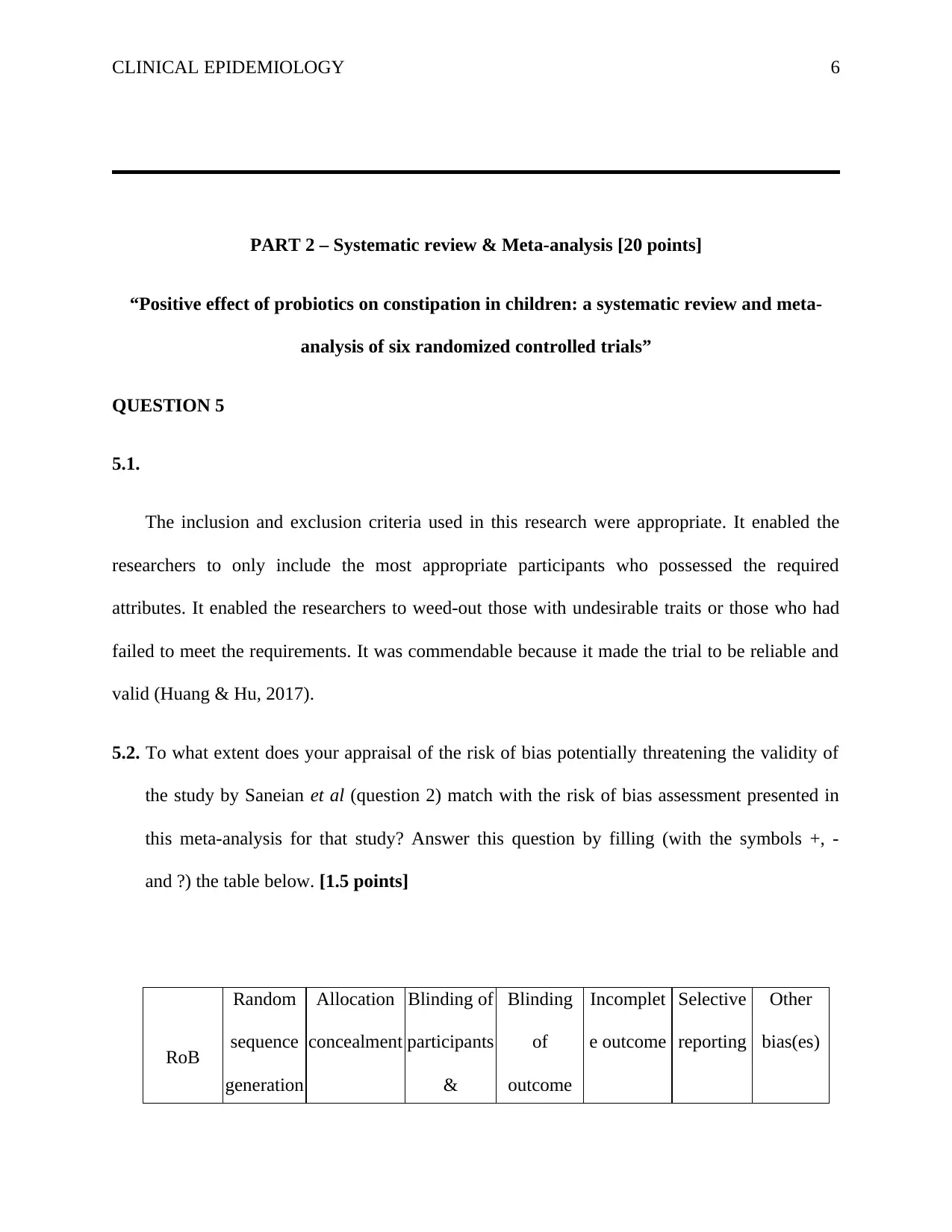
Running head: CLINICAL EPIDEMIOLOGY 1
Clinical Epidemiology
Name
Institution
tabler-icon-diamond-filled.svg

Paraphrase This Document

Need a fresh take? Get an instant paraphrase of this document with our AI Paraphraser
Document Page
CLINICAL EPIDEMIOLOGY 2
Clinical Epidemiology
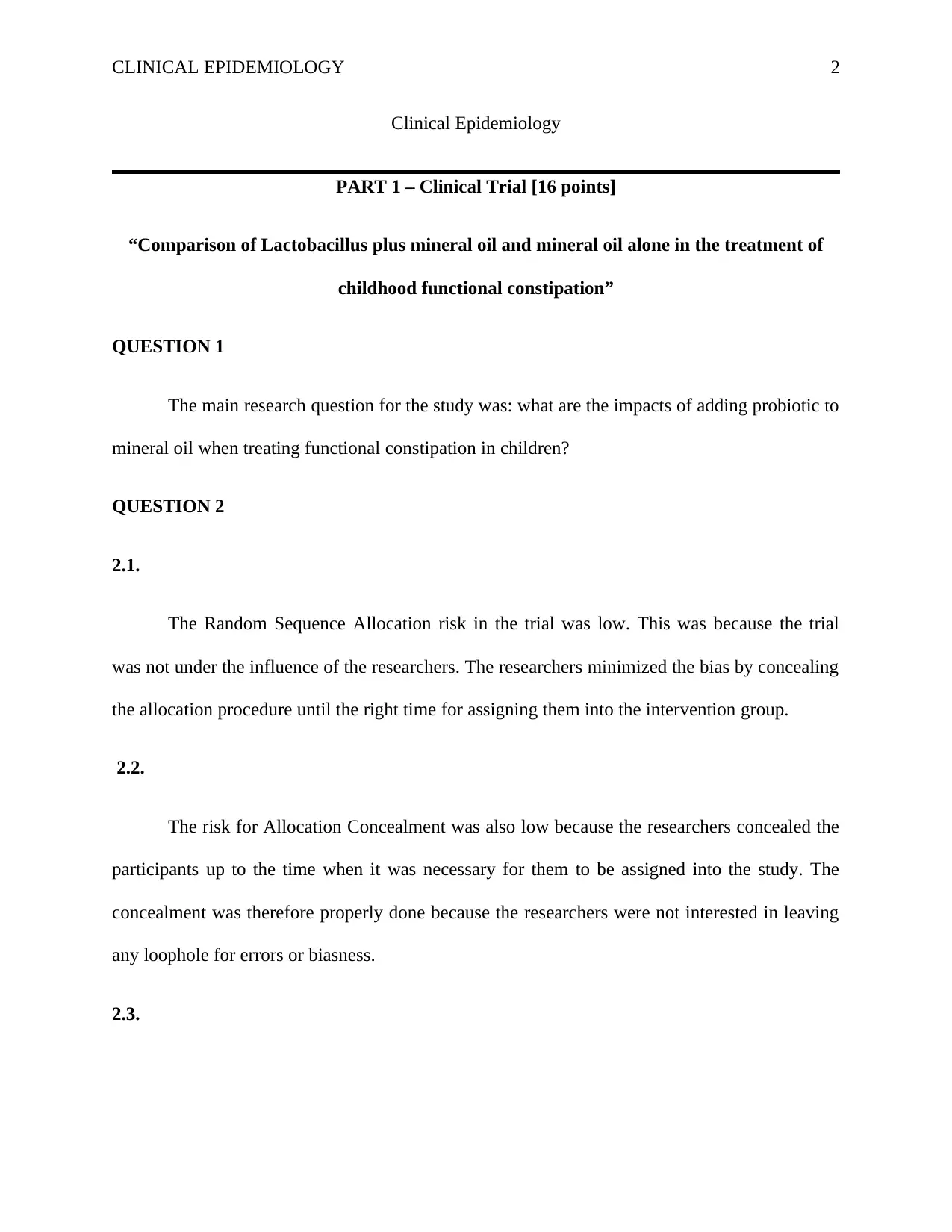
PART 1 – Clinical Trial [16 points]
“Comparison of Lactobacillus plus mineral oil and mineral oil alone in the treatment of
childhood functional constipation”
QUESTION 1
The main research question for the study was: what are the impacts of adding probiotic to
mineral oil when treating functional constipation in children?
QUESTION 2
2.1.
The Random Sequence Allocation risk in the trial was low. This was because the trial
was not under the influence of the researchers. The researchers minimized the bias by concealing
the allocation procedure until the right time for assigning them into the intervention group.
2.2.
The risk for Allocation Concealment was also low because the researchers concealed the
participants up to the time when it was necessary for them to be assigned into the study. The
concealment was therefore properly done because the researchers were not interested in leaving
any loophole for errors or biasness.
2.3.
Document Page
CLINICAL EPIDEMIOLOGY 3
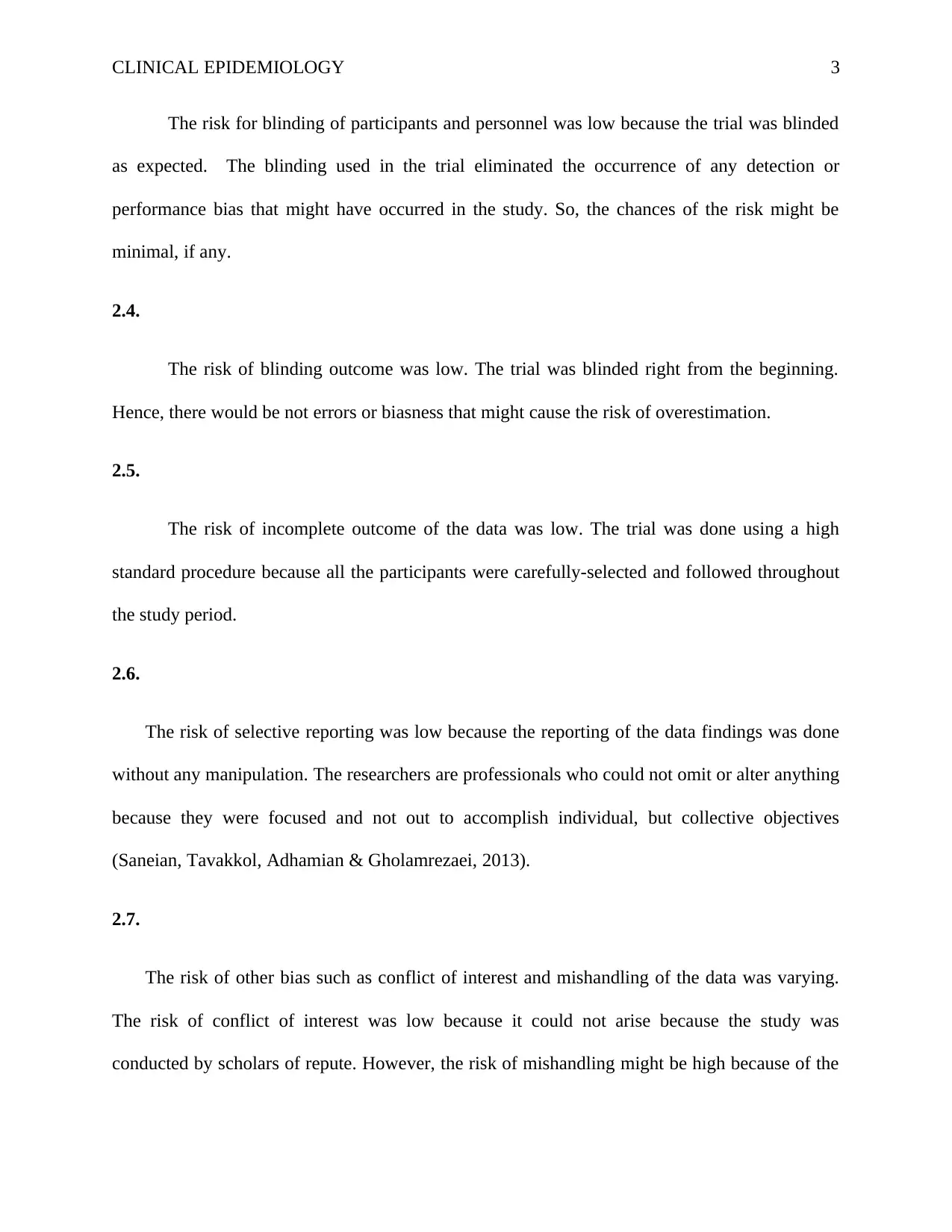
The risk for blinding of participants and personnel was low because the trial was blinded
as expected. The blinding used in the trial eliminated the occurrence of any detection or
performance bias that might have occurred in the study. So, the chances of the risk might be
minimal, if any.
2.4.
The risk of blinding outcome was low. The trial was blinded right from the beginning.
Hence, there would be not errors or biasness that might cause the risk of overestimation.
2.5.
The risk of incomplete outcome of the data was low. The trial was done using a high
standard procedure because all the participants were carefully-selected and followed throughout
the study period.
2.6.
The risk of selective reporting was low because the reporting of the data findings was done
without any manipulation. The researchers are professionals who could not omit or alter anything
because they were focused and not out to accomplish individual, but collective objectives
(Saneian, Tavakkol, Adhamian & Gholamrezaei, 2013).
2.7.
The risk of other bias such as conflict of interest and mishandling of the data was varying.
The risk of conflict of interest was low because it could not arise because the study was
conducted by scholars of repute. However, the risk of mishandling might be high because of the
Document Page
CLINICAL EPIDEMIOLOGY 4
different people who were involved. On the other hand, the risk of trial registration after the
study was unclear because it is not certain what might have happened.
QUESTION 3
3.1.
One of the main findings of this trial is that the frequency of defecation changed from what
it was before or at the start of the trial. The changes in stool frequency were, therefore,
determined by measuring it using a stool consistency scale. The scale range varies from low,
medium, and high. These are the units that were used in measurement.
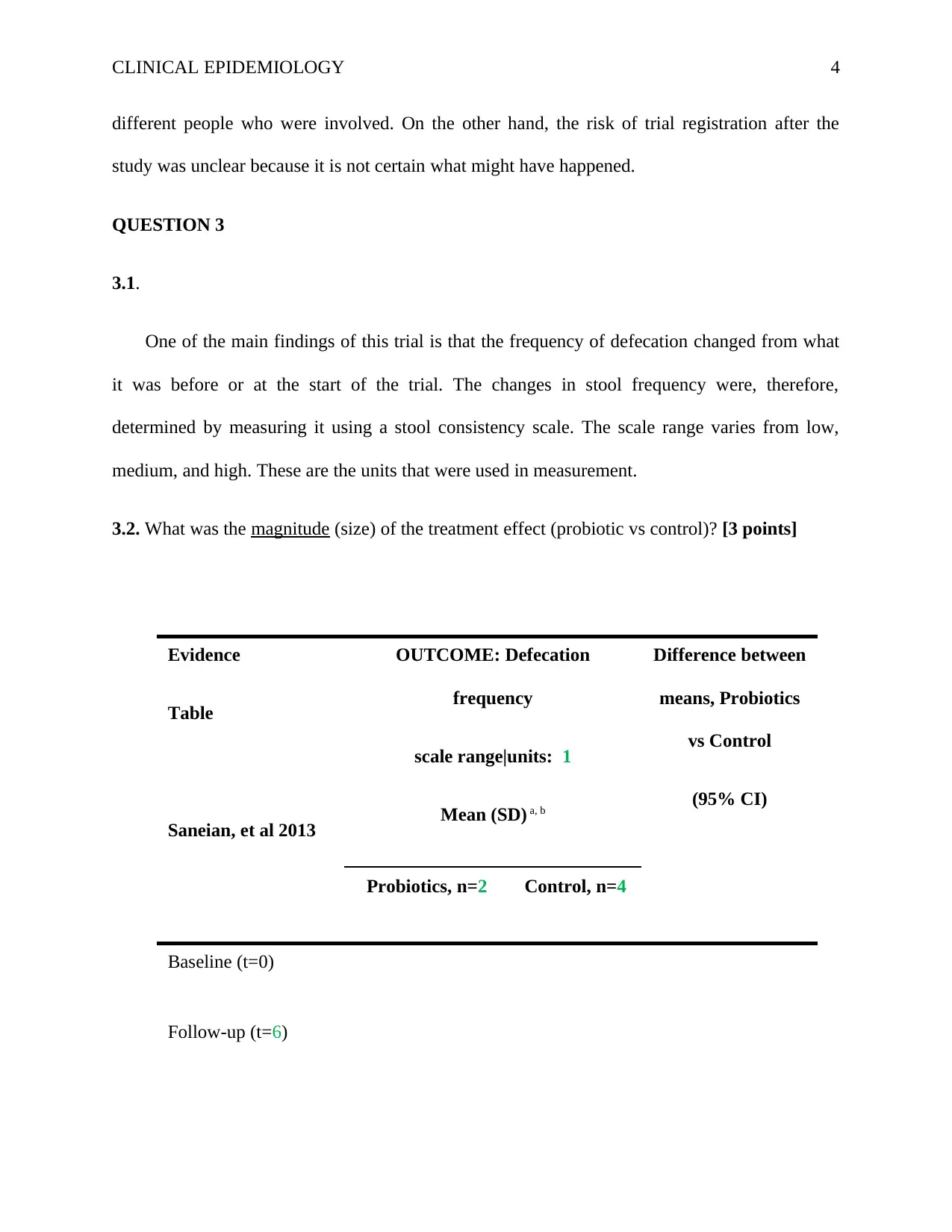
3.2. What was the magnitude (size) of the treatment effect (probiotic vs control)? [3 points]
Evidence
Table
Saneian, et al 2013
OUTCOME: Defecation
frequency
scale range|units: 1
Mean (SD) a, b
Difference between
means, Probiotics
vs Control
(95% CI)
Probiotics, n=2 Control, n=4
Baseline (t=0)
Follow-up (t=6)
tabler-icon-diamond-filled.svg

Paraphrase This Document

Need a fresh take? Get an instant paraphrase of this document with our AI Paraphraser
Document Page
CLINICAL EPIDEMIOLOGY 5
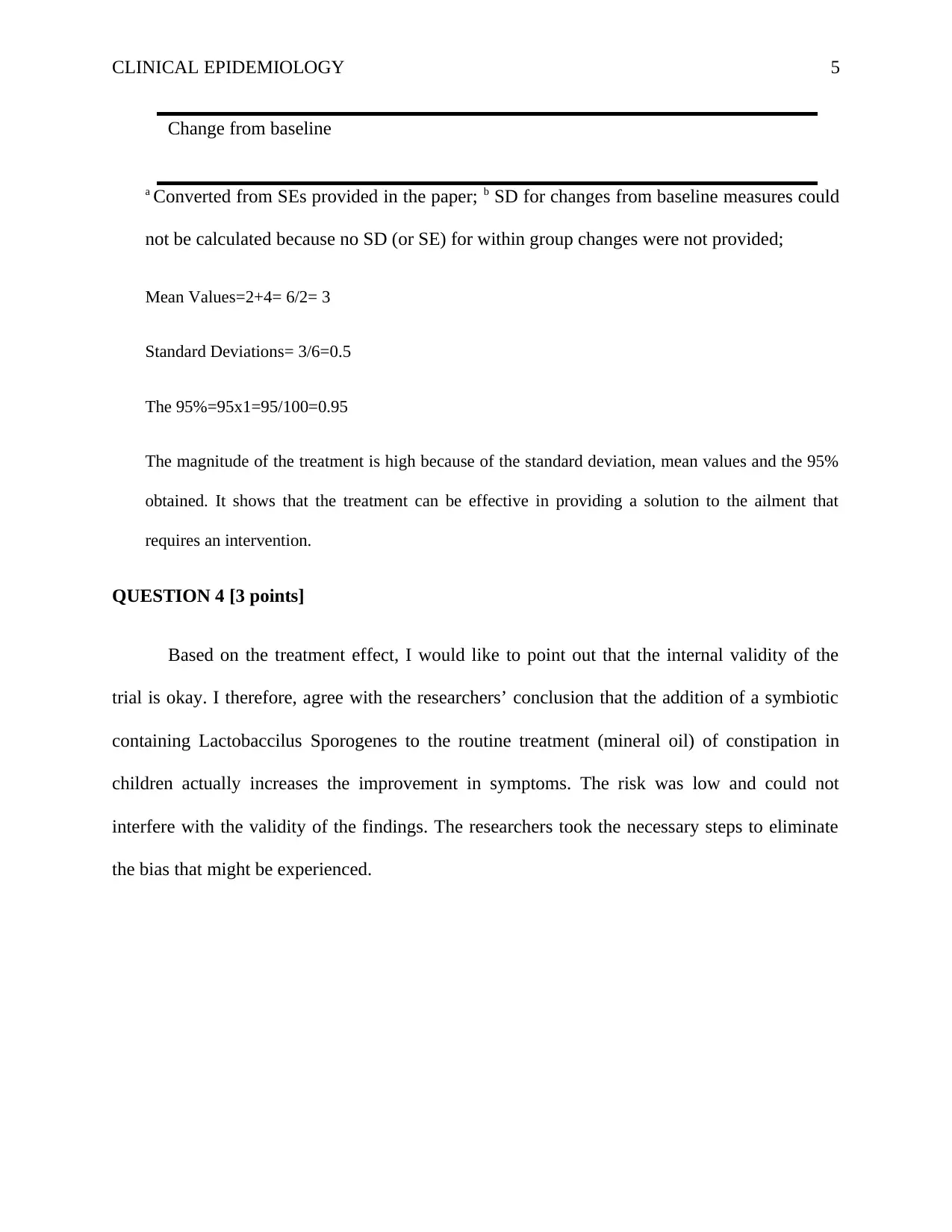
Change from baseline
a Converted from SEs provided in the paper; b SD for changes from baseline measures could
not be calculated because no SD (or SE) for within group changes were not provided;
Mean Values=2+4= 6/2= 3
Standard Deviations= 3/6=0.5
The 95%=95x1=95/100=0.95
The magnitude of the treatment is high because of the standard deviation, mean values and the 95%
obtained. It shows that the treatment can be effective in providing a solution to the ailment that
requires an intervention.
QUESTION 4 [3 points]
Based on the treatment effect, I would like to point out that the internal validity of the
trial is okay. I therefore, agree with the researchers’ conclusion that the addition of a symbiotic
containing Lactobaccilus Sporogenes to the routine treatment (mineral oil) of constipation in
children actually increases the improvement in symptoms. The risk was low and could not
interfere with the validity of the findings. The researchers took the necessary steps to eliminate
the bias that might be experienced.
Document Page
CLINICAL EPIDEMIOLOGY 6
PART 2 – Systematic review & Meta-analysis [20 points]
“Positive effect of probiotics on constipation in children: a systematic review and meta-
analysis of six randomized controlled trials”
QUESTION 5
5.1.
The inclusion and exclusion criteria used in this research were appropriate. It enabled the
researchers to only include the most appropriate participants who possessed the required
attributes. It enabled the researchers to weed-out those with undesirable traits or those who had
failed to meet the requirements. It was commendable because it made the trial to be reliable and
valid (Huang & Hu, 2017).
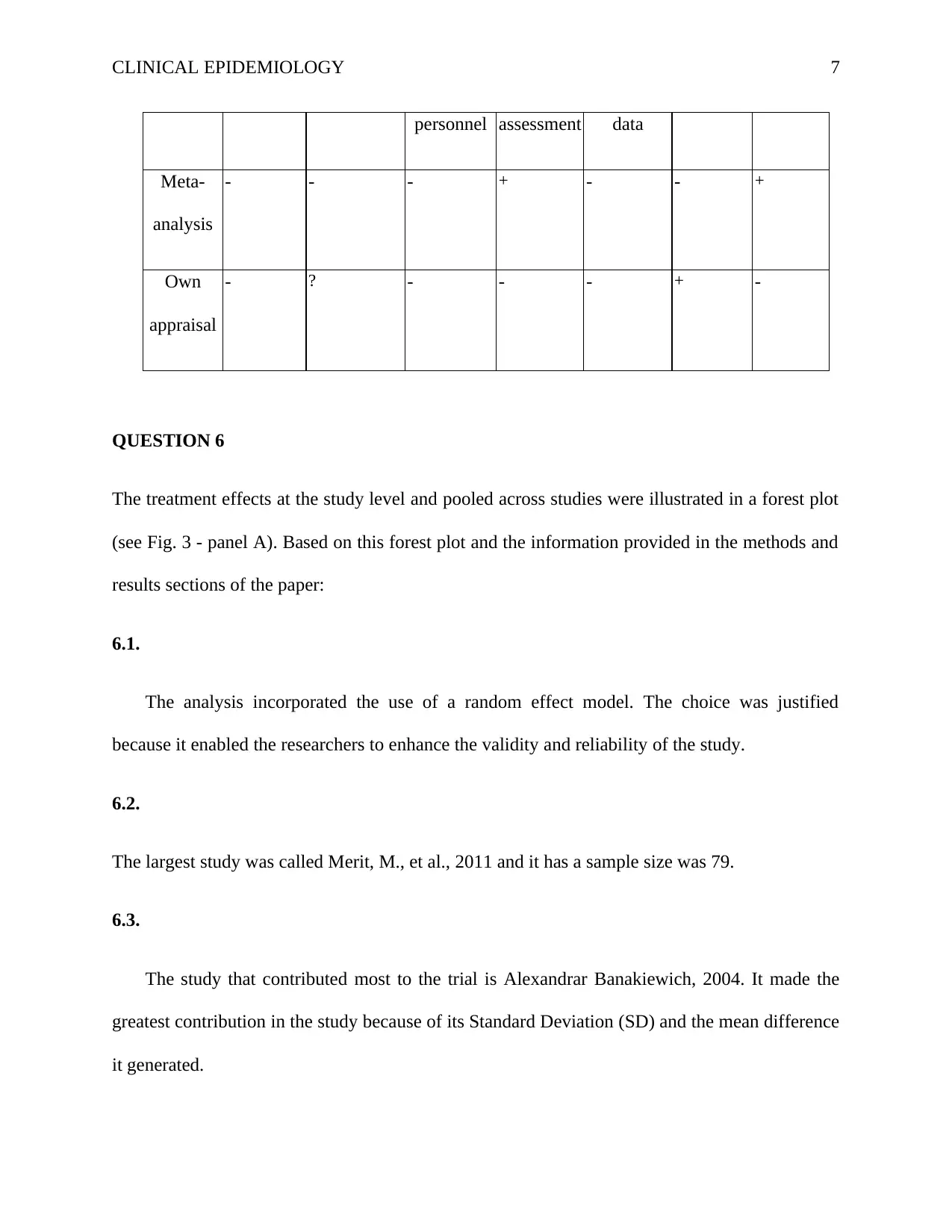
5.2. To what extent does your appraisal of the risk of bias potentially threatening the validity of
the study by Saneian et al (question 2) match with the risk of bias assessment presented in
this meta-analysis for that study? Answer this question by filling (with the symbols +, -
and ?) the table below. [1.5 points]
RoB
Random
sequence
generation
Allocation
concealment
Blinding of
participants
&
Blinding
of
outcome
Incomplet
e outcome
Selective
reporting
Other
bias(es)
Document Page
CLINICAL EPIDEMIOLOGY 7
personnel assessment data
Meta-
analysis
- - - + - - +
Own
appraisal
- ? - - - + -
QUESTION 6
The treatment effects at the study level and pooled across studies were illustrated in a forest plot
(see Fig. 3 - panel A). Based on this forest plot and the information provided in the methods and
results sections of the paper:
6.1.
The analysis incorporated the use of a random effect model. The choice was justified
because it enabled the researchers to enhance the validity and reliability of the study.
6.2.
The largest study was called Merit, M., et al., 2011 and it has a sample size was 79.
6.3.
The study that contributed most to the trial is Alexandrar Banakiewich, 2004. It made the
greatest contribution in the study because of its Standard Deviation (SD) and the mean difference
it generated.
tabler-icon-diamond-filled.svg

Paraphrase This Document

Need a fresh take? Get an instant paraphrase of this document with our AI Paraphraser
Document Page
CLINICAL EPIDEMIOLOGY 8
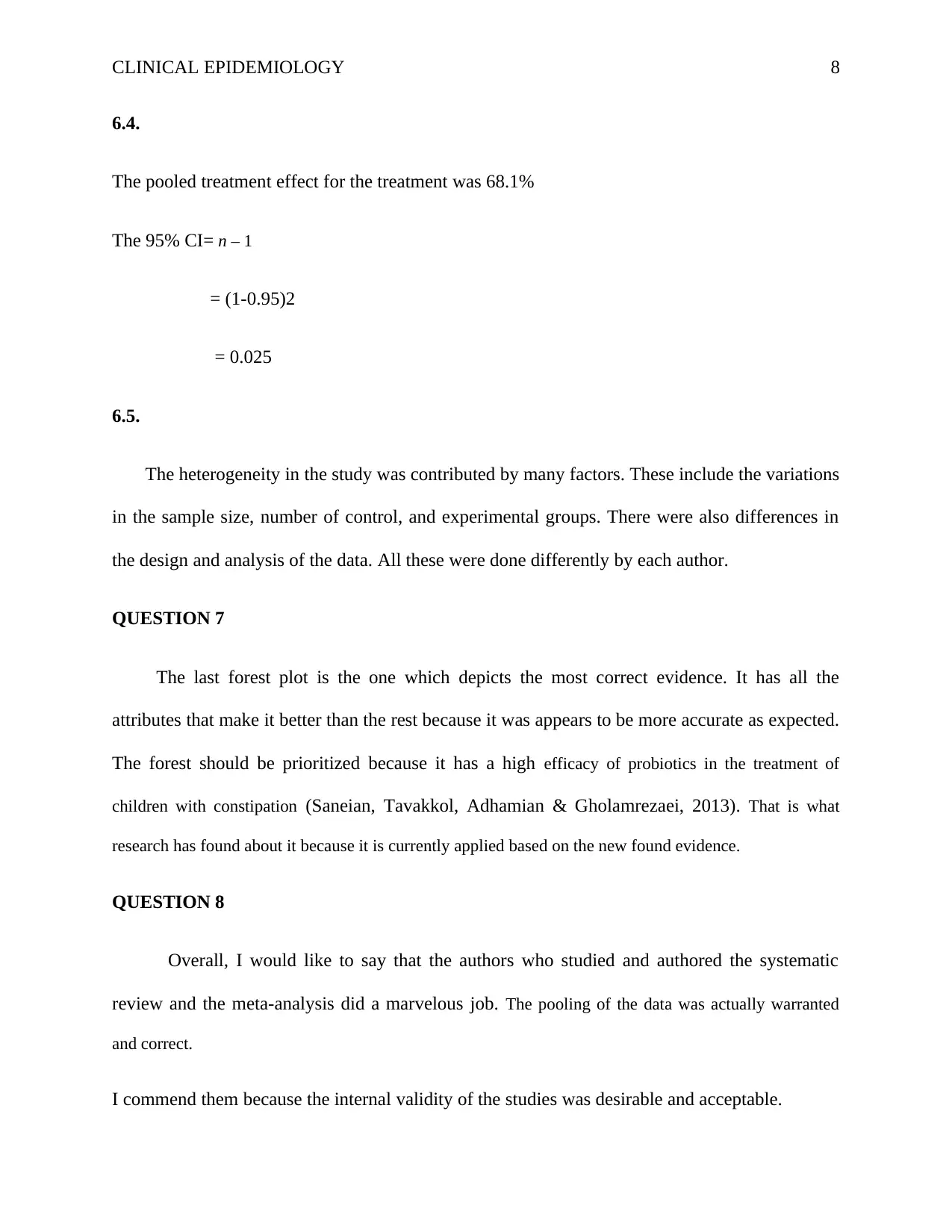
6.4.
The pooled treatment effect for the treatment was 68.1%
The 95% CI= n 1
= (1-0.95)2
= 0.025
6.5.
The heterogeneity in the study was contributed by many factors. These include the variations
in the sample size, number of control, and experimental groups. There were also differences in
the design and analysis of the data. All these were done differently by each author.
QUESTION 7
The last forest plot is the one which depicts the most correct evidence. It has all the
attributes that make it better than the rest because it was appears to be more accurate as expected.
The forest should be prioritized because it has a high efficacy of probiotics in the treatment of
children with constipation (Saneian, Tavakkol, Adhamian & Gholamrezaei, 2013). That is what
research has found about it because it is currently applied based on the new found evidence.
QUESTION 8
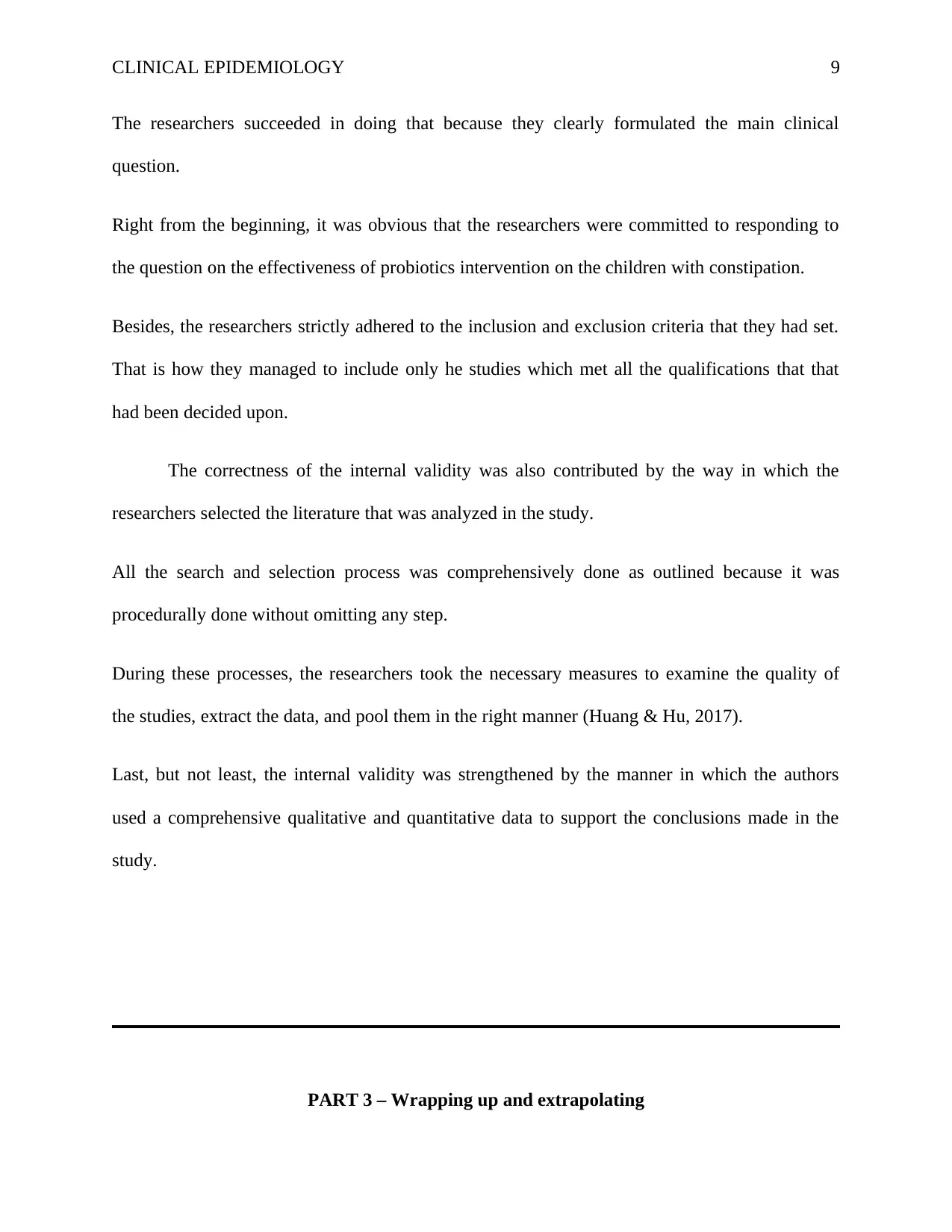
Overall, I would like to say that the authors who studied and authored the systematic
review and the meta-analysis did a marvelous job. The pooling of the data was actually warranted
and correct.
I commend them because the internal validity of the studies was desirable and acceptable.
Document Page
CLINICAL EPIDEMIOLOGY 9
The researchers succeeded in doing that because they clearly formulated the main clinical
question.
Right from the beginning, it was obvious that the researchers were committed to responding to
the question on the effectiveness of probiotics intervention on the children with constipation.
Besides, the researchers strictly adhered to the inclusion and exclusion criteria that they had set.
That is how they managed to include only he studies which met all the qualifications that that
had been decided upon.
The correctness of the internal validity was also contributed by the way in which the
researchers selected the literature that was analyzed in the study.
All the search and selection process was comprehensively done as outlined because it was
procedurally done without omitting any step.
During these processes, the researchers took the necessary measures to examine the quality of
the studies, extract the data, and pool them in the right manner (Huang & Hu, 2017).
Last, but not least, the internal validity was strengthened by the manner in which the authors
used a comprehensive qualitative and quantitative data to support the conclusions made in the
study.
PART 3 – Wrapping up and extrapolating
Document Page
CLINICAL EPIDEMIOLOGY 10
QUESTION 9
The beneficial effects of probiotics have been advocated in a variety of other conditions in
children, such as (but not restricted to):
- The prevention of atopic dermatitis (AD), a common allergic disease
9.1.
NNT=0.96-0.77= 0.19
= NNT = 1/ARR
= 19
9.2.
The treatment effect is relevant. Its statistical significance proves that it is clinically relevant
and should be used for treatment.
95%
4.61
3.43
tabler-icon-diamond-filled.svg

Paraphrase This Document

Need a fresh take? Get an instant paraphrase of this document with our AI Paraphraser
Document Page
CLINICAL EPIDEMIOLOGY 11
References
Huang, R., & Hu, J. (2017). Positive effect of probiotics on constipation in children: a systematic
review and meta-analysis of six randomized controlled trials. Frontiers in cellular and
infection microbiology, 7, 153.
Saneian, H., Tavakkol, K., Adhamian, P., & Gholamrezaei, A. (2013). Comparison of
Lactobacillus Sporogenes plus mineral oil and mineral oil alone in the treatment of
childhood functional constipation. Journal of research in medical sciences: the official
journal of Isfahan University of Medical Sciences, 18(2), 85.
chevron_up_icon
1 out of 11
circle_padding
hide_on_mobile
zoom_out_icon
[object Object]