NUR2300: Evidence-Based Clinical Issue Report on Cancer Survivorship
VerifiedAdded on 2022/12/23
|16
|4071
|44
Report
AI Summary
This report addresses the clinical issue of cancer survivorship, emphasizing the need for improved strategies to enhance patient experiences post-treatment. It highlights the limitations in current approaches, particularly the lack of focus on long-term well-being and the emergence of new side effects. The study explores shared medical appointments as a potential intervention, framing a PICO question to assess their impact on cancer survivors. A systematic literature review was conducted, analyzing articles published within the last seven years to gather evidence on the effectiveness of shared medical appointments. The findings suggest that shared medical appointments can improve patient satisfaction, access to care, and education, ultimately leading to better health outcomes. The report concludes with recommendations for practice change and further research, advocating for increased awareness, evidence-based practice, and policy support to incorporate shared medical appointments into cancer care. The report also acknowledges limitations, such as small sample sizes and the need for randomized control trials. The report highlights the importance of time efficiency, informative strategies for enhancing patient care, self-management, and the improvement of the quality of life for cancer patients and survivors.
Running head: CLINICAL ISSUE 1
Clinical Issue
Name
Institutional Affiliation
Clinical Issue
Name
Institutional Affiliation

Paraphrase This Document
Need a fresh take? Get an instant paraphrase of this document with our AI Paraphraser
CLINICAL ISSUE 2
Outline of Clinical Issue
Cancer survivorship is one of the areas that has received little attention and
prioritization from researchers and healthcare providers. Most of the healthcare providers
focus on cancer treatment and fail to pay attention to the long-term well-being of patients and
their ability to regain their normal lives, Cancer survivorship refers to the phase of cancer
care after active treatment of cancer. It is characterised by social, mental and psychological
aspects of living with cancer diagnosis. Many cancer survivors often suffer from early and
late effects of cancer which may result in premature death or psychosocial morbidity.
However, there are rapid changes in the manifestation of cancer, as new side effects and
symptoms are emerging. Therefore, there is an increased demand from novel therapies
(Lagergren et al., 2019).
Currently, cancer is no longer regarded as a killer disease. In 2012, over 32 million
people globally were still alive even five years after diagnosis with cancer. The number is
forecasted to increase in coming decades due to an increase in the aging population,
advancements in detection and treatment, and an increased cancer incidence. For instance, in
the United States, 14 million people were living with a history of cancer by 2012, and the
number was expected to increase to 18 million by 2022. Similar trends are expected in
Germany (Thong et al. 2018). Cancer is the most prominent cause of disease burden in
Australia with cancer survivors estimated to be over 1.1 milion. The number is expected to
increase to 1.9 million by 2040. Additionally, 68% of people diagnosed with cancer in
Australia are expected to live for more than five years after diagnosis (Lisy, Langdon, Piper,
& Jefford, 2019).
Failure to enhance better survivorship may result in reduces quality of life for cancer
patients. Approximately 50% of all patients treated with cancer undergo radiation therapy,
either for palliative or curative purposes. Radiation therapy may predispose the patients to a
Outline of Clinical Issue
Cancer survivorship is one of the areas that has received little attention and
prioritization from researchers and healthcare providers. Most of the healthcare providers
focus on cancer treatment and fail to pay attention to the long-term well-being of patients and
their ability to regain their normal lives, Cancer survivorship refers to the phase of cancer
care after active treatment of cancer. It is characterised by social, mental and psychological
aspects of living with cancer diagnosis. Many cancer survivors often suffer from early and
late effects of cancer which may result in premature death or psychosocial morbidity.
However, there are rapid changes in the manifestation of cancer, as new side effects and
symptoms are emerging. Therefore, there is an increased demand from novel therapies
(Lagergren et al., 2019).
Currently, cancer is no longer regarded as a killer disease. In 2012, over 32 million
people globally were still alive even five years after diagnosis with cancer. The number is
forecasted to increase in coming decades due to an increase in the aging population,
advancements in detection and treatment, and an increased cancer incidence. For instance, in
the United States, 14 million people were living with a history of cancer by 2012, and the
number was expected to increase to 18 million by 2022. Similar trends are expected in
Germany (Thong et al. 2018). Cancer is the most prominent cause of disease burden in
Australia with cancer survivors estimated to be over 1.1 milion. The number is expected to
increase to 1.9 million by 2040. Additionally, 68% of people diagnosed with cancer in
Australia are expected to live for more than five years after diagnosis (Lisy, Langdon, Piper,
& Jefford, 2019).
Failure to enhance better survivorship may result in reduces quality of life for cancer
patients. Approximately 50% of all patients treated with cancer undergo radiation therapy,
either for palliative or curative purposes. Radiation therapy may predispose the patients to a
CLINICAL ISSUE 3
variety of acute and late side effects. It may also result in second cancers (Lagergren et al.,
2019). The post-treatment cancer survivorship phase has resulted in significant and
unexpected challenges that result from various socioeconomic, individual and clinical factors.
Some of the late onset side effects of cancer treatment that affects cancer survivors include
pain, cognitive changes, fatigue, lymphoedema, and cardiotoxicity. Other challenges
affecting pot-treatment cancer survivors include factors may include psychosocial issues such
as body image concerns, cancer recurrence and anxiety (Jones, Howell & Grunfeld, 2018).
Therefore, there is need to enhance survivorships strategies for individuals with a history of
cancer.
The focus of this study is to explore shared clinical approach as a critical strategy for
enhancing cancer survivorship. Shared medical appointments are a method of healthcare
delivery that can improve the prevention and management of chronic disease management.
The advantages of shared medical appointments include increased contact-time between the
healthcare provider and the patient, better patient education, timely access and improved
service provision, closer attention to performance measures and routine health maintenance,
improved disease prevention and self-management. The overall aims of shared medical
appointments include improving the health of the general population, reducing healthcare
costs and enhancing patient experiences (Wadsworth et al., 2019). The study aims to explore
the effectiveness of shared medical appointments in enhancing the experiences of cancer
survivors.
Clinical Question
The aim of this study is to explore the impact of shared medical appointment interventions on
the patient experiences of cancer survivors. The intervention PICO question is essential for
achieving the research objectives. Therefore, the following is the PICO question in this study:
Population: Cancer survivors
variety of acute and late side effects. It may also result in second cancers (Lagergren et al.,
2019). The post-treatment cancer survivorship phase has resulted in significant and
unexpected challenges that result from various socioeconomic, individual and clinical factors.
Some of the late onset side effects of cancer treatment that affects cancer survivors include
pain, cognitive changes, fatigue, lymphoedema, and cardiotoxicity. Other challenges
affecting pot-treatment cancer survivors include factors may include psychosocial issues such
as body image concerns, cancer recurrence and anxiety (Jones, Howell & Grunfeld, 2018).
Therefore, there is need to enhance survivorships strategies for individuals with a history of
cancer.
The focus of this study is to explore shared clinical approach as a critical strategy for
enhancing cancer survivorship. Shared medical appointments are a method of healthcare
delivery that can improve the prevention and management of chronic disease management.
The advantages of shared medical appointments include increased contact-time between the
healthcare provider and the patient, better patient education, timely access and improved
service provision, closer attention to performance measures and routine health maintenance,
improved disease prevention and self-management. The overall aims of shared medical
appointments include improving the health of the general population, reducing healthcare
costs and enhancing patient experiences (Wadsworth et al., 2019). The study aims to explore
the effectiveness of shared medical appointments in enhancing the experiences of cancer
survivors.
Clinical Question
The aim of this study is to explore the impact of shared medical appointment interventions on
the patient experiences of cancer survivors. The intervention PICO question is essential for
achieving the research objectives. Therefore, the following is the PICO question in this study:
Population: Cancer survivors
⊘ This is a preview!⊘
Do you want full access?
Subscribe today to unlock all pages.

Trusted by 1+ million students worldwide
CLINICAL ISSUE 4
Intervention: Shared medical appointments
Control: individual medical interventions
Outcome: enhancing patient experiences
Among cancer survivors (P), how do shared medical appointments (I), compared to
individual medical interventions (C), enhance patient experiences (O)?
Evidence Search
The systematic literature review strategy as employed to achieve the evidence-based
search strategy. The articles sought in the review are recent and were published in the last
seven years (2012-2019). Identifying recent articles is essential in ensuring that the findings
of the study align with the current research practice. The articles included in the study were
related to cancer survivorship and shared medical appointments. The intention of selecting
these articles was to ensure that they provided current and relevant information regarding the
clinical issue, which is challenges experiences by cancer survivors in disease prevention and
self-management, cost of medication and limited access to healthcare providers. The
researcher considered quantitative research with a focus of random control trials to ensure
high quality of evidence.
The key search terms used in the search include ‘cancer survivors’, ‘shared medical
appointments’, and ‘patient experiences’. The alternative search terms include ‘patient
outcomes’, ‘healthcare outcomes’, ‘post-treatment cancer survivorship’, and ‘self-
management’. The search terms were combined using Boolean operators (and) to develop
search phrases. The key search phrases included ‘cancer survivorship and shared medical
appointments’, ‘shared medical appointments and cancer self-management’, ‘patient
experiences and post-treatment cancer survivorship’. Articles that were older than 7 years
were excluded from the study. Additionally, articles that discussed other chronic illnesses
other than cancer and other interventions other than shared medical appointments were
Intervention: Shared medical appointments
Control: individual medical interventions
Outcome: enhancing patient experiences
Among cancer survivors (P), how do shared medical appointments (I), compared to
individual medical interventions (C), enhance patient experiences (O)?
Evidence Search
The systematic literature review strategy as employed to achieve the evidence-based
search strategy. The articles sought in the review are recent and were published in the last
seven years (2012-2019). Identifying recent articles is essential in ensuring that the findings
of the study align with the current research practice. The articles included in the study were
related to cancer survivorship and shared medical appointments. The intention of selecting
these articles was to ensure that they provided current and relevant information regarding the
clinical issue, which is challenges experiences by cancer survivors in disease prevention and
self-management, cost of medication and limited access to healthcare providers. The
researcher considered quantitative research with a focus of random control trials to ensure
high quality of evidence.
The key search terms used in the search include ‘cancer survivors’, ‘shared medical
appointments’, and ‘patient experiences’. The alternative search terms include ‘patient
outcomes’, ‘healthcare outcomes’, ‘post-treatment cancer survivorship’, and ‘self-
management’. The search terms were combined using Boolean operators (and) to develop
search phrases. The key search phrases included ‘cancer survivorship and shared medical
appointments’, ‘shared medical appointments and cancer self-management’, ‘patient
experiences and post-treatment cancer survivorship’. Articles that were older than 7 years
were excluded from the study. Additionally, articles that discussed other chronic illnesses
other than cancer and other interventions other than shared medical appointments were
Paraphrase This Document
Need a fresh take? Get an instant paraphrase of this document with our AI Paraphraser
Eligible articles were
(n=59)
Identification Screening Eligibility Included
The number of articles retrieved
after initial search (2012-2019) was
280 (n=80)
Elimination of duplicates led
to the removal of 21 articles
Article excluded after
screening of the abstracts
were 24
35 articles were
included for final
screening (n=35)
The outcomes
considered ineligible for
review after evaluation
of the full text were 22
Total number of articles that
met inclusion criteria and
eligible for final review was 13
(n=13)
Excluded with reasons
(n=8) not eligible
Total number of articles for
final review
(n=5)
CLINICAL ISSUE 5
excluded from the study. Primary research articles and reviews of primary research articles
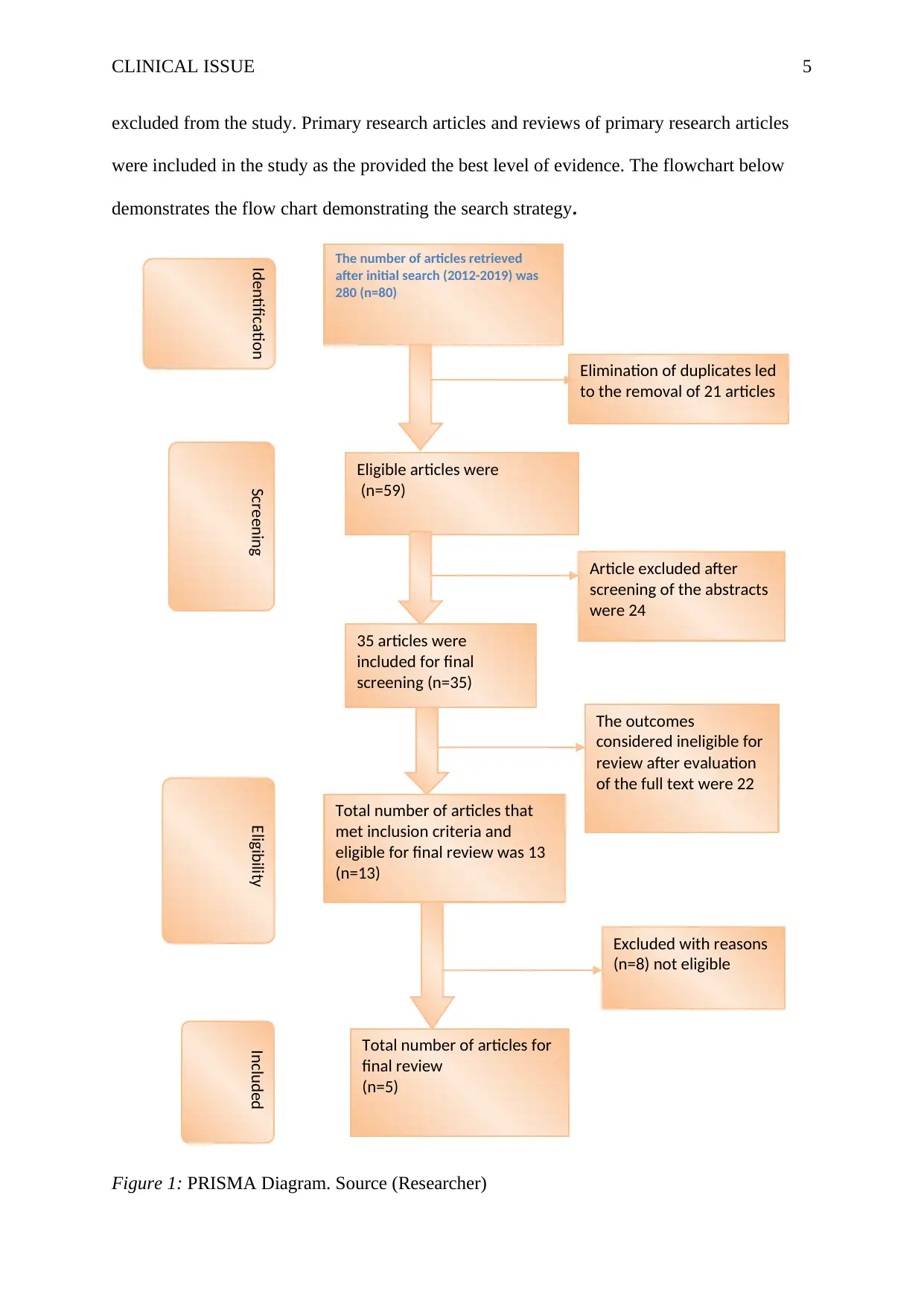
were included in the study as the provided the best level of evidence. The flowchart below
demonstrates the flow chart demonstrating the search strategy.
Figure 1: PRISMA Diagram. Source (Researcher)
(n=59)
Identification Screening Eligibility Included
The number of articles retrieved
after initial search (2012-2019) was
280 (n=80)
Elimination of duplicates led
to the removal of 21 articles
Article excluded after
screening of the abstracts
were 24
35 articles were
included for final
screening (n=35)
The outcomes
considered ineligible for
review after evaluation
of the full text were 22
Total number of articles that
met inclusion criteria and
eligible for final review was 13
(n=13)
Excluded with reasons
(n=8) not eligible
Total number of articles for
final review
(n=5)
CLINICAL ISSUE 5
excluded from the study. Primary research articles and reviews of primary research articles
were included in the study as the provided the best level of evidence. The flowchart below
demonstrates the flow chart demonstrating the search strategy.
Figure 1: PRISMA Diagram. Source (Researcher)
CLINICAL ISSUE 6
Literature Synthesis of Best Evidence
There was a prominent need for education of disease management and prevention
among cancer survivors as demonstrated by Lambourne et al. (2018). They system issues that
can be addressed through SMAs include adequate education regarding the expected side
effects of diseases, various treatments such as oral versus intravenous chemotherapy, wait
times and the need for more staff.
The findings of the article review uphold the importance of shared medical
appointments in enhancing care, support, prevention of disease and quality of life among
cancer patients. In studies, where the patients underwent shared medical care, they were more
likely to enhance their satisfaction levels, as compared to the patients who underwent usual
care. Further, shared medical care patients described their experiences to be more accessible
and the healthcare providers to be more sensitive to their needs. Despite the fact that both
usual care and SMA patients demonstrated satisfaction, SMA patients were more appreciative
of the care (Heyworth et al., 2014; Zhao, Brettle, & Qiu, 2018). Similarly, Prescott et al.
(2016) upheld the importance of shared medical appointments in enhancing better, more
accessible and efficient education for cancer patients and survivors. According to
Schneeberger et al. (2019), the education provided in shared medical appointments helps the
patients to change their lifestyles and achieve better health benefits such as weight
management, improved quality of life, and better dietary habits. The shared medical
appointments were also enjoyable and educative.
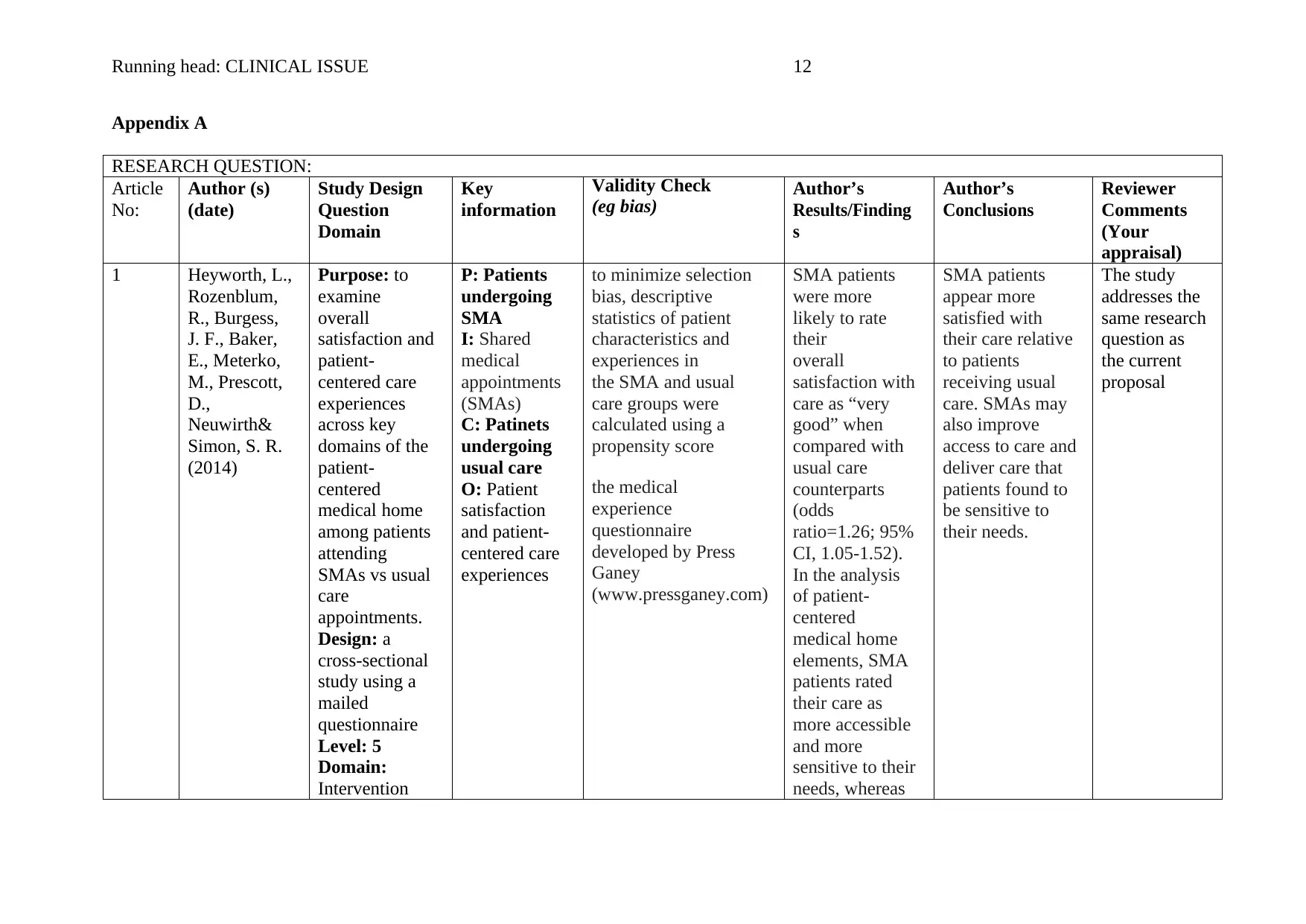
The findings of Heyworth et al. (2014) indicated that there was no much difference
between patients who underwent shared medical appointments and usual care patients
because they both demonstrated more accessible care and that physician were more sensitive
to their needs as they spend adequate time with their physicians. However, cancer patients
and survivors who underwent shared medical appointments demonstrated better outcomes.
Literature Synthesis of Best Evidence
There was a prominent need for education of disease management and prevention
among cancer survivors as demonstrated by Lambourne et al. (2018). They system issues that
can be addressed through SMAs include adequate education regarding the expected side
effects of diseases, various treatments such as oral versus intravenous chemotherapy, wait
times and the need for more staff.
The findings of the article review uphold the importance of shared medical
appointments in enhancing care, support, prevention of disease and quality of life among
cancer patients. In studies, where the patients underwent shared medical care, they were more
likely to enhance their satisfaction levels, as compared to the patients who underwent usual
care. Further, shared medical care patients described their experiences to be more accessible
and the healthcare providers to be more sensitive to their needs. Despite the fact that both
usual care and SMA patients demonstrated satisfaction, SMA patients were more appreciative
of the care (Heyworth et al., 2014; Zhao, Brettle, & Qiu, 2018). Similarly, Prescott et al.
(2016) upheld the importance of shared medical appointments in enhancing better, more
accessible and efficient education for cancer patients and survivors. According to
Schneeberger et al. (2019), the education provided in shared medical appointments helps the
patients to change their lifestyles and achieve better health benefits such as weight
management, improved quality of life, and better dietary habits. The shared medical
appointments were also enjoyable and educative.
The findings of Heyworth et al. (2014) indicated that there was no much difference
between patients who underwent shared medical appointments and usual care patients
because they both demonstrated more accessible care and that physician were more sensitive
to their needs as they spend adequate time with their physicians. However, cancer patients
and survivors who underwent shared medical appointments demonstrated better outcomes.
⊘ This is a preview!⊘
Do you want full access?
Subscribe today to unlock all pages.
Trusted by 1+ million students worldwide
CLINICAL ISSUE 7
Therefore, it is evident from the review that shred medical appointments are essential in
enhancing better outcomes and improved quality of life among cancer patients.
The findings of the research were reliable and valid. This is because each study
included in the review was tested for validity and reliability. Some of the strategies used to
enhance validity included use of a reflective journal, validated research tools and use of high
quality studies. Therefore, the findings of this review are valid. However, some of the
limitations that may result in bias were the use of small sample sizes in some studies. Also,
some studies were systematic reviews, which depend on the quality of reviewed studies for
validity and reliability. Nevertheless, all the studies were influential in addressing the
research question and presenting the justification for the proposed study.
The findings of this literature review demonstrate the importance of shared medical
appointments as an effective strategy for enhancing cancer survivorship. All the reviewed
articles acknowledged the need for time effectiveness, more informative and enjoyable
strategies for enhancing patient care and self-management to prevent disease and enhance the
quality of life. The articles also uphold shared clinical appointments as a critical strategy for
enhancing better healthcare outcomes among cancer survivors and cancer patients undergoing
treatment.
Recommendations for Practice Change And Research
Shared medical care may be effective in addressing the challenges of time
constraints, lack of access to adequate care due to shortage of healthcare providers, increased
cost of care and financial burden, lack of adequate awareness and emotional, psychological
and social distress. Unfortunately, the benefits may not be achieved due to several barriers.
One major barrier is lack of awareness, evidence and information on the application of shared
medical care among healthcare providers and cancer patients and survivors. Therefore, the
intervention has not effectively been incorporated into practice. Similarly, in the reviewed
Therefore, it is evident from the review that shred medical appointments are essential in
enhancing better outcomes and improved quality of life among cancer patients.
The findings of the research were reliable and valid. This is because each study
included in the review was tested for validity and reliability. Some of the strategies used to
enhance validity included use of a reflective journal, validated research tools and use of high
quality studies. Therefore, the findings of this review are valid. However, some of the
limitations that may result in bias were the use of small sample sizes in some studies. Also,
some studies were systematic reviews, which depend on the quality of reviewed studies for
validity and reliability. Nevertheless, all the studies were influential in addressing the
research question and presenting the justification for the proposed study.
The findings of this literature review demonstrate the importance of shared medical
appointments as an effective strategy for enhancing cancer survivorship. All the reviewed
articles acknowledged the need for time effectiveness, more informative and enjoyable
strategies for enhancing patient care and self-management to prevent disease and enhance the
quality of life. The articles also uphold shared clinical appointments as a critical strategy for
enhancing better healthcare outcomes among cancer survivors and cancer patients undergoing
treatment.
Recommendations for Practice Change And Research
Shared medical care may be effective in addressing the challenges of time
constraints, lack of access to adequate care due to shortage of healthcare providers, increased
cost of care and financial burden, lack of adequate awareness and emotional, psychological
and social distress. Unfortunately, the benefits may not be achieved due to several barriers.
One major barrier is lack of awareness, evidence and information on the application of shared
medical care among healthcare providers and cancer patients and survivors. Therefore, the
intervention has not effectively been incorporated into practice. Similarly, in the reviewed
Paraphrase This Document
Need a fresh take? Get an instant paraphrase of this document with our AI Paraphraser
CLINICAL ISSUE 8
evidence, there is evidence of limited research in the field. Available evidence is obtained
from small samples or using qualitative research, which may limit research quality.
Therefore, there the proposed research will be conducted using the randomised control trials
to address the research gap presented in the review.
Based on the literature search, it is evident that the issue of shared medical
appointments has not received adequate attention from researchers. The quantitative studies
and randomised control trials, which provide high level off evidence, are limited in the study.
While shared medical appointments have received attention in other fields such as diabetes
and chonic disease management, very limited attention has been given to cancer survivorship.
Therefore, there is need for further research to explore how shared medical appointments can
be effective for cancer patients and survivors.
Various strategies can be implemented to enhance support for shared medical
appointments in enhancing better healthcare outcomes among cancer survivors. Such
strategies include enhancing awareness among healthcare providers through seminars,
workshops and clinical-based research. Additionally, researchers in the healthcare sector can
focus on the topic to create better evidence and enhance uptake of the interventions in cancer
care. Further, publishing the benefits of shared medical clinics in journals, websites, blogs
and the media is a critical strategy for motivating cancer survivors, patients, caregivers and
healthcare providers to pay attention to the issue. Finally, it important for policy makers and
decision-makers in the field of oncology to appreciate, uphold and advocate for the
incorporation of shared medical appointments in oncology to improve patient outcomes.
Consequently, standards and guidelines will be developed to enhance professionalism and
patient-centered care in the interventions. Also, with adequate policies in place, more
strategies stakeholders will embrace the shared medical appointments.
evidence, there is evidence of limited research in the field. Available evidence is obtained
from small samples or using qualitative research, which may limit research quality.
Therefore, there the proposed research will be conducted using the randomised control trials
to address the research gap presented in the review.
Based on the literature search, it is evident that the issue of shared medical
appointments has not received adequate attention from researchers. The quantitative studies
and randomised control trials, which provide high level off evidence, are limited in the study.
While shared medical appointments have received attention in other fields such as diabetes
and chonic disease management, very limited attention has been given to cancer survivorship.
Therefore, there is need for further research to explore how shared medical appointments can
be effective for cancer patients and survivors.
Various strategies can be implemented to enhance support for shared medical
appointments in enhancing better healthcare outcomes among cancer survivors. Such
strategies include enhancing awareness among healthcare providers through seminars,
workshops and clinical-based research. Additionally, researchers in the healthcare sector can
focus on the topic to create better evidence and enhance uptake of the interventions in cancer
care. Further, publishing the benefits of shared medical clinics in journals, websites, blogs
and the media is a critical strategy for motivating cancer survivors, patients, caregivers and
healthcare providers to pay attention to the issue. Finally, it important for policy makers and
decision-makers in the field of oncology to appreciate, uphold and advocate for the
incorporation of shared medical appointments in oncology to improve patient outcomes.
Consequently, standards and guidelines will be developed to enhance professionalism and
patient-centered care in the interventions. Also, with adequate policies in place, more
strategies stakeholders will embrace the shared medical appointments.
CLINICAL ISSUE 9
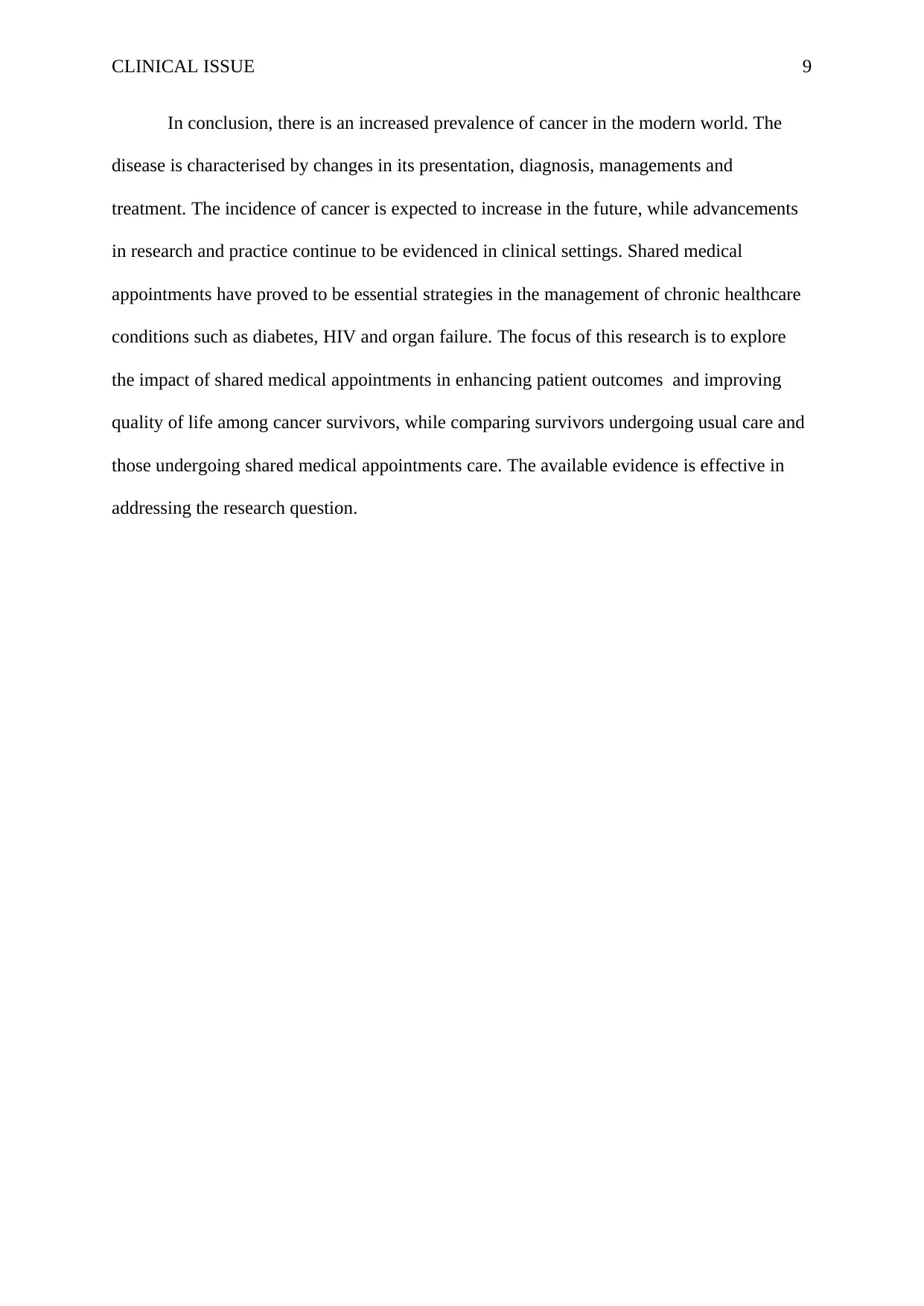
In conclusion, there is an increased prevalence of cancer in the modern world. The
disease is characterised by changes in its presentation, diagnosis, managements and
treatment. The incidence of cancer is expected to increase in the future, while advancements
in research and practice continue to be evidenced in clinical settings. Shared medical
appointments have proved to be essential strategies in the management of chronic healthcare
conditions such as diabetes, HIV and organ failure. The focus of this research is to explore
the impact of shared medical appointments in enhancing patient outcomes and improving
quality of life among cancer survivors, while comparing survivors undergoing usual care and
those undergoing shared medical appointments care. The available evidence is effective in
addressing the research question.
In conclusion, there is an increased prevalence of cancer in the modern world. The
disease is characterised by changes in its presentation, diagnosis, managements and
treatment. The incidence of cancer is expected to increase in the future, while advancements
in research and practice continue to be evidenced in clinical settings. Shared medical
appointments have proved to be essential strategies in the management of chronic healthcare
conditions such as diabetes, HIV and organ failure. The focus of this research is to explore
the impact of shared medical appointments in enhancing patient outcomes and improving
quality of life among cancer survivors, while comparing survivors undergoing usual care and
those undergoing shared medical appointments care. The available evidence is effective in
addressing the research question.
⊘ This is a preview!⊘
Do you want full access?
Subscribe today to unlock all pages.
Trusted by 1+ million students worldwide
CLINICAL ISSUE 10
References
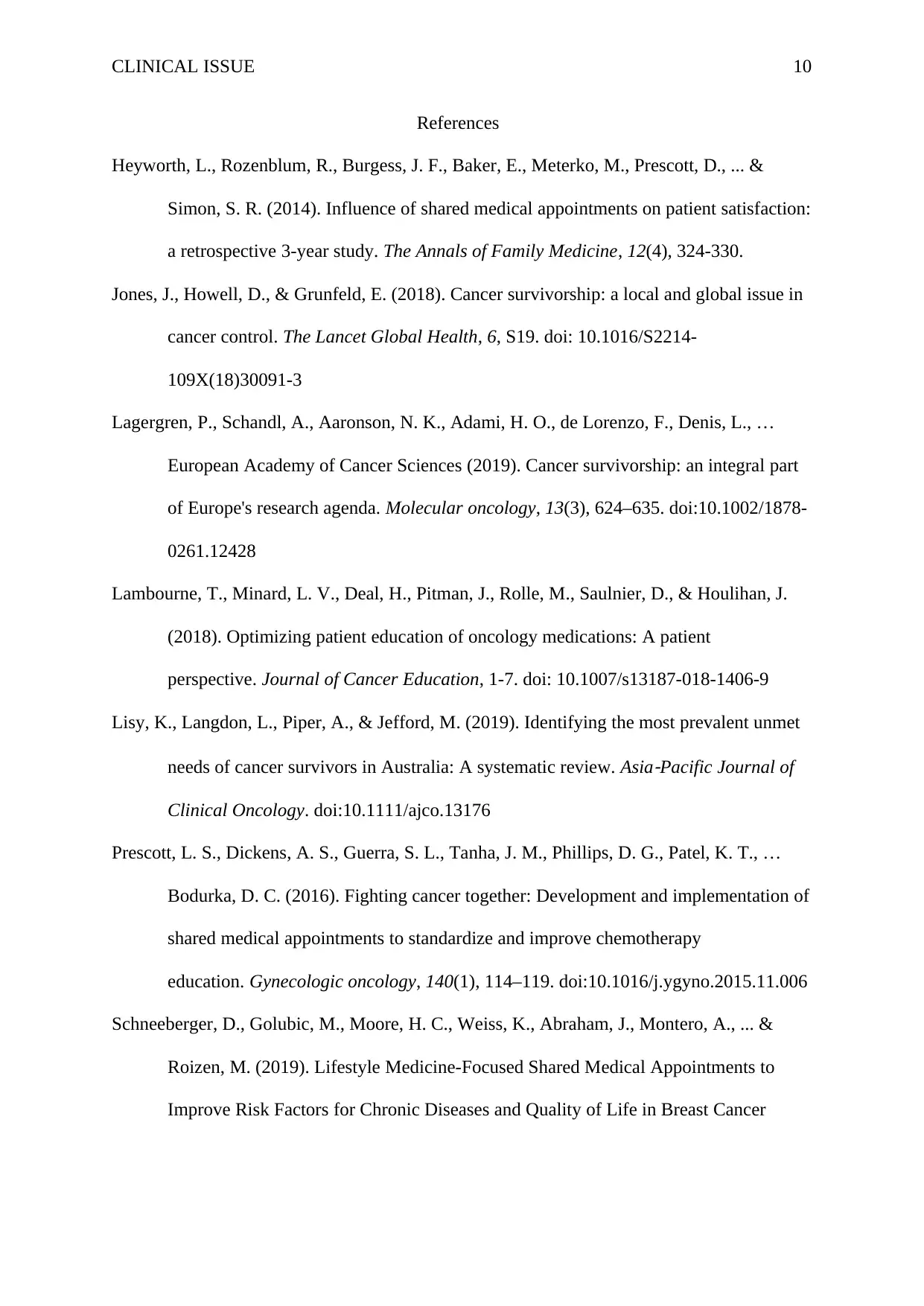
Heyworth, L., Rozenblum, R., Burgess, J. F., Baker, E., Meterko, M., Prescott, D., ... &
Simon, S. R. (2014). Influence of shared medical appointments on patient satisfaction:
a retrospective 3-year study. The Annals of Family Medicine, 12(4), 324-330.
Jones, J., Howell, D., & Grunfeld, E. (2018). Cancer survivorship: a local and global issue in
cancer control. The Lancet Global Health, 6, S19. doi: 10.1016/S2214-
109X(18)30091-3
Lagergren, P., Schandl, A., Aaronson, N. K., Adami, H. O., de Lorenzo, F., Denis, L., …
European Academy of Cancer Sciences (2019). Cancer survivorship: an integral part
of Europe's research agenda. Molecular oncology, 13(3), 624–635. doi:10.1002/1878-
0261.12428
Lambourne, T., Minard, L. V., Deal, H., Pitman, J., Rolle, M., Saulnier, D., & Houlihan, J.
(2018). Optimizing patient education of oncology medications: A patient
perspective. Journal of Cancer Education, 1-7. doi: 10.1007/s13187-018-1406-9
Lisy, K., Langdon, L., Piper, A., & Jefford, M. (2019). Identifying the most prevalent unmet
needs of cancer survivors in Australia: A systematic review. Asia
‐Pacific Journal of
Clinical Oncology. doi:10.1111/ajco.13176
Prescott, L. S., Dickens, A. S., Guerra, S. L., Tanha, J. M., Phillips, D. G., Patel, K. T., …
Bodurka, D. C. (2016). Fighting cancer together: Development and implementation of
shared medical appointments to standardize and improve chemotherapy
education. Gynecologic oncology, 140(1), 114–119. doi:10.1016/j.ygyno.2015.11.006
Schneeberger, D., Golubic, M., Moore, H. C., Weiss, K., Abraham, J., Montero, A., ... &
Roizen, M. (2019). Lifestyle Medicine-Focused Shared Medical Appointments to
Improve Risk Factors for Chronic Diseases and Quality of Life in Breast Cancer
References
Heyworth, L., Rozenblum, R., Burgess, J. F., Baker, E., Meterko, M., Prescott, D., ... &
Simon, S. R. (2014). Influence of shared medical appointments on patient satisfaction:
a retrospective 3-year study. The Annals of Family Medicine, 12(4), 324-330.
Jones, J., Howell, D., & Grunfeld, E. (2018). Cancer survivorship: a local and global issue in
cancer control. The Lancet Global Health, 6, S19. doi: 10.1016/S2214-
109X(18)30091-3
Lagergren, P., Schandl, A., Aaronson, N. K., Adami, H. O., de Lorenzo, F., Denis, L., …
European Academy of Cancer Sciences (2019). Cancer survivorship: an integral part
of Europe's research agenda. Molecular oncology, 13(3), 624–635. doi:10.1002/1878-
0261.12428
Lambourne, T., Minard, L. V., Deal, H., Pitman, J., Rolle, M., Saulnier, D., & Houlihan, J.
(2018). Optimizing patient education of oncology medications: A patient
perspective. Journal of Cancer Education, 1-7. doi: 10.1007/s13187-018-1406-9
Lisy, K., Langdon, L., Piper, A., & Jefford, M. (2019). Identifying the most prevalent unmet
needs of cancer survivors in Australia: A systematic review. Asia
‐Pacific Journal of
Clinical Oncology. doi:10.1111/ajco.13176
Prescott, L. S., Dickens, A. S., Guerra, S. L., Tanha, J. M., Phillips, D. G., Patel, K. T., …
Bodurka, D. C. (2016). Fighting cancer together: Development and implementation of
shared medical appointments to standardize and improve chemotherapy
education. Gynecologic oncology, 140(1), 114–119. doi:10.1016/j.ygyno.2015.11.006
Schneeberger, D., Golubic, M., Moore, H. C., Weiss, K., Abraham, J., Montero, A., ... &
Roizen, M. (2019). Lifestyle Medicine-Focused Shared Medical Appointments to
Improve Risk Factors for Chronic Diseases and Quality of Life in Breast Cancer
Paraphrase This Document
Need a fresh take? Get an instant paraphrase of this document with our AI Paraphraser
CLINICAL ISSUE 11
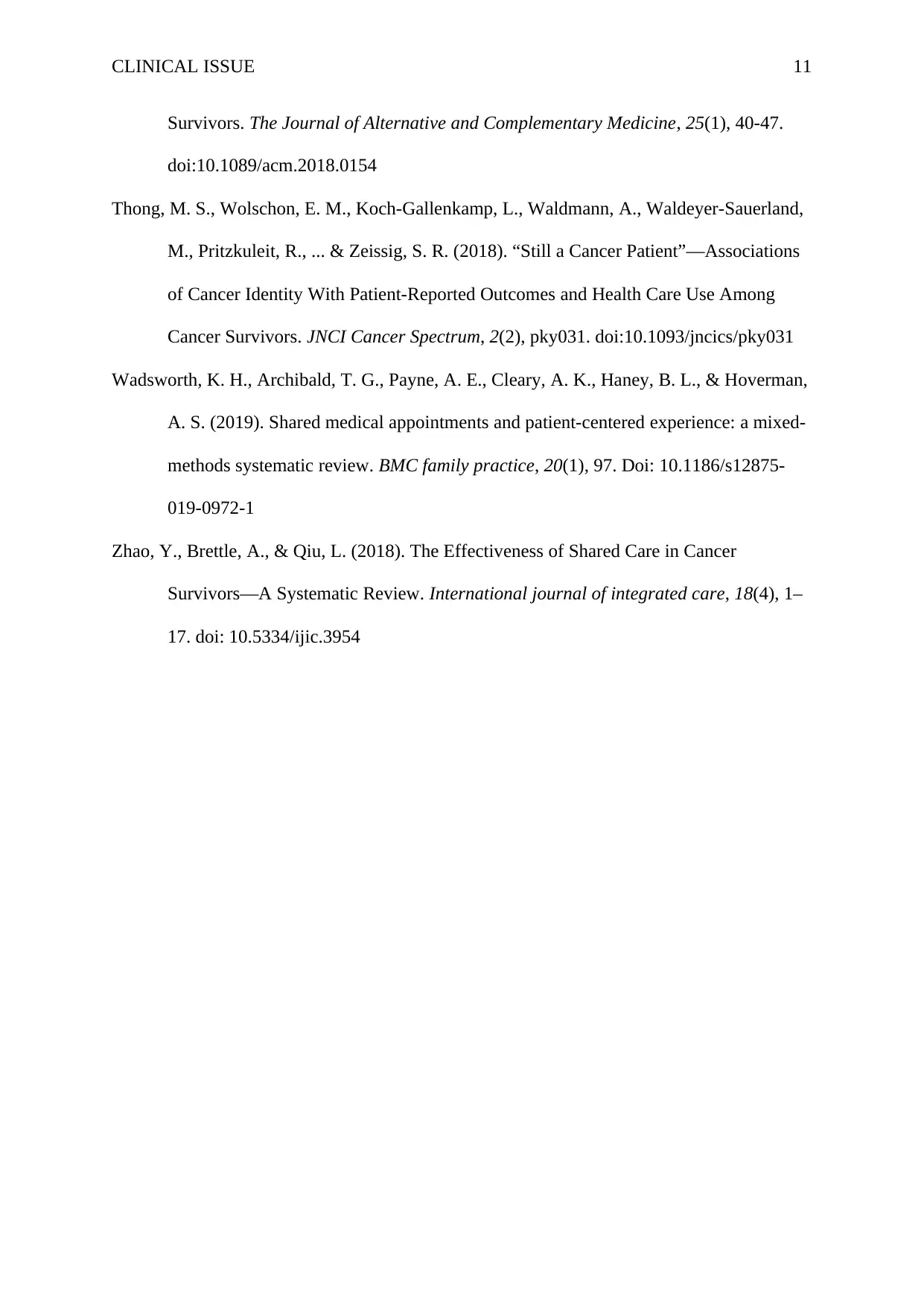
Survivors. The Journal of Alternative and Complementary Medicine, 25(1), 40-47.
doi:10.1089/acm.2018.0154
Thong, M. S., Wolschon, E. M., Koch-Gallenkamp, L., Waldmann, A., Waldeyer-Sauerland,
M., Pritzkuleit, R., ... & Zeissig, S. R. (2018). “Still a Cancer Patient”—Associations
of Cancer Identity With Patient-Reported Outcomes and Health Care Use Among
Cancer Survivors. JNCI Cancer Spectrum, 2(2), pky031. doi:10.1093/jncics/pky031
Wadsworth, K. H., Archibald, T. G., Payne, A. E., Cleary, A. K., Haney, B. L., & Hoverman,
A. S. (2019). Shared medical appointments and patient-centered experience: a mixed-
methods systematic review. BMC family practice, 20(1), 97. Doi: 10.1186/s12875-
019-0972-1
Zhao, Y., Brettle, A., & Qiu, L. (2018). The Effectiveness of Shared Care in Cancer
Survivors—A Systematic Review. International journal of integrated care, 18(4), 1–
17. doi: 10.5334/ijic.3954
Survivors. The Journal of Alternative and Complementary Medicine, 25(1), 40-47.
doi:10.1089/acm.2018.0154
Thong, M. S., Wolschon, E. M., Koch-Gallenkamp, L., Waldmann, A., Waldeyer-Sauerland,
M., Pritzkuleit, R., ... & Zeissig, S. R. (2018). “Still a Cancer Patient”—Associations
of Cancer Identity With Patient-Reported Outcomes and Health Care Use Among
Cancer Survivors. JNCI Cancer Spectrum, 2(2), pky031. doi:10.1093/jncics/pky031
Wadsworth, K. H., Archibald, T. G., Payne, A. E., Cleary, A. K., Haney, B. L., & Hoverman,
A. S. (2019). Shared medical appointments and patient-centered experience: a mixed-
methods systematic review. BMC family practice, 20(1), 97. Doi: 10.1186/s12875-
019-0972-1
Zhao, Y., Brettle, A., & Qiu, L. (2018). The Effectiveness of Shared Care in Cancer
Survivors—A Systematic Review. International journal of integrated care, 18(4), 1–
17. doi: 10.5334/ijic.3954
Running head: CLINICAL ISSUE 12
Appendix A
RESEARCH QUESTION:
Article
No:
Author (s)
(date)
Study Design
Question
Domain
Key
information
Validity Check
(eg bias) Author’s
Results/Finding
s
Author’s
Conclusions
Reviewer
Comments
(Your
appraisal)
1 Heyworth, L.,
Rozenblum,
R., Burgess,
J. F., Baker,
E., Meterko,
M., Prescott,
D.,
Neuwirth&
Simon, S. R.
(2014)
Purpose: to
examine
overall
satisfaction and
patient-
centered care
experiences
across key
domains of the
patient-
centered
medical home
among patients
attending
SMAs vs usual
care
appointments.
Design: a
cross-sectional
study using a
mailed
questionnaire
Level: 5
Domain:
Intervention
P: Patients
undergoing
SMA
I: Shared
medical
appointments
(SMAs)
C: Patinets
undergoing
usual care
O: Patient
satisfaction
and patient-
centered care
experiences
to minimize selection
bias, descriptive
statistics of patient
characteristics and
experiences in
the SMA and usual
care groups were
calculated using a
propensity score
the medical
experience
questionnaire
developed by Press
Ganey
(www.pressganey.com)
SMA patients
were more
likely to rate
their
overall
satisfaction with
care as “very
good” when
compared with
usual care
counterparts
(odds
ratio=1.26; 95%
CI, 1.05-1.52).
In the analysis
of patient-
centered
medical home
elements, SMA
patients rated
their care as
more accessible
and more
sensitive to their
needs, whereas
SMA patients
appear more
satisfied with
their care relative
to patients
receiving usual
care. SMAs may
also improve
access to care and
deliver care that
patients found to
be sensitive to
their needs.
The study
addresses the
same research
question as
the current
proposal
Appendix A
RESEARCH QUESTION:
Article
No:
Author (s)
(date)
Study Design
Question
Domain
Key
information
Validity Check
(eg bias) Author’s
Results/Finding
s
Author’s
Conclusions
Reviewer
Comments
(Your
appraisal)
1 Heyworth, L.,
Rozenblum,
R., Burgess,
J. F., Baker,
E., Meterko,
M., Prescott,
D.,
Neuwirth&
Simon, S. R.
(2014)
Purpose: to
examine
overall
satisfaction and
patient-
centered care
experiences
across key
domains of the
patient-
centered
medical home
among patients
attending
SMAs vs usual
care
appointments.
Design: a
cross-sectional
study using a
mailed
questionnaire
Level: 5
Domain:
Intervention
P: Patients
undergoing
SMA
I: Shared
medical
appointments
(SMAs)
C: Patinets
undergoing
usual care
O: Patient
satisfaction
and patient-
centered care
experiences
to minimize selection
bias, descriptive
statistics of patient
characteristics and
experiences in
the SMA and usual
care groups were
calculated using a
propensity score
the medical
experience
questionnaire
developed by Press
Ganey
(www.pressganey.com)
SMA patients
were more
likely to rate
their
overall
satisfaction with
care as “very
good” when
compared with
usual care
counterparts
(odds
ratio=1.26; 95%
CI, 1.05-1.52).
In the analysis
of patient-
centered
medical home
elements, SMA
patients rated
their care as
more accessible
and more
sensitive to their
needs, whereas
SMA patients
appear more
satisfied with
their care relative
to patients
receiving usual
care. SMAs may
also improve
access to care and
deliver care that
patients found to
be sensitive to
their needs.
The study
addresses the
same research
question as
the current
proposal
⊘ This is a preview!⊘
Do you want full access?
Subscribe today to unlock all pages.
Trusted by 1+ million students worldwide

1 out of 16


Related Documents


Your All-in-One AI-Powered Toolkit for Academic Success.
+13062052269
info@desklib.com
Available 24*7 on WhatsApp / Email
![[object Object]](/_next/static/media/star-bottom.7253800d.svg)
Unlock your academic potential
Copyright © 2020–2026 A2Z Services. All Rights Reserved. Developed and managed by ZUCOL.